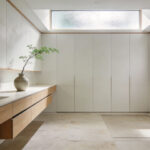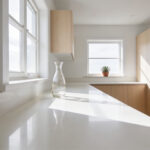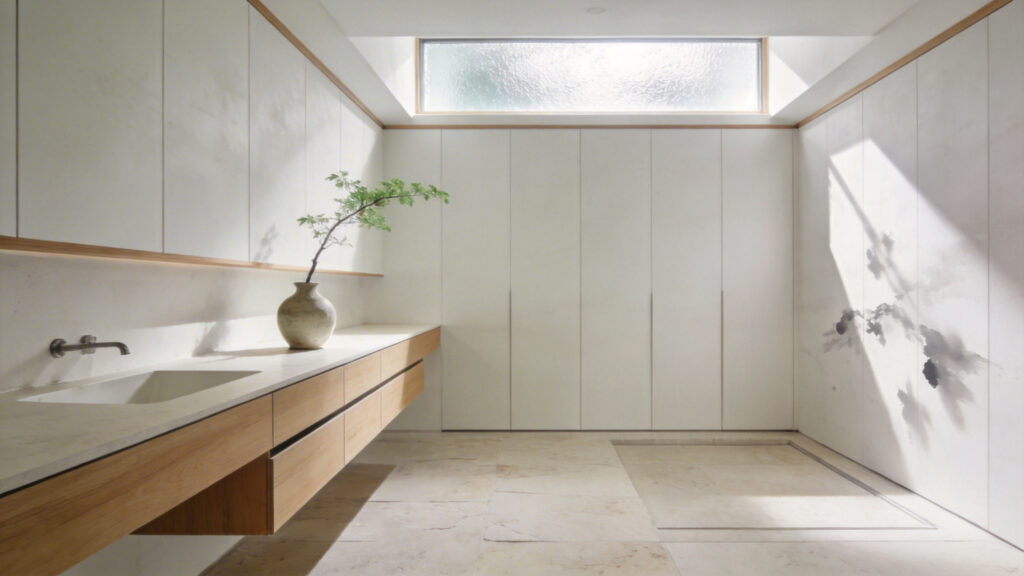
Many Western designers view an empty corner as a problem. So, they rush to fill every nook with shelving or heavy cabinetry. But this approach often creates visual noise rather than order. Traditional Japanese philosophy, however, treats emptiness as the primary objective. This concept is known as *Ma*. It defines space not as a lack of substance, but as pure potential. Therefore, it offers a powerful framework for rethinking modern bathroom storage solutions and achieving profound bathroom storage organization.
Historically, *Ma* referred to a sacred void created to invite spirits. Today, this principle suggests that the “interval” matters more than the fixture itself. Indeed, true luxury lives in the distance between things. Technical consensus now warns against filling storage to capacity. In fact, a cluttered environment triggers a cortisol stress response. Thus, effective design requires “functional breathing room.” We reduce mental friction through tactile materiality and bespoke cabinetry.
This guide reveals how to apply *Ma* to contemporary homes. We will explore the “60/40 rule” to minimize cognitive load. Next, we examine how floating fixtures extend visual lines. We also discuss using “visual silence” to separate utility from ritual. Ultimately, prioritizing negative space turns a functional room into a restorative sanctuary.
Understanding ‘Yohaku-no-bi’: The Beauty of Empty Space in Small Bathrooms
Yohaku-no-bi* translates to “the beauty of remaining white.” Western minimalism often focuses on removal. However, this Japanese principle creates intentional emptiness. In traditional ink wash painting, unpainted areas allow the viewer’s imagination to flow. Similarly, empty space serves as the primary design element in a small bathroom. Therefore, storage solutions should not fill every corner. Instead, we must “submerge” utility to create a deliberate void that complements luxury bathroom amenities.
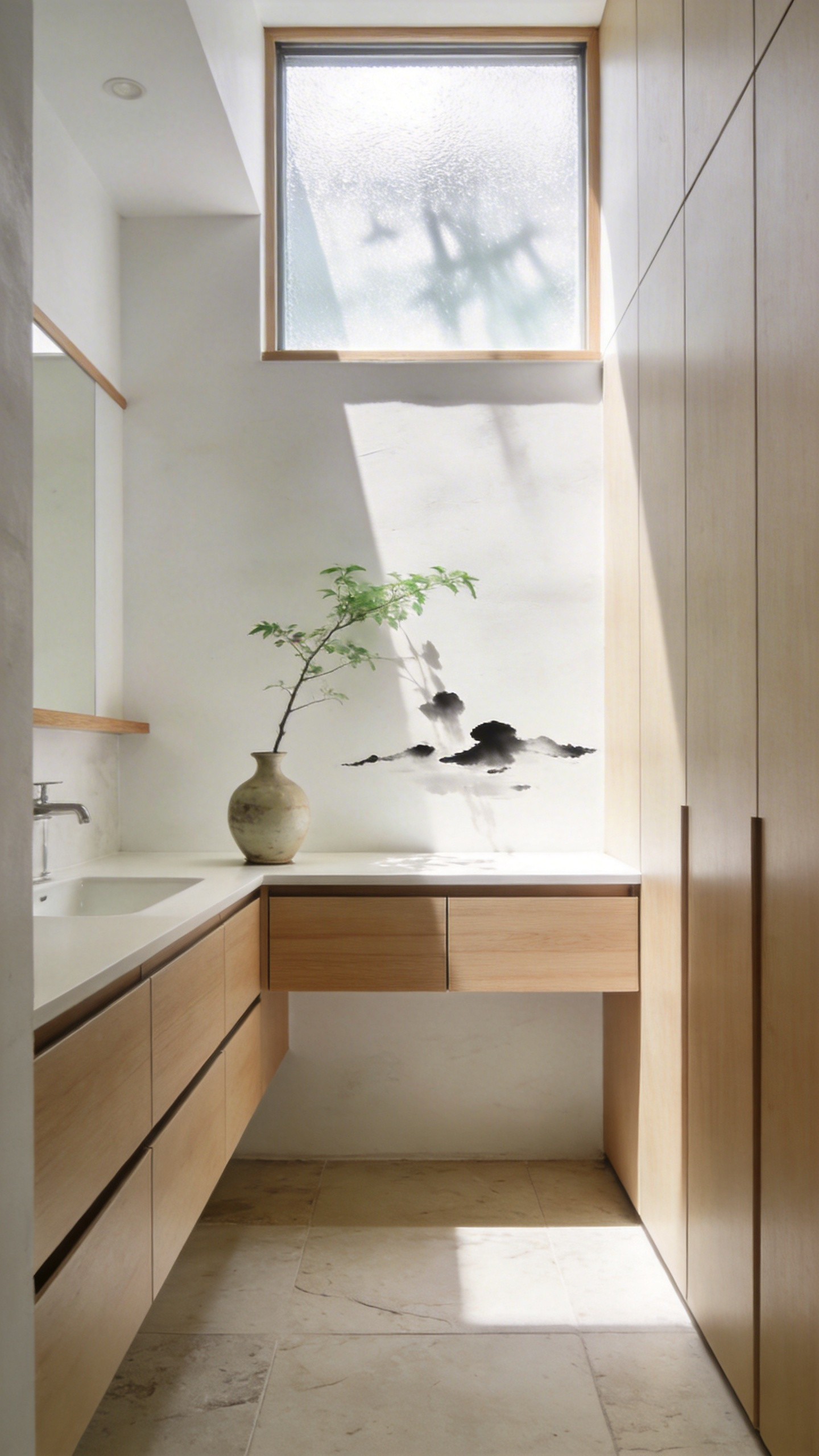
Effectively, this creates a sense of boundlessness. The absence of visual noise makes the room feel psychologically larger. To achieve this, adopt a strict “hidden versus revealed” strategy. Specifically, conceal eighty percent of your items inside handle-less cabinetry. Ideally, these units match the wall color. They should disappear into the architecture.
Conversely, treat the remaining twenty percent as curated art. Imagine a rough clay tray on a smooth, empty stone counter. The surrounding emptiness creates a vivid contrast. It highlights the texture of the clay. Furthermore, this prevents the flat look caused by overhead lighting. Prioritizing empty space transforms a cramped bathroom into a sanctuary. Thus, the most luxurious element is not the fixture, but the space itself.
Visual Silence: The Art of Decanting and Removing Brand Noise
Modern packaging is engineered for crowded supermarket shelves. It is not designed for private sanctuaries. Bright logos and bold typography create “visual noise.” This clutter disrupts the peaceful atmosphere. In fact, neuro-aesthetic research suggests that removing labels reduces cognitive fatigue. Our brains automatically read text. Seeing words like “VOLUMIZING” triggers mental processing. Therefore, decanting products into anonymous vessels restores visual tranquility and spatial harmony.
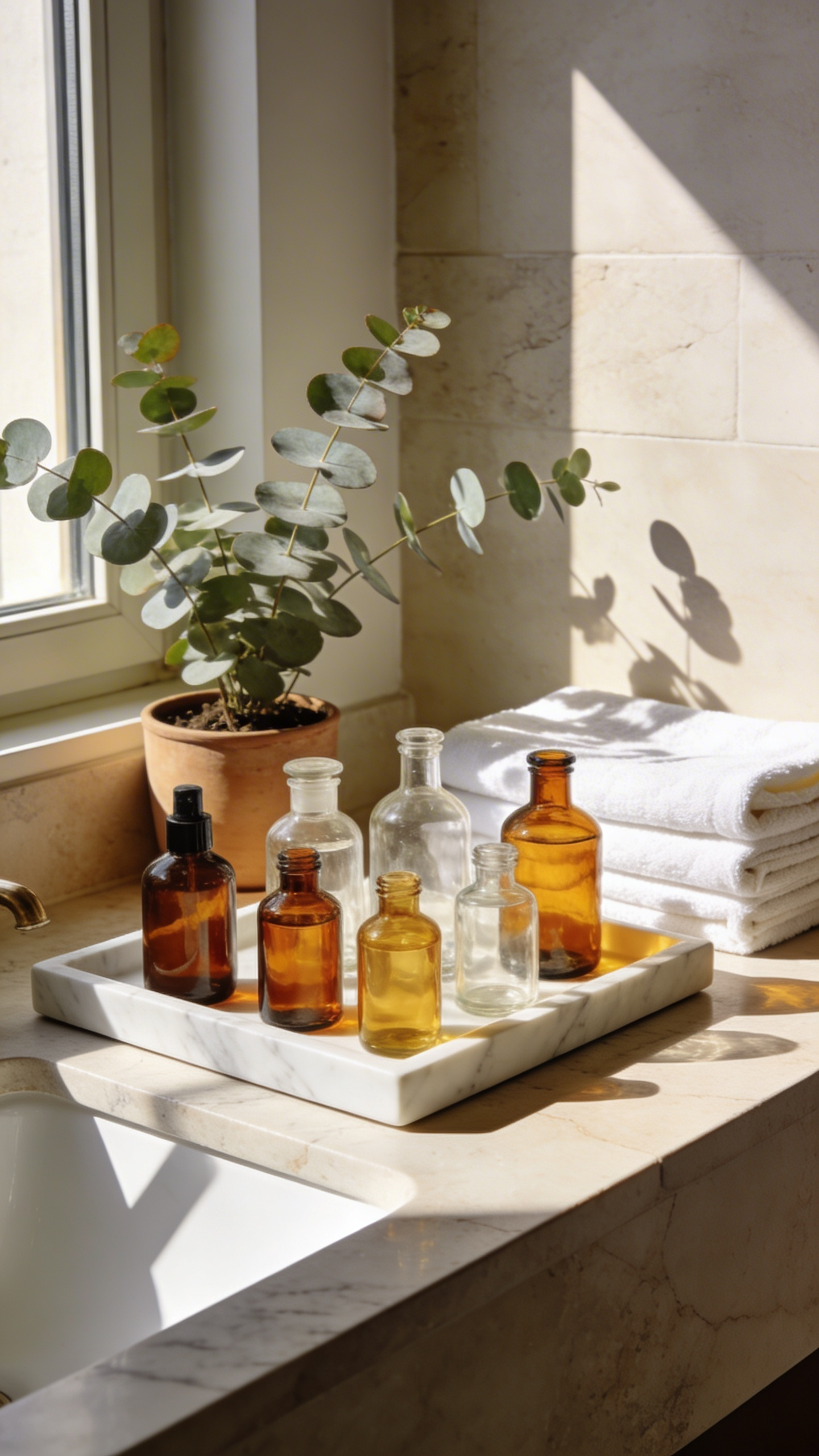
This shift also elevates the tactile experience. Visual silence connects deeply to physical weight. Heavy glass feels more substantial than lightweight plastic. This “heft” creates a subconscious sense of quality. Additionally, materials like ceramic offer a thermal coolness. Thus, the daily ritual becomes grounded and deliberate.
However, proper decanting requires technical consideration. Many skincare ingredients are sensitive to light. Clear glass simplifies the space, but it degrades products like Vitamin C. As a result, amber glass is the functional gold standard. It creates a warm aesthetic while blocking UV rays. Removing brand noise transforms scattered products into a cohesive architectural feature.
Materiality Principle: Integrating Breathable Hinoki and Sustainable Bamboo
In Japanese design, the bathroom is a metabolic environment. Storage materials must actively manage humidity. They cannot simply endure it. Specifically, sustainable bamboo provides the necessary skeleton. Unlike solid hardwoods, this hygroscopic grass resists warping. Consequently, it creates a stable frame that remains flat despite steam.
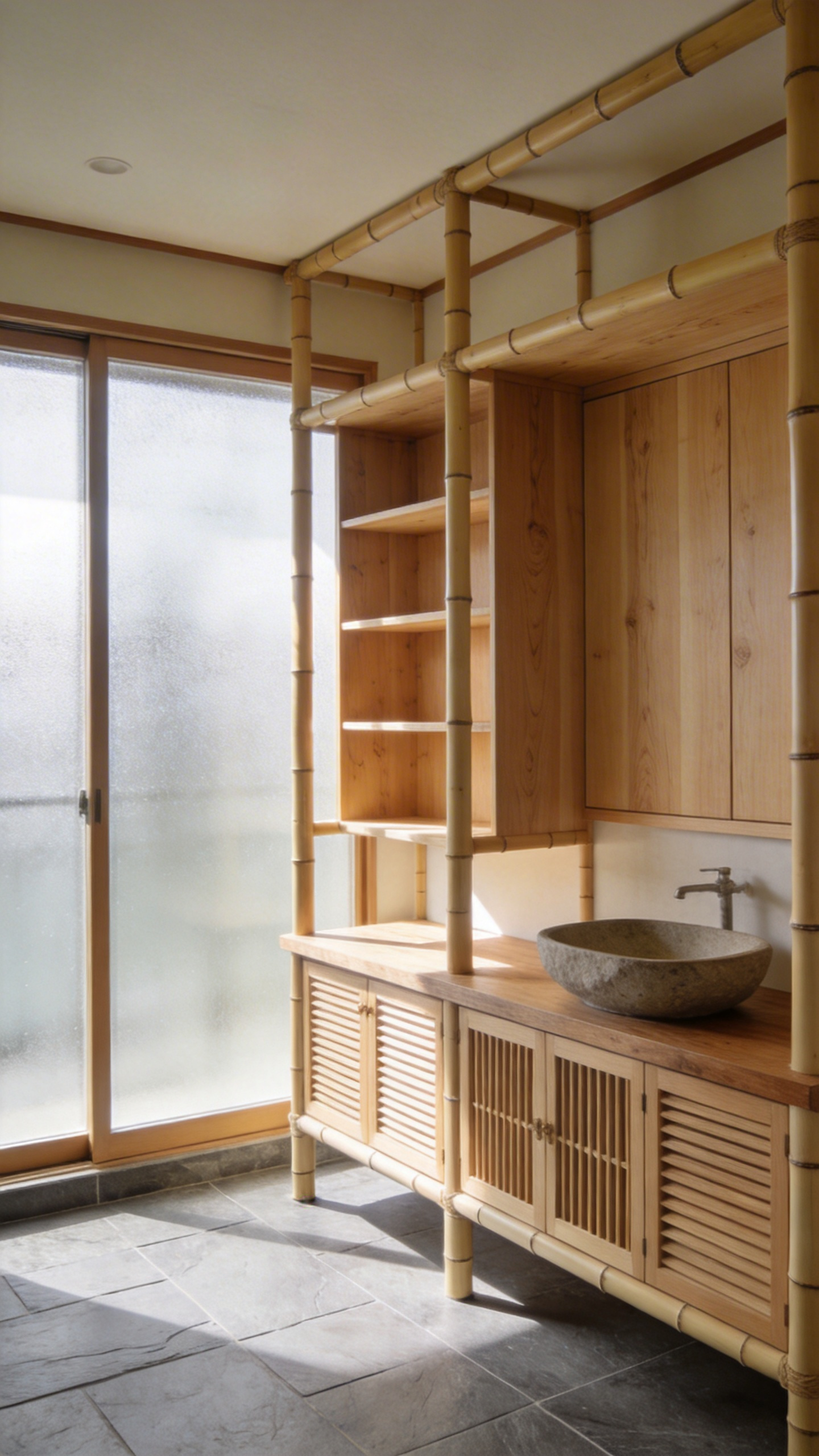
Within this bamboo framework, Hinoki wood serves as the heart. Unvarnished Hinoki is prized for its high porosity. Indeed, it releases natural phytoncides when exposed to heat. Thus, your storage actively purifies the air inside drawers. Steam from a shower activates these oils. Instantly, the sterile room transforms into a fragrant forest.
To maximize this, designers utilize slatted forms. This open construction ensures cross-ventilation. It prevents musty odors common in sealed cabinets. Moreover, this pairing balances responsibility with luxury. Bamboo represents renewal. Hinoki offers a velvety softness that connects us to ancestry. Ultimately, this synergy creates a resilient space that honors nature.
The Warmth of Order: Softening Ceramics with Hand-Woven Natural Baskets
Bathrooms are dominated by “high-inertia” materials like porcelain and chrome. These surfaces feel thermally and visually cold. However, introducing hand-woven baskets creates a necessary “haptic dissonance.” The irregular surface of a weave absorbs sound. It diffuses harsh light. Consequently, the basket acts as a “visual anchor.” It transitions the space from clinical utility to comfort while exploring small bathroom vanity ideas.
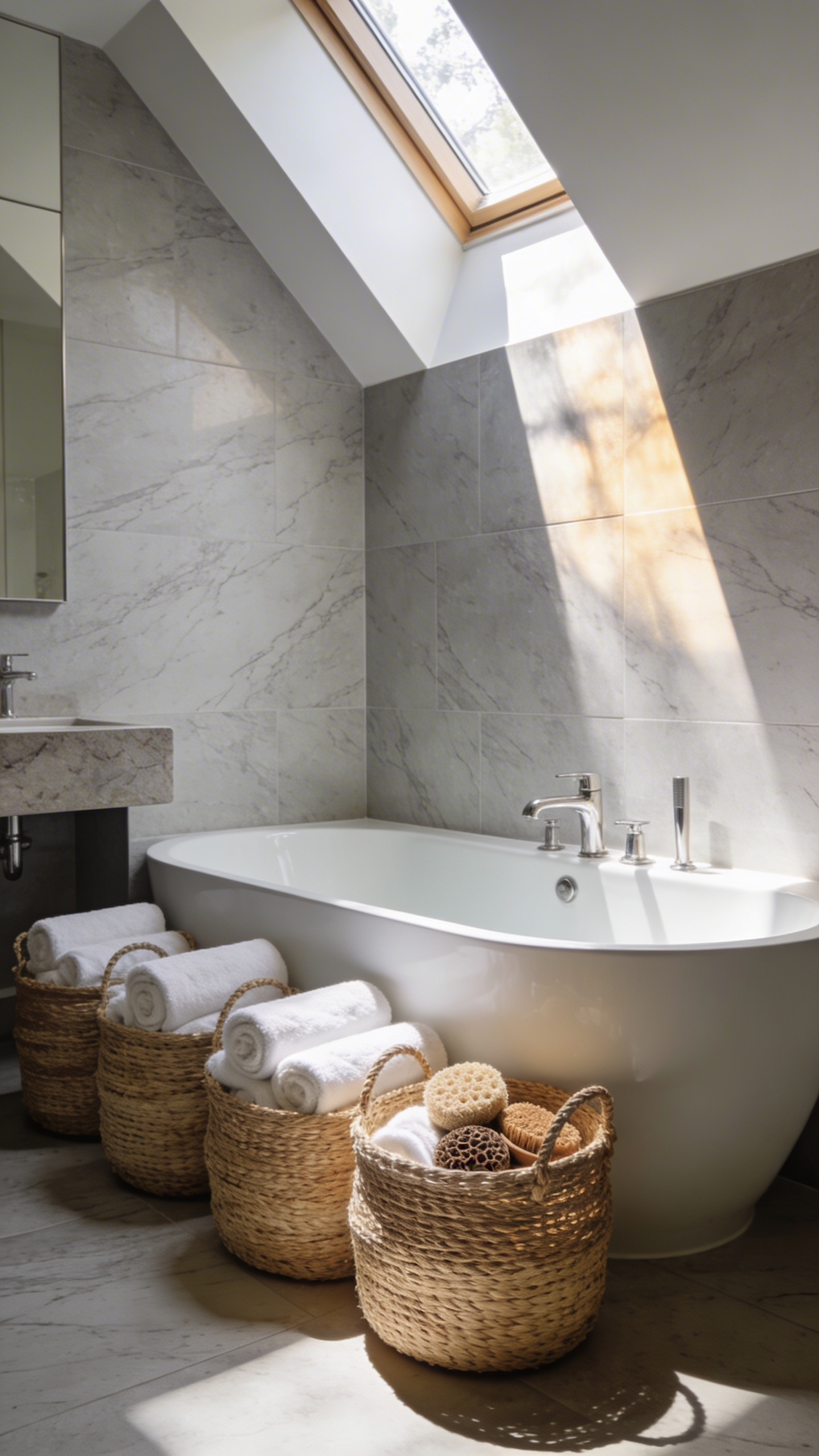
Most modern bathrooms rely on a strict geometric grid. Hand-woven baskets serve as “grid-breakers.” Because they are handmade, their silhouettes are imperfect. Therefore, placing a round basket against rectangular tile creates a “visual rest point.” The eye settles on the organic chaos rather than the hard lines.
Beyond aesthetics, natural fibers provide functionality. Unlike closed cabinetry, baskets allow for “passive ventilation.” Thus, air circulates through stored towels. This prevents stale odors. However, material selection is vital. Seagrass features a waxy coating that resists moisture. Conversely, water hyacinth is absorbent and best for dry items. This pairing balances the durability of stone with the breathability of nature.
Transparency and Light: Using Glass Vessels to Maintain Airy Atmospheres
To create an airy bathroom, we must address “invisible volume.” Opaque ceramics act as visual stops. But glass vessels allow the eye to travel through them. Consequently, the brain perceives more negative space. This process is known as *dematerialization*. It significantly reduces the “looming effect” of storage. Furthermore, glass manipulates natural light. Because of its refractive index, a curved vessel bends rays. Static shelves gain a dynamic, shimmering quality.
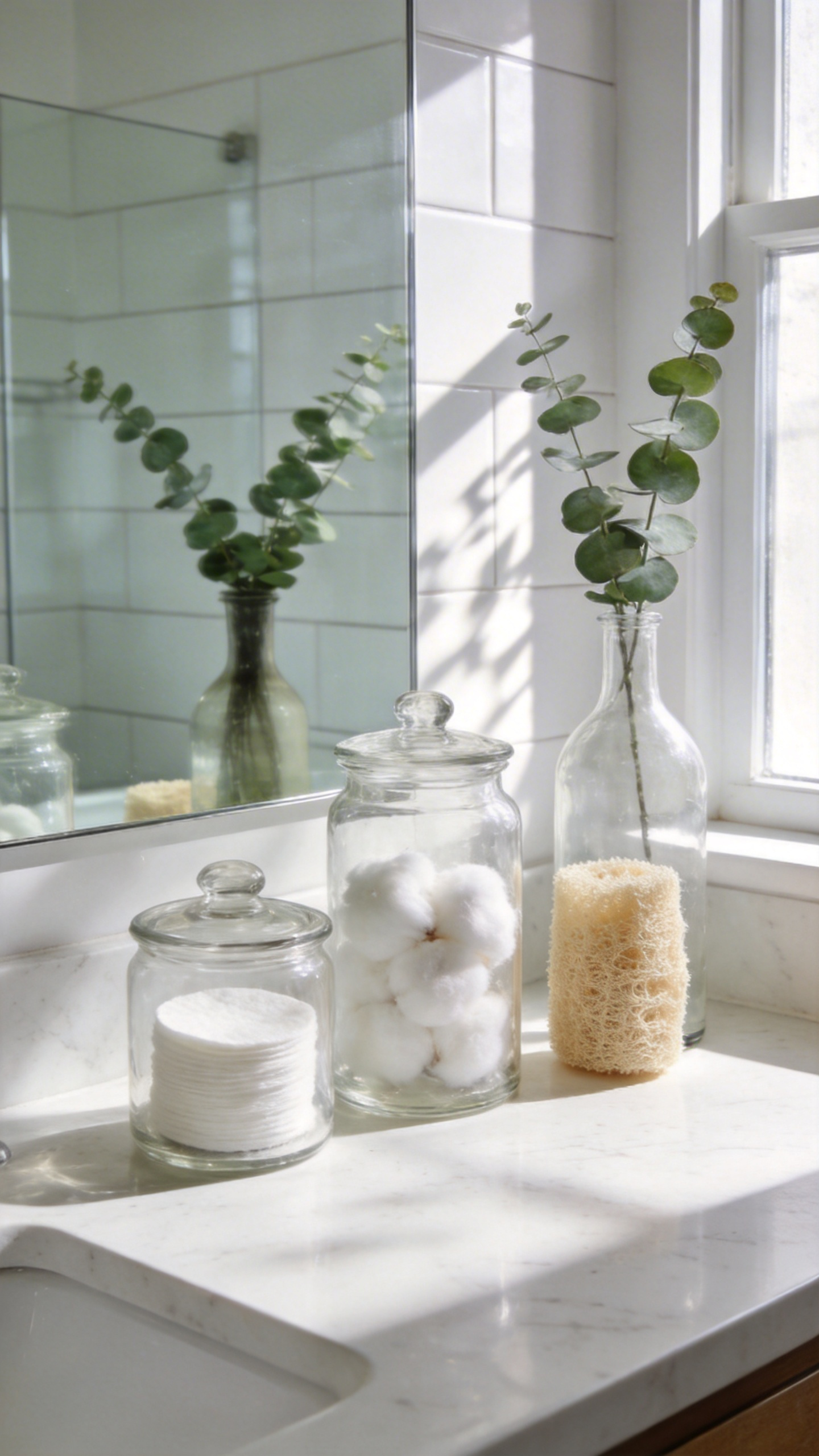
Textured options like reeded glass offer “curated privacy.” They blur contents while maintaining lightness. Therefore, items need not be perfectly arranged. Beyond visuals, glass offers a distinct narrative. The cool temperature and acoustic “clink” provide a sense of permanence. In fact, this mimics the refined atmosphere of a historical apothecary.
However, transparency poses a risk to sensitive products. Sunlight can deactivate ingredients like Vitamin C. Thus, experts recommend “atmospheric layering.” Use clear glass for inert items like sponges. Conversely, utilize amber or cobalt glass for active serums. This approach protects the product while preserving the aesthetic.
Vertical Harmony: Leveraging Height with Lean-To Ladder Shelving
Lean-to ladder shelving is a sophisticated tool for spatial manipulation. Historically, this traces back to the mid-century “Ladderax” system. In a bathroom, it acts as “provisional architecture.” Specifically, it reclaims vertical space without wall-mounted cabinets. Therefore, it preserves the room’s structural integrity while adding utility.
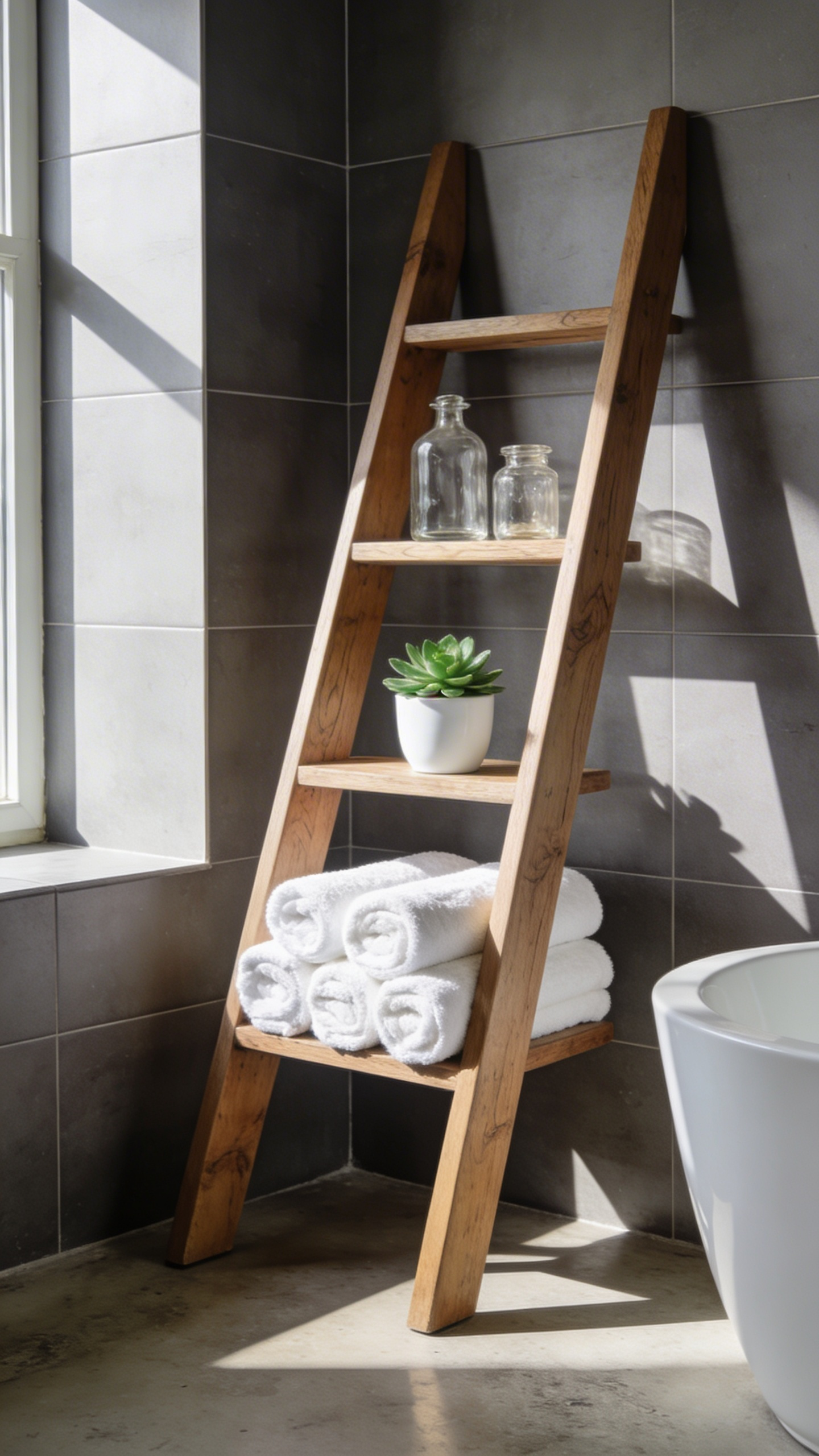
Structurally, these units rely on “tapered stability.” A deep base graduates to a shallow top shelf. This lowers the center of gravity to prevent tipping. Also, the tapering creates a forced perspective. As wood retreats from your eye, the ceiling appears higher. Consequently, this reduces spatial compression in narrow bathrooms.
Material choice impacts sensory wellness too. Teak is the maritime standard due to natural oils. Over time, it develops a silver-gray patina. Alternatively, carbonized bamboo offers a warm aesthetic. Unlike cold steel, these materials add warmth. Ultimately, this design combats “The Box Effect.” The frame remains transparent, so the brain registers the wall behind it. Thus, the room retains a sense of *ma*. Moreover, open rungs allow for 360-degree airflow.
The Floating World: Wall-Mounted Vanities to Reveal Floor Space
The wall-mounted vanity creates a powerful optical illusion. It manipulates “visual weight” to alter spatial perception while accommodating various bathroom vanity styles. By revealing the floor beneath the cabinetry, the eye registers an uninterrupted plane. So, the brain perceives the room as larger. This design introduces *ma*, or meaningful negative space, to a cluttered area.
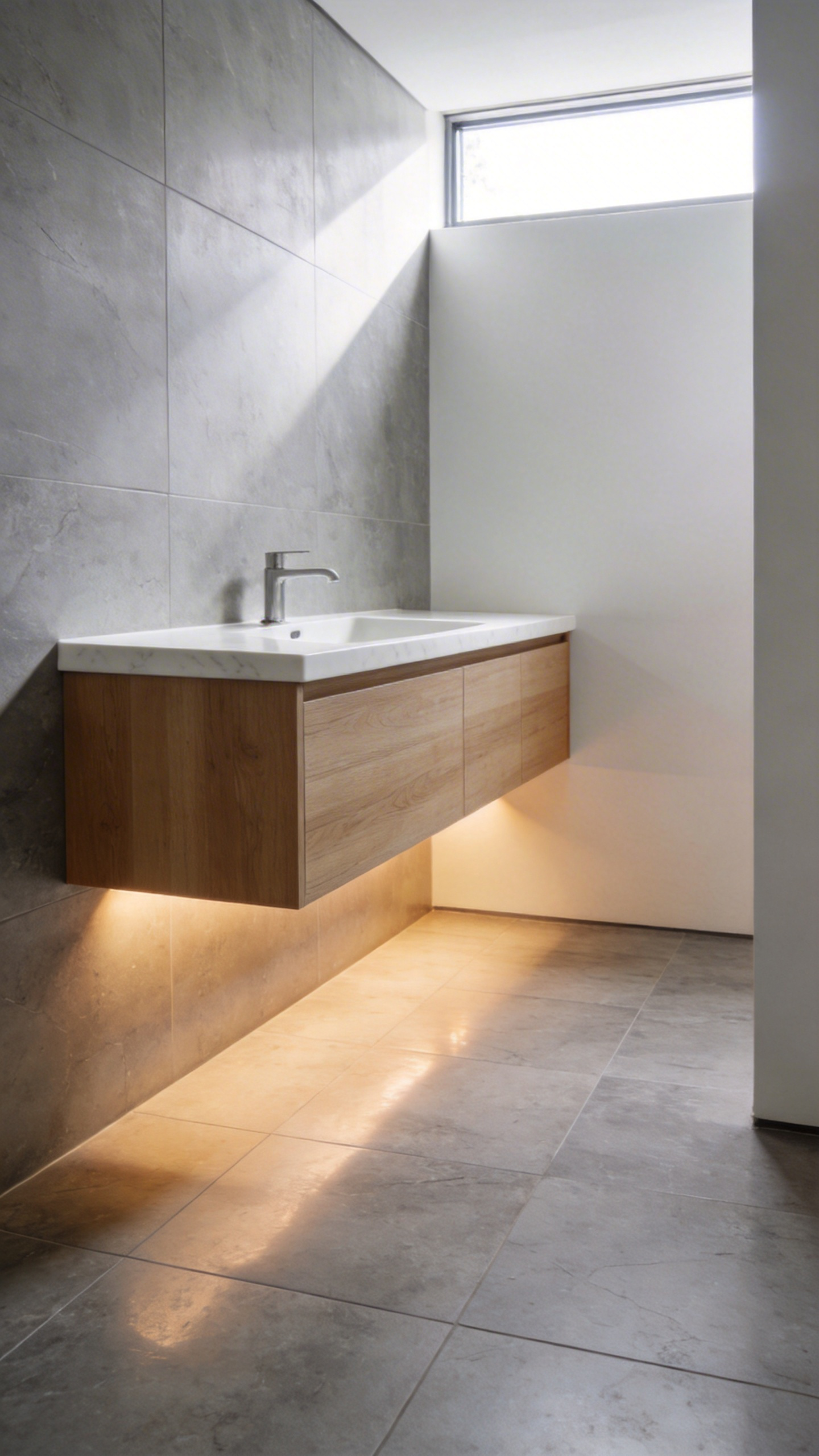
This suspension allows ambient light to penetrate deeper. Light bounces off the floor, eliminating dark corners. However, achieving this “levitation” requires precise engineering. Floating units demand structural “blocking” behind the drywall. Additionally, plumbing rough-ins must be positioned strictly between 17 and 20 inches. This keeps them concealed within the cabinet.
Beyond aesthetics, these units offer functional advantages. The open space supports Universal Design by accommodating wheelchair users. Moreover, sanitation standards improve. This layout eliminates floor-level caulking joints where mold breeds. Nevertheless, designers must balance openness against storage loss. Therefore, experts recommend a minimum clearance of 10 inches. This facilitates cleaning tools. Ultimately, the floating vanity transforms a bathroom into a breathable sanctuary.
Concealed Tranquility: Maximizing Recessed Niches Behind Shoji-Style Panels
“Concealed Tranquility” redefines storage by merging tradition with efficiency. It capitalizes on the void within wall studs. In fact, standard framing offers nearly four inches of usable depth. By utilizing thin track systems, we create capacity without encroaching on the room. Consequently, the bathroom feels significantly larger.
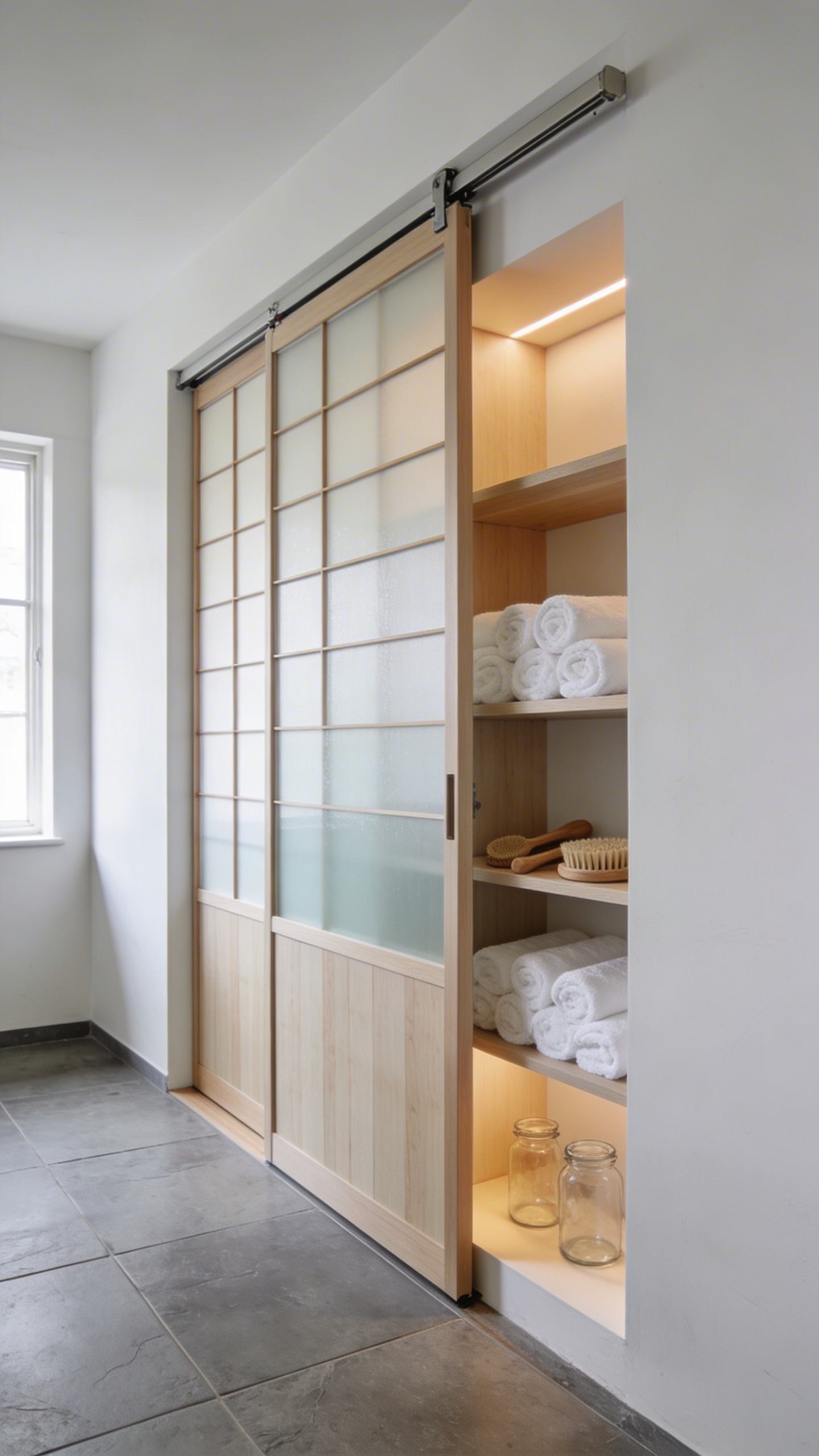
However, traditional Washi paper struggles in humidity. Therefore, modern designs incorporate resin-laminated sheets like Warlon. These high-tech materials resist moisture while mimicking paper. As a result, the panels create a “soft focus” effect. Instead of clutter, you perceive gentle shadows.
This layout also respects verticality. Following the *Tenbukuro* philosophy, seasonal items reside in upper niches. The *Jibukuro* concept places utility items near the floor. Additionally, installing waterproof LEDs transforms niches into ambient light sources. A simple cabinet becomes an architectural lantern. Finally, the physical interaction must remain silent. Precision hardware ensures a weightless glide. These panels “erase” visual noise, leaving a sanctuary defined by *Ma*.
Drawer Geometry: Implementing Bento-Style Dividers for Precision Organization
Ma* represents the intentional use of negative space. Western organization often seeks to fill every cubic inch. Bento-style organization, however, prioritizes the critical “pause” between objects. Consequently, this creates a “quiet” environment. It reduces cognitive drain during your morning ritual.
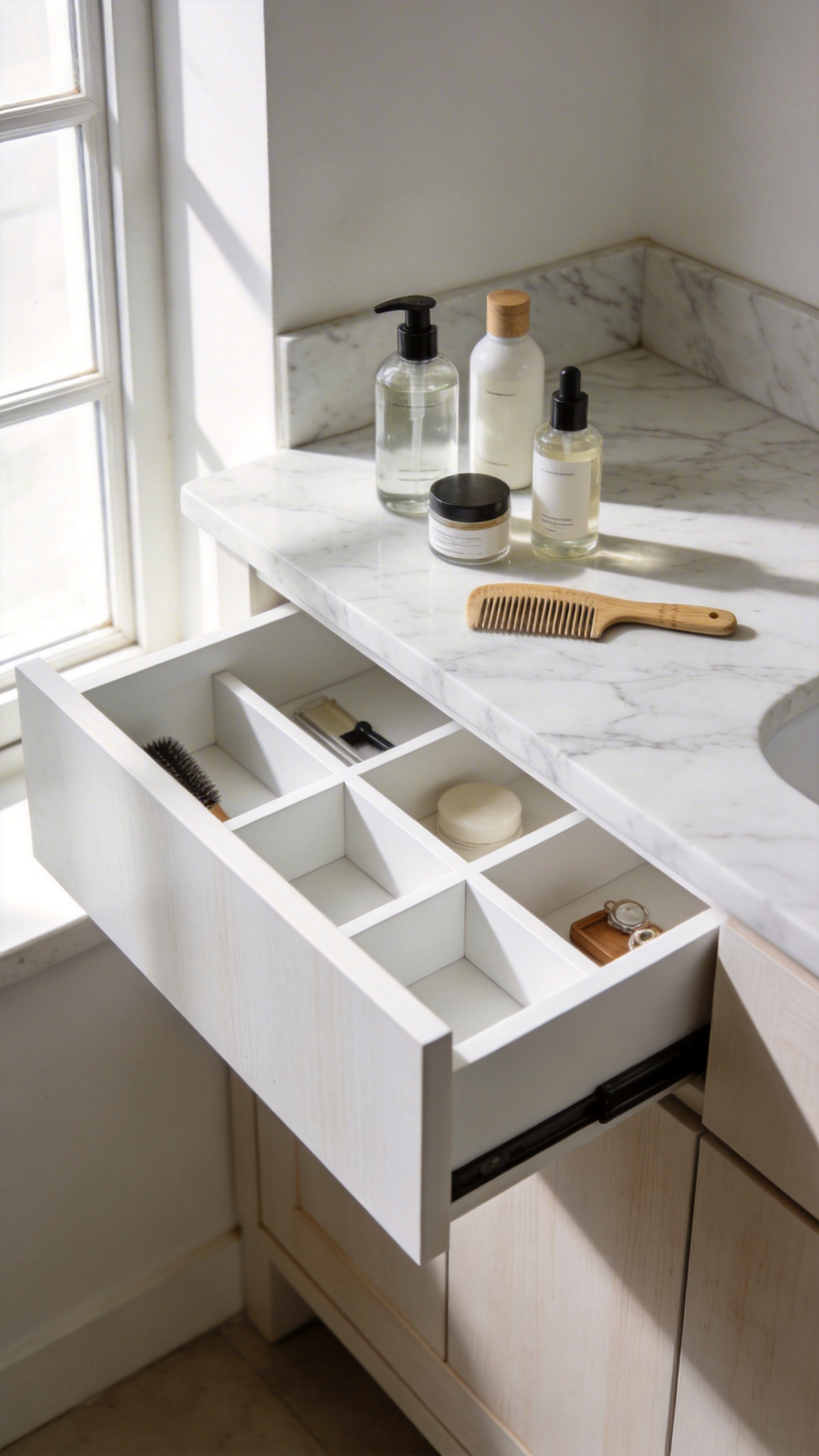
To implement this, consider geometry. Most plastic bins feature tapered sides. In practice, these tapers trap small items in “dead zones.” Therefore, true precision requires straight-wall containers. These maximize the drawer’s footprint, allowing for a seamless grid.
Furthermore, nuanced organization extends to sensory engineering. Incorporating flocked surfaces helps “silence the clink” of glass. Thus, the vanity functions like refined lacquerware. Finally, consider categorization depth. A distinct slot for every lipstick creates a high “maintenance tax.” So, expert consensus favors a hybrid solution. Use rigid bins for broad zones, but add adjustable dividers. This transforms a messy drawer into a restorative tool.
The Shower Sanctuary: Teak Benches with Integrated Hidden Storage
A teak bench transforms a shower into a tactile sanctuary. Specifically, Grade-A Teak contains dense natural oils. Therefore, it resists water without brittle sealants. Unlike cold stone, this wood acts as an insulator. Consequently, it offers a warm texture against the skin.
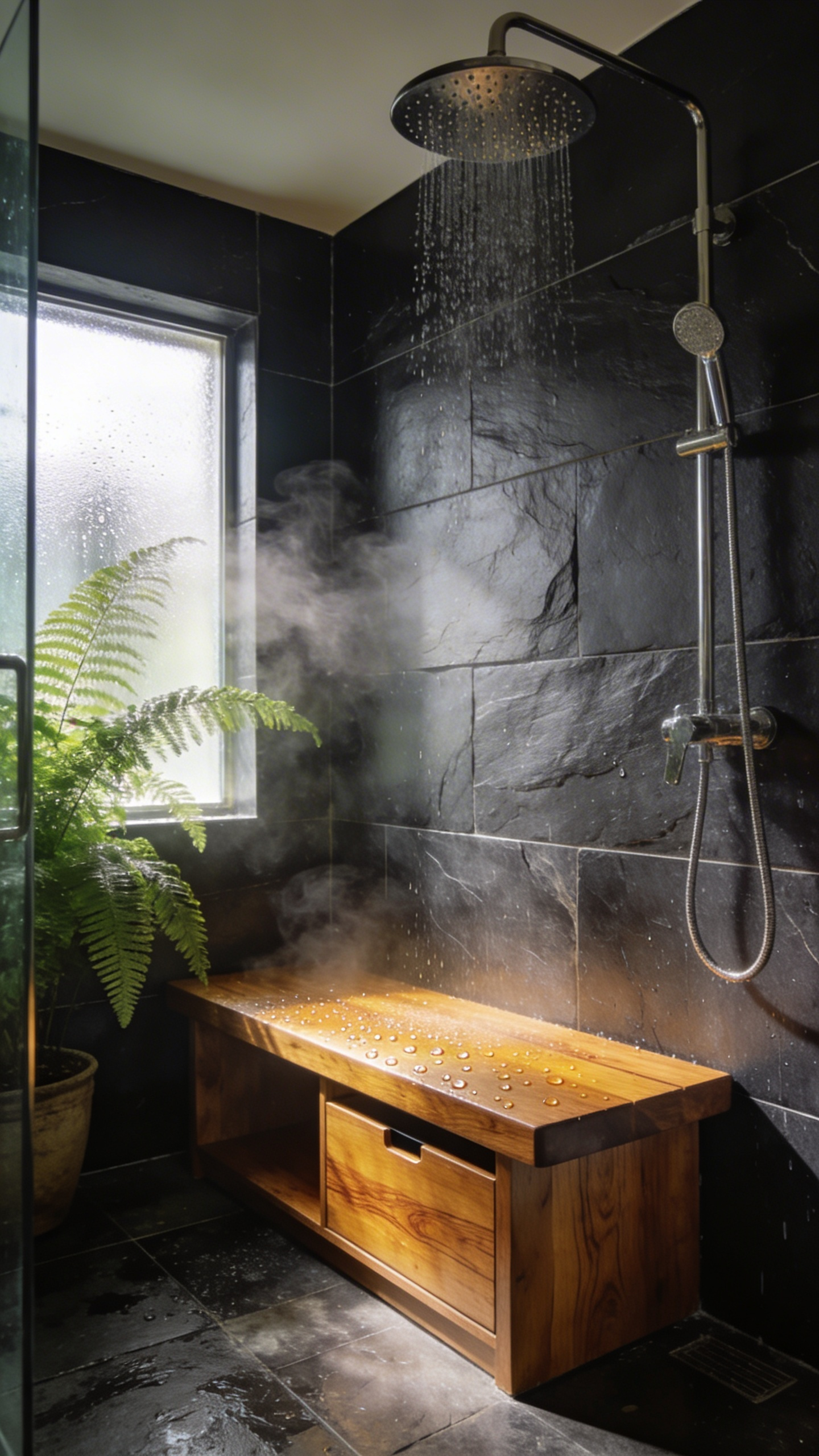
Integrating storage requires precise engineering. To prevent mold, designs employ louvered joinery. Thus, air circulates continuously. This hidden functionality supports “visual quiet.” By tucking away bright bottles, you eliminate noise. Therefore, the shower becomes a place of meditation.
The material’s appearance evolves beautifully. While some maintain a gold hue, a purist embraces aging. Eventually, teak develops a silver-grey patina. This oxidized layer creates a natural barrier. Ultimately, allowing the wood to weather honors the *wabi-sabi* aesthetic.
Over-Toilet Utilization: Minimalist Shelving That Respects Symmetry
Historically, over-toilet storage relied on bulky units. These structures created a “boxed-in” atmosphere. Contemporary design, however, prioritizes floating shelves. By removing vertical legs, you reclaim floor space. Consequently, the eye perceives a larger footprint.
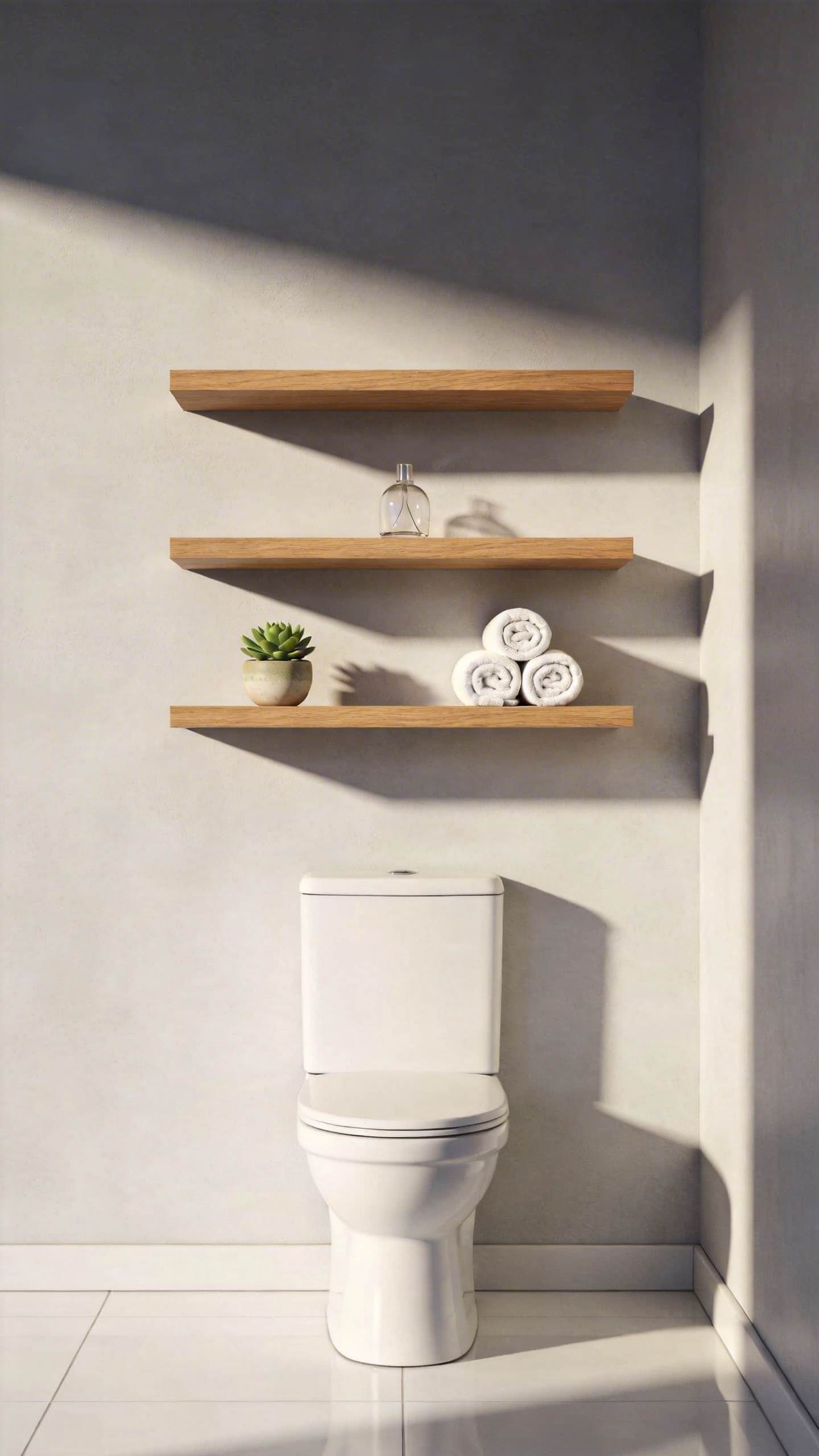
This shift is psychological. Humans crave bilateral symmetry. Perfectly balanced shelves trigger “processing fluency.” This lowers cognitive stress. Therefore, reducing visual noise here fosters calm.
Achieving this requires structural considerations. Installation must be stud-first to handle downward force. Additionally, the bathroom is a moisture chamber. Select non-porous materials like anodized aluminum. Unlike untreated timber, these resist warping. Yet, architecture is rarely perfect. Toilets are often off-center. To correct this, consider a wall-to-wall ledge. Thus, the shelf aligns with the room’s boundaries. Finally, embrace negative space. Leave forty percent of the shelf empty. This transforms storage into an architectural anchor.
The Towel Ritual: Rolling vs. Folding for Spa-Like Accessibility and Aesthetics
The decision to roll or fold towels transforms a bathroom’s atmosphere. Rolling shifts the space to a personal sanctuary. Textile science supports this choice. Unlike flat folds, compression rolling prevents sharp creases. Consequently, this reduces the growth of bacteria. Furthermore, rolling minimizes stress on fabric edges. As a result, cotton loops remain parallel and soft.
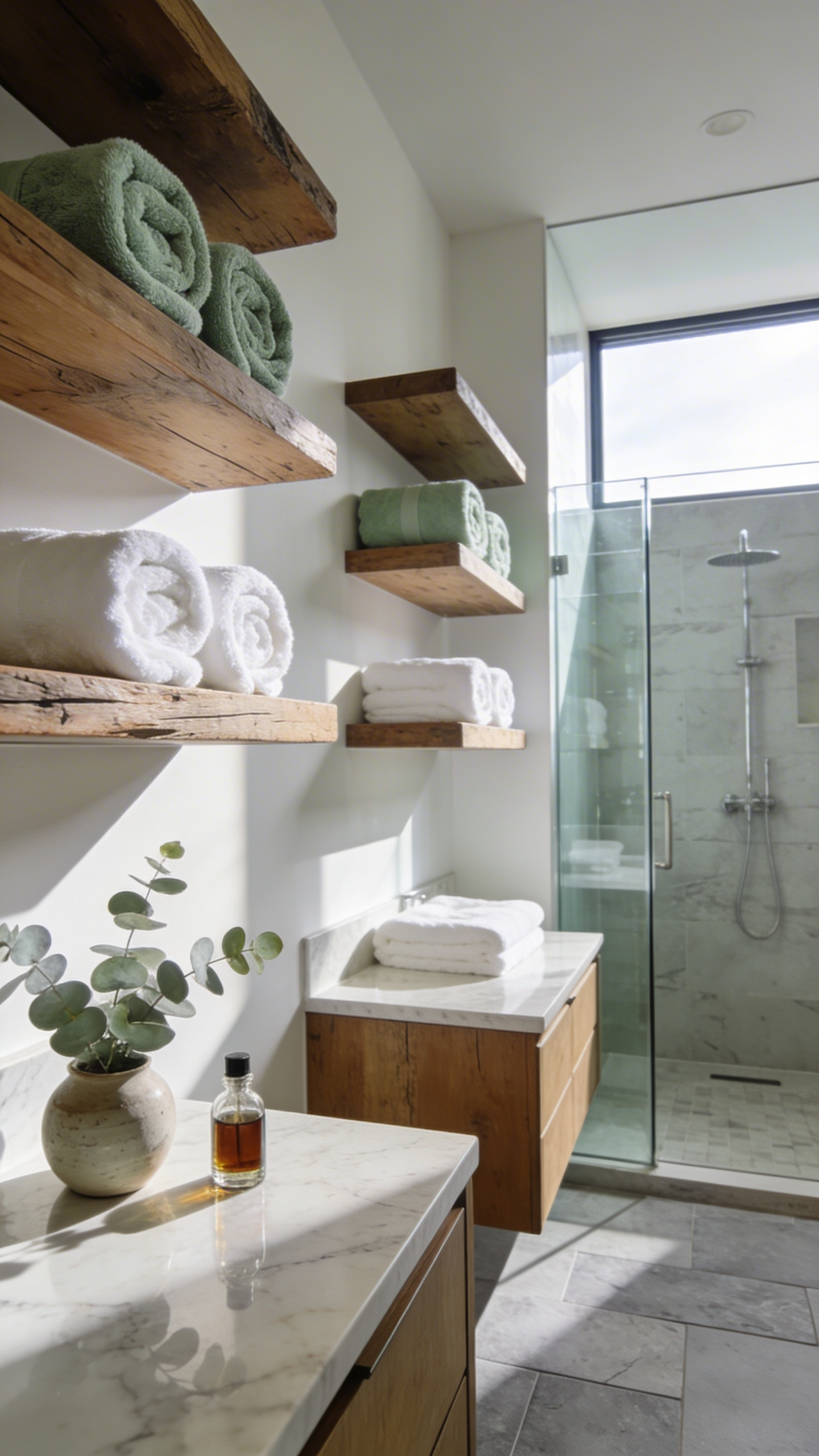
The “Spa Roll” solves storage frustrations. Traditional stacks suffer from the “Jenga effect.” Pulling one towel disrupts the pile. Rolled towels are structurally independent. Therefore, they allow for seamless accessibility. Visually, this arrangement introduces a soft silhouette. Ideally, store rolls in open baskets to emphasize readiness.
Mastering the perfect cylinder requires the “Triangle Tuck.” First, fold a corner diagonally. Then, roll tightly. Tuck the tip into the side to lock the shape. Ultimately, this ritual elevates daily routines.
Thresholds of Cleanliness: Dedicated Zones for Robes and Slippers
In Japanese architecture, the *genkan* is a vital boundary. Here, one sheds the outside world. Modern bathrooms benefit from a similar “decompression chamber.” Swapping street clothes for robes reduces cortisol. However, placing slippers on the floor creates a hygiene issue. Damp grout allows bacteria to wick into soles.
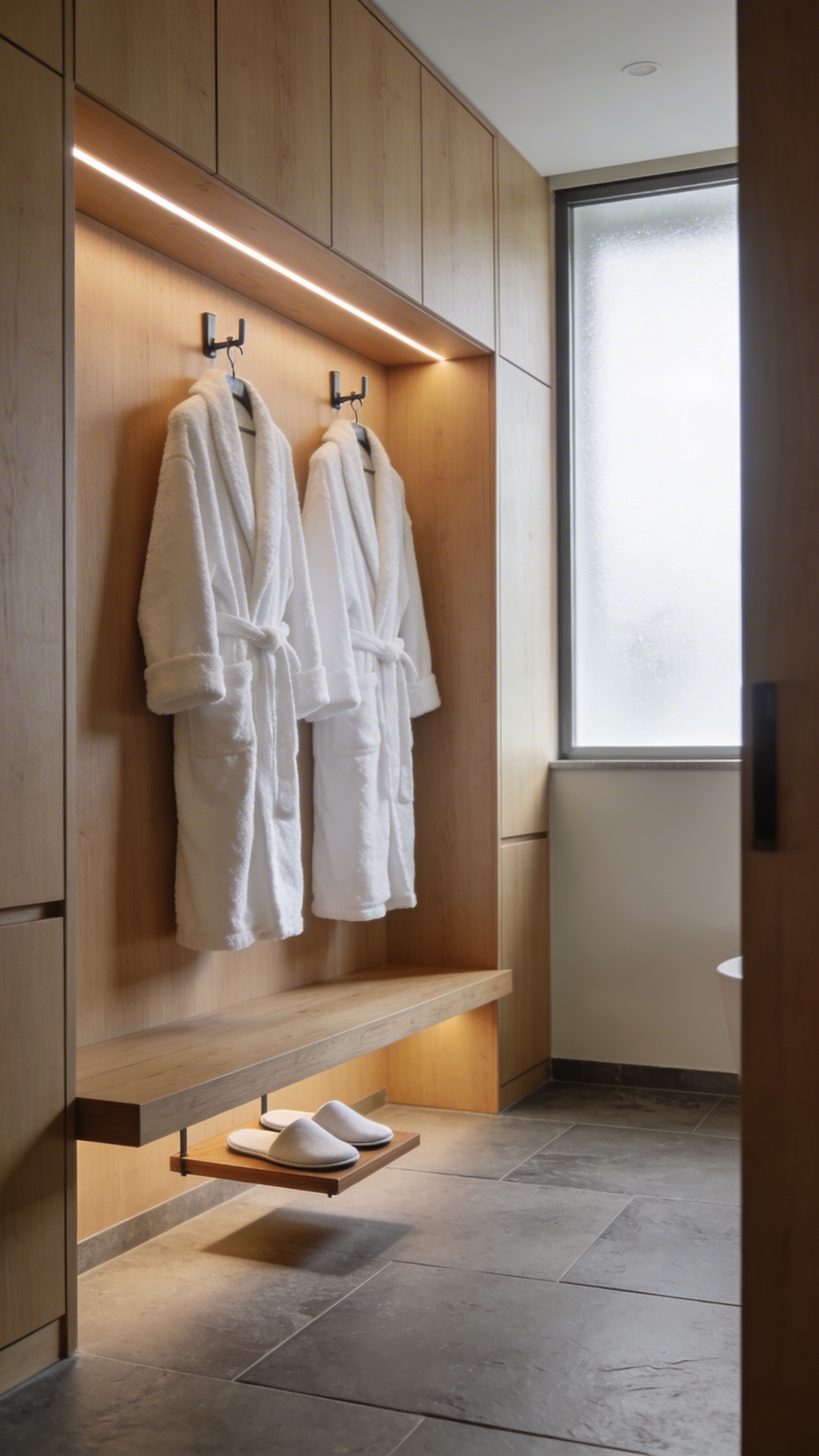
Therefore, design dictates elevating these items. Utilize floating shelves to lift footwear. This creates a hygienic separation. Furthermore, robes present a moisture challenge. If stored in closed cabinetry, damp fabric develops odors. Instead, incorporate breathable elements like cane webbing.
Even better, utilize cedar-lined storage. The wood’s natural properties combat moisture. Ultimately, these thresholds respect *ma*. They allow garments to breathe. Thus, dressing becomes a ritual of purification.
Wabi-Sabi Maintenance: Accepting Impermanence in Daily Organization Rituals
Conventional organization fights against time. We seek materials that remain eternally new. *Wabi-sabi* invites a different approach. It asks us to honor time through “living materials.” Instead of plastic, choose unsealed Hinoki or copper. Consequently, storage becomes a record of life. A copper dish develops a green verdigris. A wooden caddy darkens beautifully.
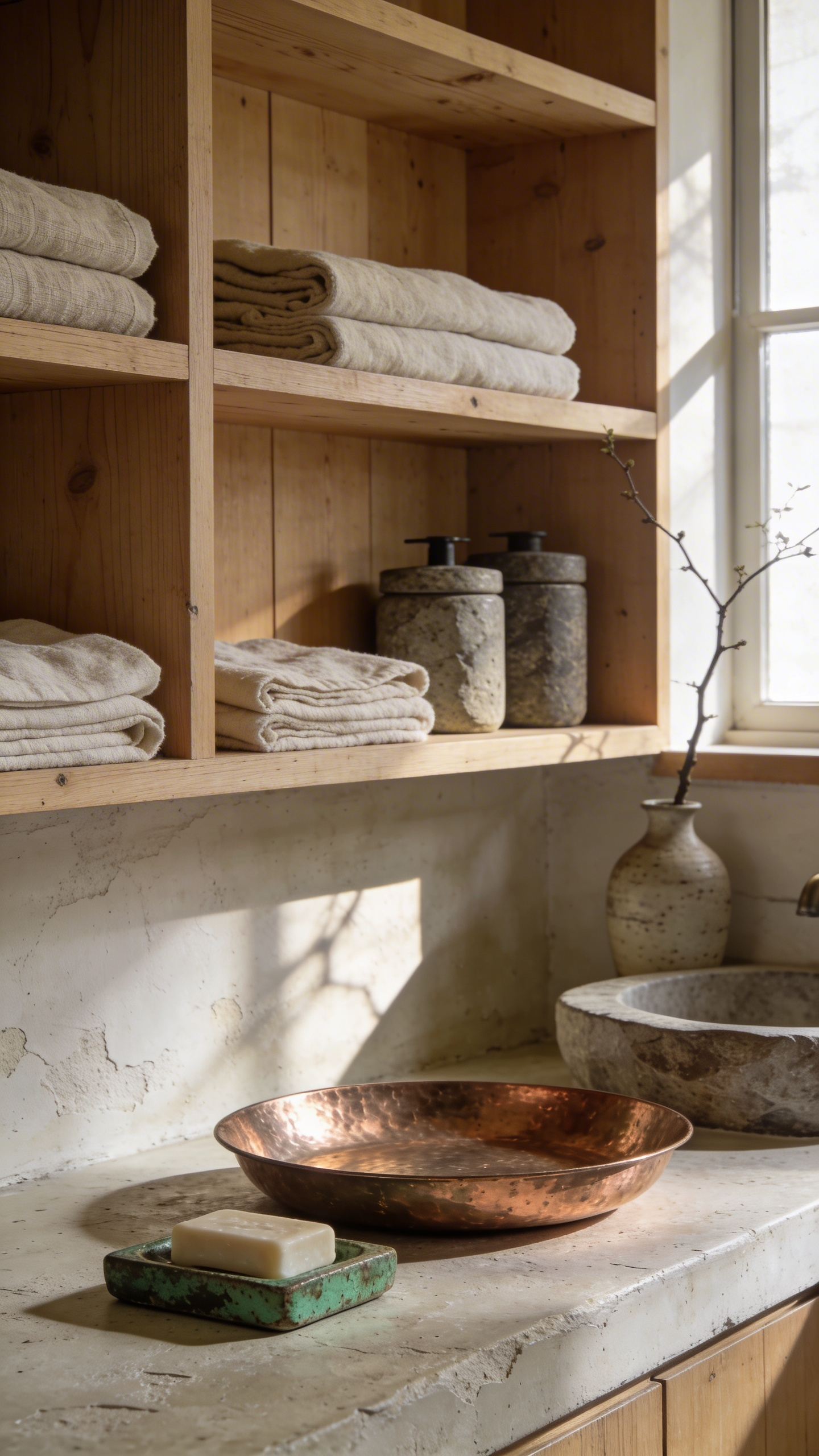
We must also consider *Ma*. Therefore, apply the “70% rule.” Shelves should never be fully packed. This gap allows objects to breathe. Furthermore, this transforms cleaning into *Misogi*, a ritual of purification. Rather than hiding used items, display them intentionally. Place a linen washcloth on a bamboo tray. Ultimately, watching artisanal soap change shape offers a grounding reminder of impermanence.
Frequently Asked Questions
How can I maximize storage in a luxury small bathroom?
To maximize space without sacrificing elegance, utilize floating vanities and recessed wall niches. These elements reveal more floor and wall area, creating an optical illusion of spaciousness. Additionally, adopt a “hidden versus revealed” strategy where 80% of utility items are concealed in handle-less cabinetry, leaving only curated essentials on display.
What materials are best for humid bathroom environments?
Natural materials like Grade-A Teak, Hinoki wood, and sustainable bamboo are ideal. These woods contain natural oils or high porosity that help them resist moisture and warping. For smaller accessories, seagrass and amber glass provide durability and protection against UV rays and humidity.
Is a floating vanity better for storage than a traditional one?
A floating vanity is superior for creating “visual silence” and an airy atmosphere. While it may offer slightly less cubic storage than a floor-mounted unit, it significantly increases perceived space. By using high-efficiency internal dividers like bento-style organizers, you can achieve superior organization within a smaller footprint.
From Clutter to Contemplation—The Bathroom as a Meditation Space
Transforming your bathroom involves more than tidying up. It requires rethinking the room’s purpose. Historically, we treated bathrooms as sanitary machines. But modern life demands a shift toward sensory restoration through holistic bathroom storage solutions. By embracing principles like *Ma*, storage becomes the infrastructure for peace. Hidden compartments do not merely conceal clutter; they create visual silence. Consequently, the vanity evolves from a crowded counter into an altar for self-care. The absence of objects allows the mind to rest.
Looking forward, your home should serve as a sanctuary. Thus, the bathroom must offer a “zero-state” for mental recovery. This transition relies on tactile experience. Choose natural materials that ground you. Start by auditing your daily items. Ruthlessly remove anything that disrupts your visual field. Finally, curate your essentials. In doing so, you turn a daily routine into a moment of profound contemplation.