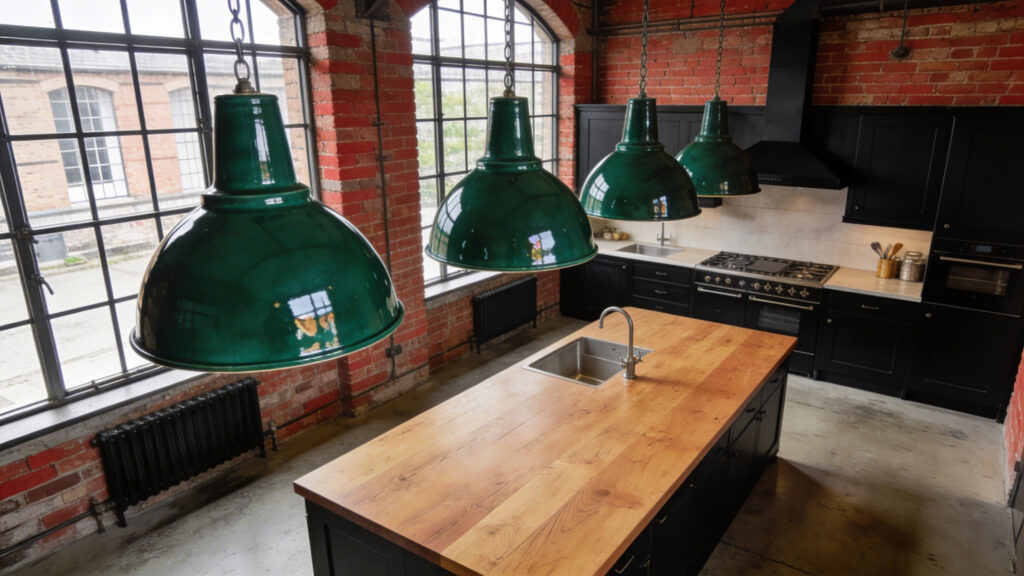
Choosing the right industrial kitchen light goes far beyond basic illumination. Indeed, it grounds a space with heritage materials and bespoke craftsmanship. For the discerning homeowner, these fixtures bridge a distinct gap. Specifically, they connect nineteenth-century utility with twenty-first-century sophistication. You might seek a bold architectural silhouette or the warm glow of a patinated pendant. However, understanding the soul of these materials remains absolutely essential. In fact, it is key to creating a refined modern kitchen interior design. These pieces do more than just light a room. Therefore, they tell a rich story of industrial resilience.
Phase I: The Heritage Materials (Authentic Foundations)
Authentic industrial lighting relies on heritage materials built for survival. In fact, these raw substances were forged for grueling nineteenth-century factories. Therefore, they bring profound historical tension to contemporary British kitchens. First, vitreous enamel acts as a rugged glass-fused-to-steel shield. Foundries originally fused powdered glass to steel at extreme temperatures. This created a chemically inert surface that easily resists grease. Indeed, tapping an authentic enamel shade produces a distinct ping. Next, stark white interiors contrast beautifully with classic factory green.
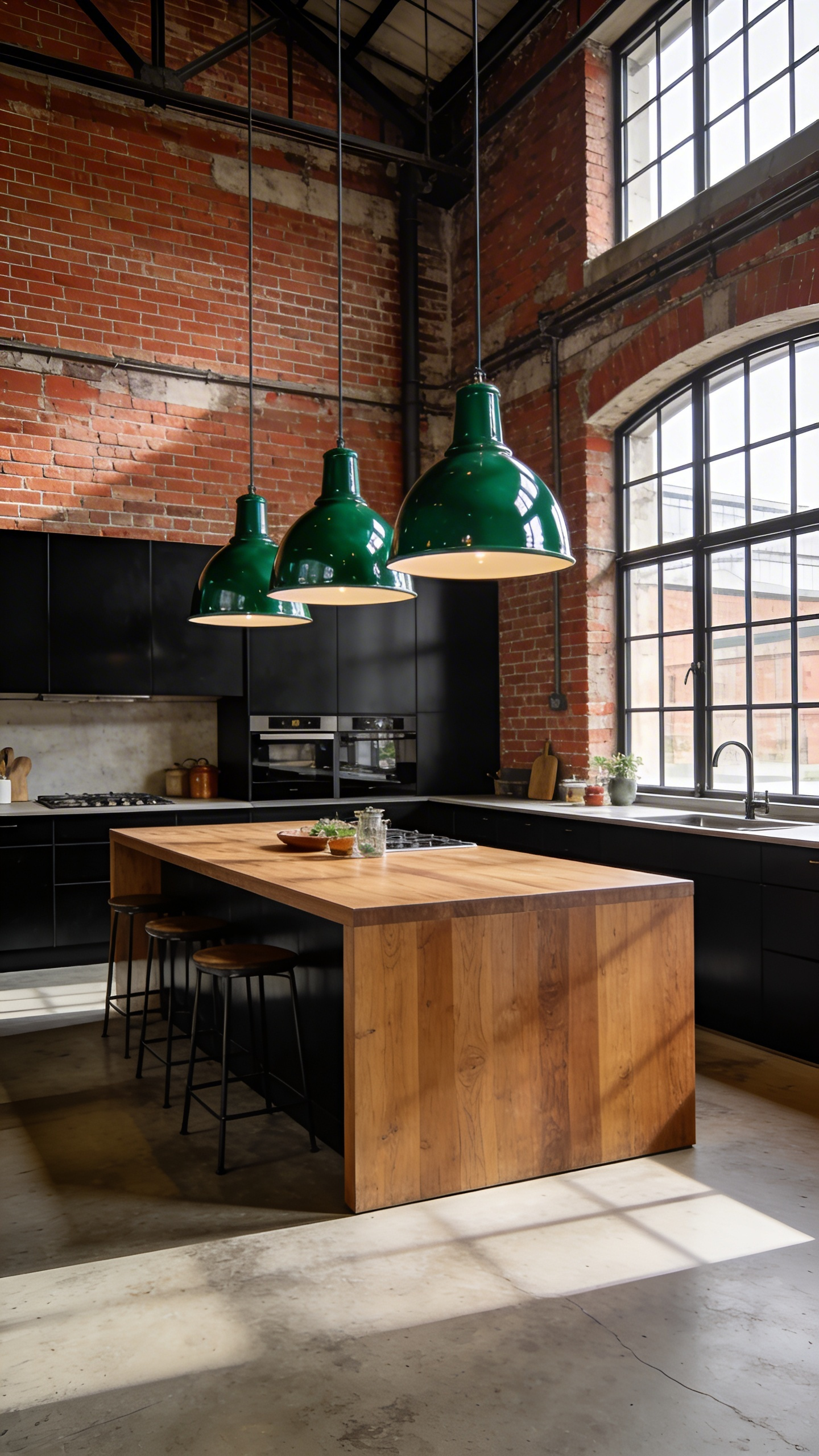
Prismatic glass, or Holophane, offers another critical design foundation. Indeed, these heavy borosilicate shades brilliantly manipulate the physics of diffusion. Specifically, interior prisms refract light downward while exterior sets reflect. Therefore, harsh beams transform into a shimmering, gem-like ambient glow. Heavy sand-cast metals also define this rugged lighting aesthetic. The pebbled brass textures tell fascinating stories of molten birth. Next, oversized wing nuts allowed grease-slicked workers easy bulb access. These exposed mechanical details beautifully remind us of manual labor’s dignity.
Next, braided textile flex provides the ultimate tactile finishing touch. Historically, early electrical wires required silk or cotton wrapping for safety. However, this fabric drape also carries a beautiful, authentic visual weight. Therefore, these resilient industrial relics ground our modern domestic spaces beautifully.
1. The Traditional Factory Dome: Spun Steel and British Manufacturing Heritage
The traditional factory dome survives from the British Industrial Revolution. Specifically, it bridges our gritty past and modern communal living. Indeed, its distinctive curvature comes directly from skilled metal spinning. Craftsmen press flat mild steel against a rapidly rotating mold. Therefore, the artisan truly feels the resistance of the heavy metal. Historically, heritage lathes from Birmingham shaped these robust steel shades.
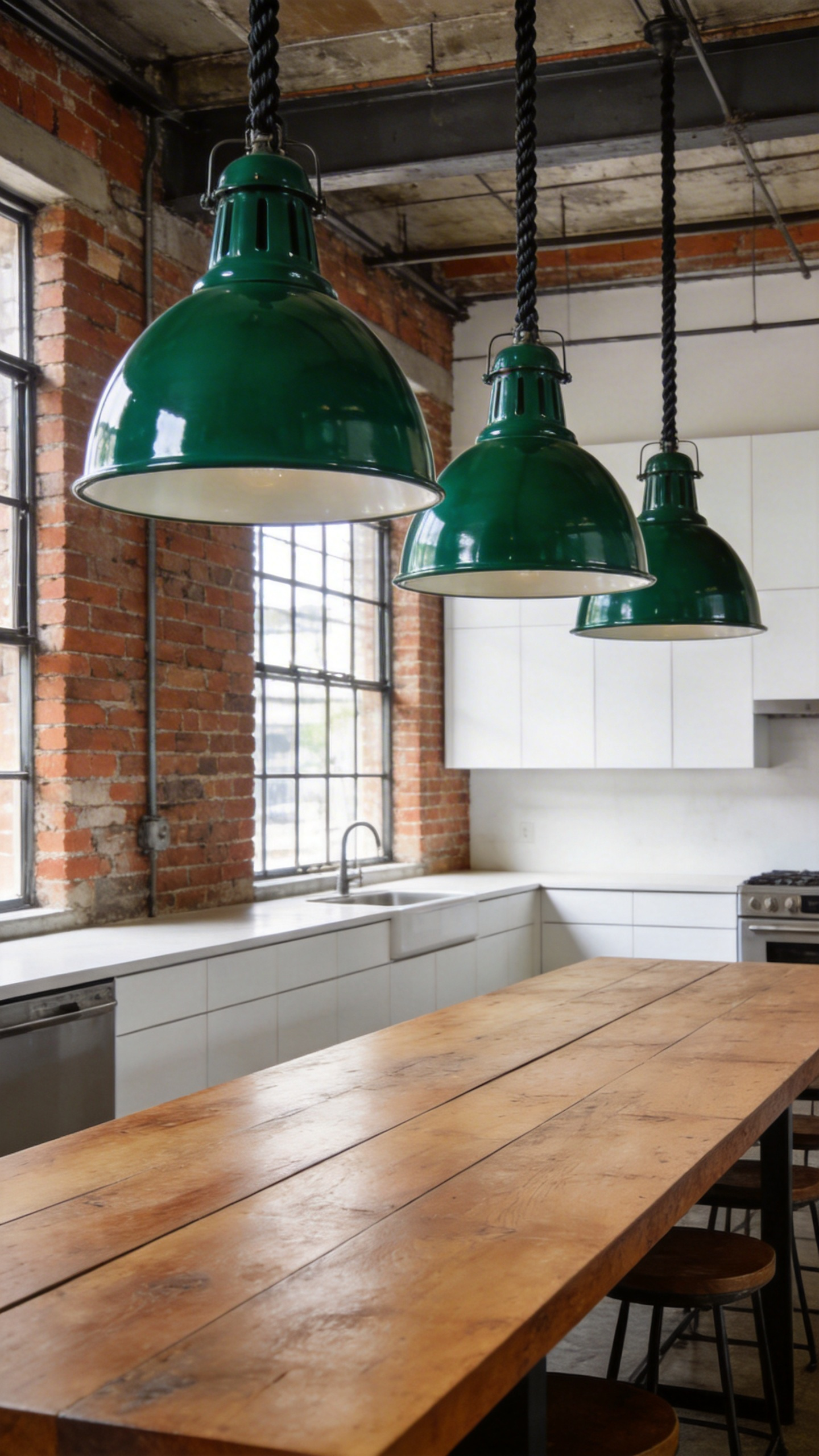
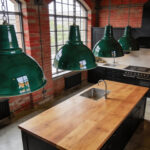
In fact, their iconic high-gloss finish is actually vitreous enamel. This porcelain layer originates directly from the fiery Black Country forges. Specifically, powdered glass fuses to the steel at extreme heat. Therefore, you feel a cool, glass-like smoothness upon touching one. Indeed, this non-porous finish resists kitchen steam and grease perfectly.
London’s Benjamin Electric Company engineered these domes for maximum performance. Specifically, engineers calculated exact geometries to maximize downward task lighting. The white internal enamel casts a clean, wide glow. Therefore, the fixture turns a kitchen island countertop into an illuminated workbench.
Next, these shades shifted from shop floors to domestic kitchens. Designers famously salvaged them from closing British textile mills and shipyards. Their massive scale provides a powerful, honest visual anchor. Indeed, heavy cast-iron galleries and braided flex celebrate this deep heritage. Therefore, they honor the proud legacy of early British industrial workers.
2. Unlacquered Brass Pendants: Embracing ‘Living Finishes’ That Age Gracefully
To understand industrial kitchen lighting, we must look past fleeting trends in kitchen light fixtures. Specifically, unlacquered brass pendants represent a deliberate rejection of static finishes. This raw alloy blends copper and zinc perfectly. Therefore, it creates a true living finish. The moment you hang the fixture, a silent chemical reaction begins. In fact, oxygen and kitchen steam trigger rapid oxidation.
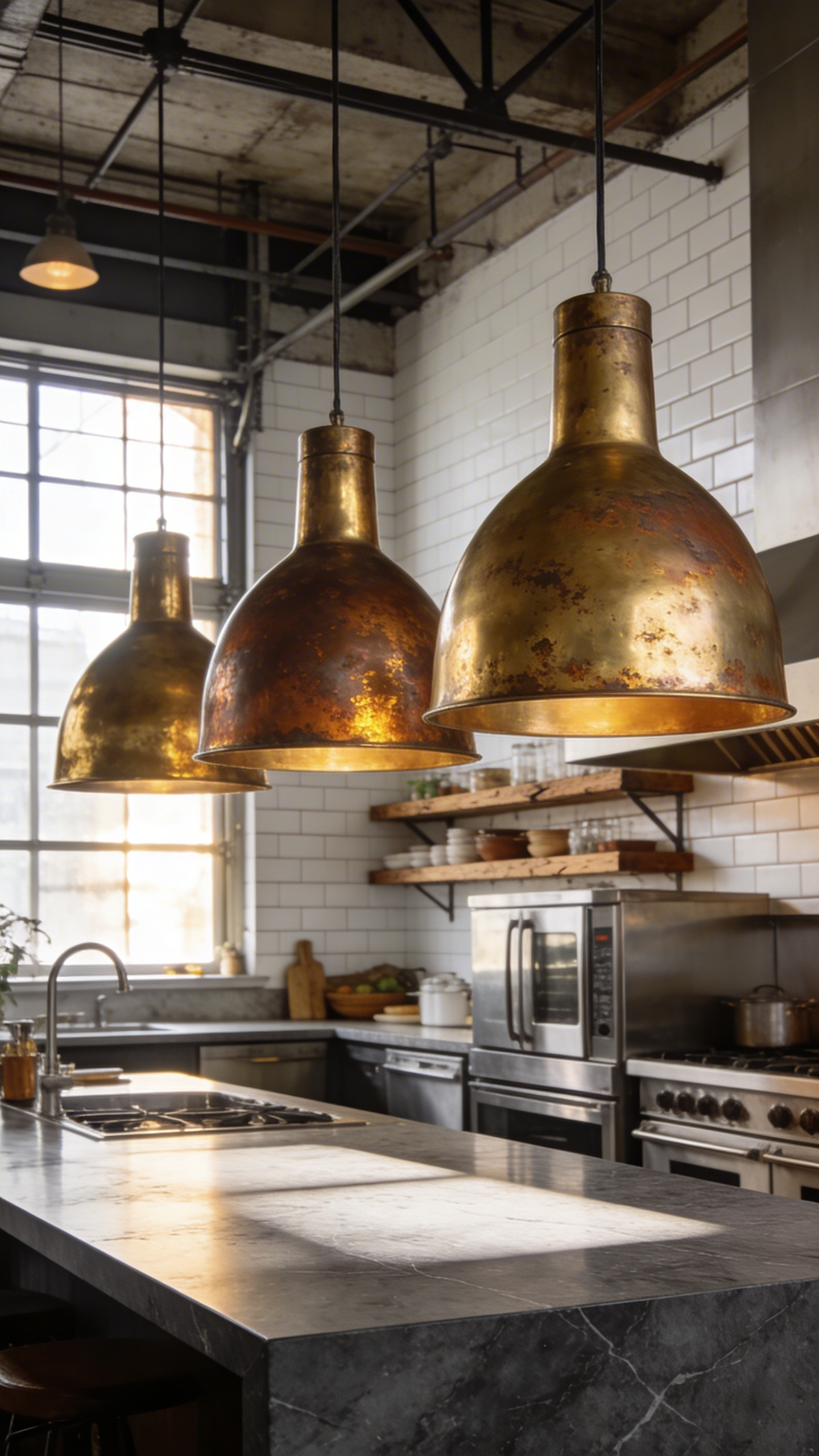
Over months, the golden hue deepens into a rich caramel. High-touch areas stay bright while crevices darken. Indeed, this creates a stunning three-dimensional depth.
Historically, brass was essential in classic British naval yards. It is famously non-sparking and highly durable. Therefore, it evokes the grit of genuine industrial heritage. Unlike plated steel, solid naval brass will never rust. Modern kitchens often rely on cold concrete and stainless steel. However, raw brass provides a vital tactile counterbalance. As it loses its reflection, it warms the ambient light. Next, the unlacquered metal offers a distinct, honest grip. Indeed, you feel the actual material instead of a slippery coating.
This living finish embraces the beauty of imperfection. A scratch on a lacquered fixture is a permanent defect. However, a scratch on raw brass simply heals over time. New patina grows into the groove beautifully. In fact, you can always reset the finish entirely. A simple lemon paste easily restores its original golden glow.
3. Ribbed Holophane Glass: Victorian Engineering Reimagined for Modern Islands
Modern Holophane pendants are often chosen for their stunning visual appeal. However, their origin is deeply rooted in Victorian physics. Specifically, French scientist André Blondel invented this glass in the 1890s. He designed the famous Blondel Flute to solve harsh early electric glare. Therefore, internal vertical flutings and external horizontal prisms refract light beautifully. Instead of merely blocking light, the fixture creates a wholly luminous glow. Indeed, this engineering entirely eliminates blinding hot spots over a modern kitchen island.
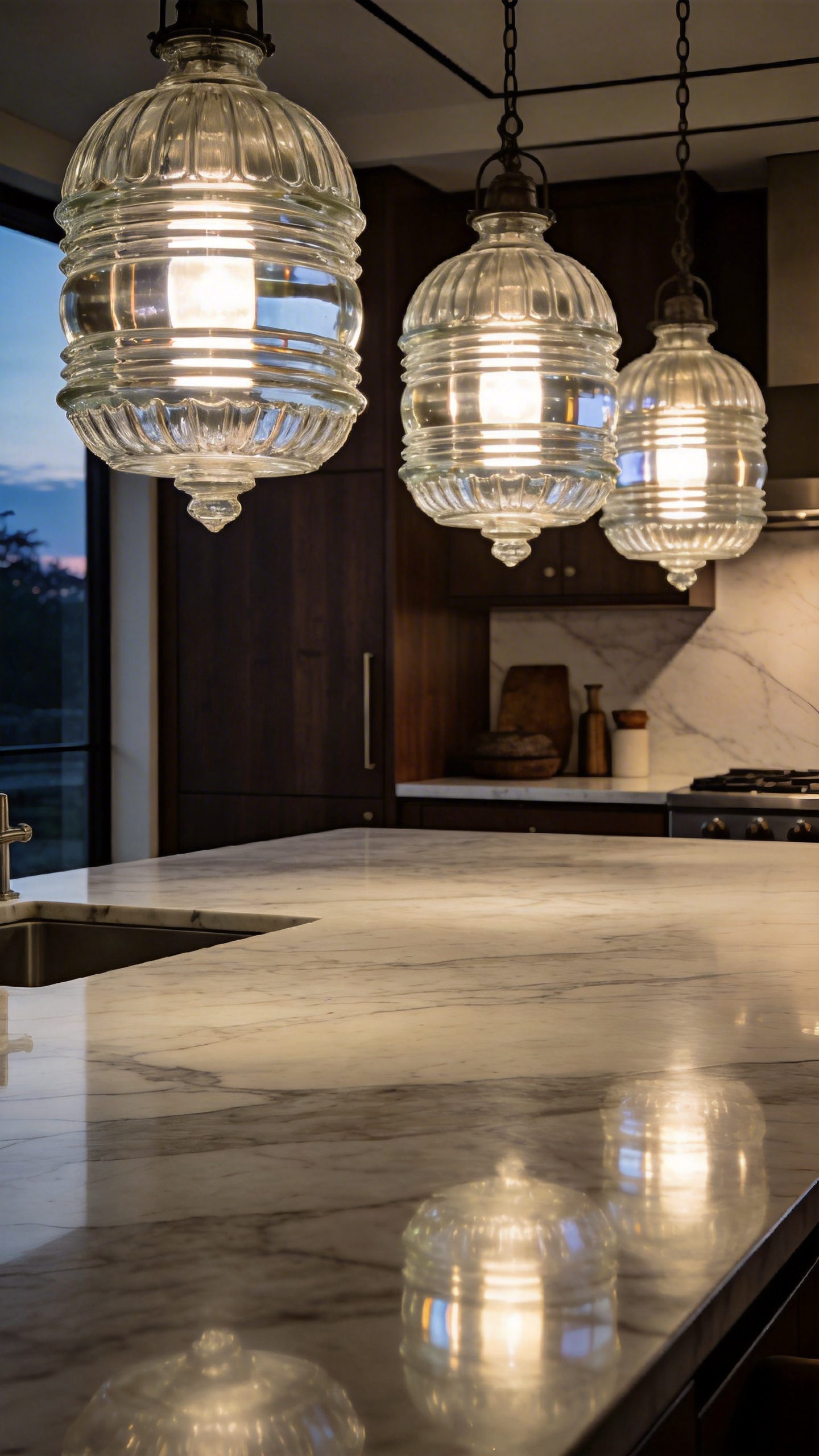
Authentic vintage Holophane possesses incredible material density. Originally, these shades featured pressed borosilicate glass with high lead content. Therefore, gently tapping the rim produces a crystalline, bell-like acoustic ring. Today, this distinct weight signifies a shift toward heirloom-quality industrialism. British designers now utilize these fixtures for their emotional gravity. In open-concept homes, the ribbed glass creates a vital visual anchor. Indeed, it provides a structural presence without blocking important sightlines.
This classic prismatic glass offers the perfect fix for modern LEDs. Typically, high-output bulbs cast stinging reflections on sleek stone countertops. However, ribbed Holophane redistributes this harsh point-source light effortlessly. Therefore, your kitchen island is bathed in a shimmering velvet glow. Next, pairing this glass with unlacquered brass achieves a true industrial luxe aesthetic. This reimagined Victorian engineering creates a beautiful tactile sanctuary in contemporary spaces.
4. Heavy Cast Iron Articulation: Grounding the Ethereal Contemporary Kitchen
Modern British kitchens often feature ethereal elements like white marble and seamless glass. Therefore, these airy spaces frequently lack a permanent visual anchor. Heavy cast iron lighting provides the perfect architectural counterweight. Historically, these fixtures descend from 1920s machinist lamps like the Utilight. Indeed, they rely on authentic circular friction plates and tapered sleeve joints. Instead of a weightless glide, these clamped articulations require deliberate manual adjustment. Specifically, loosening a heavy wing nut forces a slower, intentional interaction.
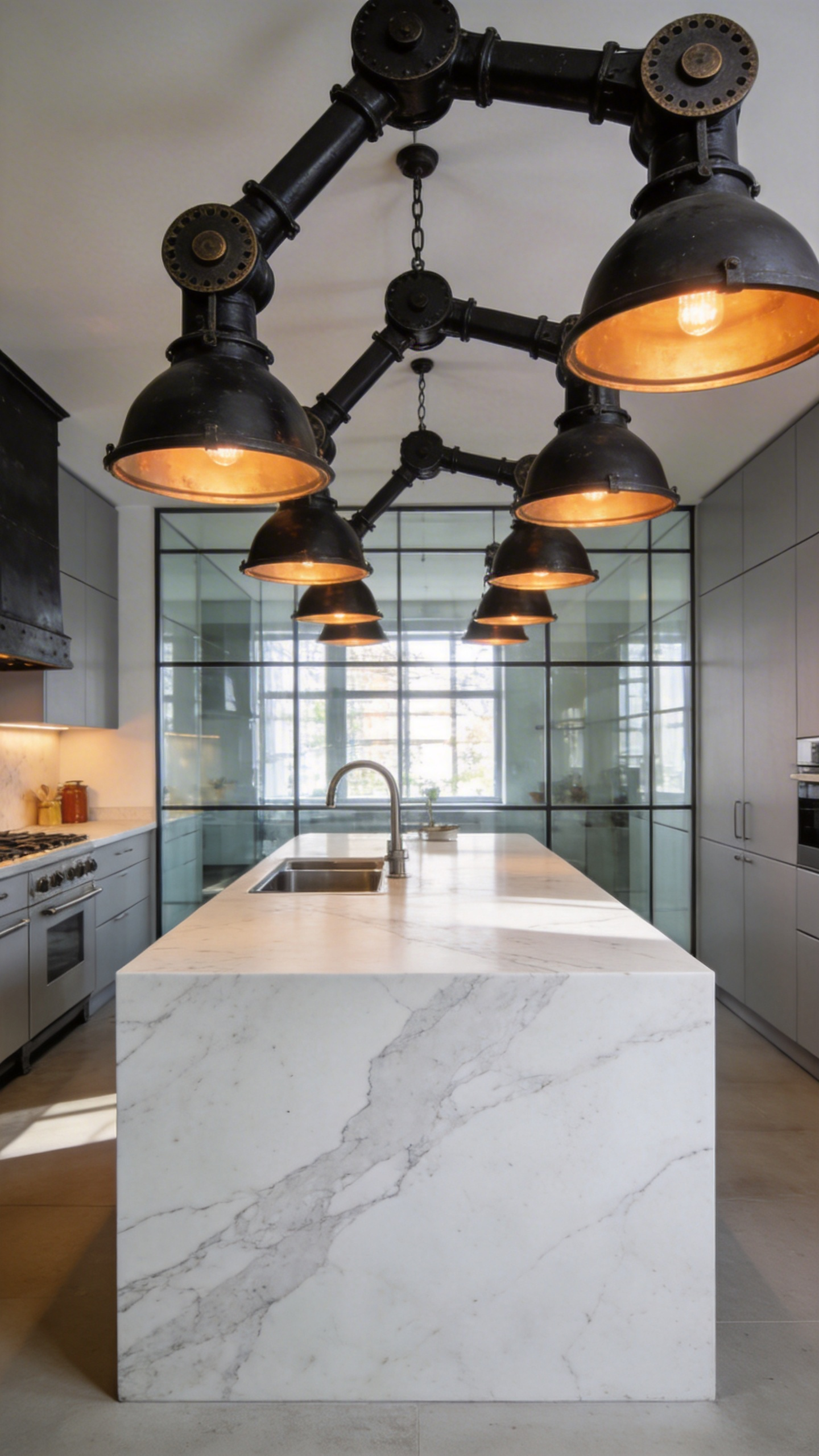
Moving the dense metal produces a reassuring, hollow metallic clunk. This distinct sound expertly grounds the modern silence of high-tech induction cooktops. In fact, the sand-cast pebble texture feels incredibly organic to the touch. Visually, the opaque iron generates hard shadows and focused pools of light. Therefore, it creates high-contrast drama within a softly diffused room. Sometimes, this physical grounding is achieved through a raw sand-cast counterweight. Indeed, pure physics holds the heavy cantilevered arm perfectly in place.
Uniquely, cast iron is often treated with natural beeswax or linseed oil. However, mass-market steel relies heavily on synthetic powder coatings to prevent rust. Therefore, authentic iron develops a deep, blackened patina over decades. This beautiful living finish ages gracefully alongside your contemporary home.
5. The Patinated Copper Shade: Introducing Warmth to the Machine Age Aesthetic
Early twentieth-century industrial lighting famously prioritized cold logic over domestic comfort. Specifically, the Machine Age aesthetic championed precision and mass production. Therefore, materials like steel and chrome can often feel slightly sterile. However, patinated copper serves as the perfect antidote to this coldness. Unlike stark white metals, copper actively absorbs the blue light spectrum. Next, it reflects a rich, golden-amber undertone across your room. Indeed, this creates an inviting hearth effect within modern kitchens.
A patinated surface offers a captivating narrative of time. Indeed, interior designers increasingly favor the unlacquered living finish. Naturally, this raw metal continuously reacts to the kitchen’s unique environment. For instance, ambient heat and daily humidity alter its surface over time. Therefore, no two copper lighting fixtures will ever look identical. Historically, this aging perfectly mirrors the industrial weathering of the Statue of Liberty. Today, skilled craftsmen replicate this exact weathering using specific accelerants.
Specifically, cupric nitrate creates a vibrant turquoise verdigris finish. However, liver of sulfur produces a deep statuary brown patina. Importantly, both finishes introduce vital tactile complexity that standard metals lack. Copper inherently satisfies our deep psychological need for natural textures. In fact, this biophilic connection perfectly grounds modern open-concept spaces. Therefore, a patinated copper shade beautifully bridges industrial precision with human warmth.
Phase II: Architectural Silhouettes (Form Following Function)
Industrial kitchen lighting has officially entered a new aesthetic era. Specifically, designers have entirely abandoned heavy literal factory salvage. They now embrace highly abstracted architectural silhouettes. In fact, this blueprint approach treats fixtures as three-dimensional line drawings. For example, blackened steel frames cleverly outline negative space. Therefore, this skeletal framework perfectly defines vertical space without visual clutter.
These sharp silhouettes directly map technical performance requirements. Therefore, thermal heat-sink fins become striking ornamental features. Exaggerated radial lines beautifully echo modern skyscraper structures. Next, flat circular and linear shapes perfectly optimize LED light distribution. These razor-thin profiles actually mimic advanced modern clean-room facilities. Therefore, they project a wide, uniform beam across kitchen islands. Indeed, open-frame architecture significantly increases vertical room illuminance.
This strict modernist engineering never feels stark or cold. However, it updates mid-century modernism through a softened brutalism philosophy. Matte-black exteriors smartly absorb surrounding ambient light. Meanwhile, antique brass interior leafing reflects a deeply warm glow. This intelligent duality wonderfully bridges classic British warmth and modern utility. Next, these precise silhouettes house multiple small LED point-sources. They flawlessly control glare while delivering high-CRI precision lighting for culinary tasks. Indeed, carefully cast geometric shadows transform the kitchen into a dynamic gallery. Therefore, this refines Louis Sullivan’s functional ethos into Zen-like elegance.
6. The Articulated Wall Sconce: Precision Task Lighting for the Scullery or Sink
Historically, the articulated wall sconce illuminated early twentieth-century factory floors. Today, it provides definitive task lighting for the modern British scullery. Specifically, this fixture offers surgical precision that static lighting simply cannot match. The very soul of this industrial sconce lies in its mechanical joints. In the 1950s, French mechanic Jean-Louis Domecq invented a revolutionary wireless contact system. In fact, copper slip rings transmitted electricity directly through the joint itself. Therefore, the lamp arms could rotate indefinitely without ever tangling internal wires.
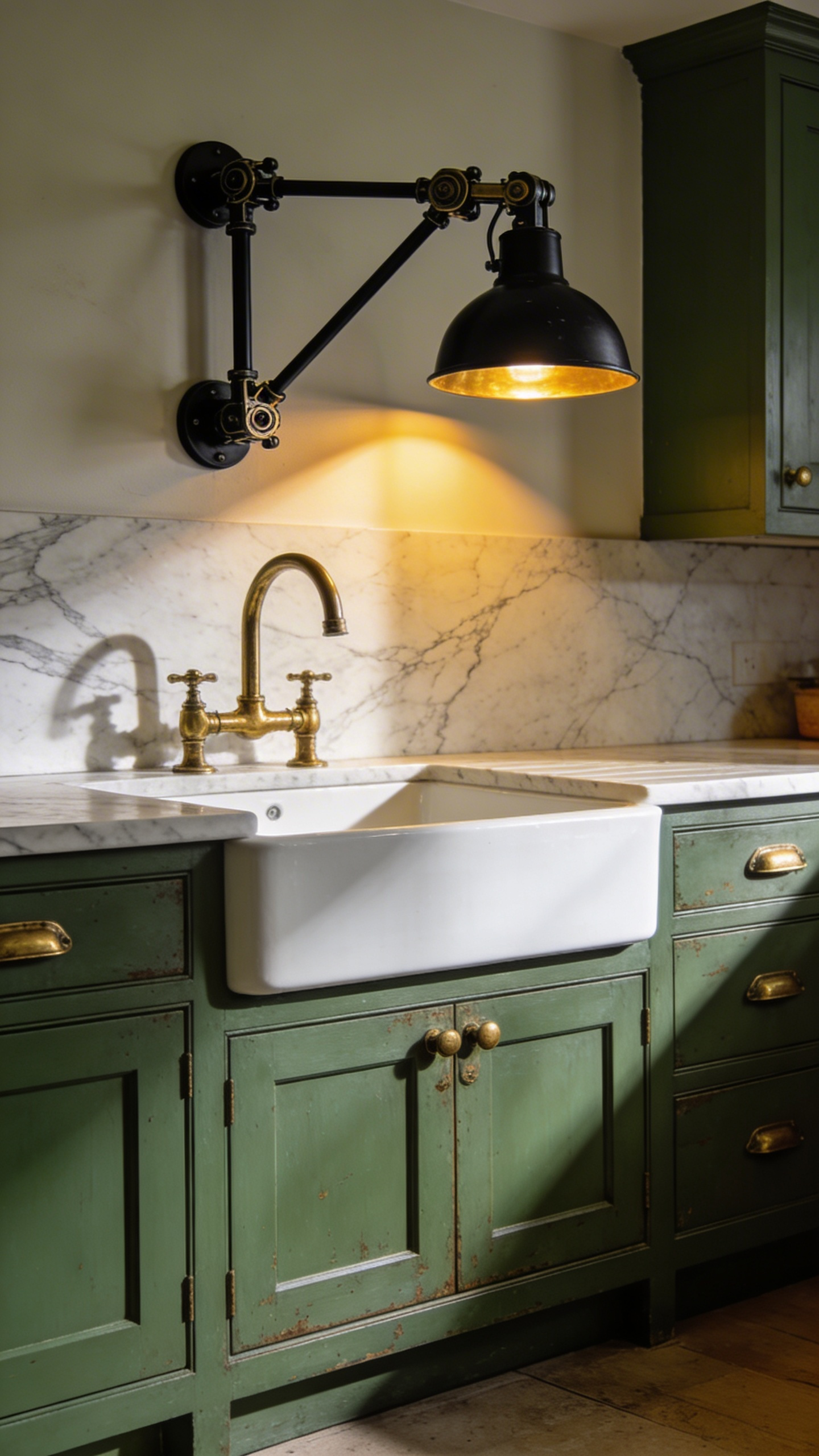
This distinct mechanical resilience proves highly vital in a busy sink area. When you pull the lamp forward, you interact with a robust, mid-century tool. Instead of casting shadows from overhead downlights, the sconce hovers directly over your task. Friction joints allow for a smooth, one-handed glide during messy food prep. However, locking knobs provide rigid stability in high-traffic kitchen zones. Indeed, the chosen materials respond beautifully to the humid environment of a sink. For instance, unlacquered brass develops a rich living finish from daily touch. Alternatively, non-porous enameled steel shades easily wipe clean of grease and grime.
Importantly, these deep conical shades prevent harsh light from spilling into your eyes. Therefore, they eliminate visual fatigue in the often narrow confines of a scullery. Originally, these productivity tools heavily illuminated medical laboratories and dental offices. Now, installing a high-end articulated lamp elevates domestic labor to a professional craft. Indeed, it transforms a simple wash basin into a serious culinary workstation.
7. Exposed-Flex Linear Suspensions: The Modernist Answer to the Grand Island
The expansive kitchen island has created a distinct design challenge for modern homes. Traditionally, designers hung three separate pendants above these massive centerpieces. However, this approach often creates visual clutter and uneven illumination. Therefore, the exposed-flex linear suspension emerged as the perfect modernist solution. Specifically, this elongated fixture replaces multiple cords with a single horizon line of light. In fact, it elegantly preserves the architectural integrity of the room.
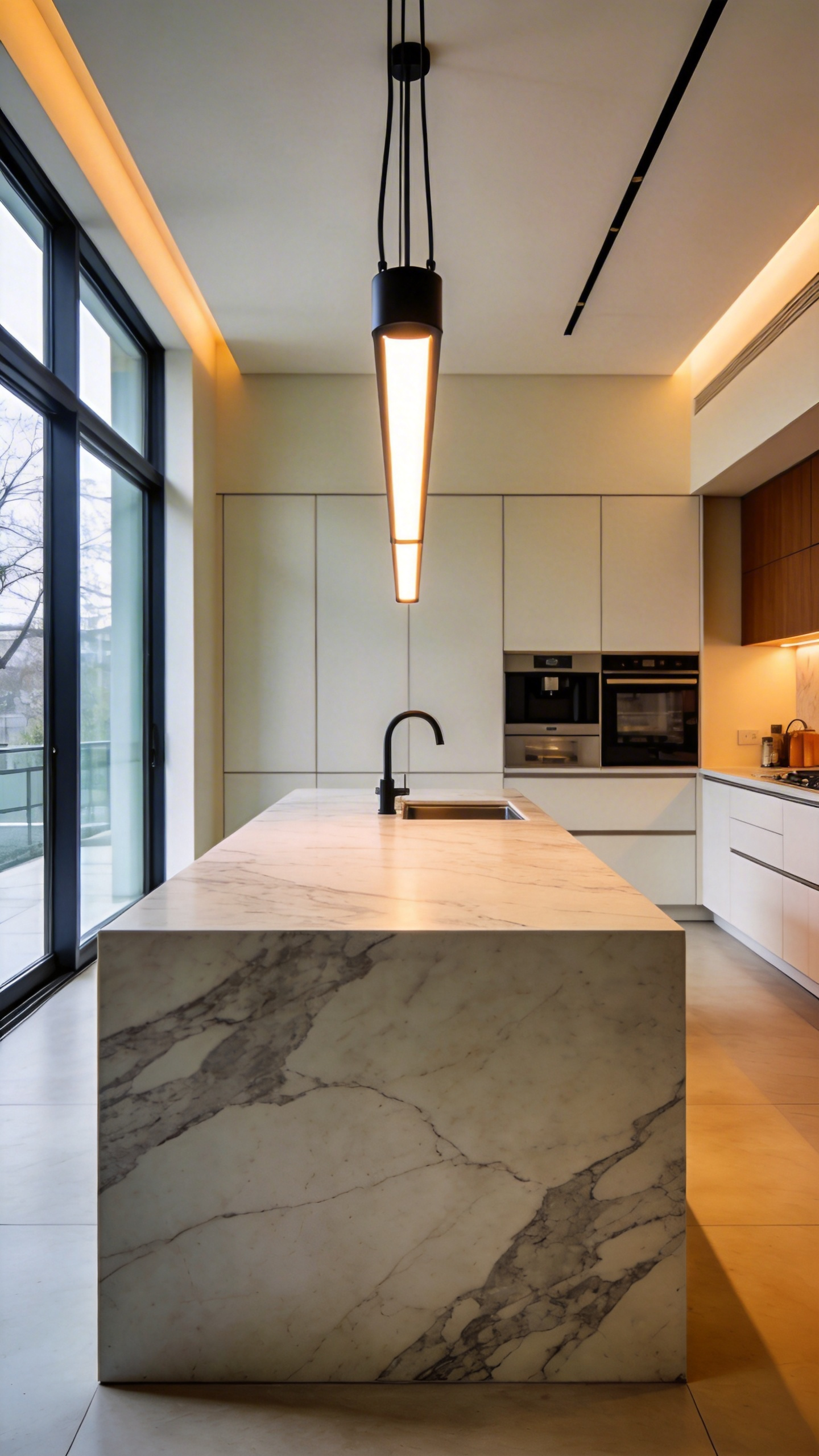
By proudly embracing technical honesty, the electrical cord becomes a celebrated design feature. Instead of hiding wires inside rigid metal rods, designers use fabric-wrapped cables. Therefore, these braided cotton cords introduce a soft, tactile warmth. In fact, the slight drape of the cables beautifully softens hard quartz surfaces. Meanwhile, it subtly nods to classic British factory wiring. Functionally, these fixtures utilize integrated LEDs for continuous downward light. Therefore, they completely eliminate frustrating head shadows during meal preparation.
Next, a large linear suspension effectively grounds high-ceilinged spaces. It essentially creates an intimate room within the larger kitchen volume. This gallery-style fixture acts as a deliberate anti-chandelier. Rather than relying on ornate maximalism, it frames the workspace with quiet precision.
8. Counterweight Pulley Systems: Celebrating the Beautiful Mechanics of Illumination
Counterweight lighting bridges industrial engineering and fine art beautifully. Specifically, these fixtures act as interactive sculptures in modern kitchens. Historically, designers drew direct inspiration from Alexander Calder’s kinetic mobiles. Therefore, they celebrate the elegant mechanics of dynamic equilibrium perfectly. Visually, pulley systems proudly display their functioning sheaves and arbors. Indeed, many utilize a double purchase ratio for extreme adjustability.
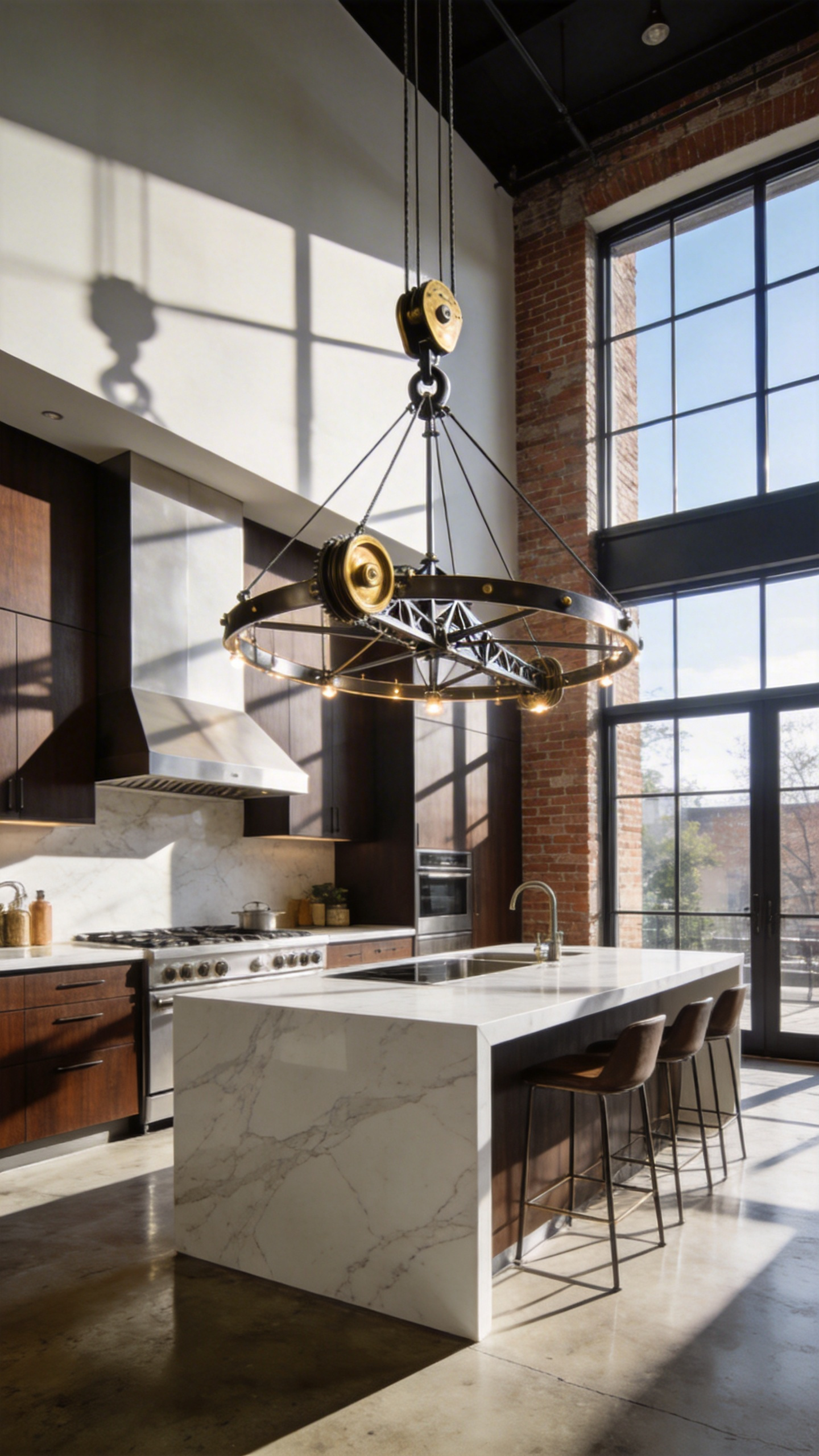
The sensory experience of using these lamps is highly deliberate. For instance, you hear a quiet whirr during height adjustments. Additionally, a satisfying mechanical click heavily grounds this tactile, analog ritual. Therefore, pulling the weighty cable feels remarkably artisanal and substantial. Material choices further enhance this rich, historical design narrative. Typically, designers swap standard plastic wires for silk-wrapped braided cables. Likewise, weights forged from unlacquered brass or blackened steel excel. Over time, these living metals develop a beautifully personalized patina.
Functionally, this mechanical system brilliantly solves the island’s dual nature. First, you can gently lower the lamp for concentrated task lighting. Next, raising the fixture opens up sightlines for social dining. The exposed vertical cables perfectly anchor open-concept architectural spaces.
9. Caged Bulkhead Fittings: Borrowing from Nautical and Railway Heritage
Historically, bulkhead fittings were engineered as vapor-proof nautical survival fixtures. They efficiently prevented engine room condensation from shorting out electrical systems. Specifically, iconic wire cages protected glass from heavy equipment strikes. The reassuring clink of metal against brass warmly represents honest utility. Indeed, that resilience translates beautifully into modern British kitchens.
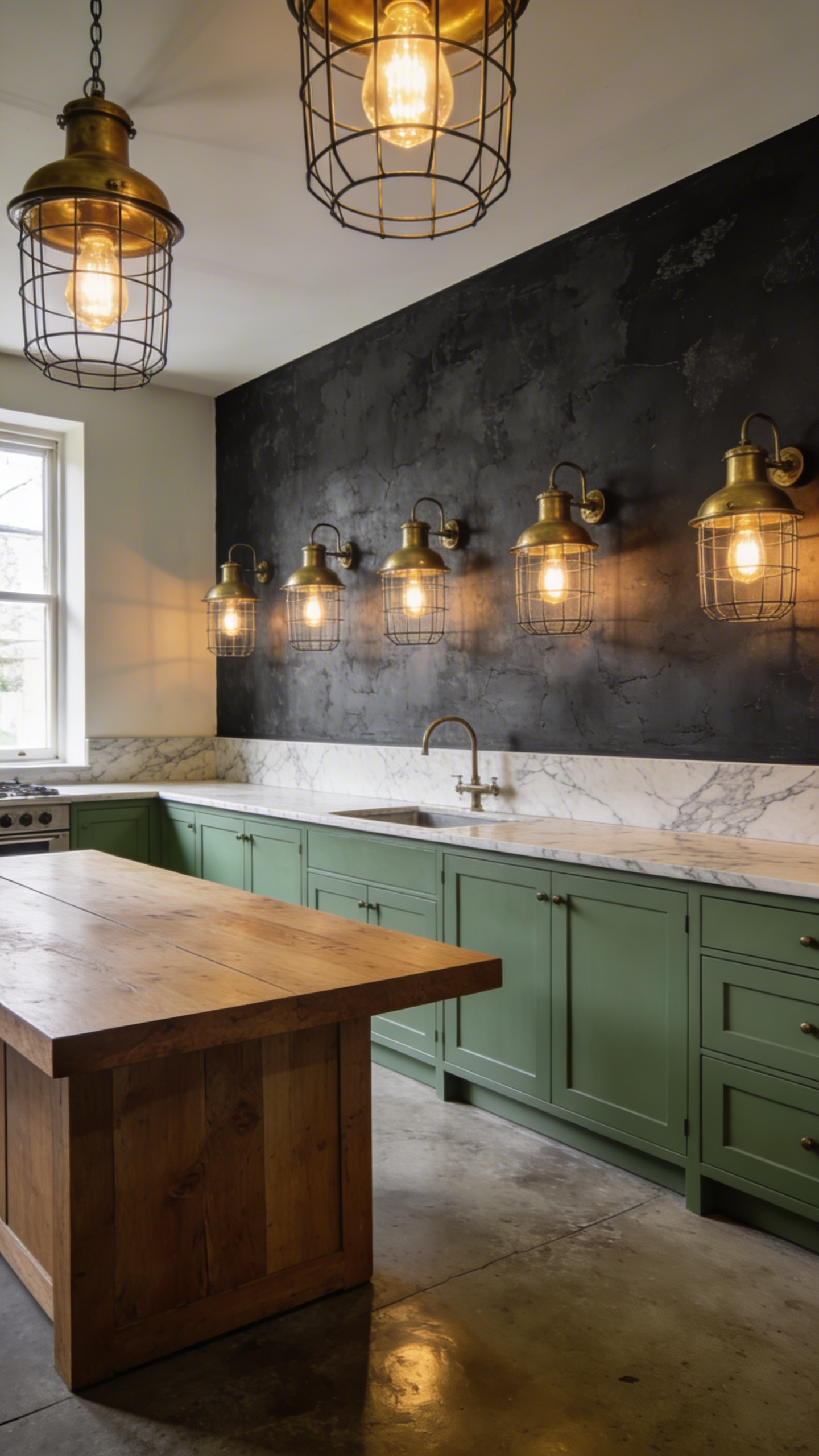
These fixtures also share a truly rich British railway heritage. Curiously, this distinct linguistic crossover stems directly from “Bullhead” track terminology. Identical utility lights brightly illuminated damp spaces like Fawley Power Station. Naturally, their impact-resistant designs withstood heavy vibrations and 20-joule blows.
A high-quality bulkhead relies heavily on ribbed prismatic glass. Initially, shipbuilders used solid deck prisms to refract sunlight downward. Subsequently, these textured lenses softly diffuse harsh modern bulbs. Therefore, they beautifully illuminate countertops without casting sharp, distracting shadows.
Authentic heritage fittings always boast serious sensory weight. Traditionally, makers expertly cast these pieces in solid brass or gunmetal. This unique composition easily resisted severe marine salt-air corrosion. Therefore, these materials naturally develop a beautiful, dark verdigris patina. However, cast iron finished in dimpled Hammerite paint dominated railways.
Authoritative industrial lighting clearly retains tactile, highly mechanical details. Next, oversized wing nuts historically allowed convenient, tool-free bulb changes. Visible brass cable glands and heavy rubber gaskets distinctly signify rugged authenticity. Placing a caged bulkhead above a pantry door expertly anchors the space. Indeed, it elevates a domestic kitchen into a dignified, purposeful work zone.
10. The Multi-Arm Industrial Chandelier: A Bold Statement Over the Dining Table
The multi-arm industrial chandelier serves as a powerful architectural anchor for contemporary dining spaces. Interestingly, its silhouette descends directly from the mid-century Sputnik design. However, this modern iteration trades polished chrome for honest materials like blackened steel. Therefore, it brings substantial visual weight to the dining area. Specifically, the exposed joints and radial arms expertly manipulate negative space.
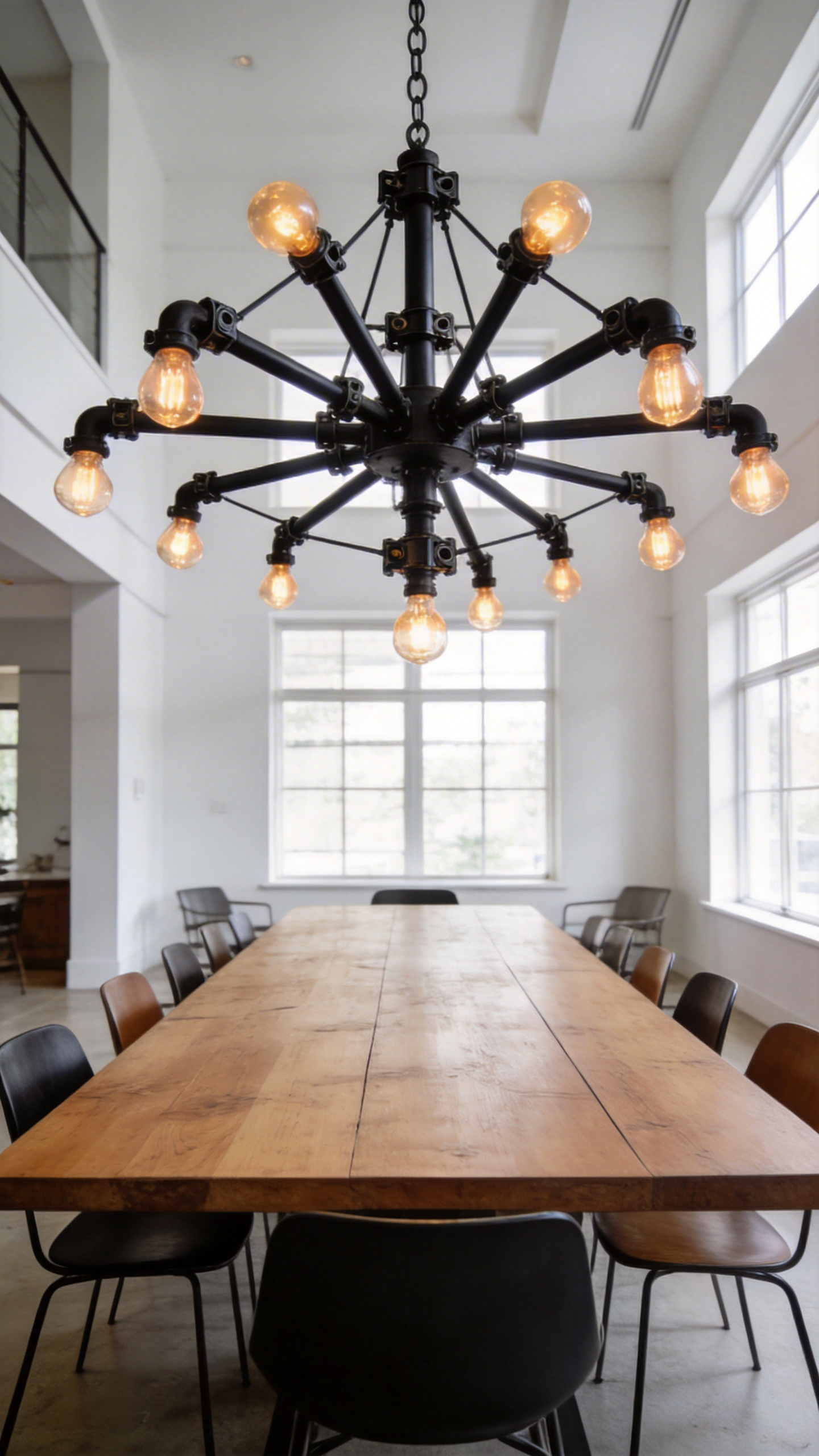
This expansive shape cleverly breaks up the rigid lines of standard kitchen cabinetry. Naturally, the exposed filament bulbs provide a beautiful sensory contrast. Typically, these fixtures utilize warm 2200K to 2700K bulbs. Therefore, the harsh mechanical structure emits a remarkably soft, golden hour glow. Meanwhile, the multiple arms cast dynamic, overlapping shadows across your dining table.
Many premium British design houses strongly prefer utilizing unsealed living finishes. Over time, raw brass or copper oxidizes to develop a rich, historical patina. Practically, achieving this bold design statement requires precise mathematical scaling. The fixture’s diameter should equal half to two-thirds of the table’s width. Finally, designers recommend hanging the piece thirty to thirty-six inches above the tabletop. Indeed, this lower positioning gracefully brings those intricate mechanical details directly into your eye-line.
11. Hand-Blown Globe Pendants with Machined Hardware: The Contemporary Classic Bridge
The contemporary classic bridge beautifully merges two distinct manufacturing extremes. Specifically, this lighting style perfectly reconciles organic glassblowing with precise engineering. Hand-blown glass simply forms a uniquely imperfect and organic bubble. Therefore, tiny air bubbles and refractive ripples provide undeniable soul. These delicate irregularities contrast sharply with the rigid machined hardware. Next, designers often utilize lathe-cut solid brass or stainless steel. This intentional pairing beautifully creates a striking dialogue between opposing materials.
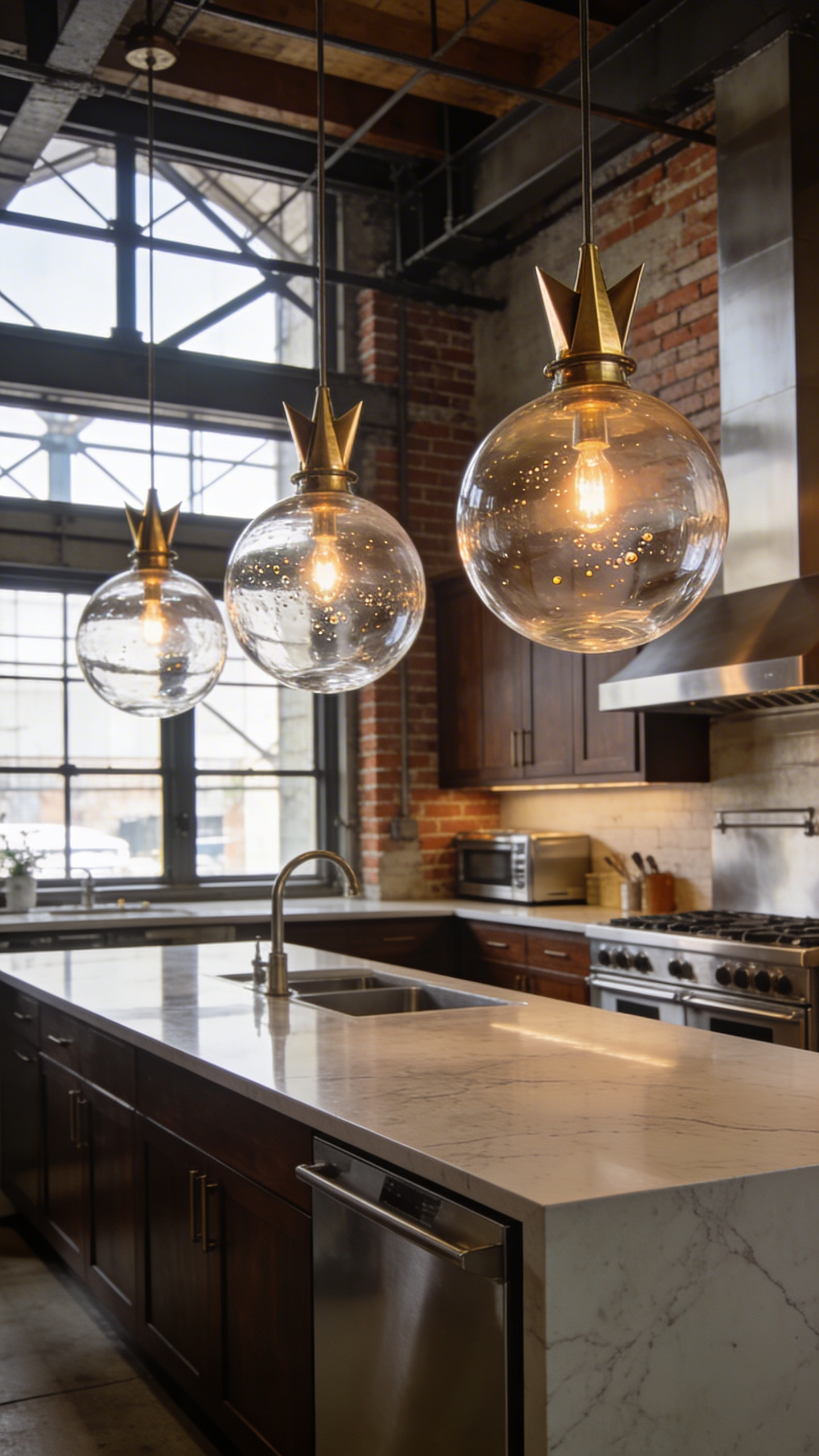
Interestingly, a defining feature of this robust industrial metalwork is knurling. Originally, knurling provided functional grip in nineteenth-century machine shops. Today, however, diamond-patterned knurling clearly adds a tactile luxury experience. Touching the textured brass provides a truly grounding sensory contrast. This aesthetic is widely known as soft industrial design. Indeed, it seamlessly evolves mid-century Eichler concepts into refined contemporary classics.
This distinct material combination drastically changes your kitchen’s overall light quality. The varying thickness of artisanal glass gently bends the light. As a result, the room receives a beautifully soft, liquid illumination. These glowing pendants essentially function as fine jewelry for the space. Visually, they beautifully soften hard surfaces like quartz and stainless steel. Meanwhile, the solid hardware strongly maintains a distinct, functional workhorse identity. Importantly, these heavy, lead-free materials are perfectly designed to age gracefully. A living finish will steadily develop a rich patina over decades. Therefore, the fixture instantly becomes a true heirloom industrial piece.
Phase III: Spatial Application (The London Flat Approach)
True industrial lighting requires careful refinement for compact London flats. This nuanced method elegantly solves unique spatial puzzles found in historic Victorian and Georgian conversions. Specifically, interior designers define functional room boundaries using strategic light instead of physical walls. For example, dropping heavy brass pendants anchors a central kitchen island beautifully. Next, specifying narrow beam angles prevents unwanted light spill into nearby relaxation areas.
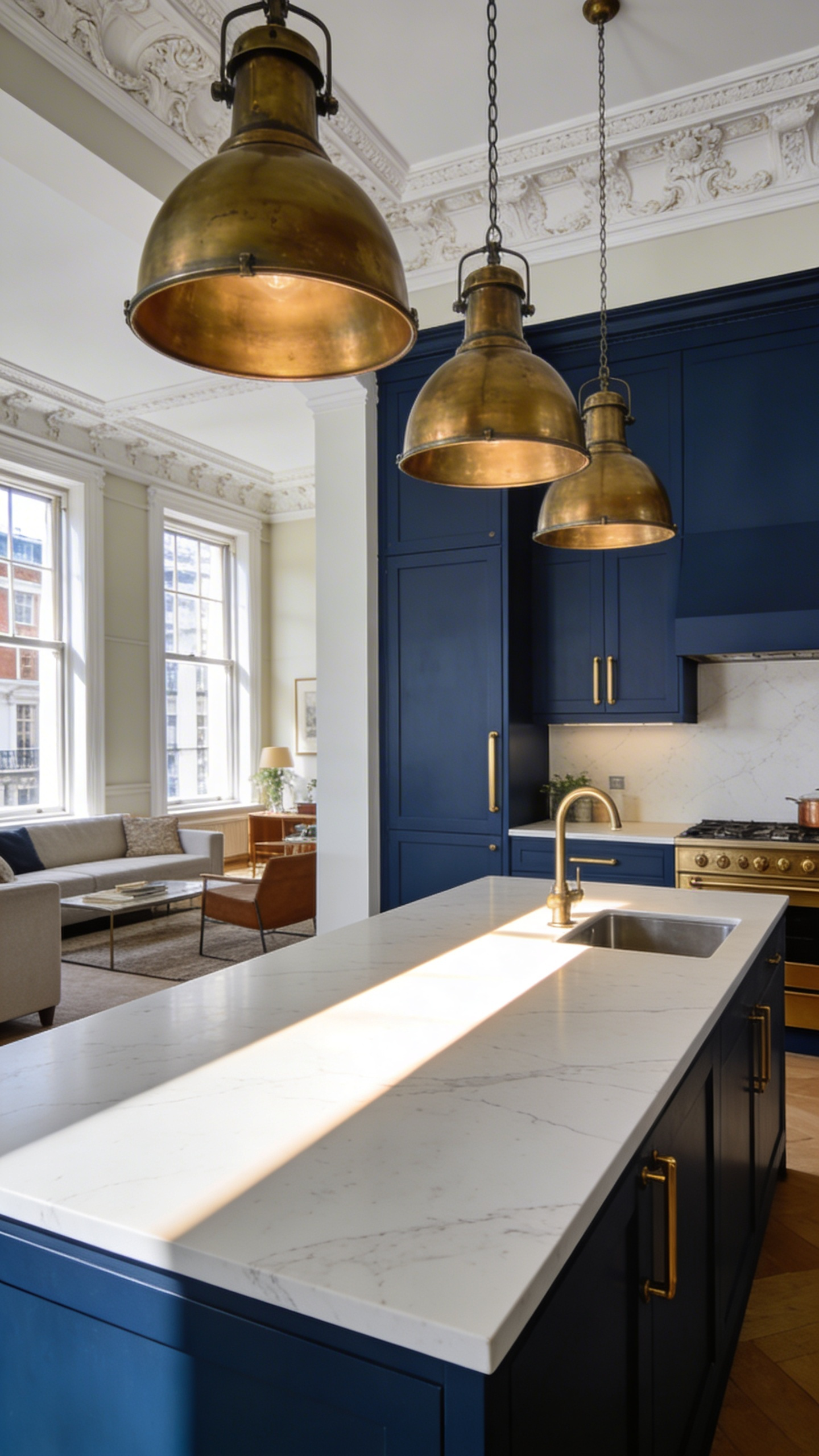
Many warehouse conversions feature surprisingly high and disproportionate ceiling heights. Therefore, extended textile cable drops draw the eye upward while bringing light to human scale. Exposed technical hardware like ceiling roses acts as luxurious architectural jewelry. In smaller urban apartments, your physical proximity to everyday fixtures makes tactile texture paramount. Indeed, living finishes like unlacquered brass or blackened steel age gracefully with daily use.
Similarly, knurled dimmer knobs effortlessly offer a deeply satisfying sensory experience. Meanwhile, exposed filament LEDs utilize beautiful smoked glass to entirely avoid stark factory aesthetics. Naturally, this creates an inviting amber glow reminiscent of classic candlelit studies. Proper spatial application also heavily demands deep respect for original architectural bones and exposed brickwork. We enthusiastically celebrate essential electrical runs by using bold surface-mounted metal conduit. Finally, sophisticated lighting systems neatly establish flexible micro-moods for highly multi-functional living spaces. Therefore, bright clinical cooking zones effortlessly fade into atmospheric evening cocktail settings.
12. The Rule of Odds: Perfecting Pendant Spacing Over the Breakfast Bar
The “Rule of Odds” provides a truly crucial psychological anchor in kitchen design. Specifically, the human brain inherently favors odd numbers. Therefore, a trio of industrial pendants beautifully prevents a split visual field. Instead, it creates a highly comforting central focal point over the breakfast bar. In fact, this middle light acts as the absolute true heart of the grouping. Indeed, it transforms a functional workspace into a traditional gathered hearth.
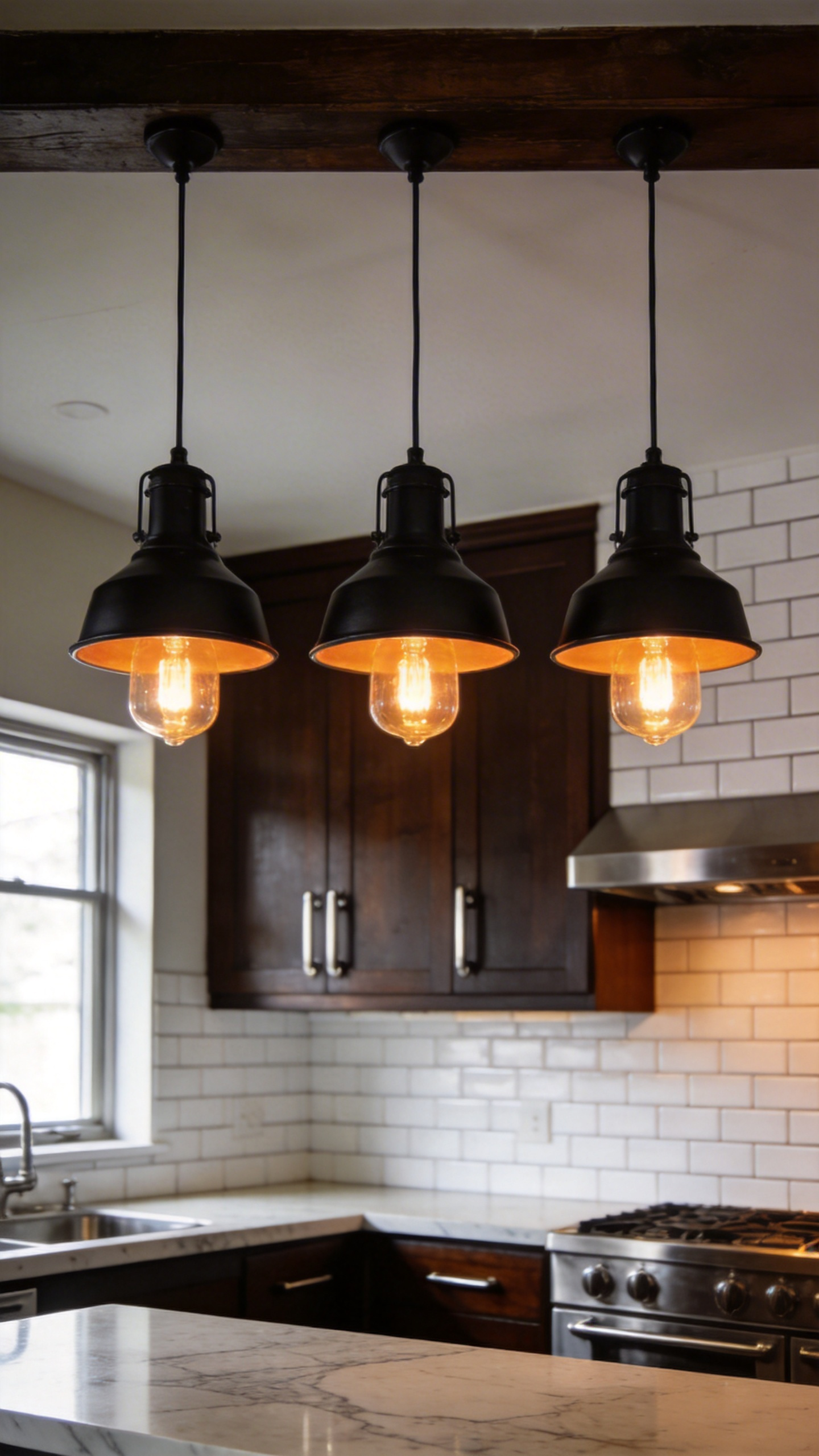
However, balancing industrial scale greatly requires careful spatial calculation. Often, factory-style zinc domes vividly possess massive physical and visual weight. Accordingly, designers must observe the strict rule of proportions. For instance, three oversized fixtures might easily clutter a standard island. In this case, dropping to two statement pieces often works much better. Alternatively, you can fully maintain the trio effect through clever styling. Simply place a large decorative vase directly beneath the central midpoint.
The negative void between fixtures also remains equally important. Usually, experts heavily recommend placing hanging pendants exactly thirty inches apart. Crucially, you must measure this exact distance from the widest shade part. Otherwise, heavy industrial textures like blackened steel might visually bleed together. Next, these overlapping pools of light gently soften harsh modern materials. Indeed, warm bulbs proudly cast an inviting amber glow across cold stone counters.
A staggered trio layout gracefully adds incredible artisanal charm. By subtly varying heights, you gently break the rigid factory line. Next, this vertical movement quickly draws the eye toward classic high ceilings. Therefore, your breakfast bar feels much less like a sterile workshop. Instead, it happily becomes a wonderfully inviting, modern social center.
13. Layering the Lumens: Balancing Ambient, Task, and Accent Lights in Industrial Spaces
Industrial lighting easily transcends the simple aesthetic of exposed bulbs. Specifically, successful design relies firmly on a carefully layered lumen approach. First, ambient lighting establishes the solid foundation of the space. Historically, this directly stems from a 1906 scientific concept called Illumineering. For instance, classic Holophane prismatic glass pendants scatter light wonderfully. Therefore, they comfortably fill high-ceilinged voids without creating harsh black holes.
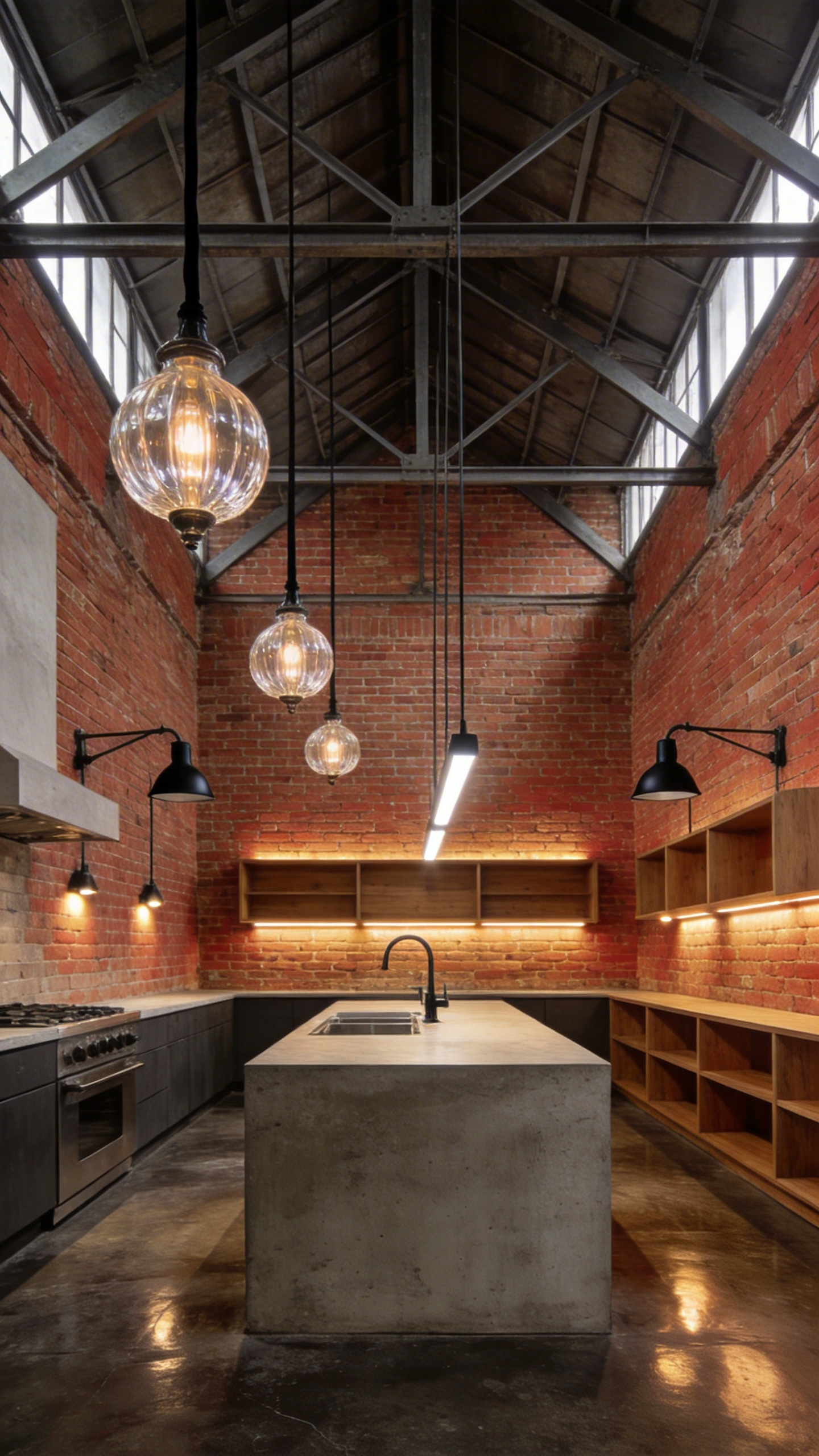
Next, task lighting strongly requires a significantly more focused lumen application. Traditionally, Benjamin enamel factory pendants boldly provided intense, downward illumination safely. Today, these opaque metal shades fiercely act as brilliant modern task lights. Therefore, they direct essential foot-candles straight onto your prep island. Hanging them mid-room cleverly creates an architectural curtain of light. Indeed, this pendant cluster forms a psychological wall in open plans.
Finally, accent lighting stylishly serves as the decorative jewelry of the room. Indeed, generic overheads easily flatten powerhouse materials like exposed brick. Instead, use adjustable gooseneck lamps to gently graze textured walls. This grazing technique brilliantly highlights microscopic valleys in rough masonry. Meanwhile, warm Edison bulbs gracefully soften raw steel and concrete. Naturally, integrating dimmers across these specific layers remains absolutely essential. Therefore, your kitchen can seamlessly transition from a bright workspace. Then, it can easily shift into an intimate entertaining atmosphere.
14. The Art of Mixed Metals: Marrying Forged Steel Lighting with Brass Cabinetry Hardware
The brilliant marriage of forged steel and brass perfectly plays on visual temperature. Specifically, metals heavily carry inherent thermal associations in modern British design. Forged steel reliably offers cool charcoal and flint-like tones. However, unlacquered brass easily provides a much-needed warm counterpoint. Therefore, an industrial kitchen light boldly acts as an architectural anchor. This heavy steel usually dominates the vertical center. Next, brass cabinet hardware flawlessly functions as visual jewelry below. Without this warm brass, the space would feel clinically cold.
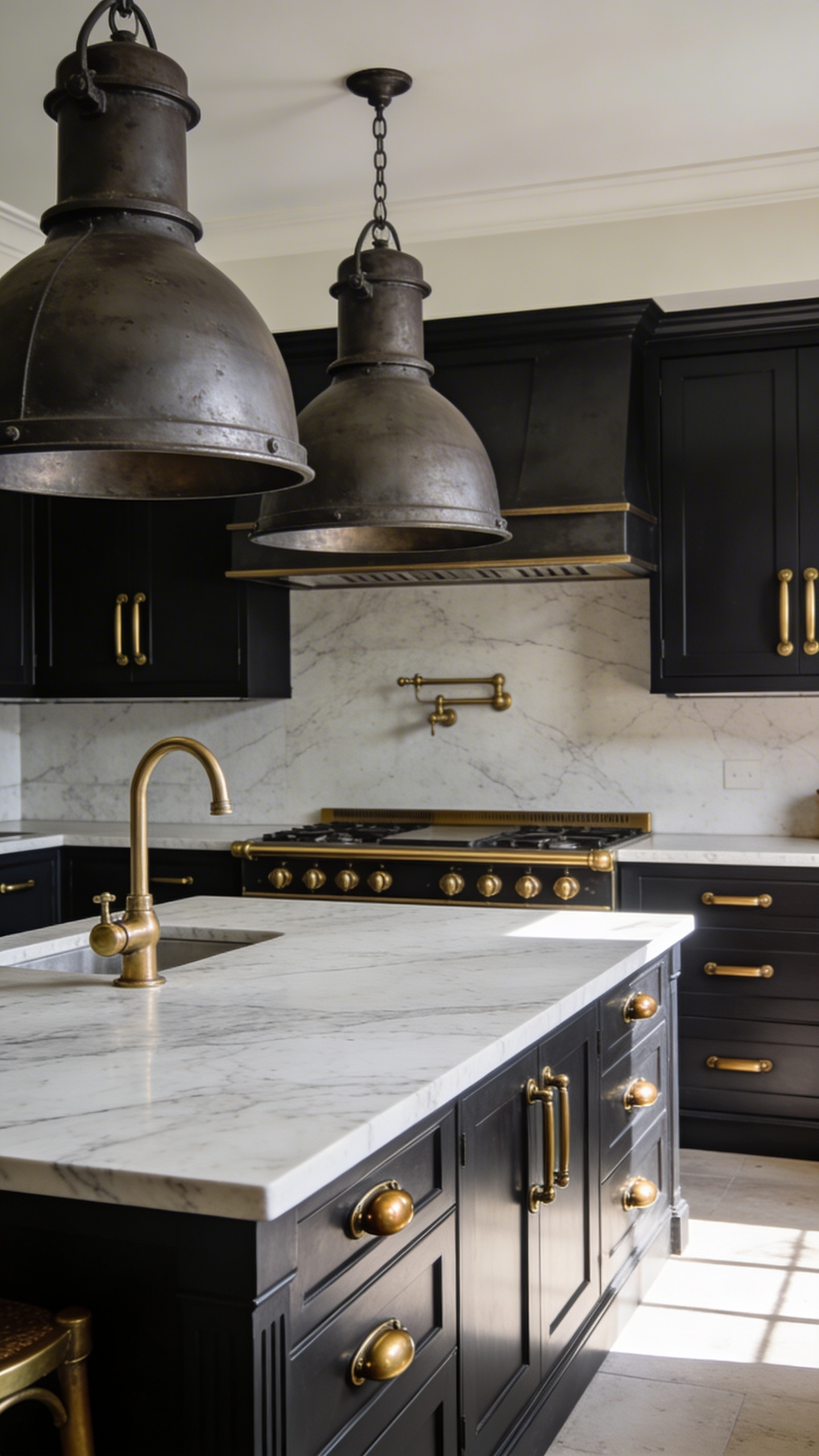
This sophisticated pairing deeply relies on tactile duality. The rough, hammered steel heavily contrasts with smooth, precision-milled brass. Historically, this perfectly mirrors the functional elegance of Victorian engine rooms. For instance, early power stations elegantly paired strong iron with brass touchpoints. Today, this historical aesthetic smoothly gives your kitchen a curated provenance. Both materials delightfully share a profound living finish narrative. Over time, steel slowly deepens into a soft, velvety matte texture. Meanwhile, atmospheric aging turns bright brass into chocolatey bronze. Therefore, the beautiful lighting and hardware simply grow together beautifully.
Finally, consider the highly strategic interplay of the glint factor. Steel pendants typically frame the extremely warm amber glow of bulbs. Below, the shiny brass handles easily catch and reflect this light. Indeed, this brilliantly creates a cohesive loop of domestic warmth.
15. Scale and Proportion: Deploying Oversized Enamel Domes for Dramatic Ceilings
Oversized enamel domes fiercely act as powerful spatial anchors in modern kitchens. Historically, their bold geometry stems from early twentieth-century RLM engineering standards. Specifically, these rigorous benchmarks originally maximized British factory worker productivity. The parabolic curves intentionally force all light directly downward. Therefore, this brilliantly creates a dramatic, stage-lit effect over a kitchen island. Meanwhile, the surrounding ceiling remains in a moody, low-key shadow.
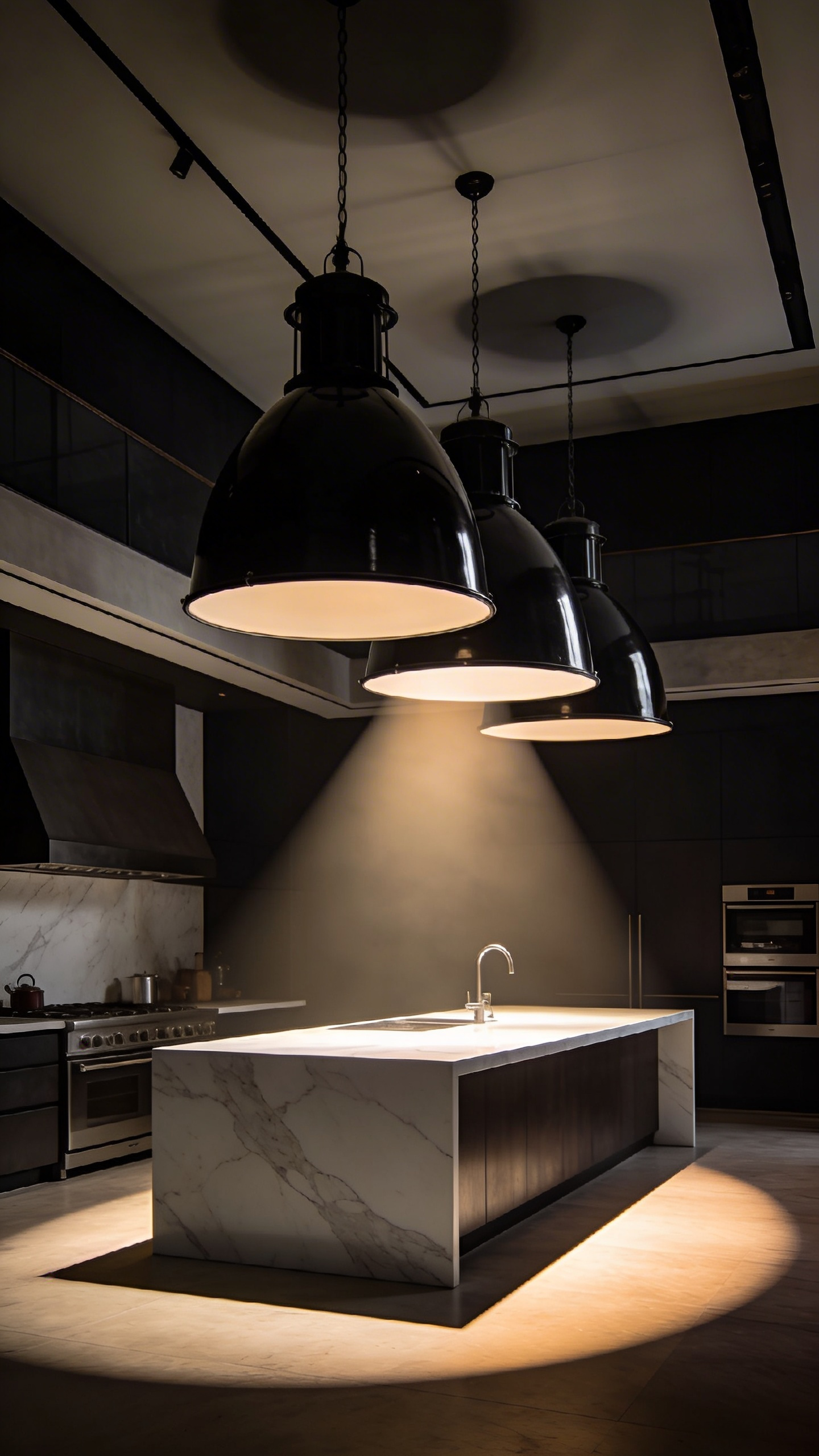
True vitreous enamel is absolutely essential for achieving this authentic industrial look. Actually, this finish deeply fuses glass silica to heavy steel at high heat. Therefore, the surface quickly achieves a deep, slightly irregular liquid texture. The stark white glass interior proudly provides intense specular reflectivity. As a result, countertop textures and culinary colors appear incredibly crisp. Heritage manufacturers like Thorlux and Benjamin Electric formally defined this iconic silhouette. Notably, their thick cast-iron necks provide immense durability and rugged provenance. Indeed, tapping these solid steel fixtures easily produces a satisfying, heavy thunk.
Naturally, deploying these functional sculptures highly requires precise attention to scale. Designers typically ensure pendants neatly occupy roughly one-third of the island length. For instance, two eighteen-inch domes gracefully anchor a large workspace beautifully. However, a single massive dome confidently commands a smaller breakfast nook. Indeed, these distinctly bold scaling choices heavily reduce visual ceiling clutter entirely.
Phase IV: Lifestyle Integration (Refined, Not Rustic)
Historically, industrial kitchen lighting relied heavily on intentional flaws. Therefore, designers once enthusiastically embraced heavy welds and faux-rust. Phase IV, however, completely rejects this loud theme-park aesthetic. Instead, London’s leading design houses now fiercely champion precision engineering. Specifically, modern homes demand machine-shop luxury over factory grit. For example, solid brass and machined steel neatly replace rough iron. Next, precision metal knurling easily provides exceptional tactile feedback. Therefore, adjusting a dimmer beautifully becomes a high-end sensory experience.
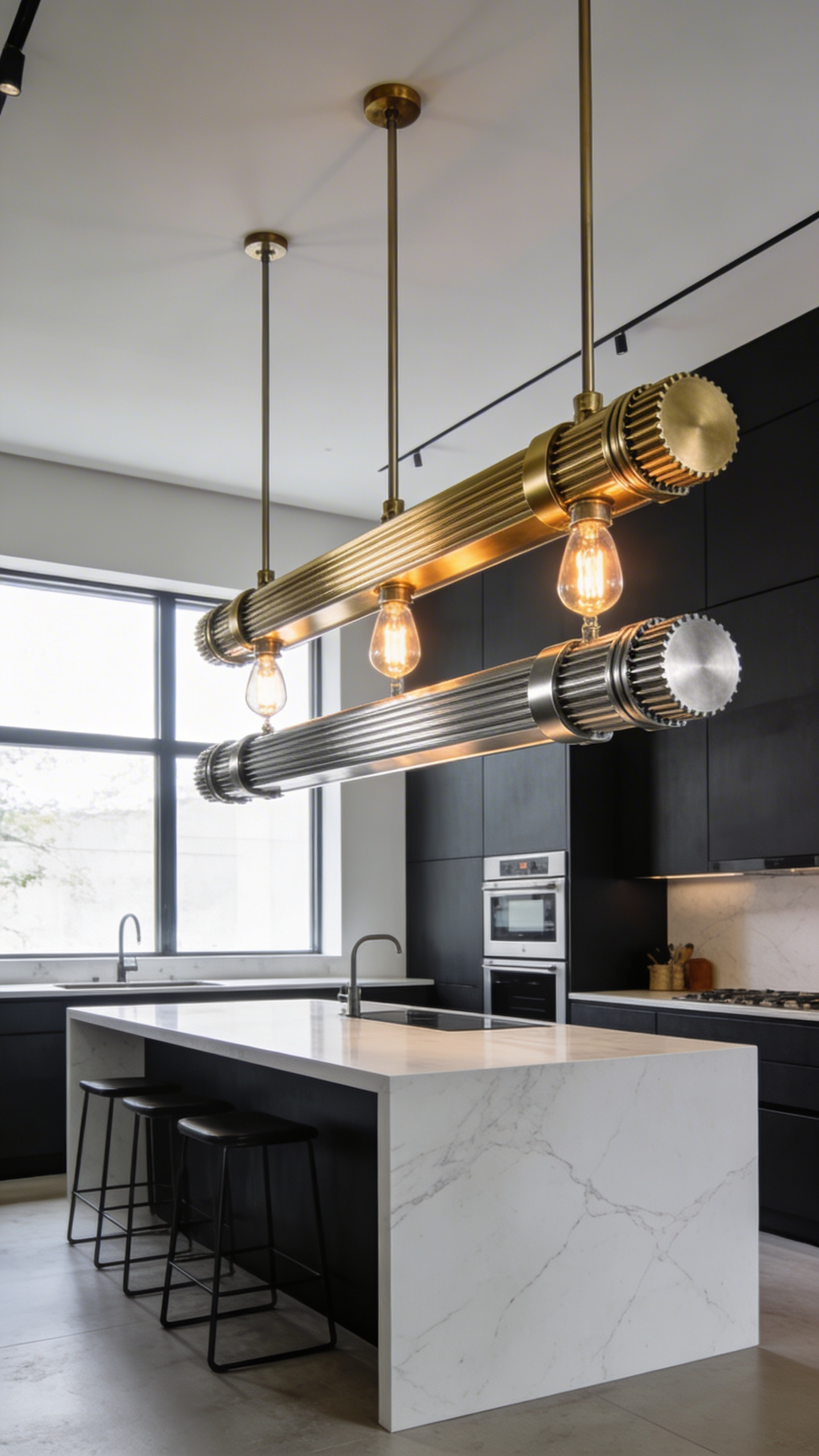
Similarly, lighting technology has dramatically evolved past cheap vintage imitations. In fact, bulky warehouse domes are now somewhat obsolete in ultra-modern spaces. Rather, miniaturized LED engines create beautifully slim, sculptural silhouettes. Therefore, these delicate fixtures deliver extremely powerful professional task lighting. Additionally, advanced smart technology smoothly hides seamlessly within refined housings.
The contemporary color palette perfectly embraces intentional warmth. For instance, hand-rubbed living patinas warmly replace cold matte black. These tactile finishes elegantly and gracefully wear in over time. Next, ribbed fresnel glass gently diffuses the emitted illumination. Therefore, the harsh blinding glare of exposed filaments entirely disappears.
Today, the modern kitchen warmly serves as a highly vital social anchor. Therefore, lighting must beautifully transition smoothly from prep to dining. Accordingly, large architectural pendants successfully act as elegant room jewellery. Refining these industrial materials proudly honors true manufacturing efficiency. Indeed, we seamlessly embrace contemporary living without losing classic British character.
16. Softening the Industrial Edge: Pairing Factory Lighting with Heritage Oak and Marble
In modern British design, thoughtfully resolving the industrial paradox is absolutely essential. Specifically, this naturally involves balancing a productive workspace with a soulful home. Therefore, designers pair utilitarian factory lighting with heritage oak and marble. Naturally, heavy metal pendants loudly represent the robust human drive for labor. However, ancient marble and slow-grown European oak perfectly provide deep biophilic grounding. Together, they instantly create a totally perfect zone of functional luxury.
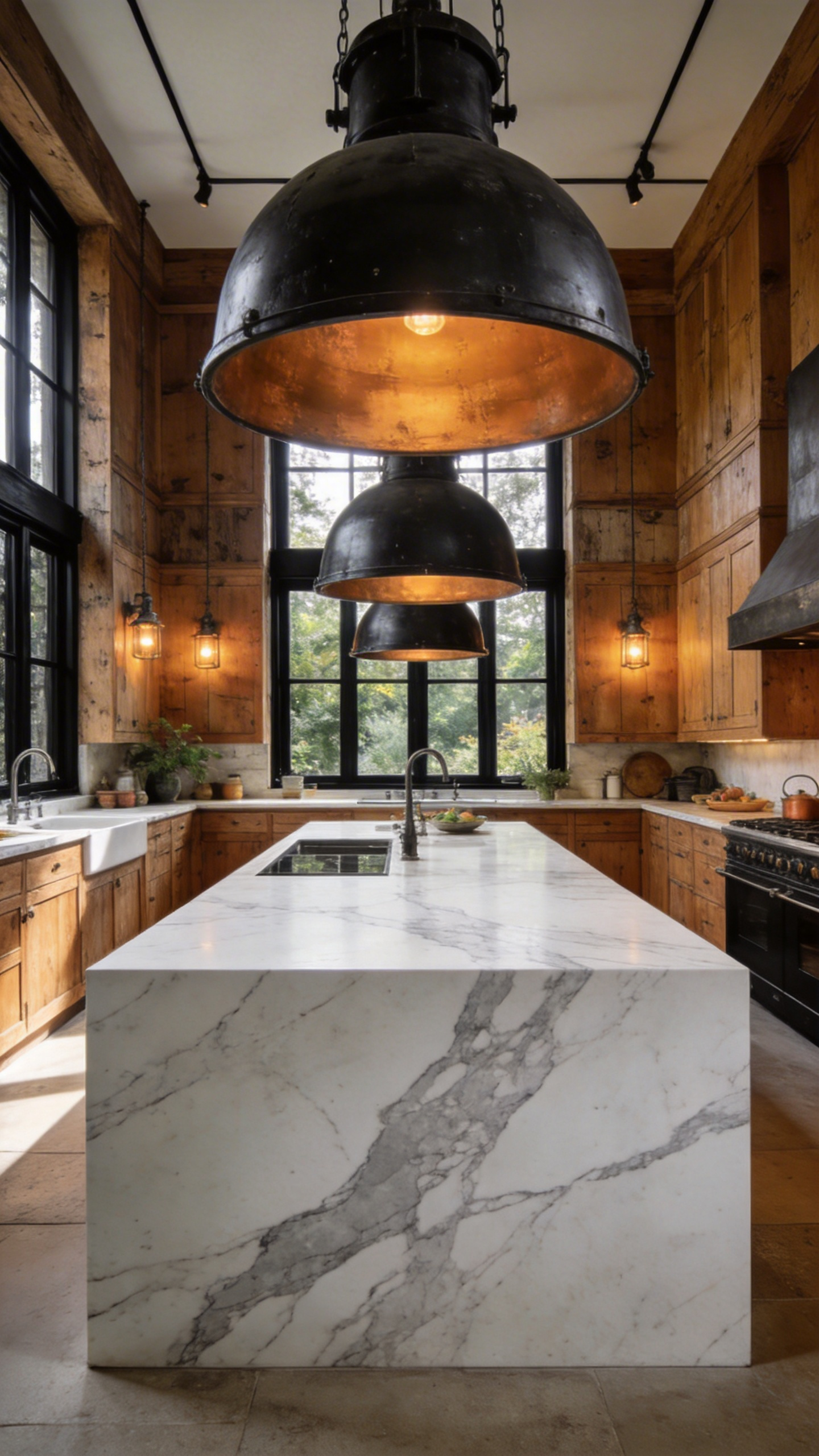
Heritage oak happily serves an incredibly important acoustic purpose. In fact, its deep cellular structure fully dampens the harsh echoes of metal. A wire-brushed oak finish proudly offers a highly pleasant tactile drag. Therefore, this contrasts beautifully with the smooth glide of polished marble.
Crucially, industrial lighting heavily dictates exactly how light hits this delicate stone. For instance, prismatic glass warmly diffuses harsh bulbs across the translucent surface. Alternatively, enamel-shaded fixtures cleanly direct light downward to graze the marble. As a result, subtle micro-shadows easily make the veining look beautifully three-dimensional.
However, mastering this precise visual balance safely requires the 3000K lighting rule. Specifically, warm bulbs easily cause the oak’s natural tannins to gently glow. Simultaneously, these warmer temperatures smoothly make the grey marble veins subtly recede. To proudly frame this, matte black fixtures heavily anchor the organic, chaotic patterns.
This intentional pairing seamlessly defines the modern heritage aesthetic. Indeed, it beautifully bridges the deep gap between utilitarian history and noble refinement. Therefore, the kitchen effortlessly remains a highly durable workspace with true high-culture status.
17. The Dimmer Switch Imperative: Taming the Edison Bulb’s Stark Illumination
The dimmer switch gracefully serves as an absolute necessity in modern industrial kitchens. Specifically, it thoroughly tames the intense glare of exposed Edison bulbs. Without control, high-lumen filaments bounce very harshly off stainless steel and polished concrete. These specular reflections easily cause immediate visual fatigue. Therefore, gently dropping the voltage entirely shifts the room’s overarching mood completely. At lower levels, the light gently grazes rough reclaimed wood instead of washing it out.
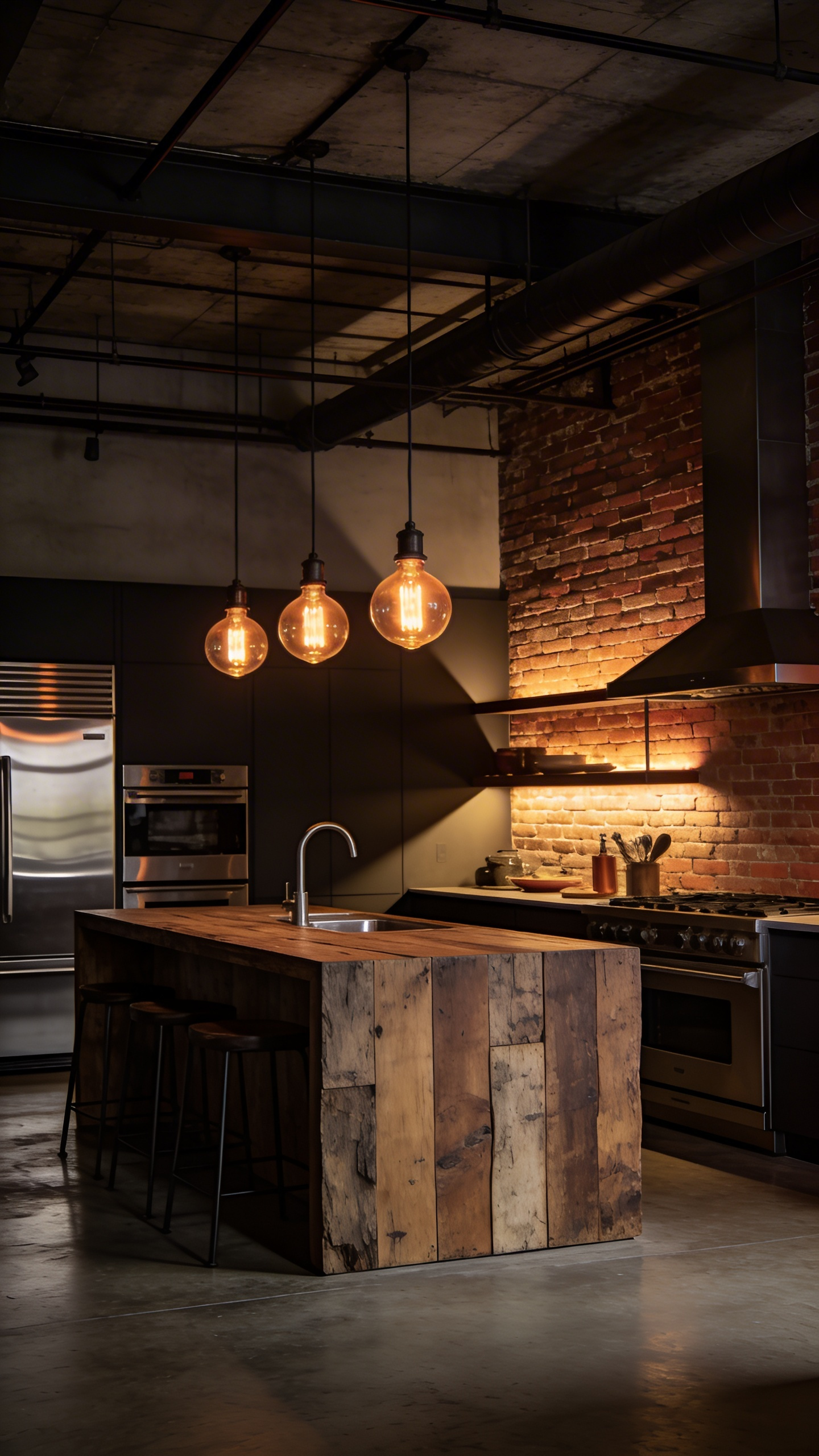
Modern warm-dim technology flawlessly mimics historical carbon-filament behavior. As you lower the brightness, it slowly shifts from a crisp 3000K to an amber 1800K. Therefore, your kitchen cleanly transitions from a clinical workspace to a moody social hub. However, deep orange light heavily distorts food colors during meal preparation. For this reason, successful British design heavily layers high-CRI under-cabinet lighting alongside dimmed Edison accents.
Dimmers excellently support the human body’s truly natural circadian rhythms in open-plan homes. By smoothly lowering island pendants, the kitchen instantly becomes a soft sculptural background element. Therefore, this entirely prevents jarring light contrasts when moving into the cozy living room. Dialing back the overall power greatly extends the bulb’s functional lifespan. Indeed, actively reducing thermal stress effortlessly protects those expensive, delicate LED filaments for years.
18. Curating Rather Than Copying: How to Emulate Loft Living Without Creating a ‘Theme Pub’
Achieving an authentic industrial kitchen heavily requires careful curation. Specifically, you must utterly avoid the dreaded “theme pub” effect. This poor design trap easily happens when a space feels like a stage set rather than a genuine home. Therefore, intentionally treat lighting as non-physical architecture instead of mere decoration. For example, large-scale pendants can visually drop the ceiling to separate a work zone from a lounge.
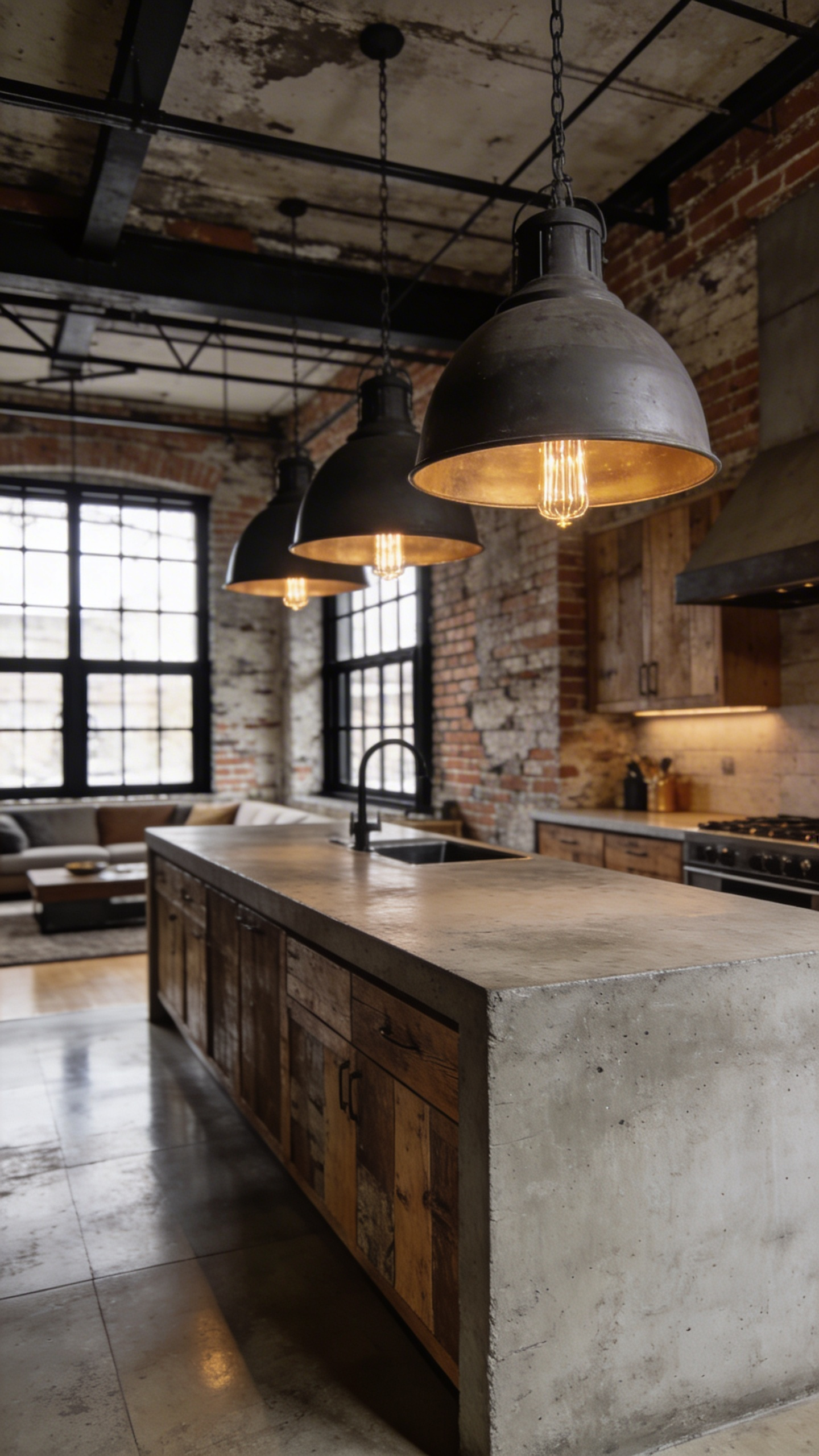
Authentic loft living heavily relies on incredible sensory depth. Many modern replicas sadly use lightweight aluminum that simply feels terribly hollow. However, historical fixtures deeply feature heavy-gauge steel elegantly finished in authentic vitreous enamel. Indeed, this glass-fused metal distinctly possesses a wonderfully deep, liquid-like luster. Therefore, genuine salvaged pieces carry a heavy gravitational presence and a cooling touch.
Next, light temperature intensely plays a highly crucial role in entirely avoiding pub cliches. Overusing deep amber Edison bulbs sadly creates a highly dysfunctional, muddy atmosphere. Instead, carefully select bright warm white bulbs resting around 2700K to 3000K. This simple choice confidently ensures your delicious food looks utterly naturally appealing.
A truly curated space brightly thrives on slow organic evolution. Early loft dwellers never bothered buying perfectly matching lighting sets. Similarly, you should confidently mix distinct eras and raw materials. For instance, successfully juxtapose a highly weathered factory pendant with a crisp marble island. This very intentional friction feels incredibly high-end and deeply sophisticated.
Next, heavily consider functional tools exactly like the classic RLM dome shade. Naturally, a heavily vented neck on these historic domes easily allows trapped heat to instantly escape. Indeed, it proudly provides a highly subtle up-light to warmly illuminate the ceiling. Therefore, you effectively avoid the depressing dark cave effect typical of overly themed spaces.
Frequently Asked Questions
What are the best materials for an industrial kitchen light in a luxury home?
For the luxury market, firmly prioritize “living finishes” like unlacquered brass, copper, and hand-forged steel. Vitreous enamel (glass-fused-to-steel) and heavy prismatic glass (Holophane) are also clear hallmarks of high-end industrial design. Indeed, they effortlessly offer extreme durability and a timeless patina that standard synthetic coatings cannot possibly replicate.
How do I choose the right size industrial kitchen light for my island?
Follow the highly reliable rule of proportions: the combined diameter of your hanging pendants should comfortably occupy roughly one-third to two-thirds of the island’s length. For a massively large grand island, oversized domes or a single linear suspension often easily create a more sophisticated architectural silhouette than using multiple small fixtures.
Can I use Edison bulbs without the harsh glare?
Yes, by seamlessly integrating a high-quality dimmer switch and carefully choosing “warm-dim” LED technology. This allows you to smoothly lower the overall intensity, effortlessly shifting the light from a functional 3000K to a soft, amber 1800K glow. Additionally, look for stylish smoked or ribbed glass shades to further warmly diffuse the point-source light.
Selecting the right industrial kitchen light is a joyful exercise in beautifully curating a distinct narrative of permanence, quality, and timeless style. By eagerly embracing deeply authentic materials and highly refined silhouettes, you beautifully transform your culinary space. Indeed, it happily becomes a perfect sanctuary of rich industrial luxury.