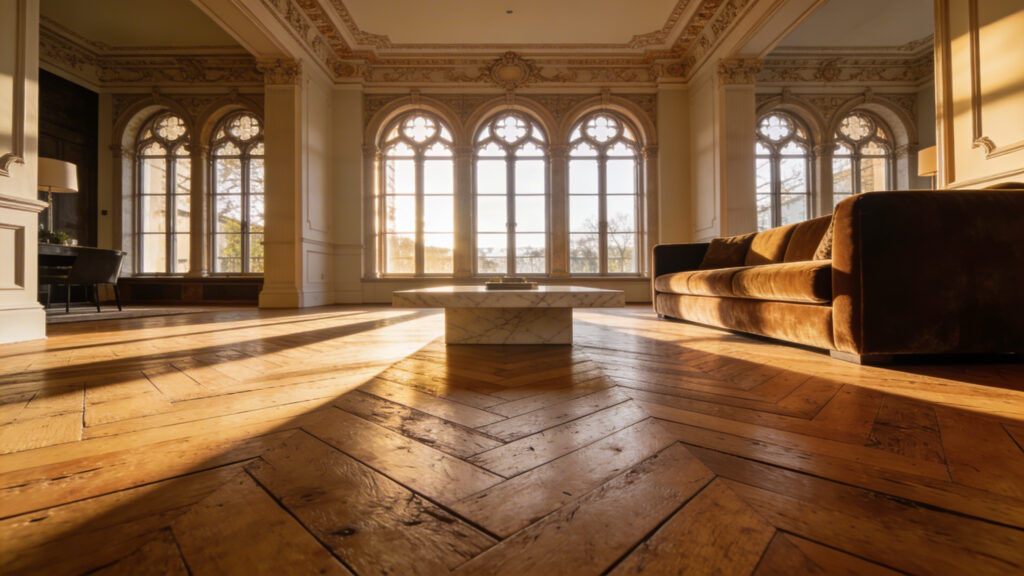
Many people assume the walls define a living room. In reality, true design begins right underfoot. Choosing your living room flooring shapes the entire feel of your home. The floor is never just a surface. It is the foundation of your space. A heritage floor brings historical weight and permanent character to a room. You can see similar principles at work in these 23 Expert Living Room Interior Design Tips. In fact, a well-chosen floor grounds a modern home perfectly.
Historically, patterns like Parquet de Versailles signaled immense social power. Today, we use these classic designs to anchor modern spaces. Genuine heritage flooring relies on materials that age beautifully. Solid European oak, for example, develops a rich patina over time. Unfilled travertine provides a wonderful, naturally textured walking surface. These historic materials offer a comforting tactile history. Indeed, their density reduces ambient noise effectively. Natural materials also satisfy our need to connect with nature. This thermal mass even helps lower the ambient stress of a noisy room.
The foundation of your space dictates its atmosphere. Previously, many homeowners ignored how living finishes impact a room’s mood. Next, we will explore the intersection of architecture and material science. This guide reveals how reclaimed timber creates visual quiet. It also helps you execute 20 Creative Living Room Layout Ideas You’ll Love. We will also look at how geometric patterns create directional flow. Finally, you will learn to blend classic tradition with modern design.
Phase I: The Heritage Foundation (Materiality & Provenance)
In high-end residential design, the living room floor is the ultimate heritage foundation. It dictates the acoustic, thermal, and visual soul of the space. A floor without provenance can feel entirely flat. Conversely, a surface rooted in history speaks directly to the architecture. We always conduct a rigorous contextual audit during the discovery period. This establishes a unique baseline for the materials.
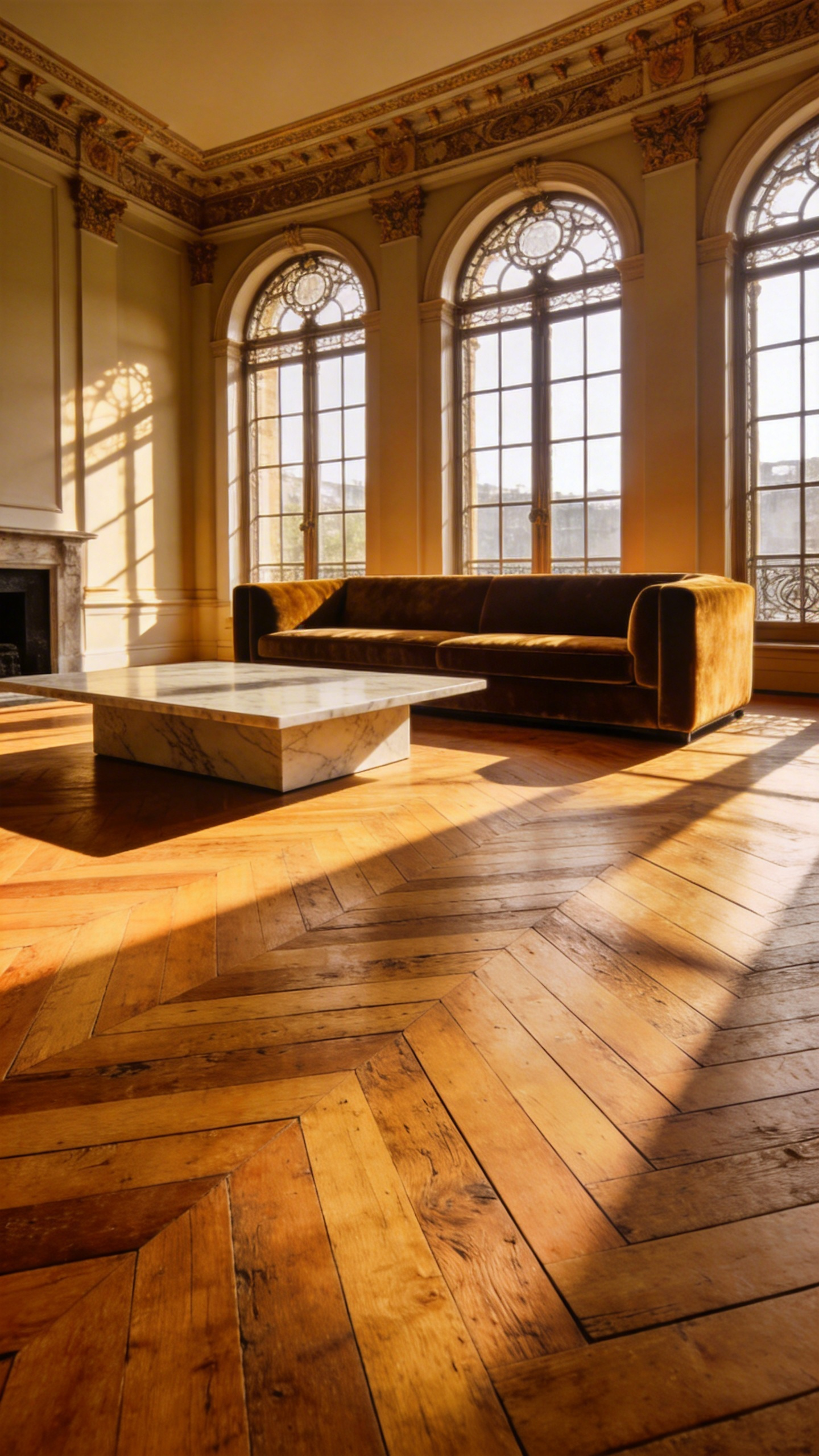
Materiality goes far beyond choosing between wood and stone. It requires a deep focus on sensory depth. A hand-planed timber edge, for instance, offers a rhythmic texture. This catches low-angled daylight to create a sense of living history. Modern machine-sanding simply cannot replicate this authentic character. We must also consider the thermal mass and finish of the material. Therefore, designers often choose traditional oxidative oils over modern polyurethanes. These natural finishes allow the ancient wood to breathe and age beautifully.
Provenance requires tracing the life story of the selected material. First-generation reclaimed oak might originate from a historic agrarian structure. Knowing your floor once supported a 19th-century Baltic warehouse elevates the room. It transforms the space from merely decorated to beautifully curated. This ties into the 19 Timeless Principles for a Living Room Interior You’ll Love. This heritage approach embraces a living finish rather than sterile perfection. Daily wear develops into a beautifully rich patina over the decades. Indeed, the floor gains enduring soul as you live on it.
1. The Enduring Legacy of Reclaimed English Oak Wide Planks
Reclaimed English oak offers far more than simple aesthetics. Choosing this wood preserves a rich piece of architectural history. During the Tudor era, builders often reclaimed ship timbers for home construction. Many wide-plank floors in historic estates originally served as naval warships. These planks feature authentic iron-staining from old hand-forged nails. This dark staining creates a beautiful map across the floor. Similarly, centuries of natural oxidation transform the wood’s deep chemistry.
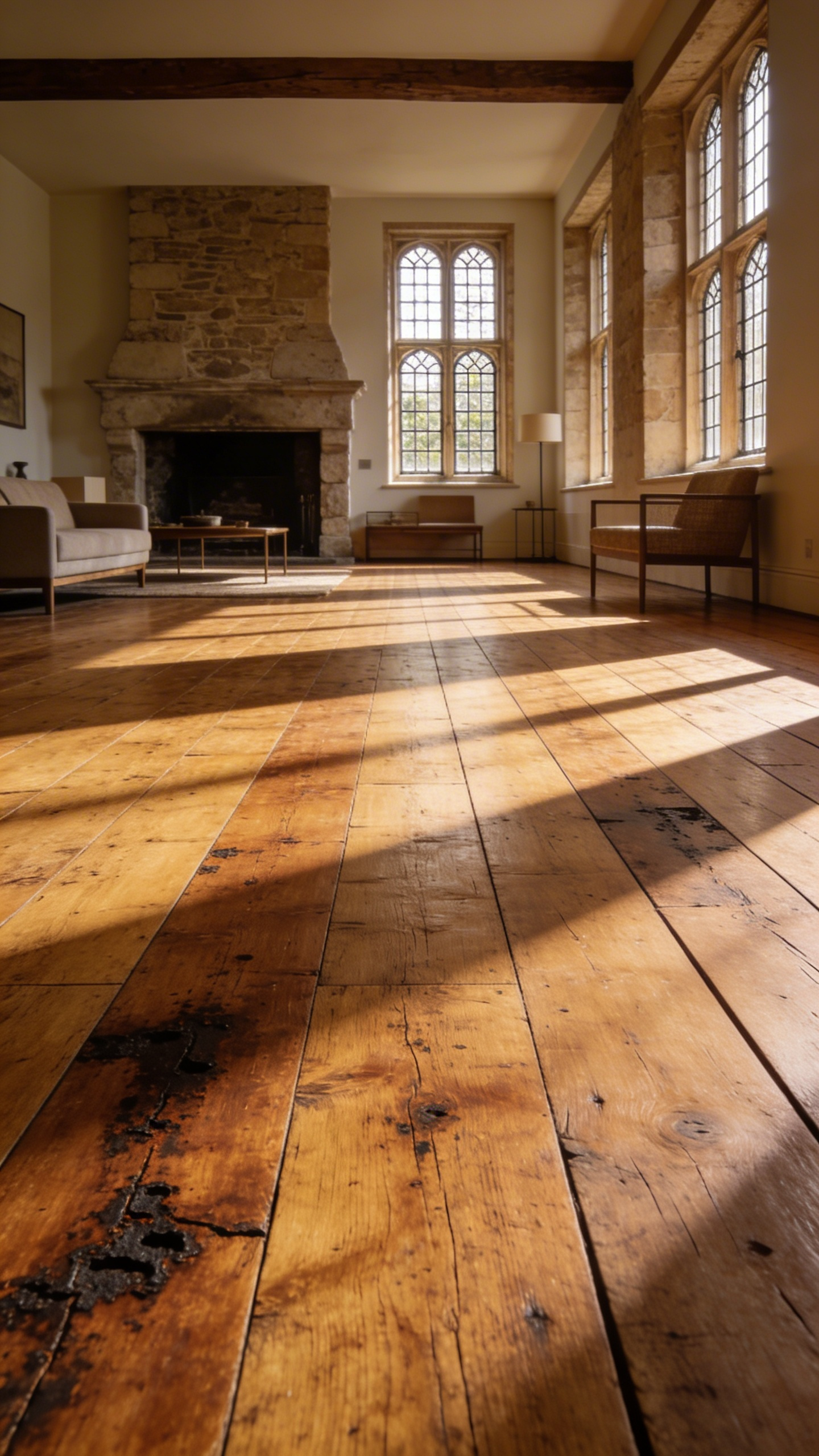
Unlike modern surface stains, this earned patina penetrates deep into the grain. Wide planks flawlessly display the shimmering flecks of medullary rays. Technically, reclaimed oak is incredibly dense from ancient, slow-growing forests. Atmospheric seasoning makes these planks exceptionally stable today. In fact, they actively resist warping from modern central heating.
Thick aged oak also acts as a natural acoustic sink. Its irregular cellular structure absorbs high-frequency room echoes. Therefore, the wide boards provide a grounded, quiet luxury. Authentic wood offers profound sensory benefits as well. The faint, tannic scent creates a comforting atmosphere. Physically, the hand-hewn surface feels incredible under bare feet. This sensory grounding naturally lowers stress in a modern home.
2. Manor House Geometry: Herringbone vs. Chevron Parquet Masterclasses
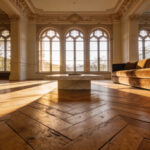
Choosing between herringbone and chevron dictates a room’s visual narrative. Master installers always begin with the Crown Line. This perfectly straight reference axis builds the entire geometric pattern. A manor installation starts centrally along the room’s most important architectural vista. A chevron seam, for instance, often aligns exactly with a grand fireplace. This precise alignment draws the eye directly toward the room’s focal point.
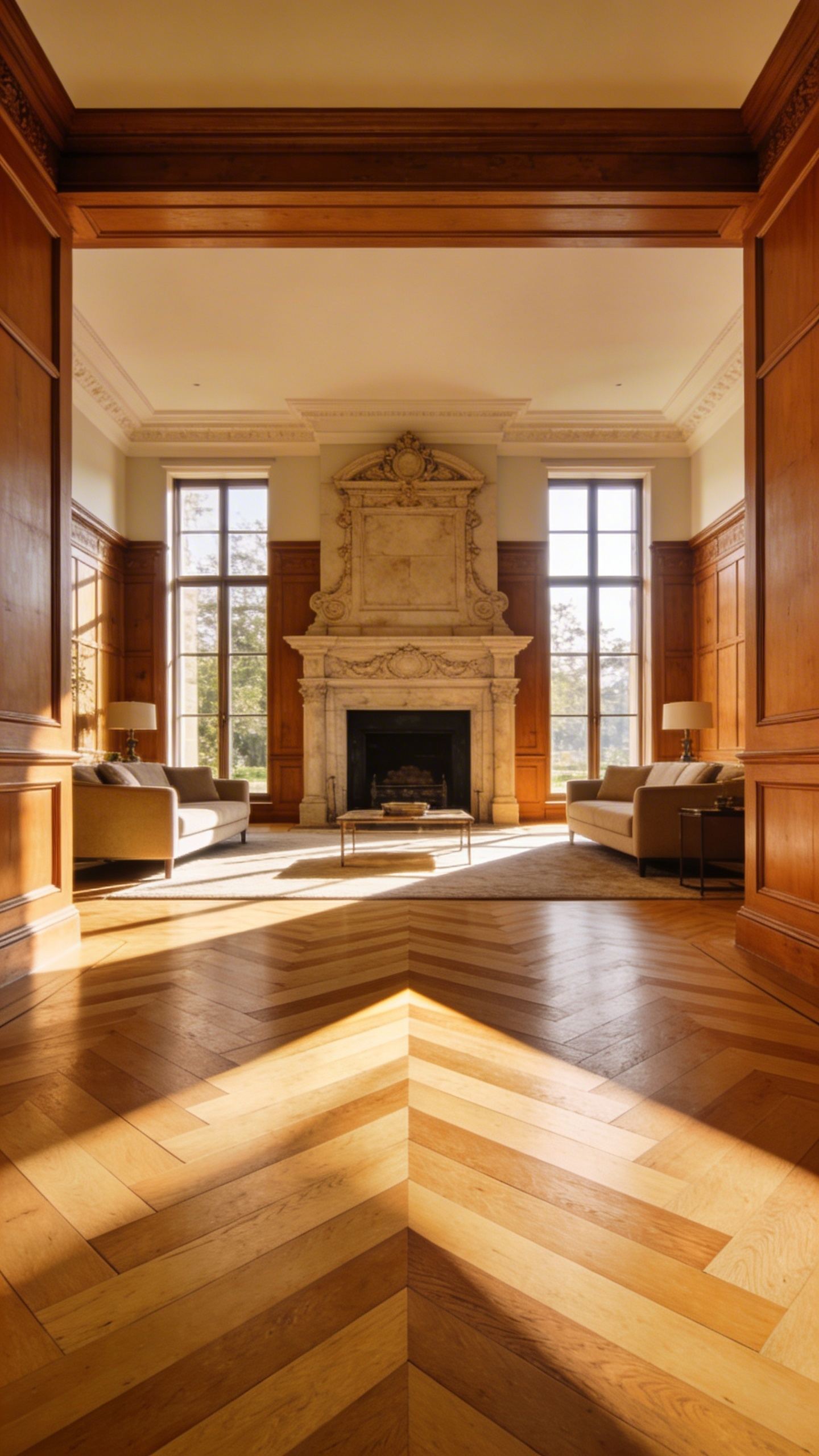
The two patterns project very different personalities into a living space. Herringbone uses overlapping rectangular planks to create a broken zigzag. Therefore, it provides a rhythmic irregularity that feels wonderfully organic. Historically, this became the warm signature of the classic English estate. Chevron features angled ends for a continuous, unbroken V-shape. Thus, it offers a disciplined symmetry deeply associated with Parisian prestige.
Beyond geometry, a true manor floor possesses a distinct acoustic signature. Gluing or nailing European oak to a stable subfloor ensures lasting permanence. This approach provides a sense of quality often found in premium Hardwood Dining Room Flooring. It creates a deep, quiet thud rather than a hollow click. The varying wood grain directions also create a captivating light dance across the boards. Using matte finishes prevents glare and highlights this textural depth. Finishing these floors with natural oils allows the wood to patina gracefully over decades.
3. Cotswold-Inspired Natural Limestone for the Contemporary Ground Floor
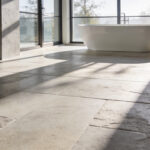
Few materials capture the essence of countryside living quite like Cotswold limestone. Its iconic honey-gold palette originates from ancient iron oxide deposits. However, authentic Cotswold stone is famously porous and soft. Modern designers often specify denser alternatives like French Dijon limestone instead. These inspired stones deliver the same historic warmth but provide greater everyday durability. Therefore, they easily withstand spills in busy, open-plan spaces.
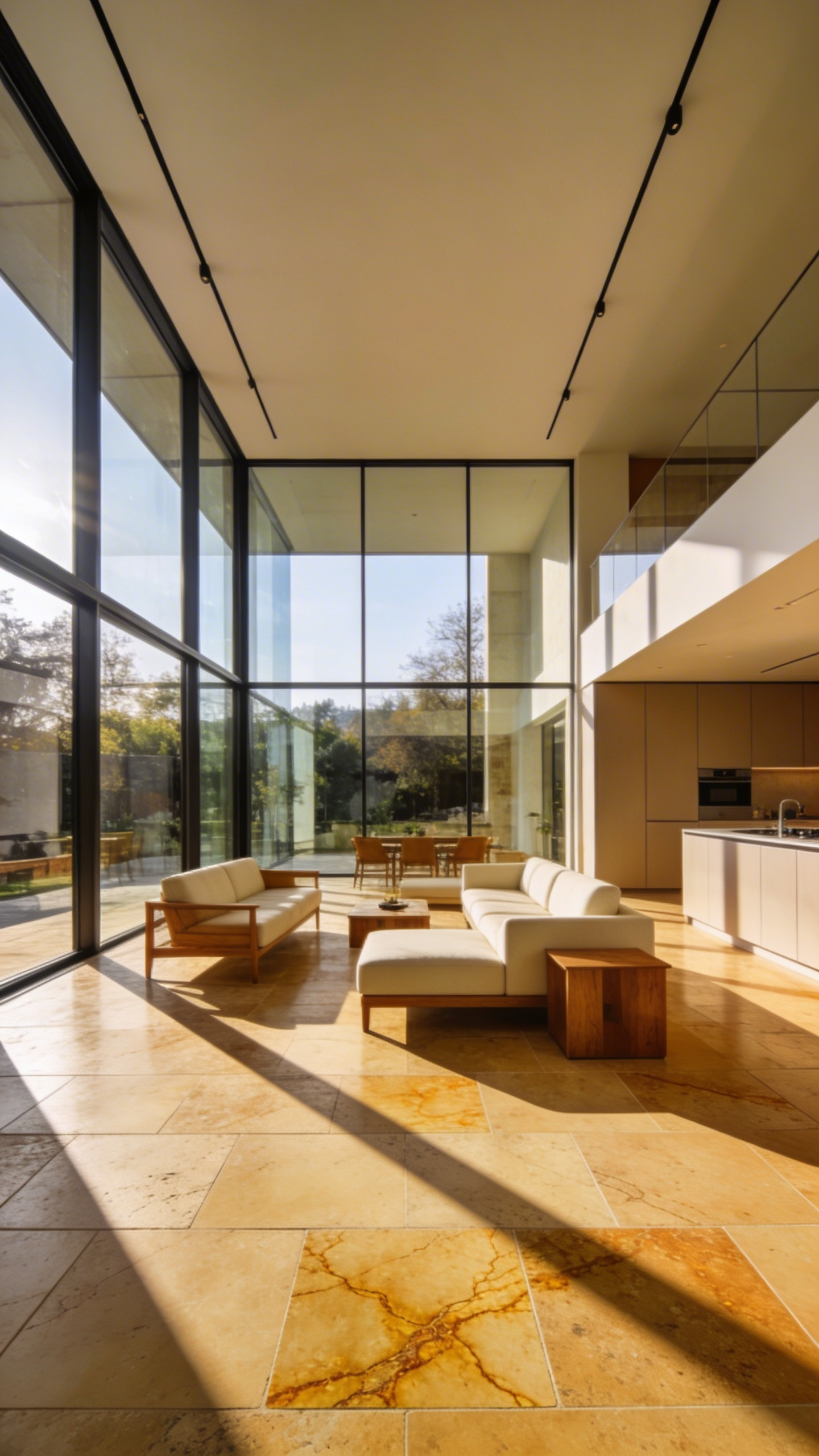
Natural limestone is also an exceptionally high-thermal-mass material. It acts as a perfect partner for modern underfloor heating systems. Indeed, the stone absorbs warmth and radiates it evenly across the room. Choosing a brushed or honed finish enhances this tactile experience. A honed finish provides a velvet-like softness under bare feet. Brushed limestone exposes fossilization to gently mask everyday micro-scratches.
Proper lighting is crucial to highlight these rich textures. Warm LEDs near 2700K amplify the stone’s golden amber undertones beautifully. Harsh blue daylight, on the other hand, can strip away this inviting warmth. Grazing wall lights illuminate the spherical grains and ancient fossil fragments perfectly. This material also excels at bridging indoor and outdoor spaces seamlessly. Designers often pair a 20mm interior tile with a frost-proof 30mm exterior version. This clever approach dissolves the architectural boundary entirely. Color-matched grout creates an unbroken, sweeping field of elegant stone.
4. The Tactile Superiority of Hand-Oiled and Matte Wood Finishes
Luxury living rooms are shifting toward sensory-rich designs. Designers are actively rejecting the plastic-wrapped floors of the twentieth century. The tactile difference between hand-oiled and lacquered wood is profound. Wood acts as a wonderful insulator with low thermal conductivity. Therefore, an oiled finish leaves the organic cellular structure open. The floor absorbs body heat slowly and feels warm underfoot. Polyurethane, in contrast, creates a synthetic plastic film. This sealed barrier feels clinically cold and traps static dust.
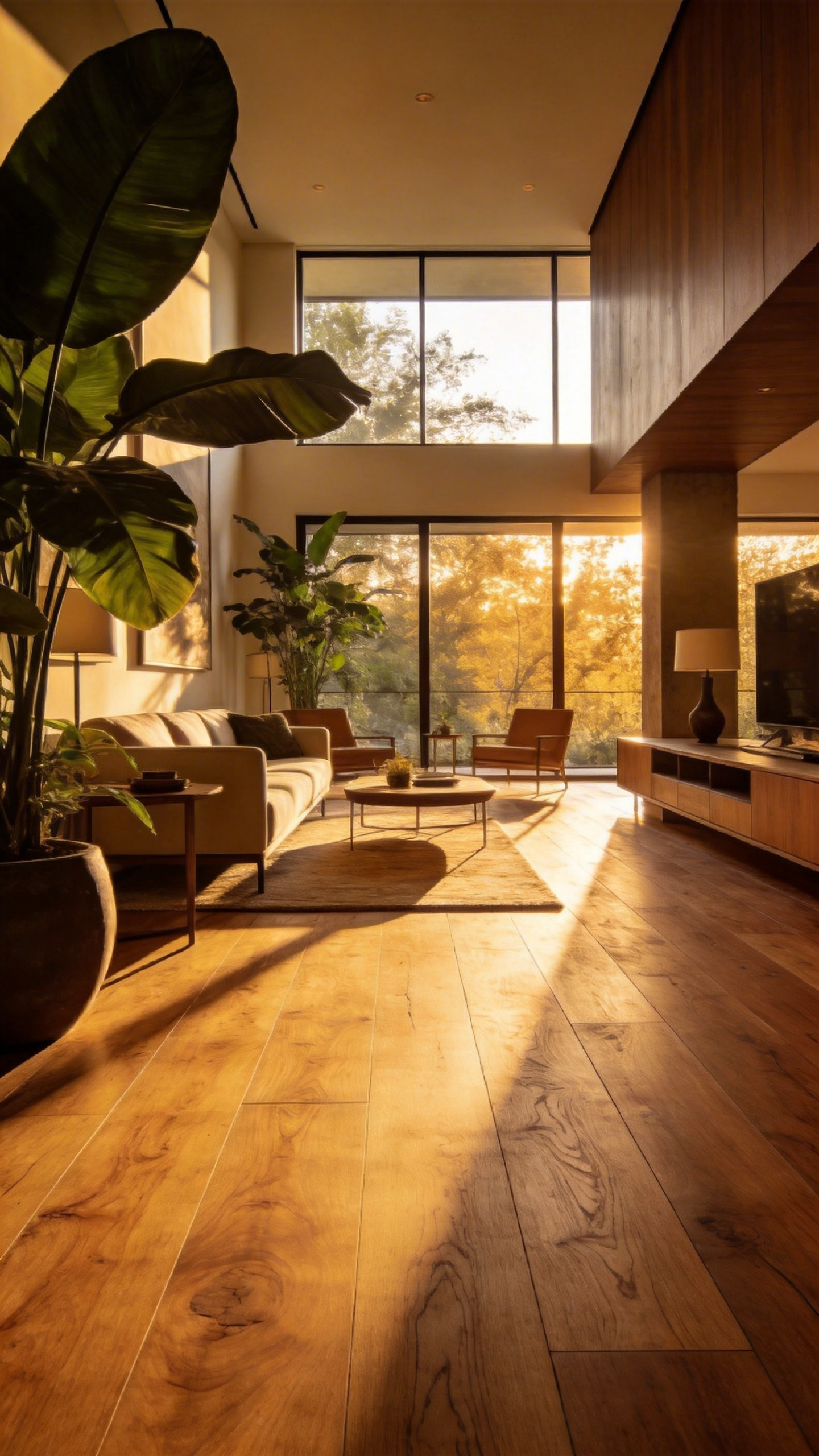
Touching natural wood grain actually triggers a deep psychological response. Environmental psychology shows this tactile contact actively lowers cortisol levels. This gentle sensory input provides a grounding effect called soft fascination. Honoring the raw material predates the industrial revolution entirely. Rubbed-wax parquet famously graced the Hall of Mirrors at Versailles. Today, hand-rubbed finishes represent a luxurious return to slow design.
Functionally, matte and oiled finishes handle daily life beautifully. Matte surfaces easily hide minor white scratches. Crucially, an oiled floor is a fully repairable system. Polyurethane acts as a sacrificial coating that eventually peels. You can simply spot-sand and re-oil a gouged oiled board. Repairing a lacquered floor requires sanding the entire room down. Oiled wood develops a rich patina that enhances the space.
5. Authentic Patina: Sourcing Timbers with Genuine Historical Character
True patina is a physical record of decades. Understanding the difference between artificially distressed and authentic wood is vital. Sourcing authentic Wormy Chestnut provides a unique historical narrative. An Asian bark fungus wiped out these trees early last century. Timber-boring beetles then carved dark-ringed galleries into the remaining wood.
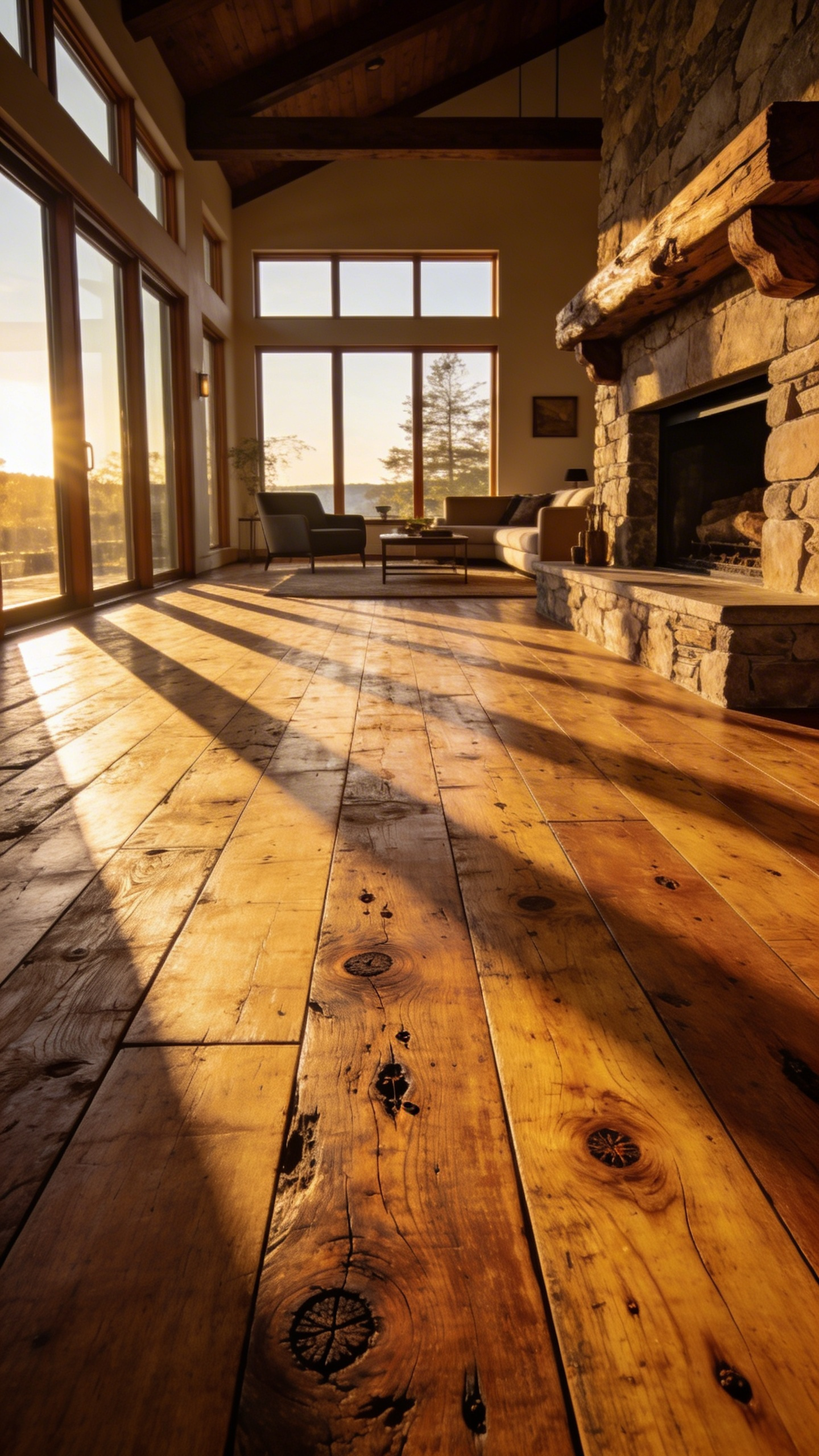
You might also consider warm Tobacco Pine for your living room. Historically, this wood cured inside towering Southern barns. Decades of extreme heat chemically altered the internal resins. It yields a rich, burnt orange color that is impossible to fake. Sinker timber offers a cooler, varied color story. Previously lost off transport rafts, these submerged logs absorbed river minerals. Therefore, vivid streaks of olive and slate gray penetrate the grain. A century underwater makes the wood incredibly dense and stable.
Authenticating these historical timbers requires a careful eye. Genuine antique nail holes feature distinct rust haloes. Original circular saw blades leave a chattered, rhythmic texture. Modern artificial distressing uses repetitive stamps and clean edges. This historical authenticity supports natural design principles beautifully. In fact, reclaimed wood boasts a lower thermal effusivity. The floor feels significantly warmer under bare feet. These old timbers often retain a faint scent biography. Together, this invisible history grounds contemporary spaces in rich tradition.
Phase II: Architectural Integration (Spatial & Structural Application)
This phase translates conceptual plans into tangible reality. Architects must decide if flooring acts as an applied finish or a structural component. Solid oak or limestone slabs become permanent parts of the building’s infrastructure. These heavy materials physically alter the vibration and solidity of every footfall. Structural integration traces back to the ancient Roman hypocaust. Today, modern designs mirror this clever heating system by utilizing a floor’s thermal mass.
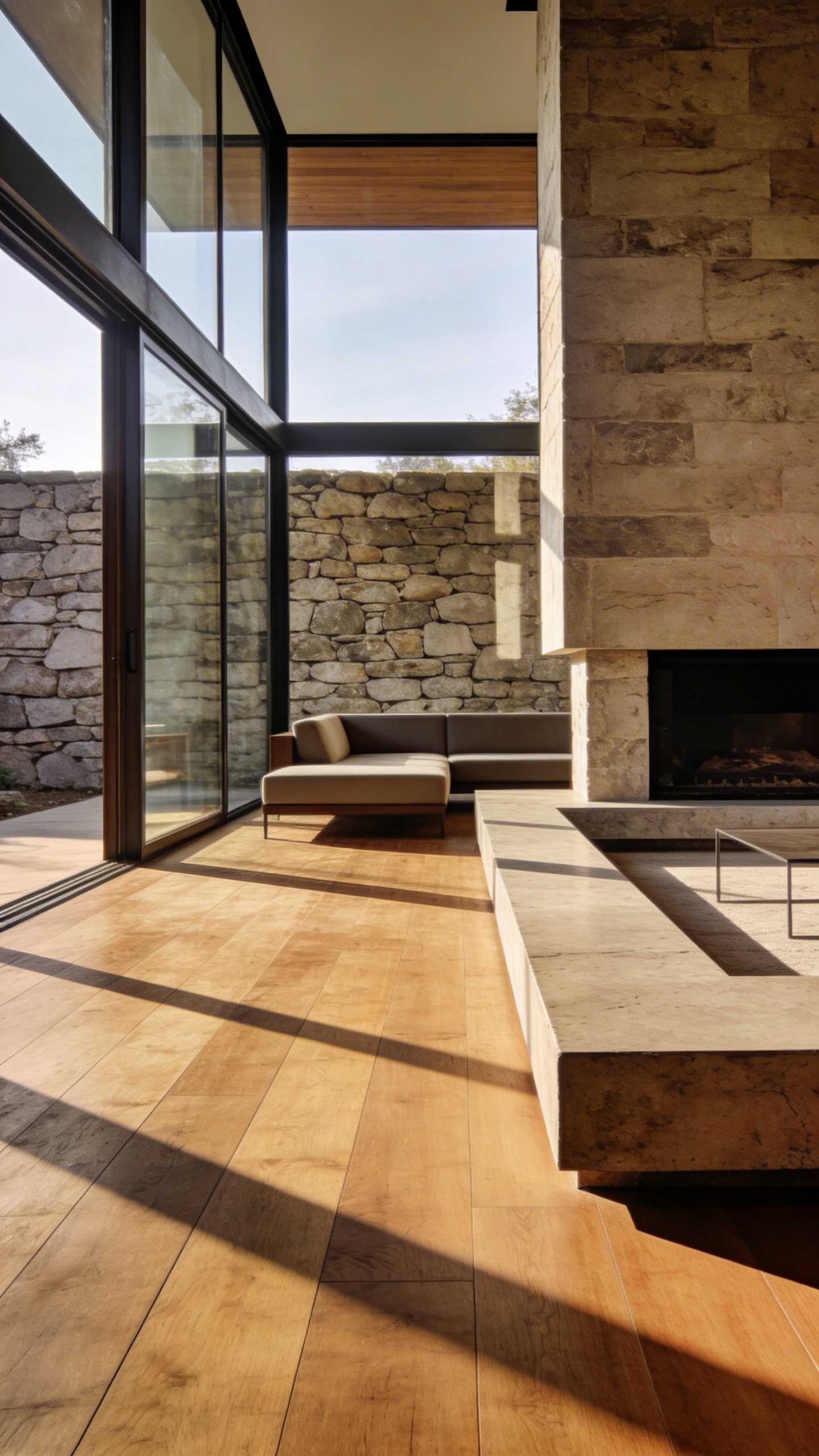
Contemporary design often relies on open-plan structural layouts. Instead of physical walls, designers create invisible boundaries through material shifts. Transitioning from polished concrete to warm timber instantly defines a living space. Vertical continuity remains vital for a cohesive aesthetic. Therefore, aligning ceiling beams with wide-plank oak naturally guides the eye across the room. Material scale also directly influences a room’s acoustic psychology. Hard surfaces often require acoustic decoupling layers beneath the floor to mitigate impact noise. Intricate herringbone parquet visually anchors a vast room with a dense texture. Large-format stone slabs reduce visual noise to make small spaces feel expansive.
Beneath the surface, the floor functions as a highly intelligent technical system. Active mechanical and electrical layers sit completely concealed. Embedded humidity sensors can trigger HVAC adjustments to prevent timber from cupping. Modern homes frequently incorporate flush-mounted service tracks into the floor’s edge. These hidden power strips allow for flexible furniture layouts without trailing cords. Treating the floor as a comprehensive structural system elevates both performance and elegance.
6. Seamless Transitions: Connecting the Living Room to Adjoining Corridors
Historically, thick thresholds created a rigid boundary between public halls and private sitting rooms. Today, modern design favors a continuous spatial flow. Contemporary living rooms often erase these heavy barriers completely. The floor appears as a single, uninterrupted plane instead. This seamless transition transforms an ordinary home into a gallery-like space.
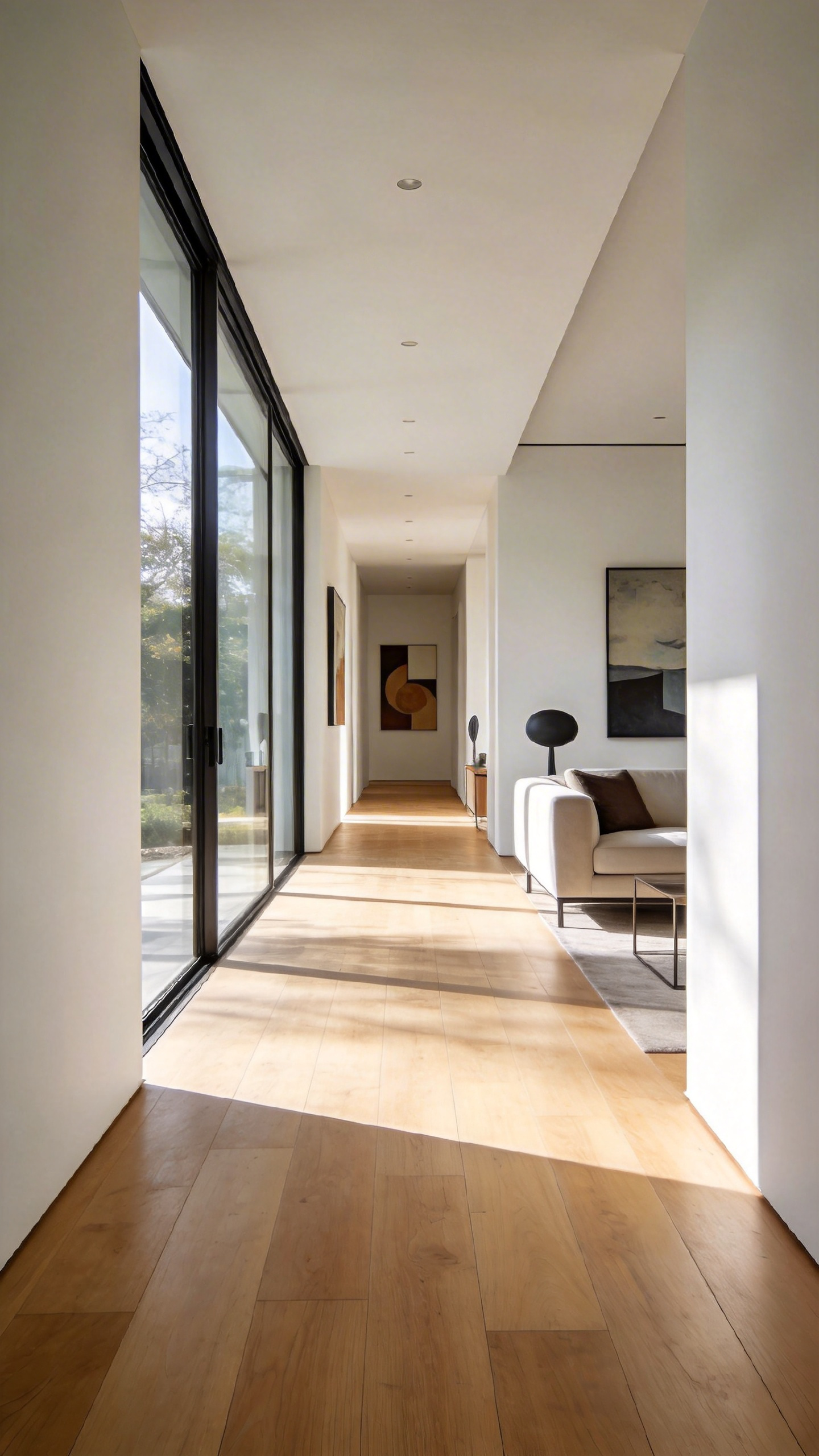
Achieving a perfectly flush transition presents physical challenges. Hardwood flooring naturally expands and contracts over time. Forcing a gap-less fit between rooms can cause severe buckling. High-traffic corridors exert significant lateral pressure on wood planks. Experts often feather the subfloor slightly to prevent this. This technique allows disparate materials to meet smoothly without bulky strips.
These transitions directly engage our senses and impact mobility. Walking from bouncy hardwood into rigid tile triggers a physical recalibration. Acoustically, continuous flooring unifies the underlying energy of the home. Shifting to hallway carpet creates a sonic muffler for private zones. Most importantly, seamless universal design eliminates dangerous toe-catching hazards. Even a half-inch height difference disrupts natural movement. Skilled installers now utilize gradual ramped subfloors. The risk of tripping is virtually eliminated for everyone.
Your plank layout acts as a silent cartographer. Running floorboards lengthwise creates a striking runway effect. This draws the eye forward to elongate shorter adjoining corridors. Alternatively, introducing a herringbone break beautifully defines a new zone. It creates a distinct visual threshold while remaining physically seamless.
7. The Mathematics of Proportion: Scaling Plank Widths to Room Dimensions
Flooring proportion is more than a simple square footage calculation. It involves the careful study of visual frequency. The ratio between seam numbers and total surface area matters. Narrow Victorian planks create a high-frequency visual hum. Therefore, these smaller boards provide a traditional, energetic rhythm. Wide planks significantly reduce this visual noise. Expansive open-concept rooms feel much calmer as a result.
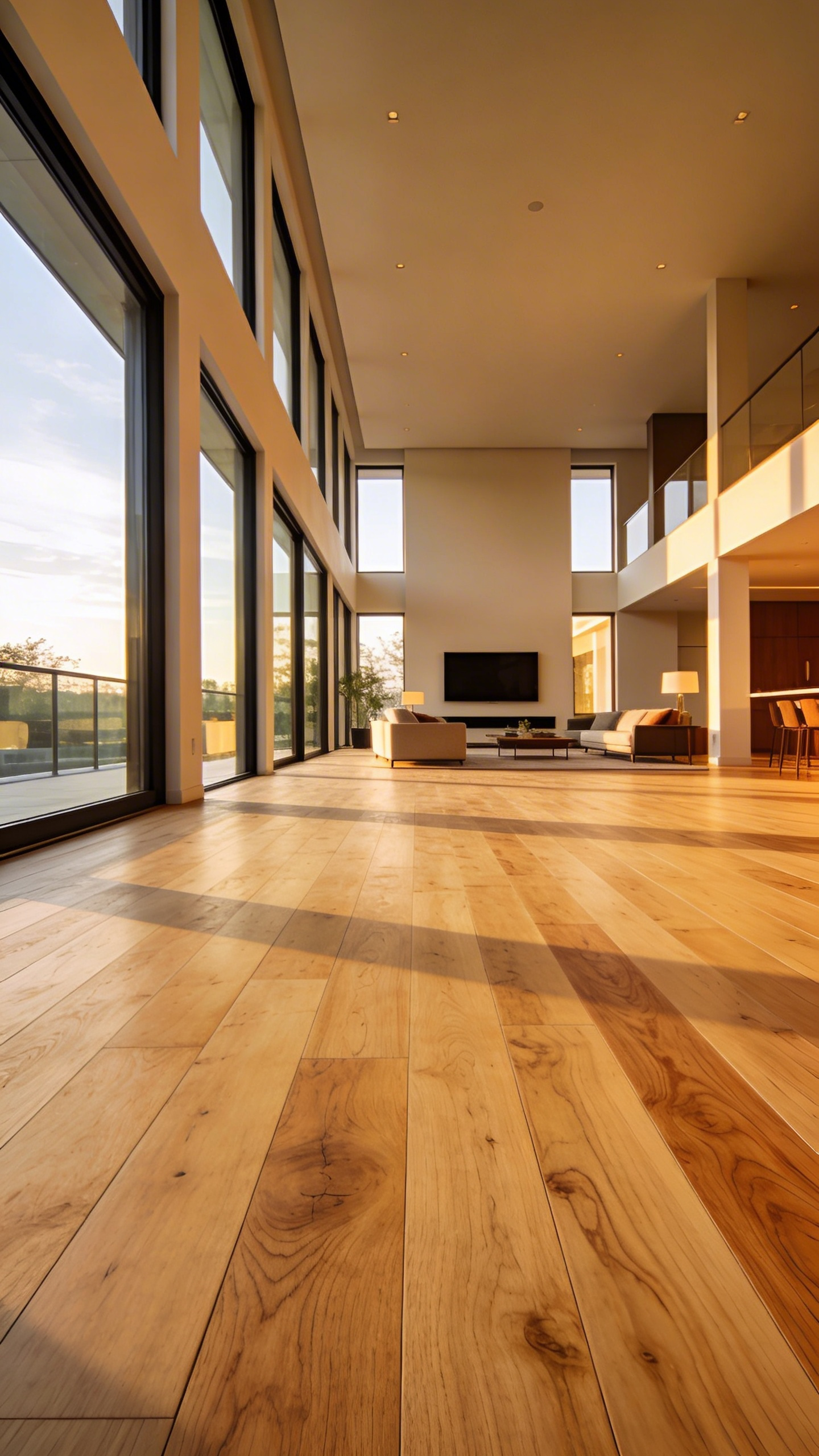
Designers often apply the Golden Ratio to achieve harmony. About sixty percent of the floor should be covered by furniture. The remaining forty percent becomes exposed negative space. Narrow strips appear underscaled for rooms wider than twenty feet. Extra-wide planks match the larger spatial volume perfectly. Wide boards also preserve the sweeping cathedral patterns of wood. This unbroken organic grain grounds the room beautifully.
Plank orientation acts as a clever mathematical correction tool. Installing wide planks perpendicularly visually widens narrow rooms. Running narrow boards parallel adds depth to squat spaces. Early homes originally used wide planks purely out of necessity. Today, we purposely mix various widths in the same room. This curated randomness blends historical charm with modern luxury.
8. Marquetry and Borders: Defining Intimate Zones in Open-Plan Flats
The use of marquetry transcends simple decoration in modern homes. Inlaid veneers miniaturized grand landscapes on traditional furniture historically. Eventually, this craft transitioned to elegant parquet flooring. These wood borders act as sophisticated invisible architecture today. They carve out intimate zones within airy, open-plan flats. Expansive rooms often lack a sense of psychological refuge. Therefore, a decorative floor border creates a necessary safe harbor. It prevents your contemporary furniture from floating aimlessly. The patterned wood grounds your central seating group perfectly.
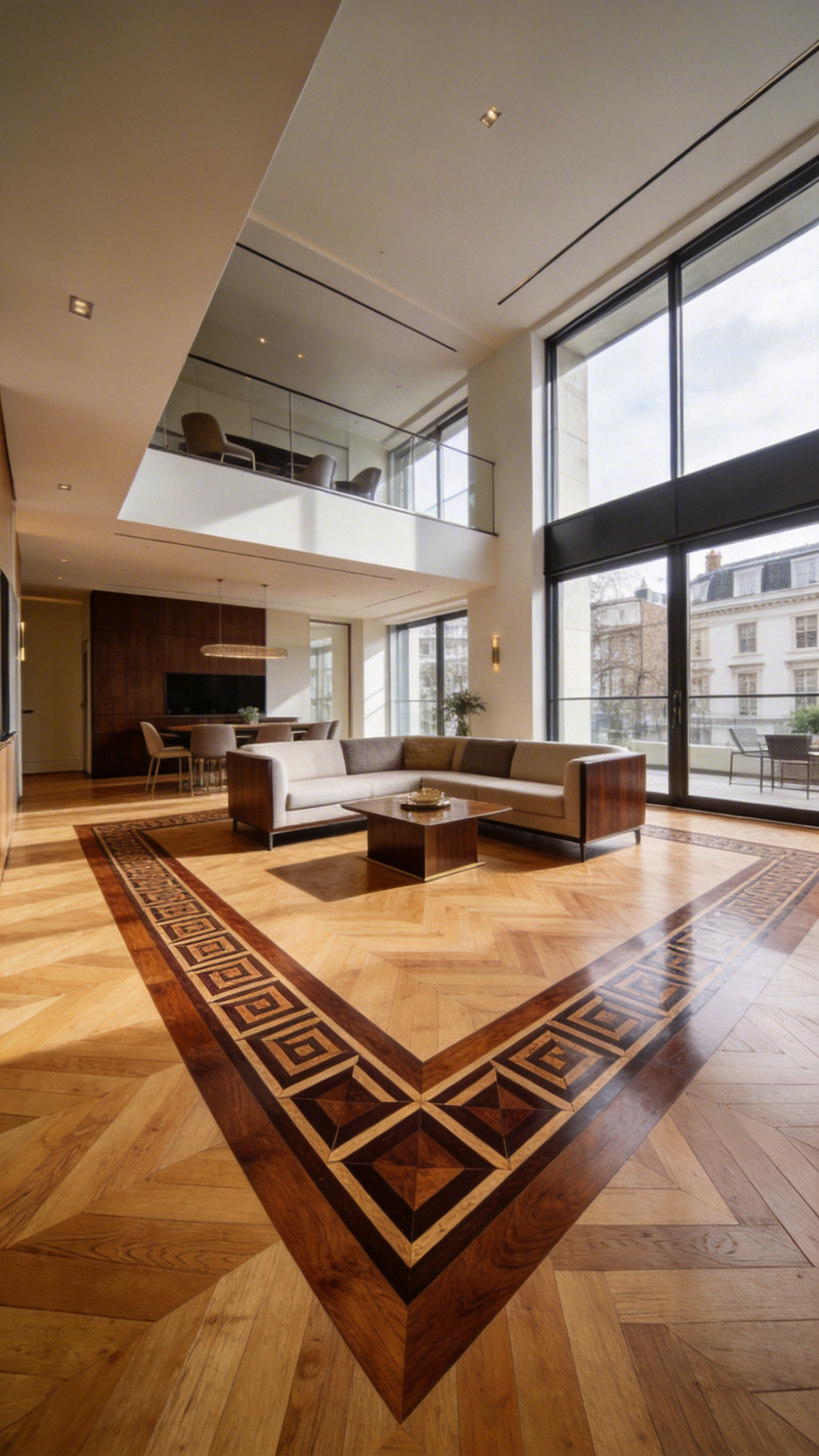
Layered marquetry structures also act as clever acoustic dampeners. This layering breaks up harsh sound reflections effortlessly. Your bordered living area becomes a quiet conversational cocoon. Crossing this flush threshold triggers a calming tactile response. Subconsciously, your nervous system registers arrival into a sanctuary.
Achieving this flawless effect required months of hand-tooling traditionally. Modern design houses now embrace precise computer-controlled cutting techniques. Craftsmen can embed brass into wood with zero-tolerance gaps. Some experts debate the risk of visual floor fragmentation. However, the most successful intimate zones rely on tonal borders. Changing grain direction with matching wood species works beautifully. The layout maintains flow while providing distinct psychological boundaries.
9. Acoustic Harmony: Premium Underlayment Strategies for London Townhouses
Acoustic harmony remains the invisible hallmark of luxury across heritage properties. Victorian and Edwardian townhouses present a unique sonic challenge due to their suspended timber floors. These massive hollow cavities act exactly like a giant acoustic drum. Achieving true quiet requires structural decoupling rather than basic foam rolls. First, specialized acoustic joist caps effectively break the mechanical bridge beneath your floorboards. Perimeter flanking strips prevent sound from climbing up the historic masonry walls.
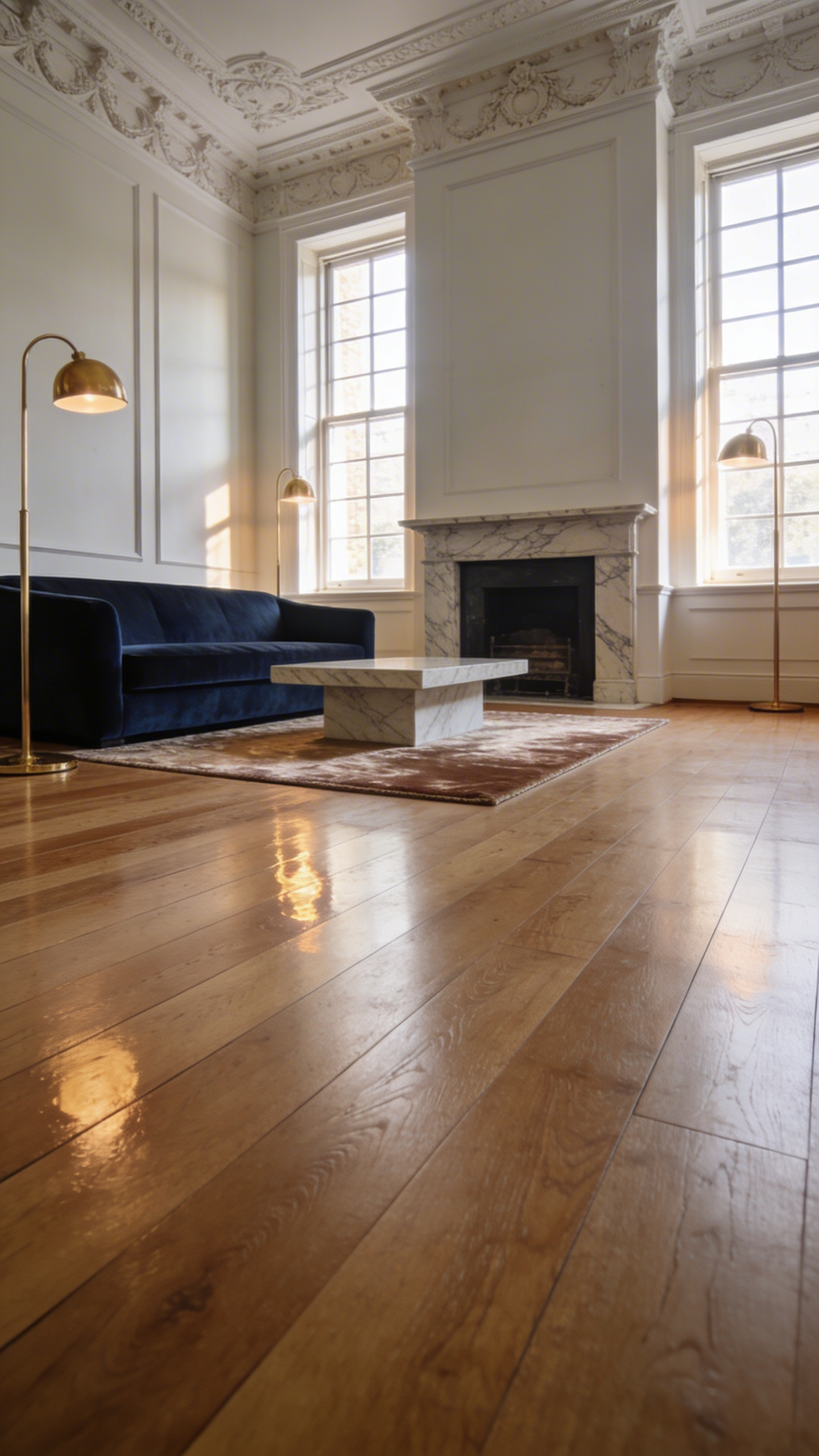
Historic buildings present a strict low-profile constraint for contemporary designers. You cannot simply add thick insulation without ruining original skirting boards and doors. High-density recycled rubber provides an elegant, highly effective compromise. These slim membranes reduce impact sound by up to 54dB while remaining just 3mm thick.
Preserving 150-year-old timber demands absolute material breathability. Standard non-porous acoustic foams inevitably trap moisture and invite devastating dry rot. Natural cork-rubber blends offer a remarkably safe and historically sympathetic alternative. They allow the antique skeleton of the house to breathe naturally.
This careful material sandwich dramatically shifts the sensory experience of the space. The sharp, clicky echo of modern living vanishes. Instead, you enjoy a beautifully muted footfall that physically grounds the entire room. This engineered silence captures the true essence of quiet luxury.
10. The Modern Hearth: Engineering Floors for Invisible Underfloor Heating
The traditional hearth has quietly transformed. Modern living rooms now rely on invisible warmth. Underfloor heating turns the floor into a thermal engine. Solid oak defined classic flooring historically. However, solid wood breathes and warps under constant heat. Engineered hardwood has become the industry standard as a result. Its cross-ply core resists warping beautifully. It allows radiant heat to penetrate the real wood veneer.
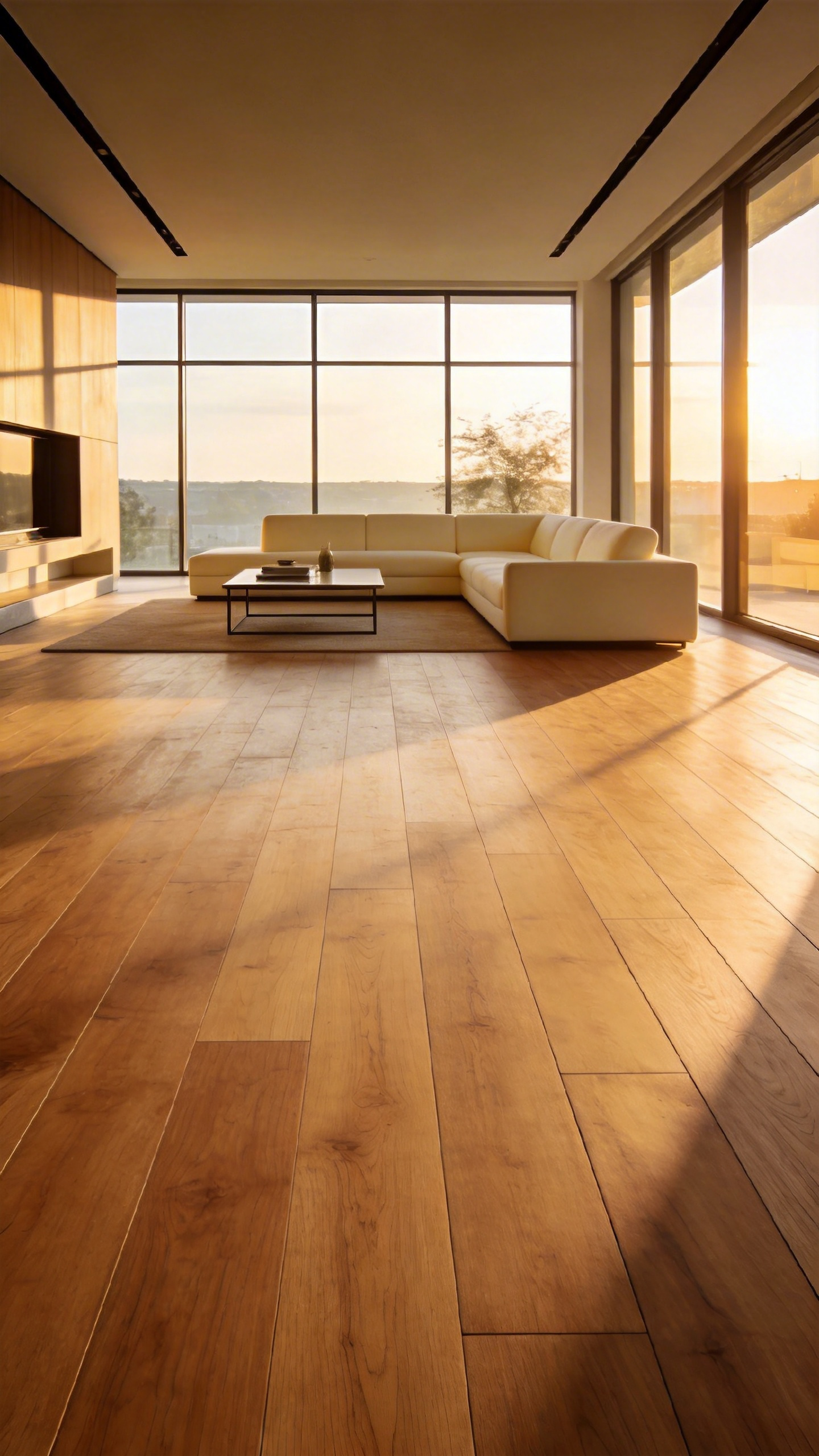
Experts recommend a total board thickness of 15mm. Anything thicker creates a frustrating thermal lag. Thinner boards cannot be sanded or refinished later. Engineering this invisible hearth requires careful calculations. Combined thermal resistance must stay below 2.5 Tog. Otherwise, heat remains trapped beneath your elegant rugs.
Smart sensors rest deep within the adhesive layer. They cap the surface temperature at exactly 27 degrees Celsius. Your engineered floor retains its structural moisture perfectly. Beneath the wood, liquid screeds wrap tightly around hydronic pipes. They eliminate insulating air pockets for faster heat transfer. However, they demand significantly longer drying times during renovations.
This silent system democratizes your living space completely. You can arrange furniture freely without bulky radiators. The absence of convection currents drastically reduces airborne dust. The contemporary floor offers a truly pristine, barefoot luxury.
Phase III: The Curated Layering (Textile & Light Interaction)
The final refinement transitions a space from functional to beautifully lived-in. The floor acts as an active, primary reflective plane. Therefore, we must consider the light reflectance value of our textiles. Layering a pale jute rug increases perceived room brightness significantly.
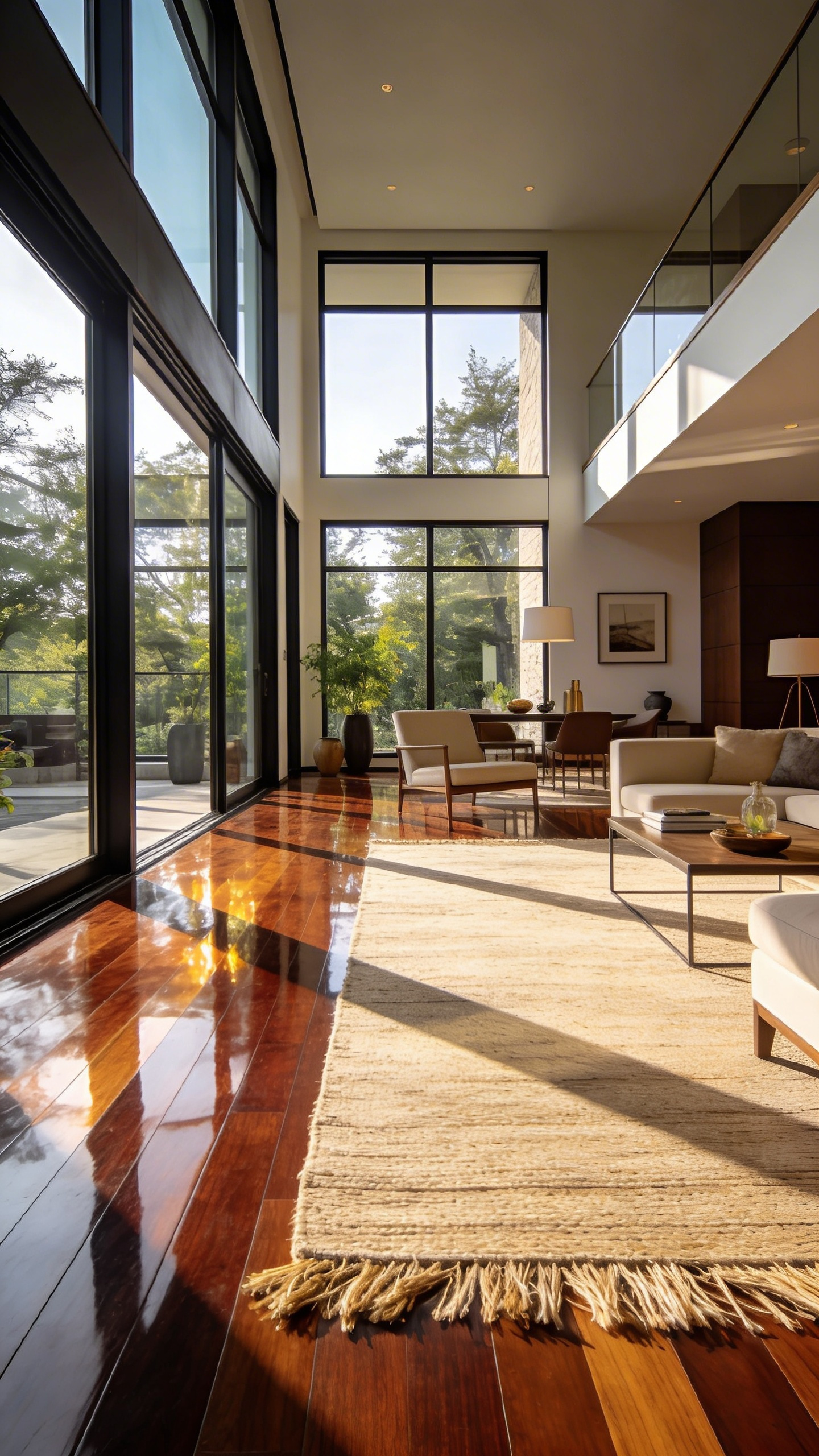
Seventeenth-century European grand salons mastered the sheen-matte dynamic. Today, design houses regularly recreate this classic magic. We pair a rustic, matte base with a glossy bamboo-silk top layer. This combination creates sophisticated visual tension. These materials experience diurnal changes as daylight shifts. Morning light emphasizes the grounded texture of natural wool. Evening light activates the reflective silk fibers. The rug appears to shimmer with a warm, luxurious glow.
Varying pile heights create stunning shadow architecture. Casting directional light across overlapping rugs reveals structural intrigue. I often angle a top rug to catch oblique light and cast dramatic micro-shadows. Pile direction remains a crucial yet overlooked technical detail. Every hand-knotted piece possesses a light and dark side based on fiber nap. Orienting the pile toward the main seating area controls the color reveal perfectly. This intentional layering guarantees a dynamic, thoughtfully curated living space.
11. The Ancestral Anchor: Sizing Antique British and Persian Rugs Correctly
Sizing an antique rug is an act of true architectural curation. These textiles reflect historical looms rather than modern retail dimensions. British Axminster carpets were historically custom-built to mirror ceiling plasterwork. They often feature long seams from narrow traditional loom strips. Classic Persian homes utilized a long layout called the mian farsh. Placing a narrow Persian kellei in a square room stretches the perspective. This bold shape draws the eye directly toward a central fireplace.
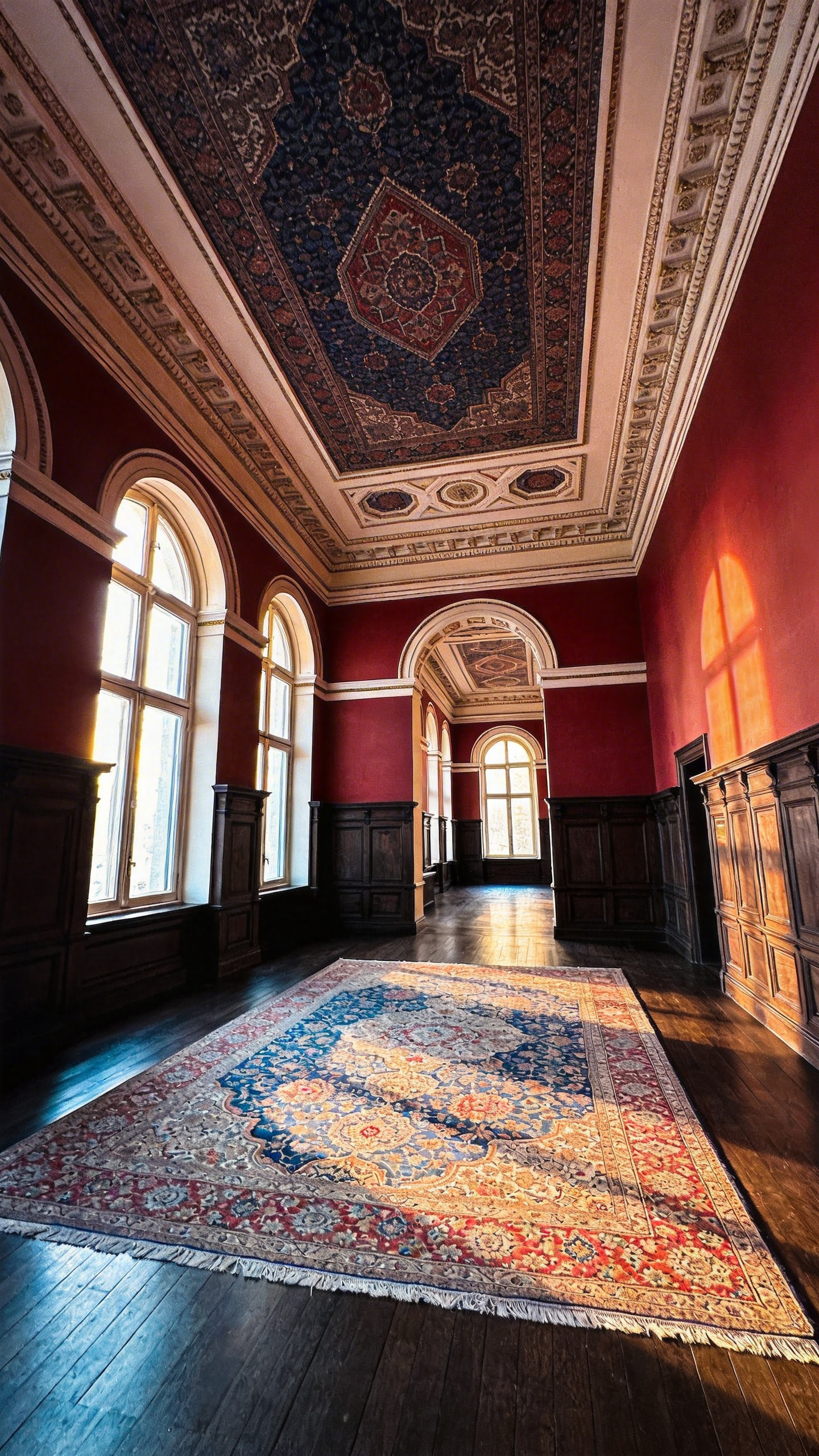
Traditional design dictates an eighteen-inch border of bare floor. Victorian homes featured higher-quality wood around the room’s outer perimeter historically. Leaving this wooden frame treats the central carpet like fine art. Stepping onto a dense rug also provides a distinct thermal transition.
Placing modern furniture on these antiques requires careful attention to pattern. Antique Persian carpets often feature a highly dominant central medallion. This striking medallion must sit entirely unobstructed under a central table. Partially covering it with a heavy sofa shifts the room’s visual weight. Designers generally prefer placing all furniture legs directly onto large Persian pieces. Smaller tribal rugs should sit entirely free of heavy furniture legs.
The chosen rug size depends heavily on your specific flooring material. Cold stone floors demand generously sized wool rugs for tactile contrast. Aligning the natural color variations, known as abrash, is absolutely crucial. These subtle dyed bands should run strictly parallel to your longest wall. This careful alignment maintains a seamless spatial flow throughout the living room.
12. Tonal Equilibrium: Balancing Dark Heritage Floors with Contemporary Upholstery
Dark heritage floors carry an immense sense of psychological permanence. Materials like fumed oak act as heavy visual anchors. They naturally pull the eye downward to create a sanctuary. However, this profound grounding effect must never swallow the room’s volume. Contemporary upholstery serves as a necessary, breathable counterweight. The looped texture of modern bouclé traps light perfectly. It creates a soft halo against the dark timber. Heavily grained linen offers a wonderfully loose, organic weave. Using leggy furniture prevents the space from feeling bottom-heavy. Slim metal legs allow the dark floor to flow uninterrupted.
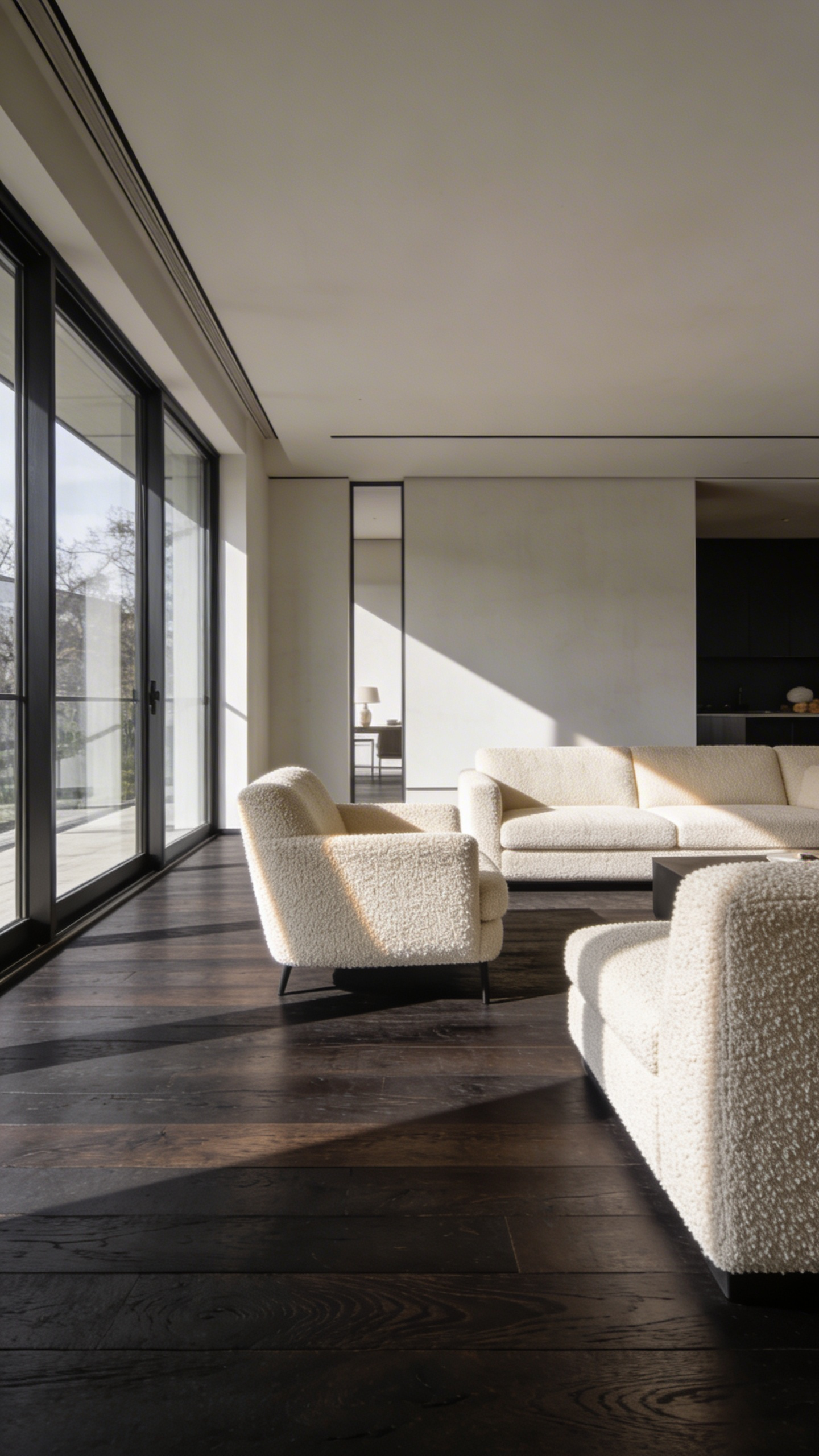
Tonal equilibrium involves managing the room’s unique acoustic architecture. Heritage wood floors naturally amplify mid-to-high sound frequencies. Bare rooms often feel cold and clattery as a result. Dense modern textiles and high-quality foam absorb this bounce. Your living room should sound as warm as it looks.
Distributing visual mass properly requires adapting the classic 60-30-10 rule. The dark floor dictates the dominant mood at sixty percent. Medium-to-light contemporary seating occupies thirty percent of the middle visual field. These transitional pieces reflect natural light back into the room. The final ten percent must feature high-contrast, sharp reflective accents. Polished brass or glass items act as crucial shimmer points.
Designers frequently rely on the squint test to verify this balance. Simply blur your vision to see where the dark masses settle. If the bottom half remains a solid block, your equilibrium fails. You must introduce negative space through carefully curated, sculptural furniture arrangements. These balanced elements ensure neither the past nor present dominates.
13. Textural Interplay: Layering Bespoke Wool and Jute Over Polished Hardwoods
Layering rugs over polished hardwoods is an exercise in architectural depth. English country estates historically used druggets to protect parquetry. Today, this tradition evolves into the contemporary 70/30 rule. A large jute base covers most of the floor. A bespoke wool rug anchors the conversation area. This combination creates a striking optical tension across the room. High-gloss wood actively bounces light around the space. Next, the natural lignin in jute provides a matte sheen. Crimped wool fibers swallow light through diffuse reflection. This hierarchy crafts a feeling of grounded grandeur.
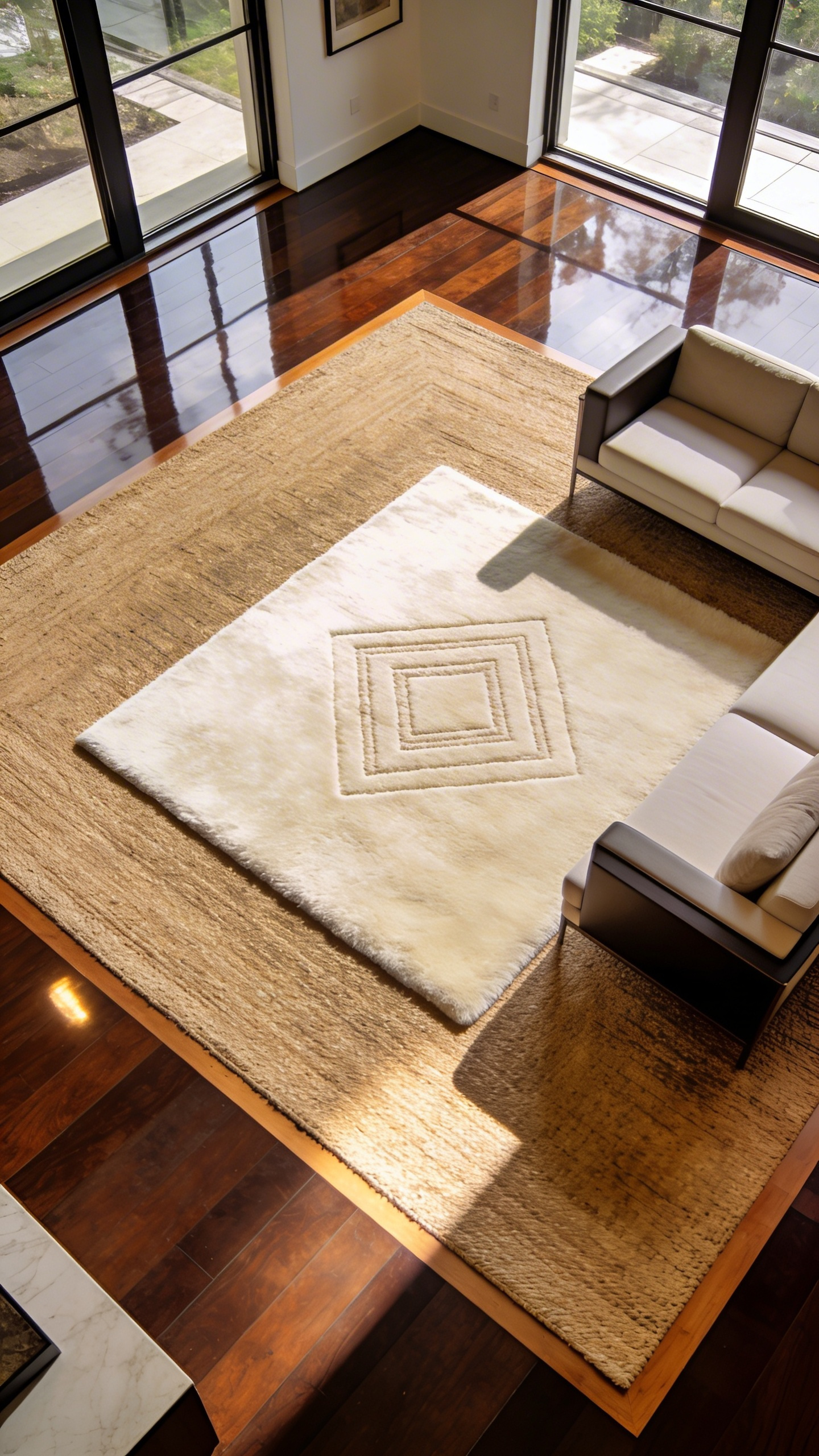
This tactile pairing offers a functional sensory experience. Walking across the room becomes a narrative of increasing comfort. You move from cool wood to firm, textured jute. You finally land in the plush, lanolin-rich softness of wool. This dual-density layering acts as a superior acoustic trap. In fact, it absorbs both low-frequency thuds and high-frequency chatter. This technique remarkably reduces impact noise by thirty decibels.
Natural fibers are highly breathable. Unlike synthetics, they prevent moisture from clouding polished finishes. However, jute still requires a rubber-felt hybrid pad underneath. This essential layer securely prevents micro-abrasions on soft-finish floors. The heavy wool rug locks everything together. This classic technique preserves your hardwood for generations.
14. Reflective Dynamics: How Floor Finishes Capture and Disperse Natural Light
Architects do not just choose flooring for its colour. They evaluate how surfaces interact with natural light. They specifically measure Light Reflectance Value and Gloss Units. A floor’s texture dramatically shapes the room’s atmosphere. High-gloss finishes act like sheer mirrors underfoot. They create long, specular ribbons of sunlight. Matte finishes scatter light rays in every direction. They produce a soft, atmospheric glow as a result.
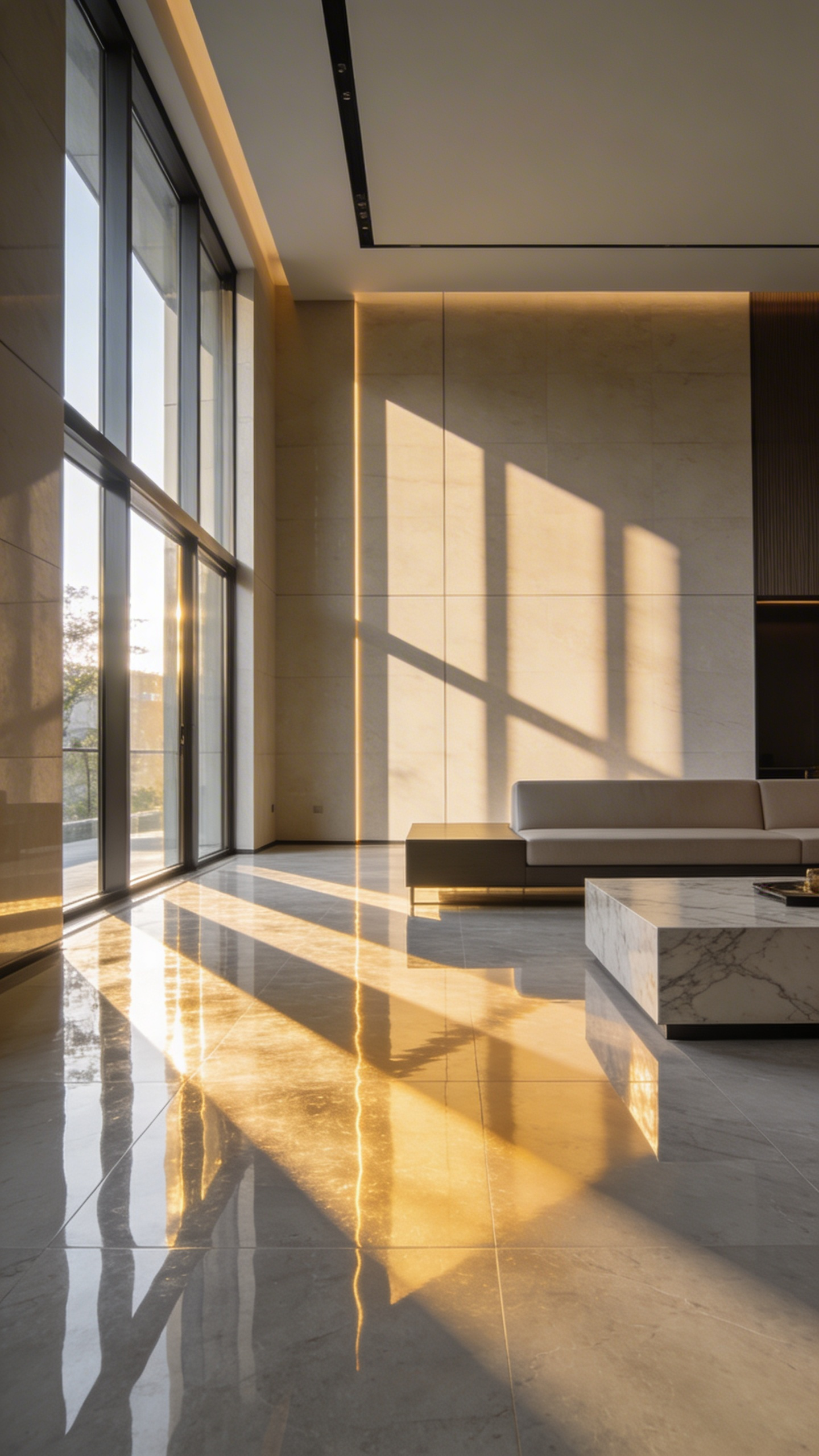
Ultra-matte pale floors can sometimes trap this light. Microscopic textures absorb illumination instead of bouncing it. A low-gloss white floor might feel surprisingly dim. Dark materials do not always absorb sunlight completely either. Traditional charred wood creates a striking metallic sheen. Carbonised ridges catch bright, spectral light beautifully. The deep black valleys anchor the living space.
Venetian terrazzo utilised this precise reflective dynamic perfectly. Varied marble chips captured and dispersed limited sunlight. Modern designers must also consider human well-being today. Excessively glossy floors often create a confusing luminous veil. Harsh glare can obscure depth for older eyes. A satin finish provides the perfect golden mean. This careful balance marries classic brightness with contemporary comfort.
Phase IV: The Lasting Legacy (Lifestyle Integration & Longevity)
A true legacy floor becomes a living archive for your family. Modern consumerism favors perpetual newness over lasting character. Classic design champions authenticity through beautiful imperfection instead. Materials like reclaimed heart pine or natural limestone are ideal choices. Their peak beauty emerges decades after the initial installation. Traditional natural oils allow the dense wood to breathe and dent gracefully. Every heel mark becomes a storied part of the patina.
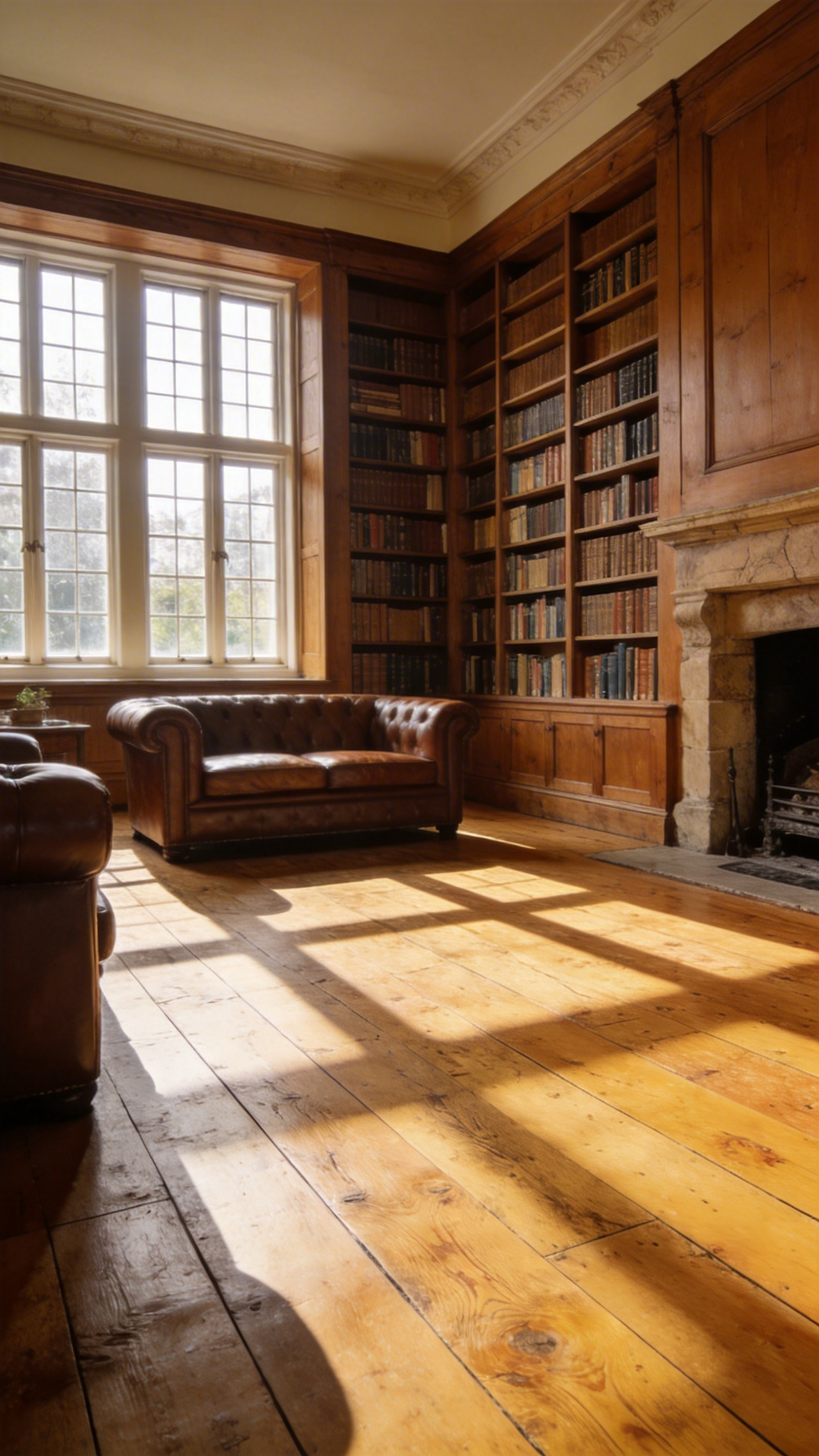
Open-plan living rooms require careful lifestyle integration. The noise of toddlers often clashes with resting seniors. High-performance homes utilize acoustic zoning through specialized flooring to manage this. Floating floor systems seamlessly incorporate hidden cork underlayments. This invisible layer can reduce reflected sound by twenty-one decibels. This structural approach facilitates intergenerational peace without adding physical walls.
Long-term longevity demands seamless inclusivity for aging safely. Legacy designs employ R10 slip-resistant micro-textures instead of clunky medical mats. Designers purposefully reject high-gloss finishes to avoid disorienting visual glare. Wire-brushed matte surfaces provide safe, tactile wayfinding for moving feet. Eliminating thresholds entirely removes tripping hazards across the home. True generational wealth avoids the wasteful ten-year replacement cycle. Solid oak or terrazzo remains a sustainable, century-long design canvas. This lasting foundation easily adapts to future aesthetic changes.
15. Patina Over Perfection: Allowing Natural Materials to Age Gracefully
Stepping away from sterile, mass-produced flooring embraces the natural traces of daily life. Classic design has long celebrated the beauty of aging materials. This philosophy treats your floor as a living canvas. Natural materials like aged oak provide profound tactile warmth. Porous terracotta regulates humidity and maintains a gentle temperature. Sunlight triggers an oxidation process called UV tanning. White oak slowly develops a stunning, honeyed golden hue. Solid hardwood produces a quiet, substantial thud underfoot. This acoustic depth dramatically reduces the auditory stress of modern living.
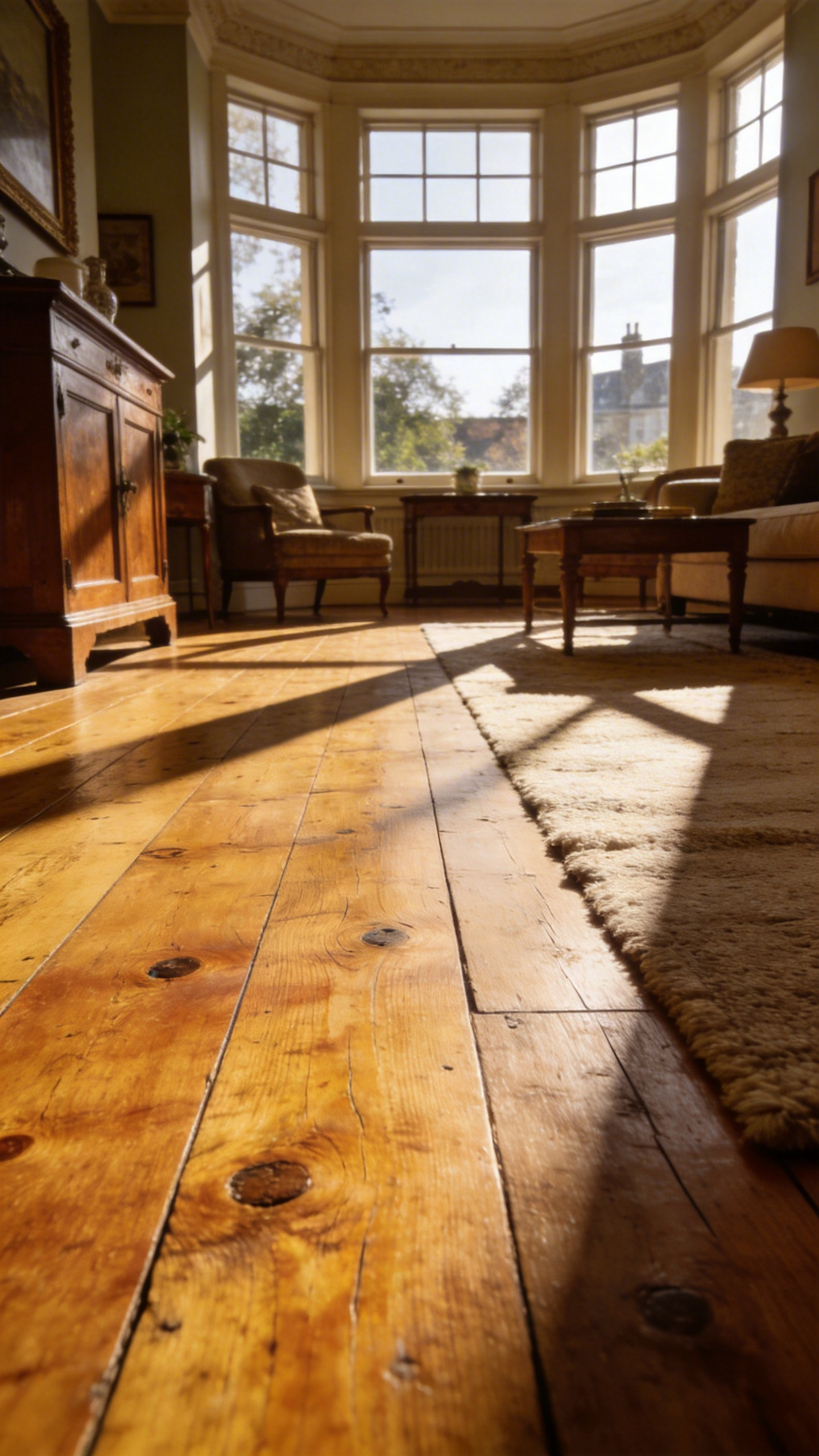
European design houses historically view these softened edges as a status symbol. The Japanese concept of Wabi-Sabi similarly celebrates these everyday scars. A scratched wood plank becomes proof of a home’s authentic longevity. The friction of daily footsteps actually hand-polishes wooden floors. Natural oils deepen the grain to create an irreplaceable sheen. However, you must avoid suffocating these floors with plasticized, high-gloss sealants. Favor penetrating waxes that allow the material to breathe naturally.
True patina represents structural change rather than surface-level neglect. Your floor should always remain scrubbed and meticulously clean. This timeworn authenticity is the ultimate modern luxury. Specifying materials that grow more beautiful removes the wasteful replacement cycle. Your floor becomes a permanent, seasoned architectural anchor.
16. The Estate Standard: Merging High-Traffic Durability with Aesthetic Elegance
The modern home demands flooring that balances historic charm with contemporary resilience. The “Estate Standard” rejects disposable construction methods. It merges historical permanence with advanced material science. True luxury must age with the grace of a country manor. Grand estates utilized massive wide planks from old-growth timber historically. We recreate this aesthetic today using the European live-sawn technique. This milling method yields a striking, complex cathedral grain. It provides incredibly stable, linear plank edges. The wood expands uniformly to prevent unsightly warping.
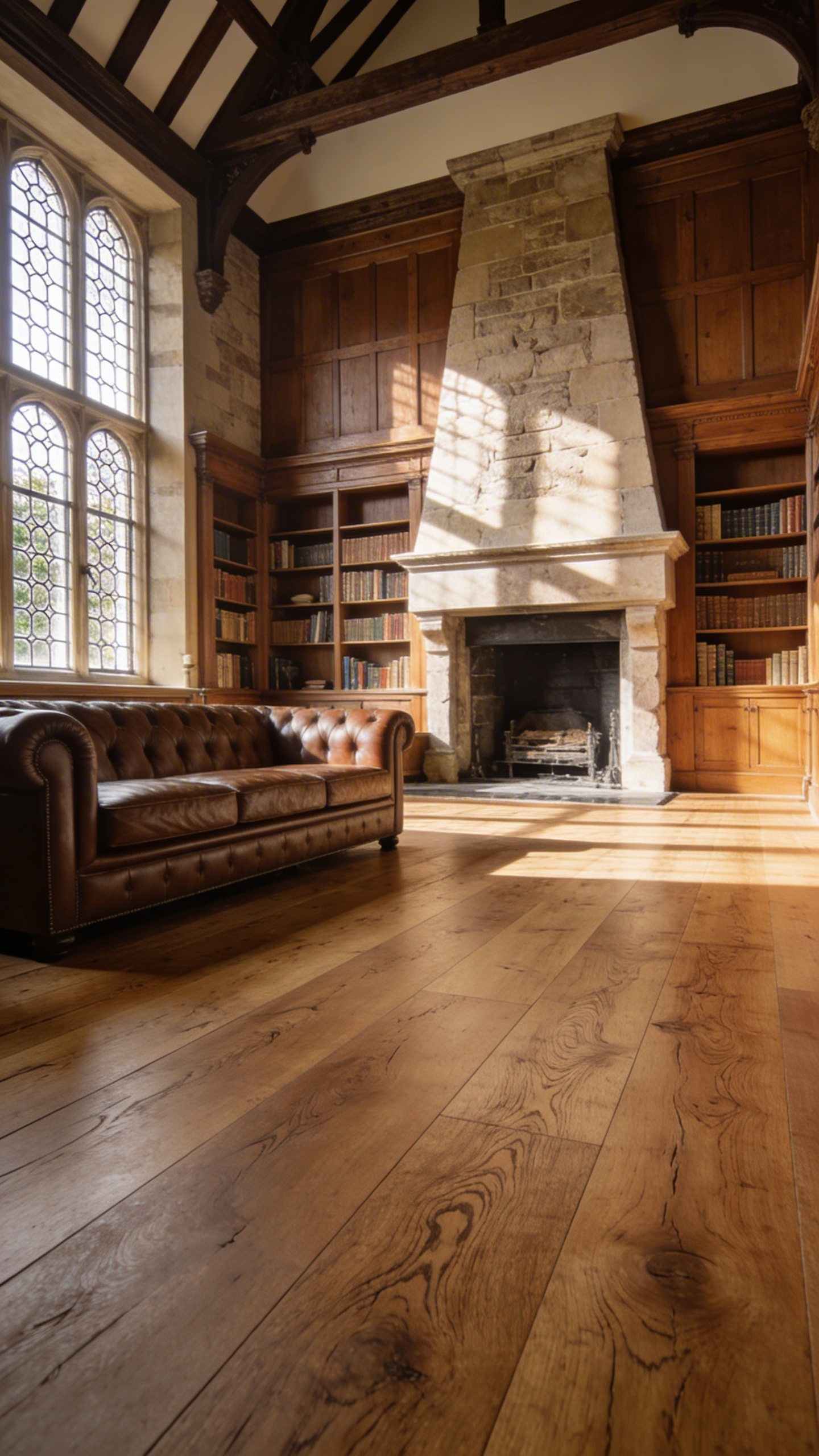
These plank proportions completely dictate the room’s visual atmosphere. Standard narrow strips create frantic visual noise. Planks exceeding ten inches in width offer architectural silence. Fewer seams naturally allow the eye to sweep smoothly across the space. This grand scale makes the living room feel expansive and intentional.
Protecting these wide planks requires a thoughtful finishing approach. Polyurethane creates a thick plastic film that highlights scratches. This elevated standard utilizes penetrating high-solid hardwax oils instead. The wood develops a soft, lived-in patina over time. Daily micro-scratches blend beautifully into the grain rather than showing damage.
Grand living spaces often suffer from unpleasant, hollow echoes. Estate-grade floors utilize engineered cores and acoustic underlayments to combat this. Specialized elastic adhesives absorb the harsh kinetic energy of heavy footsteps. The sharp clack of heels becomes a muted, grounded thud.
Selecting the perfect wood species remains crucial. The hardest exotic woods are rarely the most practical choice. Classic white oak provides the ultimate performance sweet spot. It resists daily dents while beautifully accepting complex, contemporary stains.
17. Sustainable Stewardship: Investing in FSC-Certified and Salvaged Timbers
Selecting the right timber is a profound commitment to sustainable stewardship. It bridges the preservation of biological futures with industrial history. Forest Stewardship Council (FSC) certified woods offer a forward-looking model. These climate-smart forests employ longer harvest rotations to maintain protective canopies. This approach nurtures vital biodiversity that traditional logging destroys. Salvaged timbers champion the circular economy through retrospective stewardship. By repurposing 19th-century beams, homeowners keep magnificent organic matter from landfills.
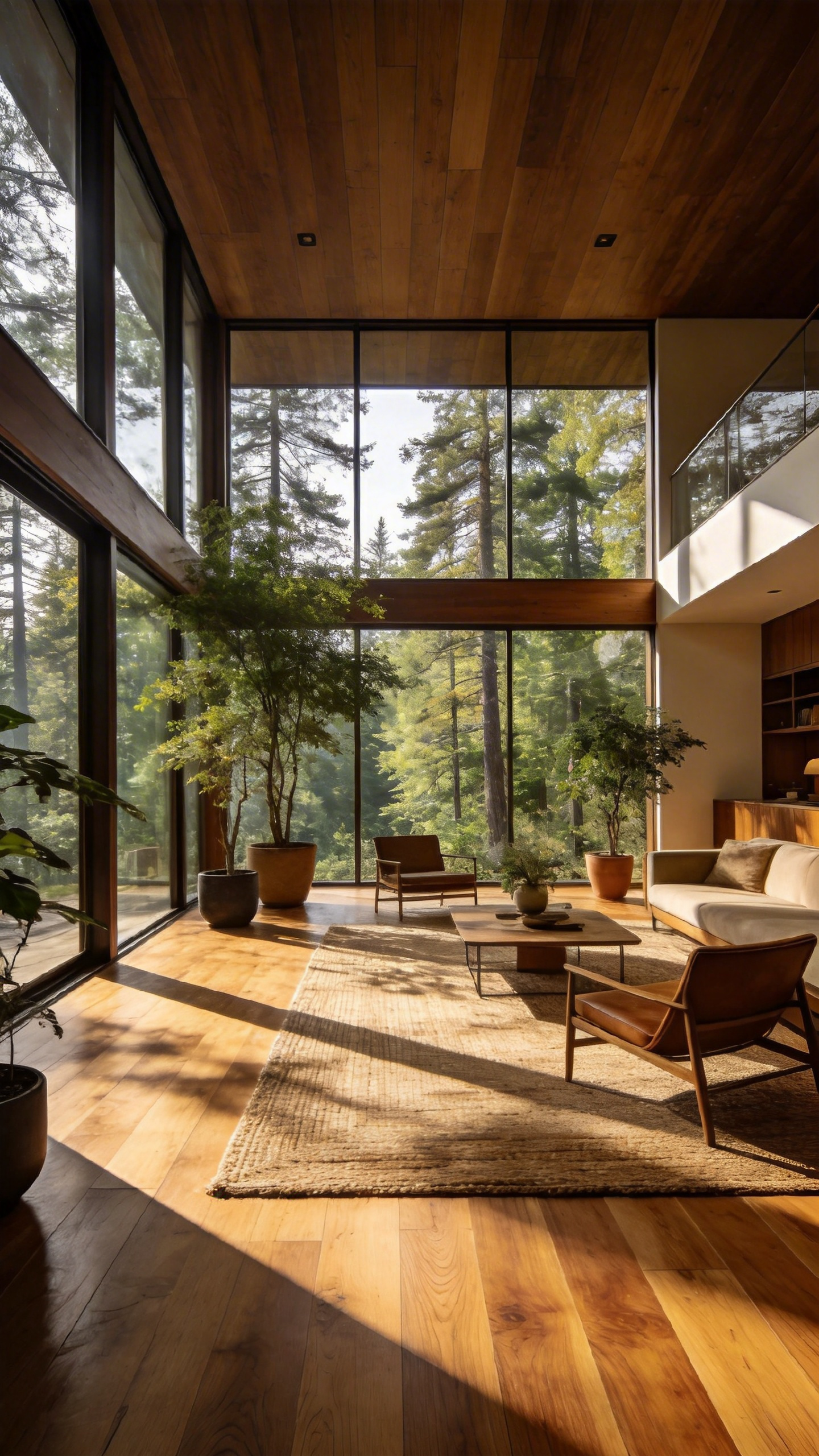
Salvaged wood provides an unmatched performance edge. Antique Heart Pine boasts an exceptionally high Janka hardness rating. These slow-growing trees formed incredibly tight growth rings. Decades of natural seasoning make these planks remarkably dimensionally stable. They resist warping or cupping when your living room humidity fluctuates. Elite river-recovered timbers offer an even more luminous internal luster. Entombed underwater for a century, these logs boast deep, unreproducible tones.
This sustainable stewardship significantly enhances acoustic and mental well-being. Research shows rooms featuring forty-five percent natural wood naturally lower human cortisol levels. The dense cellular structure of old-growth timber beautifully diffuses harsh echoes. This creates a quiet, grounded luxury rather than a hollow sound. Authenticating these materials is crucial to avoid modern greenwashing pitfalls. Always demand a proper Chain of Custody certificate for new FSC products. Investing in finite reclaimed wood secures an appreciating asset with an enduring soul.
18. The Collector’s Canvas: Framing Your Living Room Floor as an Enduring Foundation
The concept of a collector’s canvas was quite literal historically. Wealthy eighteenth-century homeowners utilized painted floor cloths. These heavy canvases cleverly mimicked expensive marble or parquetry. Today, this tradition evolves into bespoke painted floorboards. High-impact patterns serve as a dynamic spatial frame. They naturally draw the eye toward prized antique groupings.
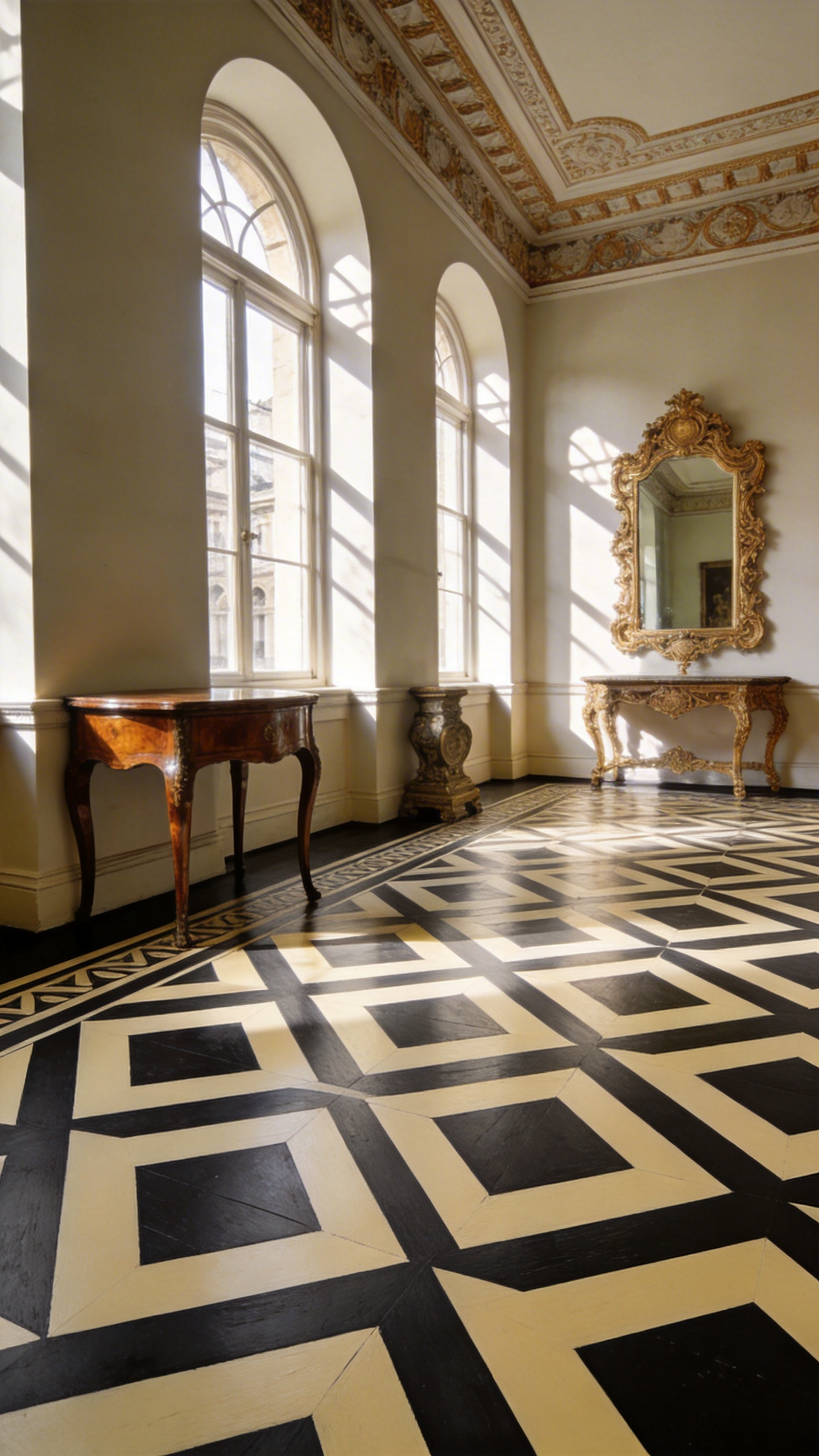
A highly curated space requires architectural gravity. Classic wood layouts provide this essential grounding effect perfectly. Parquet de Versailles anchors large rooms beautifully. Herringbone patterns function as subtle directional arrows. These geometric grids visually unify entirely disparate furniture. A mid-century chair sits harmoniously beside a traditional heritage table.
True design character lies within subtly imperfect surfaces. The rich concept of patina transforms ordinary floors into enduring foundations. Discerning collectors frequently source reclaimed old-growth timber for this reason. This historic wood possesses incredible material memory. Its wire-brushed texture creates a beautiful tactile poetry. Patinated floors offer warm counterpoints to stark gallery walls.
The sensory dialogue between flooring and light is nuanced. A matte wide-plank oak floor absorbs light to ground the room. Polished stone reflects light to illuminate sculptural undersides. Irregular tactile textures actually encourage guests to linger longer. The floor itself often acts as a structural pedestal. Collectors confidently place heavy bronze sculptures directly onto the boards. Dense white oak provides necessary and silent structural support. Investing in high-quality living room flooring creates a legacy foundation that ages with grace and character.
Frequently Asked Questions
What is the most durable living room flooring for a luxury home?
For high-end residential spaces, solid or engineered European white oak is the gold standard. When finished with high-solid hardwax oils, it provides exceptional durability. The repairable surface develops a rich patina over time. For those seeking stone, French Dijon limestone offers high thermal mass and resists heavy traffic beautifully.
Does hardwood flooring work with modern underfloor heating?
Yes, but engineered hardwood is the preferred choice for underfloor heating. Its cross-ply core provides superior dimensional stability. This allows it to resist warping and cupping as temperatures fluctuate. Ensure the combined thermal resistance remains below 2.5 Tog for optimal efficiency.
How do I choose the right plank width for my living room?
Plank width should be scaled to the room’s dimensions. In large open-concept spaces, wide planks reduce visual noise by minimizing seams. This creates a much calmer atmosphere. Narrower planks add energetic rhythm and traditional character to smaller rooms.