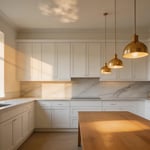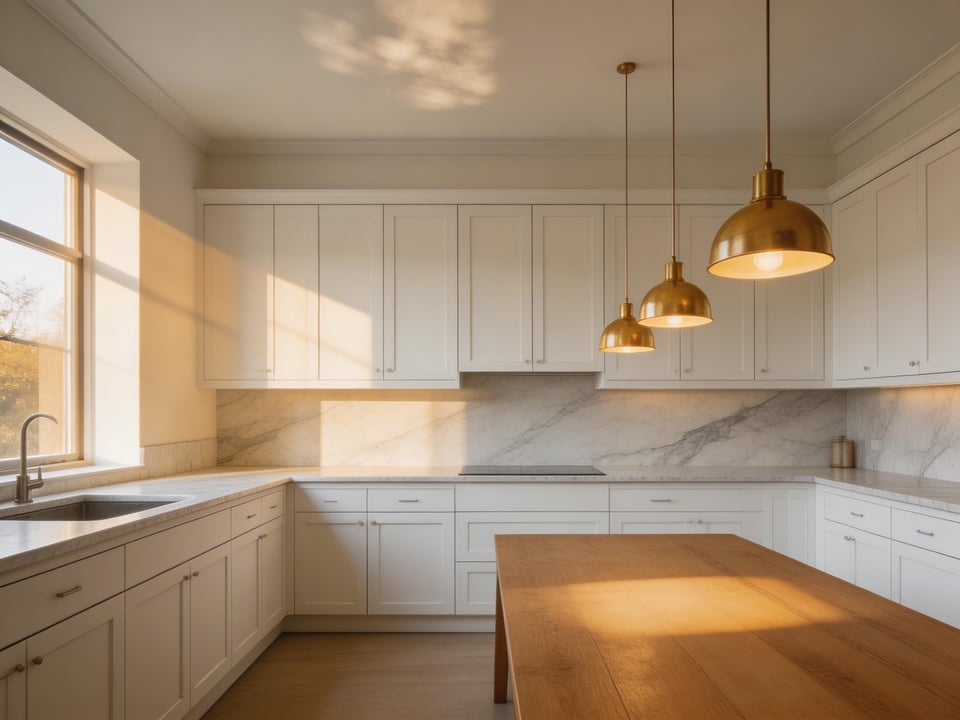
There is a particular quality of light that changes everything at a kitchen table. Think of a weekday evening. The meal is ready, someone dims the pendant above the table, and the room rearranges itself. The table becomes its own space — a warm pool of light holding the moment while the rest of the kitchen falls gently away. This is what kitchen lighting over table does at its best: it creates an intimate territory within a utilitarian room.
Emma Blake has spent a decade watching British kitchens transform into the heart of the home. The single most underestimated element in that transformation is the pendant above the table. Not the spotlights. Not the under-cabinet strips. The light above where people actually sit. Get that right and the kitchen gains a quality no amount of expensive cabinetry can manufacture on its own.
What follows is a guide to fifteen pendant lighting approaches for above the kitchen table. They range from the confidence of a single oversized fixture to the science of bulb colour temperature. Some are structural decisions made at the design stage. Others are changes you can make this weekend. All of them treat the kitchen table as the most used piece of furniture in your home — and the one most deserving of light that does it justice.
Pendant Styles That Set the Scene
1. A Single Statement Pendant as Your Kitchen Lighting Over Table
The single pendant above the kitchen table is the quietest and most confident of all pendant choices. One fixture. One decision. No complexity, no visual noise — just a deliberate object hung above the table that says: this is the place.
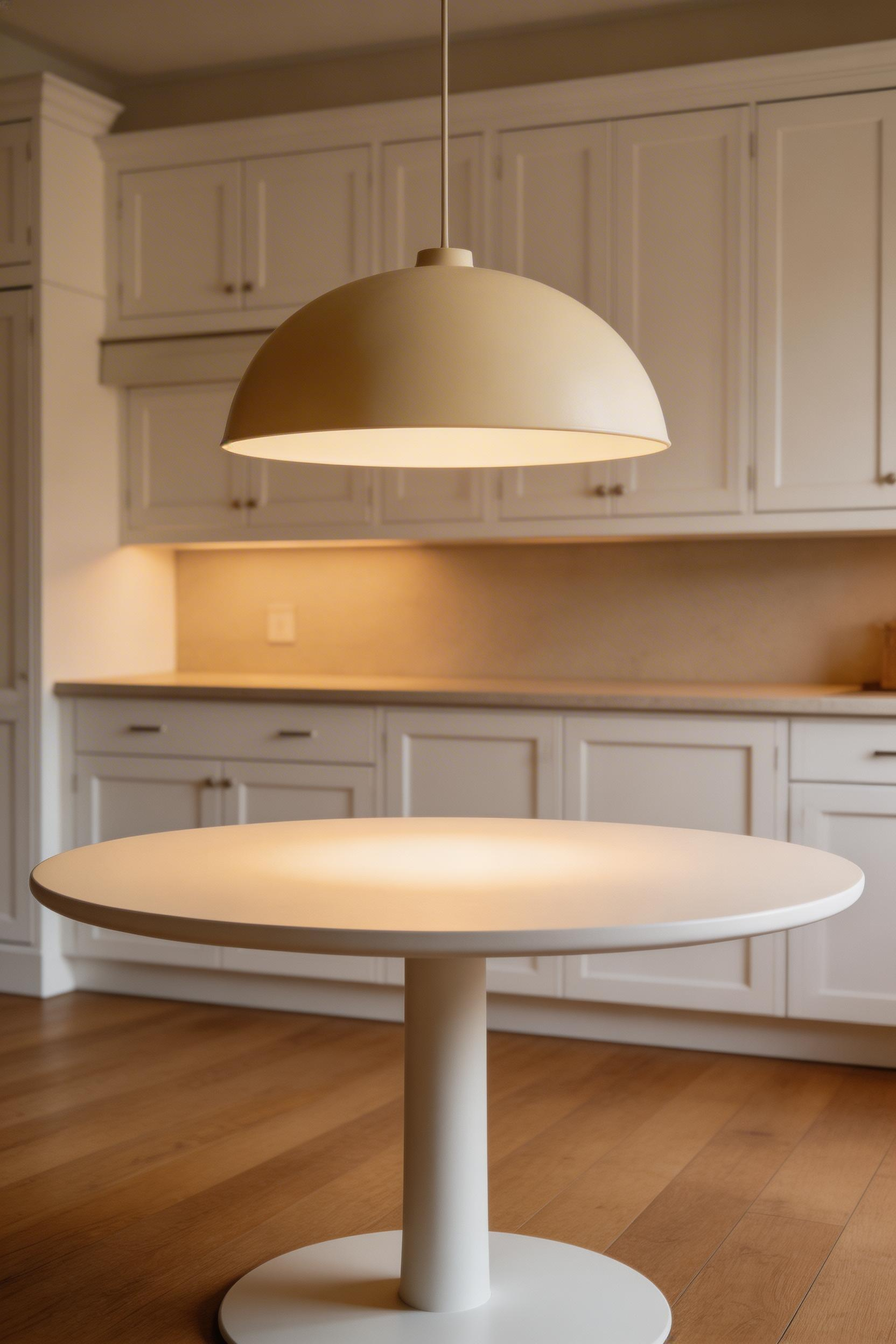
Where a cluster distributes attention, a single pendant focuses it. The eye goes straight to the table, and the table gains an authority it would not otherwise have. Size matters more than drama. A pendant with a diameter between half and three-quarters of the table’s width will sit in the space with quiet confidence. For a standard thirty-six-inch-wide table, that means a shade of eighteen to twenty-four inches across. The more common mistake is to go too small, producing a fixture that looks lost rather than grounding the surface below.
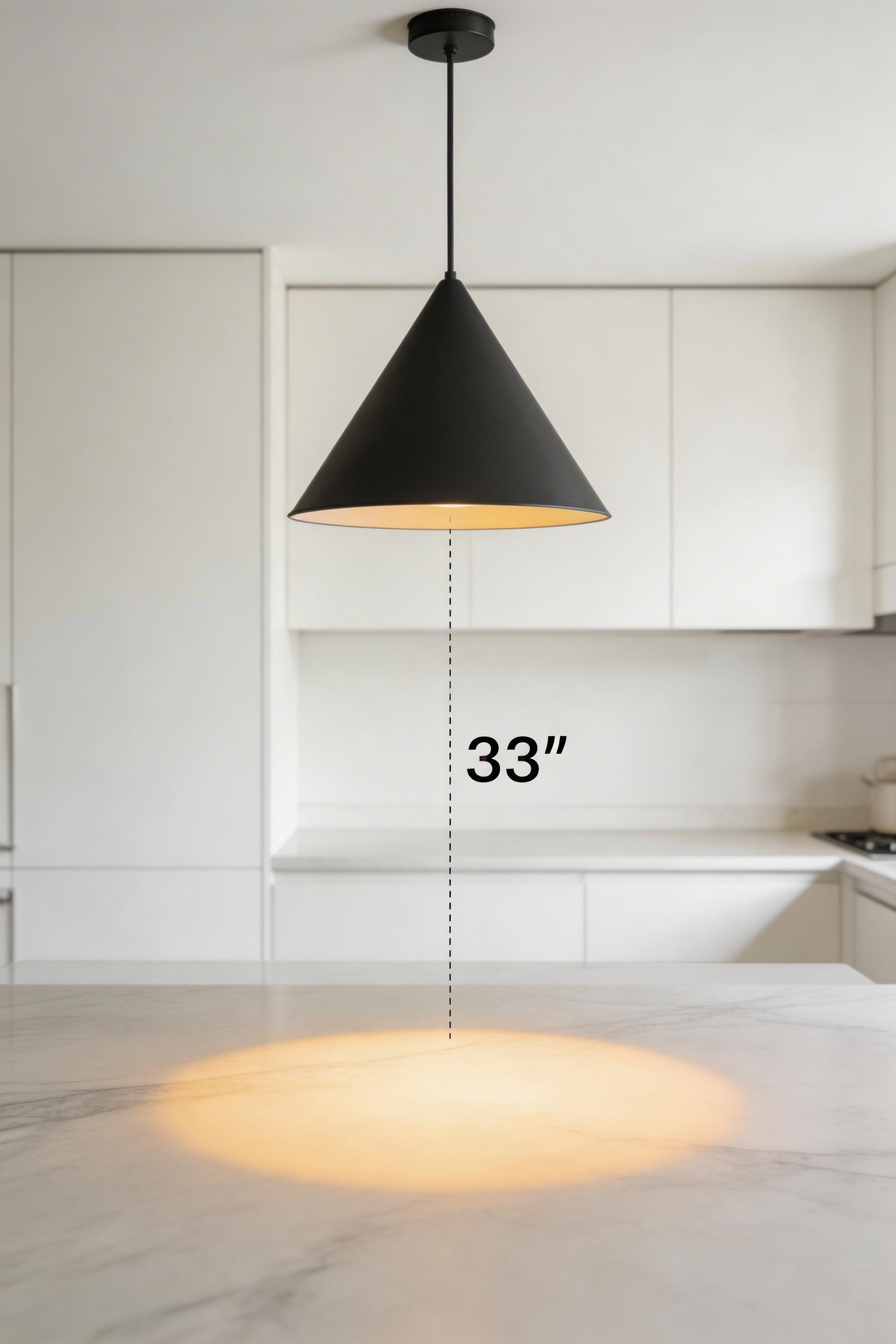
The bottom of the pendant should sit thirty to thirty-four inches above the table surface. This is low enough to cast an intimate pool of downlight across the meal, and high enough not to interrupt sightlines for anyone seated. For ceilings of nine feet or higher, add three inches for each additional foot. A ten-foot ceiling warrants thirty-six to thirty-nine inches of clearance between table and pendant base.
One practical note: a single pendant should centre above the table, not the room. If the ceiling’s electrical box sits off-centre from where your table actually stands, use a pendant with an extra-long cable on a ceiling hook, or a swag-style installation.
—
2. Clustered Pendants at Varied Heights for Sculptural Lighting
If the single pendant is about quiet confidence, a cluster above the table is about something more theatrical. A grouping of three or five pendants hung at varied heights stops being purely functional. It starts being a composition — something the eye reads as a sculptural object, a mobile, a small installation that happens also to light the surface below.
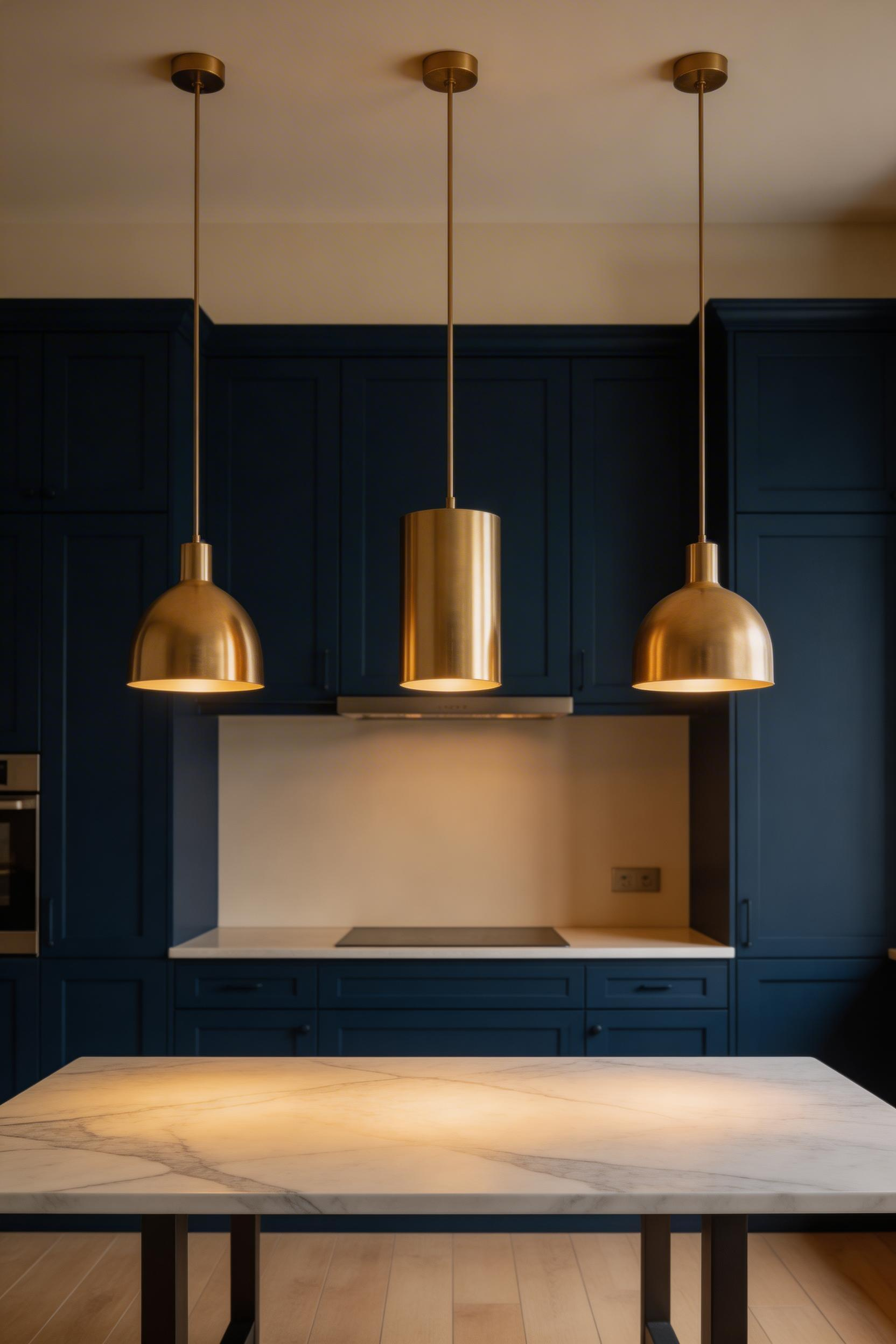
The rules here are few but firm. Always use an odd number: three is most manageable; five allows a more dramatic spread. Even numbers produce symmetrical pairs the eye resolves immediately — there is no tension, no movement. Odd numbers have a natural centre that grounds the composition while the outer fixtures add energy. The middle pendant of a cluster should sit directly above the table’s centre point.
Height variation is what transforms three pendants from a row into a cluster. Drop the outermost fixtures to standard thirty to thirty-four inch clearance. Raise the central fixture by four to six inches. Place the middle two at an intermediate height. The result has the quality of something organic. For spacing between fixtures, the gap between any two pendants should equal the diameter of each shade. An eighteen-inch pendant needs eighteen inches of breathing room on each side.
—
3. Linear Pendant Bar Kitchen Lighting Over Table for Long Surfaces
A rectangular table suits a linear pendant bar better than almost any other fixture. One long horizontal fitting spans the length of the table, hung above its centre, creating an immediate visual alignment between the light and the surface below.
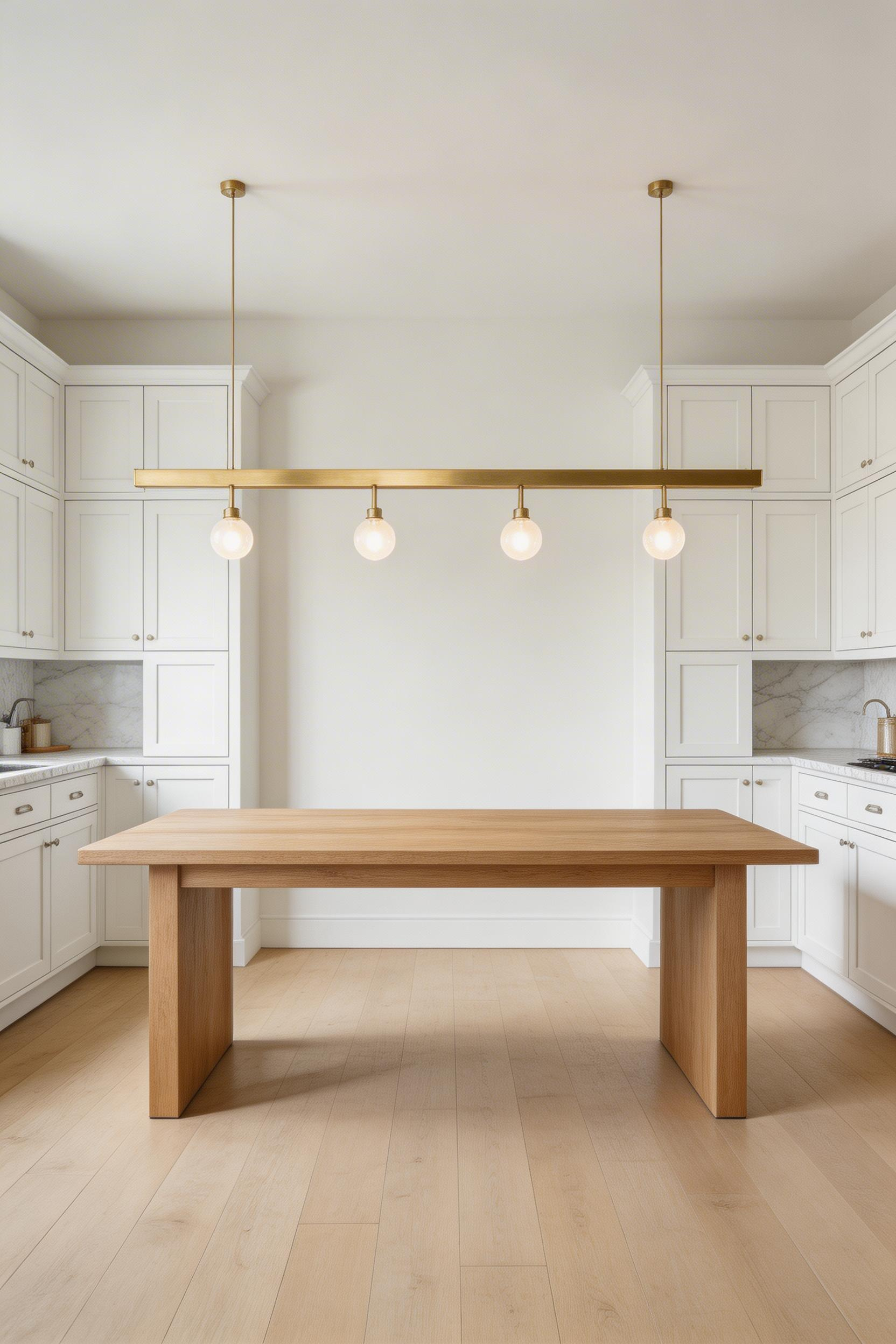
Proportions govern everything here. The fixture should span approximately two-thirds the length of the table. For a standard seventy-two-inch table, that means a bar of forty-seven to fifty-four inches. The edges must clear the table edge by at least six inches on each end. This avoids the awkward visual of a bar overhanging the table and competing with the chairs. In terms of width, a linear pendant whose body is roughly one-third to one-half the table’s width sits comfortably in the space.
Linear bars suit contemporary, Scandinavian, and minimally styled kitchens. The horizontal line of the fixture rhymes with the horizontal line of the table below. Slim profiles in brushed brass, matte black, or natural oak are the most compelling choices. For very long tables above ninety-six inches, two shorter bars hung end to end produce better illumination while keeping the linear aesthetic intact. It is a quietly resolved solution — the kind that looks inevitable once you see it done well.
—
4. Lantern-Style Kitchen Lighting Over Table for Heritage Charm
The lantern form is one of the oldest kitchen lighting arrangements in Western domestic history. The glass-and-brass lantern above the kitchen hearth carries centuries of domestic credibility in its bones. This is precisely why it retains authority in contemporary kitchens today.
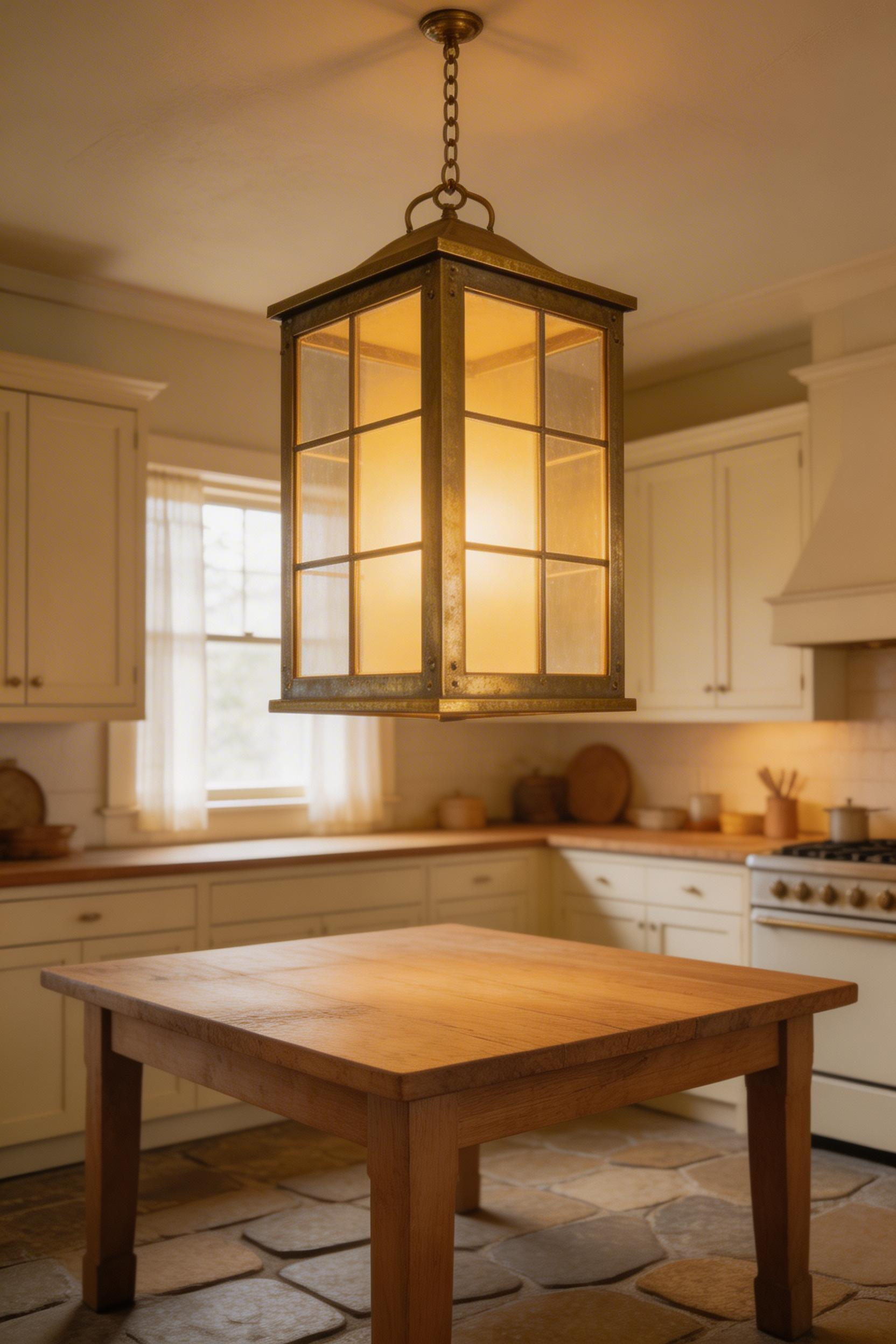
In 2025, lantern-style pendants are experiencing a strong revival. There is a growing appetite for heritage materials and forms that feel genuinely rooted rather than trend-dependent. The dominant expressions are three. There is the geometric open cage in matte black iron, which lets light scatter freely. There is the glass-panelled box lantern in antique or unlacquered brass. And there is the pendant lantern in antiqued bronze or aged copper, warmer and richer than brass, with an organic patina quality.
The brass box lantern suits heritage British and European kitchen styles best. It pairs naturally with painted Shaker cabinetry, stone floors, and deep windowsills. That combination describes the ideal country kitchen just as well in 2025 as it did in 1985. The cage lantern brings a more urban character and suits kitchens that lean industrial or contemporary-farmhouse. For kitchens with an existing heritage character, farmhouse kitchen lighting explores the broader range of fixtures that complement these schemes.
Scale, Height, and Placement
5. Matching Pendant Scale to Your Table: Kitchen Lighting Over Table Sizing
The single most common failure in pendant lighting above a kitchen table is poor scale. A pendant that is too small looks marooned above its surface. It casts a beam that reaches the centre while leaving the ends in shadow. A pendant that is too large feels oppressive — it crowds the seated diners and makes the table beneath it disappear.
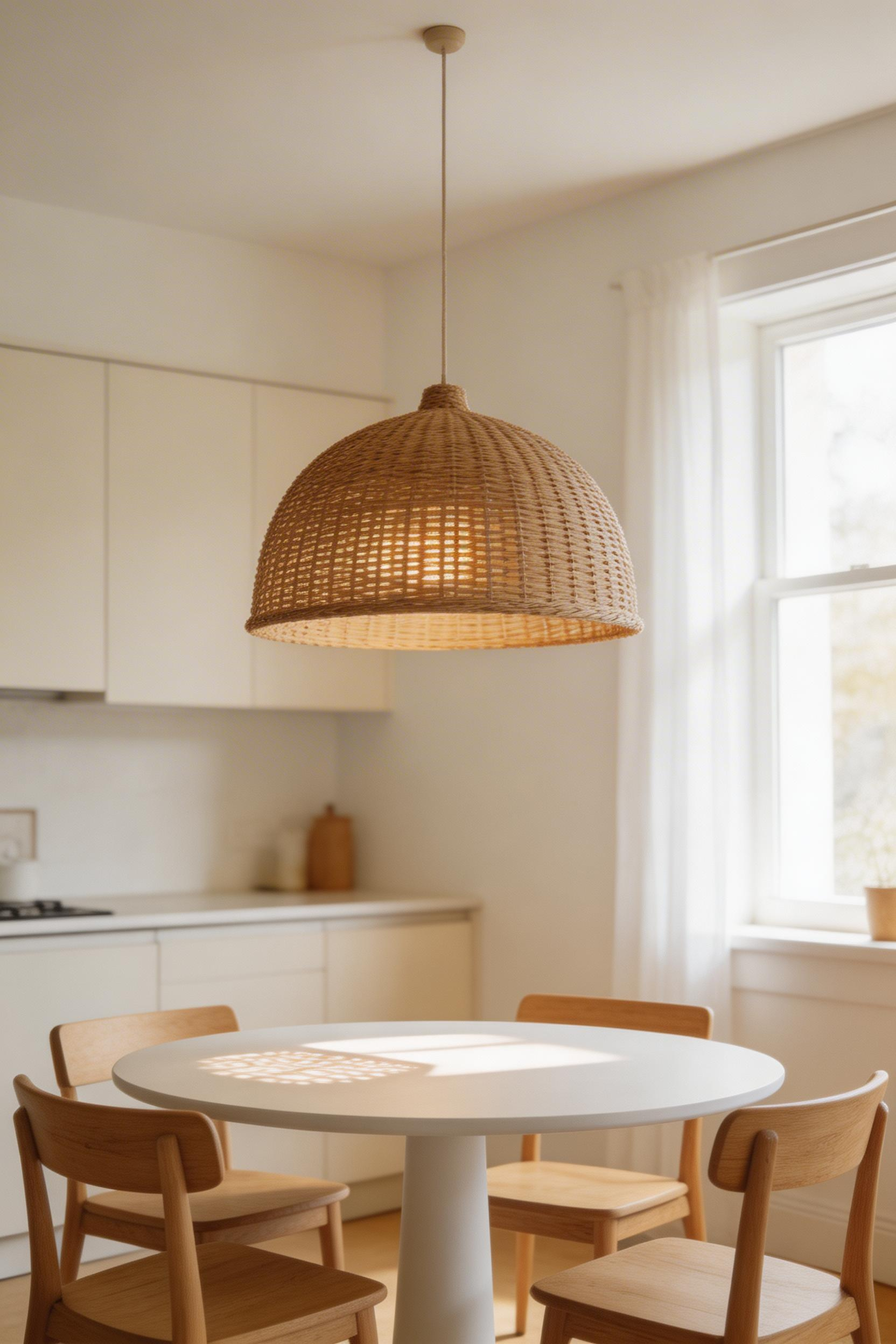
The sizing rule used by most lighting designers is simple and reliable. A single round or cylindrical pendant should have a diameter of between half and three-quarters of the table’s width. For a thirty-six-inch-wide table, that puts the range at eighteen to twenty-seven inches. For a forty-eight-inch table — a larger six-person surface — the pendant diameter can rise to twenty-four to thirty-six inches. The same principle applies to linear bars: the bar length should cover roughly two-thirds the table’s length, with six inches of clearance at each short end.
For pendant clusters, individual shades can be smaller — ten to fourteen inches in diameter — because their combined footprint covers the table effectively. When in doubt, go larger rather than smaller. An under-scaled pendant over a kitchen table is the more common problem. A pendant slightly larger than the formula suggests almost always reads as confident and intentional.
—
6. The Correct Hanging Height for Kitchen Lighting Over Table
Of all the pendant decisions you will make, hanging height has the highest impact. A pendant hung too low creates oppression — the shade cuts into the room and blocks sightlines. What should be an intimate effect becomes a claustrophobic one. A pendant hung too high loses its function. The downlight scatters, the pool of light disperses, and the fixture floats uselessly above the space.
Adjusting for Ceiling Height
The standard guidance is well-established: the bottom of the pendant should hang thirty to thirty-six inches above the table surface. For standard eight-foot ceilings, the lower end of this range — thirty to thirty-four inches — creates the tightest and most atmospheric light. For ceilings of nine feet and above, add three inches for each additional foot. A nine-foot ceiling warrants thirty-three to thirty-seven inches. A ten-foot ceiling warrants thirty-six to forty inches.
Adjustable cable pendants are the most practical choice because height can be set precisely during installation. A fixed-rod pendant commits you to the installed length, so measure the drop carefully before purchase — the canopy and fitting can add unexpected length. For a broader look at how hanging height interacts with different fixture types, kitchen light fixtures covers placement rules across the full range of kitchen lighting choices.
—
7. Centering and Symmetry: Positioning Kitchen Table Pendant Lighting
Positioning a pendant above the table is more exacting than it first appears. Most people assume it means centring the fixture in the room. It does not. The pendant must centre above the table — a different thing entirely. The distinction matters most in kitchens where the table does not sit at the geometric centre of the room, which is most kitchens.
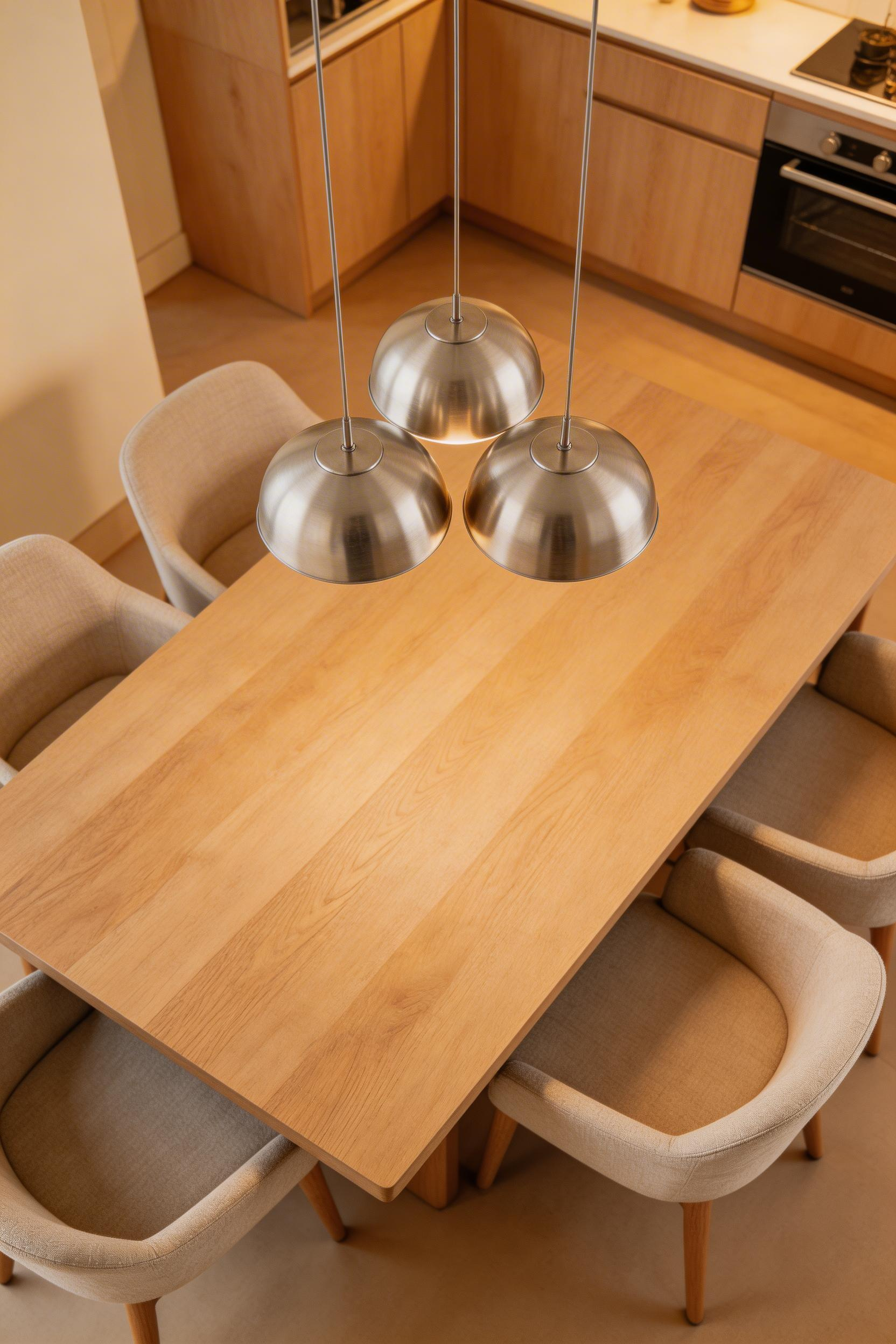
For a round table, the pendant drops directly above the centre point. For a rectangular table, it centres on both the length and width axes. A linear pendant bar centres along the length axis and splits the width symmetrically. A cluster of odd-numbered pendants has its middle fixture directly above the table’s centre, with the flanking pendants arranged symmetrically on each side.
When the Electrical Box Is Off-Centre
The challenge arrives when the existing ceiling box does not align with the table. This is common when a table has been repositioned, or when the original electrical installation was made without the table in mind. The cleanest solution is a swag installation. The pendant is fitted to the existing ceiling box. The cable is then rerouted to a secondary hook positioned directly above the table. The visible run of cable between hook and canopy becomes part of the visual. Alternatively, an electrician can relocate the ceiling box — straightforward work in most homes, and worth doing if the misalignment is significant.
—
8. Rattan and Woven Fibre Kitchen Lighting Over Table for Organic Warmth
Of all the materials used in pendant lighting, rattan is the one that performs the most visual alchemy. Light passing through a woven shade creates a dappled pattern of light and shadow on the surrounding surfaces. The effect is warm, layered, and immediately residential. There is nothing clinical about rattan light, which is exactly why it belongs above a kitchen table.
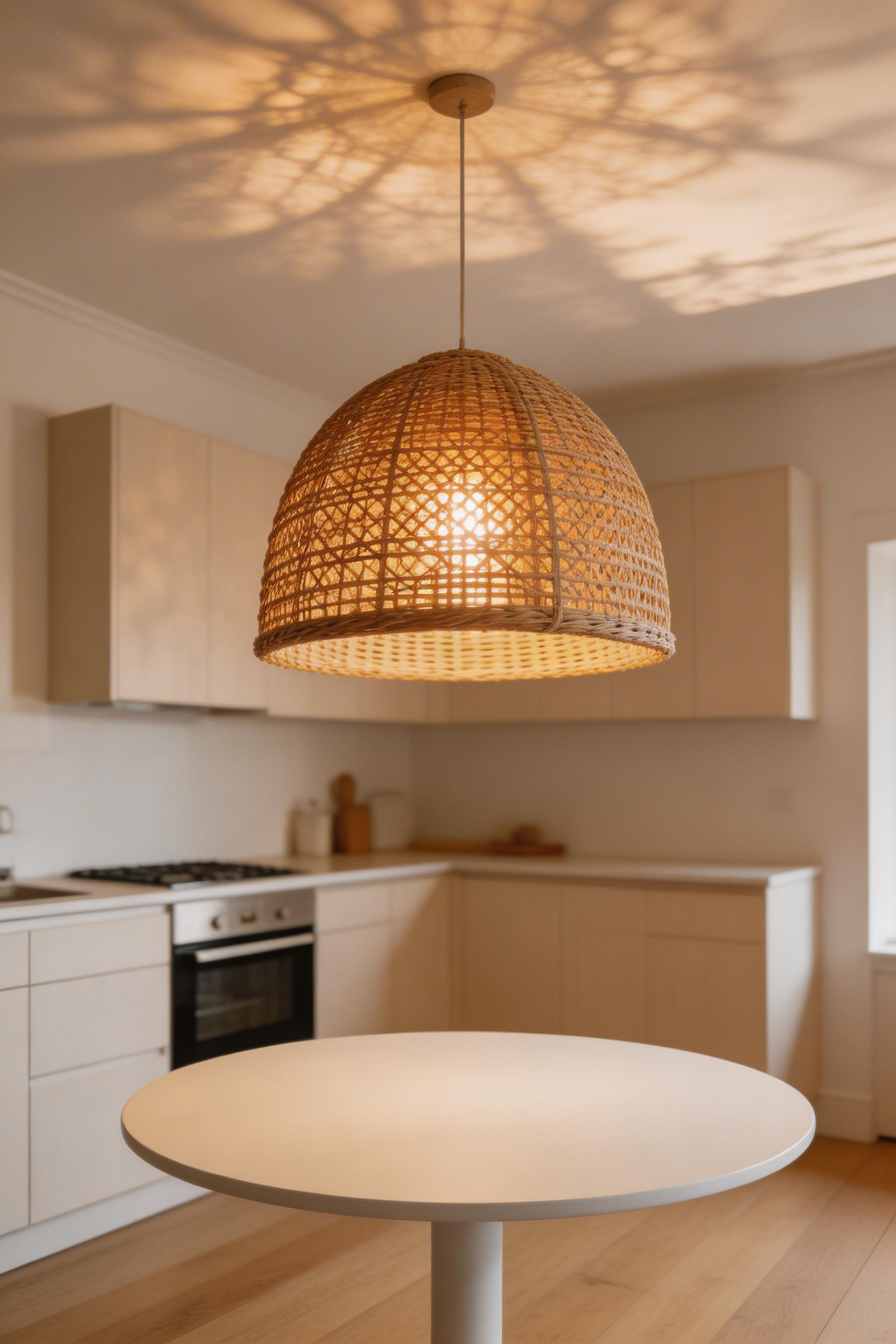
Rattan pendants come in a range of forms — dome, bell, drum, barrel, and teardrop — and each sits differently in a room. The dome is the most versatile. Its wide, low profile covers a kitchen table effectively and creates the fullest light pattern on surrounding walls. The teardrop and barrel shapes suit smaller tables or kitchens where a wide dome would sit too low. For a genuinely organic quality, look for hand-woven pieces rather than machine-pressed rattan sheet. The irregularity in the weave produces a more complex and animated light pattern when illuminated.
The styling possibilities are broader than rattan’s rustic reputation suggests. A natural dome over a pale oak table with white Shaker cabinetry has a clean, Scandinavian quality. The same fixture over a slate-grey table with terracotta tiles reads earthier, more Mediterranean. Warm white bulbs at 2700K are the consistent recommendation. They enhance the amber and honey tones in the weave and create the warmest possible pool of light below.
Materials and Aesthetic Directions
9. Glass Globe Pendant Kitchen Lighting Over Table for Airy Elegance
The glass globe pendant is the most intellectually honest of all pendant choices for a kitchen table. Nothing is hidden. The bulb is right there, inside the glass, visible and unapologetic. The fixture works because it turns this transparency into a virtue: the light source becomes the design element.
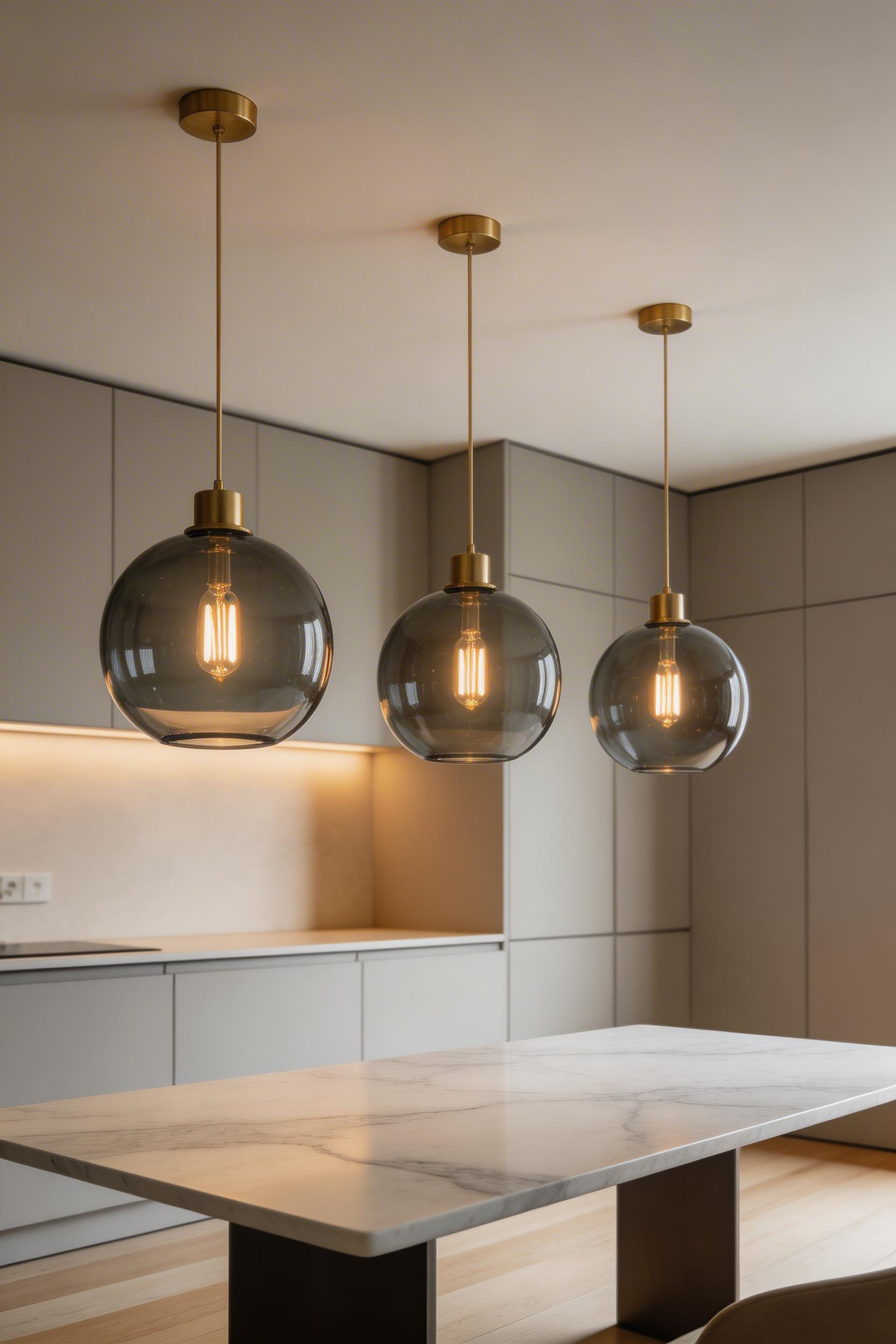
Clear glass suits kitchens that lean contemporary, Scandinavian, or simply uncluttered. It is the most airy option. The globe barely registers visually until illuminated, at which point the room gains a warm glow without the shade competing with anything else. Smoked glass brings a different register. The obscured bulb creates a more contained pool of light, slightly mysterious, with a visual weight that makes the pendant feel more deliberate. Smoked glass with brushed brass or satin gold hardware is among the defining pendant signatures of 2025. Amber glass produces a honeyed pool below the table that suits kitchens with warm timber, stone, and unlacquered brass.
For a dining table seating six to eight, glass globes of sixteen to twenty-four inches in diameter read as proportional. A cluster of three smoked glass globes at varied heights above a rectangular table is one of the most compelling kitchen pendant arrangements available. It reads as sculptural, warm, and entirely practical all at once.
—
10. Burnished Metal and Industrial Kitchen Lighting Over Table
The industrial pendant — metal shade, utilitarian form, unadorned surface — is the pendant choice that trusts in function and lets the material do all the talking. It brings graphic confidence to the table space that more delicate fixtures simply cannot match.
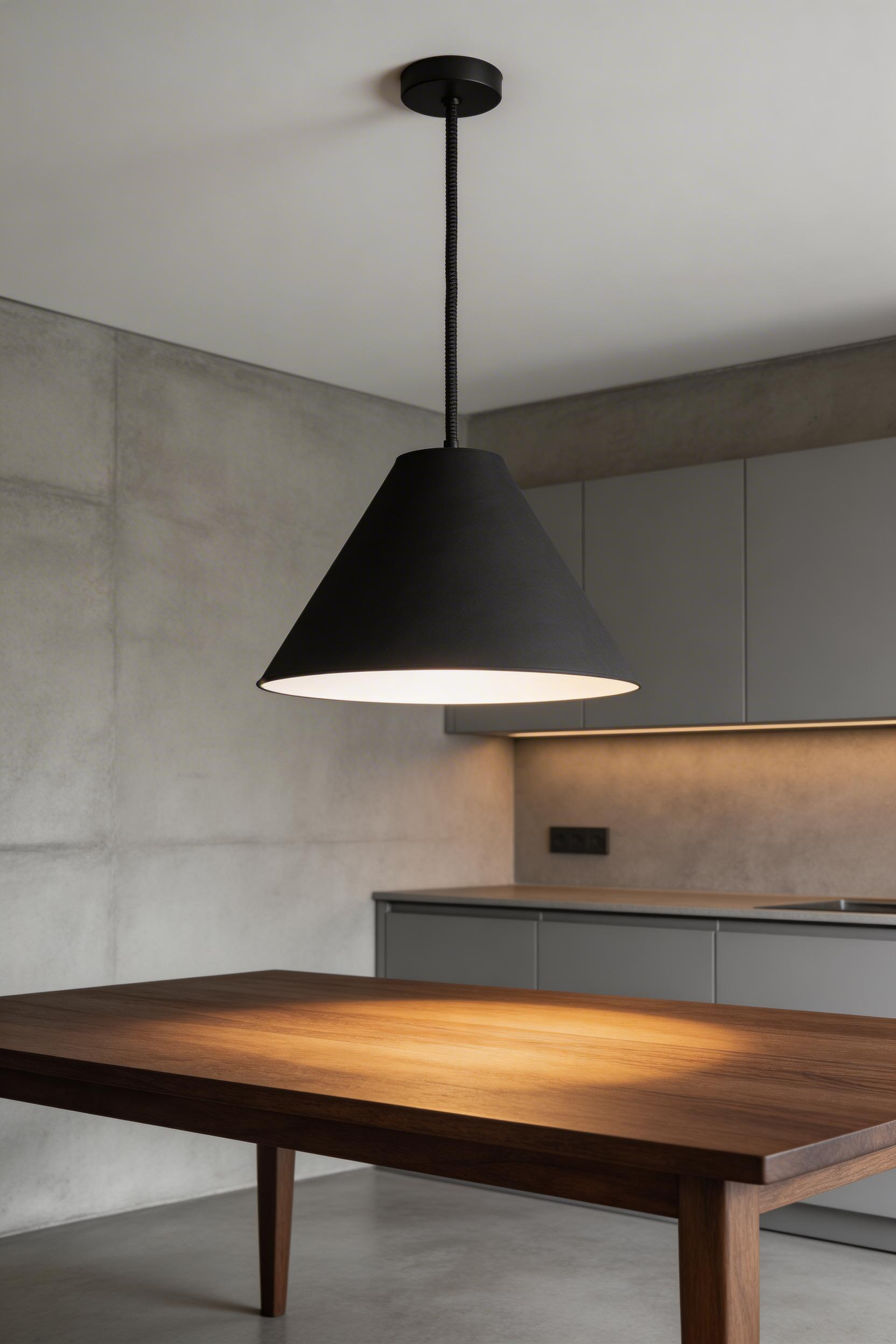
Matte black is the dominant industrial finish in contemporary kitchen design. It reads against white, grey, dark timber, marble, and concrete with equal conviction. The classic barn shade — a wide metal bowl, matte black exterior, white interior — bounces a warm, even light downward across the table surface. The cage variant, a geometric iron frame with an inner wireframe structure, adds visual complexity while keeping the industrial language intact.
For kitchens that want the structural quality of industrial design without its austerity, unlacquered or burnished brass brings warmth back into the scheme. A matte-black-and-brass combination — black exterior with brass interior or hardware — is among the most successful dual-metal treatments available. Raw steel pendants, left unsealed to develop a natural patina, bring the most authentically industrial character. They are not for everyone, but in the right kitchen they read as entirely coherent. In a kitchen environment, a periodic light oil treatment preserves the surface while maintaining the aged quality.
—
11. Ceramic and Stoneware Shade Pendants as Kitchen Table Lighting
A ceramic pendant shade is a slow thing. You look at it once and see a lamp. You look at it again and notice the slight irregularity in the form. The rim is not quite level. The glaze pools differently on one side. The shadow falls across the surface as if the clay itself has a topography. This is what a ceramic shade offers that no other material can: actual individuality. Not a finish option. Not a brand identity. Individuality.
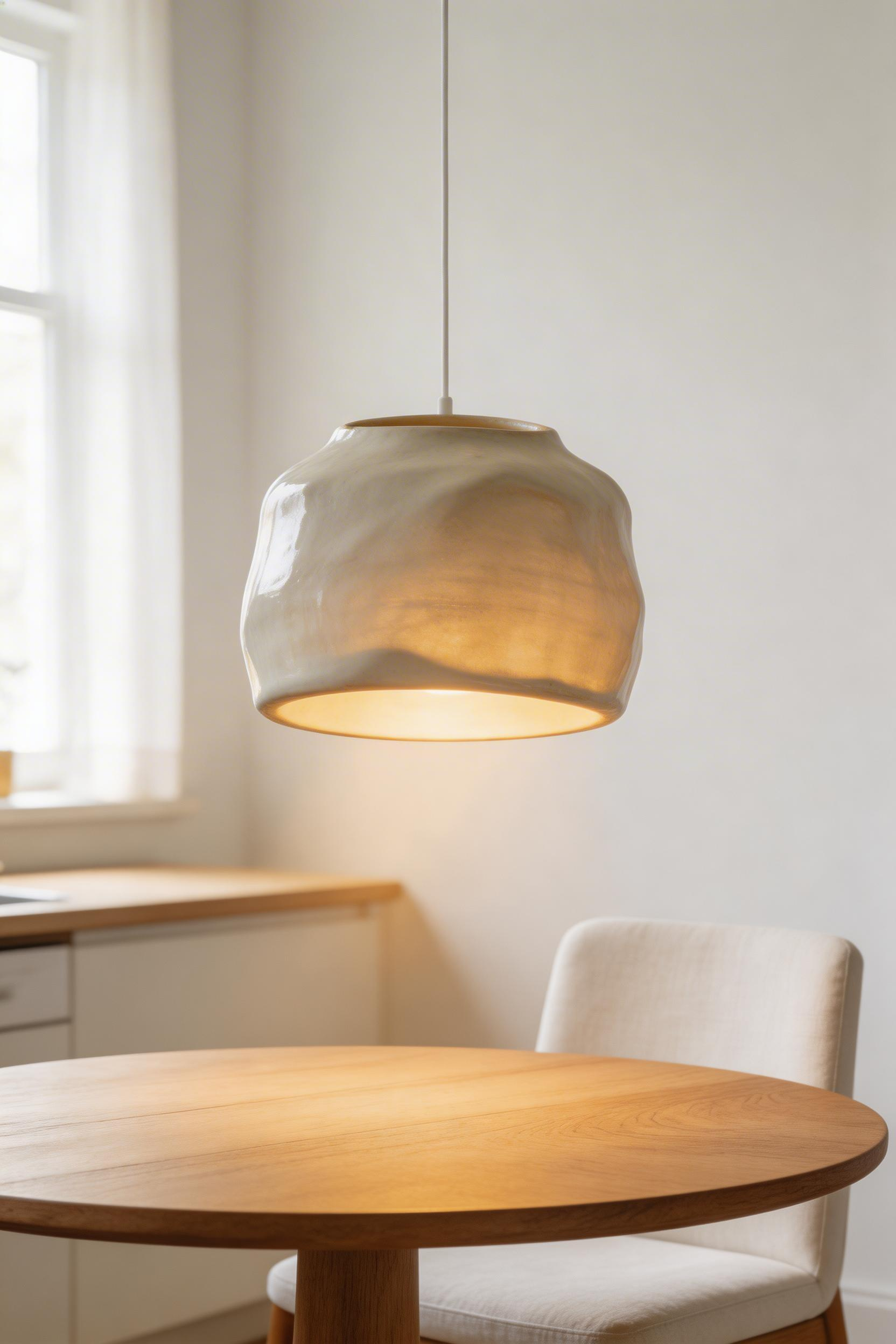
Hand-thrown and cast stoneware shades are made one at a time. Cedar & Moss produces stoneware shades with turned wood canopies, each fixture handmade to order in Portland. Notary Ceramics hand-throws each shade on a potter’s wheel — a small, female-owned Portland studio whose shades carry the literal mark of the maker’s hands. Muddy Heart, a British maker, offers stoneware shades with hand-carved cutouts. These produce a starry pattern of light across the ceiling when illuminated. Rex Design marbles differently coloured porcelain clays to create surfaces as individual as a fingerprint.
The light quality from a ceramic shade is soft and diffuse through the shade walls. A directional glow from the open base falls across the table below. The light collects beneath the fixture rather than projecting outward. This creates a contained and intimate atmosphere well-suited to a kitchen table that doubles as a homework, breakfast, or evening conversation space.
Design Integration and Finishing Details
12. Layering Kitchen Lighting Over Table with Ambient and Natural Sources
The pendant above the table does not work in isolation. It is one element within a layered scheme. Understanding how those layers work together is what separates a kitchen that looks beautifully lit from one that simply has lights.
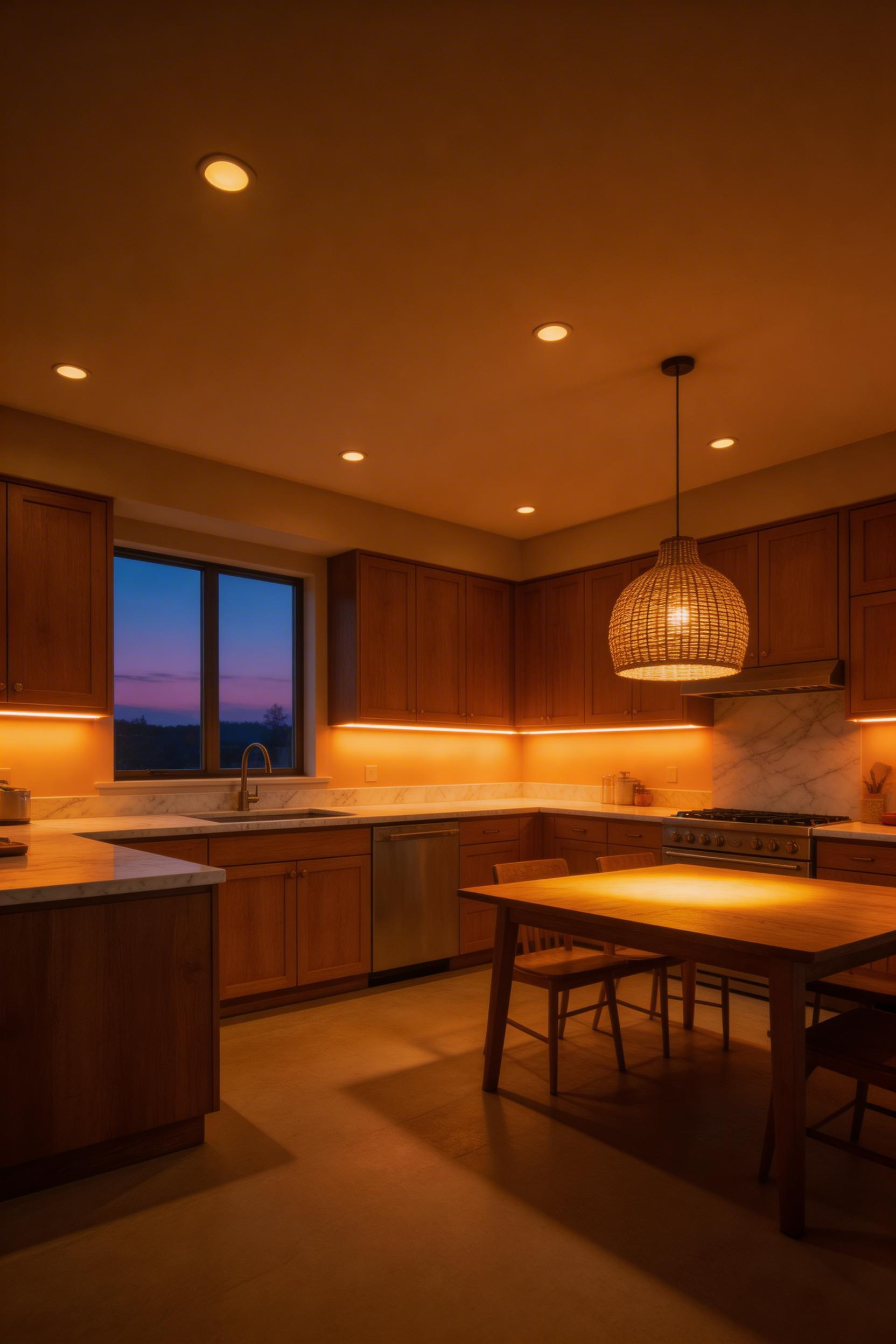
The three layers are ambient, task, and accent. Ambient lighting is the general fill — recessed ceiling fixtures on dimmers that keep the room at a comfortable overall brightness. Task lighting is the functional layer: under-cabinet LED strips that light the worktops for cooking, and the pendant over the table for eating. Accent lighting is the atmosphere layer: concealed LED strips above cabinetry, a picture light, or a warm floor lamp in an adjacent living zone.
The Table Pendant as Dual-Purpose Light
The pendant above the table functions as both task light and, when dimmed, accent light. This dual role makes it the most important fixture in the kitchen. It should be on its own dimmer circuit, independent of the ambient ceiling lights. This means you can bring the ambient lights down and leave the pendant at a warm low setting during an evening meal. There is no need to choose between near darkness and overhead brightness. For kitchen island lighting ideas that follow the same layered principle, the approach translates directly. A kitchen table near a window is lit by sunlight for part of the day. The pendant is most active — and most needed — in the evenings.
—
13. Dimmable Kitchen Lighting Over Table for Variable Ambiance
If there is one technical decision in pendant lighting above the kitchen table that matters more than any other, it is this: make the fixture dimmable. A fixture at full brightness all day is a functional light. A fixture on a dimmer is an atmospheric instrument.
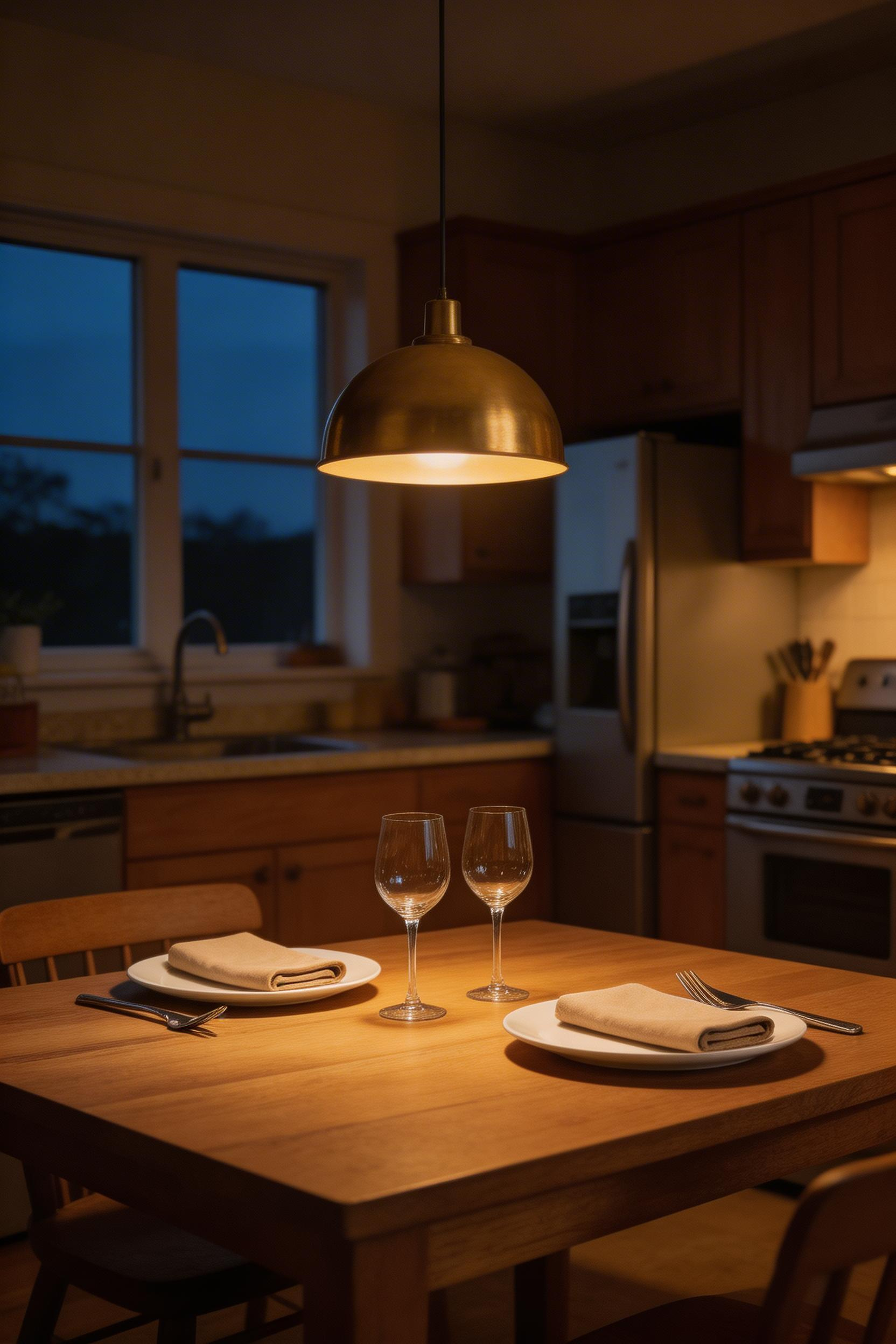
The transformation is startling. At one hundred percent, a 2700K pendant above the kitchen table is a clear, warm work light suitable for a working lunch or family breakfast. When sixty percent, it becomes a comfortable dining light. At thirty percent, it turns the table into a separate room within the kitchen. The same pendant. The same bulb. Three completely different experiences.
Getting the Dimmer Right
Not all LED bulbs are compatible with dimmer switches. Specify ‘dimmable LED’ when purchasing. Fitting a non-dimmable LED on a dimmer switch produces flickering, buzzing, or simply no dimming behaviour at all. For dimmable LEDs, match the dimmer switch model to the bulb manufacturer’s compatibility list. Choosing the right bulbs gives a clear overview for anyone working through this. Some smart LED systems include a ‘warm-dim’ feature that shifts colour temperature downward as brightness drops. This mimics the warm amber shift of an incandescent at low settings — a genuinely useful addition for kitchen table use. The recommended operating range: full brightness for breakfast; sixty to seventy percent for everyday meals; twenty to forty percent for evening dining.
—
14. Kitchen Lighting Over Table in Open-Plan Living Spaces
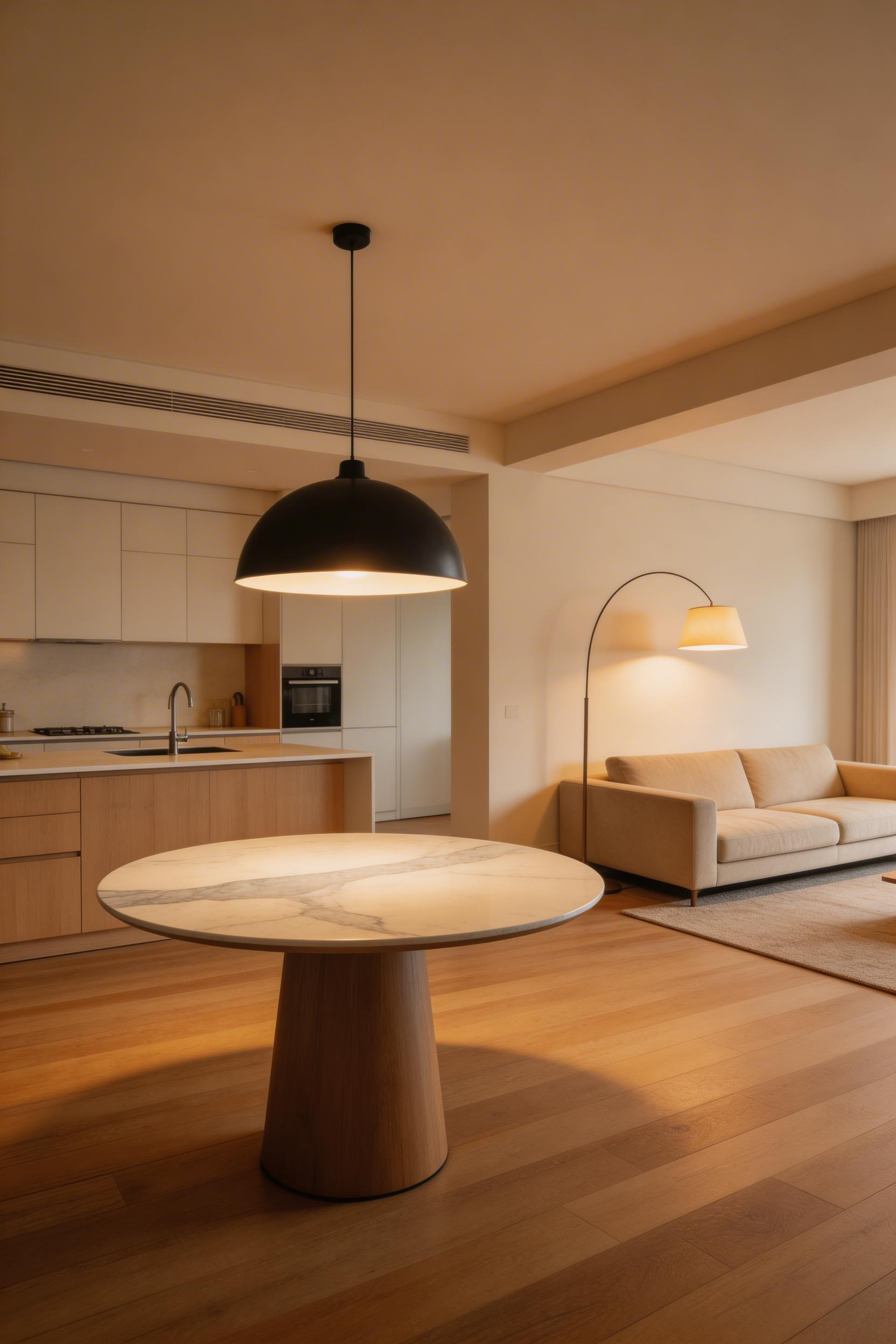
An open-plan kitchen presents a specific challenge: the table is no longer contained within a room. It sits within a continuous space that also includes cooking, living, and sometimes working. The pendant above the table must define its territory within that open floor plan without fighting with the lighting in adjacent zones.
Zoning with Downward Focus
The pendant’s role in an open-plan kitchen is partly architectural. A well-positioned fixture above the table draws a circle of warm light that marks the dining territory. An omnidirectional globe pendant scatters light in all directions and blurs the boundary of the zone. A downward-focused shade — a dome, barn, drum, or cone — keeps the light where the table is and preserves the zone’s definition.
Colour temperature consistency between zones matters more than fixture style. If the kitchen table pendant runs at 2700K and the living room floor lamp at 4000K, the visual junction between spaces will look wrong. Aligning all zones within a shared 2700-3000K range, then varying brightness and fixture style to distinguish each area, produces a coherent open-plan scheme. For broader modern kitchen decor ideas that take the whole open-plan kitchen into account, pendant zoning and consistent colour temperature are the recurring principles.
A final consideration: pendant height in a social environment. Keep the bottom of the pendant at sixty-four to seventy-two inches from the floor. Combined with a table at thirty inches, the thirty to thirty-four inch clearance is only achievable in kitchens with ceilings of at least eight feet.
—
15. Choosing the Right Bulb Temperature for Kitchen Lighting Over Table
The final decision in kitchen lighting over table is the least visible and the most underestimated: bulb colour temperature. You can choose the perfect pendant, hang it at the perfect height, position it with precision — and then fit a 4000K bulb and undo most of the work.
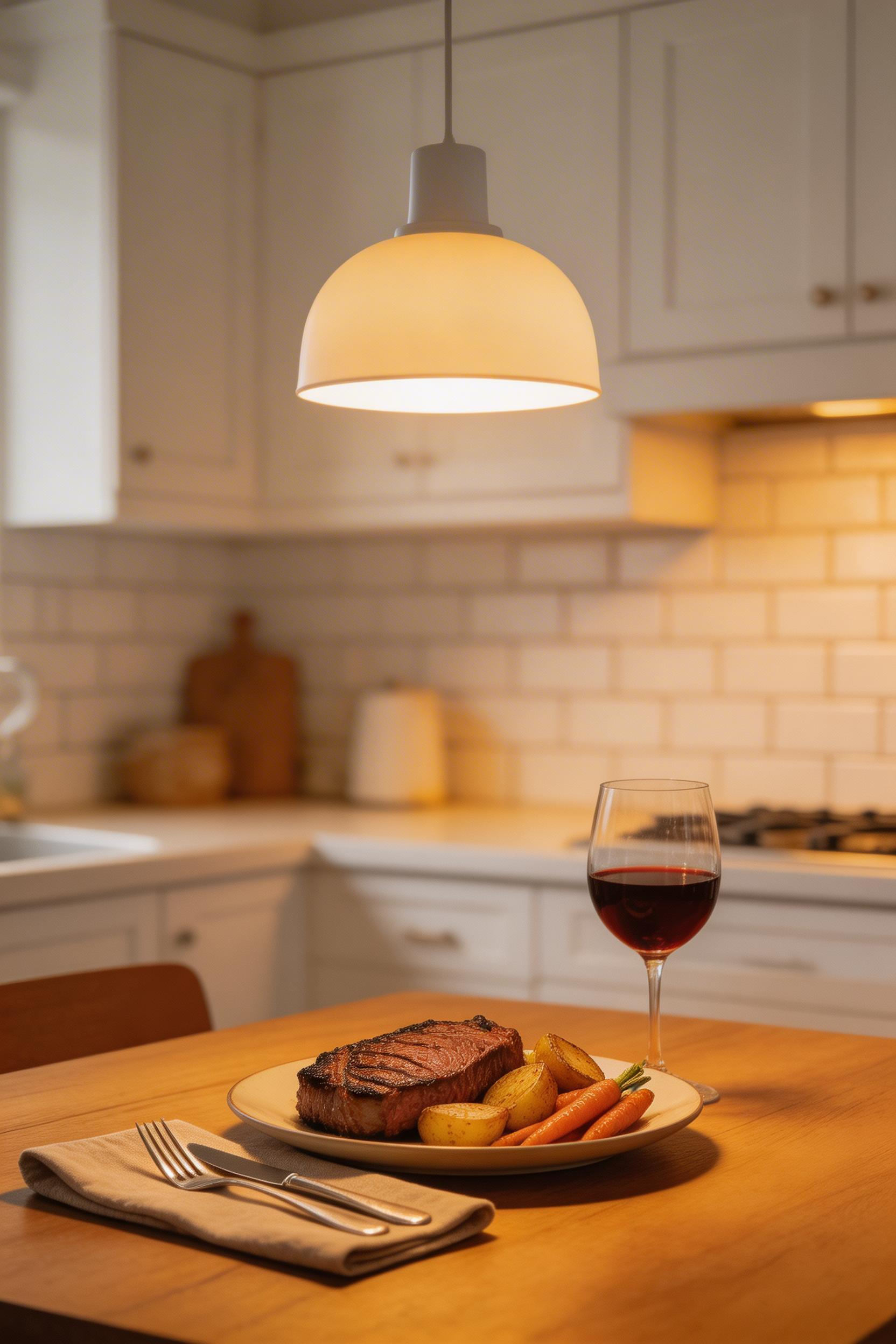
For a kitchen table, 2700K is the designer’s consistent recommendation. At this temperature, the light has a warm yellow-white quality that flatters food and skin tones with equal reliability. Red and orange tones in food — roasted vegetables, a pasta sauce, a grilled steak — are enhanced by warm light and look rich and appealing. The same food under a 4000K bulb looks flatter, slightly grey, and significantly less appetising. This is not a subjective impression. The physics of warm light and food colour rendering are well-established in restaurant and hospitality design. They apply equally to a kitchen table.
2700K vs 3000K
3000K is a reasonable alternative, particularly in kitchens that double as workspaces. It is slightly more vibrant — a clean warm white rather than a warm yellow-white. It handles the transition from daytime task use to evening dining more smoothly. The difference between 2700K and 3000K is most noticeable in direct comparison. In practice, both sit far warmer than the cool white 4000K that belongs in offices and bathrooms, not above kitchen tables. Smart bulbs — Philips Hue White Ambiance, LIFX White — allow the temperature to shift from higher in the morning to a warm 2700K for dinner. For more on dining room fixtures and their light quality, dining room chandeliers covers the same temperature and rendering principles in a formal context.
—
Finding Your Kitchen’s Lighting Moment
Kitchen lighting over table is not a single decision — it is a series of layered ones, each building on the last. The pendant style sets the room’s visual register. The scale and height determine whether the light does its job. The material communicates something about how the kitchen understands itself. The dimmer unlocks the range from workaday to atmospheric. The bulb temperature decides how the food looks and how the room feels.
What connects all fifteen ideas is a single principle: the light above the kitchen table deserves the same care as the table itself. A beautiful table lit carelessly is an opportunity lost. The same table under a pendant chosen with equal care — the same attention given to the chairs, the surface, the room — that is a kitchen that has understood what it is for. That is the difference. It is a kitchen that has a moment: a warm pool of light, a gathering place, and the confidence of a space considered from floor to ceiling.