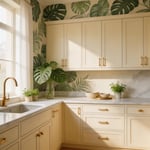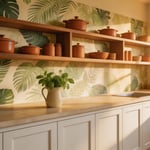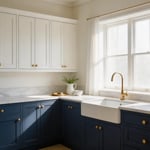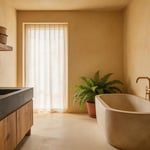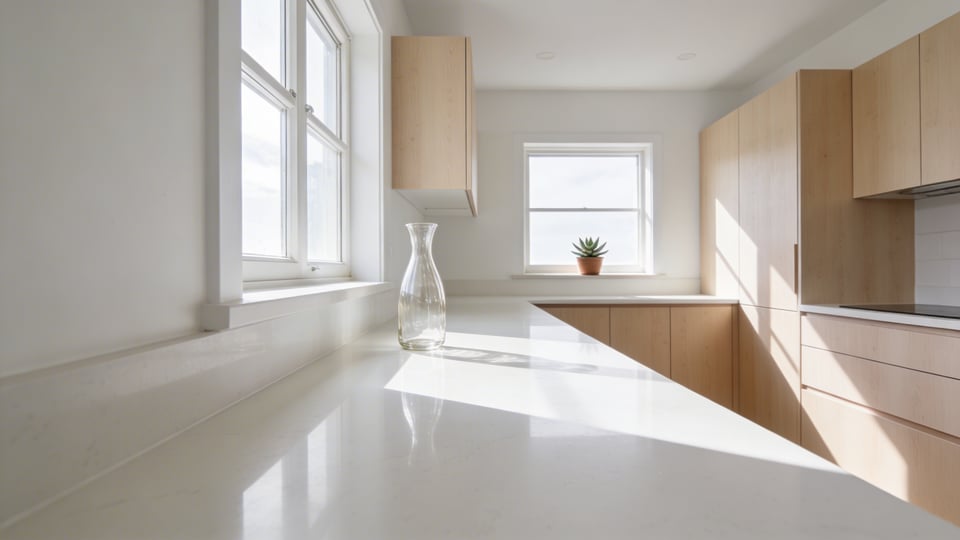
Many homeowners believe a small kitchen demands maximizing every possible inch of storage. Consequently, we often fill walls with cabinets and cover countertops with appliances. However, this density creates a heavy, stagnant atmosphere that feels smaller than reality. Instead of stuffing the room, we must embrace the Japanese design principle of *Ma* (間). Mastering the art of small kitchen decor involves more than just selecting compact appliances; it requires a shift toward bespoke cabinetry and visual respiration. By treating the room as a curated sanctuary, we allow functional elements to resonate within an intentional, “active emptiness.”
Often misunderstood as simple nothingness, *Ma* is more accurately described as “active emptiness.” Ideally, it acts as the necessary pause that allows functional elements to resonate. Consider the Japanese character for *Ma*, which explicitly depicts a sun positioned within a gate. This imagery suggests that a space is never truly empty if it is filled with light. Without these intentional gaps or “gates,” a small footprint feels restrictive.
Moreover, both history and modern science support this intuitive approach. The traditional *Mizuya* tea preparation room utilized hidden storage to maintain essential “visual respiration.” Similarly, recent studies indicate that specific “void ratios” significantly lower our cognitive load. Therefore, a kitchen should function as a place of ritual readiness, not merely storage. This guide reveals how to transform a cramped utility room into a curated sanctuary. We will examine the “respiration ratio” and the importance of flow over furniture. Ultimately, true luxury is not abundance, but the freedom to move.
Phase I: Foundation—Establishing the Meditative Canvas
Establishing a meditative canvas begins with subtraction. In small spaces, every object emits “visual noise.” Consequently, the brain must work harder to process a cluttered environment. Therefore, the first step is a subtractive reset. To find inspiration, you might explore these 22 meditative small kitchen decor ideas for a harmonious home that prioritize tranquility over density. Remove items that do not serve a daily ritual. In fact, research links clutter directly to elevated stress hormones. Thus, keeping countertops clear allows the mind to rest.
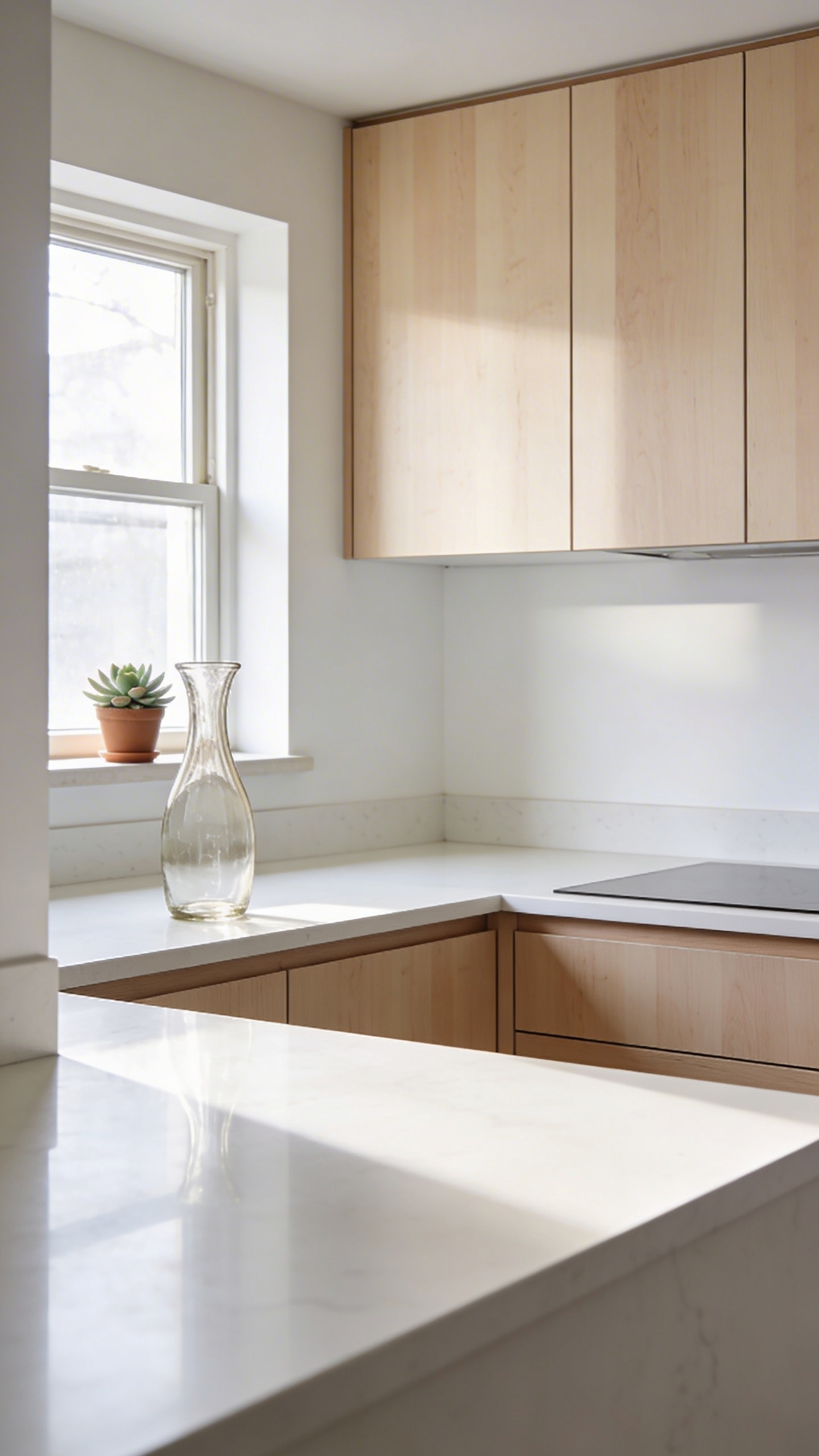
Next, consider the Japanese concept of *Ma*, or intentional voids. Rather than filling every inch, leave “strategic voids” on shelves. These empty spaces act as breathing room for the eyes. As a result, the walls feel less confining. Effectively, this psychologically expands the room’s footprint without moving a single stud.
Simultaneously, the color palette requires attention. Move beyond sterile white toward “mucky neutrals” like greige or soft oat. These tones create a cocooning effect. Furthermore, lighting must shift from harsh overheads to layered ambient sources. Soft, diffused light obscures the room’s tight boundaries.
Finally, focus on tactile grounding. Avoid high-gloss synthetics that feel cold. Instead, prioritize organic materials that develop a patina, such as reclaimed wood or unglazed ceramics. Specifically, these raw textures anchor you to the present moment. Ultimately, this approach turns a functional workspace into a sensory sanctuary.
1. The Art of Elimination: Decluttering as a Design Ritual
In small kitchen design, elimination functions as a sophisticated ritual rather than a chore. Specifically, this practice creates *Ma*, the concept of the “pure void.” This philosophy dictates that emptiness is not a lack of design; rather, it *is* the design. Therefore, we must reject the impulse to fill every “wasted” inch with storage. By intentionally leaving surfaces forty percent open, we create a “breathable” atmosphere. Consequently, singular objects, like a handmade mortar, gain profound visual presence. Without this negative space, even luxury decor becomes mere visual noise.
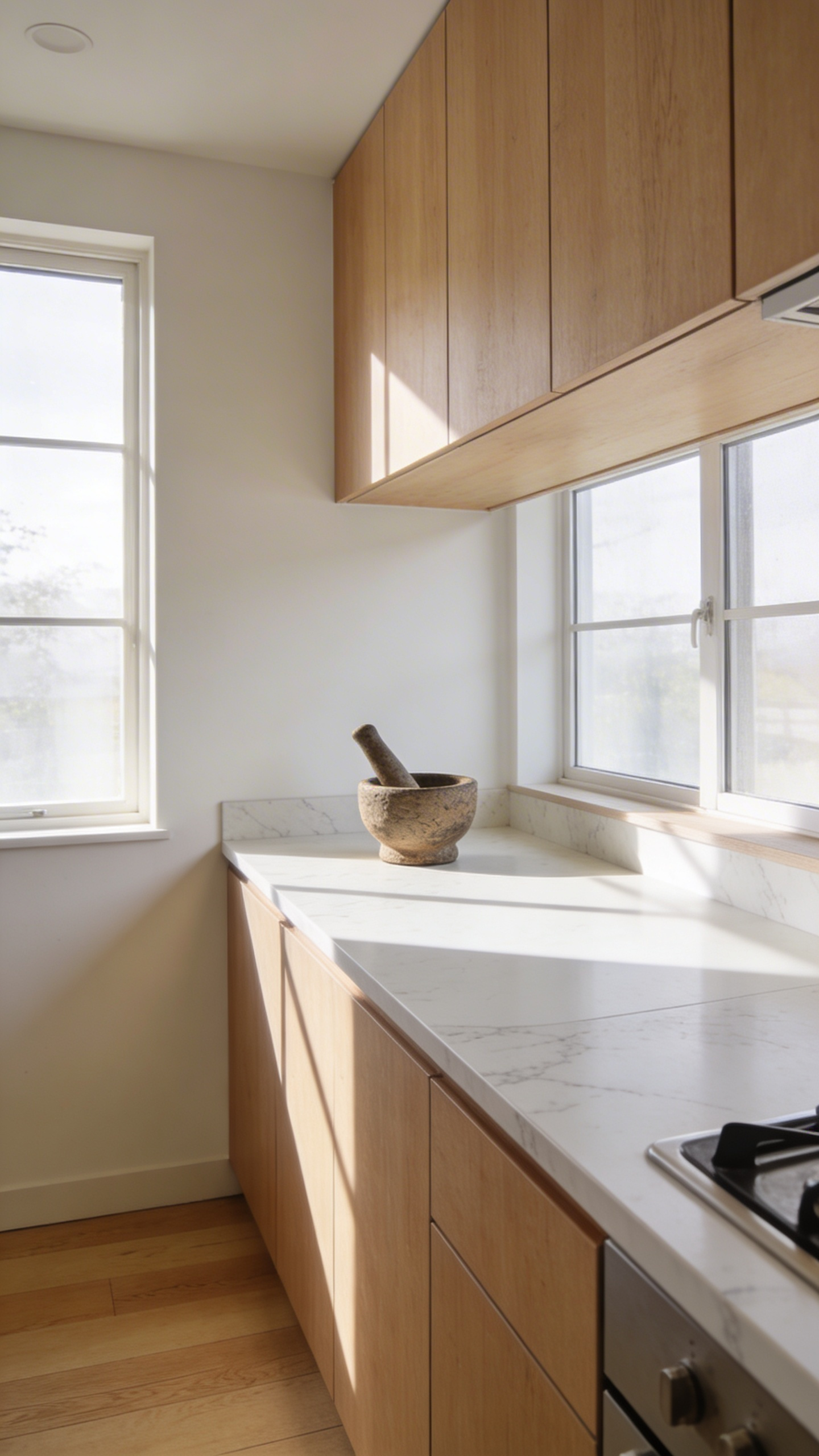
Furthermore, this approach establishes a calming psychological architecture. Studies indicate that high visual complexity directly correlates with increased cortisol levels. Thus, a cluttered kitchen triggers a subconscious stress response. To combat this, we can adopt the chef’s principle of *Mise en Place*. This “kitchen religion” ensures only immediately necessary tools remain visible. Effectively, this removes “visual friction” and creates a streamlined sightline. Finally, the result is sensory optimization. Natural light acts as a material, “painting” the exposed surfaces. Ultimately, the silence of an uncluttered counter becomes the room’s most luxurious feature.
2. Chromatic Silence: Utilizing Monochromatic Palettes to Dilute Boundaries
Chromatic silence transforms a small kitchen from a utilitarian box into a sensory sanctuary. Fundamentally, this concept reduces visual “stutter.” Traditional designs often rely on high-contrast breaks, effectively creating noise. Consequently, the brain processes every edge, making the room feel segmented. In contrast, utilizing a monochromatic palette creates a seamless flow. This technique, known as “color drenching,” effectively dilutes physical boundaries. Therefore, the eye travels across surfaces without interruption, pushing the walls outward visually.
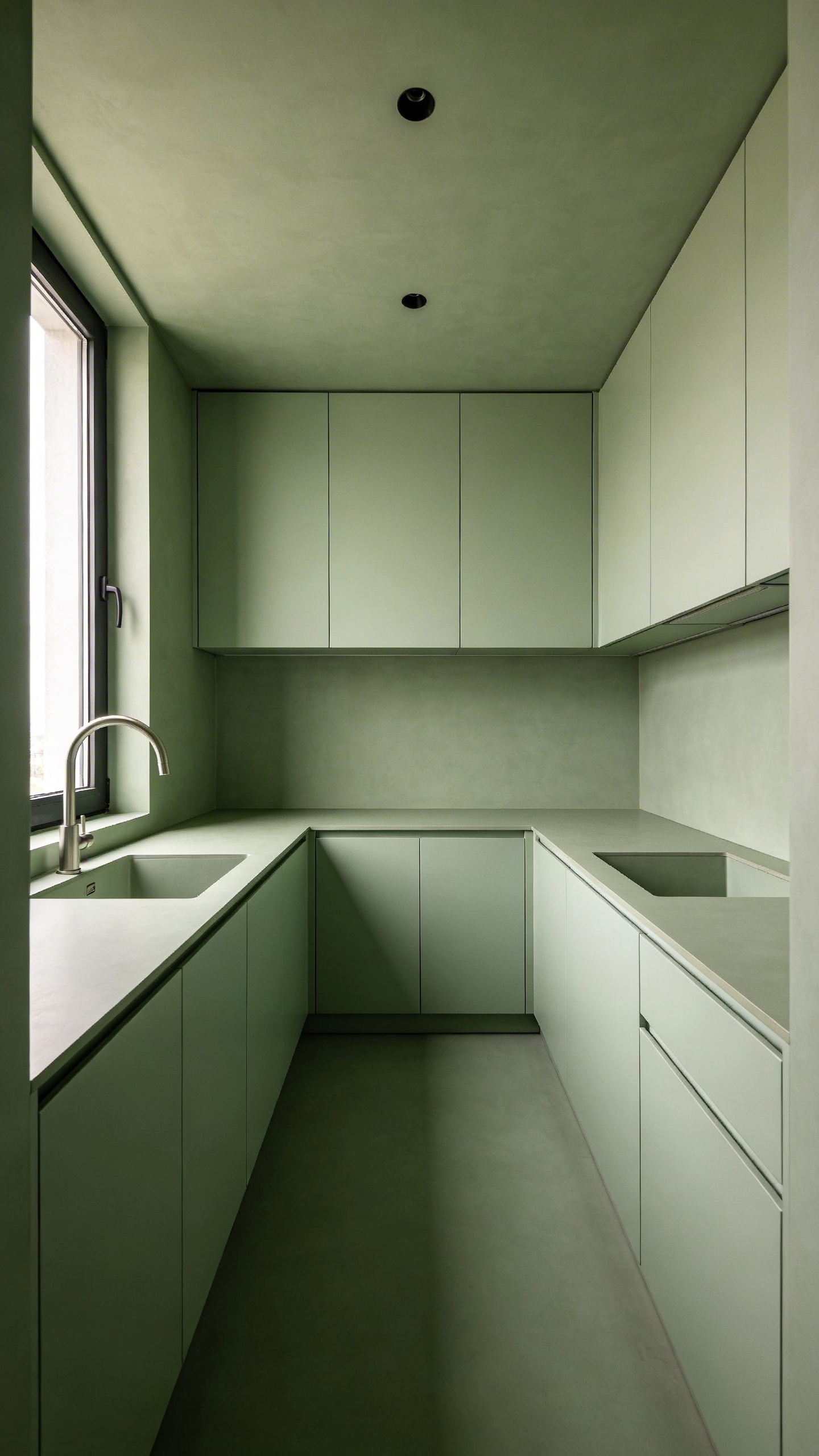
However, this silence requires nuance. We are shifting away from clinical whites toward enveloping hues like “Cloud Dancer.” These soft, breathing shades react dynamically to natural light. To prevent the space from feeling flat, texture becomes the new color. Specifically, designers employ a strategic mix of finishes. For instance, pairing matte cabinets with high-gloss backsplashes creates necessary depth. This interplay mimics the natural environment, ensuring the room feels alive.
Furthermore, material choice is crucial. Industrial materials like orbitally finished stainless steel offer rhythm through light reflection. Ultimately, true silence demands the removal of visual clutter. Thus, handleless architecture acts as the backbone of this aesthetic. By eliminating hardware, we honor the Japanese concept of *Ma*, or negative space. This approach allows the kitchen to exist as a continuous, calm volume.
3. Light and Shadow: Maximizing Natural Illumination to Expand Perception
In small kitchen decor, light acts as a psychological tool to manipulate perceived volume. Consequently, the common instinct to flood a room with brightness often backfires. Instead, sophisticated design utilizes contrast to create necessary depth where there is none.
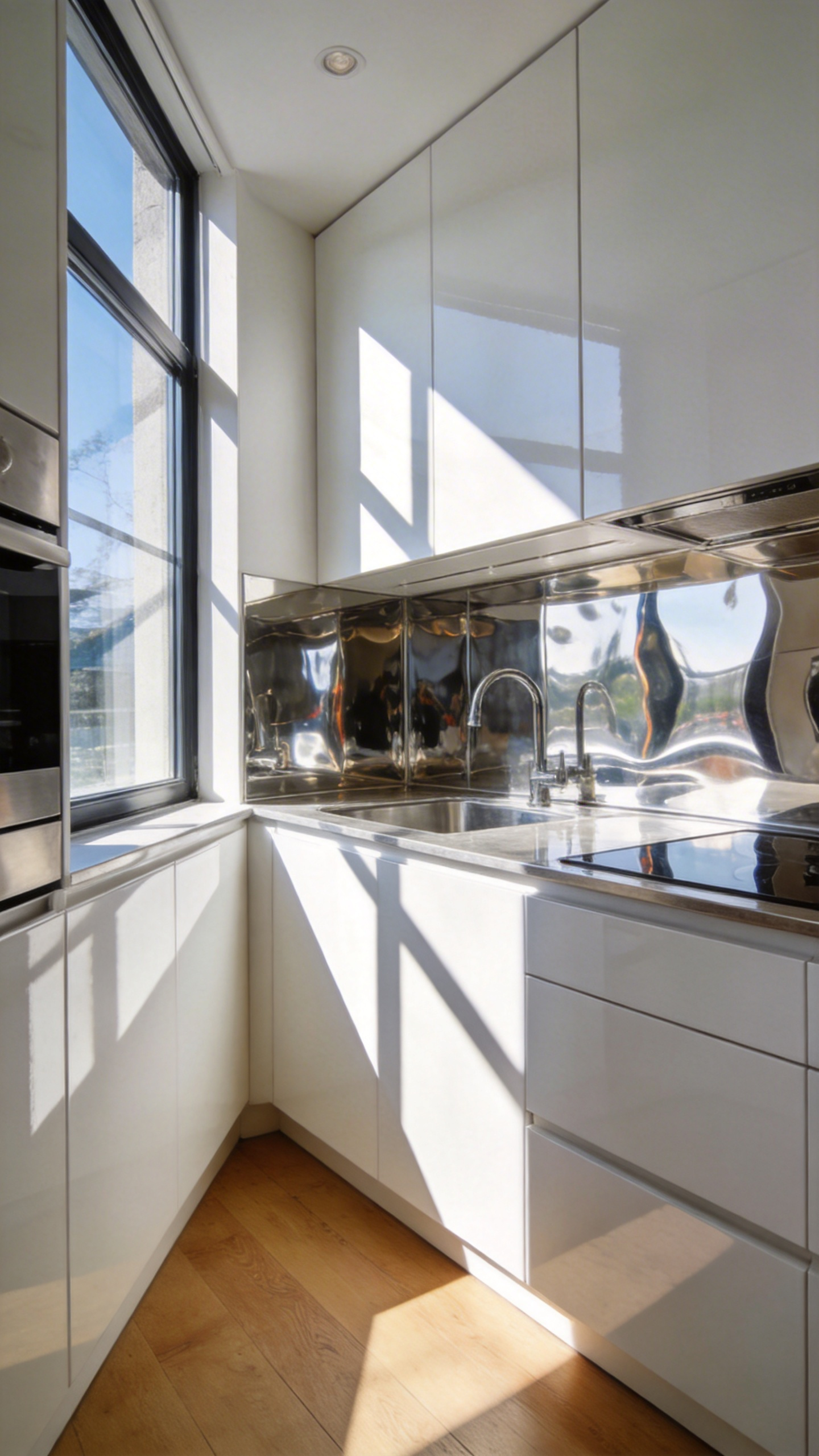
Specifically, understanding the physics of reflection is vital for maximizing space. Specular reflections on smooth surfaces, like stainless steel, preserve light directionality. Thus, they create virtual images that trick the eye into seeing beyond the wall. Conversely, diffuse reflections on matte stone provide essential visual weight. Without them, a room feels like a flat, sterile “light box.” Therefore, a mixed-reflection environment creates the most expansive atmosphere.
Furthermore, shadows function as invisible architecture. Historically, Jun’ichirō Tanizaki argued that beauty lies in the “patterns of shadows” rather than light itself. In a galley kitchen, rhythmic shadows from slatted screens act as vanishing points. As a result, the eye is drawn outward, lengthening the space visually. Similarly, creating shadow pockets with open shelving adds distinct visual relief to the back wall.
Finally, consider the temporal narrative of the room. Static lighting makes small spaces feel stagnant. For instance, solar tubes offer a dynamic solution for windowless areas. Unlike flat skylights, these diffusers mimic a window’s natural glow. Ultimately, this interplay transforms a cramped enclosure into a breathing environment.
4. Flooring Continuity: Seamless Transitions to Borrow Visual Space
The concept of flooring continuity serves as a strategic architectural tool rather than a simple aesthetic choice. Historically, this principle is rooted in the Modernist movement, intended to break the Victorian habit of compartmentalized rooms. In a small kitchen, the floor acts as your primary visual horizon. Consequently, if that horizon breaks at a threshold, the brain registers an immediate “stop” command. This signals that the room has ended, effectively shrinking the space. Therefore, extending materials like engineered oak or large-format porcelain invites the eye to travel further.
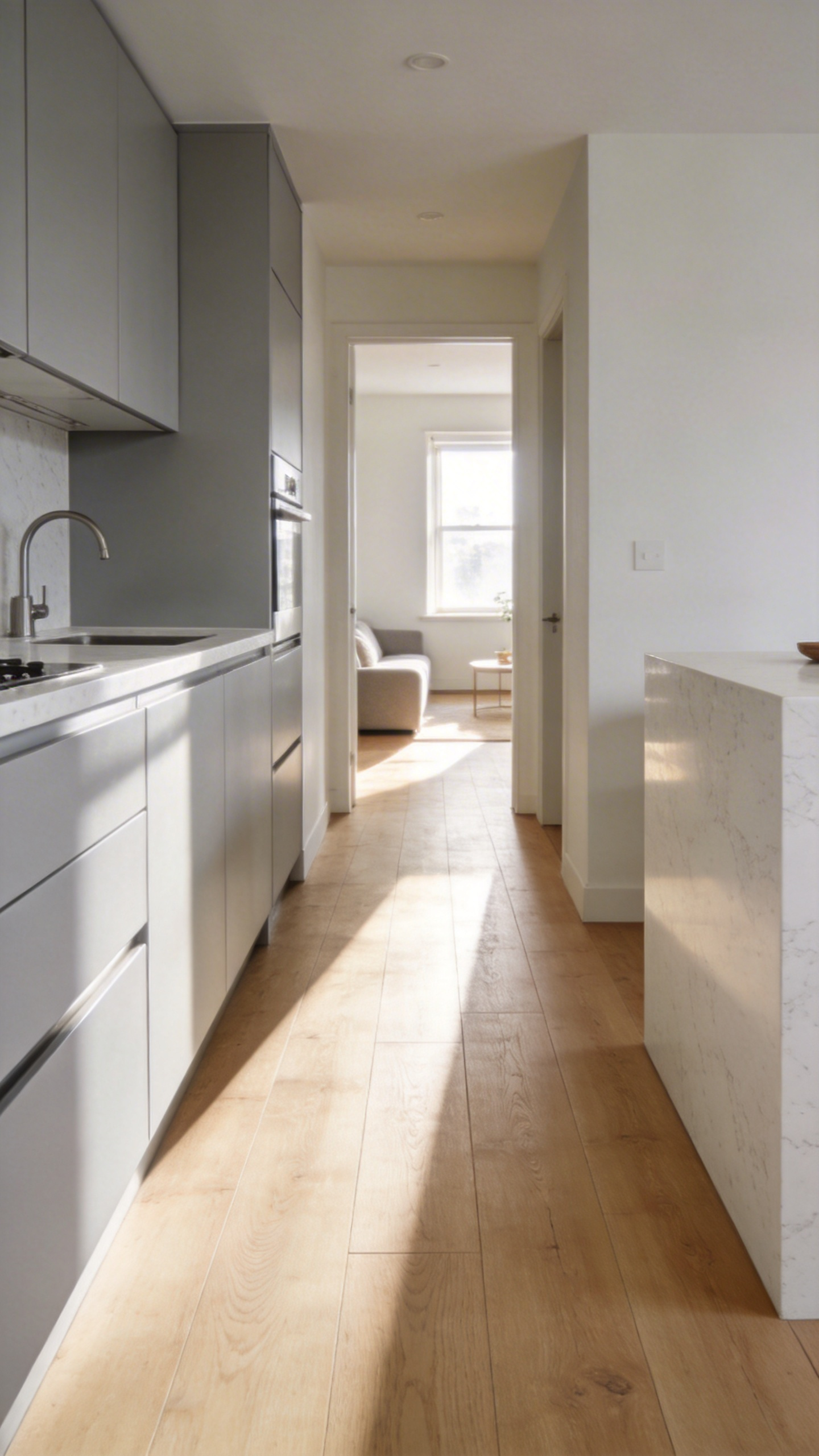
Specifically, this technique allows a compact kitchen to “borrow” visual volume from the adjacent living area. Furthermore, recent neuro-architecture research supports the value of a “zero-threshold” experience. For those looking to update their space without a complete overhaul, applying these 22 kitchen makeover ideas without a full renovation can provide high-impact visual results. Even a small transition strip causes a micro-adjustment in gait. Conversely, a seamless floor removes this barrier, creating a fluid rhythm.
Fortunately, modern innovations make this easier to achieve than ever before. For instance, water-resistant Luxury Vinyl Planks (LVP) allow wood textures to run safely under kitchen sinks. However, some distinct zoning may still be necessary in studio layouts. In these cases, designers often employ a monochromatic solution to maintain harmony. By matching the color value of different materials, you signal a change in utility without tripping the eye. Ultimately, eliminating visual noise creates the breathable atmosphere essential for small spaces.
Phase II: Materiality—Wabi-Sabi and Texture
In a confined kitchen, luxury is redefined through haptics, or the sense of touch. Specifically, nearly every surface in a small footprint is within arm’s reach. Therefore, the visual “weight” of these materials drives the room’s atmosphere. Wabi-Sabi philosophy teaches that beauty exists in the unrefined and imperfect. Consequently, avoiding high-gloss, synthetic surfaces prevents the space from feeling clinical or claustrophobic.
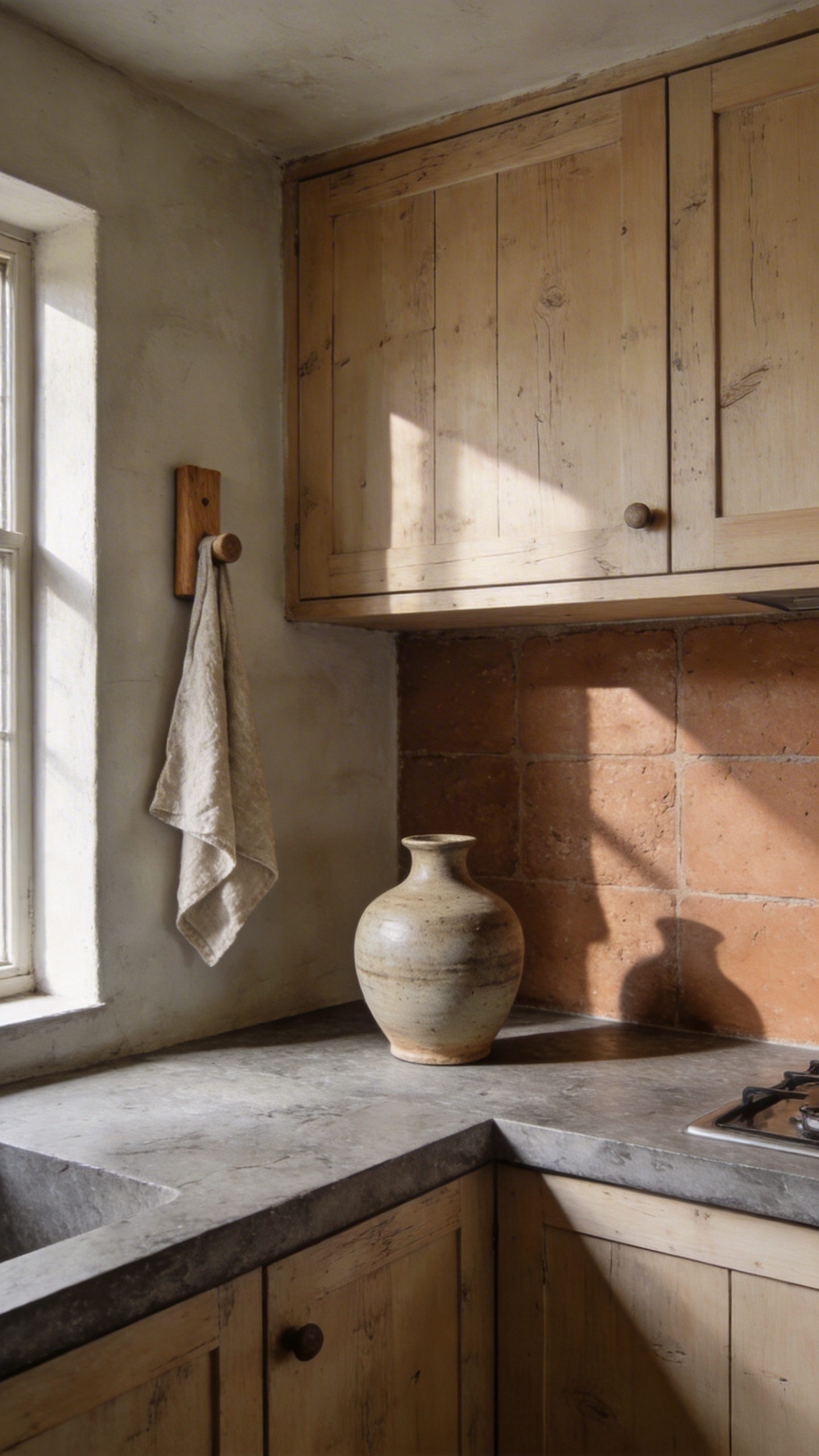
Instead, introduce micro-textures to create *Ma*, the concept of negative space. For instance, hand-troweled lime wash walls make the perimeter seem to “breathe.” Thus, the kitchen feels intimate rather than cramped. Your eye lingers on the grain of reclaimed wood rather than sliding off slippery plastic.
Furthermore, we must embrace *Sabi*, the beauty found in age and wear. In small spaces, surfaces naturally endure high-frequency use. Therefore, choose living materials that evolve comfortably. For example, unlacquered brass faucets develop a dark, rich patina over time. Similarly, a knife mark on a wooden butcher block becomes a memory of a meal rather than a defect.
Finally, avoid the “all-white” trap often used to simulate spaciousness. Conversely, utilize texture as a substitute for flat color. Layering monochromatic tones creates necessary complexity. Specifically, pair a matte linen curtain with a rough-hewn stone mortar. Ultimately, these varied granularities provide quiet depth, allowing the eye to travel smoothly.
5. Honoring Imperfection: Introducing Hand-Thrown Ceramics as Functional Art
In a modern compact kitchen, introducing hand-thrown ceramics rejects the sterile aesthetic of factory perfection. Historically, Japanese tea masters like Sen no Rikyū revolutionized design by prioritizing *wabi-sabi*, the beauty of the incomplete. Therefore, we embrace the “gentle scars” inherent in clay. Unplanned glaze drips or slight warping are not flaws; indeed, they are “marks of life.” These organic details provide a necessary soulful counterpoint to the sharp, cold lines of stainless steel.
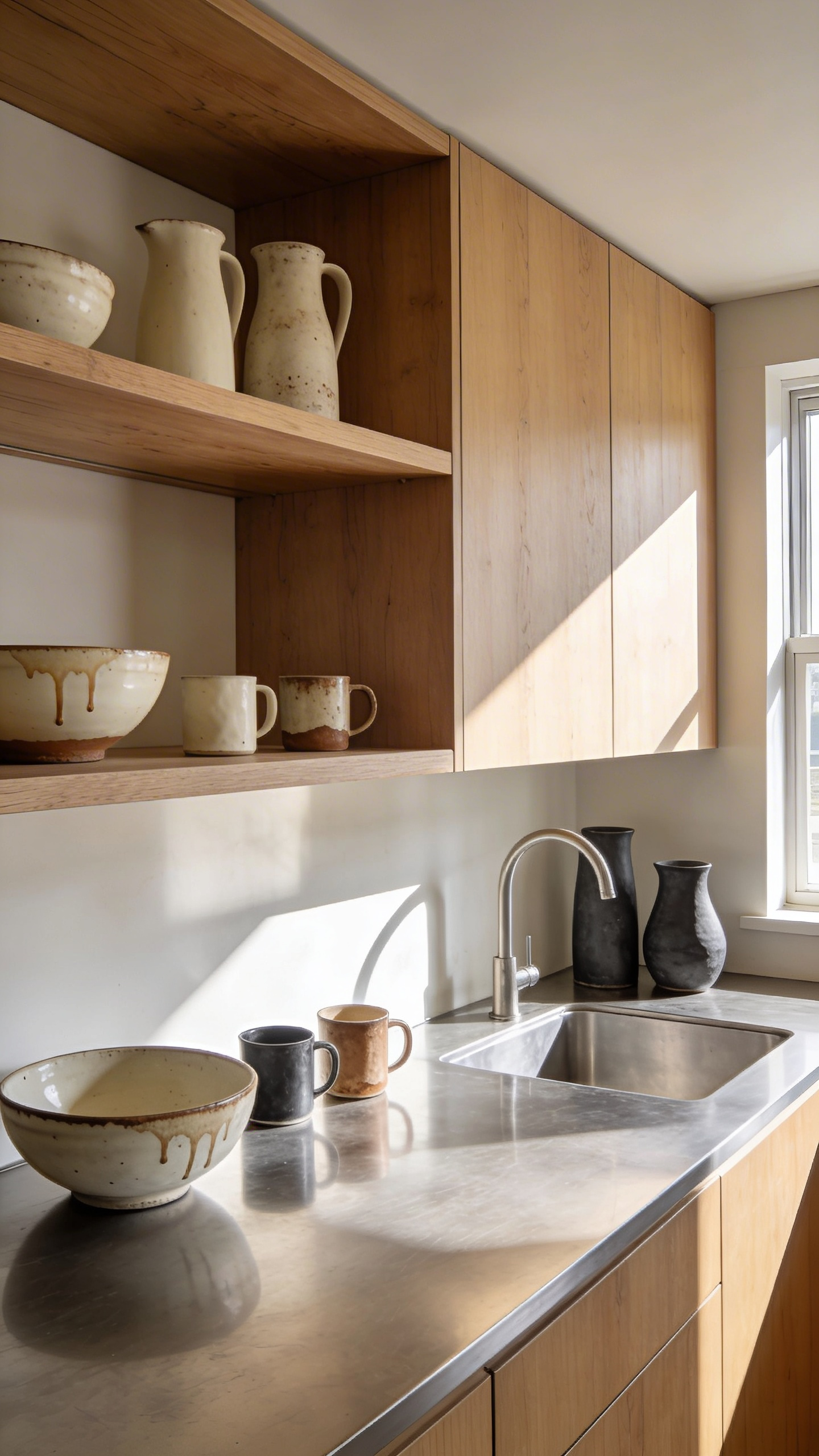
Furthermore, hand-thrown ware offers a unique sensory architecture. Unlike thin industrial porcelain, dense stoneware possesses a “thermal heart,” keeping your morning coffee warm longer. Additionally, your fingers often find the potter’s trimming rings, creating a tactile connection to the maker. Even the sound differs. Specifically, a handmade bowl creates a resonant, grounded thud, contributing to a quieter atmosphere.
Consequently, these items function as vital “focal anchors” in small spaces. Design experts suggest utilizing a “Power-Piece” strategy to manage visual weight. For instance, replace a generic wire rack with a textured, wood-fired utensil crock. This transforms a cluttered necessity into a sculptural element. Ultimately, this elevates functionality to art. Using a unique, “wobbly” bowl turns a simple meal into a mindful ritual.
6. Raw Timber Accents: Warming the Minimalist Void
Minimalism in small kitchens often risks feeling sterile. Consequently, hard surfaces like steel create a clinical atmosphere. However, raw timber accents offer a deliberate organic relief. This strategy effectively shifts design from visual minimalism to “tactile minimalism.” Specifically, wood acts as a visual anchor in a monochromatic void. Because wood grain is irregular, it naturally guides the eye. Therefore, mental fatigue is reduced through this effortless visual flow.
Moreover, raw timber softens the overall sensory experience. Unlike cold stone, wood is a natural acoustic insulator. Thus, it mellows the harsh sounds of a cramped room. Furthermore, touching raw wood triggers a calming biological response. In fact, this connection to nature creates a sense of home. For tight footprints, choose lighter woods like Ash or White Oak.
To maximize space, consider replacing heavy cabinets with timber shelving. Practically, this “vertical relief” lightens the room’s visual load. Additionally, these accents must remain tactile to be effective. Instead of high-gloss varnishes, use penetrating natural oils. Consequently, the wood retains its texture and matte finish. Ultimately, this maintenance becomes a mindful ritual of care.
7. Stone Surfaces: Grounding the Compact Space with Earth Elements
In the context of small kitchen decor, stone serves as a vital physical and psychological anchor. Fundamentally, it introduces the concept of “geological time” into a compact footprint. Unlike synthetic laminates, natural stone creates a sense of permanence and rootedness. For those seeking depth, adhering to 23 principles for authentic kitchen countertop decor ensures your stone surfaces tell a personal story. Specifically, materials like soapstone offer a rich narrative. Known historically as a “settler’s radiator,” soapstone retains heat efficiently. Therefore, it acts as a thermal battery, stabilizing temperatures in tight quarters.
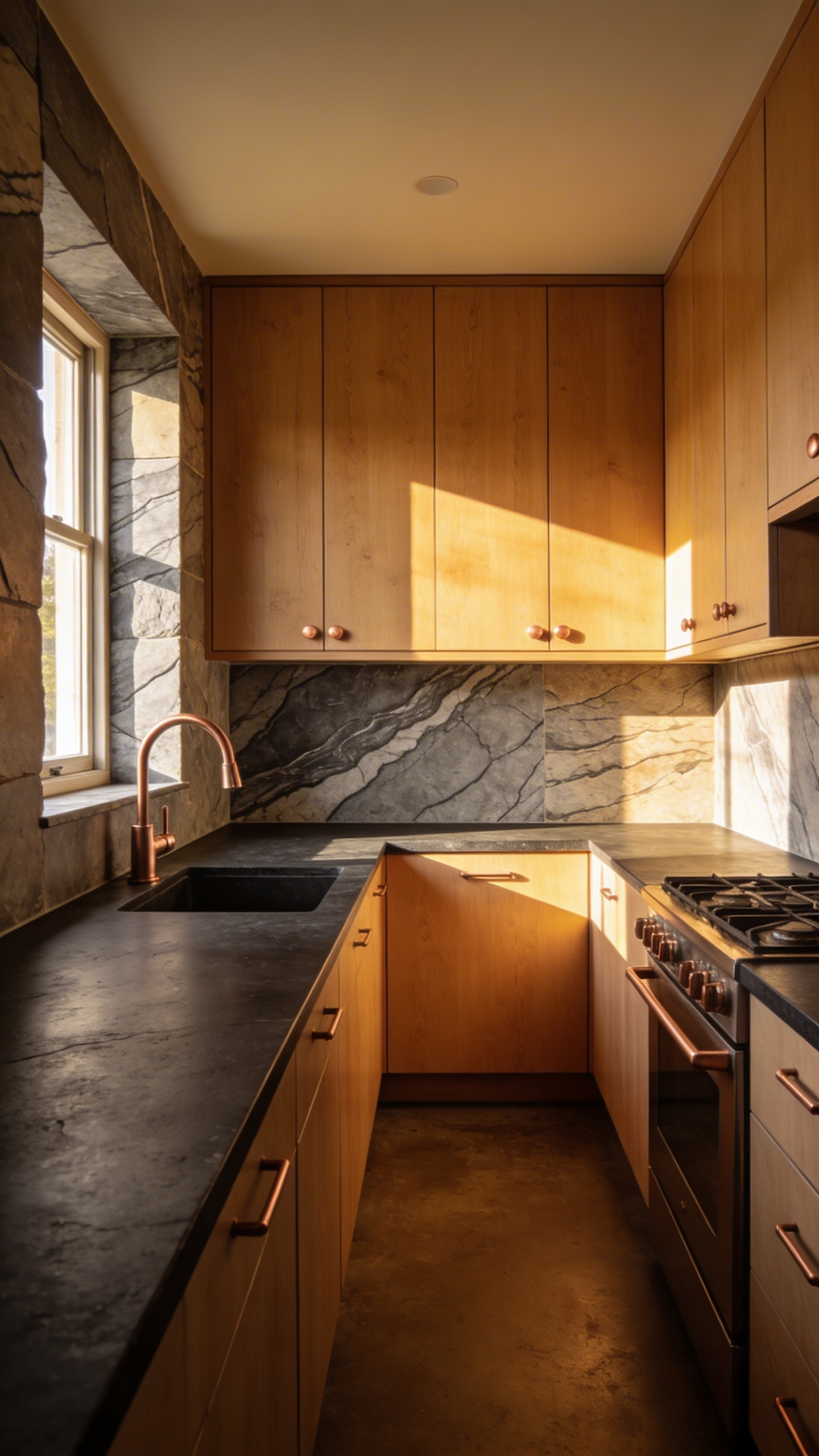
Moreover, the sensory experience of stone transforms the atmosphere. For instance, honed surfaces naturally dampen the sharp acoustics of a busy kitchen. Instead of a metallic clatter, setting down a mug creates a solid, quiet thud. Additionally, minerals like mica scatter light rather than simply reflecting it. Thus, they add visual depth to the counter. This prevents the space from feeling flat or sterile. Furthermore, softer stones develop a patina over time. Eventually, the surface records the home’s history through subtle scratches and wear. Ultimately, incorporating these earth elements grounds the frantic energy of modern life.
8. Textile Softness: Linen Curtains and Natural Weaves to Absorb Sound
In the hard-surfaced environment of a small kitchen, acoustic control is often overlooked. However, incorporating natural textiles serves as a vital strategy to dampen noise. Specifically, linen functions as a “soft anchor” amidst industrial appliances. Unlike smooth synthetics, flax fibers feature natural irregularities known as “slubs.” These textural imperfections scatter sound waves rather than reflecting them directly back into the room. Consequently, this reduction in echo lowers the cognitive load, making the space feel calmer.
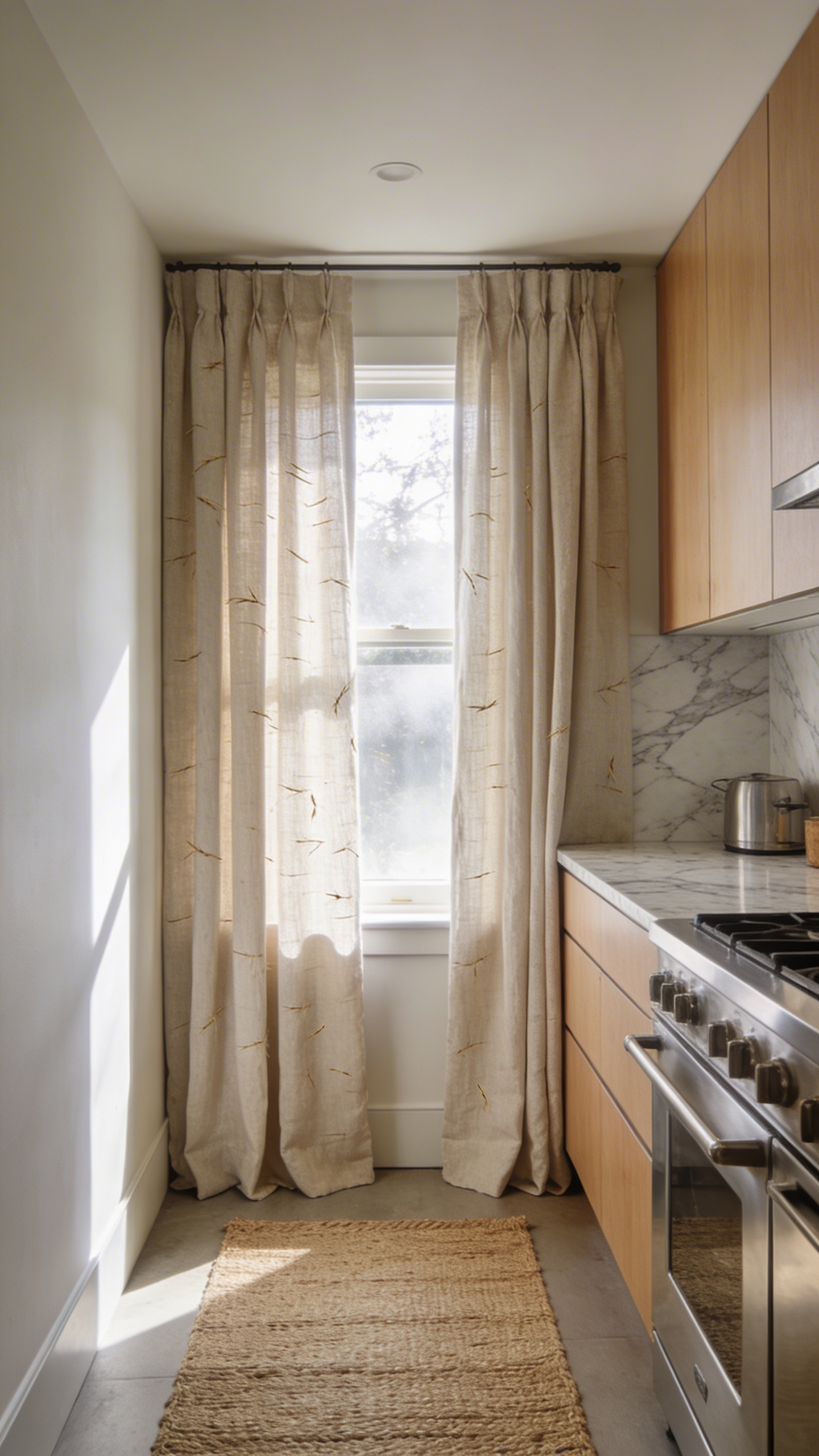
To implement this without sacrificing light, designers often utilize the Viennese café curtain. By covering only the lower window, you soften the active “noise zone” where washing and chopping occur. Simultaneously, the upper window remains open to preserve a sense of airy spaciousness. Furthermore, linen is superior to heavy velvets regarding olfactory hygiene. Its breathable nature prevents the trapping of lingering cooking odors or grease.
For maintenance, a simple white vinegar rinse effectively clears the fiber’s pores. Regarding installation, you must aim for “100% fullness” by doubling the fabric width. In fact, deep vertical pleats significantly increase the surface area available for sound absorption. Finally, mounting curtains two inches off the glass creates an insulating air gap. This invisible buffer effectively muffles street noise, restoring tranquility.
Phase III: Spatial Architecture—Function as Aesthetic
To understand Phase III, one must view the kitchen as a structural installation. It is no longer a collection of appliances, but a high-performance space where engineering creates beauty. Historically, this philosophy stems from the 1926 Frankfurt Kitchen. Specifically, that design transformed the room into a “living engine” prioritized for efficiency. Modern luxury homeowners often favor 19 modern kitchen decor ideas that balance form and function to achieve this streamlined, architectural look.
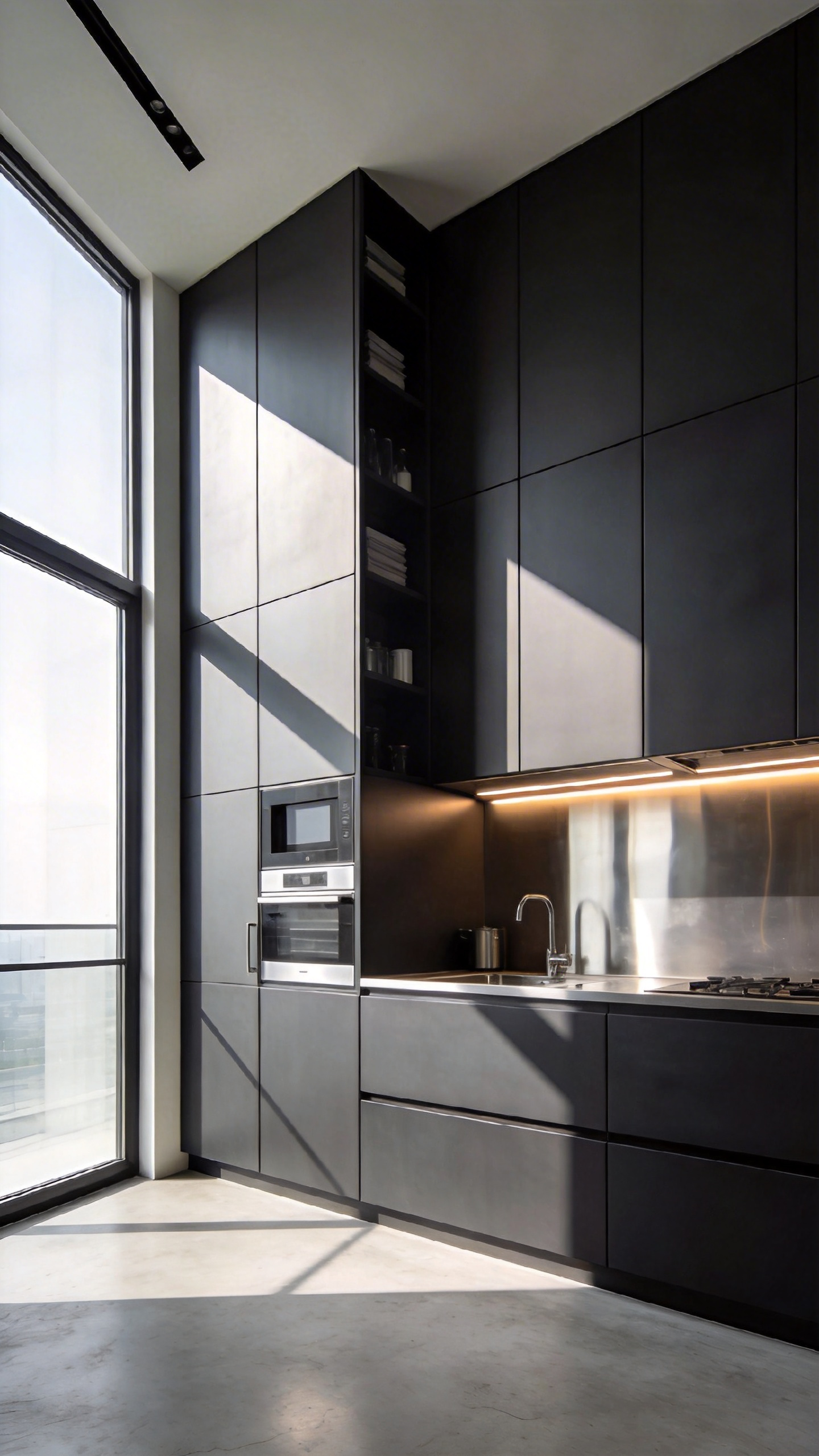
Architects utilize a technique known as “compression and release.” Consequently, floor-to-ceiling cabinetry creates a dense, compressed storage zone. This allows the adjacent work area to feel open and expansive. Visually, the kitchen becomes a monolithic block. By removing distinct shadow lines, the cabinetry resembles a sleek architectural wall rather than traditional storage. Furthermore, the “No-Kitchen” trend takes this concept to its peak.
In this style, integrated paneling disguises appliances to create a continuous skin. Additionally, kinetic elements like pocket doors allow the entire technical engine to disappear. Therefore, a small space can transition instantly from a utility workspace to a serene living area. Crucially, “decor” is replaced by sensory minimalism. For instance, integrated LED channels define edges instead of hanging pendants.
However, a purely machine-like space can feel cold. Thus, designers distinguish between sterile “hospital” finishes and organic, matte surfaces. Finally, successful architecture reintroduces warmth through tactile materials. A single shelf of raw oak ensures the function does not become too sterile. Ultimately, the room remains efficient, yet distinctly human.
9. Verticality: Drawing the Eye Upward with Floor-to-Ceiling Joinery
In compact kitchens, the gap above standard cabinets often creates visual noise. Specifically, this “dead zone” interrupts the vertical line, making walls feel shorter and the room more cramped. Consequently, extending joinery from floor to ceiling utilizes the Gestalt principle of continuity to correct this. Instead of perceiving individual boxes, the brain sees a seamless, monolithic wall. Thus, the ceiling feels higher, and the space becomes architecturally quieter.
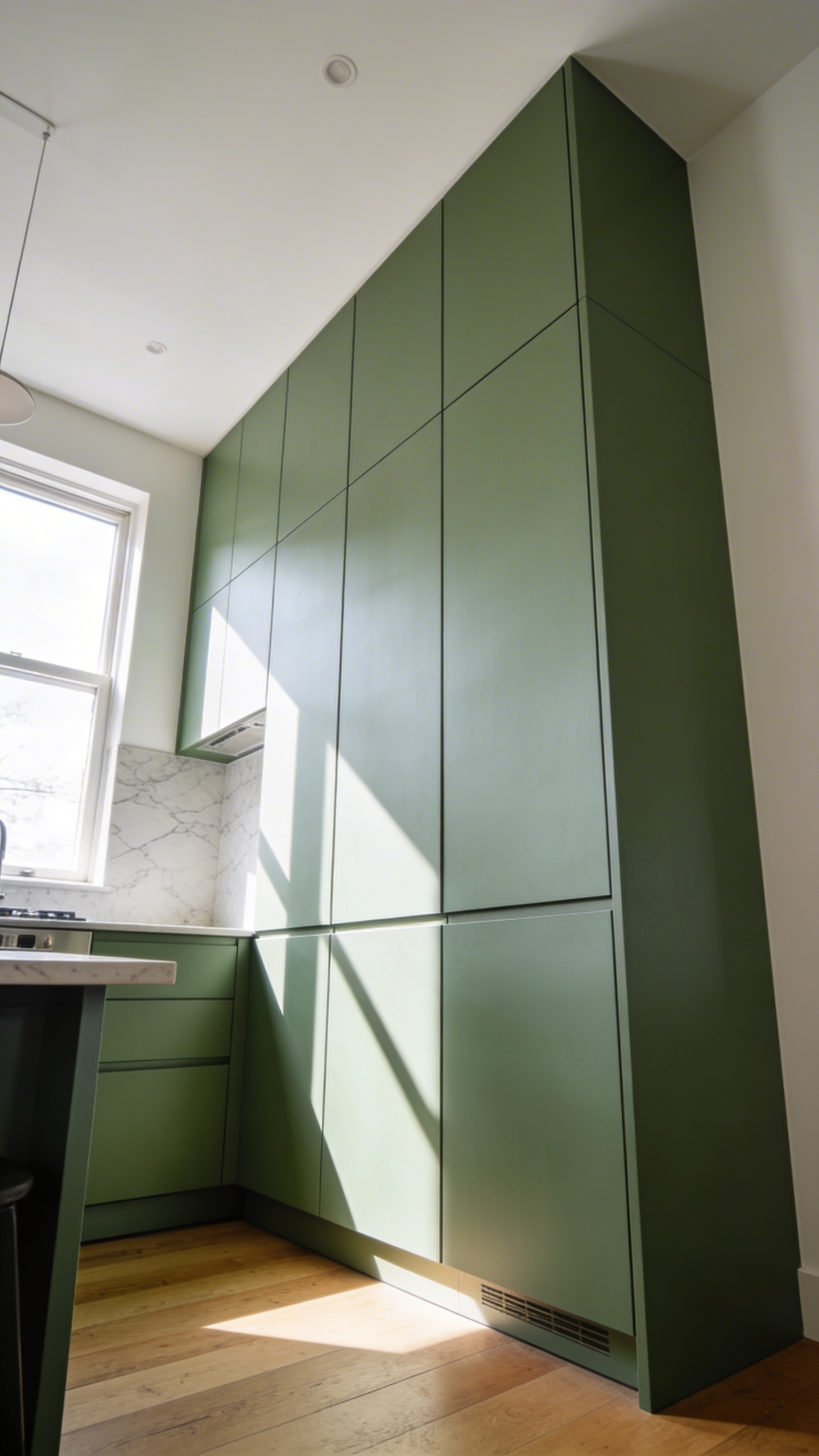
To maximize this effect, designers often employ vertical grain matching. Like pinstripes on a suit, these upward-running lines visually lengthen the room’s body. Furthermore, achieving this look in older homes requires technical precision. Because ceilings are rarely level, master joiners use a “scribe” or a recessed shadow gap. Ideally, this technique creates a “levitating” visual, implying the cabinetry is a structural pillar rather than furniture.
Historically, this approach mirrors the efficiency of the 1920s “Frankfurt Kitchen,” prioritizing cubic footage over square footage. However, modern applications offer more than just storage. In fact, a solid wall of cabinetry acts as a significant acoustic buffer. In open-plan apartments, this insulation absorbs kitchen clatter, providing a sense of “hushed luxury.” Ultimately, verticality transforms a utilitarian workshop into a cohesive, calming element.
10. The Hidden Kitchen: Concealing Appliances Behind Shoji-Style Panels
In small kitchen design, visual clutter is the primary enemy of tranquility. Specifically, the mix of stainless steel and digital displays creates jarring visual noise. Therefore, applying the concept of *ma*, or negative space, helps unify the room. By replacing standard cabinetry with Shoji-style sliding panels, you create “visual silence.” Consequently, the kitchen transitions from a chaotic utility zone into a serene, cohesive living area.
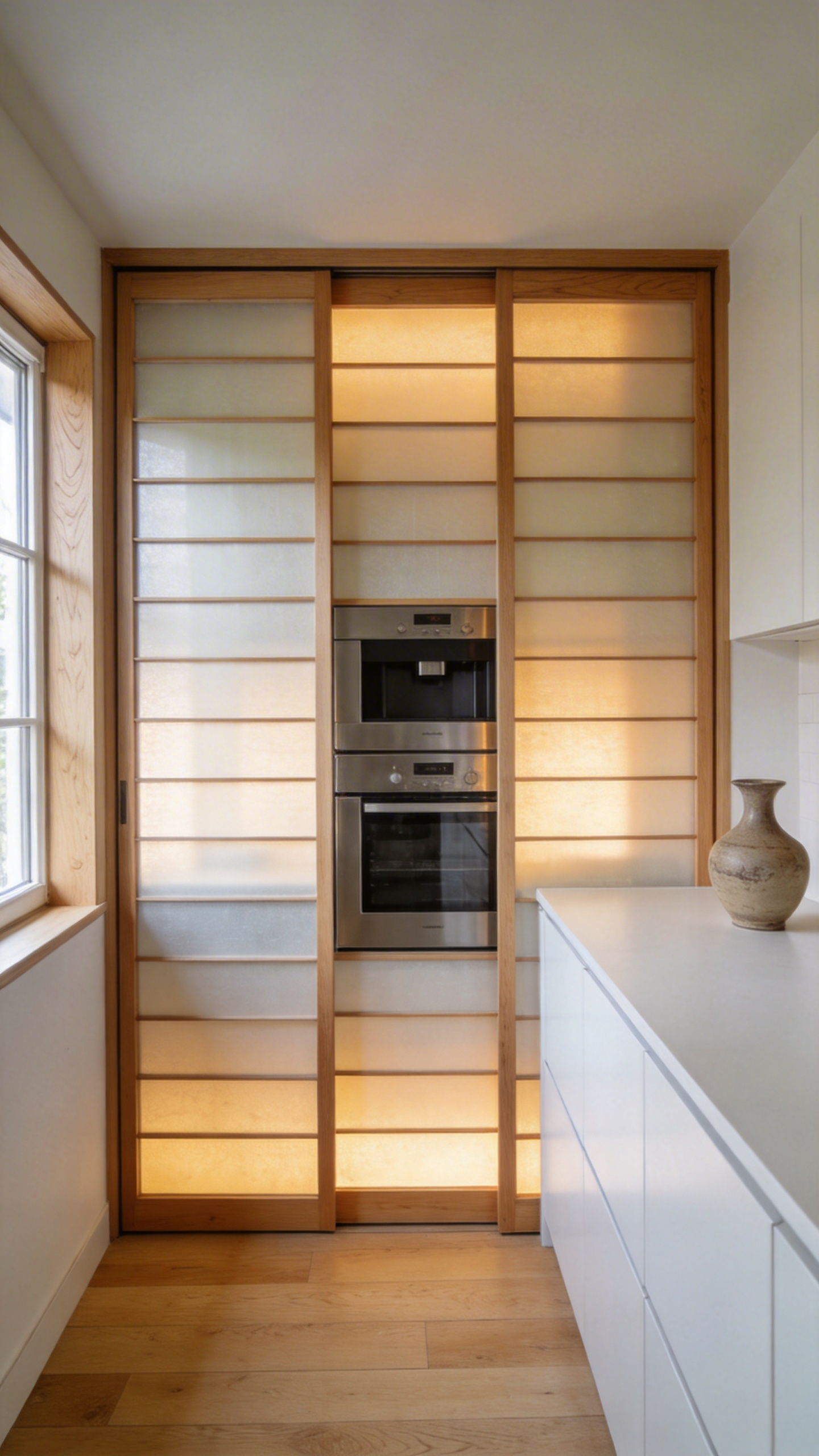
Historically, traditional *Washi* paper was too fragile for culinary environments. However, modern applications utilize high-performance “Washi-resins” to solve this issue. Ideally, these laminated acrylics mimic the fibrous texture of paper but remain heat-resistant and washable. Thus, they withstand grease and steam without warping. Furthermore, these panels act as sophisticated light diffusers. If you install low-heat LED strips inside the cabinetry, the screen transforms into a glowing lantern. In fact, this provides gentle ambient lighting while making the wall appear to recede.
Mechanically, this design solves spatial issues through top-hung sliding tracks. In narrow galleys, standard cabinet doors block essential walkways when open. Conversely, sliding panels require zero clearance. Therefore, you can conceal a toaster or coffee station without sacrificing floor space. Finally, the design addresses ventilation concerns. Unlike solid doors, the *Kumiko* lattice framework supports passive airflow. Specifically, designers often include “shadow gaps” to create a chimney effect. Ultimately, this allows heat to dissipate safely while maintaining a seamless aesthetic.
11. Floating Shelves: The Curated Display of Essential Objects
Floating shelves have evolved far beyond simple storage alternatives. In fact, they serve as sophisticated architectural tools for manipulating spatial perception. Traditional upper cabinetry often creates a claustrophobic “closet effect” in compact areas. Conversely, floating designs introduce essential negative space. Specifically, they allow the eye to travel unobstructed to the back wall. Therefore, a confined kitchen instantly feels significantly more expansive.
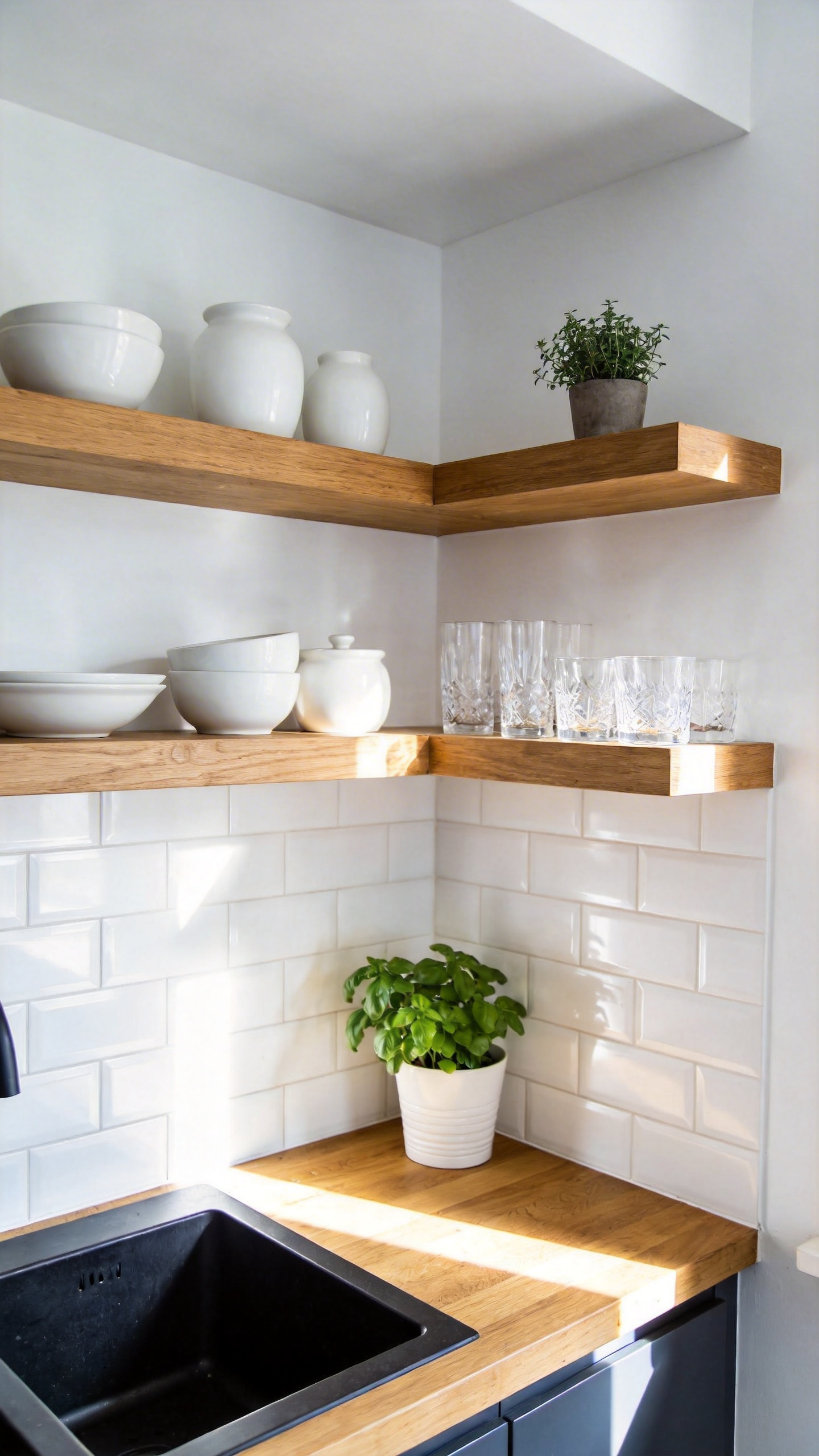
However, this visual freedom requires intentional curation. Experts frequently cite the “Tidiness Tax” associated with open shelving. To manage this mental load, we recommend the strict 80/20 rule. Ideally, prioritize 80% daily-use items to minimize dust accumulation. Then, dedicate the remaining 20% to “soul” objects that spark joy.
Furthermore, the material choice defines the room’s sensory experience. Solid walnut or white oak adds biophilic warmth to cold tiles. Alternatively, glass options allow light to permeate vertical space. Crucially, structural integrity is non-negotiable for these functional displays. You must anchor shelves into studs to support heavy stoneware stacks.
Finally, the modern “un-kitchen” trend treats shelves as art galleries. This approach integrates non-traditional elements like framed paintings or vintage lamps. As a result, the kitchen transforms into a cohesive living space. Ultimately, a well-curated shelf balances utility with personal narrative.
12. Multifunctional Islands: Custom Woodwork that Serves Dining and Prep
In contemporary small kitchen decor, the multifunctional island serves as a vital social bridge. Historically, islands were purely utilitarian worktables hidden away from guests. However, modern design reimagines this feature as the home’s psychological center. Consequently, custom woodwork is often preferred over cold stone surfaces. Wood offers a softer acoustic profile, effectively absorbing the clatter of prep work. Furthermore, natural timber introduces a necessary warmth, transforming a sterile kitchen into an inviting space.
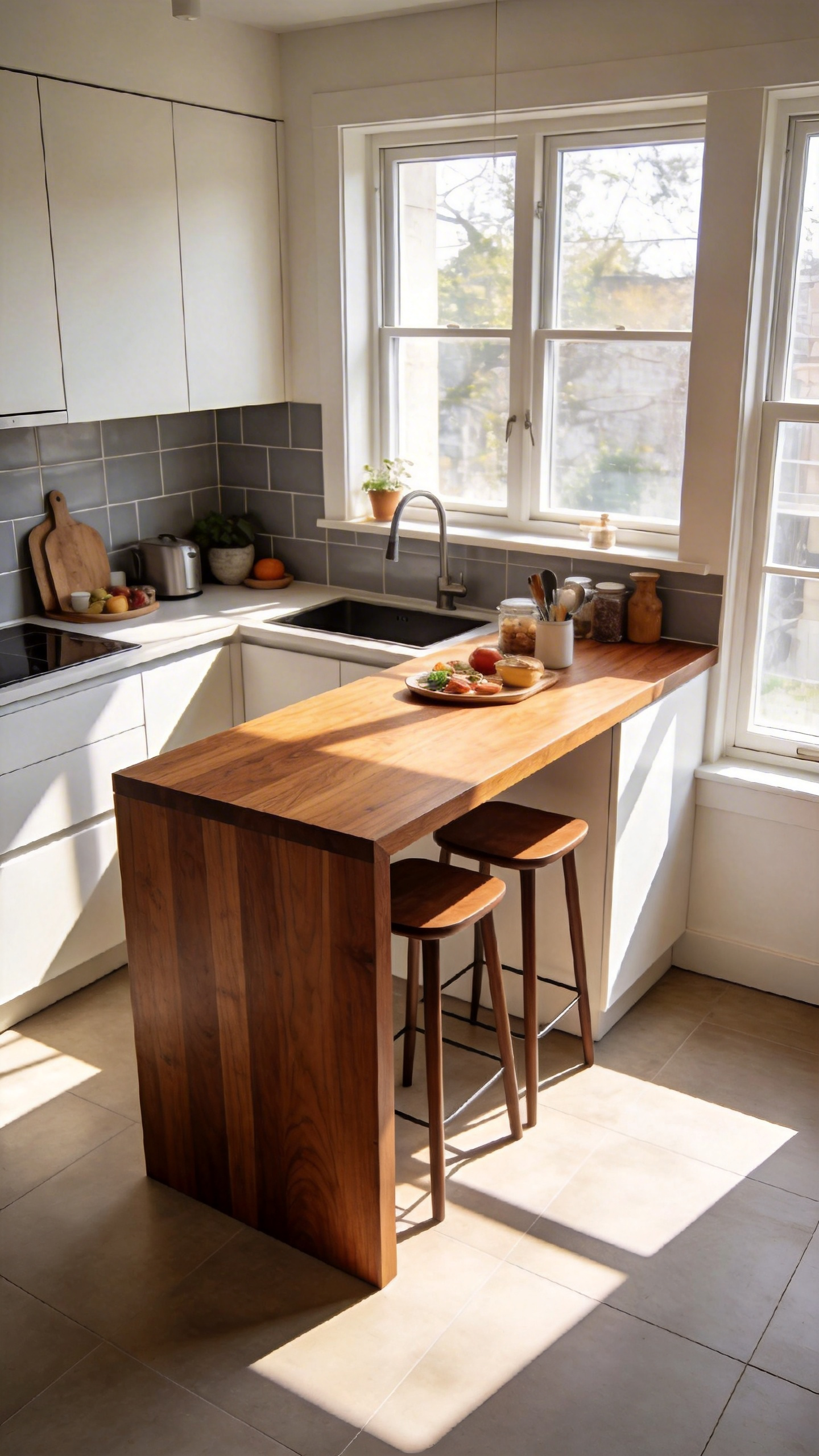
Technically, these dual-use surfaces require advanced joinery to manage natural wood movement. For instance, artisans often utilize “breadboard ends” to allow the main panel to expand without cracking. This precise engineering ensures the surface remains perfectly flat for dining while handling the humidity of cooking. Moreover, ergonomic fluidity is essential in compact footprints. Designers frequently utilize a “stepped” approach, placing the dining tier lower than the prep block. Effectively, this arrangement visually hides culinary chaos from guests.
Additionally, high-end “stealth hardware” allows dining leaves to rotate and tuck away entirely. This capability maximizes the room’s negative space when the table is unused. Finally, the finish dictates the tactile and olfactory experience. Instead of using plastic-like polyurethanes, artisans apply natural Tung oil blends. Thus, maintenance becomes a pleasant ritual, releasing fresh citrus scents.
13. Lighting as Sculpture: Washi Paper Pendants for Soft Diffusion
In compact kitchens, hard surfaces like stainless steel and quartz often dominate the visual landscape. Consequently, the environment can feel clinical rather than communal. Therefore, introducing a Washi paper pendant acts as a radical design intervention. It functions not merely as a lamp, but as a “light sculpture.” Drawing from Isamu Noguchi’s *Akari* legacy, these fixtures mimic sunlight filtering through traditional *shoji* screens. Thus, they act as a “surrogate sun,” bringing organic warmth to windowless spaces.
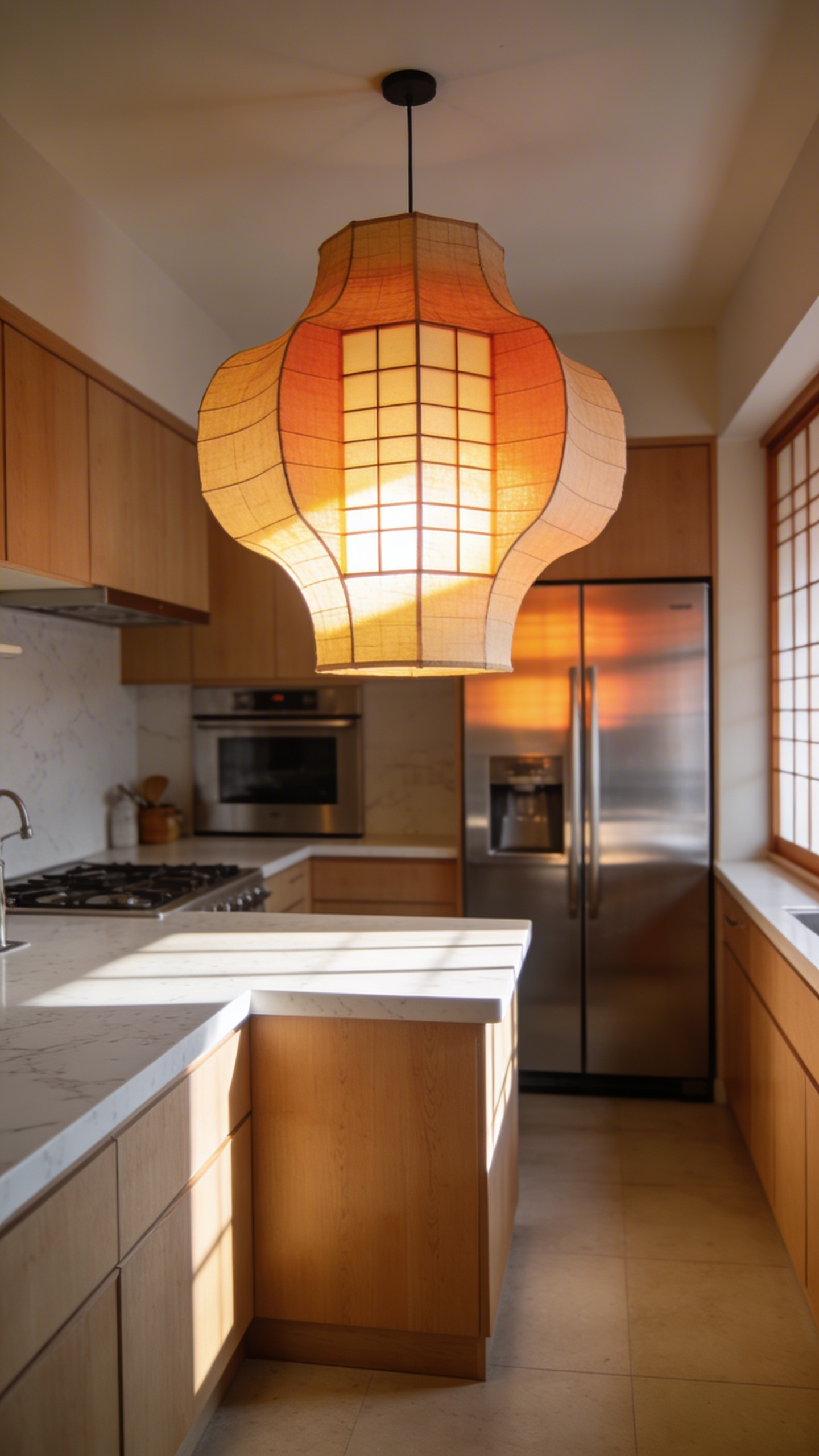
Technically, the material makes the difference. Specifically, the inner bark of the mulberry tree contains long, tough fibers. As a result, the paper creates a high “haze factor,” scattering light in every direction. This soft diffusion eliminates the harsh glare and “hot spots” typical of glass fixtures. Psychologically, this shifts the atmosphere from a high-stress laboratory to a calming sanctuary.
Furthermore, Washi pendants solve the issue of visual clutter in small footprints. Opaque metal fixtures often act as heavy anchors, making ceilings feel lower. Conversely, translucent paper possesses a quality of visual weightlessness. The organic shapes break up rigid cabinetry lines without blocking crucial sightlines. However, because paper is porous, strategic placement is vital. Ideally, hang these pendants over a breakfast bar or dining corner. This creates a “safe zone” away from stove grease. Finally, always utilize low-heat LED bulbs to preserve the delicate fibers.
Phase IV: Living Rituals—Decor in Practice
Phase IV marks the vital transition from construction to daily choreography. In this stage, the kitchen ceases to be a mere collection of cabinets. Instead, it becomes a stage for the efficiency of grace. Because space is limited, decor cannot be superfluous. Therefore, every object must strictly justify its physical footprint.
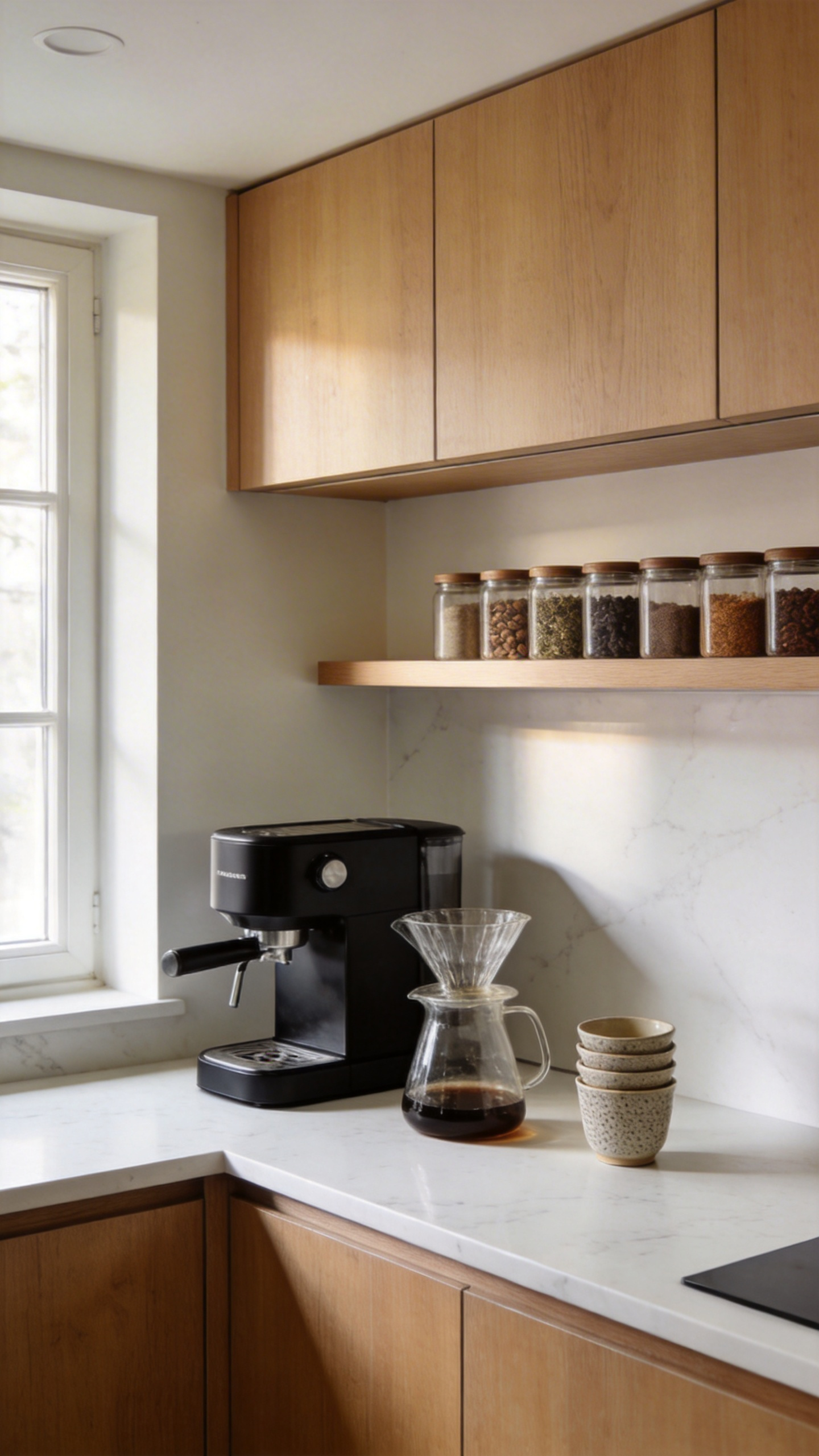
This approach relies on “Strategic Visibility” rather than hiding every tool. For instance, a curated coffee station serves as a ritualistic anchor. Consequently, the placement of these items facilitates a soothing, semi-automatic habit. We move beyond the clinical efficiency of the historic Frankfurt Kitchen. Now, we prioritize a “Social Triangle” that fosters connection.
Furthermore, sensory design manages the emotional climate of the room. Specifically, “shadow management” becomes a ritualistic necessity in small quarters. Dimming under-cabinet LEDs signals the end of the functional day. Additionally, tactile cues provide a sense of “cocooning.” The weight of a stone countertop grounds you in the present moment. Ultimately, these elements transform a small kitchen into an emotional refuge.
14. The Tea Corner: Carving Out a Micro-Sanctuary for Contemplation
Creating a dedicated tea corner transforms a chaotic utility space into a deliberate micro-sanctuary. Historically, Japanese tea masters sought *shichu no sankyo*, meaning a “mountain dwelling within the city.” Consequently, even a cramped urban kitchen can embrace this spirit of isolation. To achieve this, prioritize materials that reflect *wabi-sabi*, or the beauty of imperfection. Specifically, integrate tactile elements like rough-hewn wood shelves or unglazed stoneware vessels. These “living” surfaces provide a necessary grounding contrast to the sterile, glossy finishes of modern appliances.
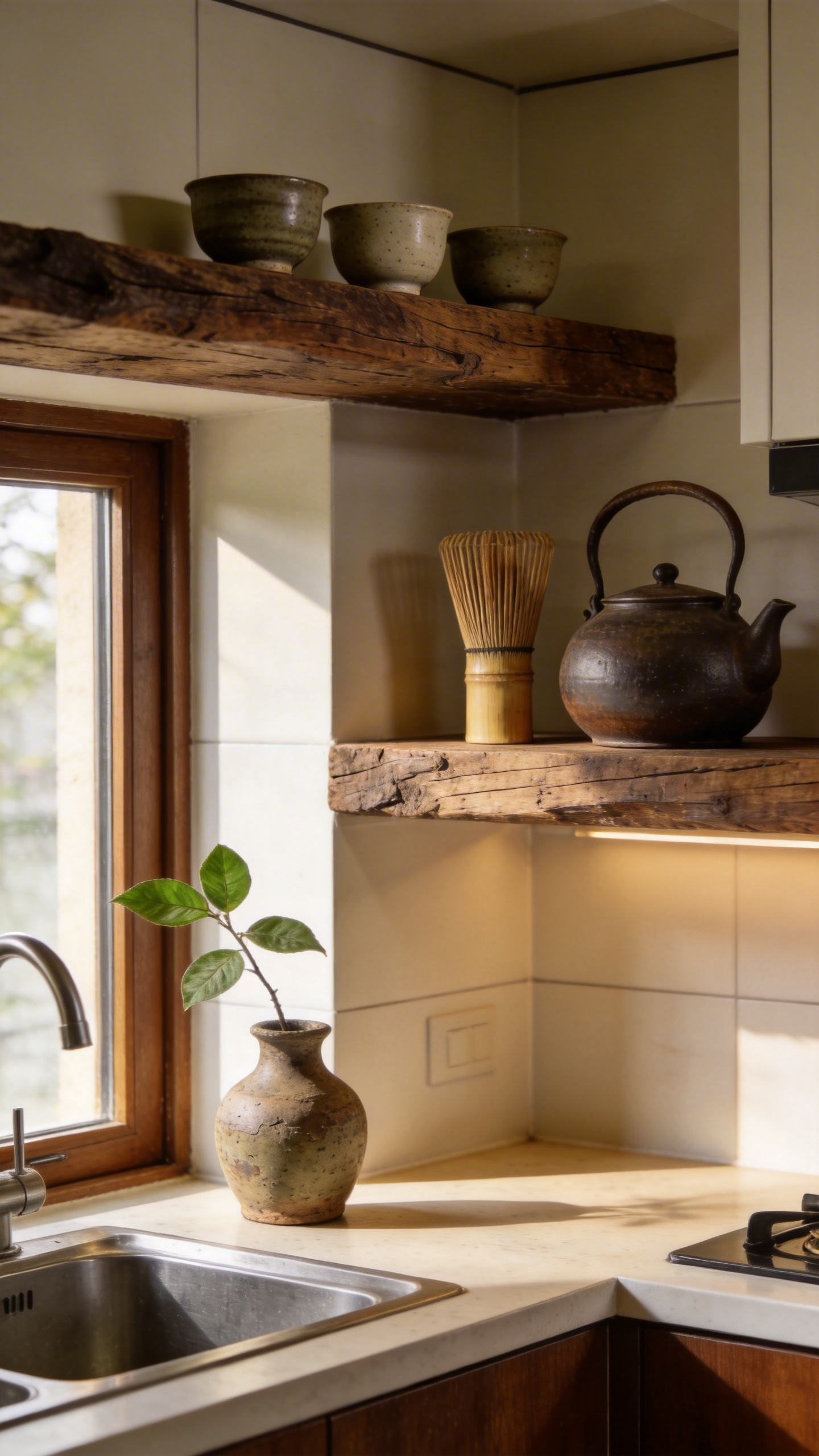
Furthermore, effective design requires careful sensory engineering. Ideally, utilize a dedicated, warm-toned light source (around 3000K) to carve out the nook visually. This soft “glow” creates a psychological threshold, separating the space from harsh task lighting. Additionally, ergonomics are vital for maintaining a meditative flow. Designers recommend a “reach zone” of approximately 600mm for essential tools. Therefore, position your kettle, canister, and cup within a single, effortless arm extension. This arrangement minimizes friction, allowing the soothing sounds of pouring water to anchor you. Ultimately, this small footprint fosters a massive internal shift from busyness to stillness.
15. Mindful Utensils: Investing in Copper and Iron Tools Worth Displaying
Investing in copper and iron transforms cookware into “living” decor. Unlike static stainless steel, these metals evolve based on daily use. Specifically, they develop a unique patina that tells a personal story. This aging process aligns with the principle of *wabi-sabi*, finding profound beauty in imperfection. Consequently, a dark, well-seasoned cast iron pan becomes a visual badge of culinary history rather than just a tool.
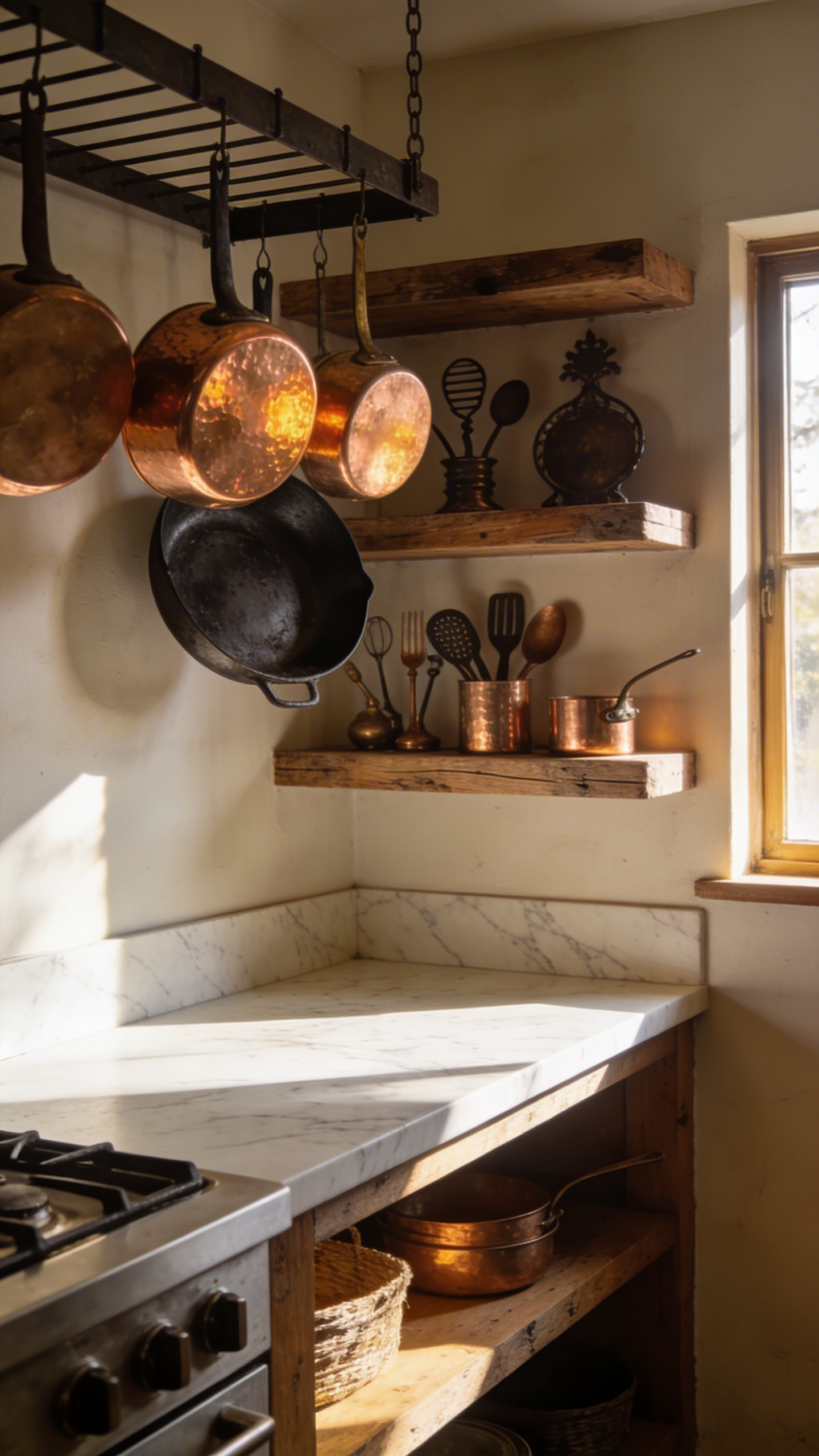
Furthermore, these utensils act as sophisticated “jewelry” for compact spaces. Because they are visually stunning, hiding them in dark drawers is unnecessary. Instead, utilize vertical space with copper rails or magnetic strips to create a functional gallery. This approach effectively clears precious cabinet real estate. Additionally, the reflective nature of hammered copper scatters light. Thus, it adds a crucial sense of airiness and depth to narrow galley kitchens.
Beyond aesthetics, these materials demand mindful interaction. For instance, copper conducts heat twenty times better than stainless steel. Therefore, it allows surgical temperature control for delicate dishes. However, the choice of lining requires consideration. Tin-lined copper offers historical purity but demands slow, attentive cooking. Conversely, stainless-lined options provide modern durability. Ultimately, these utensils embrace a sustainable “repair over replace” philosophy. Thus, they serve as functional heirlooms.
16. Living Breath: Integrating Kokedama or Bonsai for Vitality
Integrating Kokedama or Bonsai into a kitchen brings “living breath” into a typically utilitarian space. Historically, this concept roots in the Japanese practice of *Nearai*, or “root wash.” Consequently, removing the ceramic pot exposes the plant’s raw vitality. In modern compact kitchens, this organic “liberation” softens the cold, hard lines of stainless steel and stone.
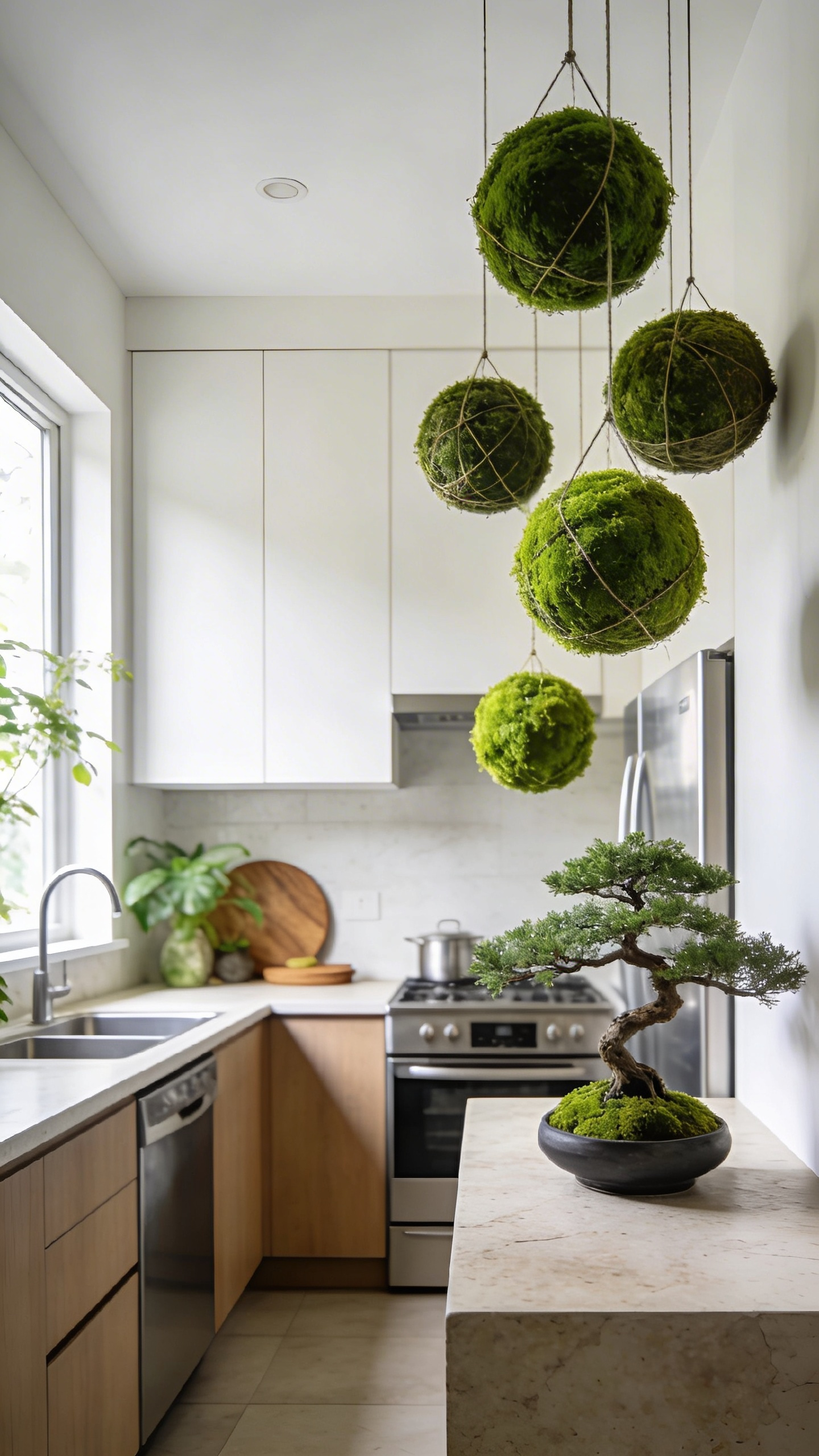
Crucially, these botanical forms utilize *ma*, or negative space, to solve common clutter issues. For instance, hanging Kokedama occupies the “dead air” above counters or near windows. Therefore, you introduce vertical vitality without consuming a single square inch of prep space. Alternatively, a Chinese Elm bonsai acts as architectural breath on a countertop. Its miniature, intricate branching creates a visual pause, making the area feel expansive rather than crowded.
Furthermore, maintenance becomes a sensory anchor in your daily workflow. Unlike standard potted plants, Kokedama communicate their needs through weight. Specifically, a light moss ball implies thirst. During the “submersion ritual” in the sink, listen for distinct bubbling sounds. This audio cue represents the soil inhaling water, a literal manifestation of the plant’s breath.
Finally, consider the kitchen’s unique micro-climate. The moss acts as a natural hygrometer, absorbing excess steam from cooking. For homes with gas stoves, choose hardy species like Ficus Retusa. These plants resist nitrogen dioxide while actively cleaning the air. Ultimately, this approach merges ancient horticulture with modern function, bridging the gap between decor and utility.
Frequently Asked Questions
How can I make my small kitchen feel more luxurious?
Luxury in small spaces is defined by haptic luxury and intentionality. Focus on high-quality organic materials like unlacquered brass, soapstone, or hand-applied lime wash walls. By reducing visual noise and investing in bespoke details like integrated appliances, you create a sophisticated, curated environment that feels high-end despite a compact footprint.
What are the best colors for small kitchen decor to maximize space?
While white is traditional, “chromatic silence” is achieved through monochromatic palettes or “mucky neutrals” like greige, soft oat, or Cloud Dancer. Utilizing a color-drenching technique, where walls and cabinetry share the same hue, dilutes physical boundaries and makes the room feel like a continuous, expansive volume.
Does open shelving work for small kitchen decor?
Yes, floating shelves are excellent for creating visual respiration. They remove the bulk of heavy upper cabinetry, allowing the eye to see back to the wall, which expands the perception of space. To keep it functional and high-end, follow the 80/20 rule: 80% daily essentials and 20% “soul” objects for a curated look.
Conclusion: Finding Infinite Space Within Finite Dimensions
Ultimately, creating infinite space requires a shift in perception, not just renovation. By embracing *Ma*, we transform simple empty walls into vital structural assets. Furthermore, visual techniques like continuous horizontal lines guide the eye toward an imaginary horizon. Consequently, the rigid physical boundaries of a small kitchen seem to dissolve. Instead of a cramped box, the room becomes a fluid landscape of light and texture. Thus, limited square footage no longer dictates the expansive feeling of your home.
Moving forward, treat your small kitchen decor as a sanctuary rather than a storage unit. Eventually, this mindful approach to reduction fosters both architectural beauty and mental clarity. Therefore, the concept of infinity is actually found within curated details. Begin by auditing your countertops to intentionally create one distinct area of negative space. Then, simply observe how the surrounding environment breathes. In fact, this single pause creates a powerful sense of limitless potential.