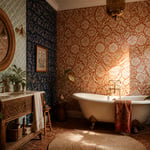
The bathroom is the first room you enter every morning and the last one you leave at night. It’s where you make the quiet decisions — about the day ahead, about how you want to feel. Yet for most people, it’s the last room to get any real art. The walls get a coat of paint, maybe a towel hook, and that’s that.
That’s a shame, because good bathroom wall art does something subtle and powerful. It gives your eyes somewhere to land. It turns a functional space into something that actually reflects who you are. I’ve spent years helping people choose art that carries meaning — handmade ceramics from a Peruvian market, folk art prints that traveled across borders, woven textiles from artisans who learned their craft from their grandmothers — and I can tell you that a single beautiful piece above the toilet or beside the vanity will change how you feel about your bathroom every single morning.
These 16 bathroom wall art ideas cover every style and every budget — from an oversized abstract canvas to a cluster of handwoven textiles, from a gallery of vintage travel posters to a collection of artisan ceramics. Start with the one that speaks to you first.
1. Oversized Abstract Canvas as the Room’s Focal Point
The most common bathroom wall art mistake is going too small. A collection of undersized prints scattered across a wall tends to read as indecision. One large canvas, positioned deliberately, reads as confidence — and the bathroom rewards confident design choices more than almost any other room.
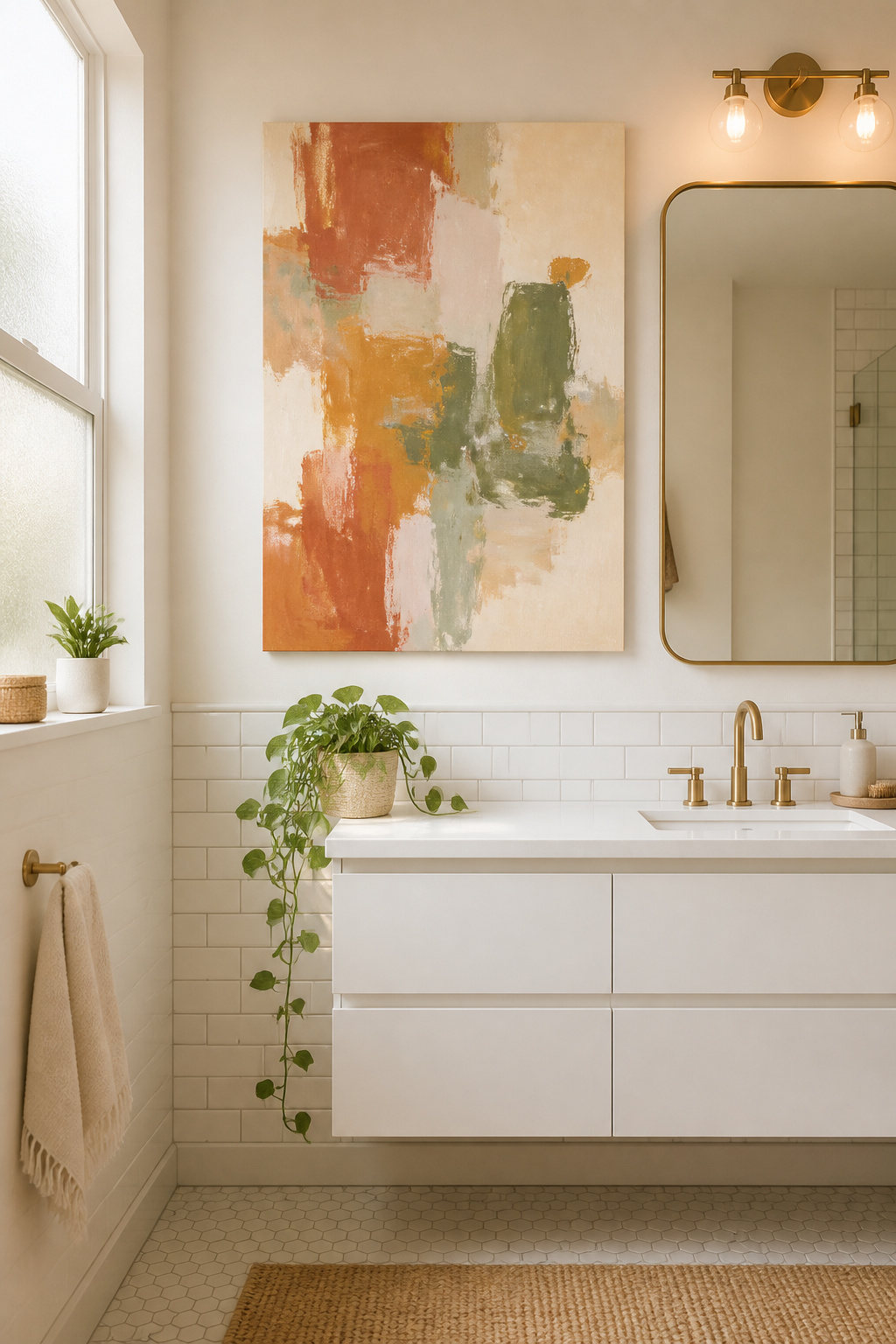
For sizing, use the two-thirds rule: the artwork should fill roughly two-thirds the width of the fixture below it. Above a standard 36-inch vanity, that means a canvas at least 24 inches wide. On a longer open wall, a 24×36-inch or 30×40-inch canvas creates genuine impact.
Abstract art is the natural choice for bathrooms because it introduces colour and texture without demanding interpretation. Soft earth tones (terracotta, warm sage, dusty ochre) are working very well in bathrooms right now, particularly with warm brass hardware. If your fittings are chrome, cooler tones — slate blue, pale mint, graphite — tend to harmonise better.
One practical note: choose a canvas print sealed with UV-resistant varnish. Unsealed canvas can buckle in a humid bathroom within months. Stretched canvas on a sealed wooden frame is the most stable format, and most print-on-demand services now offer moisture-resistant sealing as standard.
2. Eclectic Gallery Wall With Mixed Frame Styles
A well-executed bathroom gallery wall looks effortless and is actually quite planned. The planning is the part most people skip — and it shows.
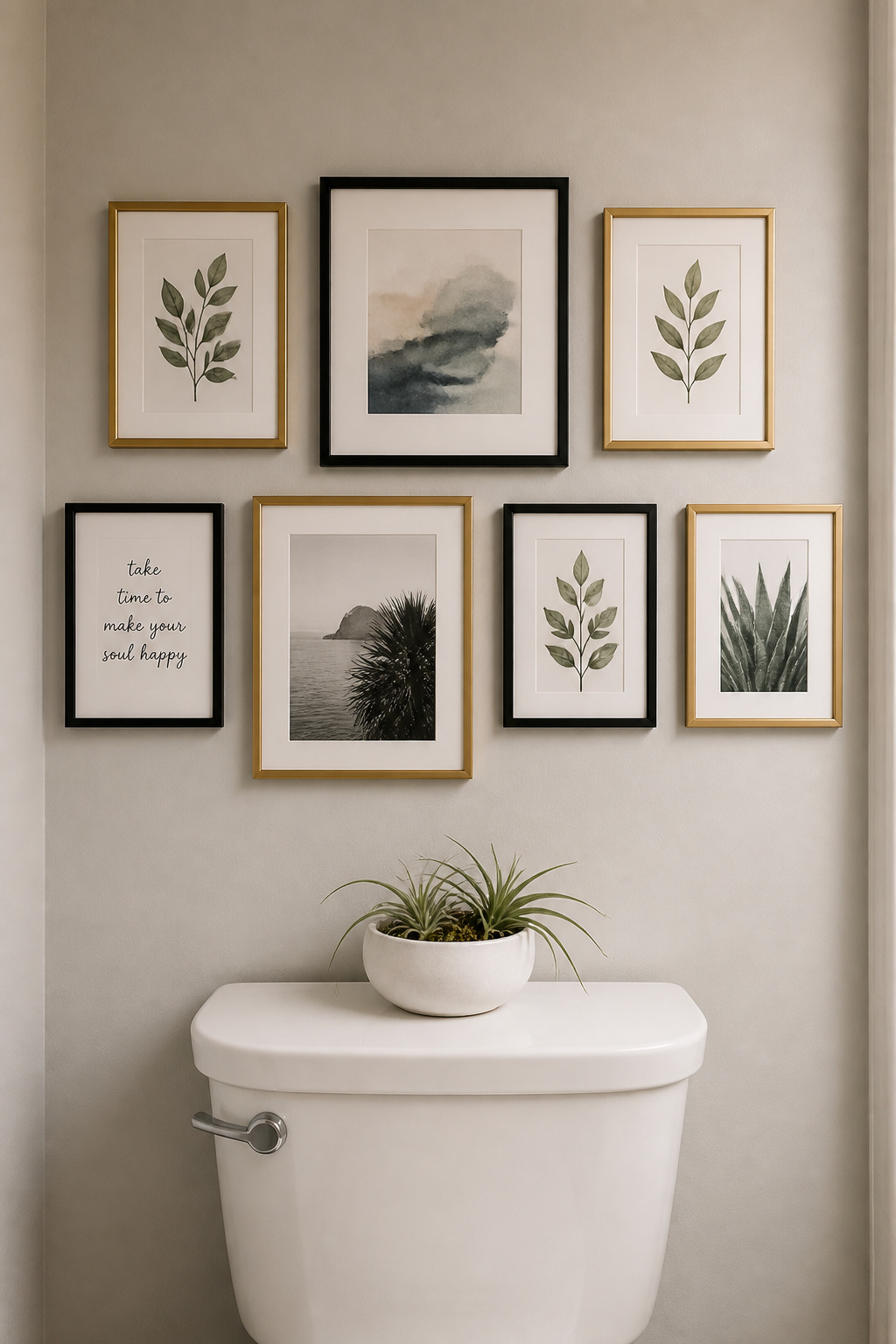
The rule that matters most: limit yourself to three frame finishes maximum. Thin matte black frames are the most reliable anchor; brass or natural oak work as secondary finishes. Black and brass together is the most reliably sophisticated combination. All-black works in darker, moodier bathrooms. White with natural wood is the Scandi and coastal choice.
For layout, trace each frame onto kraft paper, cut it out, and tape it to the wall before touching a single nail. Move the paper templates around until the grouping feels right. The visual centre of your gallery should sit at 57-60 inches from the floor. Above a vanity, leave 6-12 inches between the top of the faucet and the bottom of your lowest frame.
For humidity-resistant print materials, metal prints (dye-sublimation ink fused directly into aluminium) are essentially waterproof — the best choice for a wall opposite the shower. Canvas with protective varnish is a strong second. Paper prints in properly sealed frames, placed away from direct steam, hold up well. For more detail on layout approaches, bathroom gallery wall ideas covers several proven formats before you commit to holes in the wall.
3. Framed Botanical Prints: Classic Bathroom Wall Art for Nature Lovers
Botanical illustration has been on walls since the 17th century, when wealthy European households displayed framed plant studies as a mark of intellectual and aesthetic refinement. It hasn’t lost any of that authority. The combination of scientific precision and genuine natural beauty makes botanical art an easy choice for bathrooms — it belongs there the way a good soap dish belongs there.
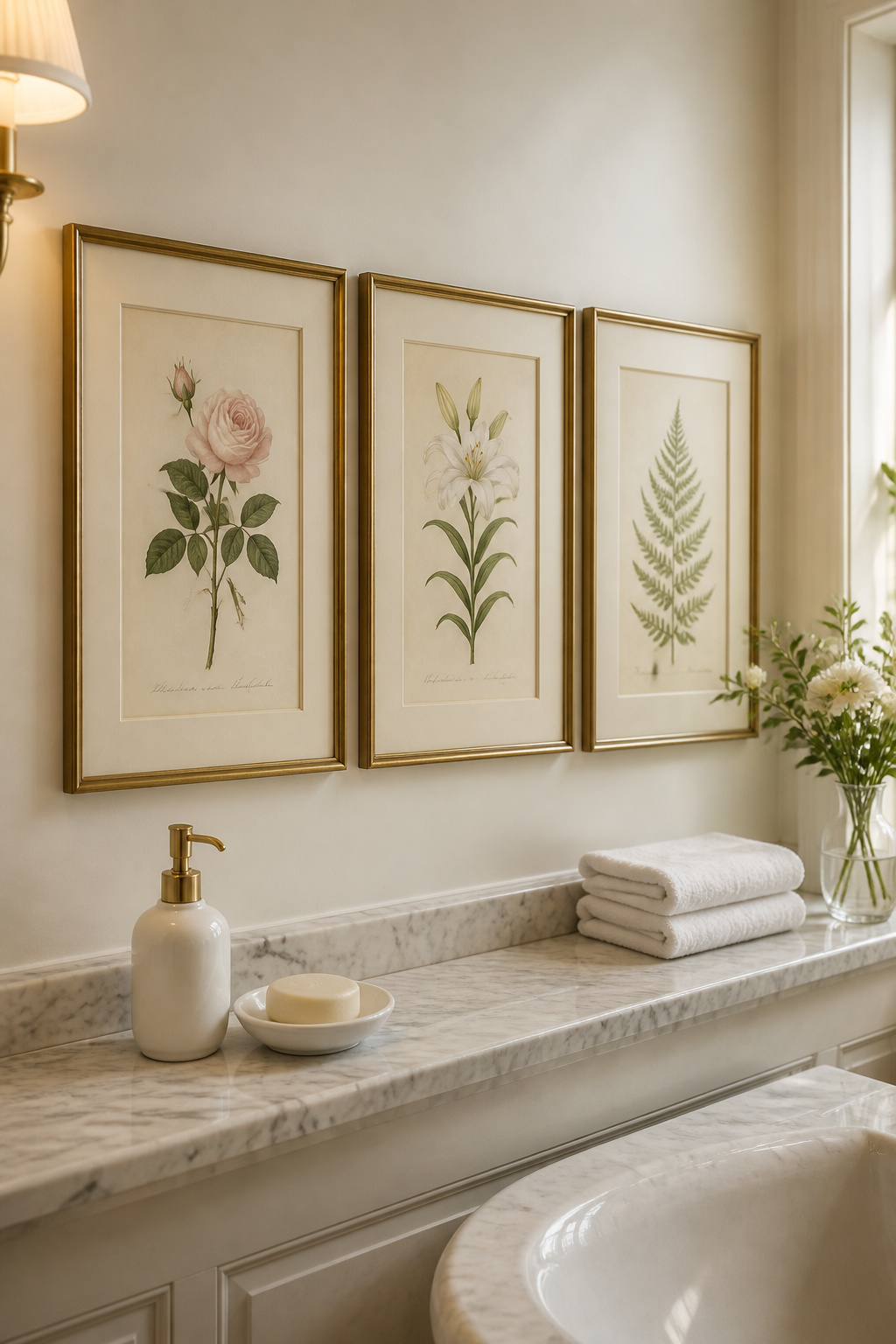
The gold standard remains Pierre-Joseph Redouté, the Belgian-born artist appointed as royal painter to three successive French Empresses — Marie-Antoinette, Josephine Bonaparte, and Marie-Amelie. His rose and lily prints are widely available as high-quality giclee reproductions from Art.com, Etsy’s botanical print sellers, and Belle Maison Art. Giclee printing on acid-free paper with pigment-based inks produces reproductions indistinguishable from originals at normal viewing distance.
If you want original prints, Paulus Swaen’s rare print gallery is a good starting point; expect $50-$500 for authenticated antique pieces. For most bathrooms, a quality reproduction is the wiser choice — the art is the point, not the investment.
Framing makes an enormous difference. A wide white or cream mat (3-4 inches) around a modest 8×10-inch print creates the visual weight of a much larger, more expensive piece. Thin black or antique gold frames let the illustration take over. For the bathroom environment, choose metal or sealed wood frames with a glass or acrylic front, and avoid cardboard backing without a plastic barrier.
4. Handwoven Macramé Wall Hanging for Boho Texture
A macramé wall hanging does something that framed art cannot: it introduces textile depth and shadow. The knotted structure casts soft shadows that shift across the day, and that movement gives a bathroom a quality that printed art on flat paper doesn’t have.
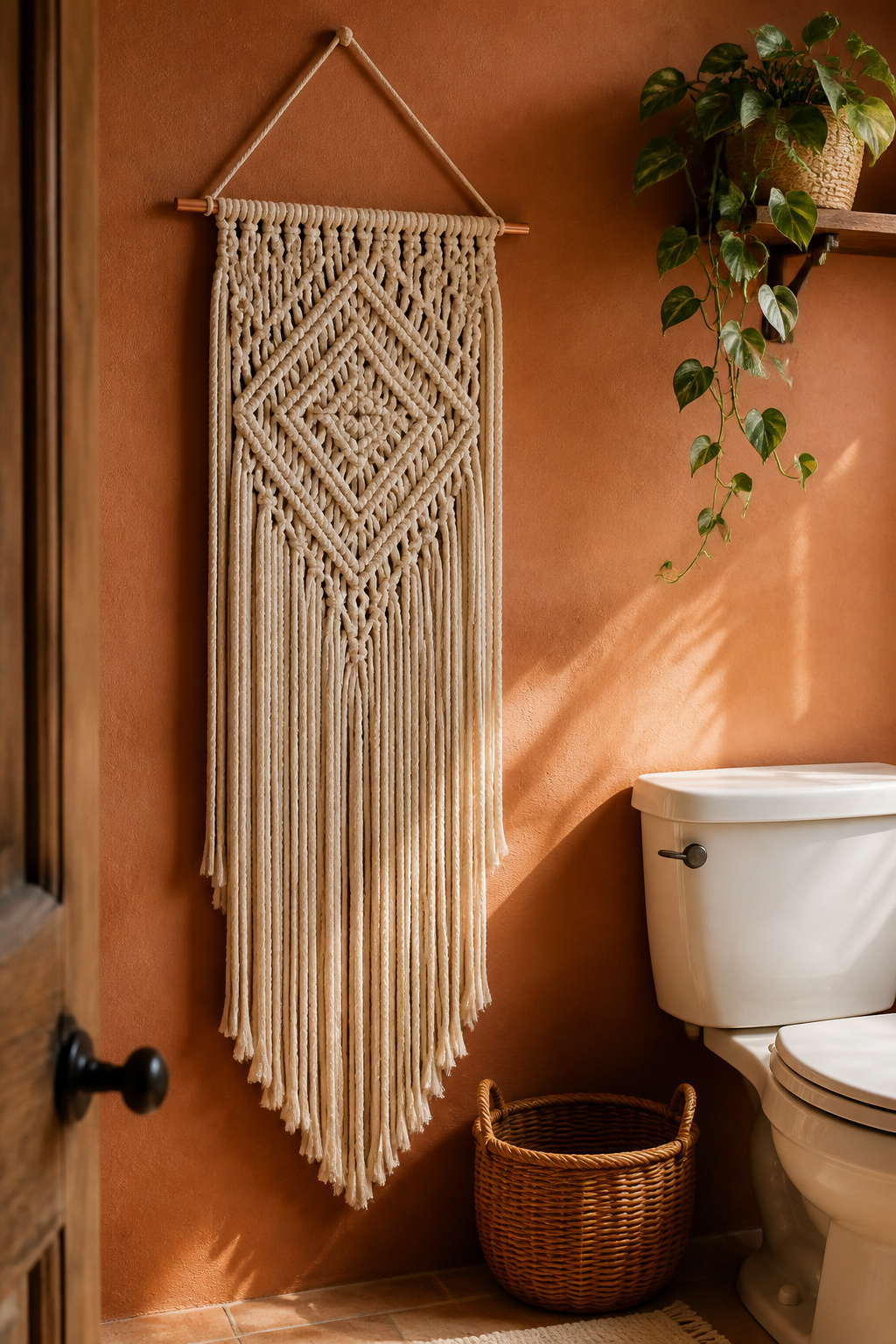
The practical case for macramé in bathrooms is strong. Above-toilet walls, door-adjacent vertical spaces, and narrow walls between fixtures are where framed art always looks awkward. A long, narrow macramé (6-8 inches wide, 30-40 inches tall) fills those spaces naturally and elegantly.
Placement matters. Keep macramé at least 36 inches from the primary moisture source — shower head, bath taps. The fibres are not waterproof, and direct steam will eventually cause damage regardless of fibre type.
Fibre choice is the most important decision after sizing. Avoid jute entirely for bathrooms — it absorbs moisture, frays, and deteriorates with repeated humidity exposure. Linen rope is the best natural option: naturally antimicrobial, low-lustre, and dimensionally stable even as humidity levels change through the day. Mercerized cotton is the most accessible alternative and is what most quality macramé artisans on Etsy use. Some makers now produce macramé in linen-synthetic blends that handle bathroom conditions with confidence.
5. Vintage Maps and Antique Cartographic Art
There’s a particular kind of curiosity that antique maps satisfy — a combination of historical interest, geographic beauty, and the pleasure of a world rendered with pre-satellite imprecision. That quality works well in bathrooms. The map wall grows in interest the longer you spend with it.
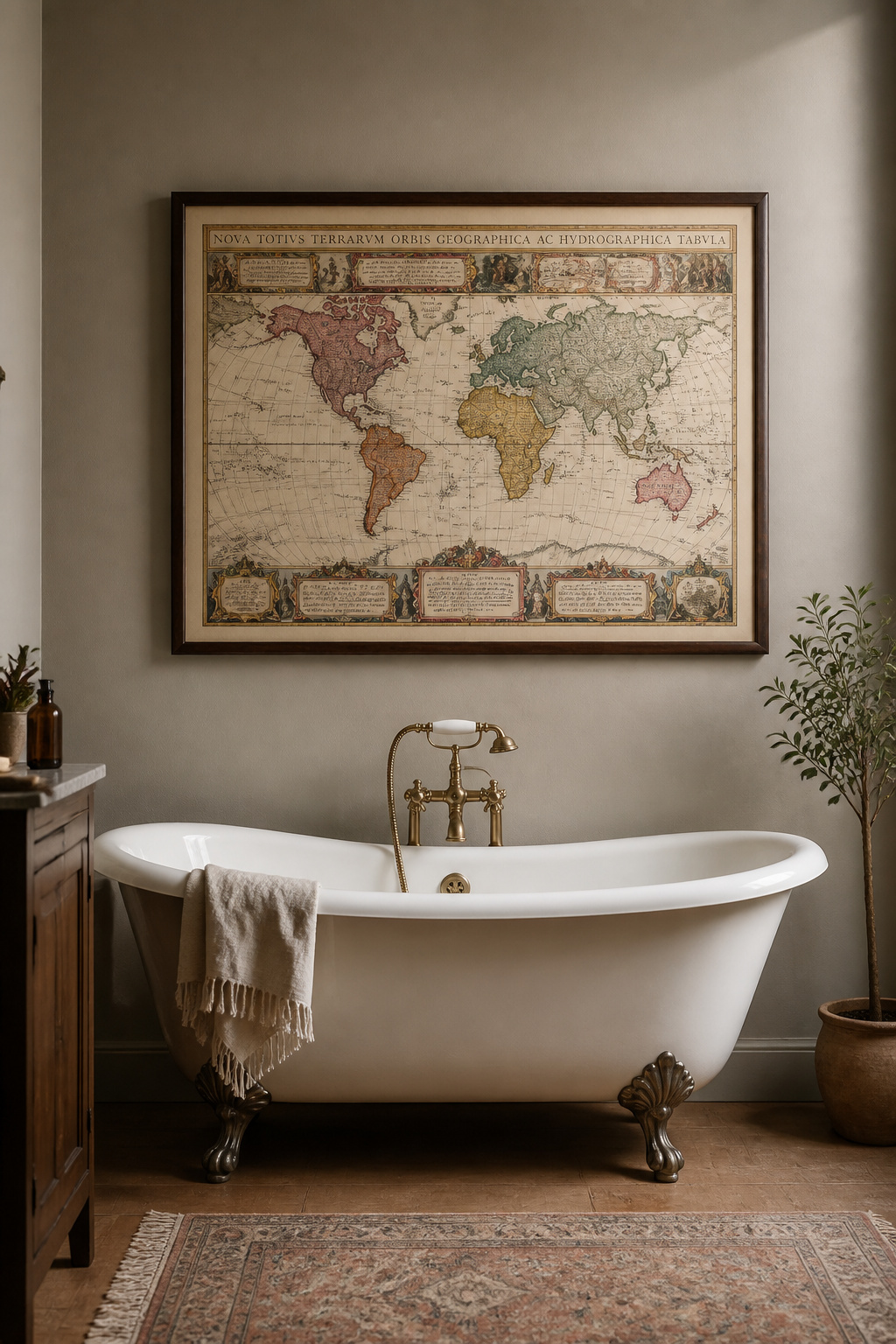
Above-toilet placement is ideal for maps: the horizontal format suits the proportions perfectly, and it’s the wall you’re facing long enough to actually read the place names and notice the decorative cartouches.
The David Rumsey Map Collection (davidrumsey.com) contains over 150,000 digitized antique maps free to access. Download a high-resolution file and have it printed as a giclee by a local print shop — you get a custom-sized antique map print at low cost. For ready-framed reproductions, Mapsofantiquity.com offers a solid selection. For authenticated originals, Paulus Swaen is the specialist source; expect $80-$2,000+ depending on age and rarity.
UV-protective framing glass is essential for paper art in a bathroom. Museum glass (Tru Vue is the leading brand) provides both 99% UV protection and an anti-reflective coating. Place the piece away from direct shower steam, and the art will last decades.
6. Black-and-White Photography as Sophisticated Bathroom Wall Art
Monochrome photography works in nearly every bathroom because it removes colour competition entirely. It doesn’t clash with your tile. It doesn’t fight with your towels. It adds tonal interest and visual weight without introducing a single colour-coordination decision — a useful quality in a space where you’ve already made a lot of decisions about grout, fixtures, and paint.
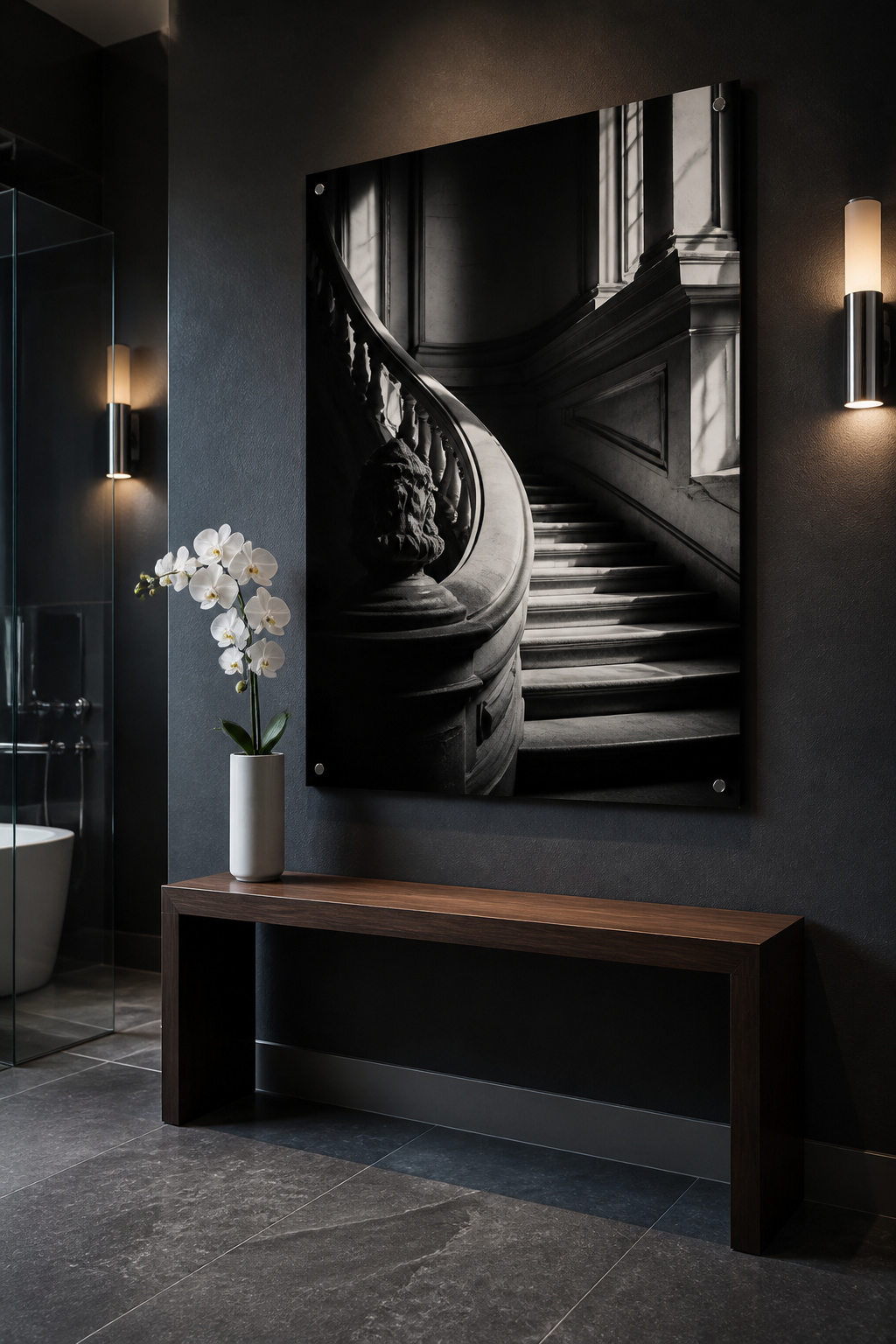
The subject choices are wider than most people assume. Architecture — arches, staircases, doorways — pairs naturally with the angular forms of bathroom fixtures. Abstract macro photography (water droplets, texture details, organic close-ups) creates conversation without being immediately recognisable. For family bathrooms, botanical macro photography is perhaps the most universally appealing choice: beautiful and accessible without being collector-serious.
Acrylic face-mount prints are worth the cost for a bathroom. The process involves laminating the photograph under an ultra-transparent acrylic plate with an aluminium dibond backing — it protects against UV, moisture, and dust, and amplifies contrast in black-and-white images. WhiteWall (whitewall.com) offers professional Ilford B&W prints under acrylic at gallery quality. Aluminium prints (dye-sublimation) are the most moisture-proof option and float off the wall on standoffs for a distinctive display.
Go large. Black-and-white photography needs a minimum of 16×20 inches to read as art in a bathroom rather than a snapshot.
7. Ceramic Plates and Sculptural Pottery Arranged on the Wall
Here’s what flat art cannot do: it cannot cast a shadow that changes as the light moves across the day. Ceramic plates and sculptural pottery mounted on a wall have that quality — and it transforms the wall from a display surface into something closer to a three-dimensional installation.
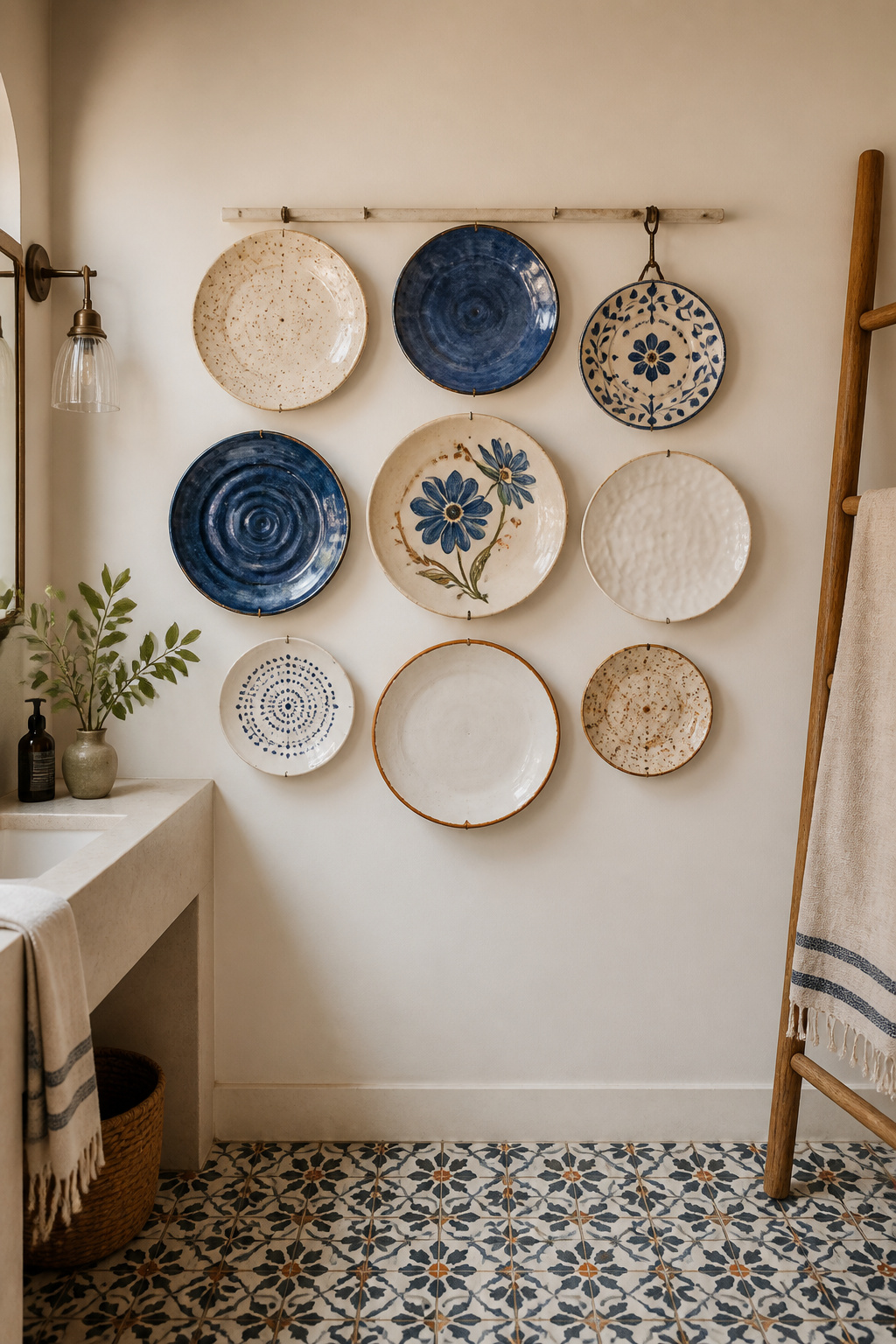
A collection of 5-9 plates in varying sizes (6-12 inches diameter) reads as a curated arrangement rather than casual decoration. Mix glazed and unglazed surfaces, combine handmade pieces from different traditions, and let the different profiles create visual rhythm. Think about how bathroom wall art affects your wellbeing — dimensional pieces with natural materials and organic variation tend to create calming, grounding effects that flat prints rarely match.
One critical installation note: adhesive disc plate hangers are not suitable for bathrooms. Moisture deactivates the adhesive bond and plates fall. Wire spring plate hangers — the type with a wire frame that grips the plate edge — are the reliable alternative, used with proper wall anchors. A horizontal plate rail (a narrow ledge with a lip) is the most elegant solution: plates lean against the rail without any drilling into the plates themselves, and you can rearrange the collection any time.
For sourcing genuine handmade ceramics, NOVICA (novica.com) connects directly with artisans across Latin America, Africa, and Asia with fair-trade certification.
8. Resin Botanical Art and Dried Arrangements — The Humidity-Safe Approach
Let me give you the honest version: traditional pressed flower art in float frames is not suitable for bathrooms. The humidity that builds up inside a sealed frame provides exactly the conditions mold needs. Pressed flowers in a bathroom frame will brown, fade, or develop mold growth within a relatively short time.
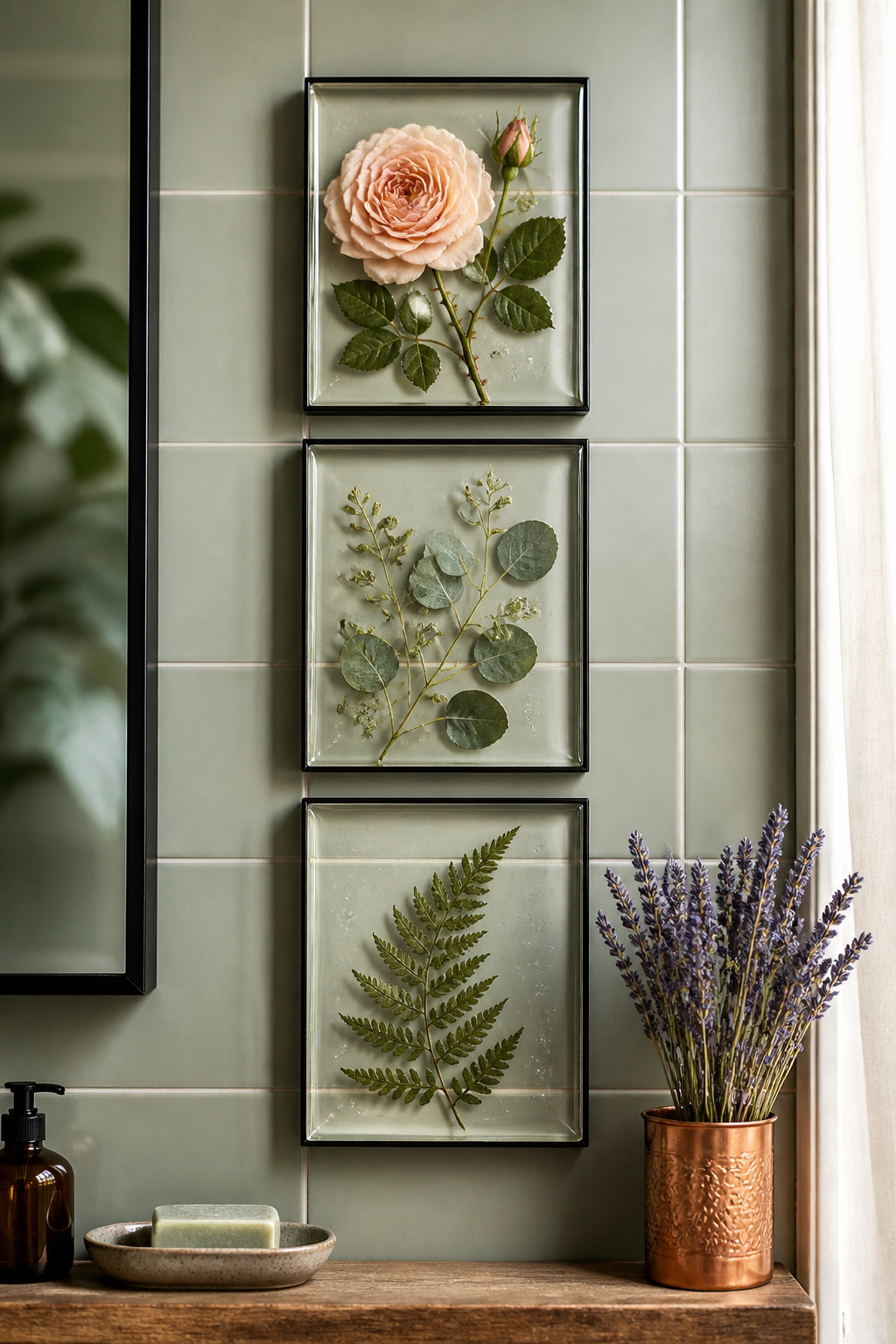
The solution is resin-cast botanical art. Flowers, leaves, grasses, and botanicals suspended in clear or tinted epoxy resin panels are fully moisture-proof. The resin creates the pressed-flower look without the humidity risk — and the clarity of the material gives botanicals an almost luminous quality. Etsy has an excellent selection of artisan resin botanical artists; search ‘resin botanical wall art’ or ‘resin pressed flower panel’. Prices start around $25 for small panels.
Dried Botanicals as an Alternative
For those who prefer the real thing: dried botanical bundles can work in well-ventilated bathrooms, away from shower steam. Eucalyptus and lavender are the most mildew-resistant dried botanicals. A cluster of three to five dried bundles hung from copper nails creates a wall installation that costs under $30 and smells extraordinary. If you enjoy layering organic textures with pattern in the bathroom, bathroom wallpaper vintage rooms show how organic wall treatments and rich pattern work together to create a genuinely collected atmosphere.
9. Geometric Prints and Modern Patterns as Minimal Bathroom Wall Decor
Geometric art is one of the most reliable choices for contemporary bathrooms because it speaks the same visual language as the room itself. Bathrooms are defined by rectangles and circles — tiles, mirrors, vanities, fixtures. Abstract geometry feels at home in that environment.
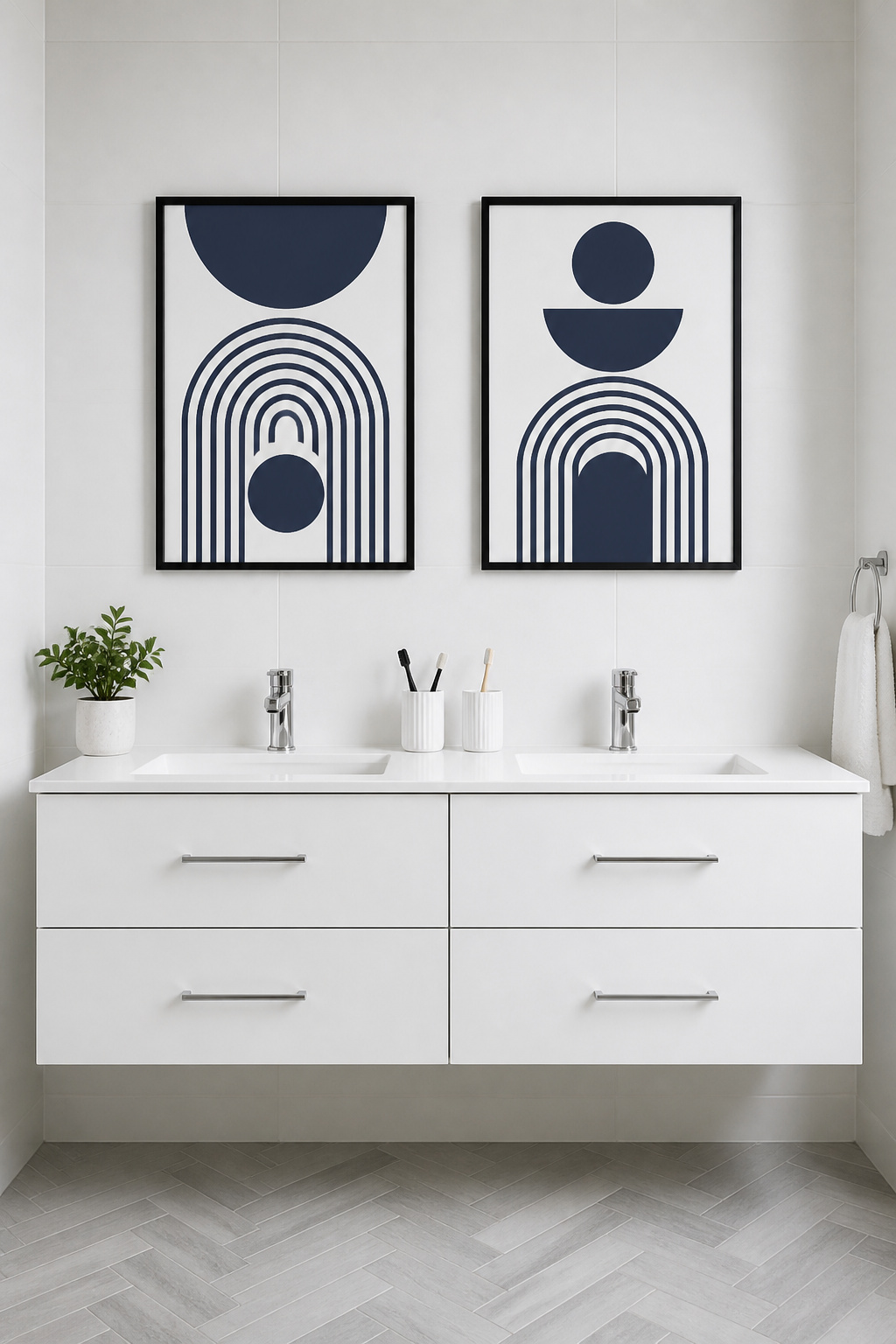
In Scandi and minimalist bathrooms, geometric art is the dominant decorative choice because it respects the negative space that defines those interiors. It adds visual interest without adding visual weight.
The critical decision is scale. When your tile is already geometric (hexagonal, herringbone, chevron), choose art with geometry at a very different scale — bold large shapes against small tile, or delicate line art against large-format geometric tile. Competing geometries at the same scale create visual noise rather than harmony. For modern bathroom decor ideas that extend beyond the art wall, there’s plenty to explore in how geometric art choices interact with fixture and tile selections.
For sourcing quality geometric prints, Society6 (independent artist designs), Desenio (affordable Scandinavian-style geometry), and Artfully Walls (curated higher-end options) all offer consistent quality. Buy from independent artists where possible — the designs are more original, and the money goes to someone who made something.
10. Neon Sign Art for a Playful or Spa-Inspired Mood
LED neon signs have become genuinely interesting bathroom wall art — not because they’re trendy, but because they do something no other art form does in a bathroom: they add light. A soft LED neon word or shape at 6am has a warmth that even good pendant lighting doesn’t quite provide.
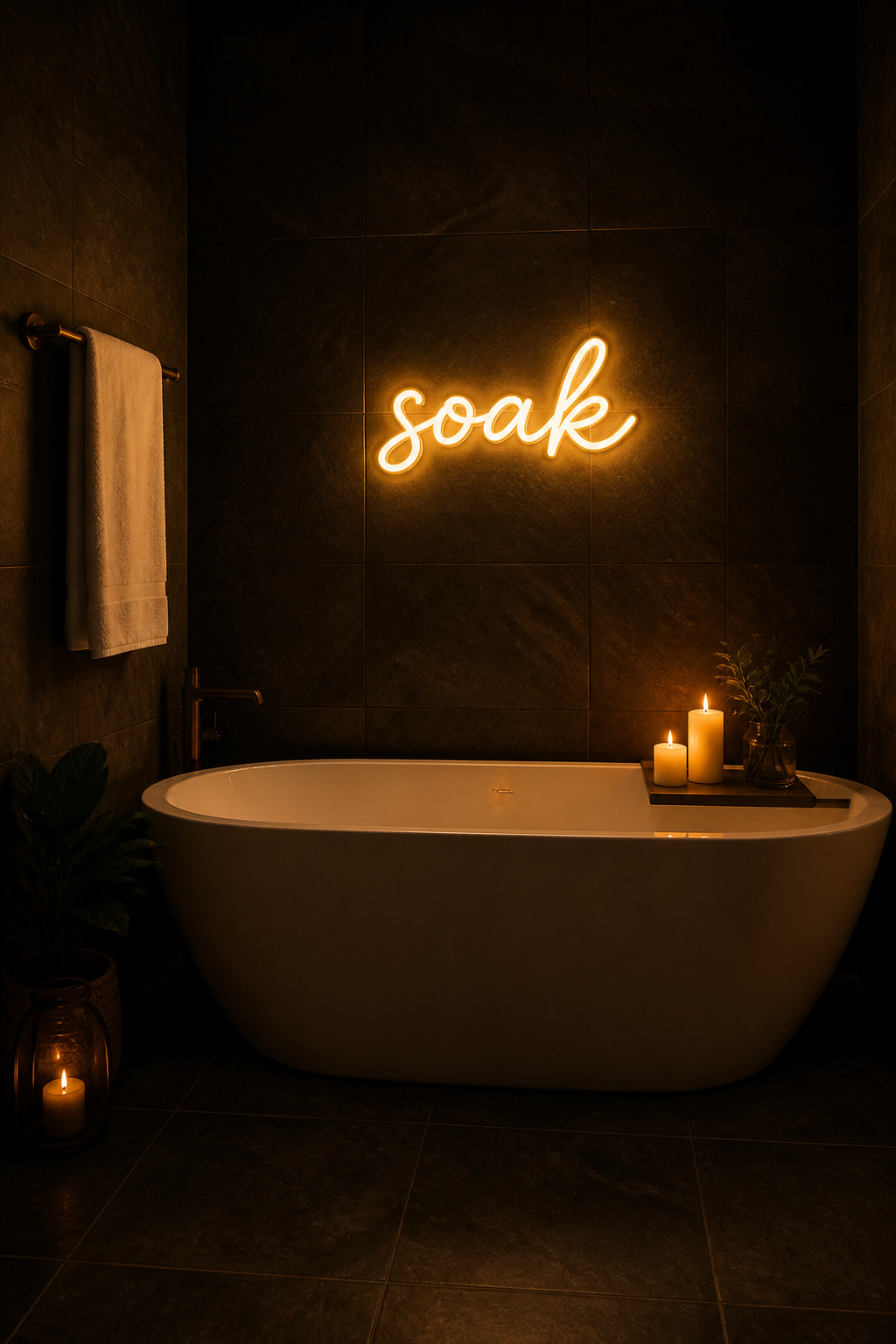
The important technical point first: traditional glass neon signs contain high-voltage gas-filled glass tubes and are not safe in humid bathroom environments. LED neon flex — silicone-encased LED strips bent into shape — is the only appropriate technology for bathrooms, and it must carry an IP65 rating or higher. IP65 means protected against water jets and dust; IP67 handles temporary submersion. If a sign doesn’t mention an IP rating, assume it’s IP20 (indoor use only, not wet-zone safe) and don’t buy it for a bathroom.
For spa-style master bathrooms, minimal phrases work best: ‘soak’, ‘breathe’, a set of meaningful coordinates, a date. For family bathrooms, something playful suits the space better — a simple word in a household language, a clean geometric shape. Keep the sign 12-24 inches wide for most bathrooms. Custom LED neon signs from Orant Neon and similar makers allow you to specify text, font, and colour. They ship with wall-mounting hardware and plug into a standard outlet — position the outlet outside the bathroom wet zone.
11. Floating Shelf Gallery With Small Prints and Curated Objects
The floating shelf gallery is the most versatile bathroom wall art approach because it combines display with function. A shelf loaded only with toiletries looks utilitarian. The same shelf with two small framed prints, a trailing pothos, and a candle becomes a styled installation.
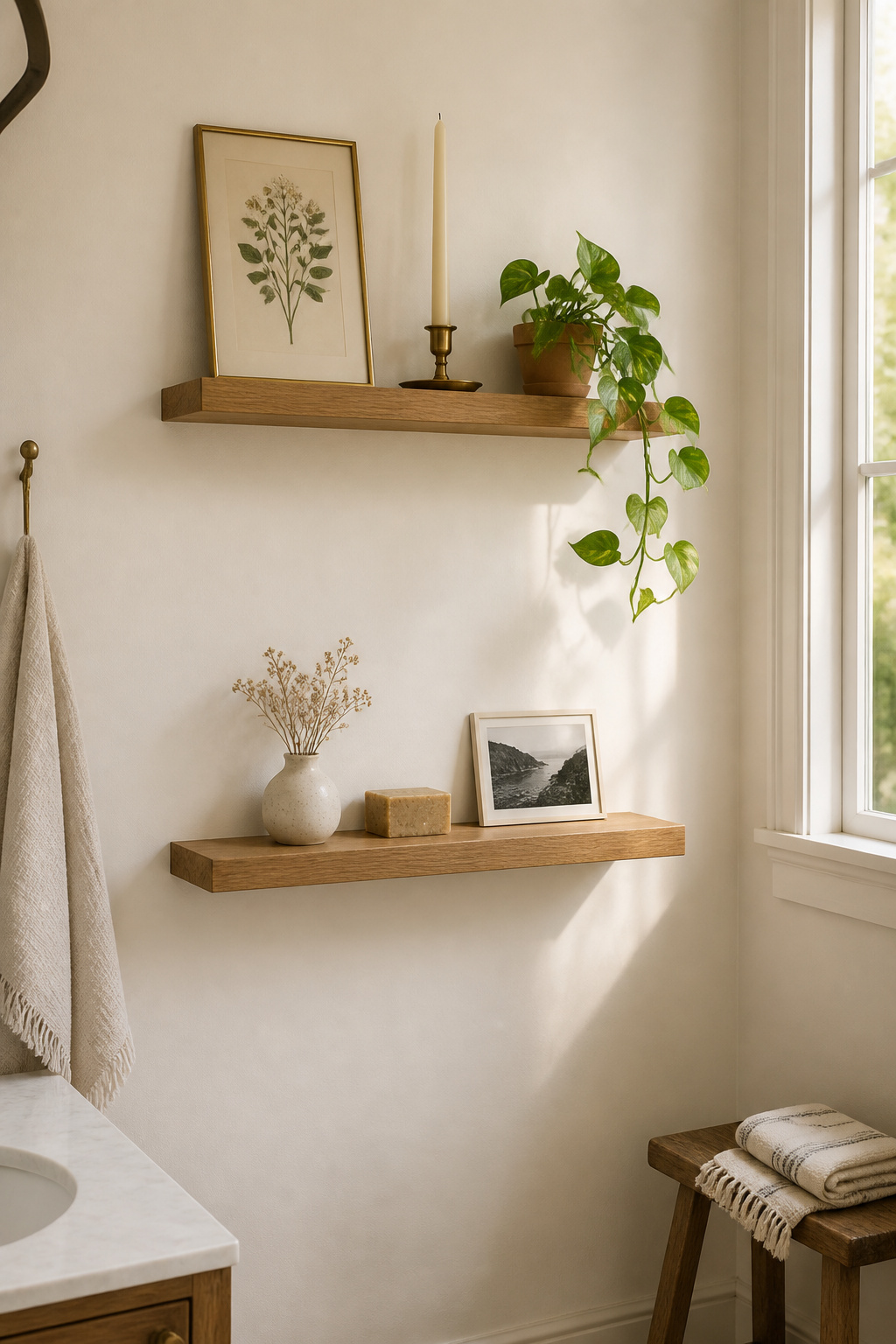
The rule of odds is your friend: three, five, or seven items on a shelf reads as intentional. An even number reads as accidentally placed. Varying heights matters more than consistent spacing — a tall candle next to a small plant pot next to a mid-height leaning print creates visual rhythm that evenly spaced objects never achieve.
Lean small prints (5×7 or 4×6 inches) against the wall behind a plant or candle rather than mounting them. The layering creates depth without more nail holes. Rotate the art seasonally — small prints swap out in seconds and keeping the shelf composition fresh takes under five minutes.
Shelf material is where people go wrong. Unsealed MDF will absorb moisture and warp within a year. Sealed solid wood (teak and oak are naturally moisture-resistant), powder-coated metal, and PVC are all safe choices. Plants that thrive on bathroom shelves: pothos (nearly indestructible), air plants (tillandsia, which absorb moisture from the air), and small succulents. All handle the humidity and intermittent light that most bathrooms offer.
12. Vintage Poster Prints: Retro Bathroom Wall Art With Personality
Vintage travel posters from the 1920s through the 1960s are among the most graphically confident art forms ever produced at scale. They were designed to stop people on a street and make them want to go somewhere. That same quality — graphic boldness, a mood of possibility, a palette refined to four or five perfect colours — makes them extraordinary bathroom wall art.
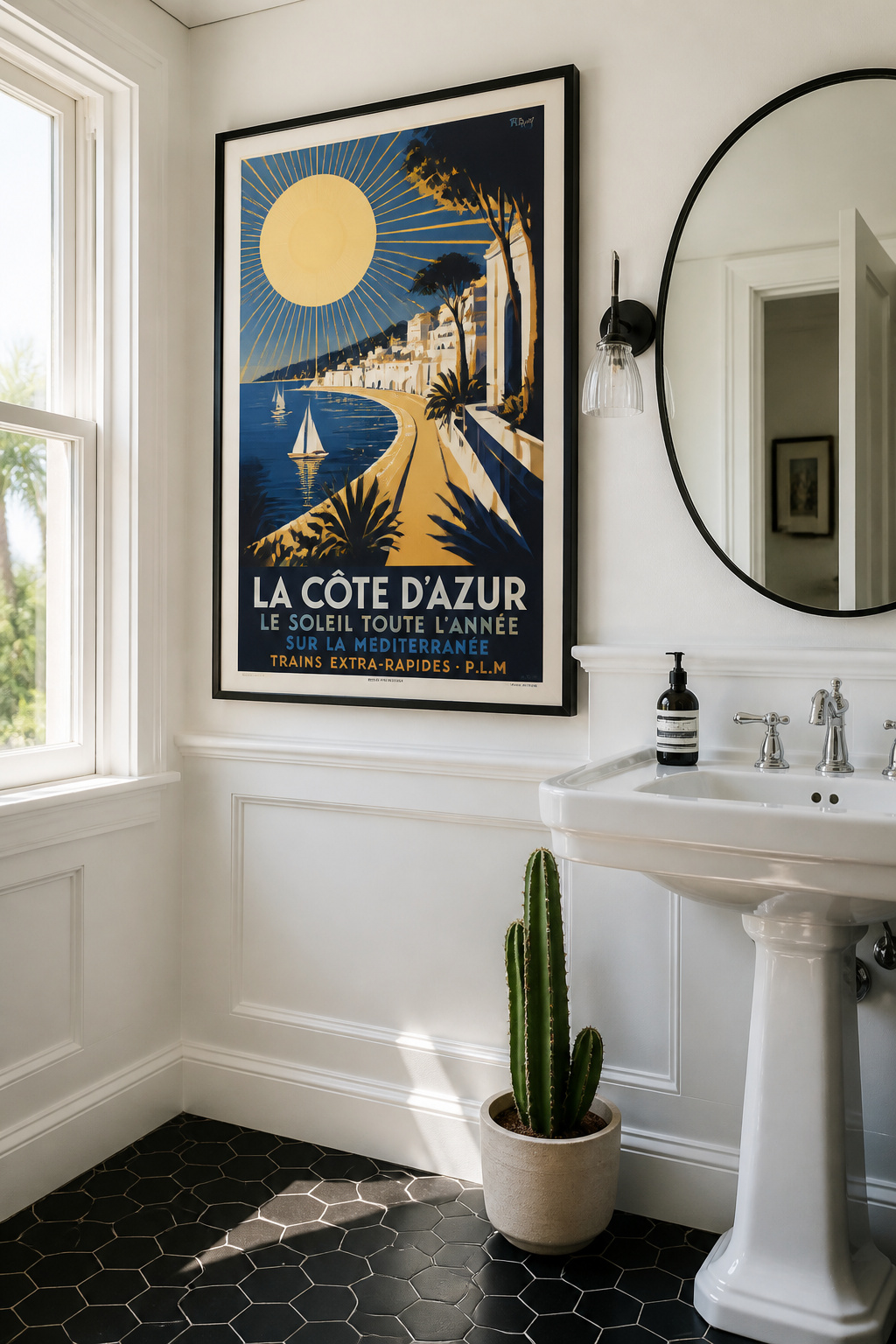
Art Deco travel posters from the 1920s and 30s are particularly effective in bathrooms. Strong geometric compositions, stylised figures, and limited palettes (gold, black, deep red, cream) coordinate easily with contemporary bathroom hardware. A large Art Deco poster above a freestanding bath is one of those combinations that looks inevitable once you’ve seen it.
For sourcing: original vintage travel posters from specialist dealers like International Poster Gallery sell for $200-$5,000+. For most bathrooms, a museum-quality giclee reproduction is the right choice. The Trumpet Shop Vintage Prints specialises in Art Deco-era reproductions with archival inks. Wallango offers museum-quality paper and archival inks. Allposters.com has the widest selection at lower price points — look for ‘archival paper’ or ‘giclée’ in the product description specifically.
Simple black frames with white mats are the universal framing choice for vintage posters. A clean contemporary frame around a bold 1930s poster lets the poster’s graphic confidence do all the work.
13. Custom Quote or Affirmation Art for a Personal Touch
Typography art in bathrooms lives or dies on restraint. The most common failure is choosing a quote everyone has already seen — the kind that turns up on mugs and tote bags — and printing it in an overly decorative font. The second most common failure is choosing a font no one can read from six feet away.
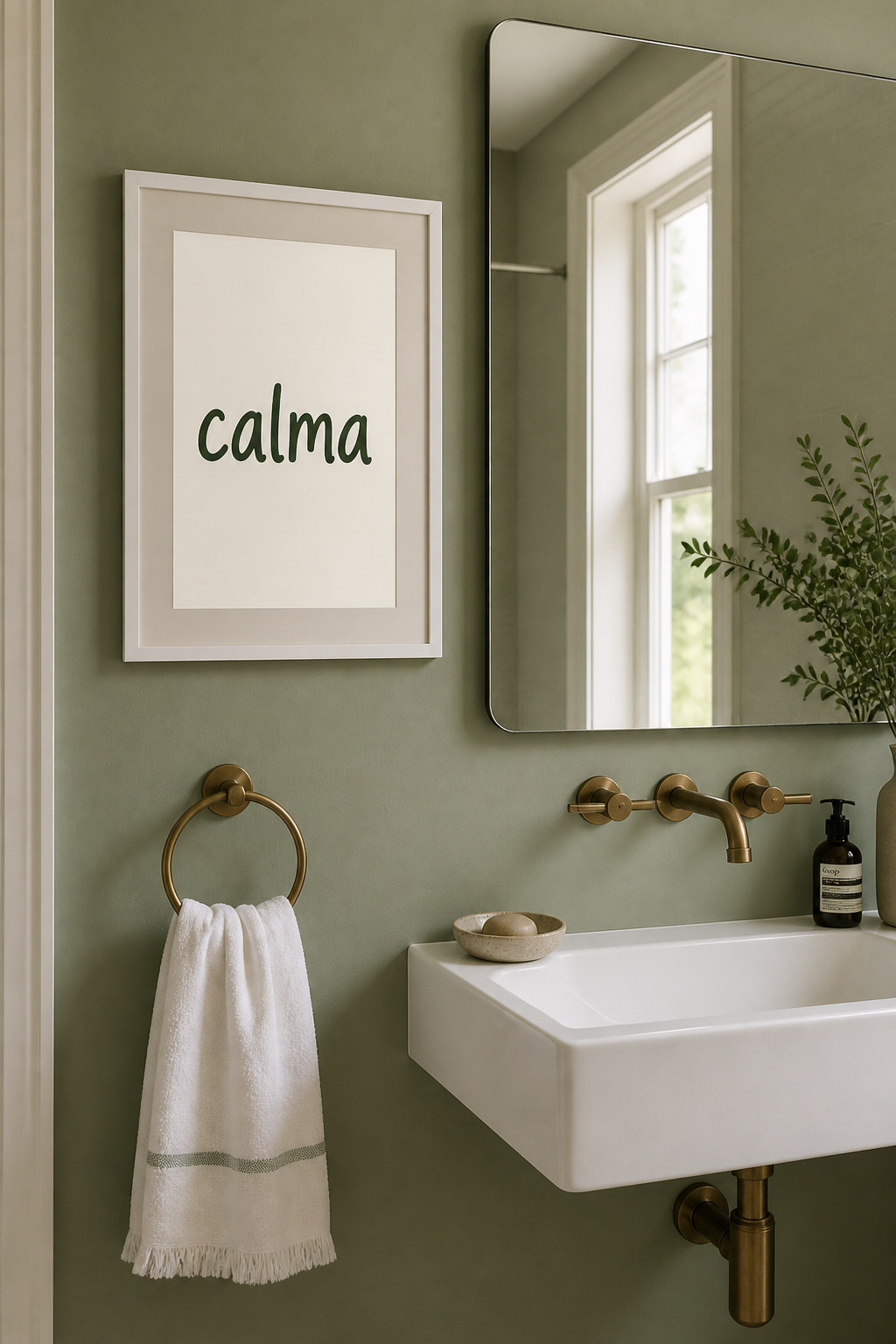
The difference between considered typography art and a generic inspirational print is almost entirely about font choice, spacing, and the originality of the text. A single word set beautifully — ‘calma’ in clean hand-lettering, a Japanese character in confident brushwork, a meaningful word in your family’s language — is often more powerful than a full sentence. If you want a sentence, make it yours: a line from a book that changed something for you, coordinates of a place that matters, a phrase from a conversation you want to remember.
Minted’s custom quote service (minted.com) lets you upload your own text, choose from a curated range of typefaces, and select size and frame style. Unframed prints start around $39 for 8×10 inches. Etsy typography artists offer fully bespoke hand-lettered pieces; search ‘custom quote art print’ and filter by ‘made to order’.
On font: clean sans-serif typefaces (Helvetica, Gill Sans, Futura) suit contemporary bathrooms. Classical serif fonts (Garamond, Baskerville, Caslon) suit traditional spaces and carry a quiet authority that decorative script fonts don’t. Frame with an acid-free mat and UV-filtering glass or acrylic front — moisture warps cheap paper prints in a sealed frame without adequate protection.
14. Mirror Cluster Gallery as Functional Art for the Bathroom Wall
A mirror cluster gallery does what no other bathroom wall art can: it amplifies light and space while functioning as art. A well-placed group of mirrors can visually double the perceived size of a compact bathroom — that’s a practical benefit that a canvas or poster will never offer.
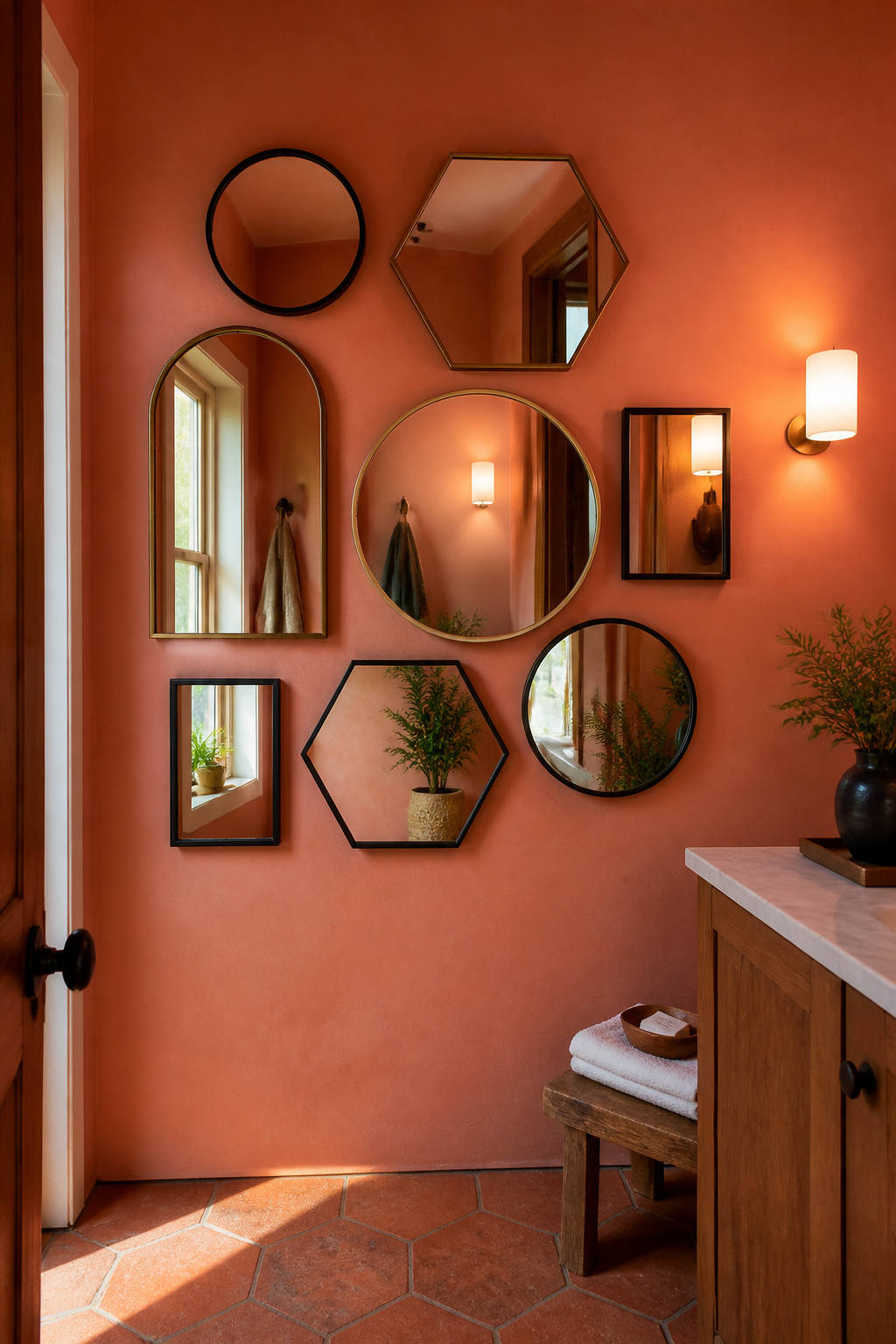
The design principle is straightforward. Arrange mirrors in varying shapes and sizes as a grouped installation, with a unifying element that holds the cluster together — shared frame material, consistent colour palette, or uniform spacing. Without at least one unifying thread, a mirror cluster reads as a surplus store rather than a gallery.
Mix shapes freely. Round mirrors bring softness and work well as secondary pieces around a larger arched or rectangular anchor. Hexagonal mirrors in a honeycomb grouping create a geometric installation with strong contemporary appeal. Arched mirrors have a height-enhancing quality useful in low-ceilinged bathrooms. For more on what using bathroom mirrors as wall art can achieve beyond a simple cluster, there are some surprising placement and combination approaches worth exploring.
Keep spacing consistent at 2-3 inches between pieces. Use paper templates before hanging — mirror hardware is less forgiving than picture wire. Frame materials that handle bathroom humidity: iron, brass, bamboo, and sealed wood are all reliable choices.
15. Personal Photography and Children’s Drawings for a Family Bathroom
Personal photography and children’s artwork do something gallery-sourced art cannot: they make the room specifically yours. A family bathroom with a cluster of well-framed family photos or a child’s drawing elevated by good presentation feels genuinely different from a generic well-decorated space. It feels lived in, in the best possible sense.
The key to making personal art feel designed rather than domestic is consistent framing. The same drawing in a clip frame vs. a proper white-mat-and-black frame looks like two different pieces — the frame accounts for at least half the perceived quality. Choose one frame style and stick to it across the display. Printing all personal photos in a consistent square format makes mixed-era images look cohesive.
For archival quality: Artifact Uprising offers museum-grade photo printing on matte or metallic paper — prices start around $10 for 4×6 prints and the quality difference from kiosk printing is immediately apparent. Children’s drawings can be converted to archival fine-art prints through services like Chatbooks or Canvify, preserving the originals safely while putting print copies at humidity risk.
Above the toilet is the natural location for a personal photo cluster in a family bathroom — visible every day, never demanding. Three frames in a tight horizontal line draws the eye upward. Five or six frames in a loose asymmetric arrangement creates a warmer, more organic display. UV-protective glass or acrylic is essential — personal photographs are irreplaceable, and bathroom humidity with standard glass will cause fading within a few years.
16. Woven Textile Tapestries as Textured Bathroom Wall Art
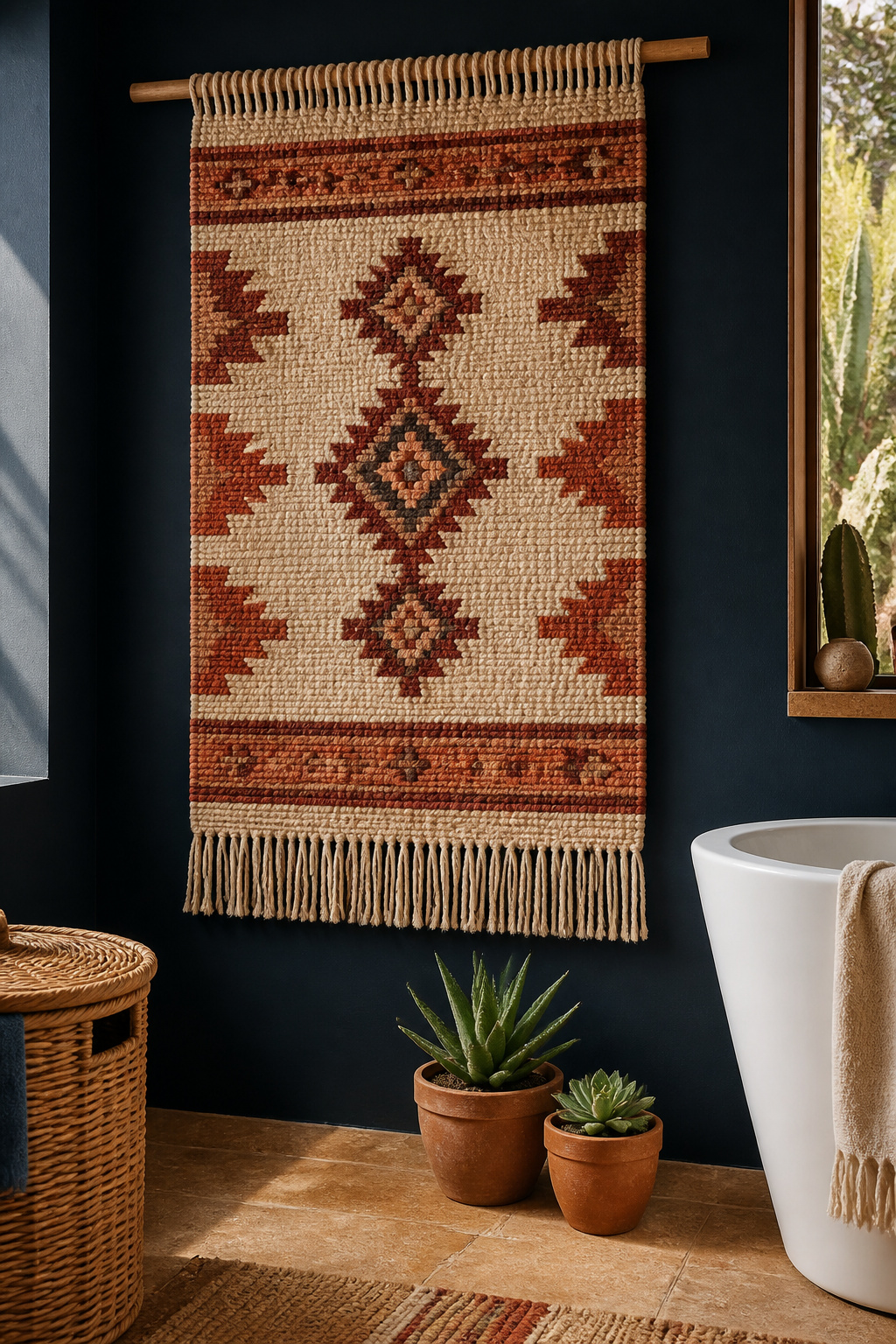
A well-chosen tapestry does something remarkable in a tiled bathroom: it absorbs sound. A room lined with ceramic and glass echoes — voices, water, everything. One textile piece on the wall has a measurable acoustic effect, softening the room’s resonance in a way that makes the space feel more intimate and less clinical. Add the visual warmth, the textural depth, and the cultural story that a handwoven piece carries, and the case for bathroom tapestry becomes hard to argue with.
Choosing Your Weaving Tradition
There are four traditions worth knowing for bathroom-scale tapestry work. South American (Andean) tapestries in handspun wool with geometric patterns represent one of the world’s most sophisticated textile traditions — NOVICA (novica.com) sells directly from artisans in Peru, Bolivia, and Ecuador with fair-trade certification. Moroccan handira wedding blankets and Beni Ourain-inspired wall textiles bring cream-and-metallic palettes that suit contemporary Western bathrooms with particular ease. Scandinavian-style cotton tapestries in muted earthy palettes are the most maintenance-friendly option and widely available through Etsy and Wayfair. Contemporary studio tapestries from independent weavers bridge traditional technique with modern design sensibility at increasingly accessible price points.
Fibre and Hanging Advice
Fibre matters for bathrooms. Cotton and linen handle humidity better than wool — wool retains moisture longer and can develop mold in poorly ventilated spaces. Synthetic or cotton-synthetic blend tapestries are the most moisture-resistant option. Hang at least 36 inches from the shower or bath; run the bathroom fan during and after showers. Copper or wooden dowels are the traditional hanging system — most artisan tapestries include a dowel. If you love the textile aesthetic beyond the bathroom, boho living room wall decor explores how woven pieces translate into larger living spaces with the same warmth.
Finding Your Perfect Bathroom Wall Art Style
The bathroom has one significant advantage over every other room in the house: you spend time there every day, mostly alone, mostly quiet. The art you choose for it becomes part of your daily ritual in a way that a painting in the hallway never quite does.
Matching Art to What’s Already There
Start by pulling from what’s already in the room. The most reliable starting point for choosing bathroom wall art is to identify one colour from your existing tile, hardware, or grout and use it as the anchor for art selection. Warm brass fixtures suggest warm-toned art — terracotta, ochre, warm botanical greens. Chrome and matte black fixtures suggest cooler or more monochromatic choices. This isn’t a strict rule, but it’s a shortcut that prevents the most common mistake: choosing art you love in isolation that fights with the room it lives in.
Match the mood too. A spa-style master bathroom calls for calming, contemplative work — botanical illustration, monochrome photography, a minimal typography piece, or soft abstract art. A maximalist family bathroom can handle bold vintage posters, a ceramic plate arrangement, or a vibrant woven tapestry. Good bathroom wall art amplifies the atmosphere the room already has.
Building Your Collection Over Time
One large, confident piece is nearly always a better outcome than a gallery wall assembled under pressure. It’s faster, easier to get right, and simpler to change if your taste evolves. Gallery walls built over time — one piece added every few months as you find the right things — have a more genuine, collected quality than walls planned and executed in a single afternoon.
Budget guidance: $50-$150 buys a quality framed single print that can anchor the whole room. $200-$500 builds a considered small gallery wall over a year or two of patient collecting. Whatever you choose: put something on those walls. Your bathroom sees you every day. Give it something worth seeing back.