Your bathroom functions perfectly. The plumbing is reliable, the lighting works, the tiles are clean. And yet something is missing — that quality that makes you pause at the threshold of a well-designed space and actually feel something before you have done anything in it. Modern bathroom decoration is rarely about spending more. It is about choosing with the kind of intention that comes from understanding why each material, each finish, each object earns its place. Drawing from the East-West material dialogue at the heart of contemporary design and the spare, considered elegance of European modernism, the ideas below are organised not around budget but around decision quality. Each of these eighteen approaches offers a way into a bathroom that feels genuinely elevated — one you will want to linger in rather than leave.
1. Floating Vanities That Unlock Visual Breathing Room
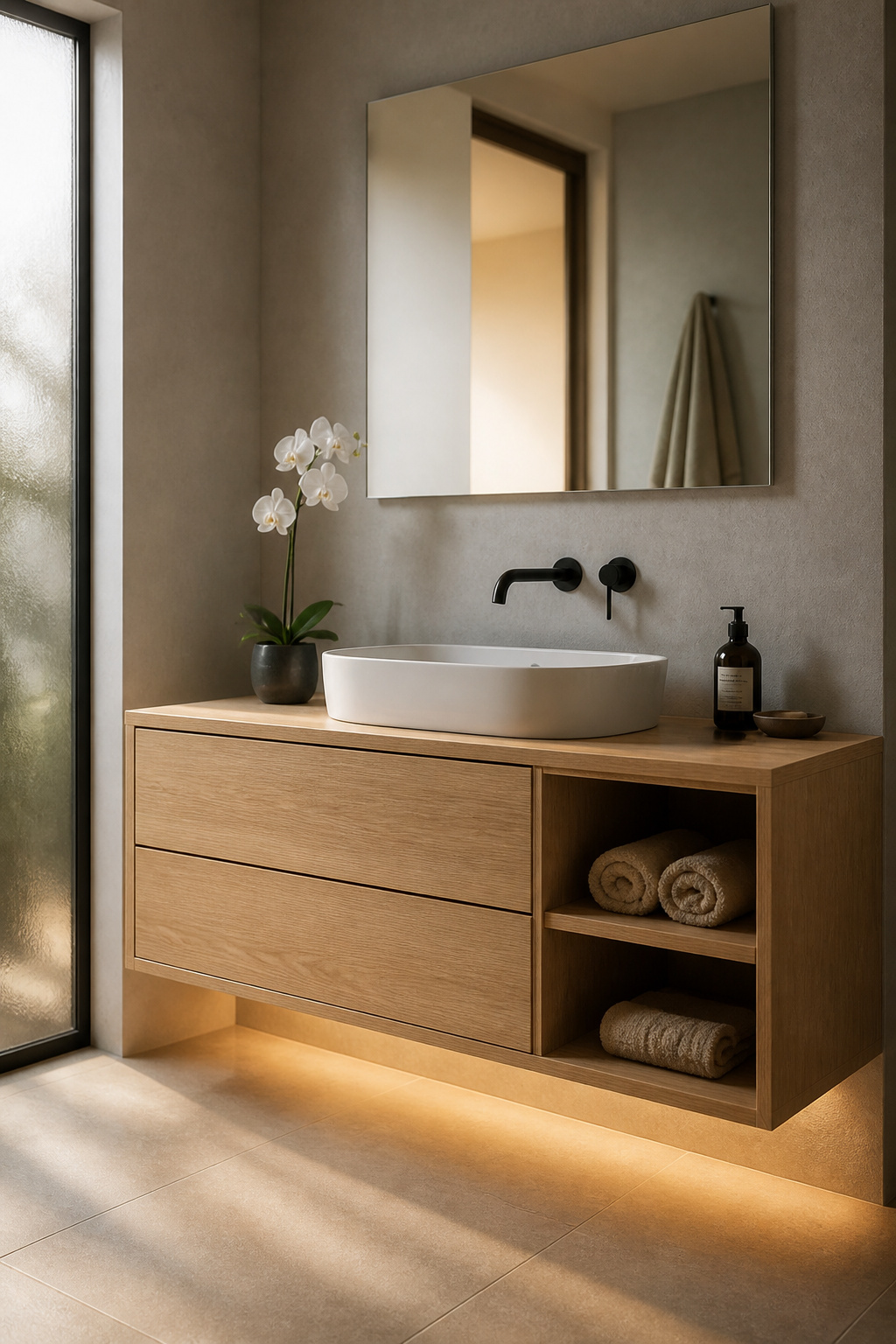
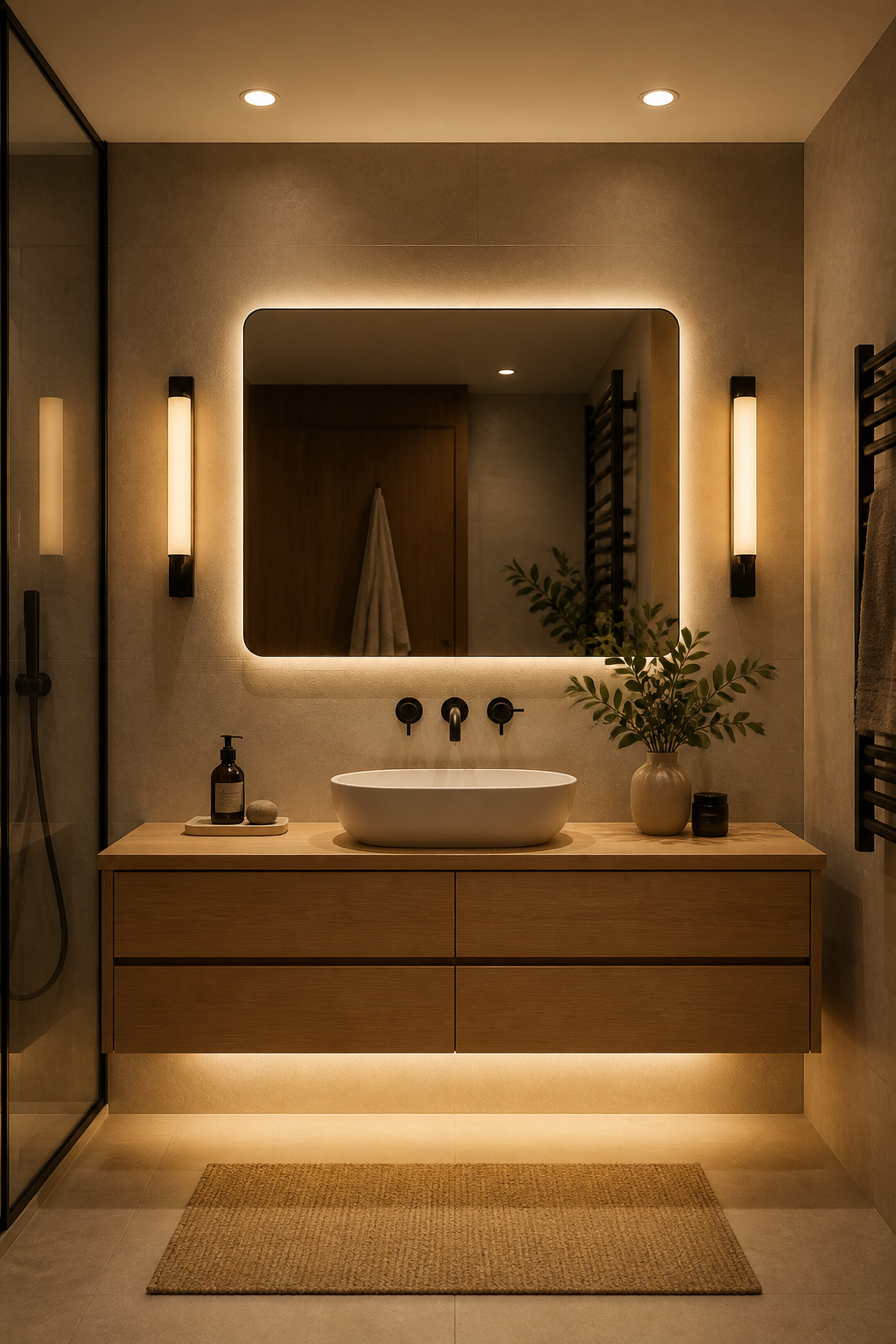
There is something architecturally honest about a floating vanity. By lifting the cabinet off the floor, you expose the surface beneath — and that single decision changes how a bathroom reads more than almost anything else. The floor reads as continuous; the room feels larger; the whole composition feels designed rather than furnished. In modern bathroom decoration terms, it is the difference between a bathroom that was assembled and one that was considered.
Why Negative Space Changes Everything
Wall-mounted vanities run from 24 to 48 inches wide for singles and up to 72 inches for doubles. Standard installation height sits at 30-32 inches from floor to countertop, adjustable — at 34 inches, the proportions shift toward a more European scale that suits taller users. Depth typically runs 20-22 inches, shallower than freestanding units, which matters in compact bathrooms.
Material pairings worth pursuing: warm white oak with a polished concrete basin, matte charcoal lacquer with brushed nickel hardware, or natural walnut against a matte white countertop. The best floating vanity designs feature handle-free drawer fronts — fluted or grooved profiles that create visual rhythm without hardware interrupting the clean silhouette. For those weighing options across the full range, the world of bathroom sinks and vanities that transform a space is larger and more accessible than most people assume.
The LED Toe-Kick Detail
Wall studs or solid blocking must be in place before the vanity goes up, particularly if a stone countertop follows. If you want the LED toe-kick glow beneath — that levitating effect that photographs beautifully — plan the wiring at first-fix stage. The effect requires an IP65-rated LED strip set behind a diffuser channel, running at 2700K to complement the warmth of the vanity material above.
2. Monochromatic Palettes That Command Calm Authority
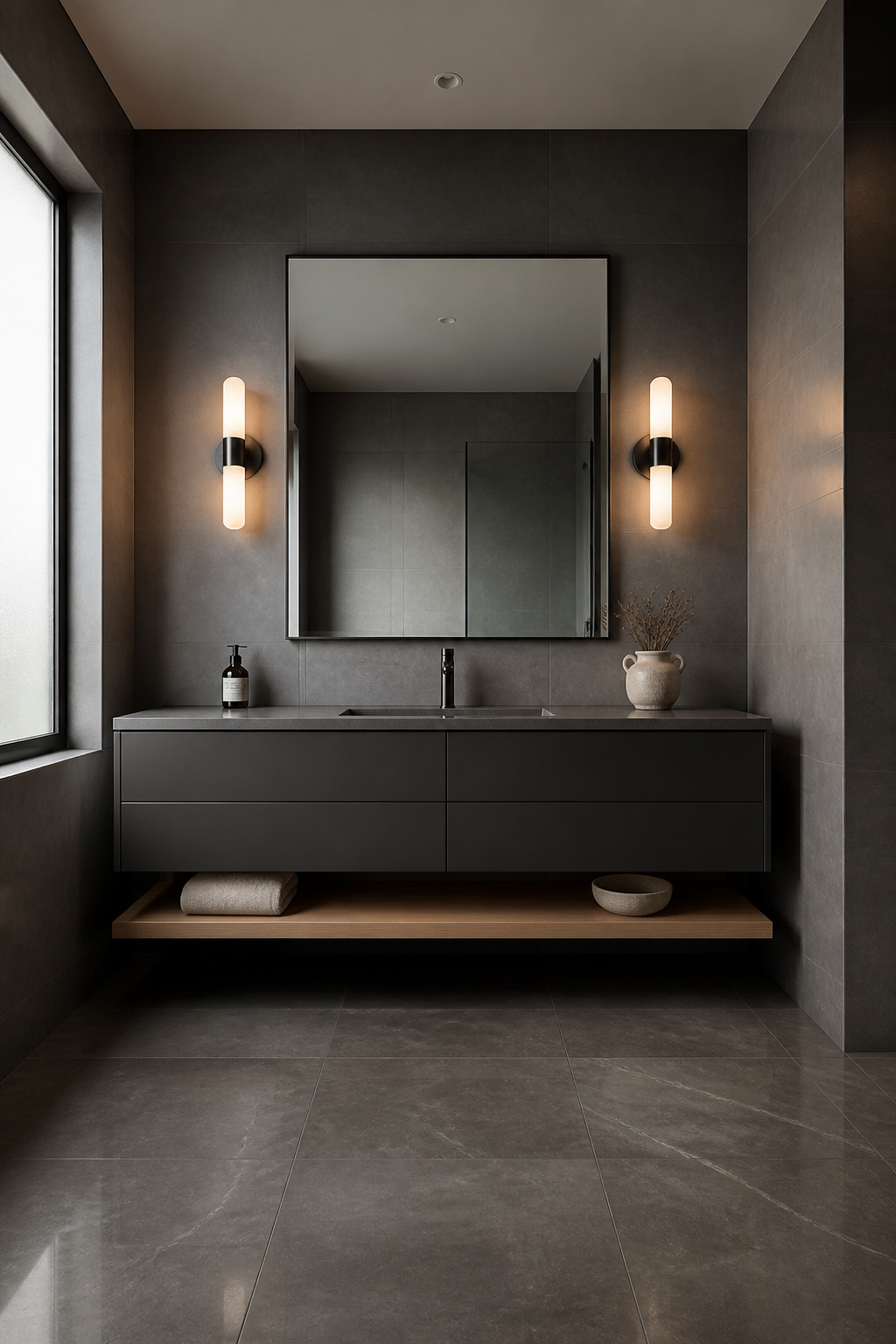
The premise of a monochromatic bathroom sounds simple: choose one colour and commit. The execution is considerably more nuanced, and it is that nuance — the careful layering of tone, texture, and finish — that separates a modern bathroom decoration scheme feeling deliberately conceived from one that just happens to be grey.
Building Tonal Depth
The most effective monochromatic schemes use three to four values of the same colour: near-white for the ceiling, a mid-tone for walls, a deeper shade for the floor, and a near-black accent in the grout or fixtures. Warm grey ranges — those with an ochre or taupe undertone rather than a blue or green cast — are more liveable under artificial light, which tends to skew cool. A pure cool grey bathroom can feel clinical by evening; a greige reads as considered at all hours.
Texture does the work that colour contrast would do in any other scheme. Mix at least four different surface qualities: matte wall tile, gloss floor tile, linen or waffle-weave towels, and a matte or brushed fixture finish. Leather-effect tile or a fluted ceramic surface catches light in a way that flat surfaces cannot, creating visual movement within the single hue. A natural material introduced as the relief element — a timber shelf, a stone basin — prevents the scheme from feeling completely engineered.
Lighting reveals everything. Subtle tonal shifts between a dove-grey wall and a charcoal floor disappear under a single flat downlight and emerge beautifully under well-positioned layered lighting. The monochromatic bathroom is perhaps the strongest argument for getting the lighting right before declaring any other decision final.
3. Statement Stone Feature Walls With Natural Vein Movement
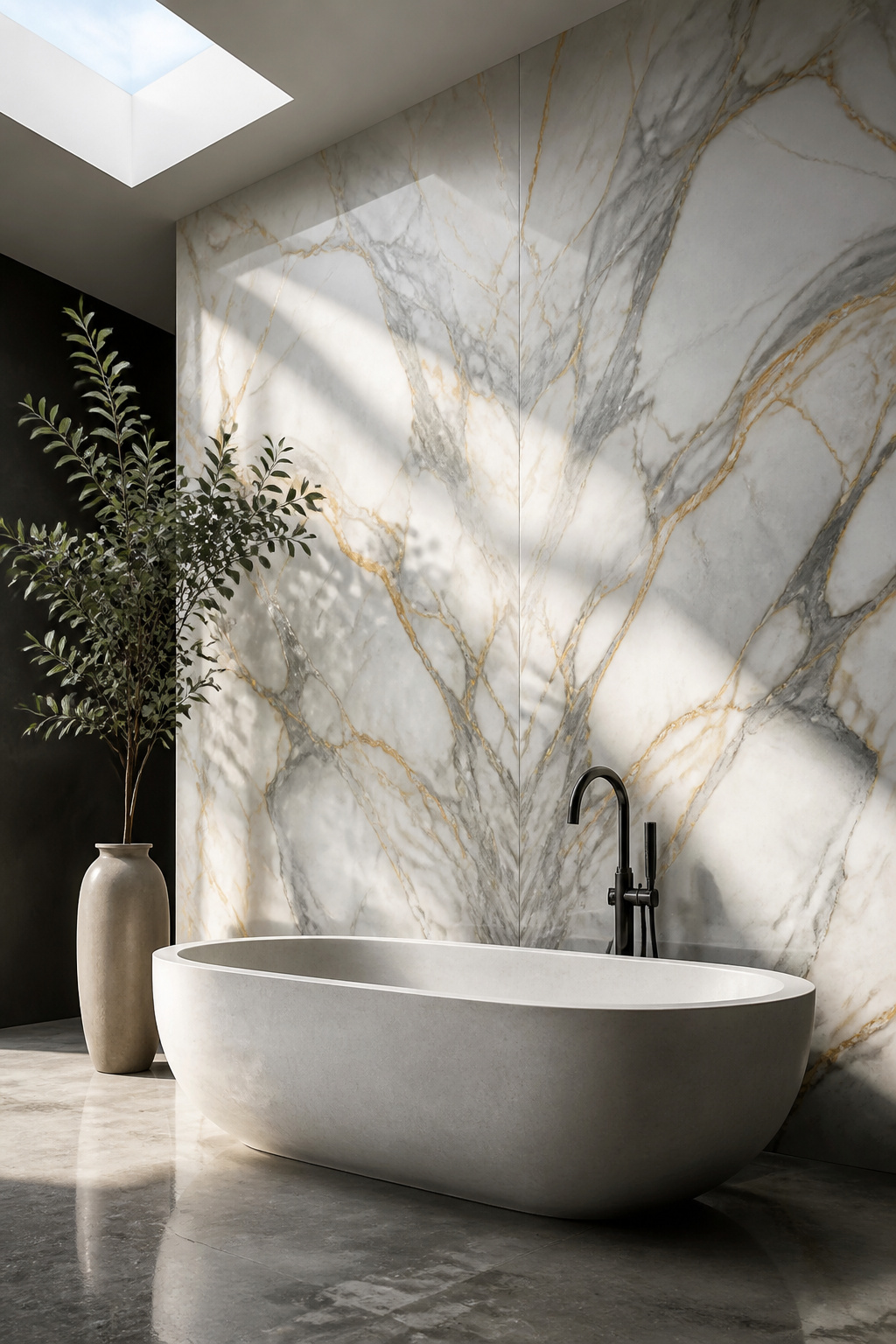
A floor-to-ceiling marble or travertine wall changes the logic of a bathroom. Instead of a room covered in tile, you have a room with a centrepiece — and the difference in how that registers, both visually and emotionally, is not subtle.
Natural Stone vs. Porcelain Slabs
Calacatta marble, with its bold grey and gold veining against a white ground, creates the most dramatic single-wall statement. Statuario works similarly with a colder, more architectural white. Travertine offers a warmer, more organic version suited to Mediterranean or wabi-sabi inflections. The professional move with slabs is book-matching: placing two panels mirror-image so the veining creates a symmetrical butterfly pattern. The effect reads as art rather than building material.
For those committed to the look but not the maintenance, large-format porcelain slabs (1200x2400mm and above, from Porcelanosa and Daltile’s Panoramic range) now replicate natural stone convincingly. Practical advantages are real: no sealing required, no porosity, no staining risk. Cost runs $8-25 per square foot installed versus $15-50 for natural stone.
Placement Strategy
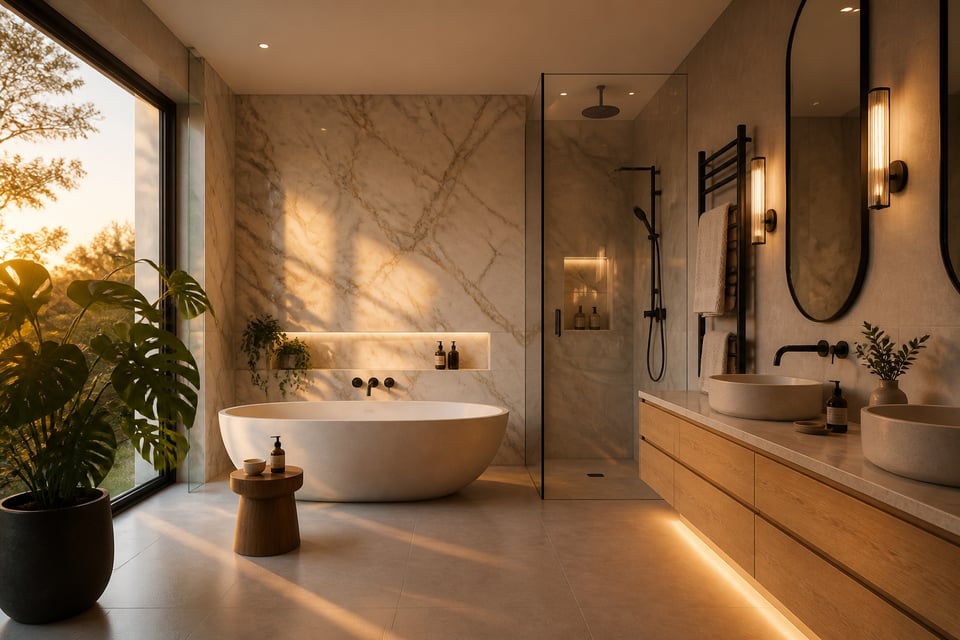
Placement matters as much as the material. A stone wall behind the freestanding bathtub positions the tub as a sculpture against a mineral backdrop. Behind the vanity, a floor-to-ceiling slab doubles the perceived height of the mirror zone. Running the same stone through a frameless glass shower enclosure — visible from both inside and outside — creates visual continuity that makes the room feel architecturally complete rather than compartmented.
4. Frameless Glass Showers for Uninterrupted Sightlines
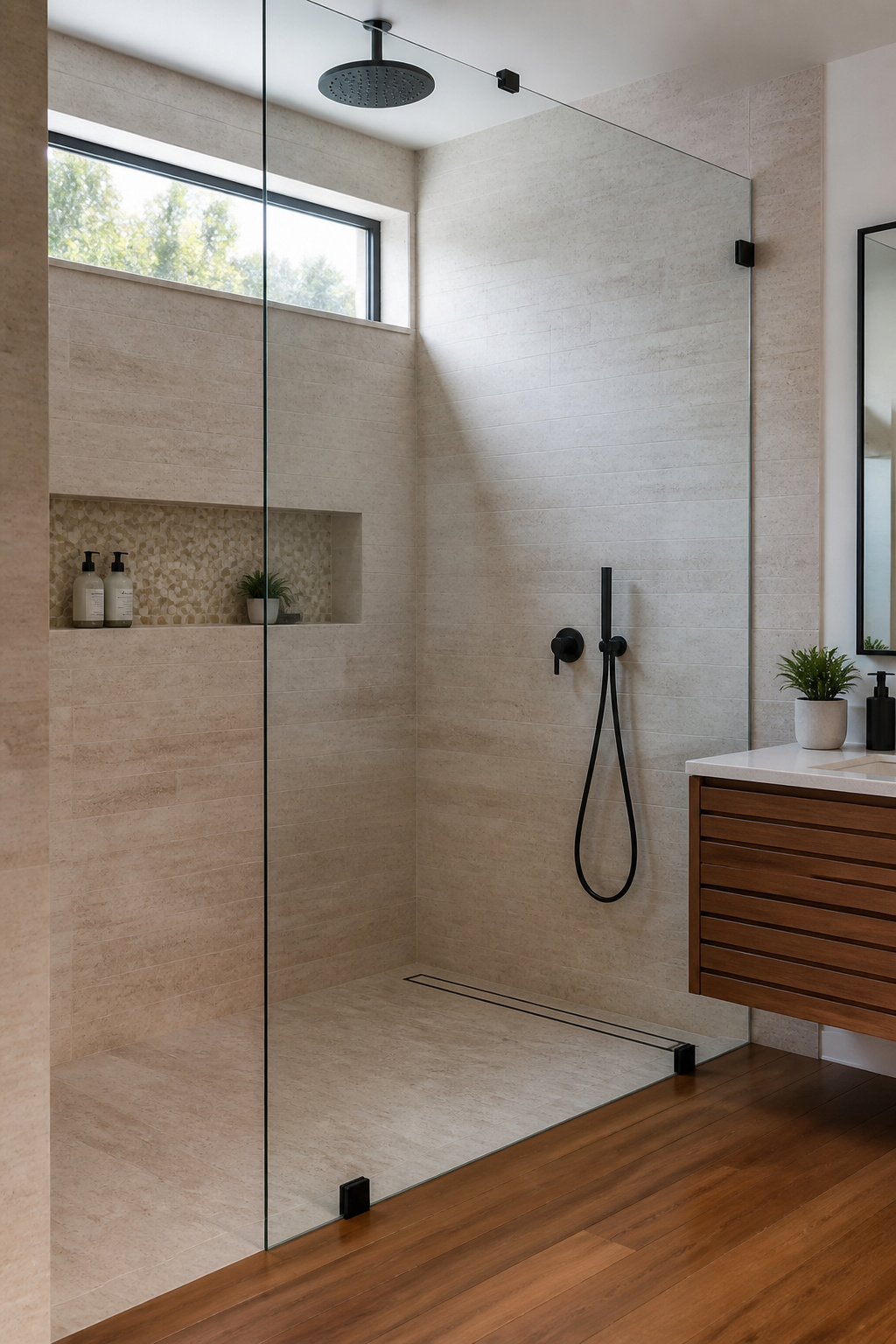
The frameless glass shower enclosure is one of the few decisions in modern bathroom decoration with a direct architectural effect on the whole room. By removing the metal channel that divides the bathroom into a wet zone and a dry zone, the glass becomes almost invisible. The tile or stone inside the shower reads as part of the larger space.
Glass Thickness and Hardware
Standard frameless enclosures use 3/8-inch (10mm) tempered glass up to 84 inches tall, which feels substantial and offers the widest hardware selection. For taller enclosures or those requiring exceptional rigidity, 1/2-inch (12mm) glass is specified — heavier, more imposing, and requiring appropriately rated heavy-duty hinges. Hardware finishes for a modern palette: matte black or brushed nickel. Polished chrome reads as slightly dated in contemporary contexts.
Factory-applied hydrophobic coating — products like EnduroShield or Diamon-Fusion — causes water to sheet off rather than deposit minerals. For the full scope of what is possible in shower design, brilliant bathroom shower designs offers a useful reference across styles and configurations.
Walk-in vs. Hinged Formats
Walk-in wetroom formats — no door, with a linear floor drain and sloped screed — eliminate hardware entirely. They require at minimum a 900x900mm wet zone, though 1000x1200mm is more comfortable in use. The Italian doccia aperta approach (a single fixed glass panel with an open entry) solves clearance constraints in smaller bathrooms while maintaining the visual logic of the frameless aesthetic.
5. Contemporary Bathroom Decor With Terrazzo Accents
Terrazzo has made a particular kind of return — not a nostalgia-driven revival of its mid-century motel period, but a genuine reappraisal of what the material offers as a component of contemporary bathroom decor. Fragment aggregate suspended in a binder, each surface technically unrepeatable, each square foot of flooring simultaneously ancient technique and fresh visual energy.
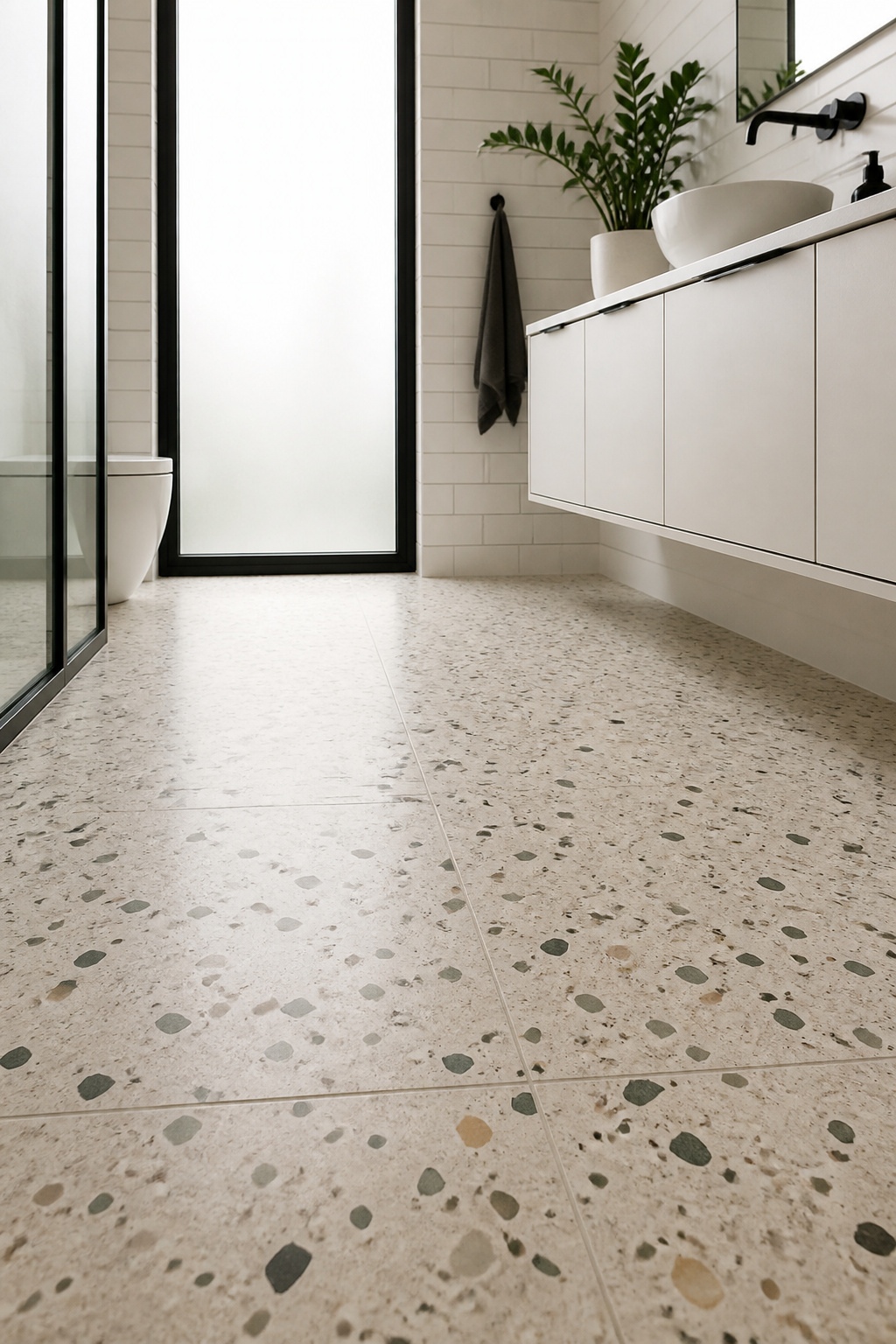
The 2025-2026 direction favours matte-finished terrazzo with larger aggregate chips and bolder colour combinations: rich green chips against a cream matrix, terracotta fragments in a slate-grey base. Paired with brass or matte-black fixtures, the material reads as decisively contemporary — the polished terrazzo of the 1960s motel lobby has very little to do with this version. Small chips (2-5mm) read as texture from a distance; larger chips (10-20mm) read as graphic pattern and can feel busy in a bathroom under 6 square metres. Porcelain terrazzo tiles from suppliers like Atlas Ceramics provide convincing visual equivalents at considerably lower cost and with standard installation. Matching the dominant chip colour to a fixture tone introduces a designed coherence that elevates terrazzo from incidental material to intentional palette element.
6. Matte Black Fixtures as Modern Bathroom Design Anchors
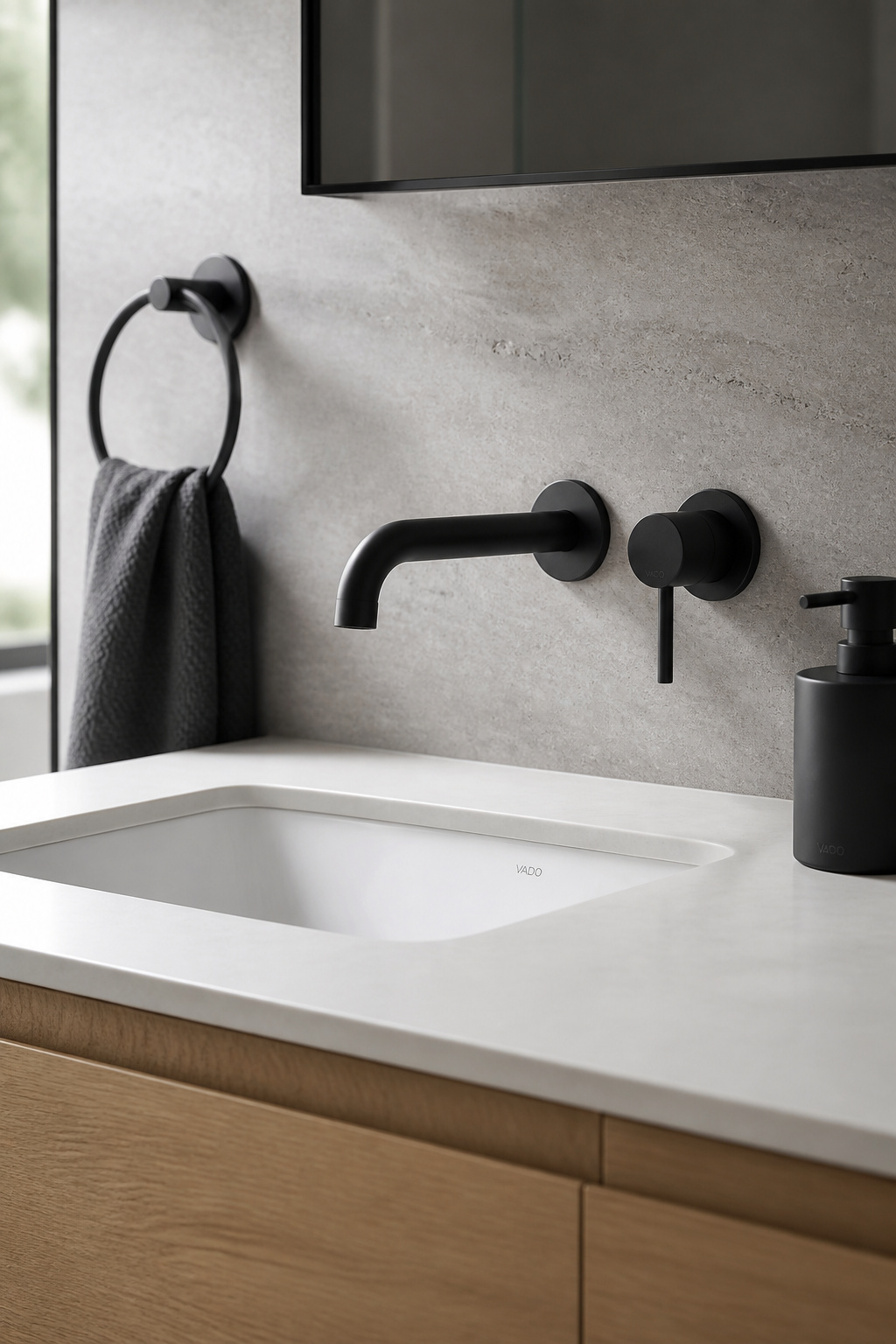
Think of matte black fixtures the way a typographer thinks of a full stop. The point is not the point itself — it is what the point allows the surrounding text to do. In a modern bathroom, matte black fixtures are the punctuation. They give the other materials — stone, timber, plaster, tile — something to resolve against. Without that dark anchor, a bathroom risks reading as pleasant but unresolved.
Building the Fixture Language
Matte black now holds approximately 35% market penetration in European and North American bathroom fixture sales. In 2025-2026, it pairs increasingly with warm materials (oak, travertine, plaster) — this East-West material dialogue is what keeps the finish feeling contemporary. The professional approach treats fixtures as a language, not a collection. Basin mixer, bath filler, shower valve, shower head, towel rail, robe hooks, toilet roll holder, and cabinet hardware should all speak the same finish. Brands with comprehensive matte-black families include Hansgrohe (Talis range), Gessi, Vola, and Nero Tapware.
PVD vs. Powder-Coat
PVD (Physical Vapour Deposition) coating bonds at a molecular level and significantly outperforms powder-coat. Look for products backed by a 10-year-plus finish warranty as a proxy for PVD technology. Maintenance requires only a soft microfibre cloth — no polishing, and no abrasive cleaners, which can damage the surface irreversibly.
7. Sculptural Freestanding Bathtubs as Meditative Focal Points
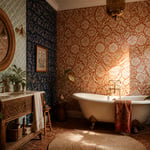
The freestanding bathtub is the clearest signal that a bathroom has moved beyond utility. It announces that this room has been designed for presence — for staying rather than passing through. In Japanese bathing culture, the ofuro (deep soaking tub) is not a convenience but a ritual space. A freestanding tub in a contemporary Western bathroom carries some of that cultural weight, even if the owners have never consciously reached for it.
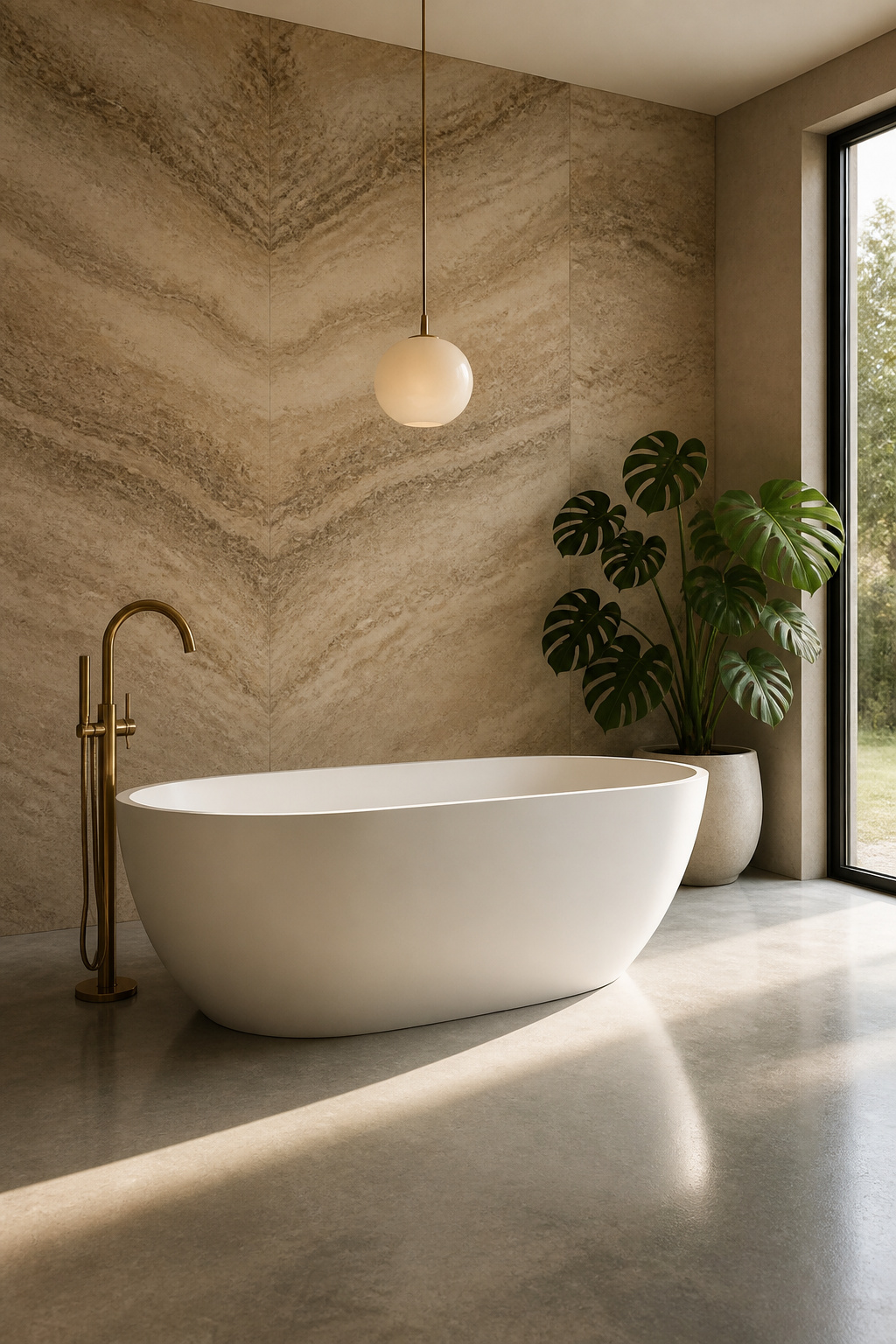
For those exploring the full range of what a bathtub change can accomplish, bathtub remodel ideas that blend function and tranquility covers the complete spectrum from accessible to high-end.
Material Comparison
Stone resin delivers a dense, matte surface with exceptional heat retention — water stays warm significantly longer than in acrylic. Cost runs $1,200-$4,000; lifespan extends well beyond 25 years. Cast iron has the longest lifespan (50+ years) with an irreducible sense of permanence — weight (130-200kg empty) requires a structural floor assessment. Acrylic remains the accessible entry point ($300-$1,200), lightweight and warm to the touch. For modern bathroom decoration purposes, stone resin is usually the optimal balance: the matte surface coordinates beautifully with contemporary finishes, and the heat retention justifies the investment.
Positioning for Maximum Impact
Centre-of-room positioning creates maximum sculptural impact but requires floor-mounted plumbing pre-routed before the floor is tiled. Against a stone feature wall, the tub becomes a scene. A floor-mounted tub filler is the cleanest aesthetic solution. This is a decision to make early — retrofitting floor plumbing after tiles are down is expensive and potentially destructive.
8. Modern Bathroom Decoration Through Curated Indoor Greenery
In a modern bathroom where every surface is controlled and intentional, a living plant provides the one element of organic unpredictability that makes the space feel inhabited rather than staged. This modern bathroom decoration principle holds across every style — from the most stripped-back Japandi interior to the warmest wabi-sabi-influenced space.
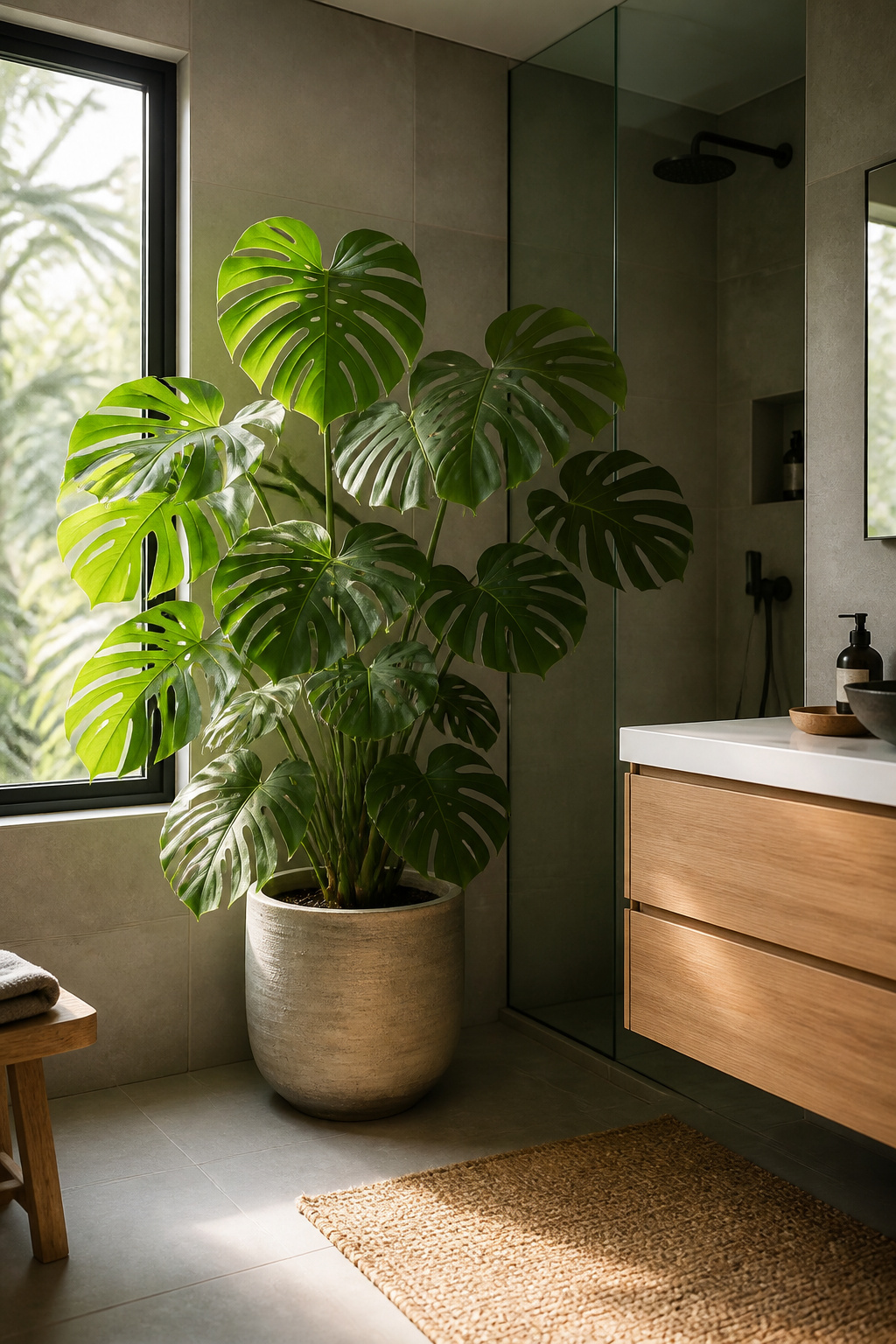
The bathroom’s inherent humidity is an advantage. Monstera deliciosa thrives in humidity above 60% and tolerates indirect light; its bold leaf architecture provides genuine sculptural weight. The ZZ plant (Zamioculcas zamiifolia) tolerates near-zero direct light and contributes a reflective, almost lacquered leaf surface that reads as sophisticated. Boston fern introduces soft, feathery texture that contrasts beautifully against hard geometry.
Restraint is the governing principle. One well-placed specimen reads as intentional; three or four scattered across the bathroom reads as a collection. A single large plant in one corner creates presence without competition. The vessel matters as much as the plant: a hand-thrown ceramic pot, a woven rattan basket with a liner, or simple terracotta. Plastic nursery pots do not belong in view in a designed space.
9. Warm Wood Tones Grounding Cool Ceramic Surfaces
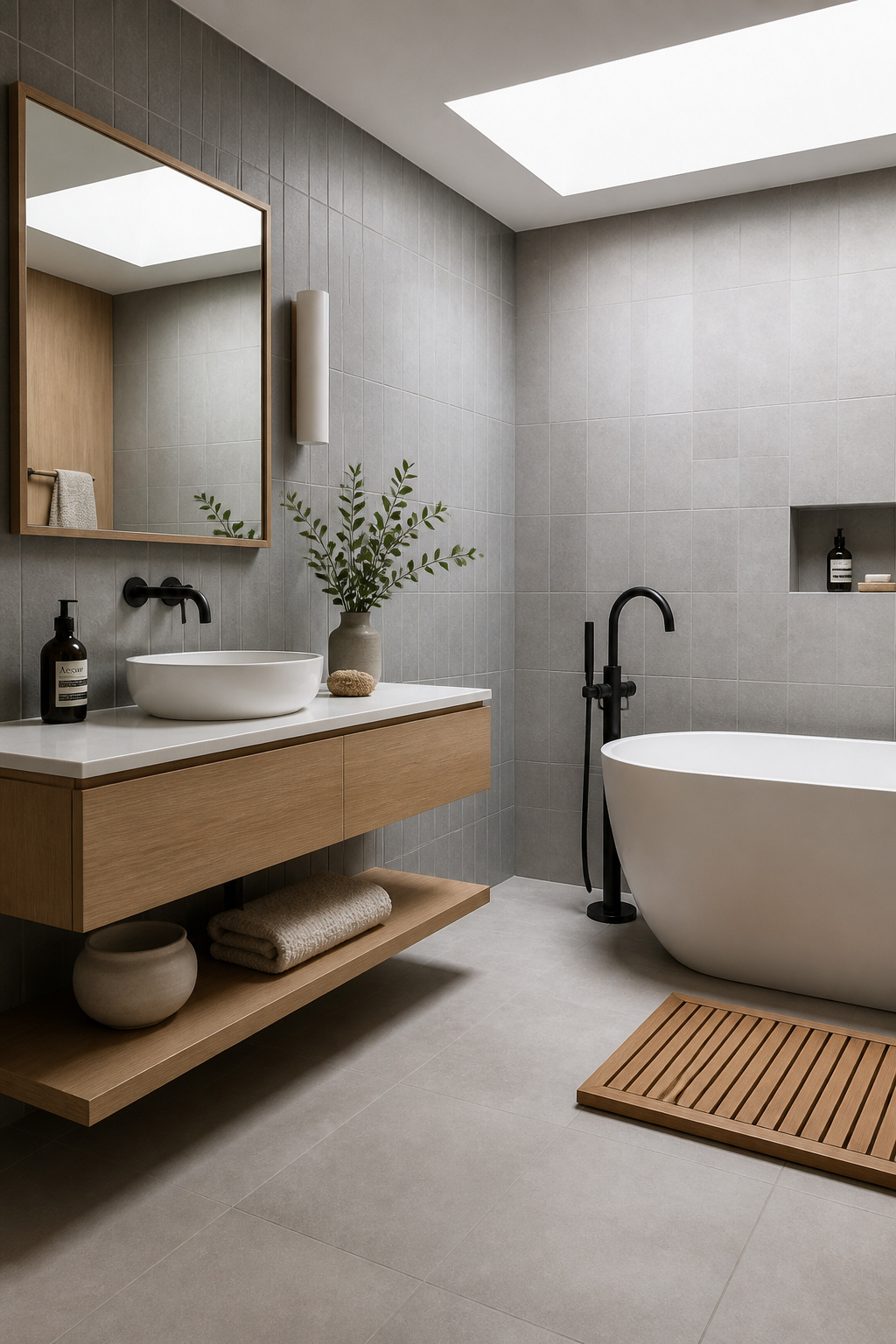
Japandi — the fusion of Japanese wabi-sabi philosophy with Scandinavian material warmth — is built on this precise material tension: the warmth of timber beside the coolness of ceramic or stone. It is not accidental contrast but a deliberate philosophical position, echoed in Japanese landscapes where rock faces stand beside bamboo groves, in Alvar Aalto’s interiors where birch curves against white plaster.
Choosing the Right Timber
Teak is the gold standard for wet-area timber — its high silica content and natural internal oils repel moisture, resist mould, and develop a beautiful silver-grey patina over time. White oak works excellently in dry zones (vanity carcass, floating shelf, timber stool) but requires annual hard-wax oil sealing in wet zones. For shower floors where the timber look is wanted without the maintenance of genuine wood, timber-look porcelain planks at 1200x200mm are now genuinely convincing.
Where to Place Timber in a Modern Bathroom Decoration Scheme
A considered hybrid approach works well: genuine timber in the zones where hands and eyes touch it most (the vanity face, the bath mat tray, the open shelf), timber-look porcelain in the wet zone floor where practical longevity matters most. The slatted teak bath mat is an underrated design piece — it echoes the wooden grate of a Japanese sento bath house and introduces authentic material underfoot. Small in scale, significant in what it communicates about the whole modern bathroom decoration scheme.
10. Layered Ambient Lighting That Sets the Morning Mood
A single overhead downlight is not a lighting design. It is a lighting decision made by someone who was not thinking about lighting. It illuminates without designing — it creates flat, function-only light that makes everything in the room visible and nothing in it particularly attractive. The modern bathroom decoration principle here is emotional range: the bathroom should have distinct lighting scenarios.
The Three-Layer System
Three layers, three circuits, three dimmers. The ambient layer — recessed ceiling downlights at IP65 rating, spaced roughly one per 1.5 square metres — provides overall illumination. The task layer — wall-mounted sconces flanking the mirror at 65-70 inches high, spaced 36-40 inches apart — provides side-lit, shadow-free grooming light that no overhead fixture can replicate. The accent layer — LED strips under the floating vanity, inside display niches, or at floor level beside the bathtub — creates visual depth and drama. For an in-depth guide to making these decisions in practice, luxury bathroom lighting ideas for a chic space covers the full scope of what thoughtful lighting specification looks like. The vanity lighting question specifically is addressed directly in the bathroom vanity lighting guide.
Colour Temperature
Colour temperature is as important as placement. The accent and ambient layers belong at 2700K (warm, candle-adjacent). The task layer works best at 3000-4000K, where accurate colour rendering matters for grooming. Mixing dramatically different colour temperatures creates a visually jarring warm/cold shift. All three layers should be within 500K of each other, with the task light being the coolest. Everything on separate dimmer circuits — this single specification decision converts a bathroom into a space with genuine emotional range.
11. Minimalist Open Shelving for a Gallery-Worthy Display
Open shelving in a bathroom is a commitment. Not a financial one, but an aesthetic one: it commits you to curating what is visible and disciplining what is not. Closed cabinetry is generous in its concealment. Open shelving forgives nothing — every object is a design decision, whether the designer intended it or not. As a modern bathroom decoration strategy, it is also one of the most rewarding.
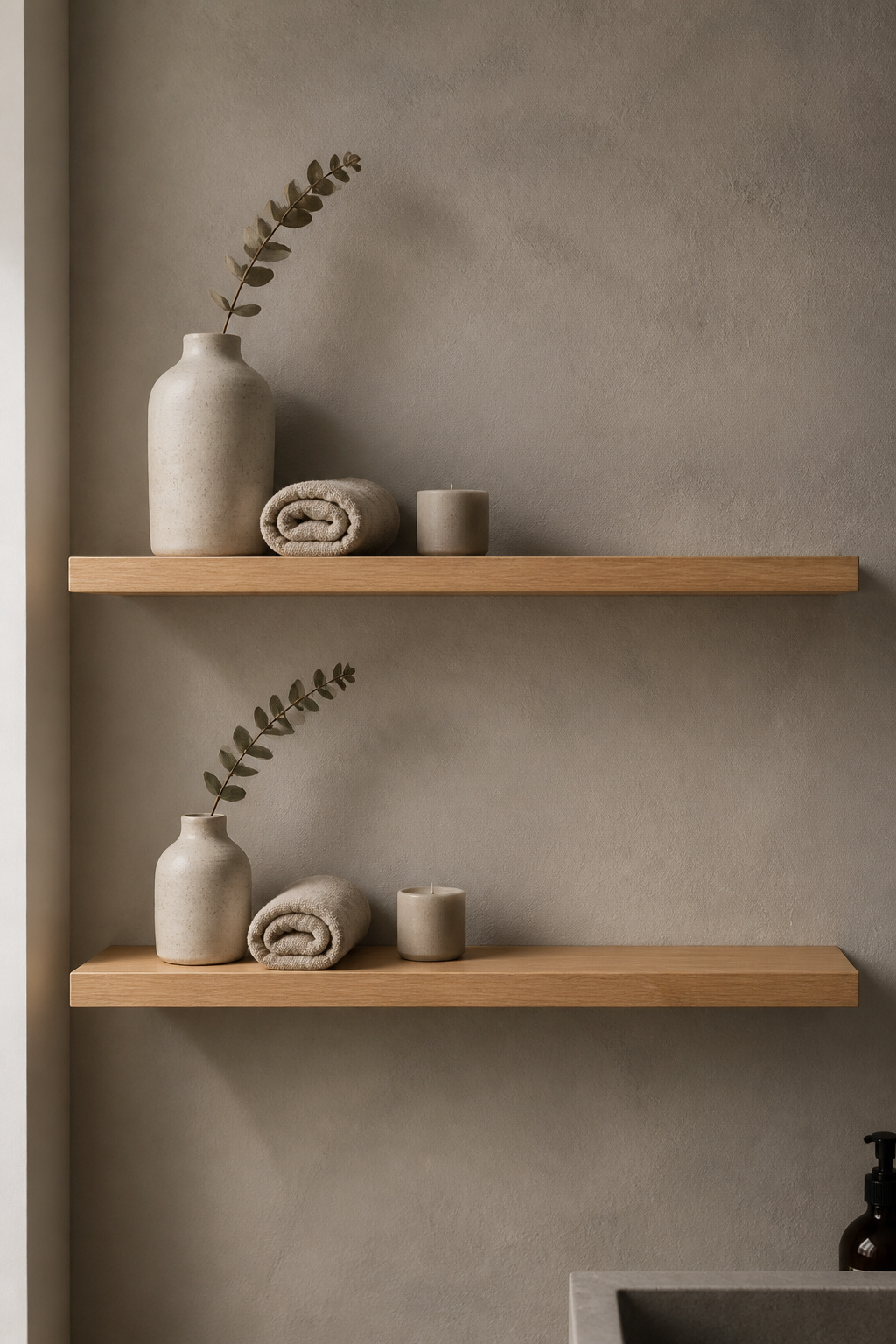
When the commitment is met, the result can be genuinely beautiful. The rule of three — grouping objects in odd numbers with deliberate variation in height — creates the visual rhythm that prevents a shelf from reading as a surface covered in things. One tall element (a ceramic vessel), one mid-height element (a folded linen towel), one low element (a soap dish or stone object) creates a triangular composition that the eye reads as balanced. The 3:3 rule suggests a third of any well-styled shelf should be empty — that breathing room is active compositional element.
For the deeper principles behind organised bathroom storage, bathroom storage organisation at its most principled offers a thorough framework. What works on open bathroom shelves: hand-thrown ceramic soap dispensers, a single pillar candle, rolled organic linen hand towels, an apothecary glass vessel, a small art object. What belongs behind a door: medication, cleaning products, anything with visible product branding, razors, cotton buds.
12. Modern Bathroom Decor With Natural Linen and Organic Textiles
In a modern bathroom where every surface is hard, textiles are the primary source of softness — not just visual softness, but tactile warmth. The choice of textile, made with the same deliberateness as the choice of tile, determines whether the bathroom reads as a considered domestic space or a well-tiled corridor.
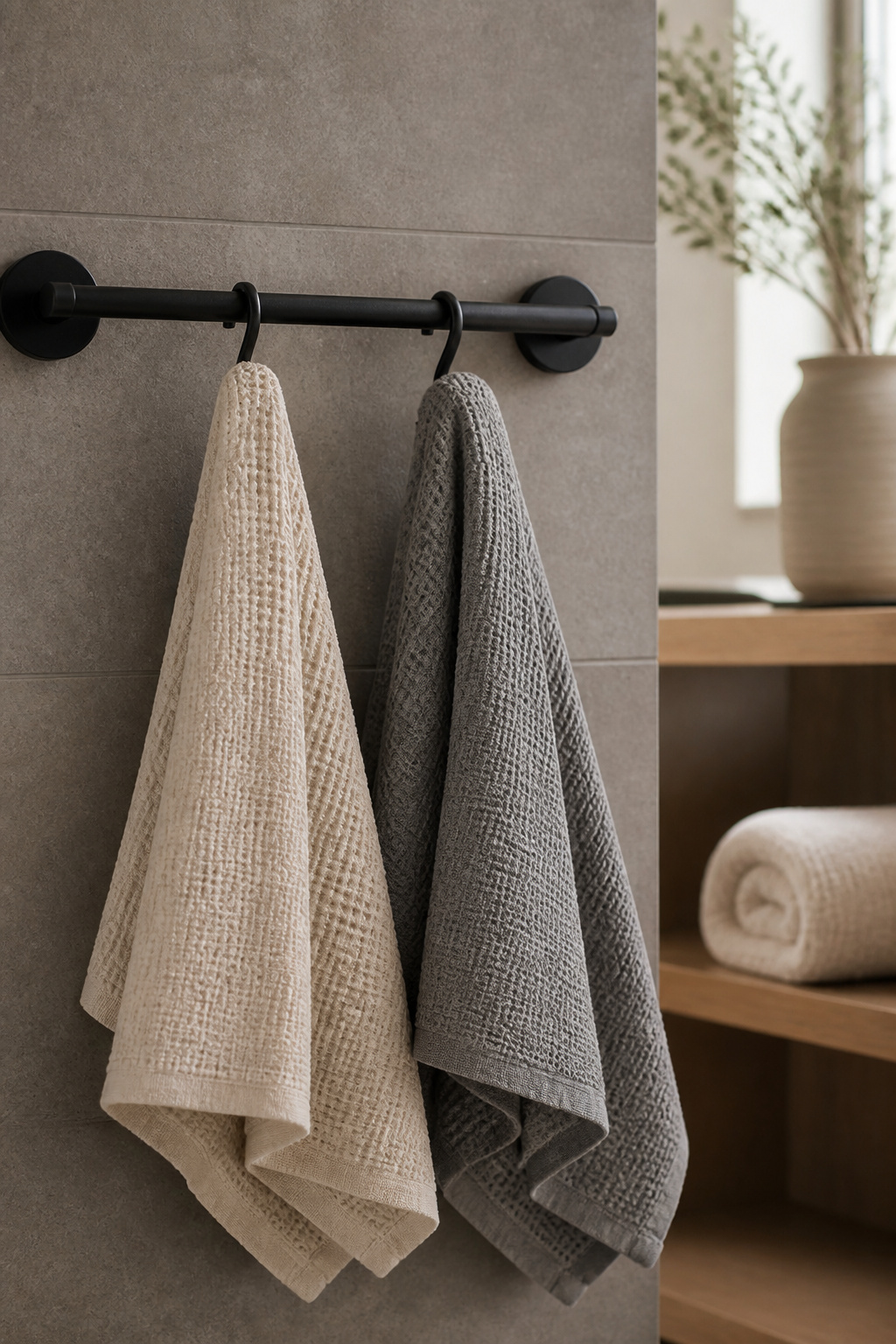
Waffle-weave and stonewashed linen towels have displaced the plush hotel cotton towel as the material of choice in design-conscious bathrooms. Linen dries faster than cotton, is naturally antimicrobial, and develops a progressively softer handle with each wash — it improves with age. Waffle-weave has a geometric texture that reads as architecturally coherent in a tiled bathroom context; it looks chosen, which is the point.
Colour discipline matters as much in this modern bathroom decor category as in any other. A textile palette limited to one or two tones within the same neutral family reads as curated. More than two colours and the grouping reads as accumulated rather than selected. MagicLinen (Lithuania) produces OEKO-TEX certified linen bath and hand towels across a comprehensive range. April Notes makes European linen towels with a deliberately relaxed quality that aligns well with a Japandi-influenced bathroom. For a credible entry point, Ikea’s SODERSJÖN linen-blend towel performs convincingly both in use and in appearance.
13. Geometric Tile Patterns That Reward Closer Inspection
The case for geometric tile in a modern bathroom is a case for surface interest that operates at two distances. From across the room, a hexagon mosaic floor reads as texture — present but not loud, adding visual warmth without graphic drama. Standing closer to it, the pattern resolves: the six-sided geometry, the grout lines defining each tile’s edge. It rewards closer inspection. That quality is rare in a bathroom, and worth engineering.
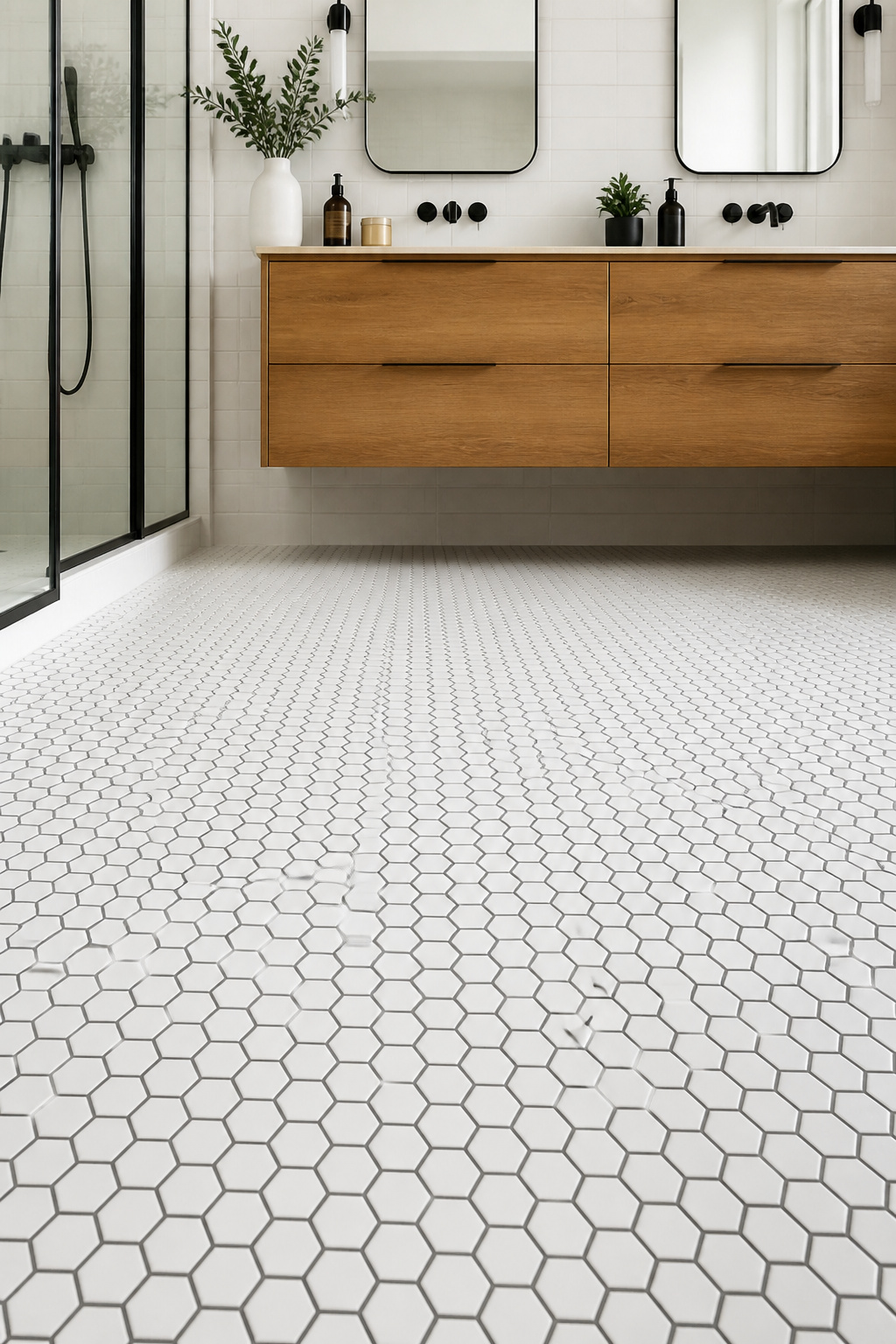
Scale determines the register of this modern bathroom decoration element. Small hexagon mosaics (25-50mm face) read as texture at normal viewing distances and reveal their geometric nature only on close inspection — quiet, considered, sophisticated. Large-format hexagons (200-300mm) read as bold graphic pattern from across the room. Herringbone in a narrow subway tile format (75x300mm) creates a directional, kinetic surface that guides the eye and suits floors where movement is felt. In a modern bathroom where the stone wall is doing significant design work, tonal grout (matching the tile in value, slightly darker) lets the floor support rather than compete. An unsanded grout with a joint below 3mm creates the finest possible grout line — approaching seamlessness, which is the direction contemporary decoration consistently favours.
14. Smart Bathroom Technology Integrated Invisibly Into Design
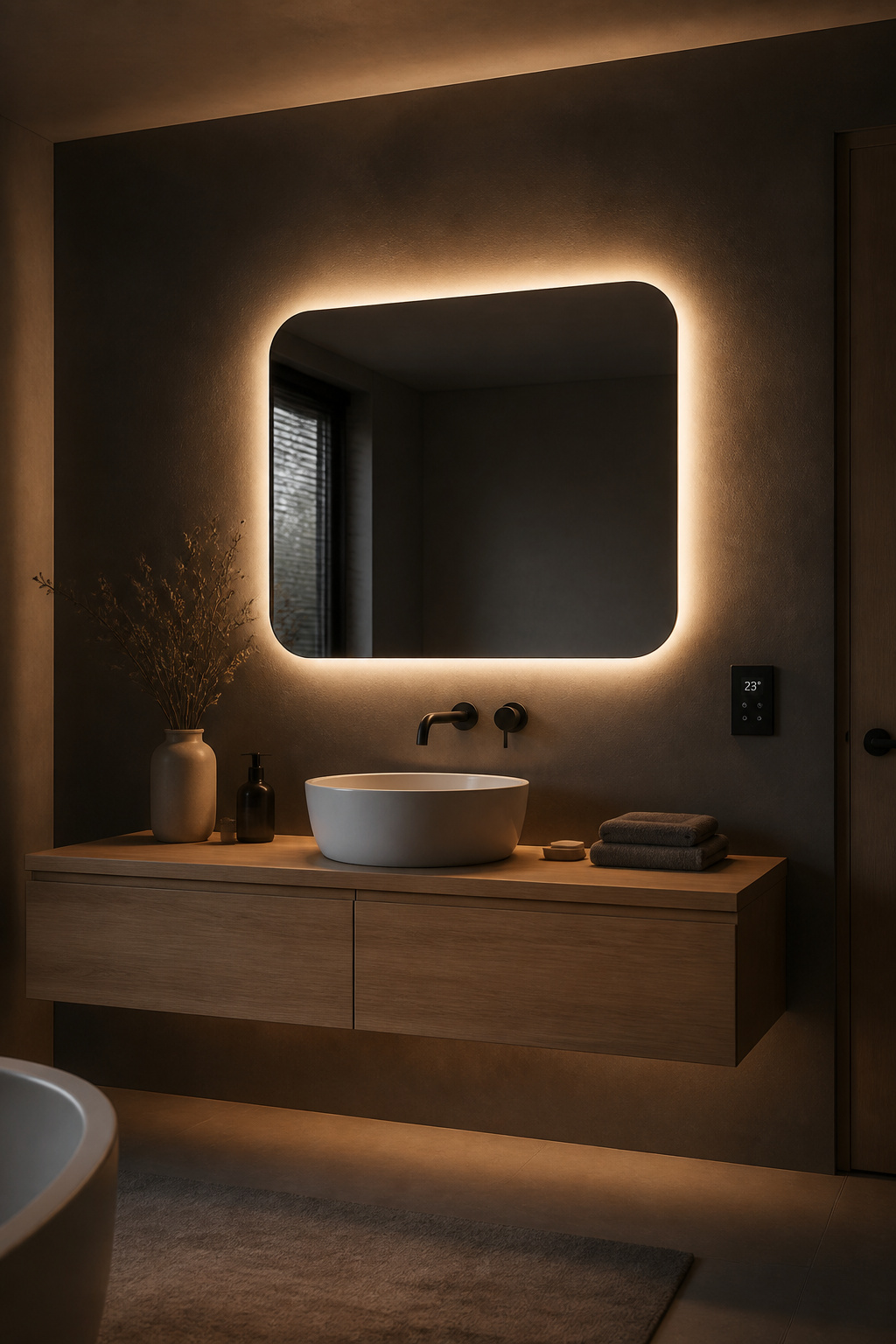
The best smart bathroom technology is invisible. You experience it — the floor warm before you have asked it to be, the mirror providing perfectly colour-rendered light, the shower arriving at your preferred temperature — but you cannot see it. No cables, no visible switches, no interfaces that compromise the surface. The bathroom remains a modern bathroom decoration scheme rather than a technology showcase.
The Three Entry Points
Three highest-impact technology options stand out. First, underfloor heating: electric mat systems laid under the tile bed connect to a smart thermostat recessed into the wall plate. Schedule the floor to reach temperature before you wake — 72% of luxury bathroom renovations now include it as standard. Second, smart mirrors: LED-lit, with anti-fog heating, built-in display, and dimmable colour-temperature control. The connection must be an in-wall circuit; a visible cable immediately defeats the purpose. Third, thermostatic shower systems: the Hansgrohe ShowerSelect iD, Vola’s smart shower range, and equivalent products from Kohler allow temperature to be set precisely, stored to user preference, and recalled with a single button.
Invisible Integration
All smart bathroom technology should be planned at the first-fix stage — before walls are plastered or tiled — as retrofitting after tile work is finished is expensive and sometimes impossible. A frosted glass touchpad panel controlling all three lighting layers, the floor thermostat, and the shower from one position is the resolved, professional solution. An IP65-rated Bluetooth speaker recessed into the shower ceiling ($150-400 installed) completes the picture — inexpensive relative to the rest, and transformative in the quality of a daily routine.
15. Artful Mirror Arrangements as Modern Bathroom Decoration Statements
The mirror is looked at more deliberately than any other surface in the bathroom. It is the one thing you face. Yet most bathrooms have a mirror chosen for size and price rather than form or presence — and the result is a vanity wall that does everything except make a statement. This is perhaps the most common modern bathroom decoration oversight, and one of the easiest to correct.
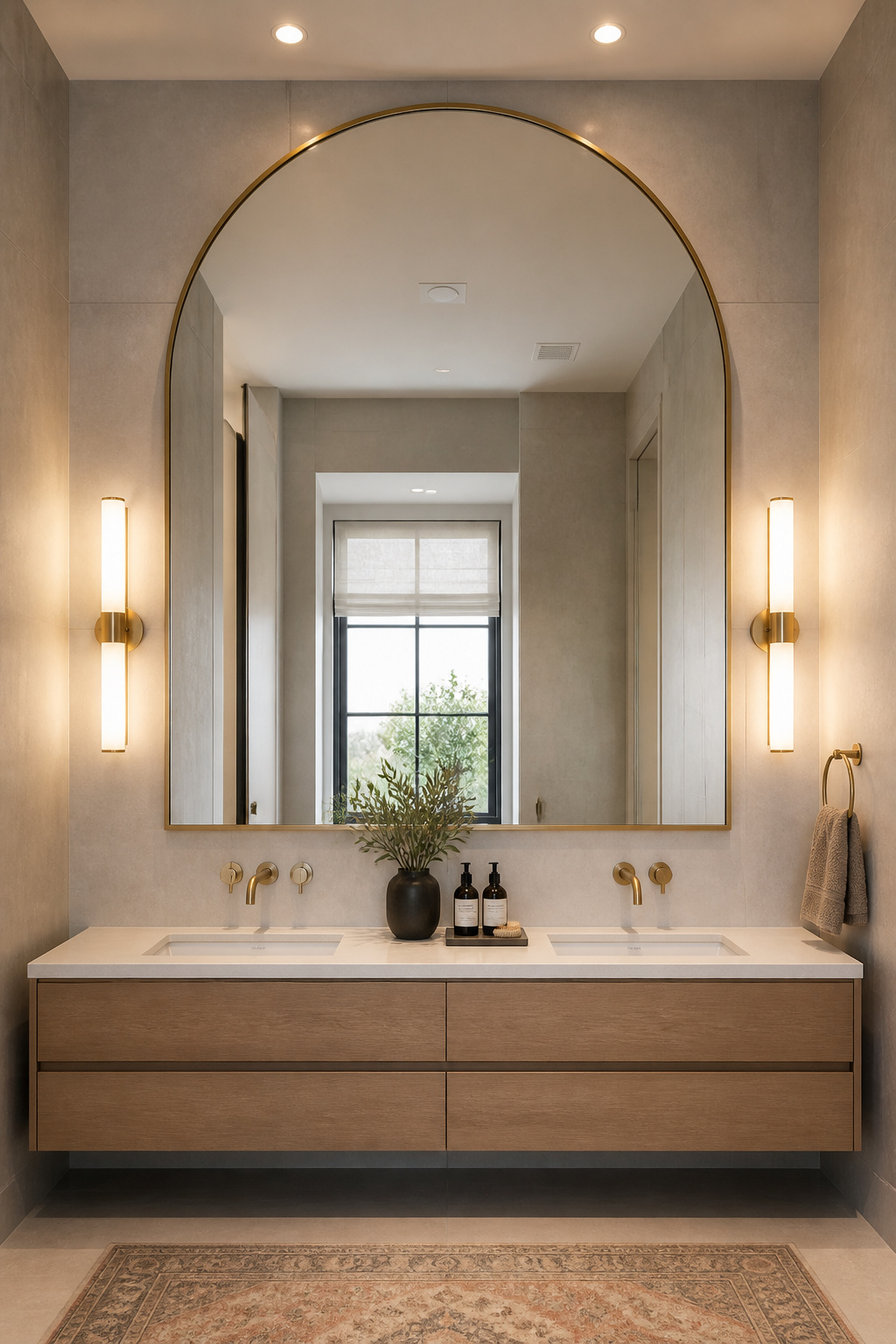
An oversized mirror — wider than the vanity it serves, or reaching floor-to-ceiling height — doubles the apparent size of a bathroom by reflecting the entire space back at the viewer. LED backlit mirrors account for 45% of current consumer selections — they eliminate the traditional wall sconce, provide a halo of light that wraps the face from multiple angles, and create theatricality that a flat, unlighted mirror cannot approach. Arch-shaped mirrors introduce softness into a room where every other element is angular. They reference architectural forms that carry centuries of resonance while reading as genuinely contemporary when specified in matte black or brushed brass. The case for using mirrors as genuine focal objects is made compellingly in bathroom mirrors as wall art. For framing, options span from frameless (maximum visual lightness) to thin metal channel (10-20mm in matte black, reading as deliberate) to a fully framed arched mirror in solid timber or brass.
16. Concrete and Plaster Finishes for Raw Industrial Elegance
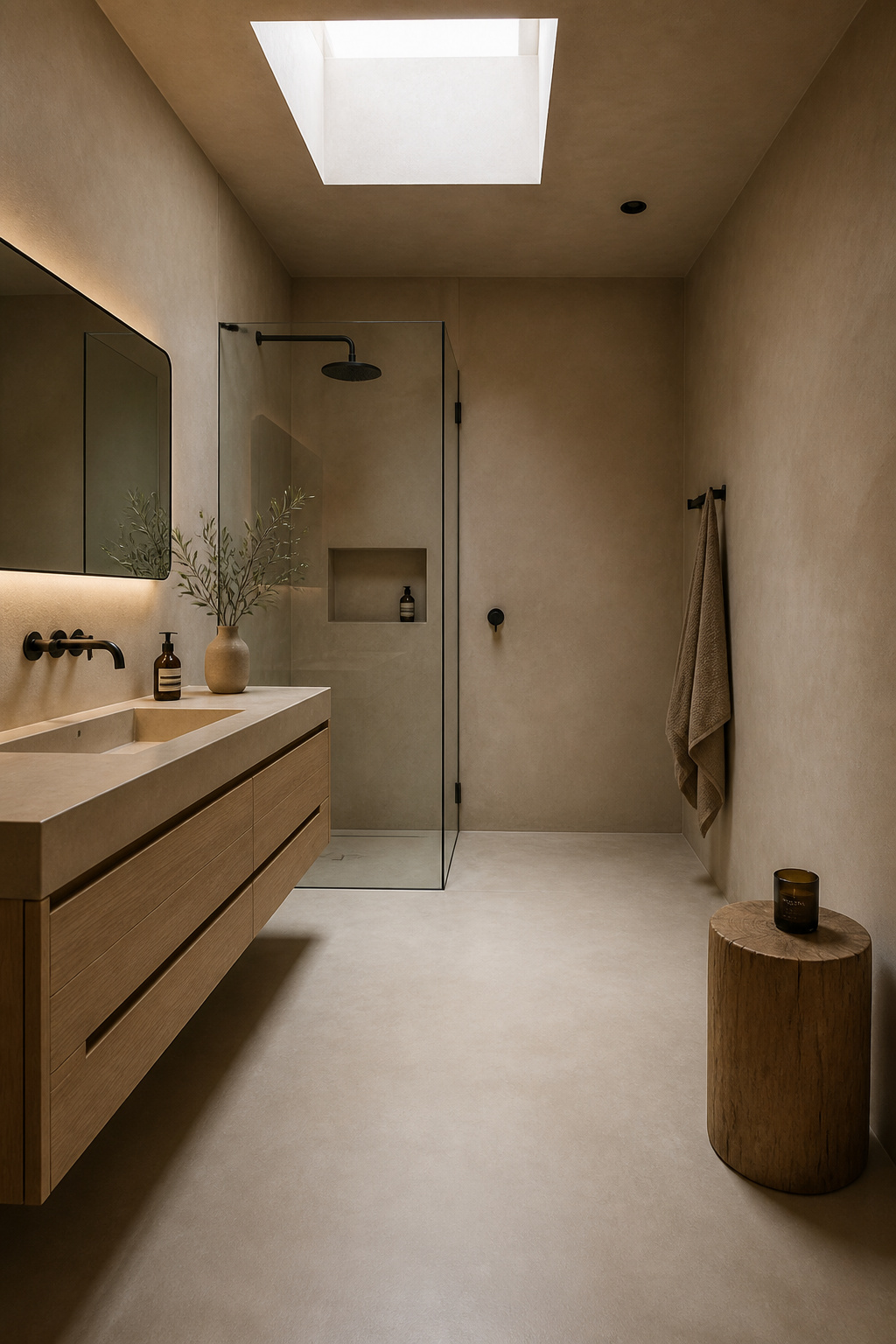
There is a quality that tile, however beautiful, cannot achieve: the appearance of a surface that has been shaped rather than applied. Applied plaster finishes — microcement, Tadelakt, Venetian plaster — create continuous, grout-free surfaces that read as architectural. The modern bathroom decoration principle here is material honesty: the surface tells the truth about its own making.
Three Finishes Compared
Microcement is the most versatile: a cement-based product (3-5mm thick) applied over existing surfaces and sealed with a two-part polyurethane coating rendering it fully waterproof for shower walls, floors, and countertops. Cost runs approximately $20-40 per square metre installed. Tadelakt is the most authentic and demanding option — a traditional Moroccan lime plaster polished with black soap, inherently water-resistant, with an unmistakable surface quality that shifts as light changes through the day. Cost runs $40-80 per square metre installed, reflecting the skill required. Venetian plaster, burnished to a high or low sheen, is the warmest and most decorative of the three — beautiful on feature walls, but not suitable for direct shower exposure without explicit wet-area product specification.
Colour Beyond Grey
Warm putty (a warm off-white with ochre undertone) suits bathrooms where the aim is depth without introducing colour. Blush stone (a dusty pink-beige from mineral pigments) creates bathrooms with skin-like warmth — when paired with matte-black fixtures and warm timber, it reads as decisively contemporary. Deep charcoal microcement combined with brass fixtures and natural timber reads as luxury without formality. In each case, the colour is not the modern bathroom decoration statement — the material itself is.
17. Modern Bathroom Decor Ideas Inspired by Wabi-Sabi Philosophy
Wabi-sabi does not mean rough or rustic. It means precisely the opposite of the perfection that factory precision has made universally available. It is a Japanese aesthetic grounded in the acceptance of impermanence and the recognition that objects made by human hands carry a beauty that manufactured uniformity cannot replicate. As modern bathroom decor ideas go, this is among the most philosophically grounded.
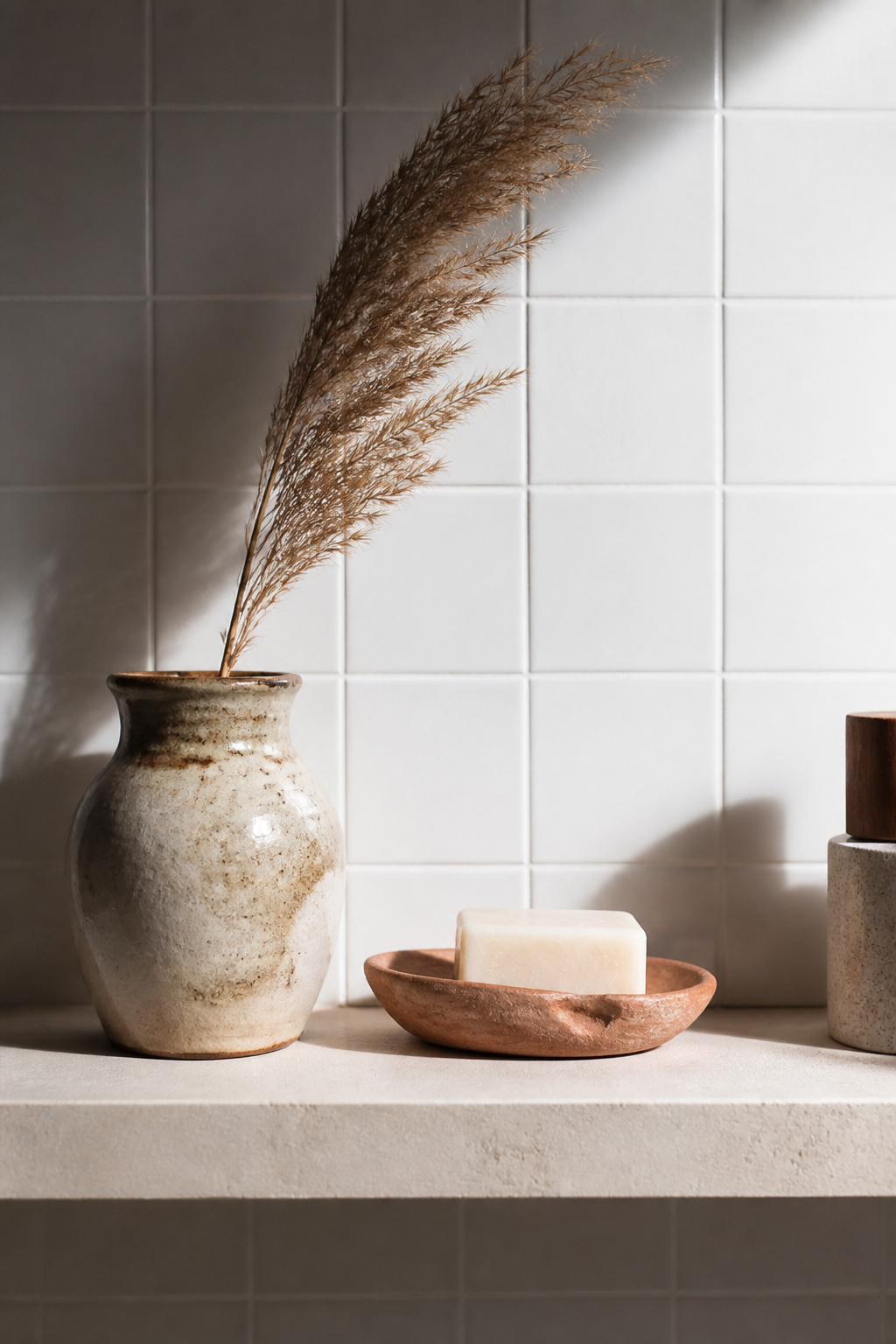
In a modern bathroom where every surface is controlled and intentional, wabi-sabi operates as the counterforce to perfection. One hand-thrown ceramic vessel on an otherwise pristine shelf — slightly asymmetric, with a glaze variation that runs different at the rim than at the base — makes the precision of the surrounding surfaces more vivid, not less. The contrast is the point. A slatted teak bath mat that develops a silver patina over months of wet use, a rough-edged linen hand towel with a visible selvage, an unglazed terracotta soap dish with a maker’s thumb indent: these are elevated choices, selected precisely for the quality that mass production has made difficult to find.
The balancing principle for modern bathroom decor ideas of this kind: one or two wabi-sabi elements in an otherwise refined, modern bathroom is the calibration that works. More than that and the register shifts from philosophical counterpoint to deliberate rusticity. Wabi-sabi elements work best at the accessory scale — the object on the shelf, the vessel beside the basin, the textile on the hook. Structural materials still benefit from precision. The irregularity of a hand-thrown pot reads as intentional against a perfectly flat tile floor; the same irregularity in the tile itself would read as faulty work. In Olivia’s Asian-European fusion framework, wabi-sabi marries naturally with the European Modernist love of honest materials — both philosophies value authenticity over surface decoration.
18. Niche Shelving Built Into Shower Walls for Clean Storage
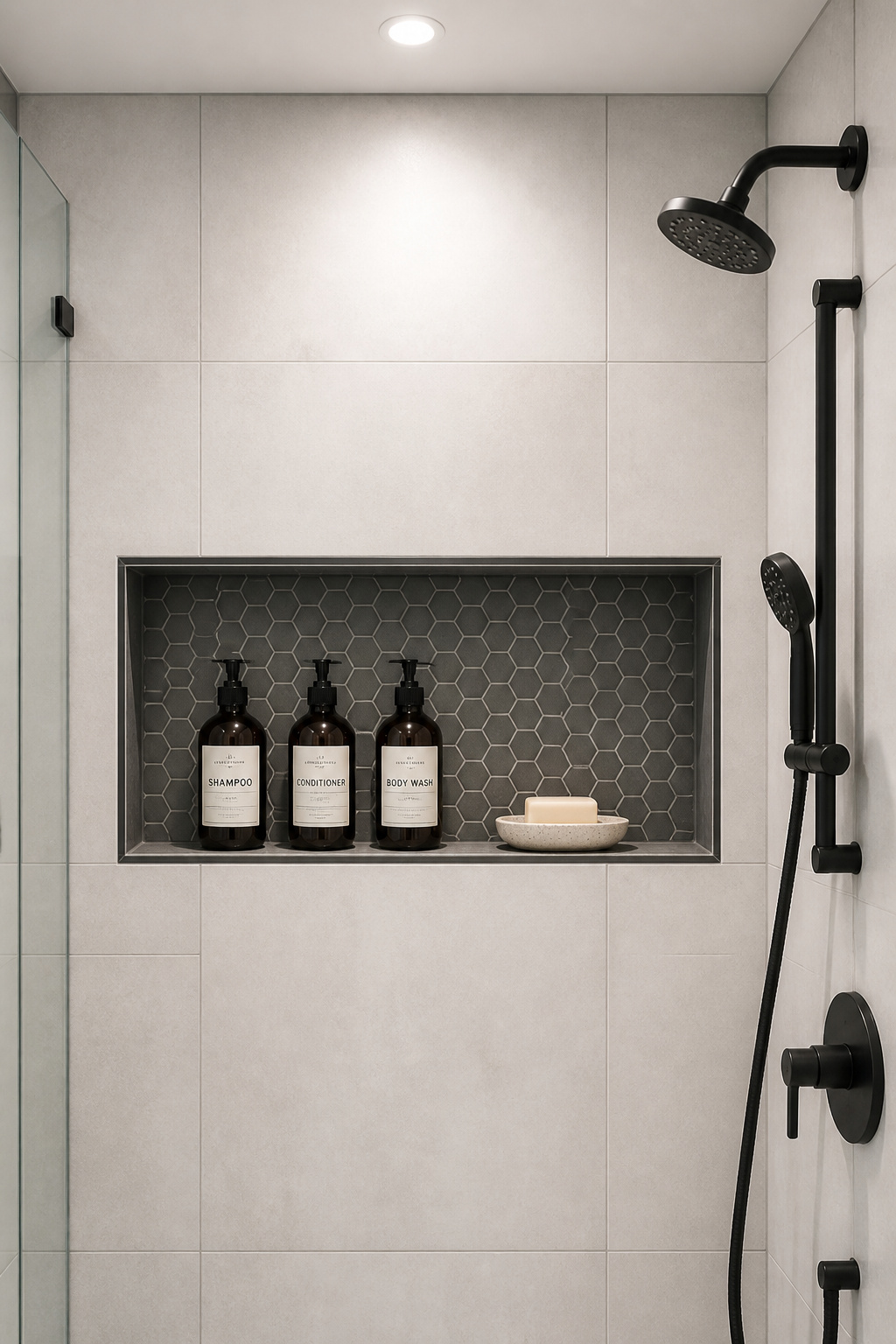
The shower niche is the one storage solution in the modern bathroom decoration toolkit that disappears into the architecture. No visible rack, no suction-cup caddy, no hanging organiser accumulating soap residue between the bottles and the wall. A well-constructed niche is the shower equivalent of a pocket — the function is present, but the form is absorbed into the surface.
Sizing and Tile Strategy
Standard sizing: 12-16 inches wide (fitting between wall studs at 16-inch centres), 3.5 inches deep (the stud bay depth), sufficient height for standard shampoo and conditioner bottles. A single oversized niche (24-30 inches wide, two bottle heights tall) reads as an architectural alcove. Tile the interior in the same field tile as the surrounding shower wall for a seamless, disappearing effect. Alternatively, tile it in a contrasting material — a small-format mosaic against a large-format field tile — and the niche becomes a deliberate display moment.
Placement and Waterproofing
Standard placement: 42-48 inches from the floor (chest height for most adults), out of the direct spray path. On an interior wall only — exterior walls contain insulation that must not be compromised. Waterproofing is not optional: the niche interior requires 2-3 layers of liquid membrane or a sheet membrane, with mould-resistant caulk in every inside corner. The majority of niche failures are waterproofing failures. The majority of waterproofing failures come from cutting corners at this stage.
Curating Your Modern Bathroom Decoration: Where to Begin
Before committing to any single idea from the eighteen above, a useful first step is a photographic audit. Photograph your bathroom at different times of day — morning with natural light, evening under artificial light — and study the images with the critical distance that being outside the space allows. Photographs reveal proportion mismatches that familiarity conceals: the mirror that is smaller than the vanity it serves, the single downlight that flattens every surface it touches, the mixed-finish accessories accumulated over years without any coherent through-line.
From there, a clear sequencing principle provides the framework. Structural decisions first: vanity position, shower type, bathtub choice, tile specification. These decisions determine all other dimensions and cannot be reversed without significant cost. Surface decisions second — they must coordinate with and enhance the structural decisions already made. Accessory decisions last, and this category — which includes mirrors, lighting, textiles, ceramics, and plants — is both the most visible in daily use and the most easily changed without structural disruption.
Many bathrooms are transformed significantly by updating accessories alone. A new oversized arched mirror, a properly positioned task light, a set of waffle-linen towels in a consistent neutral, and one hand-thrown ceramic vessel: the cost is modest, the effect is considerable. Budget guidance: labour accounts for 40-65% of any bathroom renovation budget. Material decisions cascade — premium fixtures justify premium surfaces; budget fixtures paired with premium surfaces create incongruent results. The most successful modern bathroom decoration projects match the quality tier consistently across every decision, from the tile on the floor to the towel on the hook.