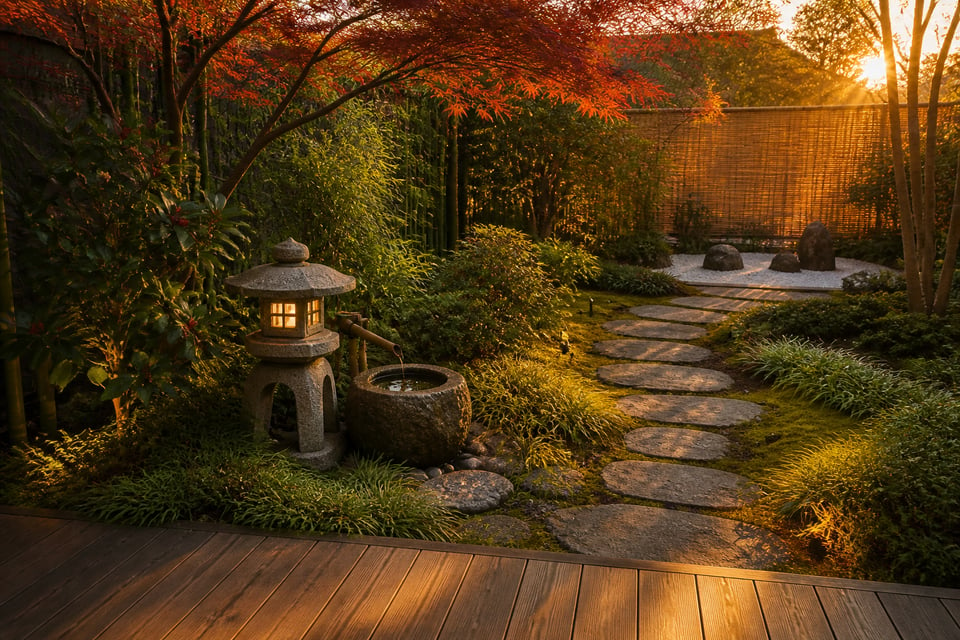
There is a concept in Japanese design called ma — the meaningful pause, the space between things that gives everything else its shape. Most backyard gardens have no ma. They fill every available inch with planting, paving, and furniture, and then wonder why they feel more like maintenance tasks than places to actually be. A backyard garden built with intention works differently: it creates quiet, organises emptiness, and becomes a space that slows you down the moment you step into it.
These 16 backyard garden ideas draw from Japanese garden philosophy — not as a style manual, but as a framework for thinking about what a garden is actually for. You will find structural ideas here (layered planting, evergreen anchors, stone paths), ecological ideas (wildflower sections, composting, native ground covers), and atmospheric ideas (water features, lanterns, fire). Not every idea is Japanese in origin. But all of them share the same underlying logic: that a backyard garden should be designed around how you want to feel in it, rather than how it will photograph in June.
1. Layered Planting Schemes That Give Your Backyard Garden Depth
A flat planting bed — one row of roses, one type of grass, one layer — is the single most common reason backyard gardens feel thin. The three-tier layering system used in Japanese garden design takes a different approach: canopy trees at the top, mid-storey shrubs and bamboo in the middle, ground-level ferns and moss at the base. Each layer conditions the environment for the one below it, regulating temperature, retaining moisture, and creating habitat for the others to thrive in.
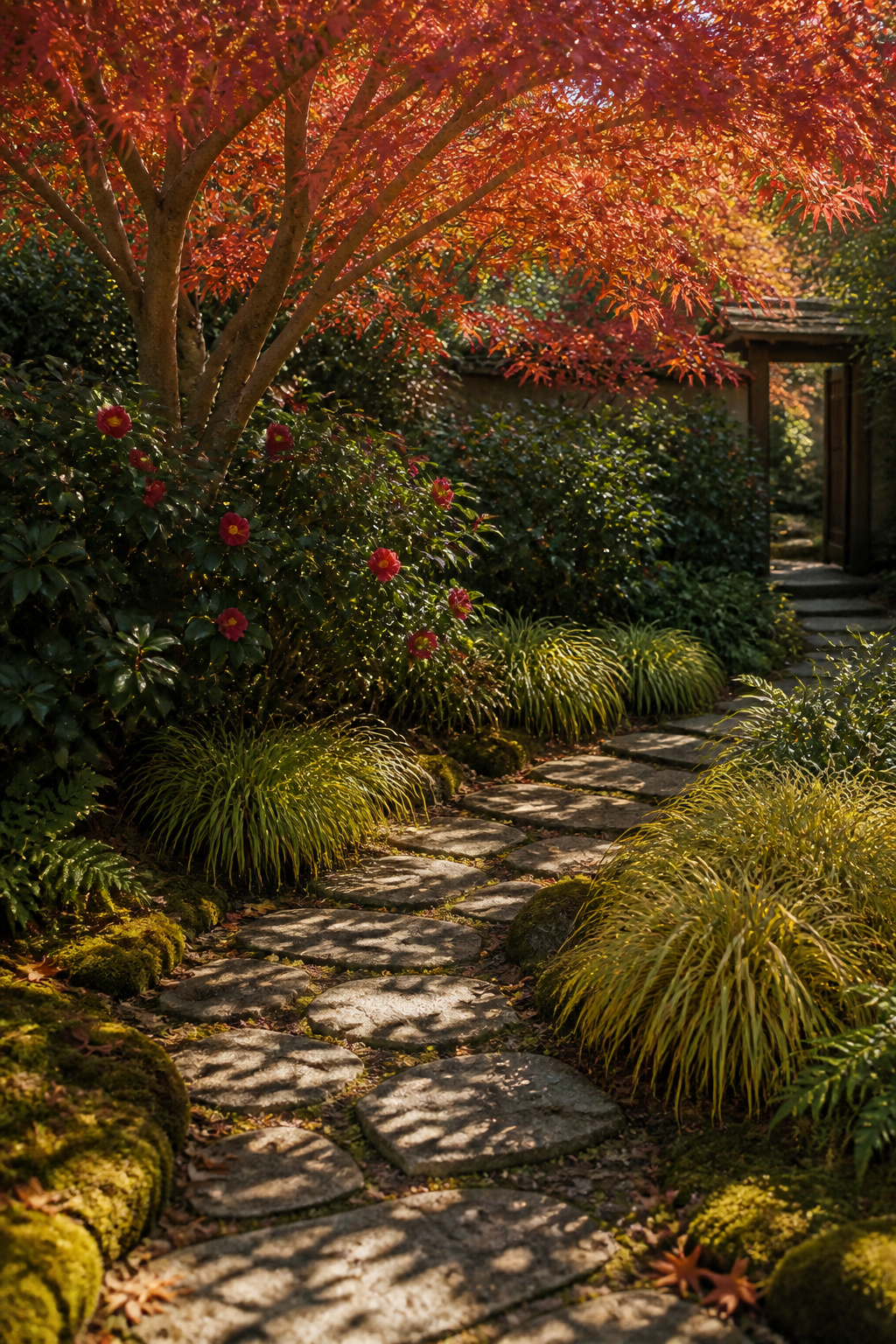
The visual result is depth. A layered garden has foreground, mid-ground, and background — like a landscape painting rather than a garden centre display. It looks larger than its footprint because the eye has multiple planes to travel through rather than a single flat surface to scan and dismiss. By 2026, layered native planting is the dominant approach in Japanese-influenced garden design precisely because it delivers high ecological and aesthetic return for modest input.
What to Plant in Each Layer
A reliable four-season combination: Japanese maple (Acer palmatum ‘Bloodgood’) as the canopy, Camellia japonica as the mid-storey evergreen, and Hakonechloa macra — Japanese forest grass — at ground level. This combination gives summer texture, autumn flame from the maple, winter structure from the camellia, and spring bloom. For wetter, shadier sites, swap the camellia for oakleaf hydrangea (Hydrangea quercifolia), which adds late-summer flowers, autumn leaf colour, and beautifully peeling winter bark. Good backyard plant selection for every layer makes the difference between a garden that works through every season and one that peaks in May and vanishes by October. One note on timing: plant the canopy first and let it establish before adding what grows beneath it. The canopy conditions the soil, creates shade, and sets the root competition patterns that determine which lower-level plants will actually thrive.
2. Natural Stone Paths That Invite Slow, Deliberate Movement
The roji — 露地, ‘dewy ground’ — is a garden path tradition created by the tea-master Sen no Rikyū in the 16th century. He designed it not as a route between two points but as a psychological transition: a walk engineered to empty the mind before the contemplative space ahead. The path bent to conceal the destination. Stone spacing was irregular, forcing attention on each step. The planting was compressed and unobtrusive. By the time you arrived, you were already in a different state.
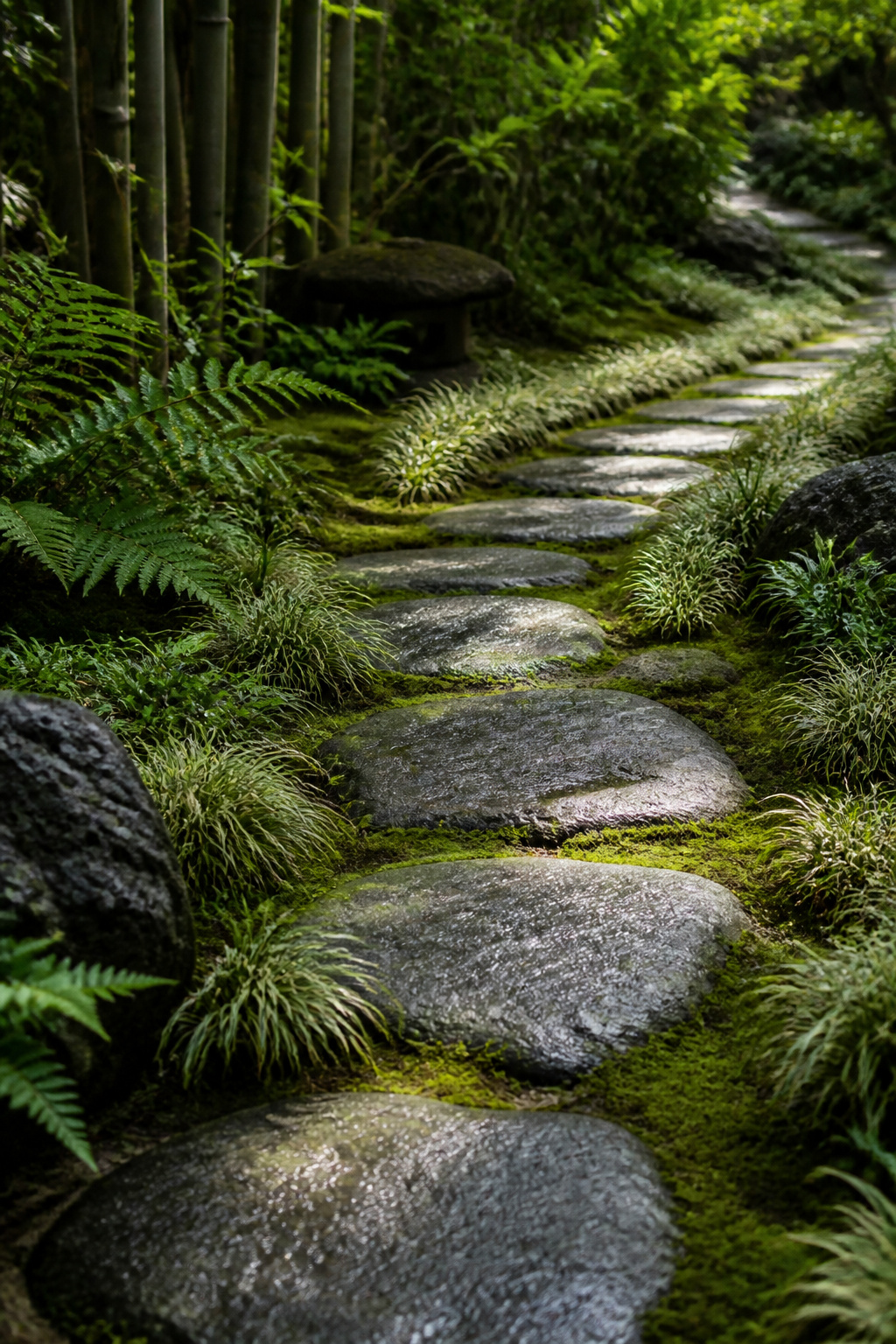
That principle applies directly to a backyard garden path. The walk from the house to the seating area, or from the deck to the kitchen garden, can be designed to slow you down rather than move you efficiently. Irregular stepping stone spacing — centre-to-centre approximately 60–65cm, deliberately varied — forces you to look at where you place each foot. The path can bend so the destination is never visible from the start, creating anticipation in even the smallest garden.
Stone selection: natural irregular flagstone (granite, blue slate, or sandstone) in 30–40cm diameter pieces gives the right scale and texture. Avoid smooth dressed stone — it becomes slippery when wet and reads as urban pavement rather than garden. The companion plants between stones finish the composition: backyard hardscaping ideas for paths and walkways show how path design and planted edges work together. Sheet moss in shade or creeping thyme in sun are the two reliable choices between stones — both soften edges and tie path into ground plane in a way bare stone never achieves.
3. A Water Feature as the Garden’s Meditative Focal Point
Not every garden needs a water feature. But almost every garden benefits from one — because water does something no planted element can: it introduces sound. The gentle trickle of a tsukubai — the small stone basin used in Japanese Buddhist gardens since the 16th century — creates a continuous acoustic layer that masks traffic noise and neighbourhood sounds. Research links the sound of slow-moving water to measurable reductions in cortisol levels. The garden becomes quieter the moment you add water to it.
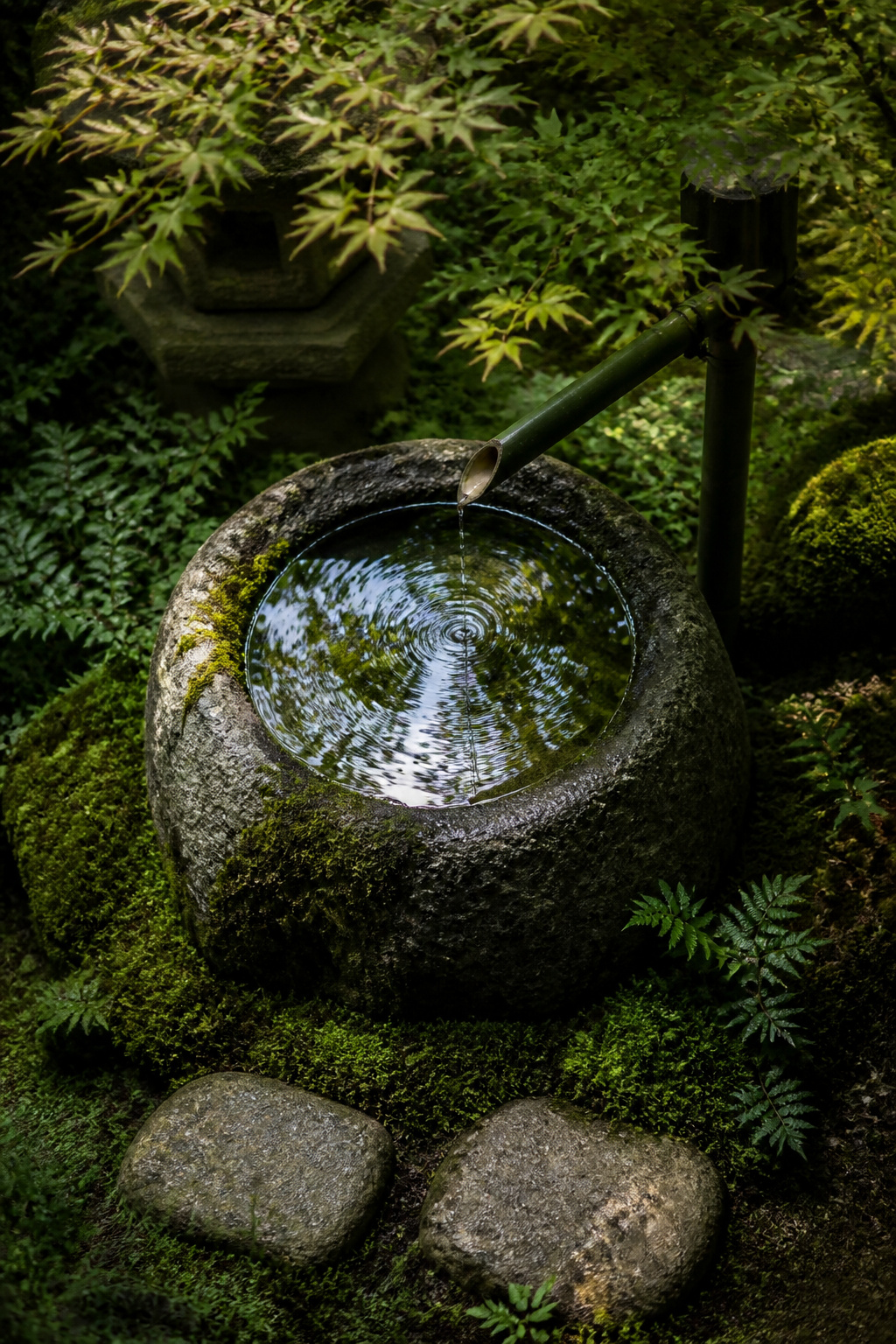
The tsukubai is among the most appropriately scaled water features for a domestic backyard garden. A carved stone basin (30–50cm diameter), fed by a slender bamboo spout from a small recirculating pump, uses dramatically less water than a conventional tiered fountain — up to 72% less — and runs on a low-voltage submersible pump rated at 200–400 litres per hour. Solar-powered models eliminate wiring entirely.
Placement is everything. Traditional installation: near a path or at the base of a tree, surrounded by moss, stepping stones, and ferns. Position it so it is audible from the main seating area but not directly visible — you should hear it before you see it, which creates a destination and draws you further into the garden. In cold climates, drain the basin before the first frost; granite and basalt withstand freeze-thaw cycles far better than sandstone.
4. Bamboo Screens for Natural Privacy and Soft Texture
Few choices in the garden carry more consequence than bamboo. Chosen correctly, it creates dense, beautiful, year-round privacy that moves in the wind and asks little in return. Chosen carelessly — specifically, a running species planted without a root barrier — it becomes a spreading liability that can cross into neighbouring properties within a few growing seasons and is extraordinarily difficult to remove.
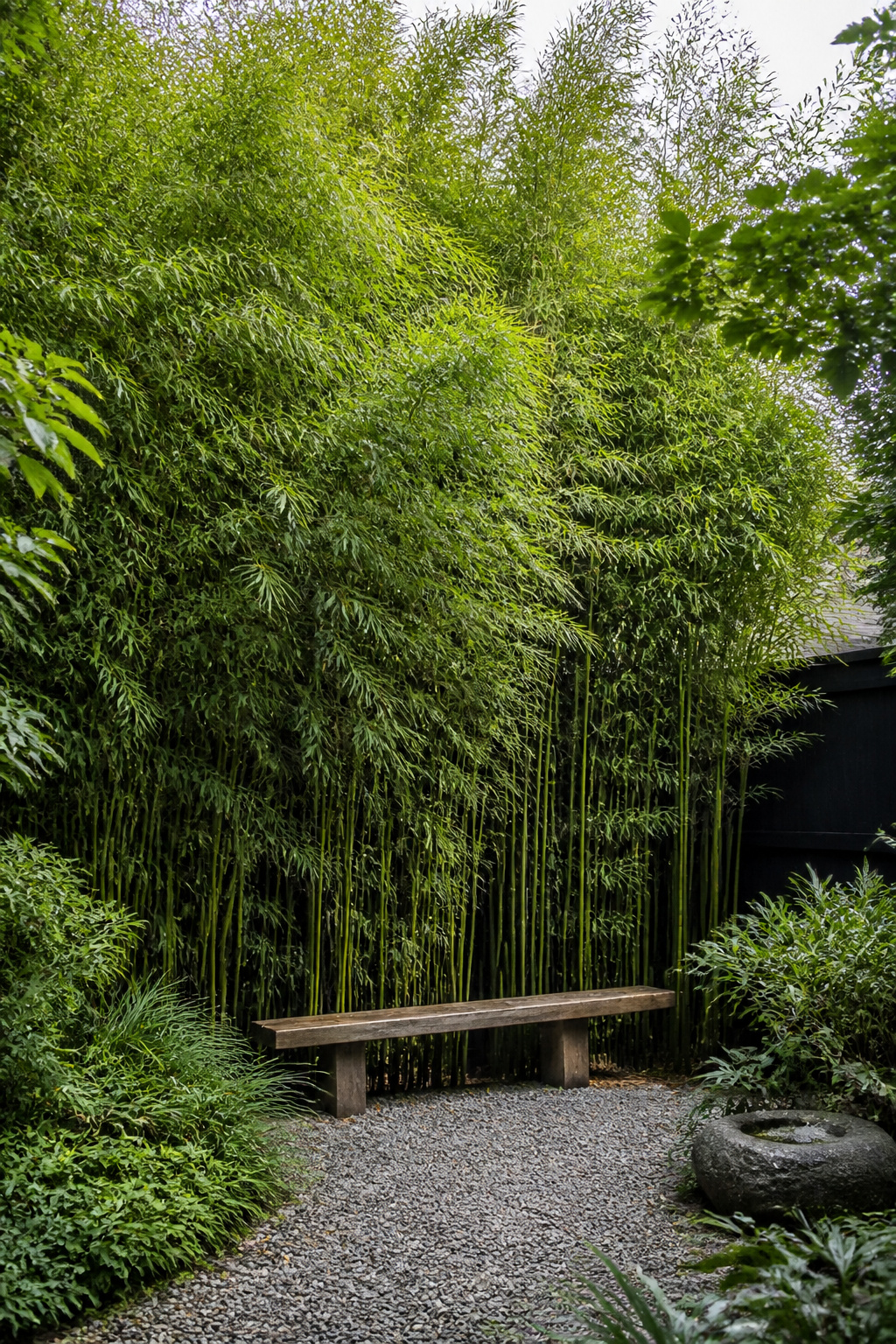
The distinction is simple: clumping bamboo (Fargesia) vs. running bamboo (Phyllostachys). For the vast majority of domestic backyard gardens, Fargesia is the right choice. It spreads outward from a central clump at approximately 10–15cm per year — entirely manageable, no root barrier needed, producing dense foliage year-round. Useful varieties for privacy: Fargesia murielae to 4m, Fargesia robusta to 5m, Fargesia rufa to 3m and hardy to -20°C.
If you use a running Phyllostachys species for faster establishment, install a high-density polyethylene root barrier at least 60cm deep, extending 5–10cm above the soil surface. This is not optional. In either case, plant at least 1.5m from walls and foundations — even clumping bamboo exerts outward pressure as the clump matures. Bamboo panels (traditional woven take-gaki style) can bridge the establishment years, providing immediate screening while the living bamboo catches up. The rattling of bamboo in wind is worth noting: it is not a problem to solve. It is part of why bamboo works in a contemplative garden.
5. A Kitchen Herb Backyard Garden With Clean Geometric Lines
The Japanese tradition of the hatake — the kitchen garden — approaches growing as a design problem: beds are sized precisely so both sides are arm-reachable without stepping in, rows are clear, materials are honest. The result is a kitchen garden that adds visual order to the composition rather than visual clutter. A backyard herb garden built on these principles becomes a design asset rather than a productive embarrassment hidden behind the shed.
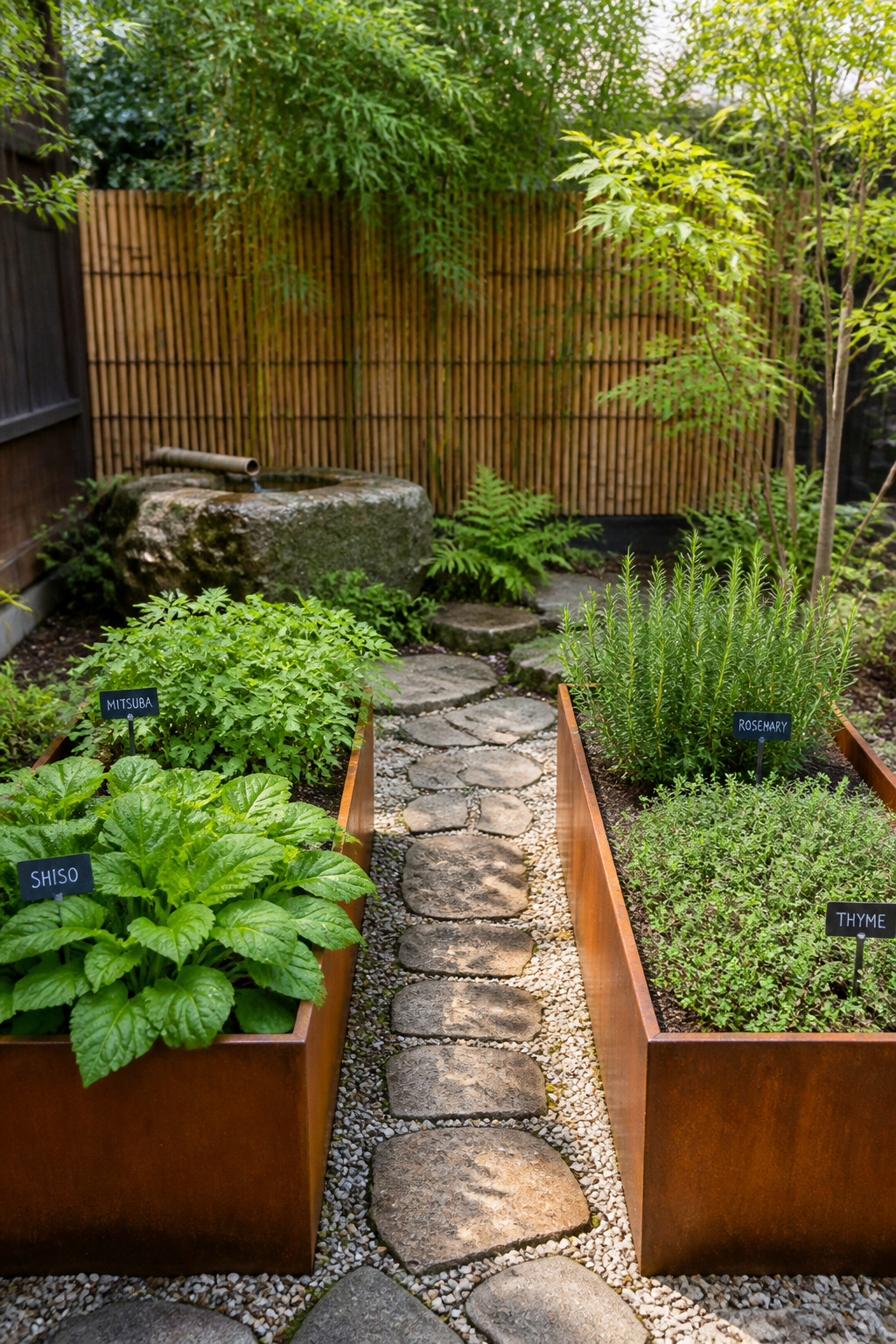
The geometry is simple: rectangular or square raised beds no wider than 1.2m (4ft) with cedar or corten steel edges. Cedar ages to silver-grey that complements stone paths and bamboo naturally. Corten steel oxidises to a stable rust patina within 6–12 months, requires no maintenance thereafter, and creates striking warm tone against green foliage. Minimum bed depth of 30cm works for most herbs. For those who extend the growing season beyond outdoor beds, container gardening techniques for year-round harvests complement a raised bed setup well.
Herb Groupings That Work
Japanese culinary herbs deserve their own section: shiso (perilla) is the single best starting choice — grown like basil, full sun, prolific, used throughout Japanese cooking. Mitsuba (Cryptotaenia japonica), known as Japanese parsley, is shade-tolerant, fast-growing, and harvestable weekly through the season. The organisational rule that matters: group herbs by water need, not flavour profile. Mediterranean herbs (rosemary, thyme, sage) want free-draining soil and full sun; Japanese herbs like mitsuba want consistent moisture and part shade. One bed each, and 90% of herb garden failures become unnecessary.
6. Raised Planting Beds That Bring Structure Without Rigidity
Raised beds impose order on a space that might otherwise feel undefined — but they do it through their edges, not through constraint. A well-placed raised bed creates a clear threshold between the geometry of the design and the biology of the planting. Inside, plants can grow freely and lean; the structure does the organising. In a Japanese-influenced backyard garden, this relates to the design principle of balancing the controlled and the natural: the bed is controlled, what grows within it is not.
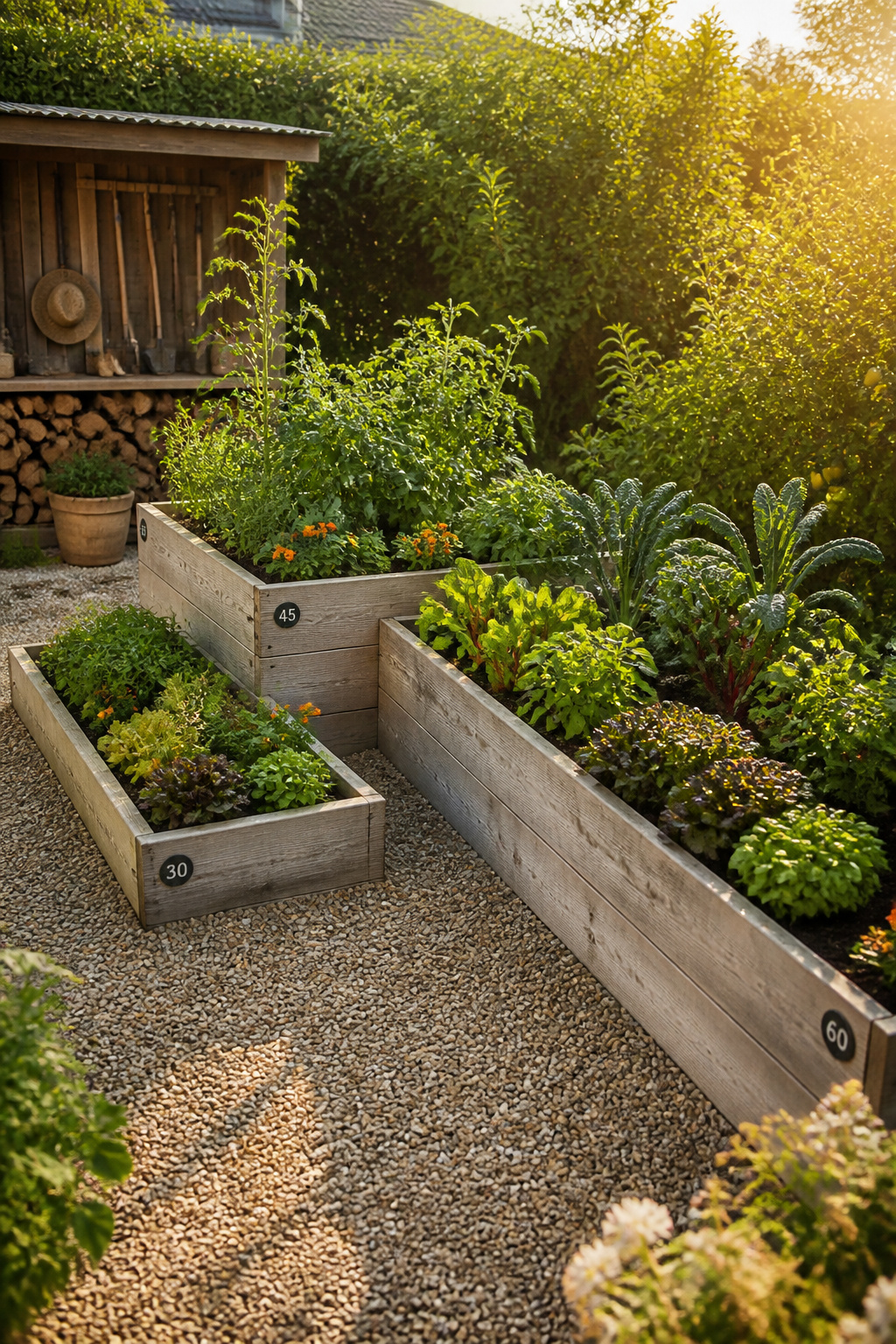
Height variation across beds adds compositional depth that a single flat planting level never achieves. Consider 30cm beds for ground-level herbs, 45cm for most vegetables, and 60cm or higher for deep-rooting crops or for those who prefer gardening standing. The material sets the visual register for the whole kitchen garden zone: cedar reads as warm and traditional; corten steel reads as contemporary and bold; reclaimed stone or brick reads as permanent.
For filling, a three-part mix outperforms complex recipes: 60% topsoil, 30% compost, 10% horticultural grit. The Hugelkultur approach — layering logs and woody debris in the bed base before adding the soil mix — creates a self-feeding system where decomposing wood slowly releases nutrients and retains moisture; the benefit becomes most visible from Year 3 onward, when conventionally filled beds begin to compact and deplete.
7. A Shaded Seating Alcove for Contemplation and Rest
The engawa is the traditional Japanese veranda — a narrow sheltered zone between inside and outside, specifically designed for sitting and watching the garden change. It was not a transitional space. It was a destination. That principle transfers directly to the backyard garden: before you choose any plants, any materials, or any structural elements, decide where you will sit, and what you will look at from there.
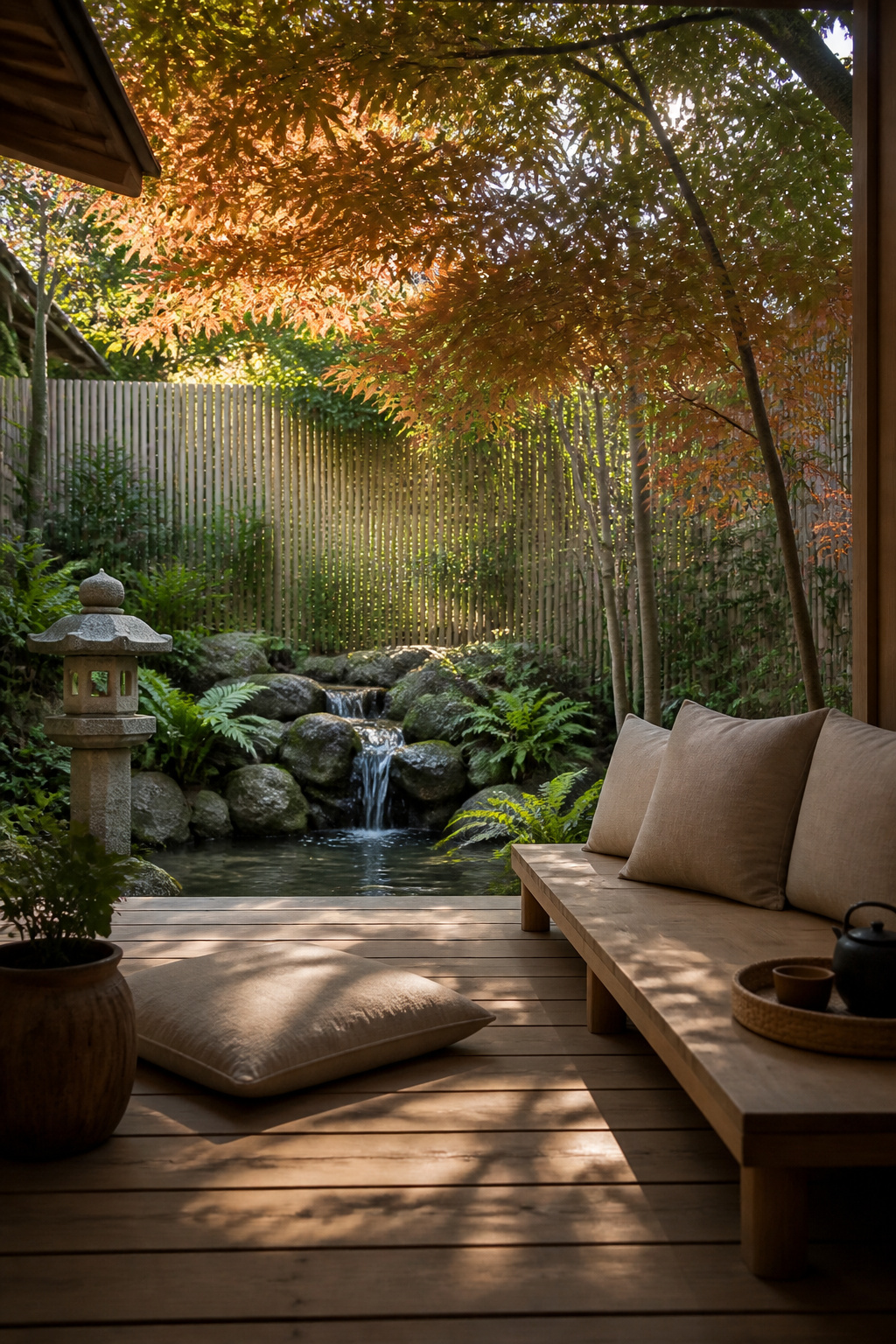
A simple low timber deck or platform — 30–45cm high, set back slightly from the garden — creates the psychological separation of ‘the alcove’ without any walls. Sitting slightly elevated above the garden plane changes the view: you see across the garden rather than into it. Position the seating to frame a specific composed view — the water feature, the dry garden corner, a significant stone or tree — rather than the whole garden at once. The frame makes the view a picture. For approaches to outdoor structure, backyard patio ideas for outdoor relaxation offer a range of options before you commit to a layout.
Shade and Furniture That Age Well
A living canopy is preferable to a built structure in a Japanese-influenced garden. A mature Japanese maple, a trained wisteria, or a large ornamental tree creates dappled shade that moves through the day — it frames the sky rather than closing it off. Where a built structure is necessary, keep it minimal: simple unpainted larch or cedar, mortise-and-tenon joinery rather than metal brackets. The furniture itself should age naturally: teak develops from golden-honey to a consistent silver-grey that actually looks better with weathering; FSC-certified iroko or eucalyptus deliver the same durability at lower cost.
8. Native Wildflowers for Color and Biodiversity
The argument for dedicating even a small section of your backyard garden to native wildflowers is ecological more than aesthetic — though the aesthetic case stands on its own. A self-sustaining native wildflower patch, once established, feeds dozens of pollinator species from April through October, provides nesting habitat for ground-nesting bees, fills seed heads for overwintering birds, and requires two mowing events per year. Compared to any other planting scheme, the return is extraordinary.
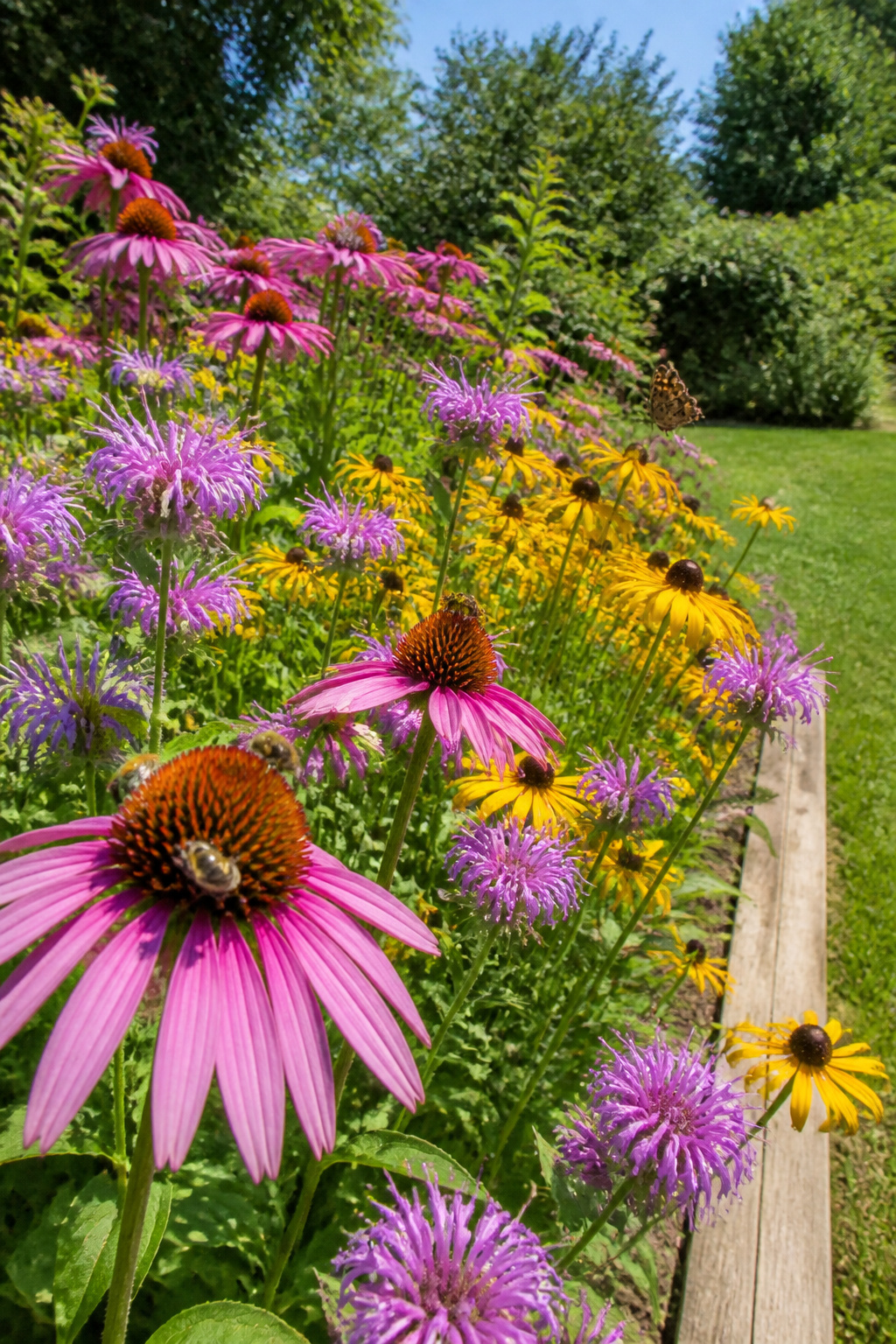
Native plants are co-evolved with local insect populations: a native prairie coneflower (Echinacea purpurea) supports 50 or more bee species; a non-native ornamental of similar appearance may support fewer than five. The difference is invisible to the human eye but critical to the garden’s ecological function. For a broader picture of how lawn and wildflower zones can work together, lawn and garden ideas for living outdoor spaces show the full range from formal turf to naturalistic planting.
The establishment process requires one decision made correctly: remove all existing turf before sowing. This step is the one most people skip, and the primary reason most wildflower patches fail in Years 1 and 2. Existing grass always outcompetes wildflower seedlings. The preferred sowing window is September–November, allowing cold stratification over winter. Year 1 shows mostly annuals and weeds — this is normal. Year 2 brings the coneflowers and coreopsis. The full self-sustaining meadow appears in Year 3, and then largely looks after itself.
9. Ornamental Grasses for Movement in Your Outdoor Garden
A garden without movement is a static composition — beautiful in photographs, but less alive to be in. Ornamental grasses translate every breath of wind into visible, audible motion that no flowering plant can replicate. The Japanese garden has always employed grasses for this quality, and the concept of mono no aware — sensitivity to the ephemeral — finds its most direct expression in the way a grass catches afternoon light and then loses it entirely in shadow.
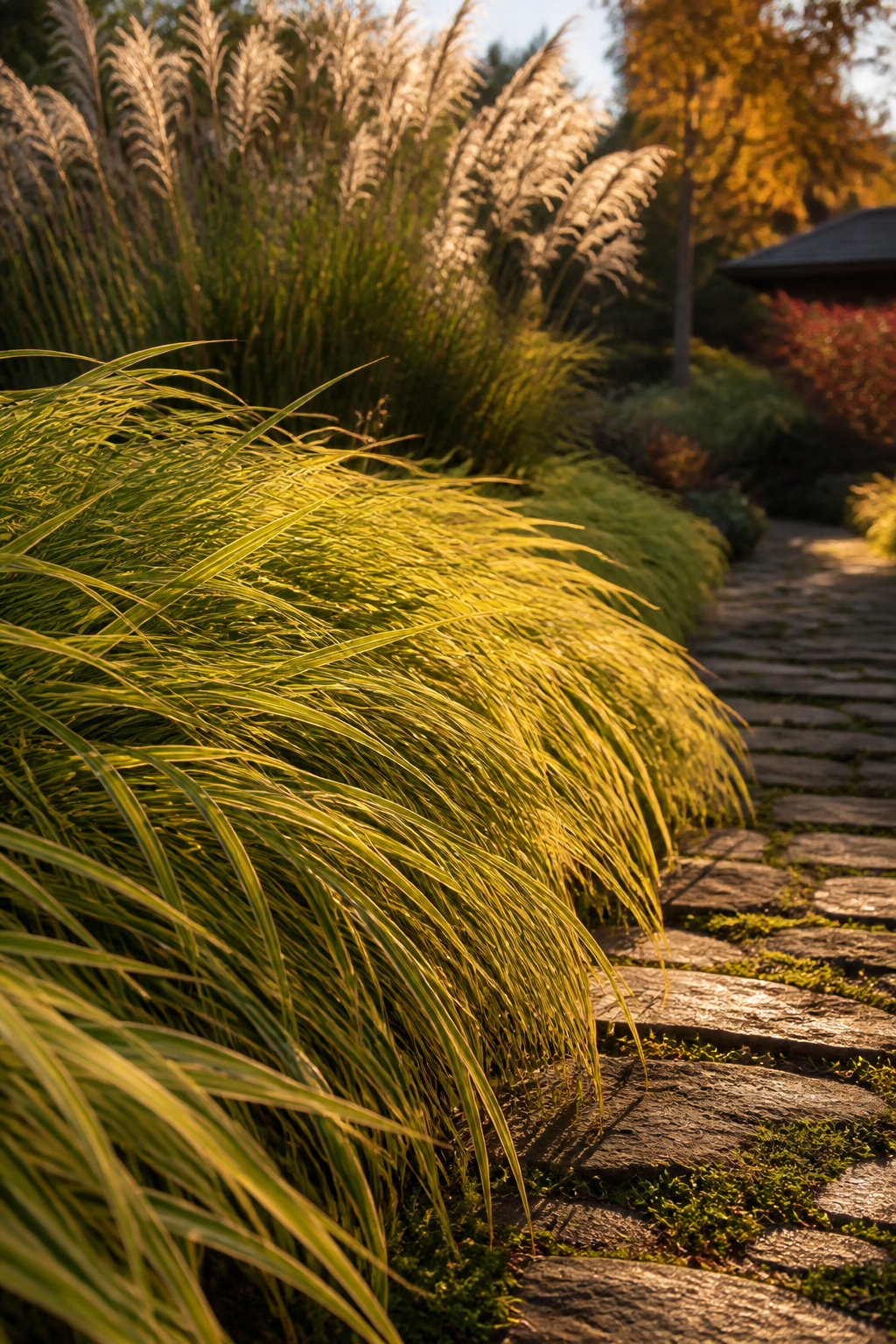
Hakonechloa macra (Japanese forest grass) is the most useful grass in a Japanese-influenced garden: it grows 30–45cm high with a cascading waterfall habit that softens path edges, integrates naturally with stone, and thrives in shade — the corner of the garden most planting refuses. The ‘Aureola’ cultivar has lime-green foliage with gold edges and turns warm gold in autumn, holding colour into early winter. Leave it in place until February rather than cutting back in autumn.
For mid-storey movement and late-season interest, Miscanthus sinensis works as a back-border statement. ‘Morning Light’ and ‘Gracillimus’ are the refined narrow-leaved forms — both reach 1.5–2m and produce feathery silver plumes from August through October. The placement rule for all ornamental grasses: plant in groups of three or five (odd numbers) rather than single specimens. One grass in a mixed planting reads as an error; five of the same variety together reads as a decision.
10. A Dry Garden Corner With Raked Gravel and Placed Stones
Karesansui — 枯山水, literally ‘dry mountain water’ — is the Zen dry landscape tradition that produced some of the most recognisable garden images in the world: raked white gravel, three stones in precise relationship to one another, an expanse of emptiness that is somehow entirely full. The garden at Ryōan-ji in Kyoto contains fifteen stones arranged so that one is always hidden from any single viewpoint. The apparent simplicity is achieved through extraordinary intentionality.
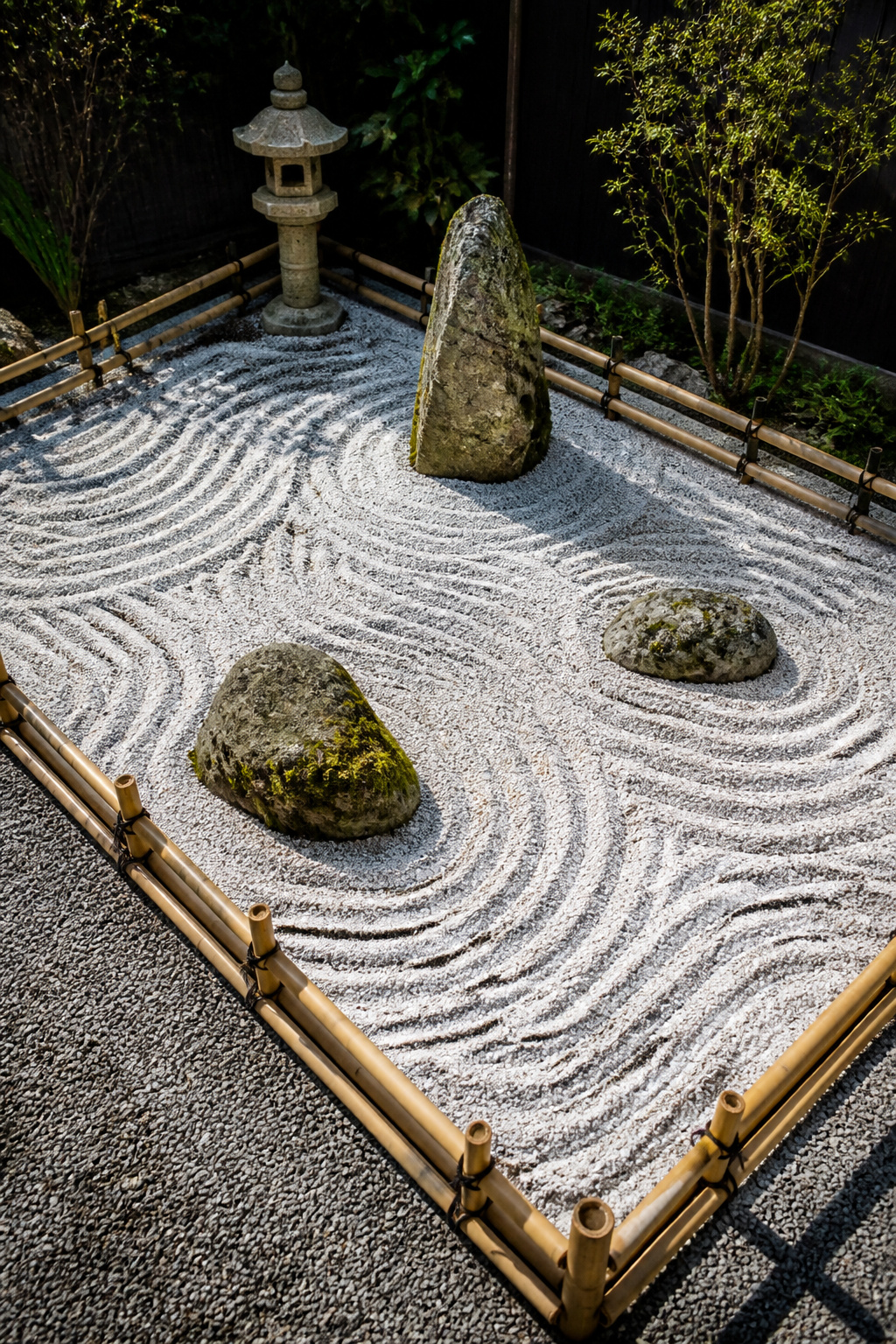
In a contemporary backyard garden, a dry garden corner of even 2m × 3m introduces a zone of radical simplicity that makes the surrounding planted garden feel richer by contrast. The materials are inexpensive: decomposed granite or crushed white granite (6–10mm particle size rakes well), 3–5 significant stones, landscape fabric for weed control, and timber or stone edging to define the border. Total materials for an 8×10 foot corner typically run $500–1,500.
Stones are placed according to Japanese compositional rules: odd numbers only, partially buried so they appear to emerge from the ground rather than sit on it. The raking is not merely maintenance — it is the practice. Moistening gravel before raking gives crisper grooves that hold their pattern longer. Between sessions, wind and falling leaves disturb the pattern — in Zen philosophy, this impermanence is not a problem to correct but a quality to accept.
11. Climbing Plants on Natural Timber Trellises
In a narrow or small backyard garden, the walls and fences are not the limit of the garden — they are its largest available growing surface. A well-chosen climbing plant against a 2m fence covers a planting area proportional to the fence’s full width while using zero ground space. In a Japanese-influenced design, it also performs an architectural function: a climbing plant softens the boundary between garden and the outside world, creating a living wall that changes month by month.
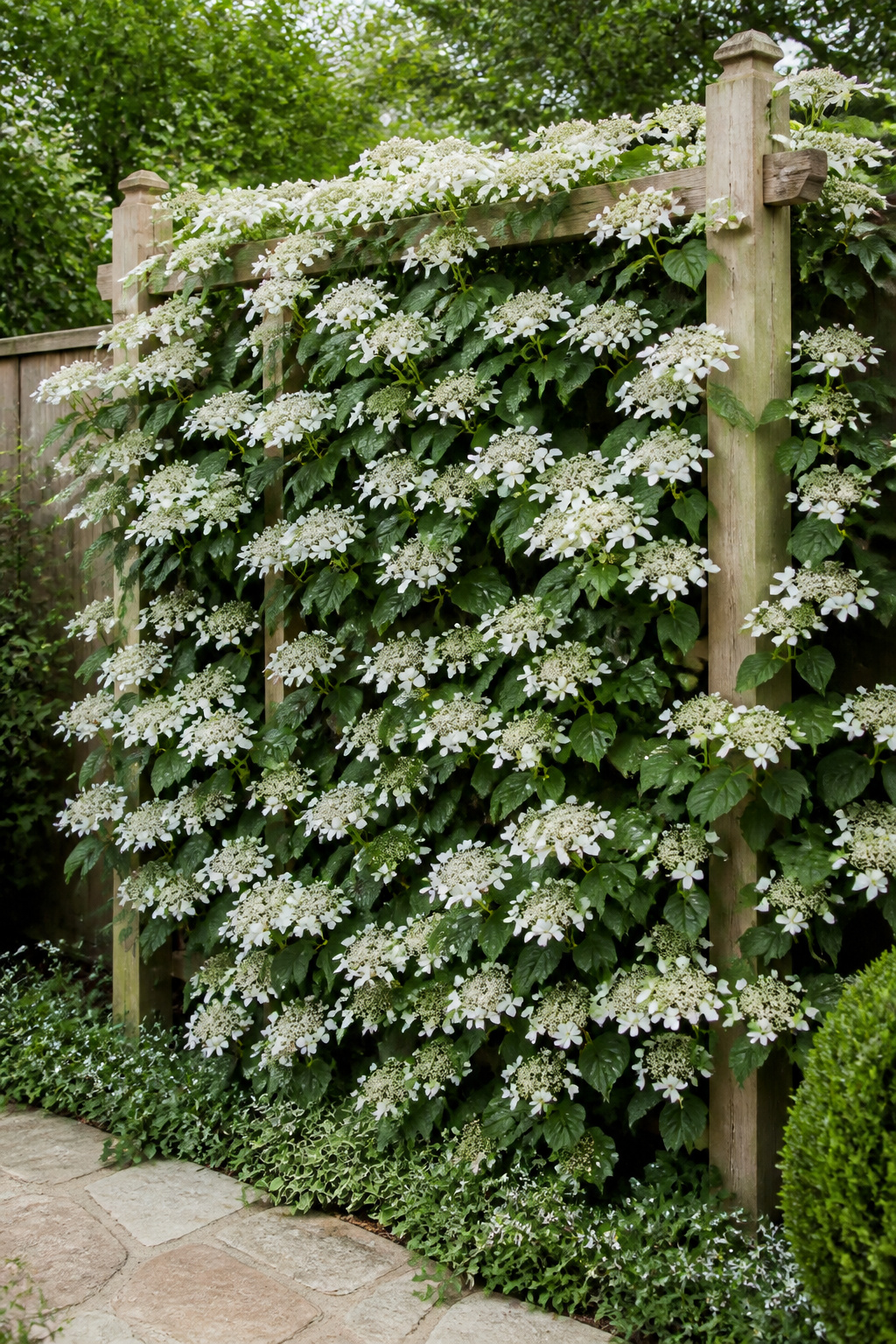
For the trellis itself, larch (Larix) is the most appropriate structural timber: it grows in dense rings that resist rot without preservative treatment and weathers to a grey that complements stone and bamboo. Simple mortise-and-tenon joinery — cross-members let into uprights rather than nailed on — produces a trellis that reads as intentional craftsmanship. Vertical garden ideas for porch and outdoor walls cover both DIY and purchased trellis systems if you prefer to buy rather than build.
The Best Climbers for This Setting
Climbing hydrangea (Hydrangea anomala petiolaris) is the most underused climber in temperate gardens: self-adhering to timber without tying, shade-tolerant, spectacular white lacecap flowers in June, turning gold in autumn — and once established, it can reach 12–15m with minimal intervention. It does take 2–3 years to settle, but from Year 4 onward it is essentially self-managing. For fragrance near a seating area, star jasmine (Trachelospermum jasminoides) produces intensely scented white flowers in summer and maintains evergreen cover year-round in mild climates. Wisteria is spectacular but demanding — requires a very sturdy support and twice-yearly pruning (August and February); American wisteria ‘Amethyst Falls’ is significantly less vigorous than its Chinese and Japanese relatives and the safer choice for a domestic trellis.
12. A Gathering Space: Fire Pit or Outdoor Hearth
Fire does something to a garden that no other element manages: it creates gravity. People drift toward it, conversations deepen around it, and the space around a fire becomes the most occupied part of any outdoor space on any evening it is lit. In the context of a Japanese-influenced backyard garden already containing water, stone, and wood, fire completes the elemental composition. It also, practically, extends the useable season of the garden by 4–6 weeks in spring and autumn.
A portable steel fire pit ($100–600, 3mm+ steel) is the wiser starting point for most gardens: it can be positioned, moved, and stored in winter. A built-in stone hearth is more permanent ($1,500–5,000 to construct) and reads as architecture rather than furniture — appropriate for a garden that has committed to a specific layout. Bioethanol fire pits offer a smokeless alternative for urban areas with smoke-restricted zones; the flame is clean but produces less radiant heat than a wood fire.
Safety clearances are not aesthetic choices: minimum 3m (10ft) from any structure or combustible material; local codes sometimes require up to 7.5m (25ft). The sitting circle should be sized generously — 3.5–4.5m in diameter, with the fire at centre and seating positioned 0.9–1.2m from the fire edge. Install non-combustible ground cover extending at least 60cm beyond the fire feature edge.
13. Backyard Garden Lighting: Lanterns and Subtle Path Illumination
Japanese garden lighting philosophy is the inverse of most Western landscape lighting. Rather than flooding the garden with light to recreate daytime conditions after dark, the Japanese approach uses minimal, precisely placed light sources to illuminate specific elements — a stone’s surface, the water in a basin, the underside of a maple canopy — while leaving the surrounding darkness intact. The garden at night should feel more intimate, not simply brighter.
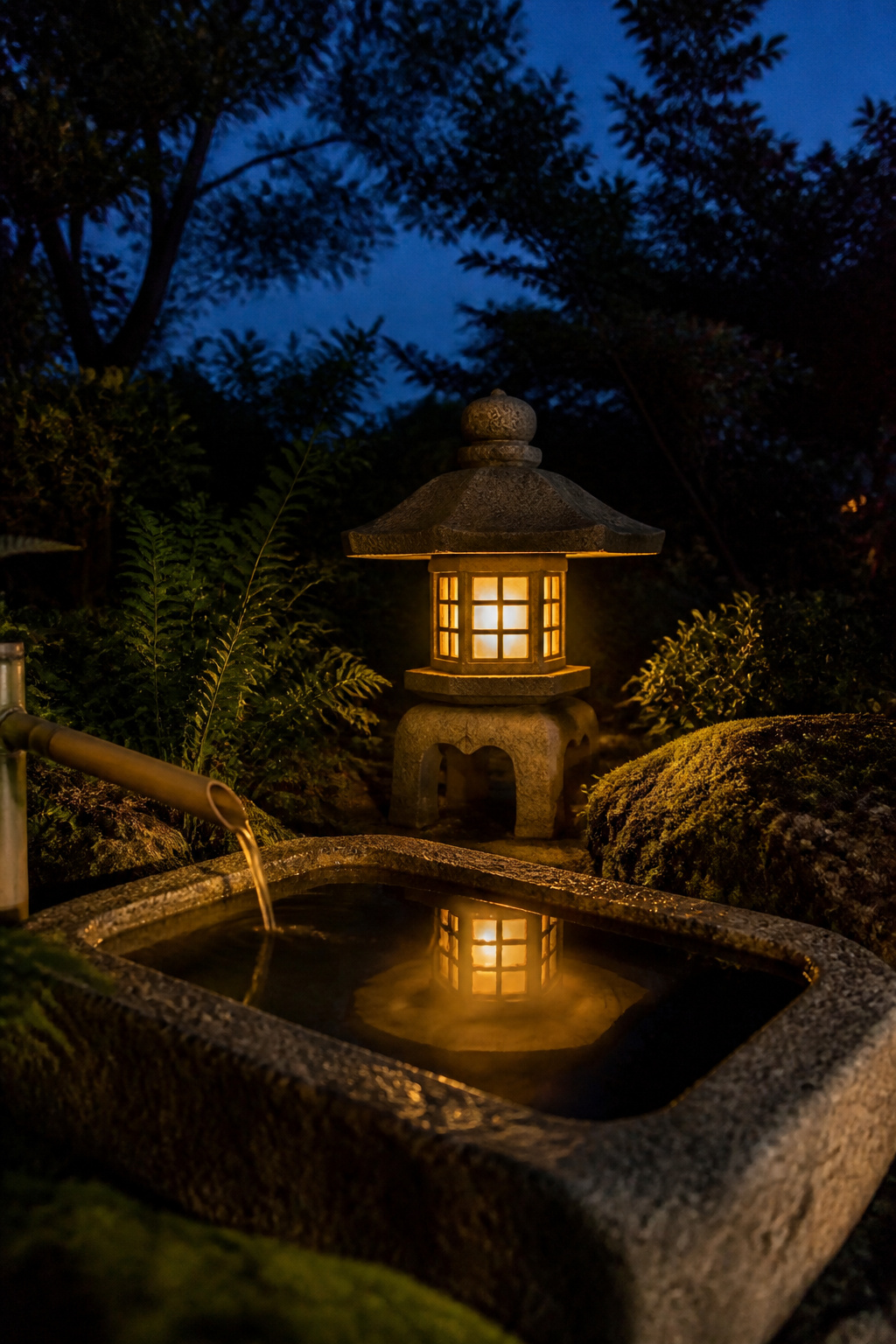
Path lighting calibrated at 5–20 lumens is the correct range for a contemplative garden; typical landscape spotlights run at 200–800 lumens — ten times too bright for mood. Low-voltage LED path systems (12V) can be installed without an electrician: a transformer connects to a standard outdoor outlet, cables run to individual fixtures, and 10–15 path lights take 2–4 hours to install. Colour temperature matters: specify 2,700K–3,000K (warm white) throughout; cool-white LEDs at 5,000K+ destroy the atmosphere even in small quantities.
Lantern Placement and the Moonlighting Technique
Stone lanterns earn their place not just as light sources but as daylight garden elements that hold visual weight against planting and stone. The yukimi-dōrō (snow-view lantern) suits the domestic scale best: short, wide-roofed, traditionally positioned near water features or at path junctions. Most come pre-drilled to accept a low-voltage LED fitting. The moonlighting technique — a downward-facing cool-white light mounted high in a tree canopy — recreates full-moon light quality, casting natural leaf-pattern shadows across the garden below. Done well, you cannot see where the light comes from.
14. Evergreen Anchors That Hold the Garden Through Winter
Walk your garden in February. If what you see holds no compositional interest — if bare earth and brown sticks are all that remain — then the garden is, in design terms, absent for six months of the year. Japanese garden philosophy insists on year-round structural integrity: the winter composition of evergreen silhouette against a grey sky is a distinct seasonal aesthetic rather than a dormancy to be tolerated.
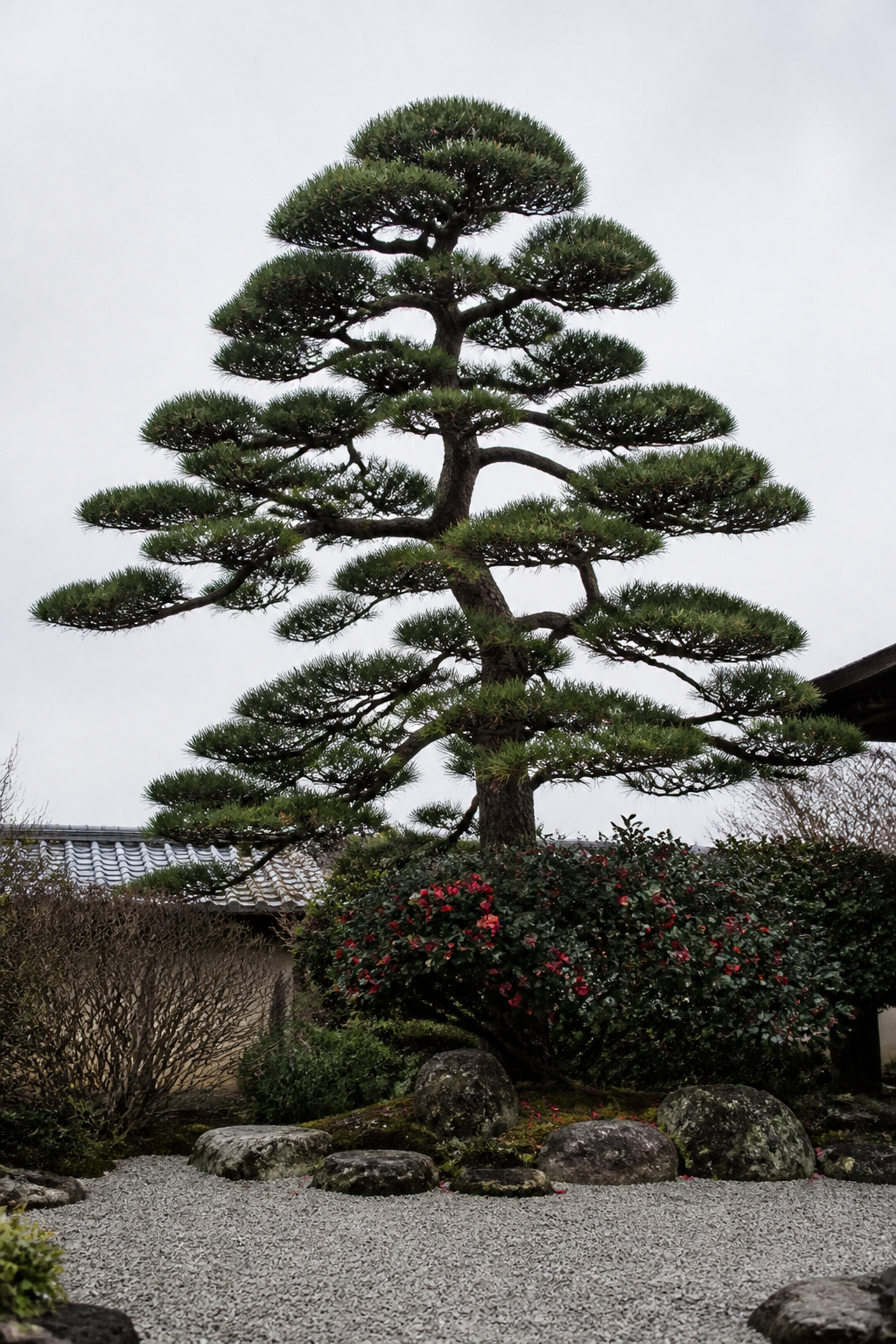
Evergreens are the bones from which all other planting hangs. Without them, a garden exists only in high summer. Japanese black pine (Pinus thunbergii) is the classic structural choice: naturally irregular in habit, responsive to shaping, and the primary candidate for niwaki — the cloud-pruning technique that creates the distinctive tiered silhouettes of traditional Japanese garden trees. It grows 30–60cm per year (controllable) and tolerates coastal exposure and urban pollution equally well. Camellia japonica is the indispensable flowering evergreen: deep-green glossy leaves year-round, blooms January through April, and after 20 years can be trained into a cloud-pruned architectural form.
The patience argument is clear: a Leyland cypress planted for instant privacy has overgrown its allotted space by Year 10 and becomes the garden’s primary management problem for the following two decades. A Japanese black pine established from a 60cm specimen, shaped patiently over 10 years, becomes a garden tree of genuine value — aesthetically, ecologically, and in plain financial terms. Fast-growing evergreens almost always cost more, over a 20-year horizon, than slow ones.
15. A Composting System Woven Quietly Into the Design
Most garden composting systems are hidden rather than designed — a bin shoved behind the shed, screened with whatever was to hand, accessed only when the guilt of a full kitchen caddy becomes too much to ignore. This approach guarantees underperformance, because composting requires regular turning, accessible materials addition, and the kind of regular attention that an inconveniently placed bin never receives.
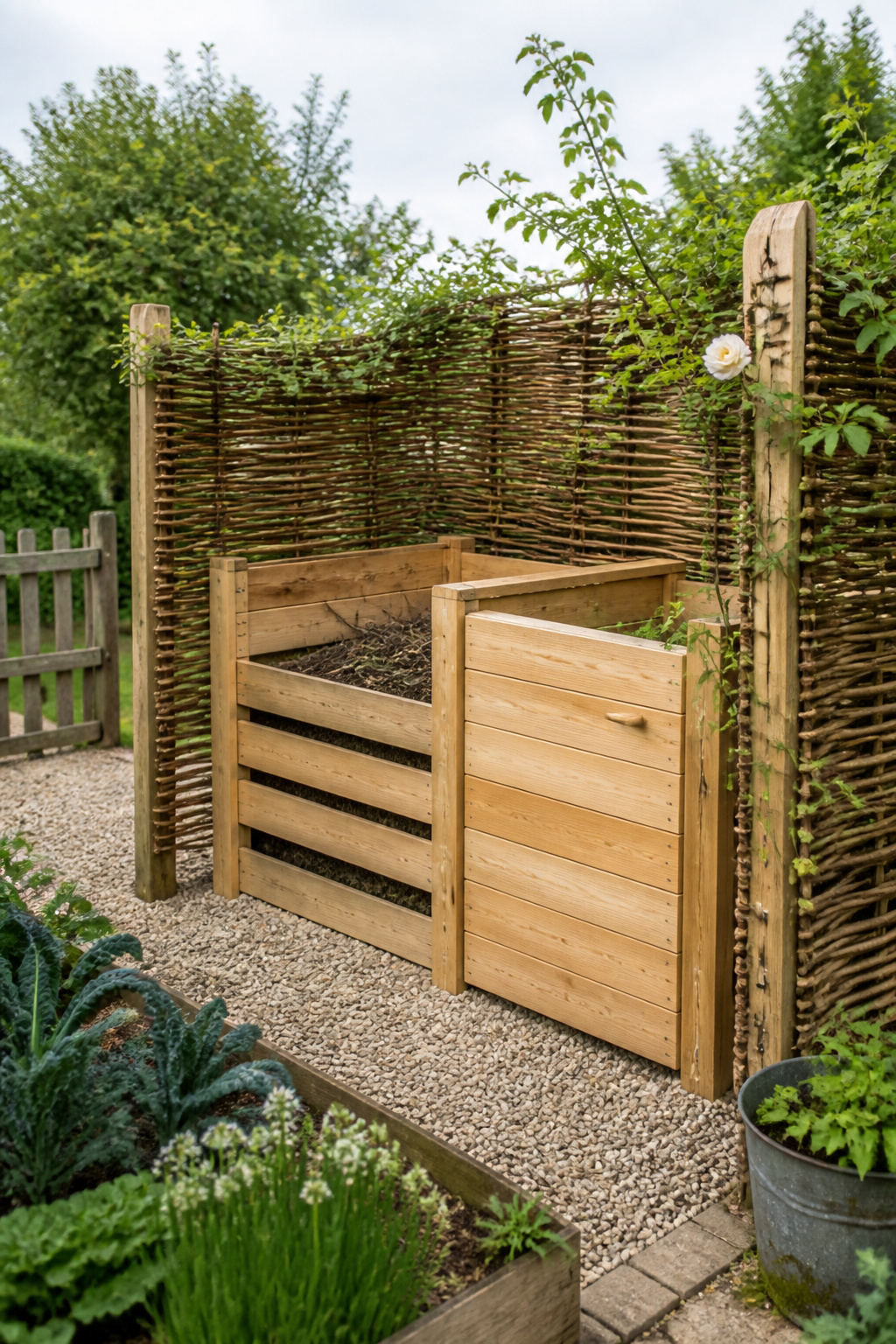
The philosophy of mu-da — no waste — runs through Japanese garden thinking. Every kilogram of garden waste returned to the soil as compost delivers roughly 200–300g of finished amendment that improves drainage, water retention, and microbial life simultaneously. A household with a small backyard garden generates 300–500kg of organic material per year. All of it can return to the garden.
Hot vs. Cold Composting
Design the compost area as deliberately as any other element. A two-bay timber system built from untreated larch — one bay actively composting, one curing — provides the most practical layout. Screen the bays with woven willow or hazel hurdle panels, which allow the airflow composting requires, age naturally, and can be planted with a rambling rose or honeysuckle. Position the system with an all-weather path from the kitchen door: composting that requires a detour in January will not happen in January. Cold composting (add materials continuously, turn occasionally) produces finished compost in 6–12 months and handles all standard garden waste — it is the right approach for most domestic gardens. Hot composting accelerates this to 4–8 weeks but requires a minimum pile of 1m³ and turning every 3–5 days to maintain the 60–70°C needed for weed seed kill.
16. Ground Cover and Moss: Softening Your Backyard Garden Floor
Bare soil is the garden designer’s enemy. It dries out in summer, compacts in winter rain, and is the primary surface from which weeds emerge. The solution in a Japanese garden is immediate and categorical: no bare soil. Every surface is either planted, gravelled, or covered with moss. The moss gardens of Saihō-ji in Kyoto — known as the ‘Moss Temple’ — demonstrate what this looks like at scale: an undulating green carpet that makes the garden floor as beautiful and considered as the canopy above it.
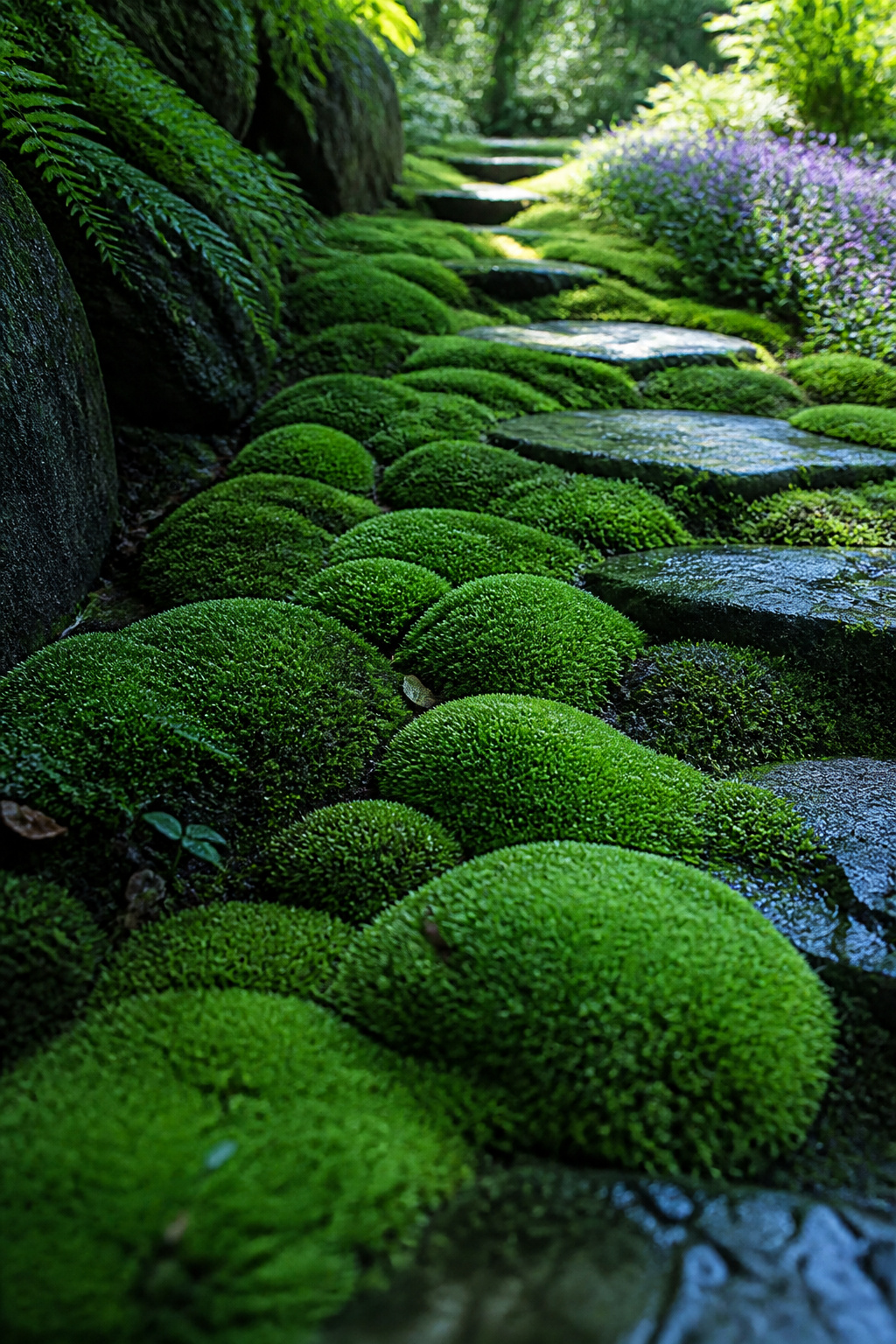
Moss cultivation is more accessible than most gardeners assume, but it requires the right conditions: soil pH of 5.0–5.5 (acidic, which most clay-based garden soils already are), shade to semi-shade with a maximum of 60% direct sun, and consistent moisture. Sandy or alkaline soils need pH amendment with garden sulfur before moss will establish. Two practical establishment methods: transplanting plugs of existing moss from a shaded garden corner and pressing firmly into damp ground; or moss slurry — blending moss clumps with buttermilk and water and painting onto prepared soil. Allow 4–6 weeks for new transplants to attach before expecting any spreading.
When Moss Won’t Work
Where conditions don’t suit moss — full sun, dry soil, or traffic areas — alternatives achieve a comparable effect. Creeping thyme (Thymus serpyllum) is drought-tolerant, releases fragrance when brushed, produces small pink flowers in early summer, and tolerates light foot traffic between stepping stones. Mazus reptans forms a dense 2–3cm mat with purple or white spring flowers and handles moderate foot traffic. Sagina subulata (Irish moss — not a true moss, despite its name) grows in part shade and sun, maintaining the bright-green even texture of true moss year-round. These ground covers complete the floor of the backyard garden in the same way that a good rug completes a room.
Composing Your Backyard Garden as a Living Space
The question most gardeners face is not which of these ideas to include, but where to begin. The answer is almost always the same: start with where you will sit and what you will look at. Before any path, any bed, any bamboo screen, the seating area and its framed view determine whether every other design decision is made in service of an experience or assembled in a vacuum.
Walk the garden in winter before you make any changes. The bones of the space — existing trees, fixed structures, natural levels — are most visible then. Note what holds compositional interest in the cold and bare season: this tells you where your evergreen anchors are already working, and where they are absent. A photograph of the backyard garden in February is a more honest design assessment than any photograph taken in full summer flower.
Phase the work across seasons rather than attempting everything at once. Year 1 should establish the infrastructure: paths, evergreen anchor planting, seating area, raised beds, and any major hard landscaping like the dry garden corner or compost bays. Year 2 brings the mid-storey and ground-level layers — bamboo screens, ornamental grasses, ground covers, the wildflower patch sown in autumn. Year 3 and beyond brings the refinements: the water feature, the stone lanterns, the niwaki shaping work on the pines and camellias. A backyard garden built this way is not finished in the conventional sense — it is composed, then recomposed. The Japanese concept of wabi-sabi asks not for perfection but for the beauty that comes from time and attention applied honestly over years. That is what a garden, at its best, actually is.