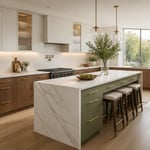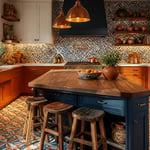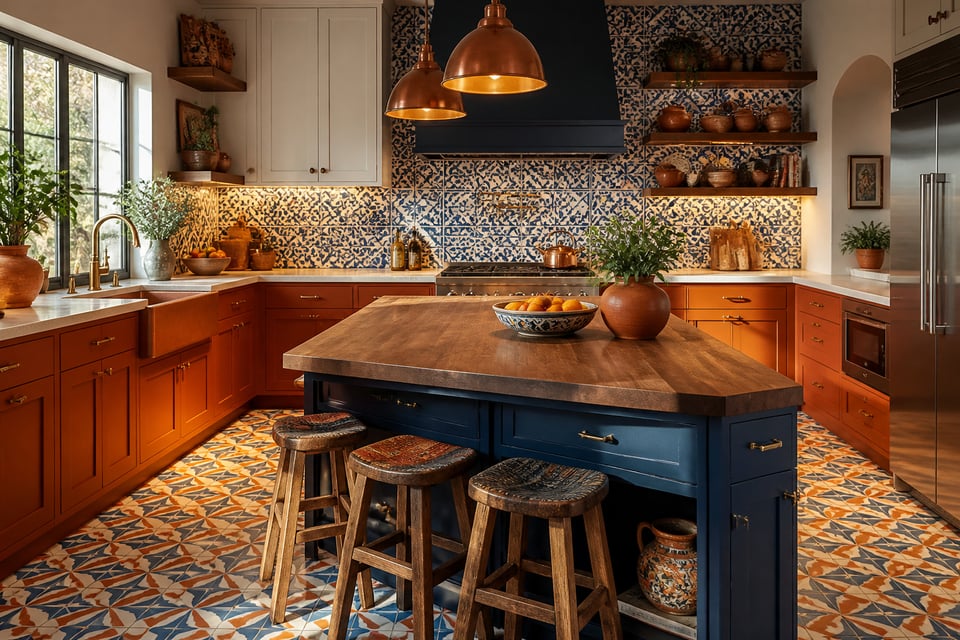
Standing in a kitchen that no longer reflects who you are has a particular kind of melancholy to it. The worn countertops, the cabinets that have lost their color, the layout that fights against how you actually cook — all of it whispers that the space was designed for someone else’s life, not yours. The best kitchen remodel ideas understand something the world’s greatest culinary cultures have always known: the kitchen isn’t just where you prepare food. It’s where families gather, where stories are told over steam and spice, where every design choice communicates what you value and who you are.
The kitchens that move me most borrow from traditions that have never been afraid to celebrate this space — the hand-painted Talavera tiles of Mexican artisans, the copper vessels that glow on open shelves in markets from Oaxaca to Puebla, the deep cobalt glazes that have lit up Moroccan kitchens for centuries. These aren’t trends. They’ve been beautiful long enough to prove themselves.
These 16 kitchen renovation ideas move from the foundational decisions — layout, cabinetry, countertops — through to the artisanal finishing details that give a renovated kitchen genuine soul. Whether you’re planning a full gut renovation or a thoughtful seasonal refresh, each idea is actionable, specific, and rooted in the kind of craftsmanship that rewards careful attention.
1. A Purposeful Layout That Puts Function Before Form
The most expensive kitchen renovation mistake is starting with surfaces and ending with layout — choosing the beautiful tile before asking whether the kitchen actually works. I’ve seen kitchens with stunning materials where the sink, cooktop, and refrigerator are positioned in ways that make cooking feel like an obstacle course.
The kitchen work triangle has governed good kitchen design since researchers at the University of Illinois developed it in the 1940s — connecting the three primary zones: sink, cooktop, and refrigerator. Each leg should be 4–9 feet, with a total perimeter of 13–26 feet, and no traffic path should cut through the middle. In 2026, the best designers build on this foundation with a “work zones” model: distinct purpose-built areas — prep zone, cooking zone, clean-up zone, sometimes a social zone — each with the tools and storage it needs. When zones are properly planned, two people can cook simultaneously without collision.
Before committing to a full redesign, do a diagnostic first. Walk through your kitchen at peak cooking times for five days and note exactly where you bump into things, where you cross the room without reason, where items are stored versus where you actually use them. Most of the time, moving one or two elements — not gutting the whole room — solves the real flow problem.
What to Look For Before You Move a Wall
Moving plumbing adds $500–2,000+ per fixture to a remodel budget; confirm it’s necessary before assuming the pipes must go. Load-bearing walls require a structural engineer’s sign-off and typically a beam or post installation — budget $2,500–10,000+ for this work. The most cost-effective kitchen remodel ideas work with existing plumbing and gas lines, focusing transformation on cabinetry, surfaces, and lighting rather than infrastructure.
Galley kitchens (two parallel counter runs) are the most ergonomically efficient layout — the critical requirement is a minimum 48-inch aisle between opposing counters. L-shaped layouts suit square kitchens and integrate naturally with open-plan dining. Island-centred layouts require a minimum kitchen width of 13 feet to maintain proper clearance on both sides.
2. Bold Cabinetry Colors: Kitchen Remodel Ideas That Make a Statement
Color is the fastest, most transformative lever in any kitchen remodel — and cabinets cover more square footage than any other element in the room. Getting this right doesn’t mean playing it safe. It means choosing with conviction and understanding which bold choices have earned their staying power.
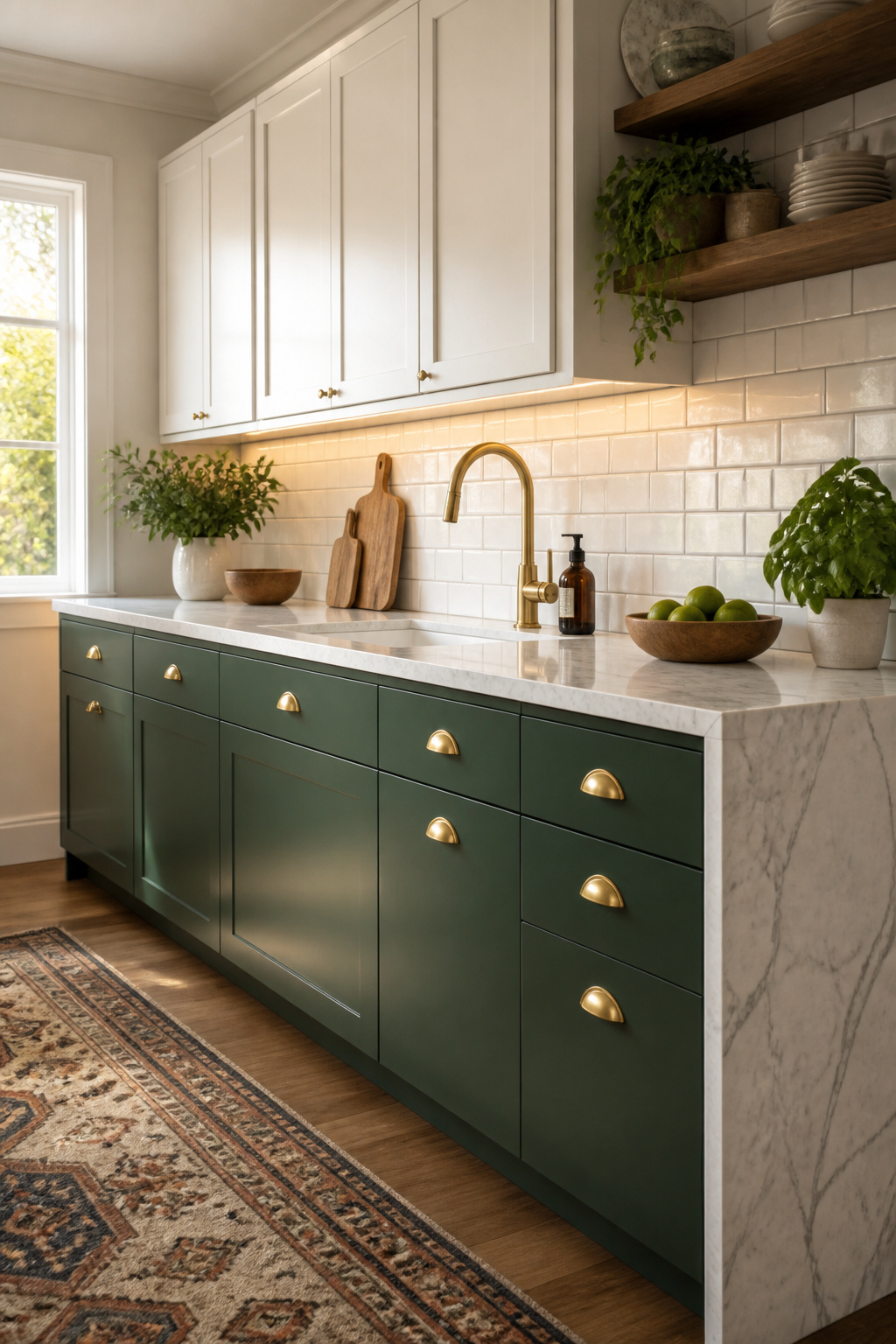
The cabinet colors with the most proven longevity in the 2020s come from deep, saturated traditions: forest greens, warm terracottas, cobalt blues, dusty navies. These are colors with cultural roots — the adobe reds of Mexican architecture, the cobalt glazes of Talavera pottery, the deep greens of colonial hacienda doors. They’ve been beautiful for centuries, which is a useful measure of durability. If forest or sage green has been drawing you in, you’re in very good company — green kitchen cabinets have proven to be among the most lasting bold cabinet choices of the decade, working across flat-panel cabinetry and traditional shaker profiles alike.
Two-tone strategies deliver character without committing the entire kitchen to a single bold statement. Real estate professionals consistently recommend them for resale appeal: lighter uppers that keep the zone airy, bolder lowers that ground the space with visual weight. Pairing dark lower cabinets with warm brass or copper hardware makes the kitchen read as intentional, globally-influenced, and deeply considered. Finish matters as much as color — matte and satin surfaces hide fingerprints, show wear less visibly, and photograph more beautifully than high-gloss in almost every application. Whatever color you choose, invest in cabinet-specific paint (Sherwin-Williams Emerald Urethane is the professional standard) and proper primer. The finish is what makes a bold color look like a design decision rather than an experiment.
One practical caution: always test your chosen color in a large sample — minimum A5 size on actual cabinet material — in your kitchen’s specific light, morning and evening. What reads beautifully in a showroom can look completely different under your kitchen’s fluorescent or daylight combination.
3. Open Shelving That Displays Artisanal Pottery and Collections
Open shelving is a love language for people who have accumulated beautiful things and want them seen. It also reveals more about a person’s design philosophy than almost any other kitchen choice — because it invites everything onto public display.
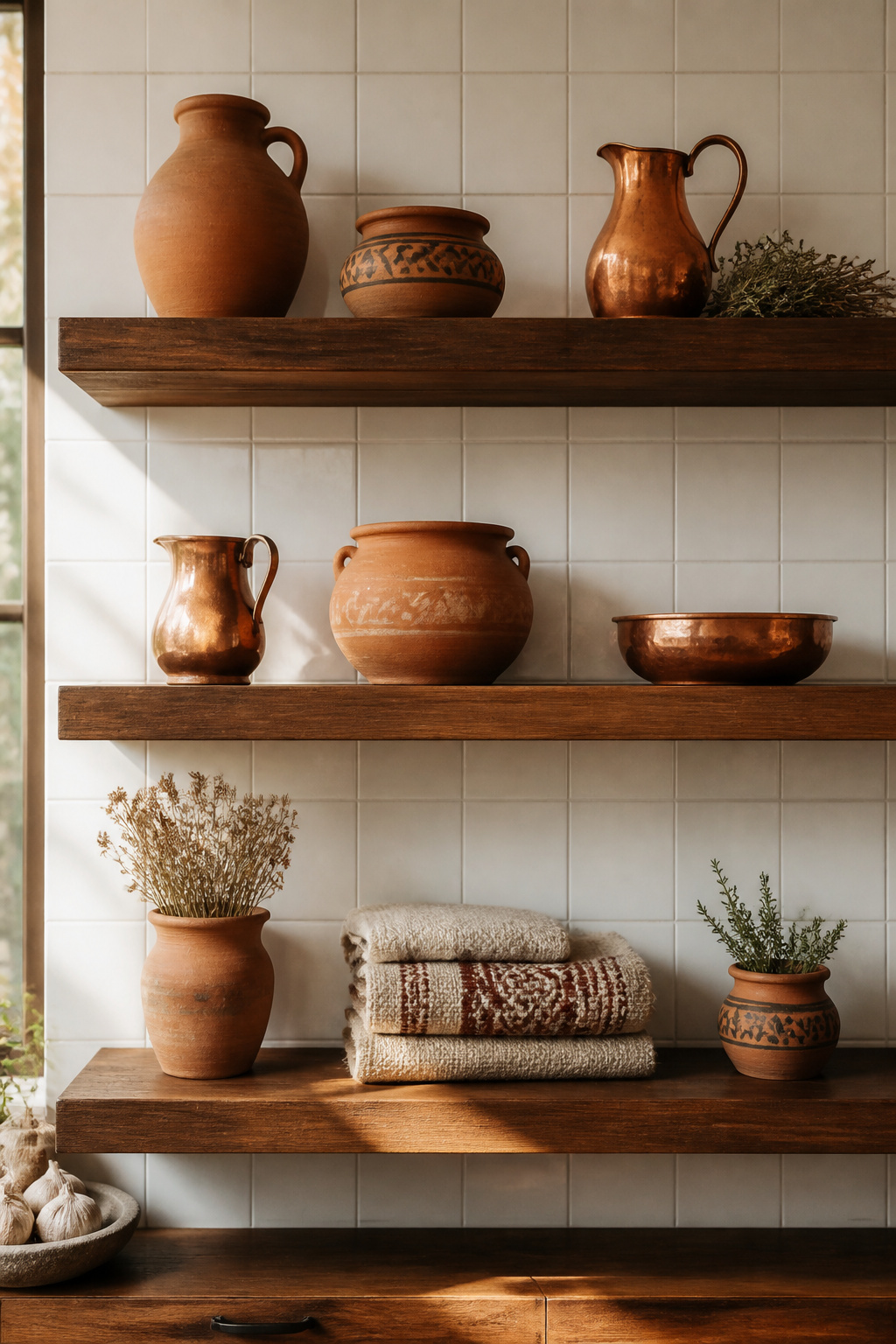
The honest truth about open shelves: they work beautifully for people who actively love their kitchen objects and find it natural to maintain order. For people who prefer to close the door on clutter, they create daily stress. The most successful approach for most homes is a hybrid — open shelving for display pieces and everyday beautiful objects, closed cabinetry for everything you don’t want to curate. A single run of three open shelves on one wall carries an entire pottery collection, a line of copper vessels, and a cluster of handmade ceramics without demanding that every drawer organizer be immaculate.
The material you choose for the shelf communicates as much as what sits on it. Solid walnut shelves, 1.5–2 inches thick, bring warmth and visual substance that no laminate can replicate — they age beautifully and pair with everything from white-painted base cabinets to dark-stained millwork. White oak’s closed-grain structure offers better moisture resistance near sinks and cooktops. Reclaimed timber — with its knots, weathered grain, and nail holes from a previous life — brings natural variation and a sense of history that new wood simply cannot manufacture. For a kitchen with Latin American sensibility, a hand-planed rough-hewn shelf in pine or cedar beneath a row of terracotta pottery sits together exactly as it was always meant to.
Styling principle: start with one anchor piece (a large ceramic, a bold decorative plate, a statement vase) and build the display in odd numbers — three or five objects rather than two or four. Leave negative space between pieces. The empty areas let each object breathe. The most common kitchen remodel idea people get wrong with open shelving is treating the shelves as extra storage; everything visible should be something you’re genuinely proud to show.
4. Handcrafted Tile Backsplashes as the Room’s Visual Centerpiece
Of all the surfaces in a kitchen, the backsplash has the best design return per square foot. It sits at eye level — the zone where a visitor’s gaze naturally lands — and typically occupies 15–25 square feet of the most visible wall space in the room. This is where handmade materials make the most dramatic difference.
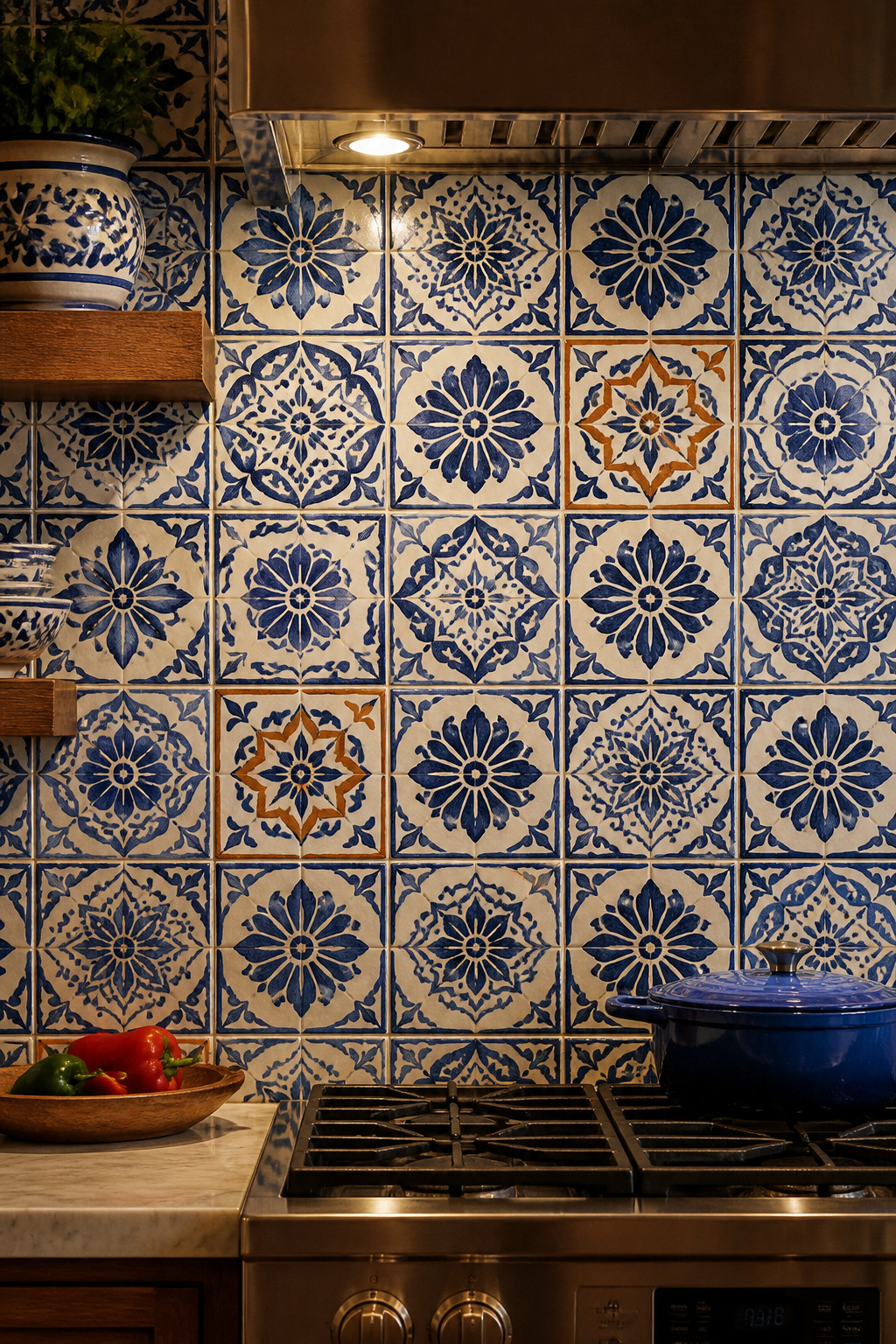
Machine tiles are consistent in size, glaze, and color in ways that can be beautiful but never feel genuinely alive. Handmade tiles — Talavera, Zellige, encaustic cement — carry natural variations that industrial production cannot replicate. These “imperfections” aren’t flaws; they’re the premium. When you place a run of authentic Talavera tiles behind a cooktop, each hand-painted piece telling a slightly different version of the same cobalt-and-white story, you’re bringing centuries of Mexican artisanal tradition into a contemporary home.
Talavera originates in Talavera de la Reina, Spain, but found its fullest expression in the hands of artisans in Puebla, Mexico, where it remains a protected craft designation. Each tile is hand-painted and kiln-fired; natural size and glaze variation from tile to tile is desirable, not a defect. Zellige, the Moroccan alternative, has a glossy, slightly rough surface that creates an almost rippling light play across the wall — the irregular surface of each tile catches light at a slightly different angle, producing depth no flat machine tile can match. Encaustic cement tiles take a different structural approach: the pattern is pressed into the tile during manufacture and penetrates the full depth of the cement, so the color cannot chip with age. For kitchen backsplash design that genuinely distinguishes a space from its neighbors, any of these three handmade traditions is the place to begin.
Getting Grout Right
Grout is a design decision equal in consequence to the tile itself, and most people treat it as an afterthought. Dark grout between patterned tiles emphasizes each individual tile as a discrete element, creating a graphic effect; lighter, tone-matched grout unifies the surface so the pattern reads as whole texture rather than a series of tiles. Neither is wrong — they produce completely different character from identical tile.
Also: always use an experienced tiler for handmade tile installations. Unlike machine tiles, Talavera and encaustic cement tiles have natural size variations that require a tiler who knows how to accommodate them in the layout. This isn’t the installation for someone learning on the job.
5. Kitchen Renovation Ideas for Countertop Materials That Last
The countertop is the most touched surface in a kitchen and the most expensive to replace — which makes the initial choice one of the highest-stakes decisions in any kitchen renovation. Understanding the material hierarchy prevents the most common remodeling regret: choosing marble for its beauty and spending the following decade managing etchings.
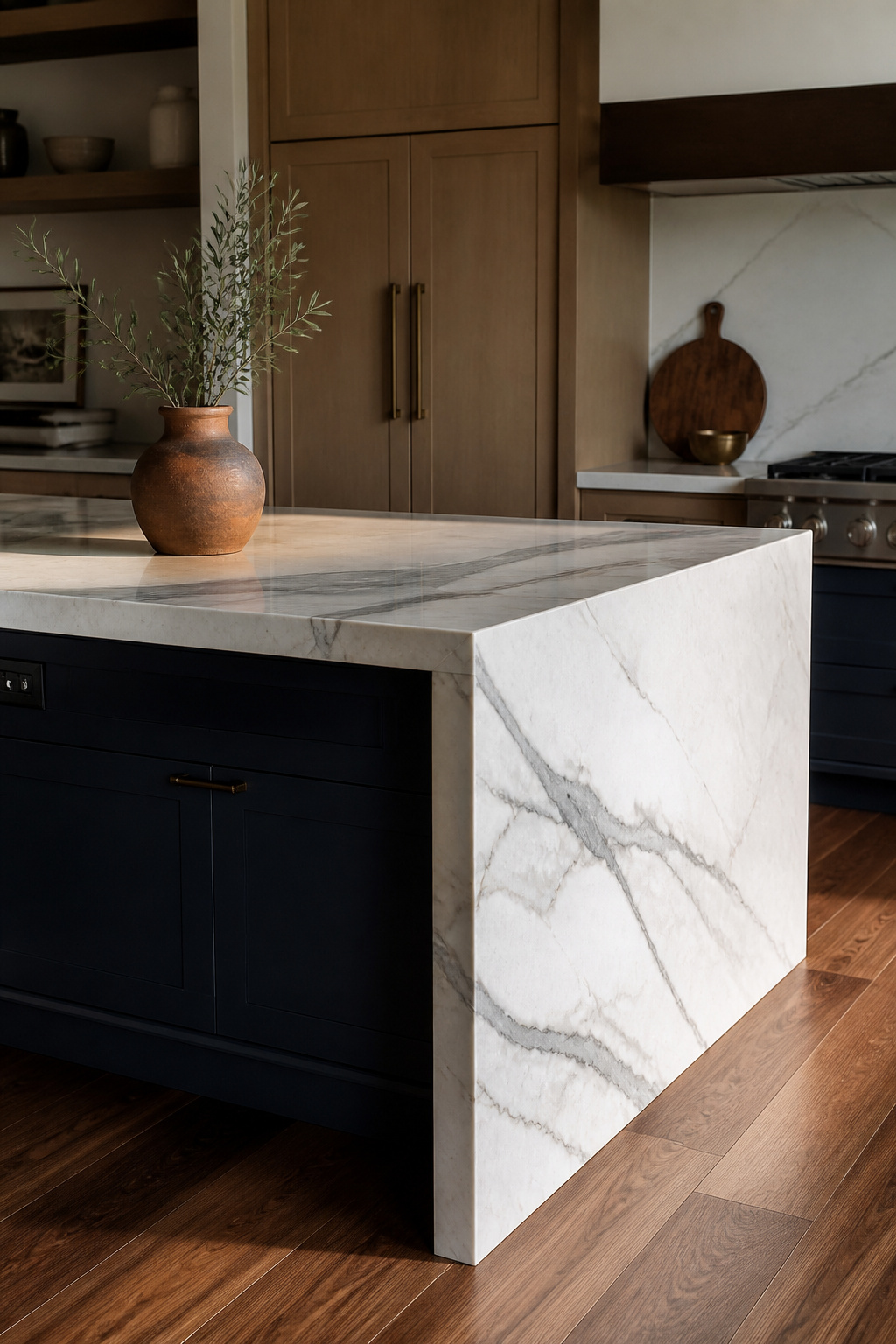
Marble rates only 3–4 on the Mohs hardness scale. Any acid — lemon juice, wine, vinegar, tomato sauce — etches its polished surface on contact. For a primary work surface in a home where real cooking happens daily, this is a maintenance challenge that never goes away. Quartzite, which looks remarkably similar to high-end marble in many formations, scores 7 on the Mohs scale (harder than granite), handles heat to 1,400°F without damage, and requires periodic sealing but far less frequently than marble. Engineered quartz — not to be confused with natural quartzite — is non-porous, never needs sealing, and has the lowest maintenance demands of any countertop material; its limitation is heat, as the polymer resin binder breaks down above approximately 300°F, so trivets near the range become mandatory rather than optional.
For the kitchen island specifically, the most compelling kitchen renovation idea is a material contrast: butcher block island against a quartzite or quartz perimeter creates warmth and visual distinction that makes the island feel like a piece of furniture rather than an extension of the kitchen. For an honest look at which materials hold up best in daily island use, the guidance around kitchen island countertop options deserves careful attention before you commit to a slab.
The Case for a Mixed-Material Approach
Waterfall edges — where the countertop material runs continuously down the sides of the island to the floor — are the single most impactful countertop detail in contemporary kitchen design. They add $500–2,000 to the island cost depending on material, but the sculptural quality is disproportionate to the price. On quartzite or marble, the natural veining flows around the corner continuously, creating the effect of a carved object. On butcher block, the exposed end grain becomes a visual element in its own right.
The warm-toned quartzite perimeter plus walnut butcher block island is an enduringly beautiful combination — one I return to again and again because it keeps the artisanal warmth of the space alive while solving the practical problem of a work surface that handles knives and cutting boards.
6. Warm Wood Accents That Ground a Modern Kitchen Aesthetic
Cool contemporary kitchens — white or grey cabinets, stone countertops, stainless appliances — risk feeling clinical without something warm to anchor them. A single wood element changes this completely. It introduces natural variation, visual warmth, and a quality that says “made” rather than “manufactured.”
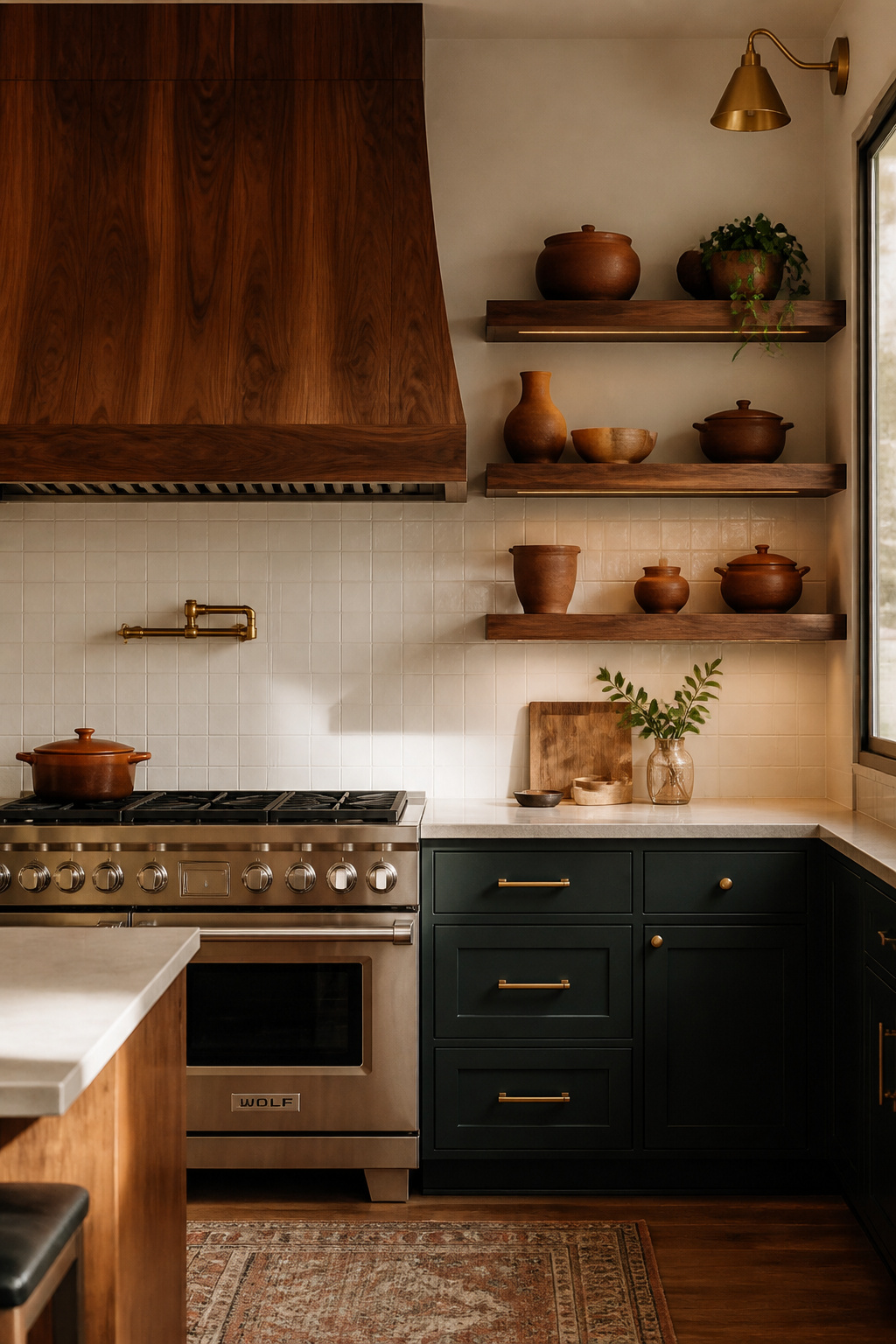
The most versatile placement for wood is open shelving: a run of solid walnut or white oak shelves above the primary prep counter catches light, displays beautiful objects, and introduces wood exactly where the eye is most drawn. White oak’s closed-grain structure gives it better moisture resistance than many species — important when shelves sit near a sink or above a cooktop. White oak rates 1,360 on the Janka hardness scale, harder than walnut at approximately 1,010, and its lighter warm-tan color accepts natural aging beautifully. For a kitchen with Latin American character, reclaimed pine or fir with visible grain, natural knots, and hand-planed surfaces communicates craftsmanship in a way new wood cannot.
A wood-clad range hood is the boldest single wood statement a kitchen can make. It dominates the cooking wall, anchors the entire design, and transforms the range into something genuinely considered. Pair it with handmade tile on the backsplash below and you have a cooking wall with real cultural depth. A wood-faced island achieves a quieter version of the same effect: while all the perimeter cabinet doors match in flat-panel profile, the island’s wood-veneered face breaks the pattern and says “this piece was chosen, not fitted.”
Maintenance reality: wood near the sink needs a penetrating oil finish (Danish oil or mineral oil) reapplied when it shows wear. Wood on cabinet door faces or island fronts requires a catalyzed lacquer for durability against cleaning products and steam. Penetrating oils are maintenance-friendly but not kitchen-proof; use them where the wood is on display, and lacquer where it takes daily punishment.
7. Statement Kitchen Islands That Anchor the Entire Space
An island isn’t furniture. It’s the functional and social center of the kitchen — the place where prep happens, where children do homework, where guests congregate with glasses of wine while you cook. Plan it generously and it becomes the most versatile element in the home.
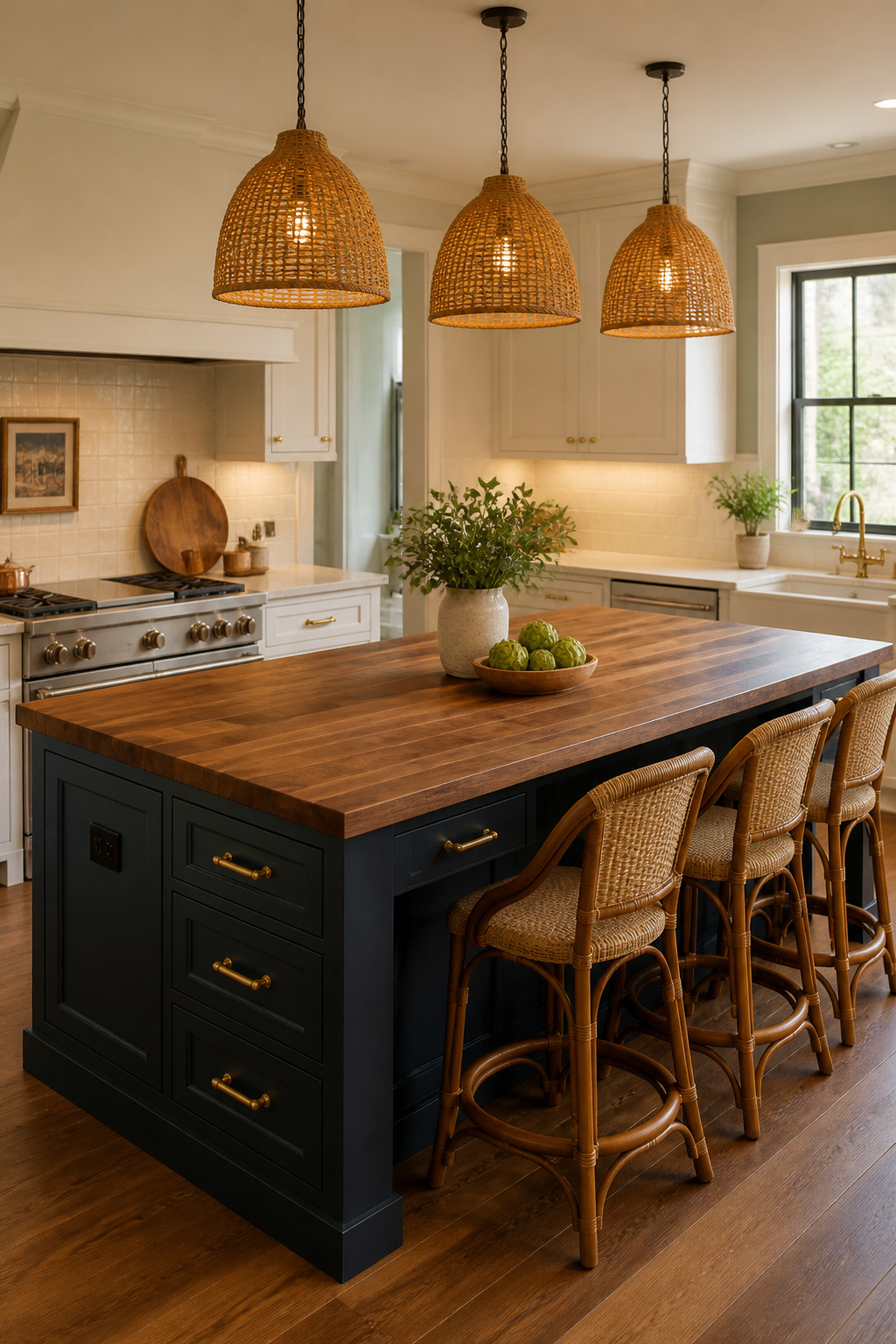
The clearance rules aren’t negotiable: 42–48 inches on all sides of the island. The absolute minimum is 36 inches, but two adults cannot pass each other comfortably in less than 42. A 6-foot by 3-foot island — the most common useful size — seats three comfortably and provides substantial prep surface. It requires a kitchen width of approximately 13 feet to maintain proper clearance on both sides. For seating: allow 24–28 inches of linear length per stool, with a countertop overhang of at least 12 inches for knee clearance. At standard counter height (36 inches), 24–26-inch stools are the right fit; at bar height (42 inches), use 28–30-inch stools. These dimensions matter enormously in daily use — an island where guests sit with their knees pressed against the cabinet face will be abandoned quickly.
Making Your Island Feel Like Furniture
The design principle that separates a beautiful island from a generic kitchen box is differentiation: a dark island against light perimeter cabinets, a wood-fronted island in a kitchen of painted flat-panel doors, furniture-style turned legs on an island where everything else has standard base-cabinet profiles. Any of these creates the “piece of furniture in a room” effect that makes kitchens feel designed rather than installed.
For a kitchen with Latin American artisanal character, handmade tile cladding on the island’s visible face — a small area of Talavera or encaustic cement — makes the island feel like a piece of inherited furniture in a way no paint color can replicate. It’s one of my favorite kitchen remodel ideas for transforming an otherwise ordinary island into the room’s true focal point.
8. Kitchen Remodel Ideas for Lighting That Sets the Mood
Most kitchen renovations install recessed downlights and call it done. The result is a kitchen that is well-lit in the way of a surgical theater — functional, flat, uniformly illuminated, and oddly unwelcoming after the sun goes down. Transforming a kitchen from functional to genuinely beautiful requires three layers of light working together.
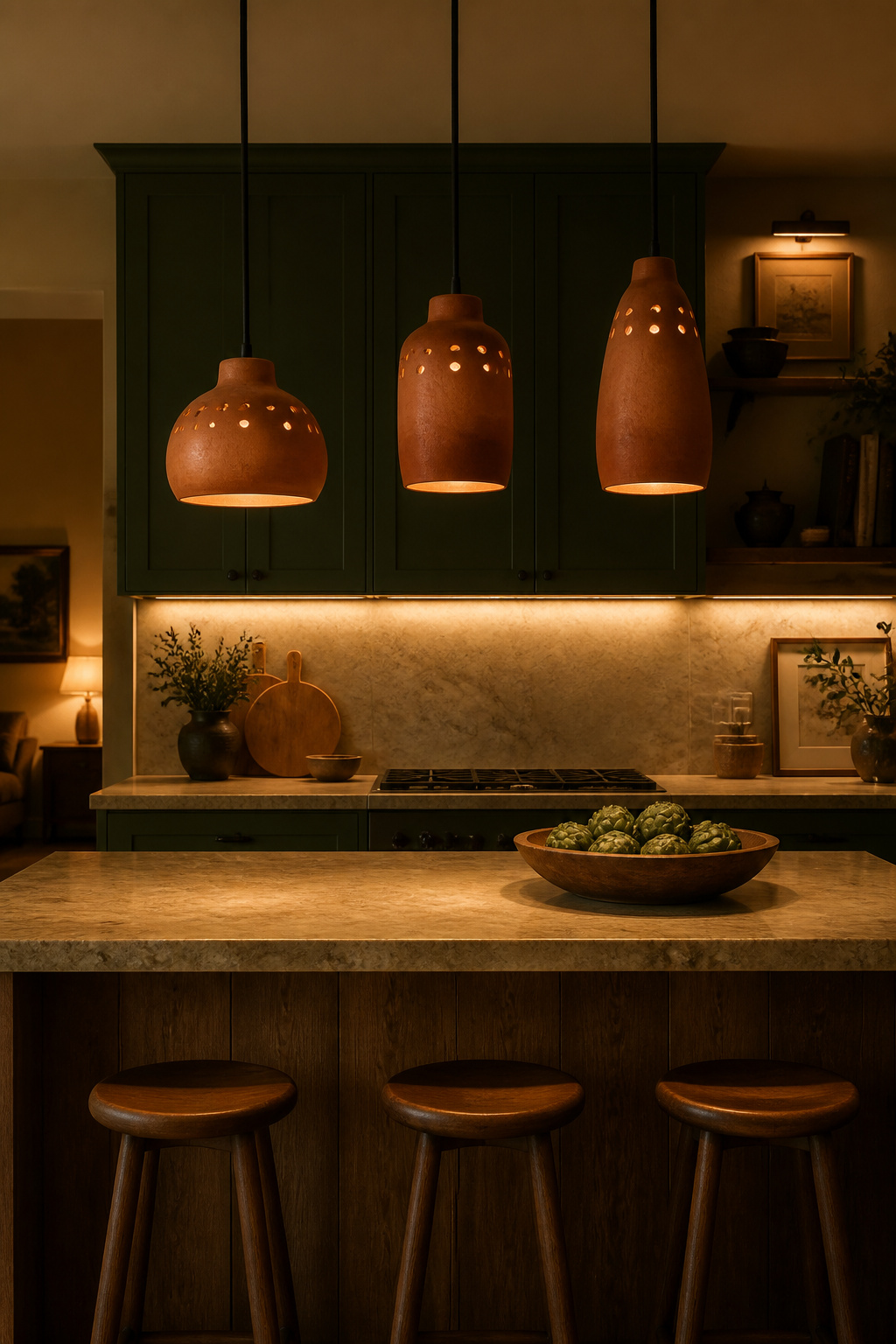
Layer one is ambient: the general illumination that fills the room from recessed downlights or a ceiling fixture, ideally on a dimmer. Layer two is task: focused light on work surfaces — under-cabinet LED strips over the counters, pendant lights over the island where the actual work happens. Layer three is accent: the light that creates atmosphere after cooking is done — inside glass-fronted cabinets, along the toe-kick at floor level, on the open shelves, in a rechargeable lamp positioned on the island for evening meals. Most kitchens have layer one. The few kitchens that feel genuinely extraordinary have all three, each on its own dimmer circuit.
Three separate dimmers — one for downlights, one for under-cabinet strips, one for accent — make the kitchen a genuinely different room at different times of day. Full brightness for prep, warm mid-levels for family meals, minimal task light and full accent for dinner parties. Lutron’s LED-compatible dimmers are the professional standard; generic smart dimmers often cause LED strip lights to flicker at low brightness, which defeats the purpose entirely. For under-cabinet strips, stay within the 2700–3000K color temperature range — this warm white range flatters food, skin tones, and most kitchen materials.
Pendants, Height, and the Detail That Finishes It
Pendant height over the island: 30–36 inches above the countertop surface. For an island under 5 feet, two pendants; for a 5–8-foot island, three. Scale: the pendants together should span approximately half to two-thirds the island width when viewed from the side.
For a kitchen with Sophia’s artisanal sensibility, hand-thrown ceramic pendants, rattan or wicker shades, or hand-forged iron fixtures extend the craft vocabulary from the backsplash and hardware into the lighting. The fixtures become part of the story rather than generic infrastructure. This is one of those kitchen remodel ideas that costs relatively little but changes the character of the whole room.
9. Copper and Brass Hardware as Artisanal Finishing Details
Hardware is where design-conscious renovators and home stagers reach first — because it’s the fastest, highest-return transformation per dollar in any kitchen. Replacing every pull and knob in a kitchen costs $300–800 in total. The visual and tactile return is disproportionate to that investment.
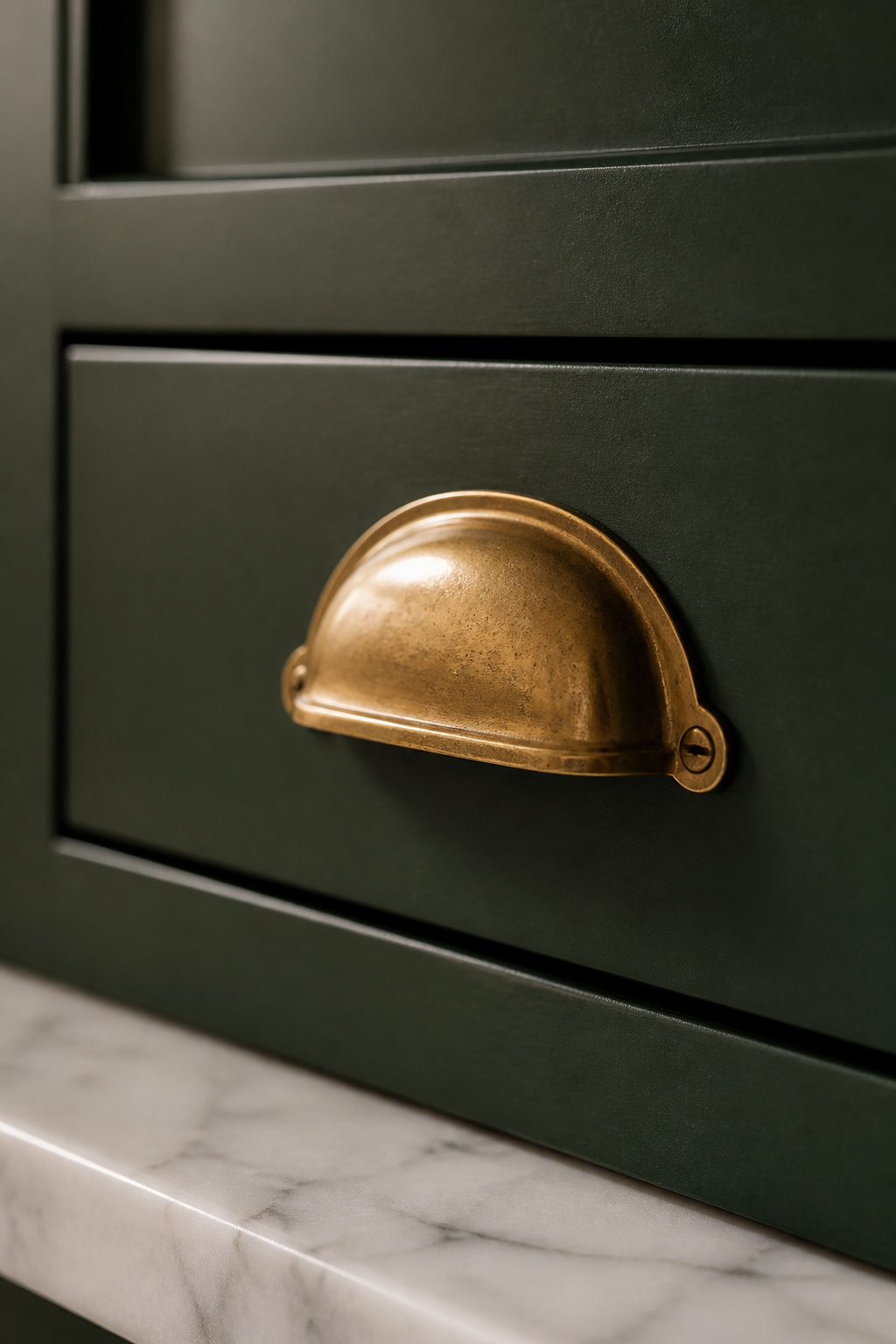
Unlacquered brass — sometimes called “living finish” — begins bright and polished and develops a natural patina through contact with skin oils, humidity, and the minerals in tap water. Over months and years, it acquires a warm, slightly uneven depth that looks genuinely antique and hand-made. This living quality is exactly what artisan-centered design values: the hardware tells the story of the hands that use it daily. You can embrace the patina as it develops, or polish it back periodically with Brasso or Bar Keeper’s Friend to maintain a brighter appearance — both are beautiful, and the choice is personal. For a thorough look at the full spectrum of hardware decisions that make a kitchen feel finished, kitchen cabinet hardware choices deserve the same careful attention as any other element in the renovation.
Mixing metal finishes requires one governing rule: establish a dominant metal and limit the total to three. If appliances are stainless steel, that’s your dominant cool metal — warm unlacquered brass for cabinet hardware and one pendant light fixture provides a perfect counterpoint. Separate metals by height zone (cabinet hardware and faucet in one metal, pendant lights in another) to prevent them from competing visually. Warm metals — brass, copper, gold, oil-rubbed bronze — mix naturally with each other; cool metals — polished chrome, brushed nickel, stainless — mix with each other. Mixing warm and cool works when one is unambiguously dominant.
For an artisanal Latin American kitchen: hand-forged brass pulls, hammered copper knobs, or hand-cast iron hardware don’t just solve a practical function — they communicate the same values as the handmade tile behind the stove and the handwoven textile on the banquette cushion. Every intentional craft detail reinforces every other one.
10. Color Palettes Inspired by Global Design Traditions
The cultures with the most vital culinary traditions have never been afraid of color in their kitchens. Mexican kitchens glow with fuchsia and cobalt blue and warm terracotta — the visual vocabulary of a culture that has always treated cooking as celebration. Moroccan kitchens bring turquoise zellige tile alongside deep terracotta and saffron. Portuguese azulejo tradition has produced one of the world’s most lasting kitchen combinations: deep cobalt blue pattern against crisp white. These palettes didn’t happen by accident, and they haven’t faded.
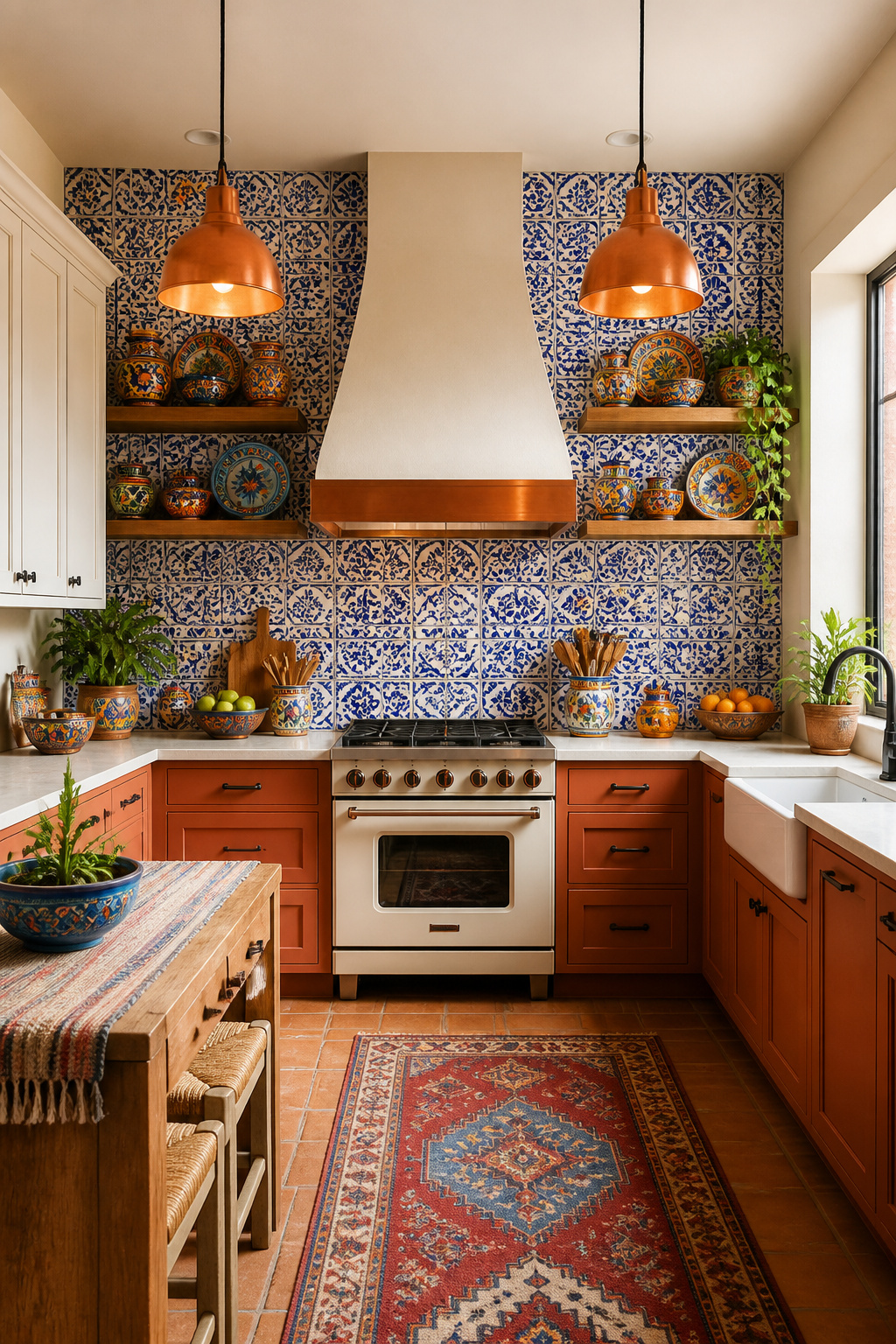
Building a palette from these traditions doesn’t mean recreating a specific cultural kitchen in a contemporary home. It means understanding the principles that make these palettes work: each has a strong dominant color, a complementary secondary, and a unifying neutral — clay floor, white plaster, natural wood — that allows the stronger colors to breathe. The 60-30-10 rule translates these proportions directly into kitchen remodeling ideas you can act on: 60% dominant color (cabinetry or walls), 30% secondary (countertop, island, backsplash), 10% accent (hardware, textiles, the color of produce and ceramics on your open shelves).
The palette fails most often when everything is bold simultaneously. Even the most colorful Mexican or Moroccan kitchen has its clay floors and white plaster walls — the natural neutral ground that makes the saturated colors sing rather than shout. In practical terms: deep terracotta lower cabinets work best against neutral countertops (natural limestone, warm quartz, or white stone), a simple or related-palette backsplash, and an airy upper zone. The restraint in the supporting elements is what gives the bold color its power. One hero element, supported rather than competed with, is always the better choice.
11. Kitchen Remodeling Ideas for Small Spaces That Feel Expansive
Small kitchens have an advantage that large ones don’t: every element is seen at once, which means a single well-executed decision creates total impact. One beautiful handmade backsplash tile makes the whole kitchen feel considered. One perfectly chosen pendant changes the entire atmosphere.
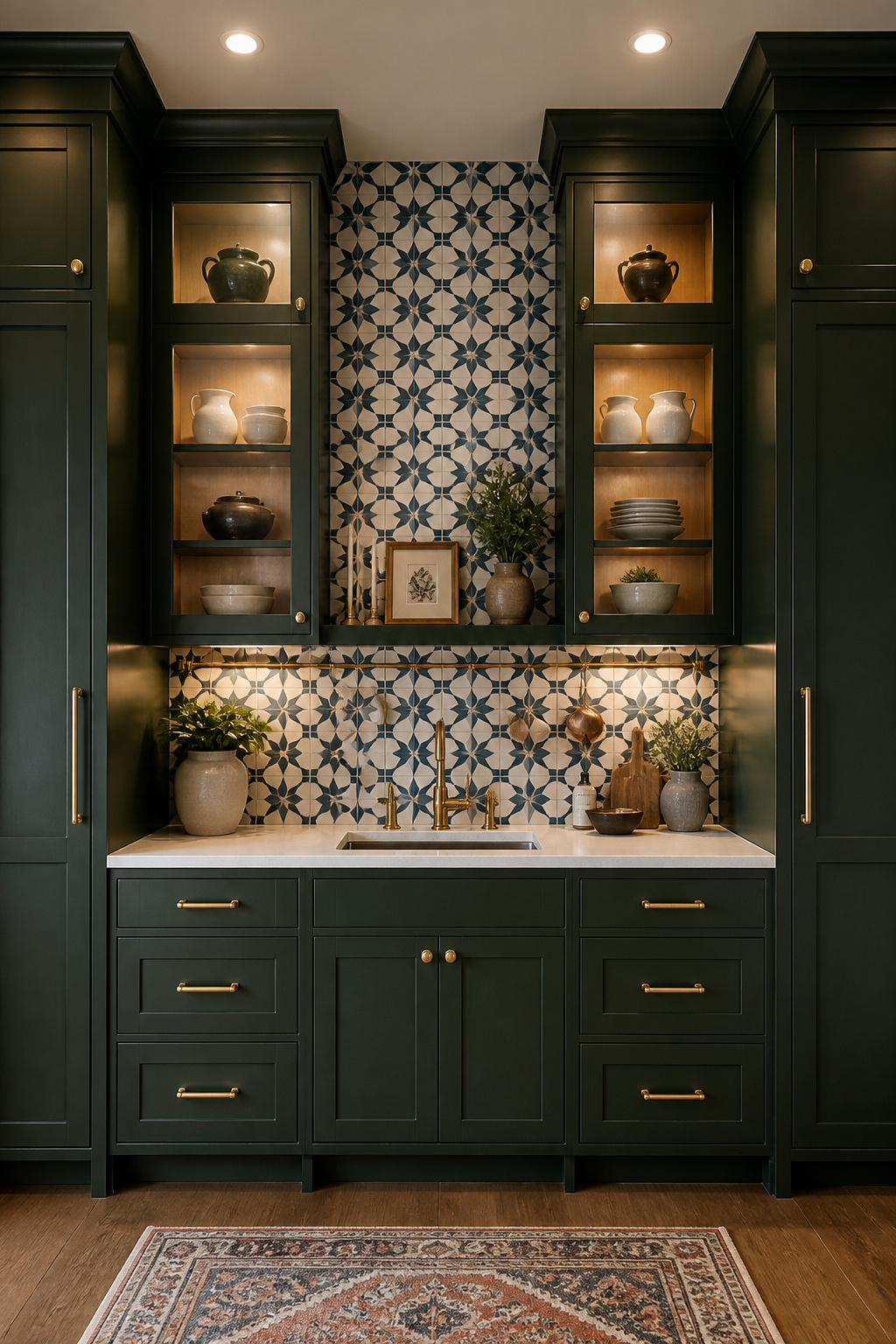
The most counterintuitive truth about small kitchen design: bold color makes a compact kitchen feel more intentional and actually more spacious than cautious neutral color. A small kitchen with deep forest green floor-to-ceiling cabinets reads as a designed room; the same kitchen with beige upper wall-mounts and white base cabinets reads as a kitchen apologizing for its size. Commitment to a strong design choice removes the anxiety from the space.
Floor-to-ceiling cabinetry is the small kitchen’s most practical structural upgrade — increasing storage capacity by up to 40% without consuming additional floor space, while drawing the eye upward to make walls feel taller. Glass-fronted upper cabinet doors extend the eye through the cabinet face, creating depth that solid fronts eliminate. Extending backsplash tile from countertop to ceiling (rather than stopping at the underside of upper cabinets) achieves the same vertical expansion on tiled walls.
One Bold Element Beats Three Modest Ones
For anyone facing the compact-kitchen challenge, the small kitchen remodel ideas that generate the most lasting impact share one principle: one bold, beautifully executed element is worth more than three modest improvements combined. A full-height run of handmade encaustic cement tile as the backsplash in a kitchen with otherwise simple flat-panel cabinetry creates more enduring impact than new cabinet doors plus new hardware plus a new light fixture installed simultaneously.
Also worth noting: using one pattern in a small kitchen, not two. A patterned backsplash against plain cabinetry works beautifully. A patterned backsplash against a patterned floor makes a small kitchen feel busy regardless of how beautiful each element is individually. Invest where the eye lands first, and let that element do the work.
12. Built-In Banquette Seating for a Warm, Communal Atmosphere
The kitchen banquette has returned with force in recent renovation cycles, and its comeback makes complete sense. Booth seating with its enclosed back and sight line to the room activates a psychological comfort — the same quality that makes café corners the seats people choose first. Built into a kitchen corner, a banquette transforms the functional eating area into the genuine heart of the home: the place where people actually linger.
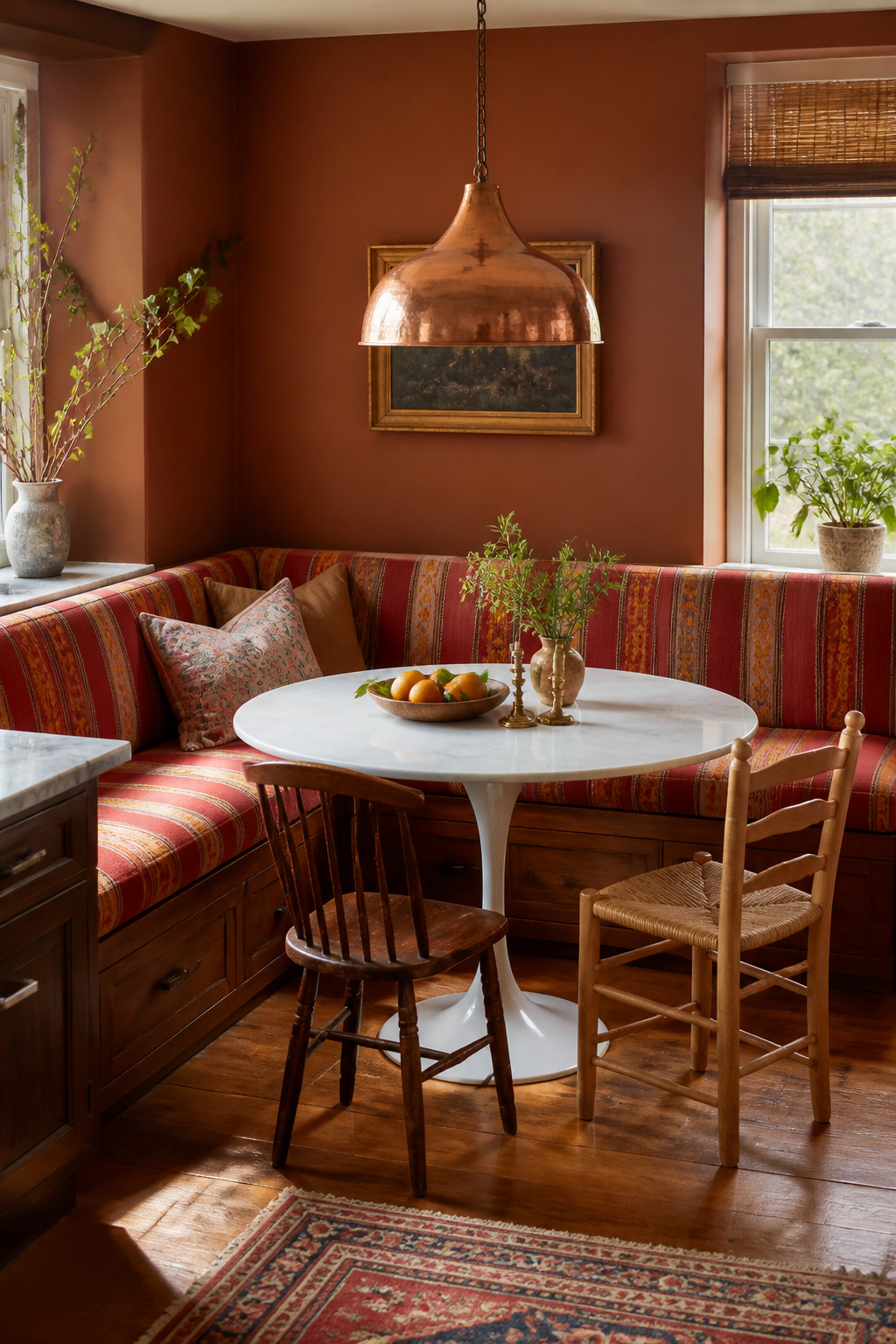
The dimensions are less flexible than people assume. Seat height: 18 inches (build the structure to 16 inches and allow a 2-inch cushion). Seat depth: 18–24 inches. Back angle: 7–9 degrees from vertical — without this slight lean, the backrest becomes a back problem. Width per person: 24–28 inches. Deviate significantly from these numbers and you’ll have a beautiful-looking nook that nobody wants to sit in for longer than ten minutes.
Build the bench with lift-up storage underneath — this bonus storage is essentially free in a kitchen where every cubic inch matters. Benches can house seasonal serving pieces, extra small appliances, table linens, anything that doesn’t need daily access. Invest in 4-inch, 2.2-lb/ft³ density foam for the cushions; lighter foam compresses quickly and looks worn within a year regardless of how beautiful the upholstery. For fabric: outdoor-grade materials in a Latin American-inspired stripe — the kind woven by artisans in Mexico and Guatemala for generations — bring the same cultural richness to the seating that handmade tile brings to the backsplash.
Pair the banquette with a round or oval pedestal table rather than a rectangular one. Round tables allow more people in the same footprint, a pedestal base maximizes knee room in a tight nook, and the curve softens the angular geometry of a typical kitchen. Standard dining height (30 inches) with an 18-inch seat height provides the 12-inch gap for comfortable knee clearance.
13. Patterned Floor Tiles That Add Character to Every Step
The kitchen floor is the most under-designed surface in most renovations. Homeowners invest enormous energy in cabinet colors and countertop materials, then install 12-inch grey porcelain because it seems safe. The floor is the largest single surface in the kitchen, and it sets the entire emotional character of the room from the moment someone steps through the door.
Encaustic cement tiles, Victorian geometric patterns, and Moroccan-inspired designs all originate in artisanal traditions that have proven their beauty across centuries and cultures. “Encaustic” means the pigment is embedded into the cement during manufacture rather than applied as a surface glaze — the color penetrates the full tile depth and cannot chip or fade with decades of use. Naturally pigmented in deep blues, verdant greens, rich terracottas, and crisp whites, these tiles are the floor equivalent of a handmade backsplash: visually irreplaceable. Victorian geometric tiles — black-and-white hexagons, diamond tessellations, checkerboard in 2-inch squares — may be the most timeless patterned floor option available, equally at home in a contemporary kitchen and a period property.
The design principle that makes patterned floors work: the floor is bold, so everything above it is calm. Natural wood cabinetry tones down the visual energy of a Moroccan-inspired geometric floor more effectively than painted cabinets. Neutral countertops — white quartz, natural limestone — provide the breathing room the pattern requires. Matte black fixtures add a grounding modern edge without competing for attention.
One non-negotiable: seal encaustic cement tiles before grouting AND again after installation. Unsealed cement immediately absorbs grout haze and becomes permanently stained. This is preventable, costs almost nothing relative to the tile investment, and is the most common expensive mistake made with these materials. These are kitchen renovation ideas where the installation detail matters as much as the design decision.
14. Open-Plan Kitchen Concepts That Connect Living Spaces
The fully open kitchen — one continuous volume from cooktop to living room sofa — has defined residential design for twenty years. For 2026, designers are reconsidering: the “broken-plan” concept is gaining genuine traction, where function-specific zoning within a largely open space gives different areas their own identity without requiring physical enclosure.
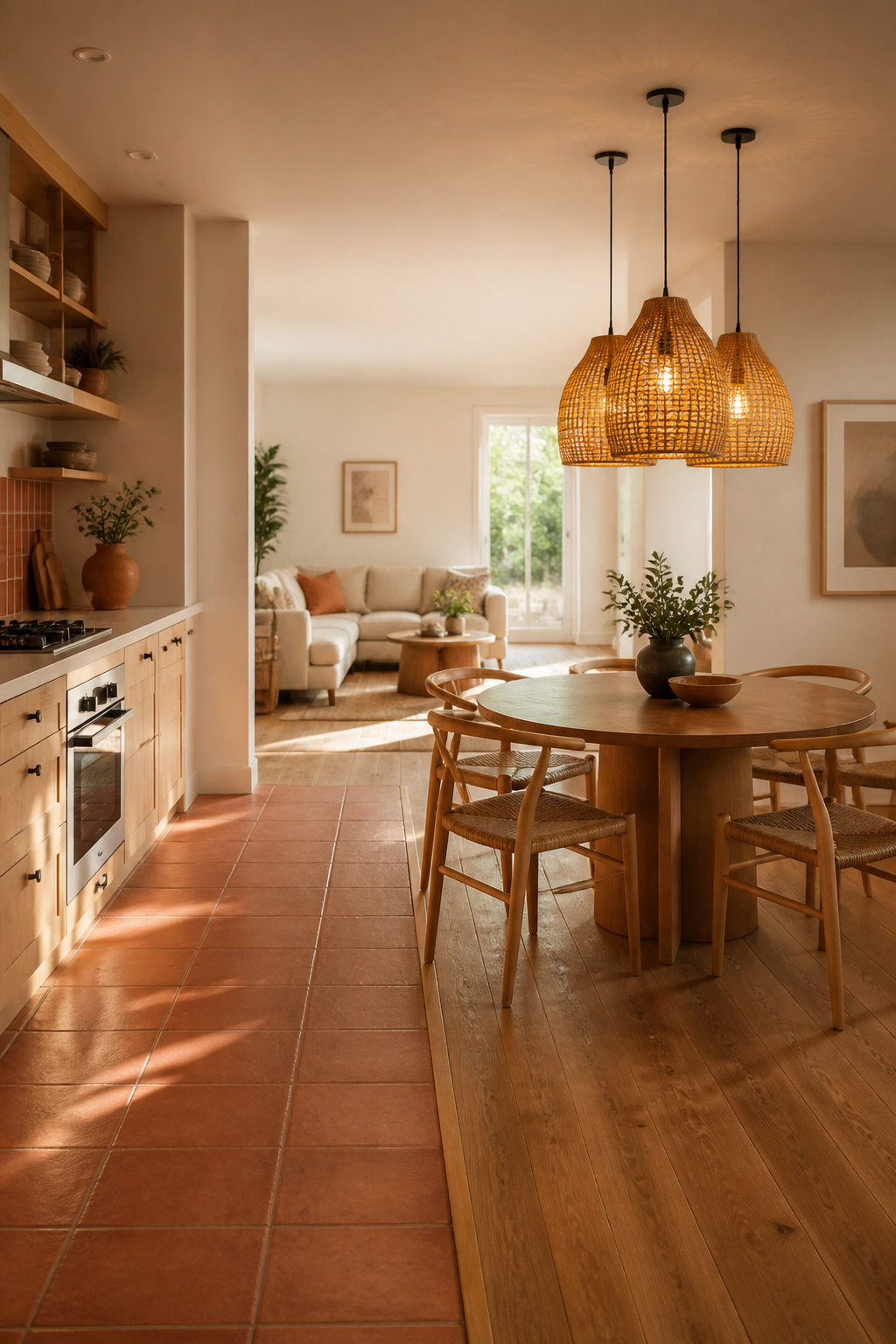
The simplest zone-delineation tools require no construction at all. Flooring transitions — switching from large-format kitchen tile to hardwood as the space moves toward dining, or changing tile format and finish as it shifts to living — create unmistakable zone boundaries that guide movement without walls. A pendant light cluster over the dining table creates a “ceiling zone” that defines the dining area even in a completely open floor plan; the light zone functions as effectively as a physical partition in telling occupants they’ve moved between areas. An area rug under the dining table is the fastest and most reversible zone-delineation decision available — it creates a room-within-a-room effect in an afternoon.
Why the Scullery Is Back
The scullery (back kitchen) is the 2026 design concept gaining most traction in response to open-plan fatigue: a secondary compact utility space attached to the kitchen that absorbs the functional reality of cooking — messy counters, appliance storage, drying racks, cleaning products — while leaving the main kitchen pristine for the social experience. Minimum useful scullery: 6×8 feet with a second sink. Even a “scullery wall” — a tall run of floor-to-ceiling cabinetry that hides the kitchen’s utility functions behind closed doors — achieves a version of the same principle without additional square footage.
In Latin American kitchen tradition, this mirrors the “cocina exterior” concept: the secondary working space that handles the hot, messy reality of cooking, preserving the main gathering kitchen for beauty and community. As kitchen remodel ideas go, it’s one where cultural tradition and contemporary function arrive at exactly the same answer.
15. Kitchen Makeover Ideas: Transformative Touches Under Budget
Minor kitchen remodels return approximately 113% nationally in 2026 — the strongest return on investment in all home improvement categories. Thoughtful, targeted improvements consistently recoup more than they cost. This is the argument for doing the smaller things beautifully before committing to a full structural renovation.
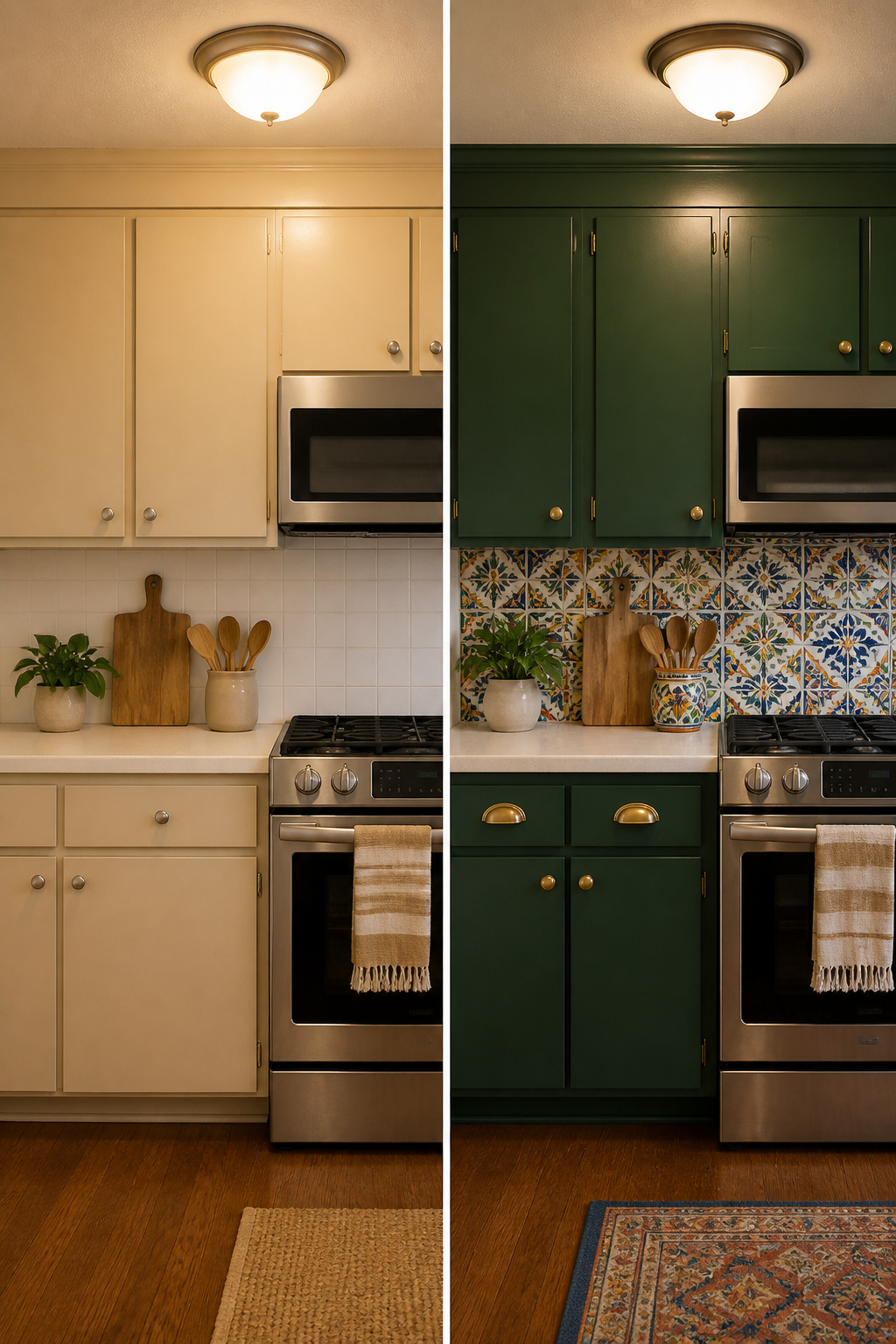
The budget transformation hierarchy, ranked by visual impact per dollar spent: new hardware ($300–800 for the whole kitchen — always start here) → cabinet painting ($1,500–3,000 professionally, $500 DIY with proper primer and cabinet-specific paint) → lighting updates (new pendants plus under-cabinet LEDs, $500–2,500) → new backsplash tile → cabinet refacing. Hardware first, always — it’s the immediate test of whether your kitchen’s bones can carry a design upgrade, and the result is visible the moment the last screw tightens.
Cabinet refacing — keeping the existing cabinet boxes and replacing all doors, drawer fronts, and veneer — costs 40–50% less than full replacement ($4,000–9,500 average versus $15,000–35,000 for a complete kitchen). ROI at resale: 70–80% of the refacing cost, making it one of the strongest financial investments in kitchen renovation when the cabinet layout and structure are sound. If you’re refreshing the kitchen and want fresh direction on surface colors that work across cabinet tones, kitchen paint ideas that coordinate with common cabinet finishes are worth exploring before you settle on a palette.
My approach for kitchen renovation ideas on a tight budget: spend on backsplash tile and lighting, save on appliance brands and cabinet interiors. A handmade backsplash occupies 15–25 square feet — the place where a modest investment produces the greatest artisanal impact in the whole kitchen. The most memorable budget kitchen I’ve ever encountered had IKEA base cabinets, laminate countertops, and a full backsplash of authentic Talavera tile purchased directly from a Puebla artisan cooperative. The Talavera made the whole kitchen. No one looked at the laminate.
16. Sustainable Materials That Honor Craft and Environmental Values
The most honest measure of sustainability in kitchen renovation is longevity. The most sustainable kitchen is one that lasts 25–30 years without replacement — because the environmental cost of manufacturing, shipping, and installing a kitchen is substantial, and repeating it every decade cancels any material-choice gains. Choosing well-made, repairable materials is always the more sustainable path, and it produces the most beautiful kitchens.
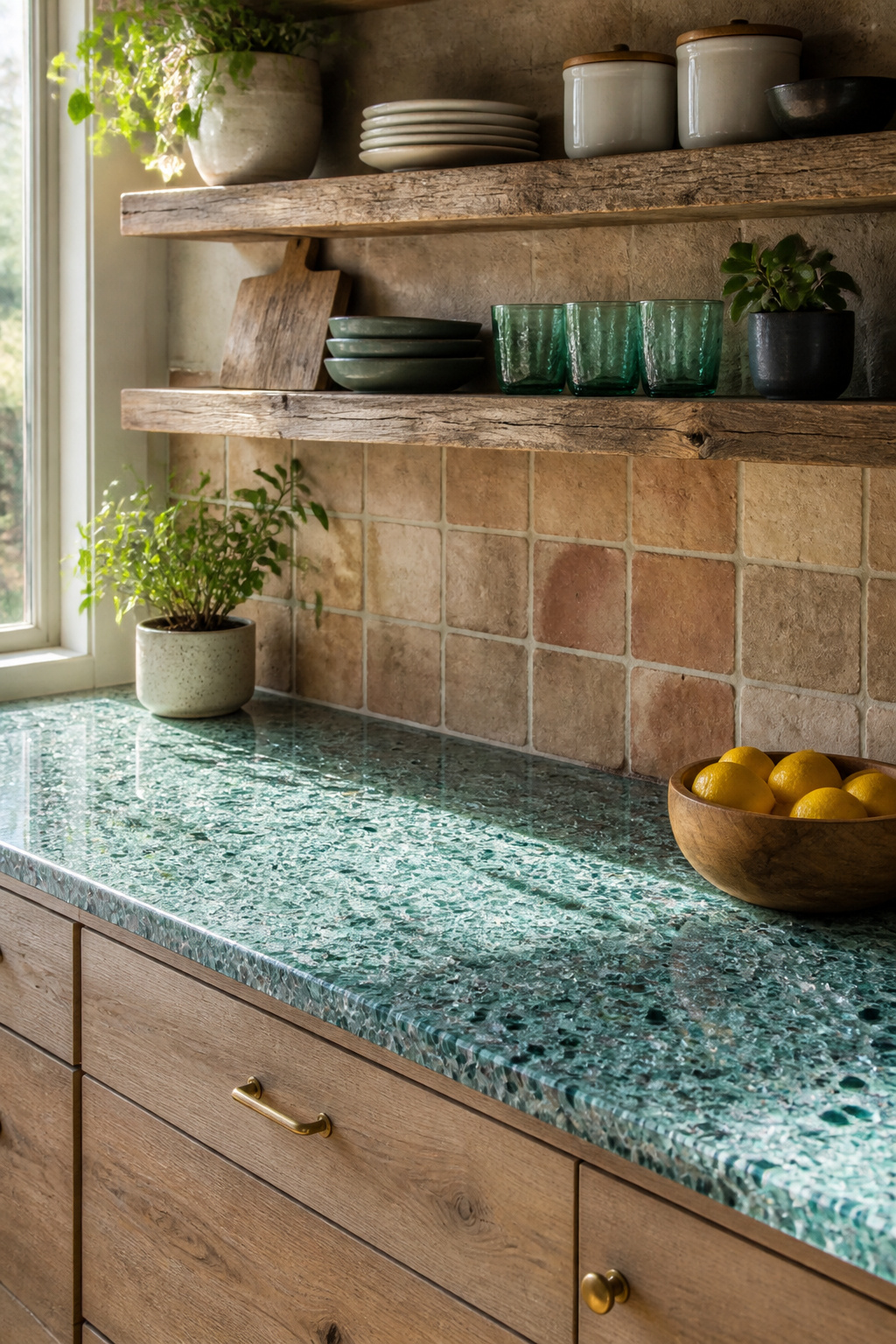
Recycled glass countertops — Vetrazzo is the most established brand — use approximately 85% recycled glass (wine bottles, traffic lights, demolished buildings) bound in cement. Each slab is visually unique, with a depth and light quality no natural stone can match. At approximately $50 per square foot, they’re comparable to mid-range quartz in cost while communicating environmental values through every visible inch. Reclaimed wood countertops and shelving ($30–150/sq ft installed) give new life to timber carrying the grain, character, and density of old-growth material unavailable in any new lumber.
Low-VOC finishes are non-negotiable in a cooking environment: standard oil-based cabinet paints off-gas for months after application, and the kitchen is where your family prepares food daily. AFM Safecoat, Bioshield, and ECOS Paints provide comparable durability with dramatically lower VOC content — a meaningful choice for air quality.
For artisanal sourcing specifically: tiles from Mexican artisan cooperatives, handwoven textiles from Guatemalan weavers, hand-thrown ceramics from regional studios — these choices connect kitchen renovation directly to the same values that make handcrafted objects beautiful. The provenance of these materials is part of their beauty, and the ethical supply chain is part of their sustainability. When you buy a tile from an artisan whose family has made the same pattern for four generations, you’re not purchasing a product. You’re participating in a living tradition.
How to Plan Your Kitchen Remodel Ideas Into Reality
The decisions that feel smallest — the sequence in which you make them — often determine the success or failure of a kitchen renovation more than the choices themselves. The correct order: layout and structural decisions first (anything affecting plumbing, electrical, and load-bearing structure), cabinetry second, countertop third, backsplash fourth, hardware and lighting last as the finishing layer. Most renovation regret comes from selecting surfaces before confirming cabinetry — when the cabinet color changes (and it often does), the confirmed tile may no longer work.
Build a physical mood board before any contractor conversations. Pin actual material samples — tile samples, paint chips at minimum A5 size, a piece of the countertop from the actual slab, a hardware sample — on one board and photograph it in your kitchen’s light at different times of day. No digital rendering can substitute for real materials in your real space. This board governs every supplier and contractor conversation.
Also: plan your decision sequence alongside your renovation budget. Minor kitchen remodel ideas — hardware, paint, lighting, backsplash tile — deliver the strongest per-dollar return and are best executed first. Full structural work (moving plumbing, removing walls, new cabinetry) delivers transformation but takes longer to recoup. Start with the high-return improvements, live with them for a year, and let them inform the larger decisions when the time comes.
One final principle from working with Latin American artisanal traditions: the most beautiful kitchens accumulate beauty over time, not in a single renovation. A Talavera-tiled kitchen in Oaxaca wasn’t designed by one person in six weeks — it gathered beauty through generations of choices made with care and conviction. Your kitchen remodel ideas don’t all need to happen simultaneously. Start with the elements that bring you the most joy, execute them beautifully, and let the room accumulate its character at the pace your life and budget allow. The result will be a space worth coming home to — genuinely, deeply, lastingly worth it.