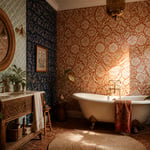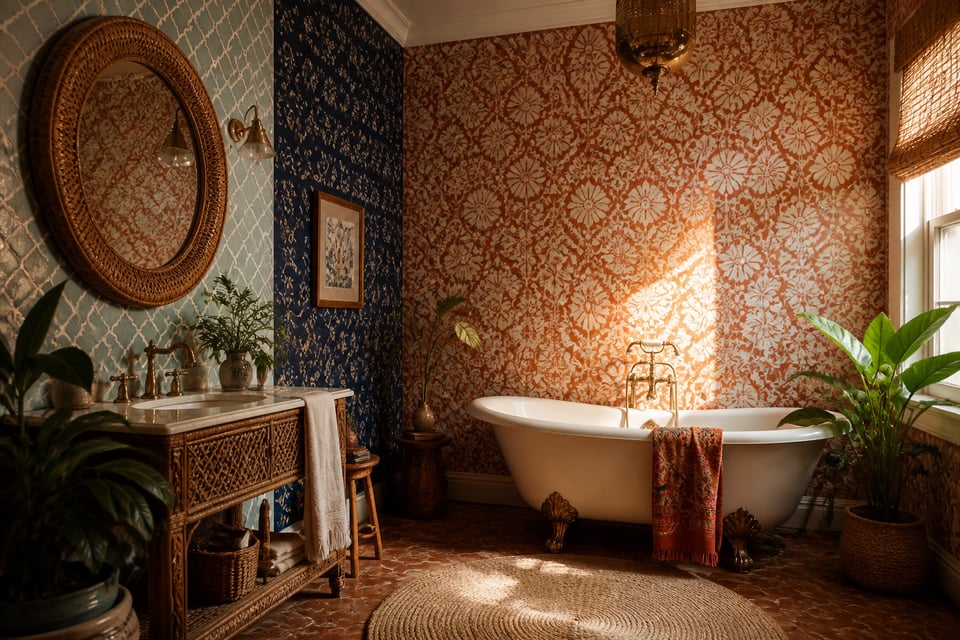
The bathroom is the smallest room in most homes, and somehow the one we forget to make beautiful. That’s exactly why bathroom wallpaper bohemian in style is such a satisfying place to start. A few square feet of pattern can transport you to Jaipur, Marrakech, or Java without touching a single load-bearing wall. I’ve spent years tracing the textile traditions behind the patterns we now hang on drywall: block printing in Rajasthan, indigo dyeing in Java, kilim weaving in Anatolia. What strikes me every time is how much story lives in a single roll of paper. These aren’t just pretty repeats. They’re centuries of craft, migration, and meaning compressed into something you can install in an afternoon.
That’s the lens I want to bring to this list. Below, you’ll find sixteen distinct directions for bohemian bathroom wallpaper, from a sun-soaked Moroccan trellis to a moody indigo batik. Each one is rooted in the actual textile or printmaking tradition it borrows from. Each also comes with the practical specifics — materials, scale, moisture ratings — you need to make it work in a small, humid space. Whether you’re working with a cramped powder room or a full bath with a clawfoot tub, there’s a bohemian wallpaper pattern here that fits.
1. Moroccan Trellis: A Bathroom Wallpaper Bohemian Style Built on Protection Symbolism
The trellis motif didn’t start as wallpaper. It started as protection. The interlocking diamond lattice traces to 16th-century Persian rugs. Moroccan Berber tribes later wove it into wool as a symbol against evil spirits. Its quatrefoil variations echo the arches and domes of Moorish architecture, so the print reads as intentional rather than as decorative filler.
Scaling the Pattern to Your Bathroom
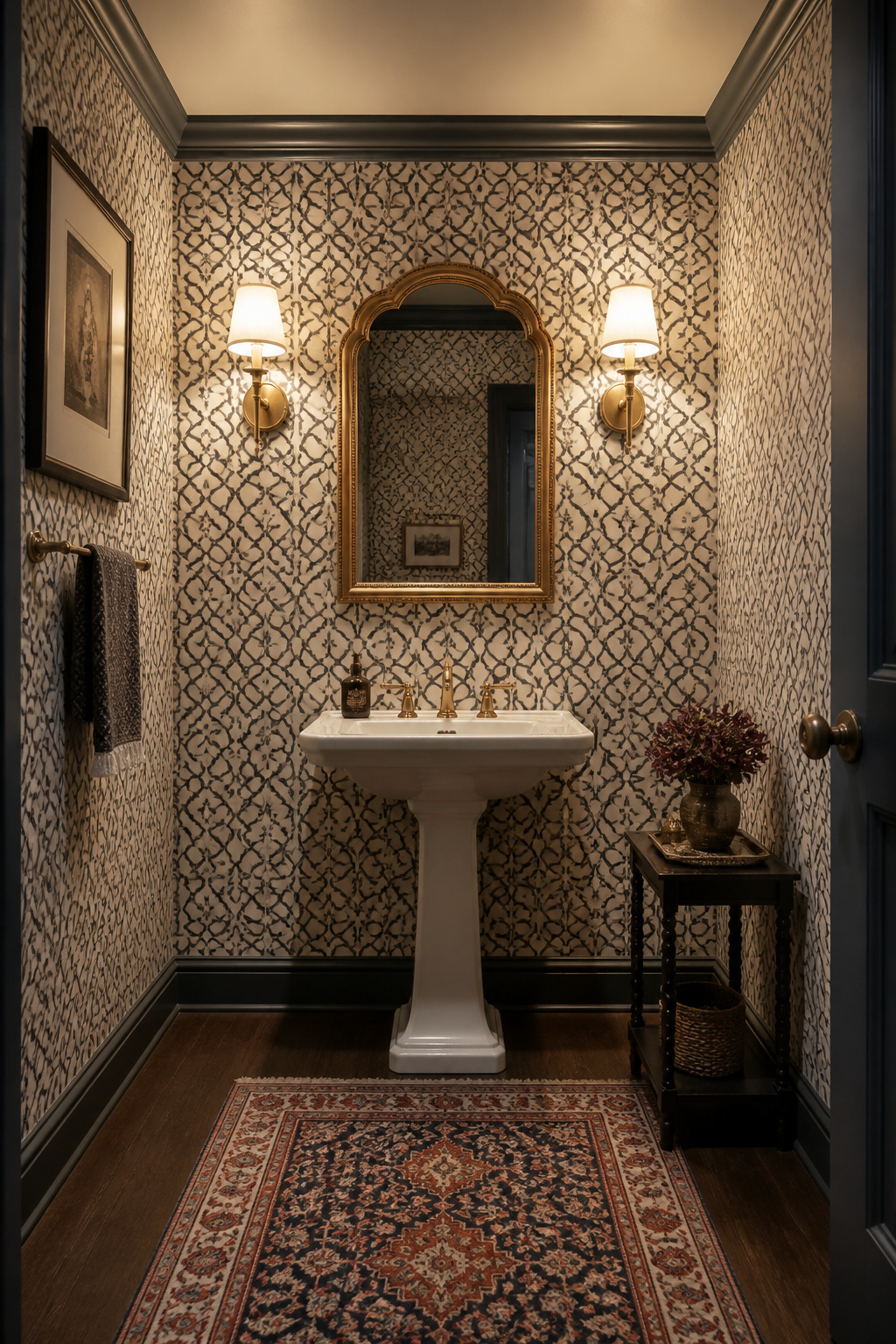
Scale is the real decision point here. Medium-to-large trellis repeats outperform tight, busy ones in small bathrooms. Wide-reaching shapes invite the eye to travel instead of registering every seam in the room. A windowless powder room handles a high-contrast version well: charcoal-on-white or terracotta-on-cream reads crisp under artificial light. A full bath with natural light, on the other hand, can carry a softer, tonal trellis instead.
Pairing Fixtures and Choosing Materials
For warmth, pairing brass fixtures with bold pattern keeps a cool-toned trellis in navy or charcoal from feeling sterile. Bathroom-rated vinyl or non-woven trellis wallpaper runs roughly $25 to $70 per roll. It’s worth budgeting for Type II commercial-grade vinyl if your bathroom doesn’t have strong ventilation. One mistake worth flagging: choosing a trellis with too much white space. In a steamy bathroom, denser patterns camouflage water spots and minor seam imperfections far better than sparse ones do. That’s something you only learn the hard way if nobody tells you first. As bohemian bathroom wallpaper choices go, this one is among the most forgiving for a beginner.
2. Botanical Jungle Print Wallpaper Behind a Clawfoot Tub
There’s a reason jungle prints feel so at home in a bathroom. The room is already a retreat, and an oversized leaf scale amplifies that escapist quality instead of fighting it. Large botanical motifs pull the eye outward. Small, repeated florals, by contrast, tend to make a compact bathroom feel more cluttered, not less.
Coverage Decisions That Change the Mood
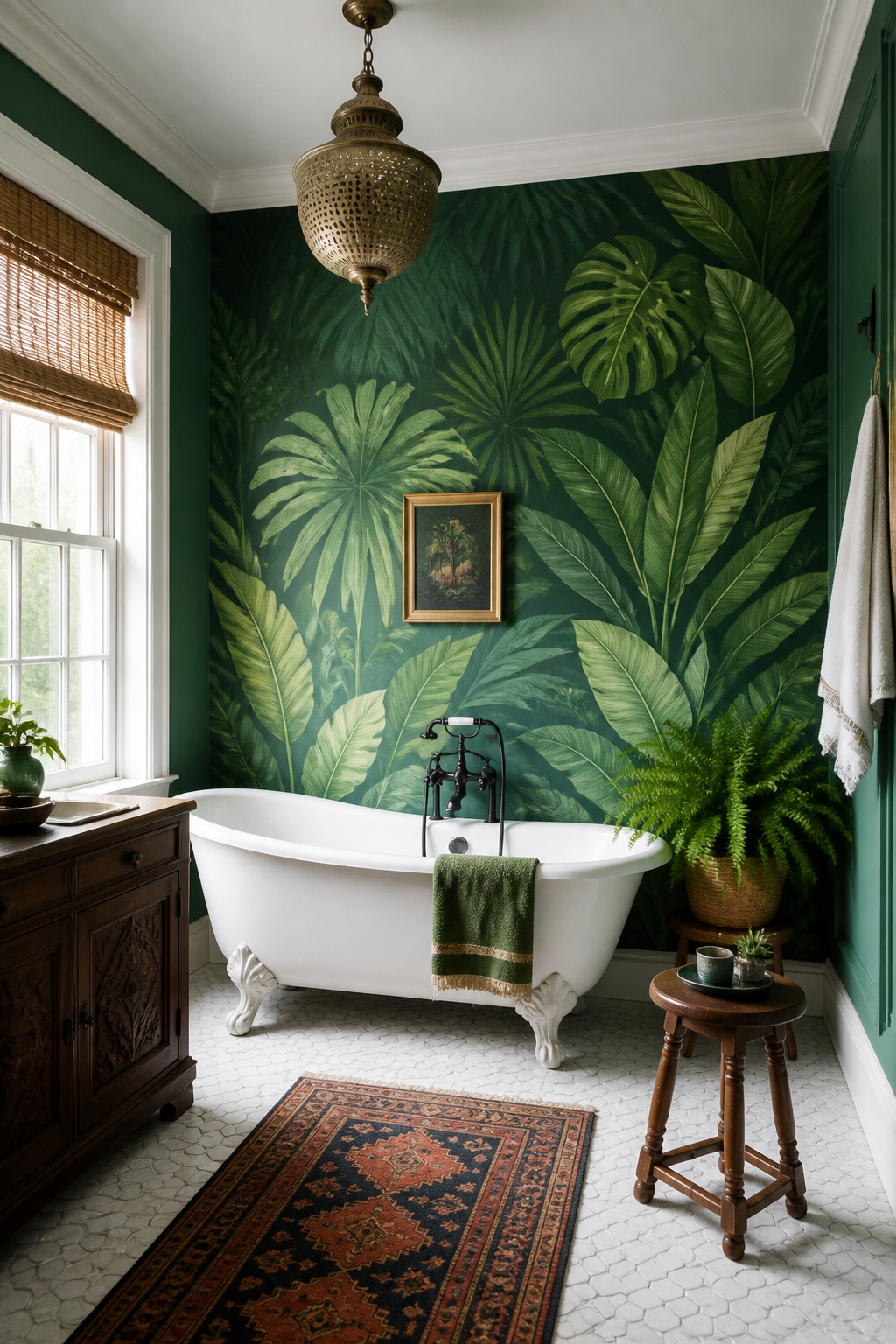
Coverage is what separates “decorated” from “transported.” A partial accent strip reads as a nice design choice. Full-wall coverage behind a clawfoot tub creates the sensation of actually stepping into foliage. Deep emerald or black-background jungle prints work best as a single dramatic accent wall paired with brass or matte black fixtures. Softer sage palettes, on the other hand, are forgiving enough for full-room coverage since the lower contrast doesn’t overwhelm at scale. Either way, limit floor-to-ceiling coverage to one wall so the room doesn’t tip into visual overload.
Material Choices for the Highest-Splash Zone
Material matters more here than almost anywhere else on this list, since the tub is the highest-splash zone in the room. Commercial-grade Type II vinyl is rated for steam, scrubbable, and mildew-resistant. Ask for it by name. Leave a half-inch gap where the paper meets the tub edge or floor. Moisture pools there, and unsealed edges are where peeling always starts first. This jungle wall is a strong anchor for anyone building toward a fuller spa-like bathroom retreat around this kind of immersive greenery.
3. Mudcloth-Inspired Print: An Earthy Boho Bathroom Wallpaper Statement
Bogolanfini, what most of us shorthand to “mudcloth,” comes from Bambara words meaning “mud, by means of, cloth.” The Bamana, Dogon, and Malinke peoples of Mali have painted cotton with iron-rich mud pigment for centuries, creating bold black-on-cream symbols. Those symbols traditionally marked rites of passage: fertility, protection, status. Malian designer Chris Seydou brought bogolan-inspired fashion to Paris in 1979. That moment is the bridge point. It’s where the pattern entered the global design vocabulary we draw from today.
Letting the Print Carry the Room
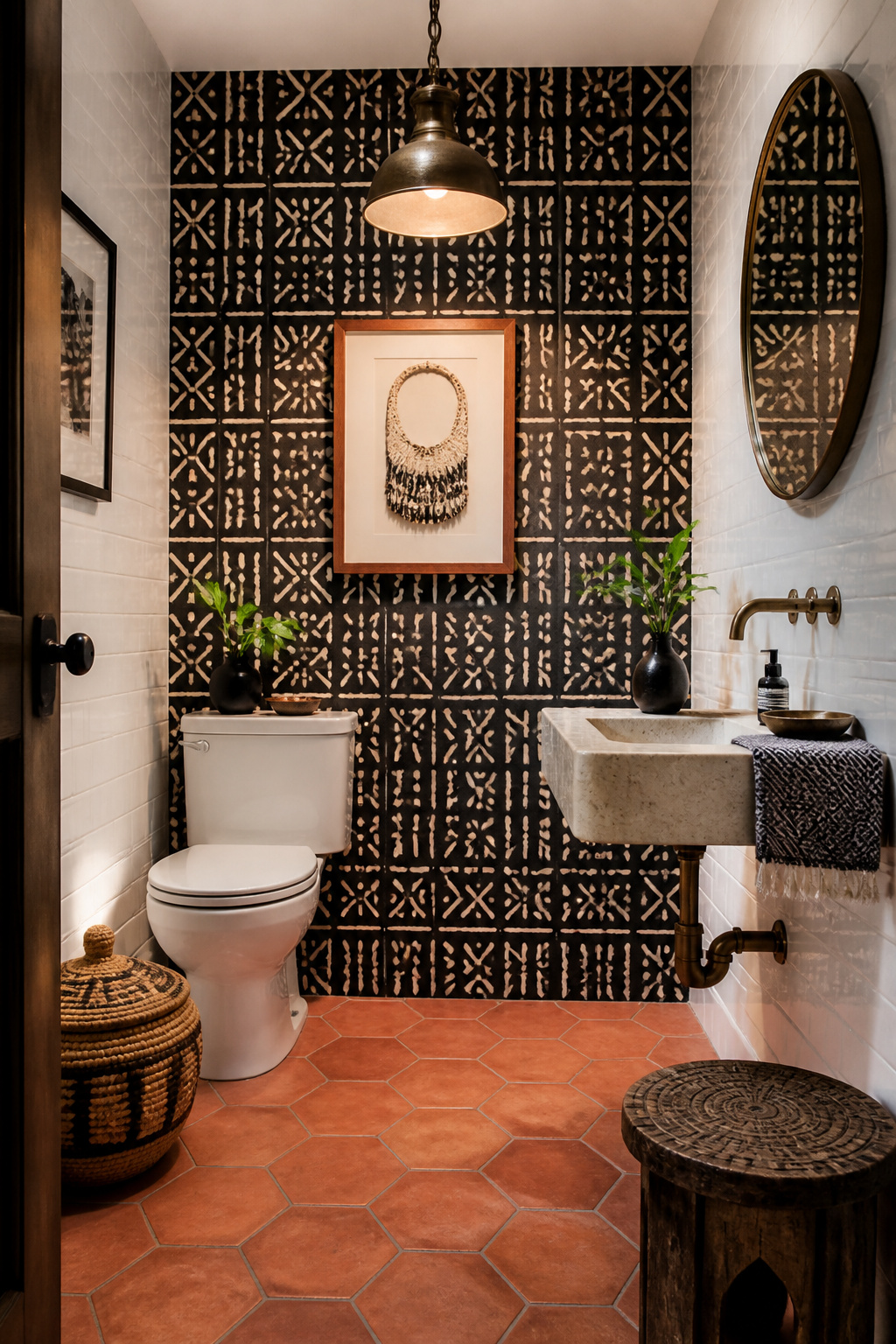
Because authentic mudcloth is graphic and high-contrast, it does best against the plainest possible backdrop. White subway tile or unglazed terracotta lets the wallpaper carry all the visual weight. Chrome and matte black fixtures both work. Brass, though, can compete with the rustier mudcloth colorways, so test a swatch against your hardware finish before committing. Wallpaper houses like Milton & King and St. Frank produce bogolan-inspired collections — St. Frank’s “Adobe Box” line, for one — specifically designed to read as authentic rather than as generic “tribal” pastiche.
Why a Half-Bath Is the Lowest-Risk Starting Point
A half-bath is the lowest-risk place to go bold with this pattern, since its small footprint means full coverage costs far less in rolls. If you’re already thinking about keeping a half-bath design simple and high-impact, mudcloth is built for exactly that brief. One striking wall, a single pendant light, nothing competing for attention. As boho bathroom wallpaper goes, this is one of the few prints confident enough to stand entirely alone. The one real misstep is mislabeling the print as generic “tribal” rather than crediting its specific Malian origin.
4. Sun and Moon Celestial Wallpaper for a Mystic Powder Room
Suns, crescent moons, constellations: celestial wallpaper taps directly into the spiritual, ritual-minded strand that runs through bohemian style. It’s having a real moment in meditation rooms, bedroom sanctuaries, and now powder rooms. Deep, moody backgrounds — near-black, deep indigo — intensify the contrast of gold detailing in a way daytime florals simply can’t match.
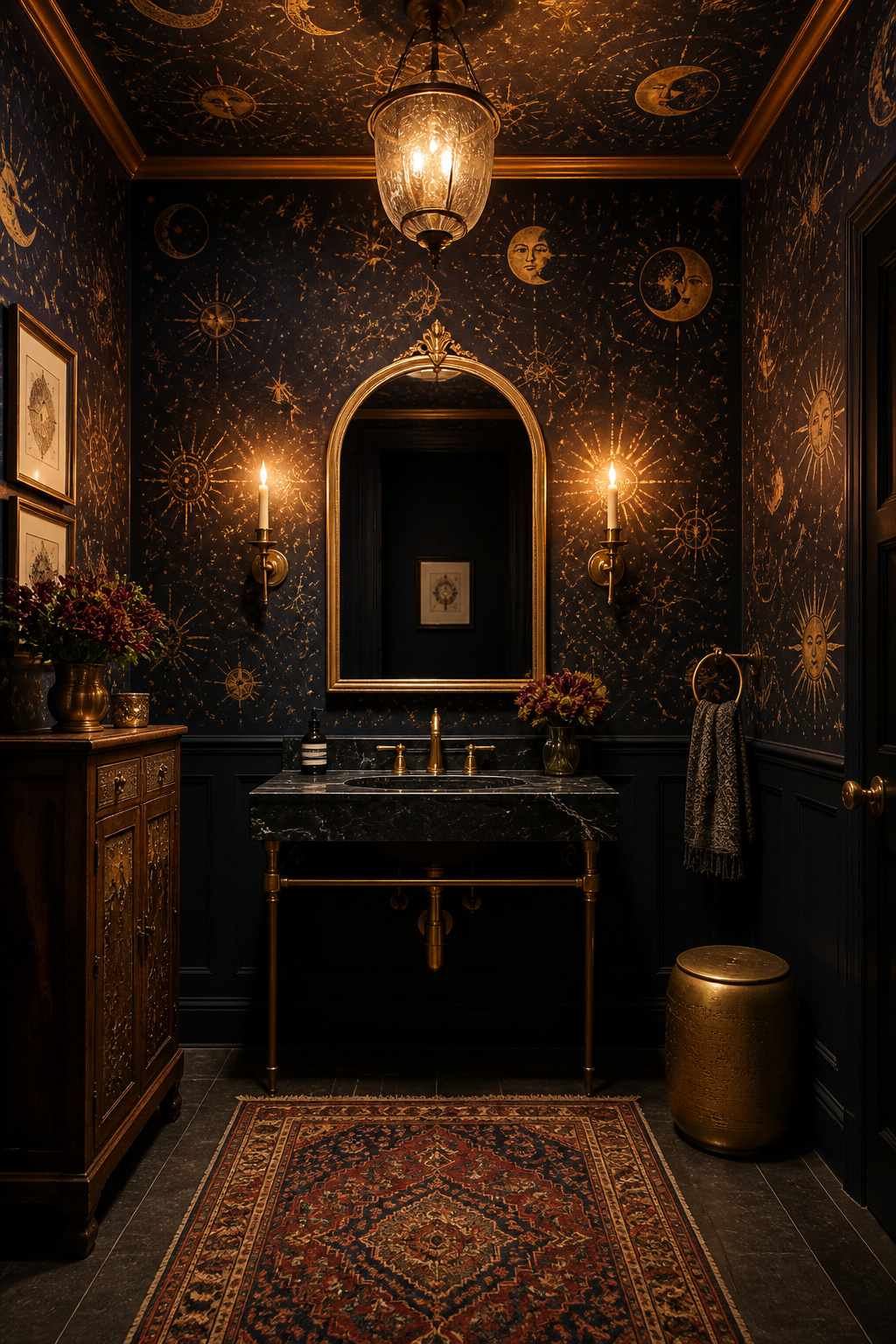
What “Metallic” Really Means on the Label
Here’s a detail worth knowing before you buy: most “metallic” celestial wallpaper uses imitation gold or silver ink effects rather than true metal leaf. True metal leaf is reserved for specific premium product lines. What you can count on is how the ink behaves under different light. Candlelight and warm-temperature bulbs amplify the imitation gold’s shimmer far more than cool LED lighting, which tends to flatten the effect. Unlacquered or antique brass fixtures echo that gold tone directly. That creates one cohesive metal story instead of two competing finishes.
Matching the Palette to How You’ll Use the Room
Muted, vintage-toned celestial prints — dusty rose, faded gold on cream — suit a full bath that sees daily natural light without tipping into theatrical. High-contrast black-and-gold versions are better reserved for a powder room used mostly in the evening, where the drama reads as deliberate. For the full effect, layering candlelight and brass for ambiance once the wallpaper is up does as much work as the print itself.
5. Block-Print Floral Wallpaper: Bathroom Wallpaper Bohemian Style from Rajasthan
Two distinct Rajasthani hand block-printing traditions sit behind this look, and they’re not interchangeable. Sanganeri and Bagru both descend from Gujarati Chippa artisans who migrated roughly 450 to 500 years ago, fleeing Mughal-Maratha conflict. They settled in what’s now Jaipur and the town of Bagru respectively. Sanganeri printing produces delicate, nature-based florals on light grounds with fine-line detailing. It’s precise enough that it earned a Geographical Indication tag in 2010. Bagru is bolder and more geometric. It carries a signature reddish tinge from a resist-dyeing technique born of the region’s water scarcity. By the 16th and 17th centuries, Sanganeri prints were already being exported to Europe. This “trend,” in other words, actually carries centuries of cross-cultural market history behind it.
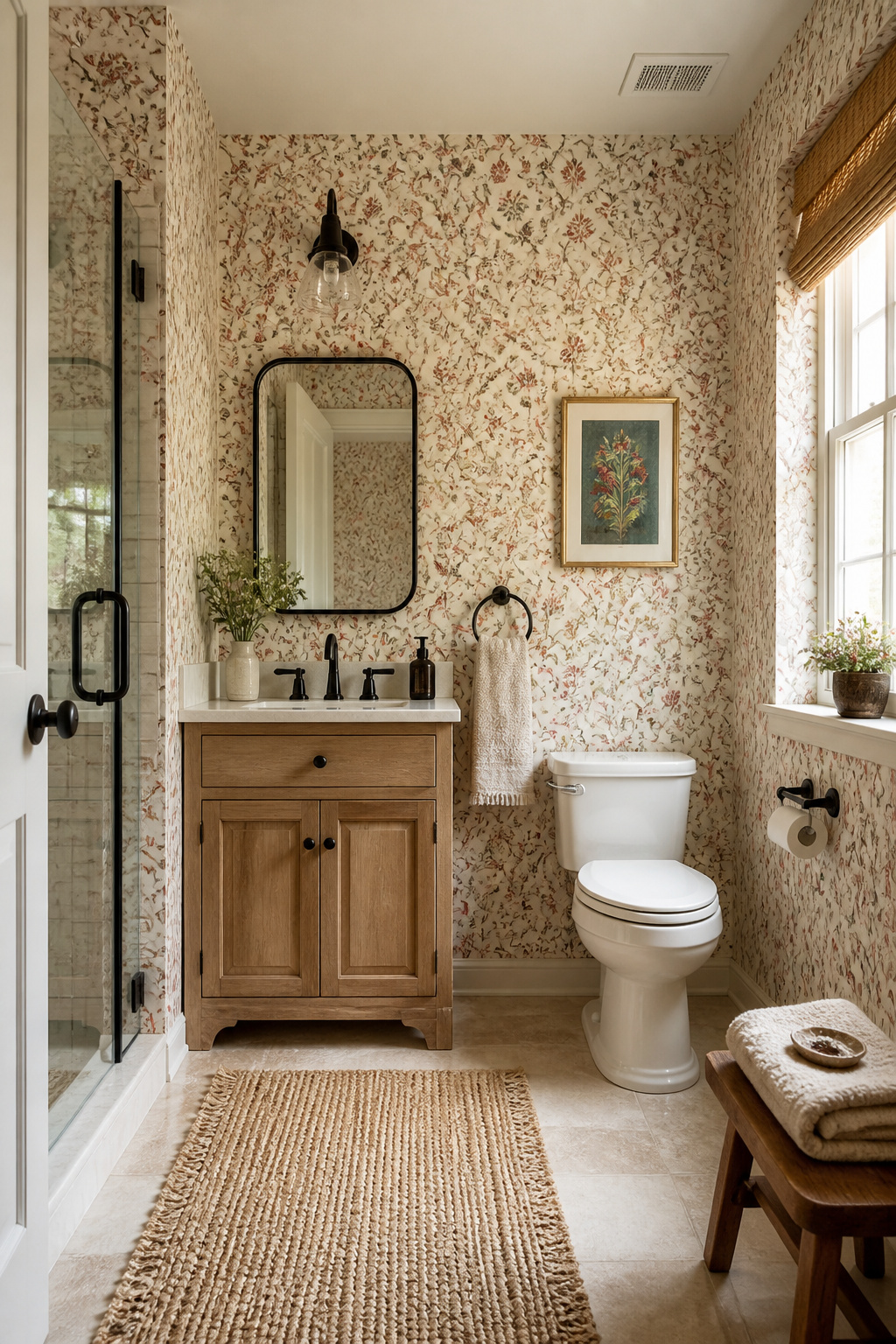
Choosing a Scale That Fits a Compact Room
For a compact bathroom, Sanganeri’s fine, airy floral scale is the more forgiving choice. Delicate repeats read as detail rather than visual weight in a small footprint. If you’re working with a single small wall, look for half-drop floral repeats under twelve inches. That keeps you from ending up with an obviously truncated motif at ceiling height.
Styling It With Natural Materials
The styling choice that ties it together is a woven jute or sisal bath mat rather than a synthetic memory-foam one. It echoes the handcrafted, natural-fiber story the wallpaper is already telling. Stick to pulling one dominant wallpaper color into the mat’s trim rather than matching the full palette. Keep hardware simple, too. Heavy, ornate brass can overwhelm Sanganeri’s fine linework, so matte black or brushed nickel lets the print stay legible. The same instinct applies when blending Indian-inspired textiles into a room more broadly: let the pattern lead.
6. Terracotta and Rust Tone Wallpaper for Warm Bohemian Bathroom Walls
If you’re mixing several patterns from this list, terracotta is your resting point. The color reads as rustic and timeless — its name literally means “cooked earth” in Italian. Used as a single accent wall, it gives the eye somewhere to land. The rest of the room can keep layering ikat, paisley, and block print across textiles, art, and tile.
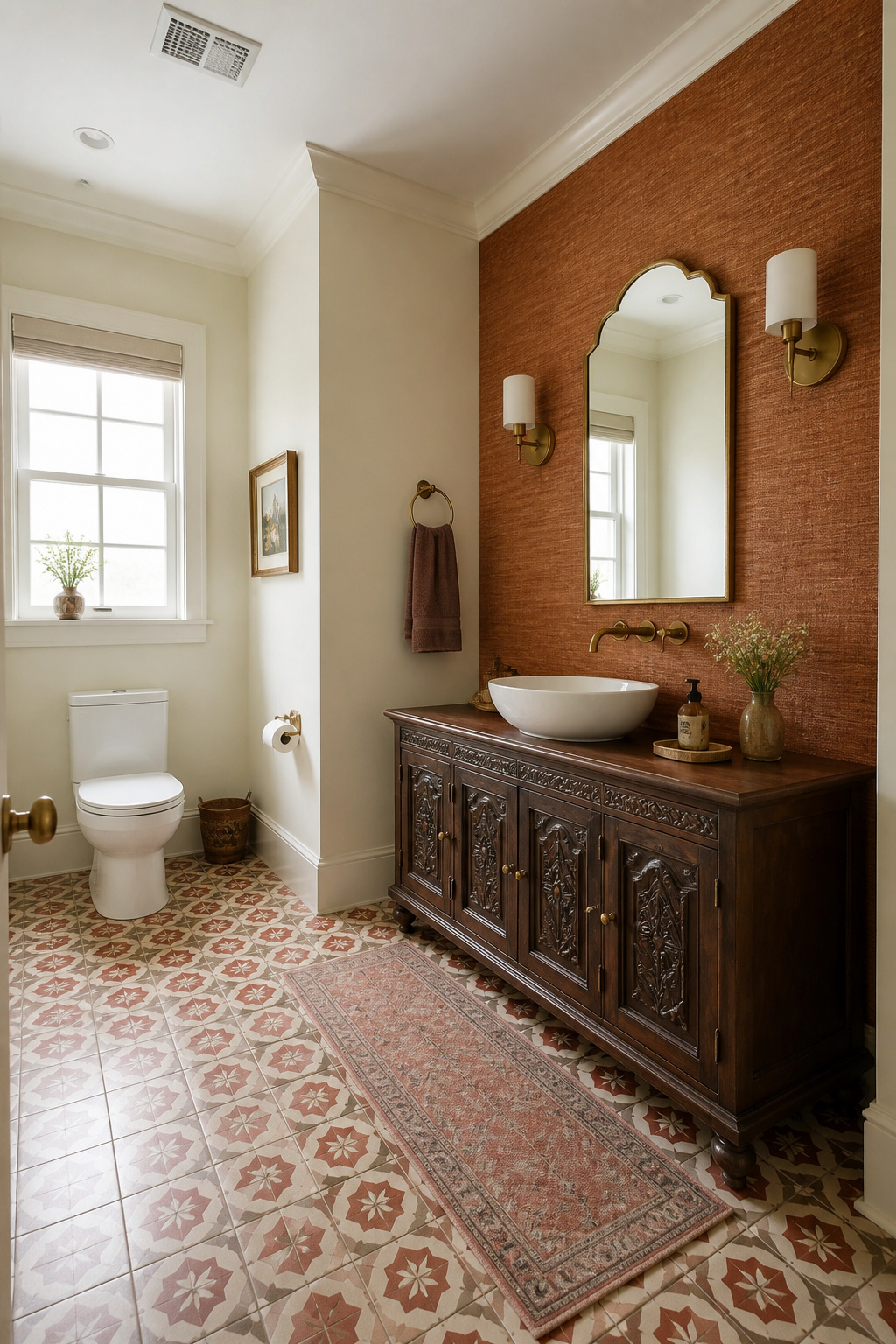
Solving a Real Lighting Problem
It also solves a real lighting problem. North-facing bathrooms get cooler, flatter daylight, and terracotta’s warm undertone is one of the few colors specifically recommended to counteract that. If you go with grasscloth rather than a printed option, its woven texture catches and scatters available light. That adds dimension to a room that would otherwise read flat under indirect daylight. High-performance Type II vinyl terracotta wallcoverings add antimicrobial protection too, which matters more in north-facing bathrooms that tend to stay damp longer than sun-facing ones.
Grasscloth or Vinyl: A Genuinely Consequential Choice
Solid grasscloth delivers texture without competing pattern, which is ideal when terracotta is meant to be the quiet wall against bolder prints elsewhere. Printed rust-toned florals on vinyl bring color and motif together, working better as a true accent than a grounding neutral. But grasscloth is meaningfully more humidity-sensitive than vinyl. Reserve it for well-ventilated bathrooms rather than high-steam, shower-adjacent walls. That’s the single most common way this terracotta bohemian bathroom wallpaper choice goes wrong. The same warm-undertone logic applies well beyond wallpaper, too, if you’re choosing finishes for darker, north-facing rooms more broadly.
7. Ikat Pattern Wallpaper for Layered Global Texture
Ikat takes its name from the Malay-Indonesian word “mengikat,” to bind, tie, or wind around. It describes a resist-dye process where yarns are dyed before they’re ever woven. Uzbekistan is widely considered where the craft was perfected. Central Asian ikats, known as “abr,” come in all-silk “atlas” or half-silk “adras” versions, and they rank among the most vividly colorful textiles in the world. UNESCO research actually suggests the technique developed independently across Central Asia, Indonesia, India, and Japan rather than spreading from a single origin. That’s worth knowing if you want to credit the tradition accurately rather than flattening it to one place.
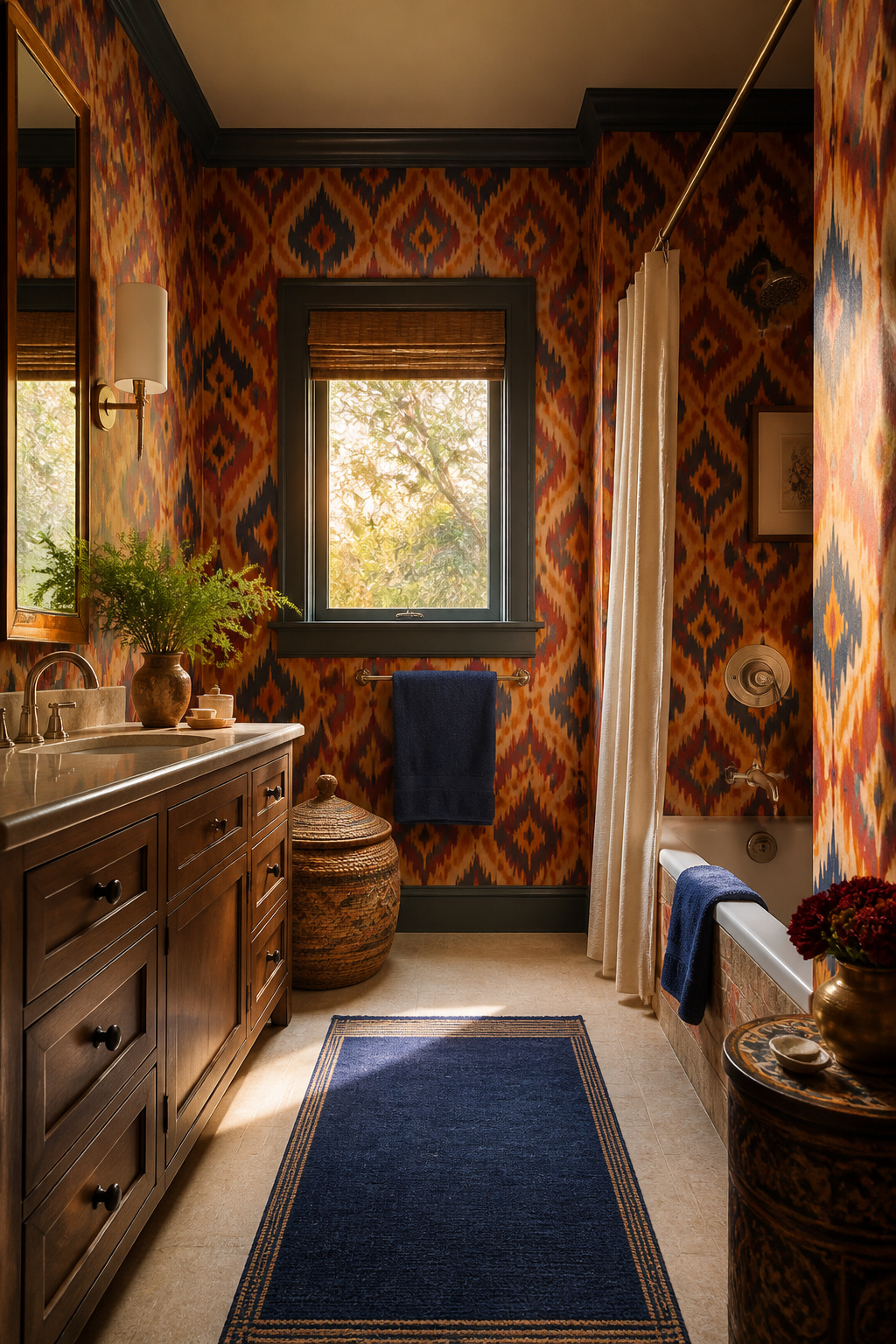
Why Ikat Works Best as a Background Pattern
What makes ikat work so well as wallpaper is the soft, slightly blurred motif edge that comes directly from the dye-then-weave process. That texture reads as more atmospheric than crisp geometric prints, so it functions best as a grounding pattern rather than the loudest thing in the room. Use it on the main walls and keep towels and bath mats in solid colors pulled from the print instead of introducing a second pattern. Ikat’s traditionally saturated colorways — deep red, indigo, marigold — photograph beautifully. Still, sample them against your bathroom’s actual lighting first.
Letting the Print Stay the Star
Hardware should recede here. Matte black or simple brushed nickel fixtures let the busy, soft-edged motif stay the star, where ornate or heavily textured brass would compete with it. The most common misstep is pairing ikat with a second bold pattern, which muddies its blurred motif instead of complementing it. A single woven or solid-color runner is the safer floor pairing.
8. Macrame-Print Wallpaper Paired with Woven Textures
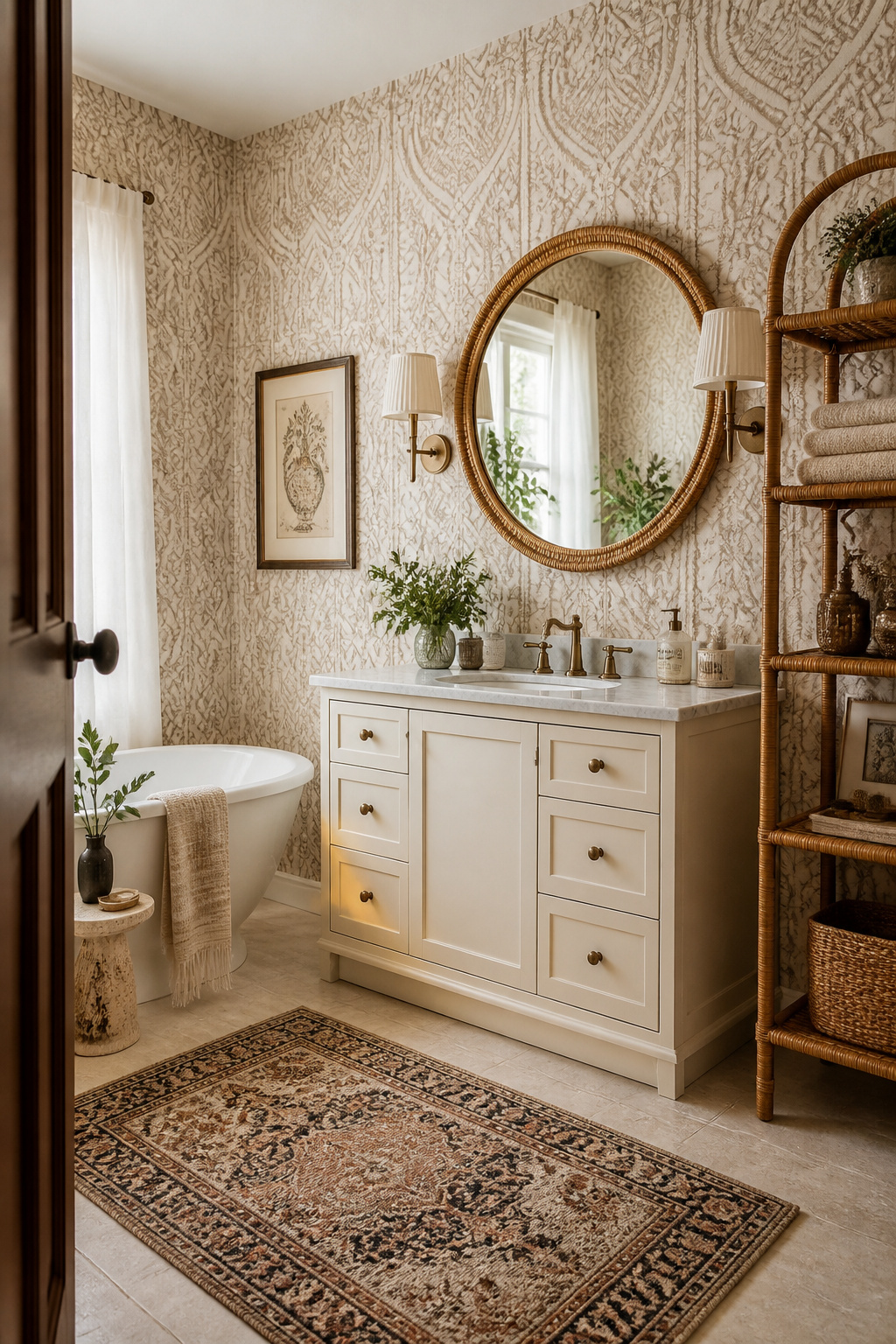
Fiber art is having a real moment. Etsy data shows searches for boho wall-hanging ideas up roughly 45% year-over-year. That confirms macrame isn’t a 2010s throwback resurfacing out of nowhere. The catch is that actual 3D macrame can absorb humidity and develop mildew over time in a bathroom. A printed, flat macrame motif solves exactly that problem: you get the knotted-fiber visual texture without the maintenance risk. Most fiber-art-inspired prints lean into a subdued, earthy palette — cream, taupe, jute-brown — that reads as organic and handmade even in two-dimensional wallpaper form.
Doubling Down on Texture Without Overdoing It
Because the printed motif already references knotted fiber texture, doubling down with actual rattan or woven shelving doesn’t create visual conflict. Instead, it reinforces the same warm, natural-fiber language from two directions. This is one of the more efficient ways of layering woven textures into a boho space. The wallpaper does half the work before you’ve added a single object. Keep the palette tonal. Cream-on-cream macrame paper against natural, unstained rattan reads cohesive, while a dark-stained rattan piece against a light print can look mismatched. A round rattan mirror is the most common pairing in current boho bathroom styling, since its frame shape echoes the circular knotting typical of macrame design.
Tonal Versus Contrast Prints
Cream-on-cream tonal prints work as a subtle backdrop in a full bath used daily, revealing themselves gradually rather than dominating. A contrast outline print — dark knot motif on a light ground — functions more like a graphic statement. It suits a powder room or single accent wall better.
9. Vintage Paisley: A Worldly Bohemian Bathroom Wallpaper Idea
Paisley’s teardrop “boteh” motif is roughly 2,000 years old. It’s believed to derive from a Zoroastrian symbol of a cypress tree representing life and fertility. Persian and Mughal influence carried it into India by the 16th and 17th centuries. It became central to Kashmiri shawl weaving using wool from the region’s Himalayan goats. It was eventually worn as a mark of elite status under Akbar’s reign. The name we actually use comes from somewhere else entirely: the Scottish town of Paisley. There, 18th- and 19th-century jacquard looms mass-reproduced the imported Kashmiri pattern for the European market. The common Western name, in other words, obscures the motif’s real Persian and Kashmiri lineage.
Why Colorway and Scale Both Matter
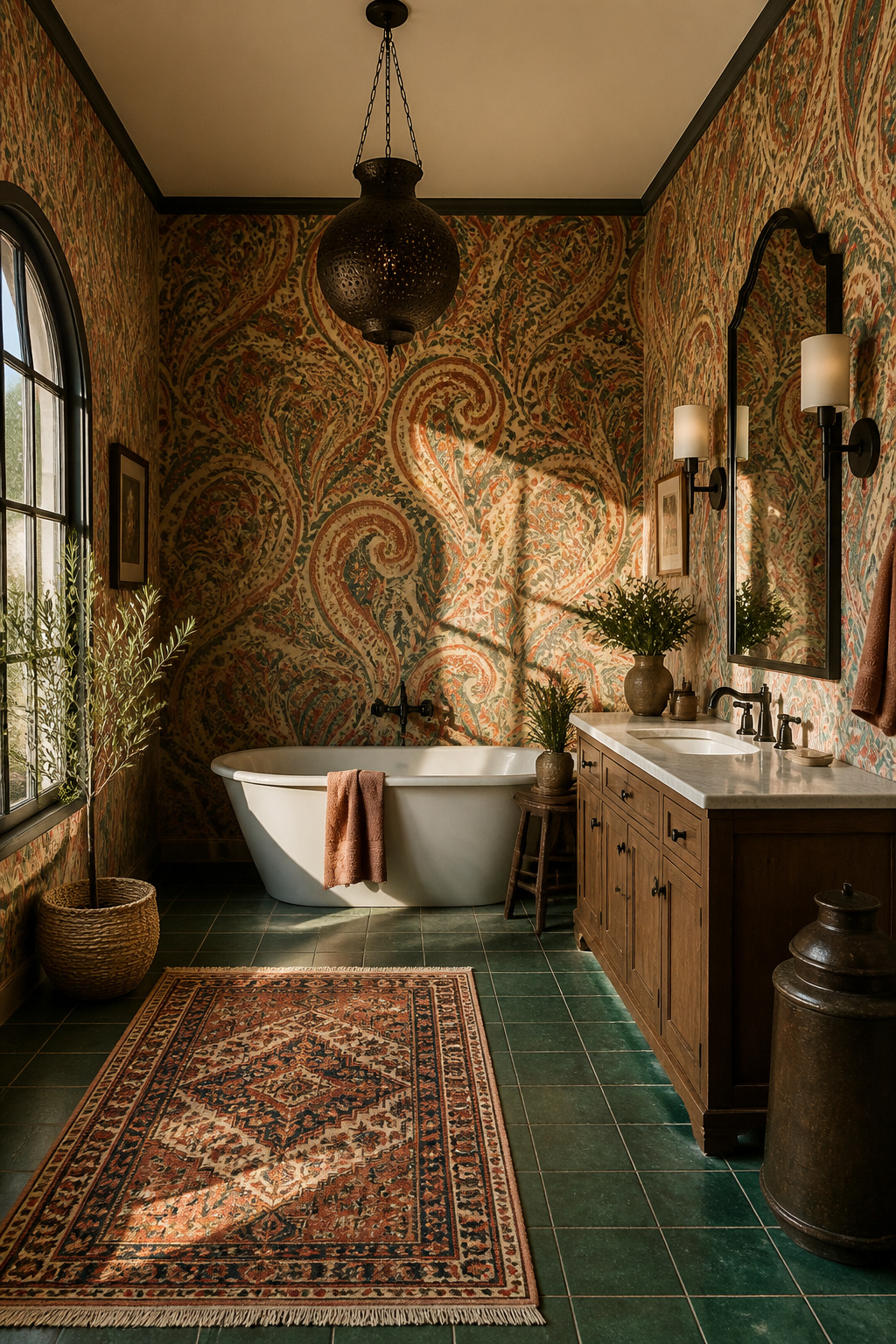
That history is exactly why colorway matters so much here. A muted, vintage-toned palette — faded rust, dusty teal, aged cream — reads as heritage textile rather than retro costume print. The saturated 1960s-revival colors, on the other hand, pull it the other direction. Scale plays a similar role. An oversized, single-direction paisley repeat feels contemporary-luxury, where the small, tightly packed repeats associated with ’60s and ’70s paisley read more costume than heirloom. For more direction, vintage-inspired bathroom wallpaper styling is worth a closer look before you commit to a print.
Flooring That Lets Paisley Lead
Pair paisley with a solid-color floor tile — terracotta, deep green, black — rather than a second patterned one. The motif itself is already complex and curvilinear. Pull that single tile color from one of paisley’s secondary tones rather than its dominant background shade, so the pairing feels deliberate. The most common mistake is pairing paisley with a busy patterned floor like encaustic cement tile. Two large-scale patterns end up competing in a small room.
10. Tropical Palm Leaf Wallpaper for a Boho Jungle Bathroom
This one has an unusually specific origin story. The defining “Martinique” banana-leaf pattern was created in 1942 by Hollywood decorator Don Loper, building on earlier sketches by Dorothy Draper. It was made for the hallways and coffee shop of the Beverly Hills Hotel, where it remains on the walls today. That Hollywood-glamour pedigree gives palm print a different cultural register than most other patterns here. It leans less on folk-textile tradition and more on mid-century design icon status. That’s part of why it bridges bohemian eclecticism with a polished tropical-modern sensibility. The print has resurfaced repeatedly since. Stephen Burrows put it on runways in the 1970s. Dolce & Gabbana revived it in 2016. It famously covered the walls of New York’s Indochine restaurant starting in 1985.
Avoiding the “Hotel Lobby” Trap
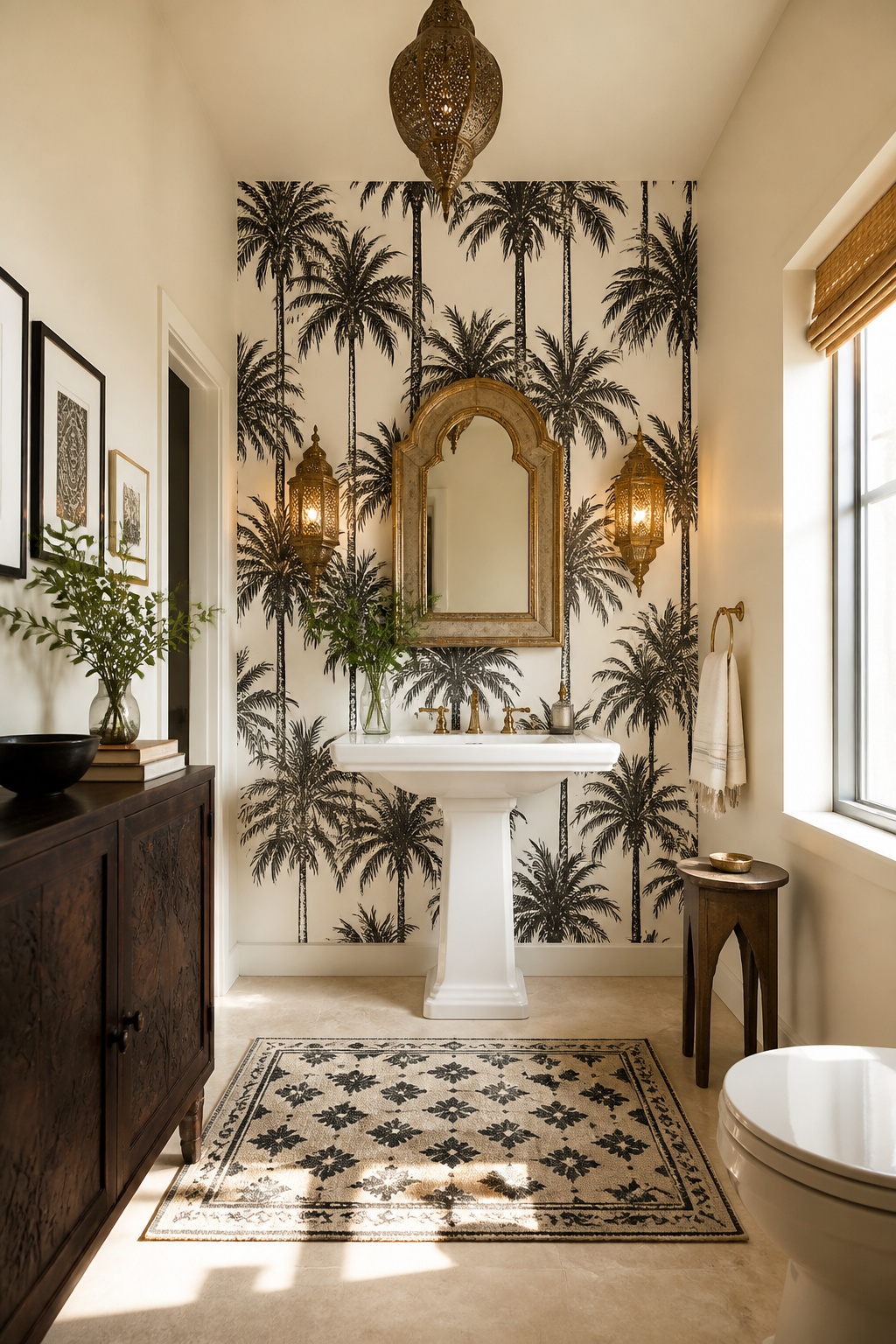
The challenge is keeping it from reading as “hotel lobby” rather than “personal home.” Avoiding the exact glossy, saturated-green Martinique colorway is the simplest fix. Muted or monochrome palm prints sidestep the direct reference entirely. Mixing palm wallpaper with handcrafted, non-tropical bohemian elements — a block-print bath mat, brass Moroccan-style sconces — signals curated eclecticism rather than themed hospitality. Limiting the print to a single wall keeps the scale personal rather than commercial.
Monochrome or Full Color
Monochrome, single-color silhouette versions read as more sophisticated and less literally tropical. Full-color botanical illustrations lean harder into resort styling and work best when everything else stays deliberately neutral. Both are widely available as peel-and-stick, so it’s easy to test before committing to a full roll.
11. Geometric Kilim-Inspired Wallpaper for Bold Bohemian Pattern Play
Kilims are flatweave rugs: no pile, no plush texture. They’re built from colored weft threads wound back and forth around warp pairs. That produces crisp-edged geometric motifs instead of the soft, blended patterns of a piled weave. The motifs carry real meaning. The Elibelinde, or “hands on hips” figure, symbolizes the mother goddess and fertility. A tulip motif traditionally signals a wish for children, and a yin-yang-like shape represents marital unity. Regional signatures vary widely across Anatolia. Konya is known for large-scale diamonds and stepped medallions, Bergama for vivid reds and blues, Van and Malatya for fertility figures and ram’s-horn motifs.
Scaling Kilim Geometry for Walls and Ceilings
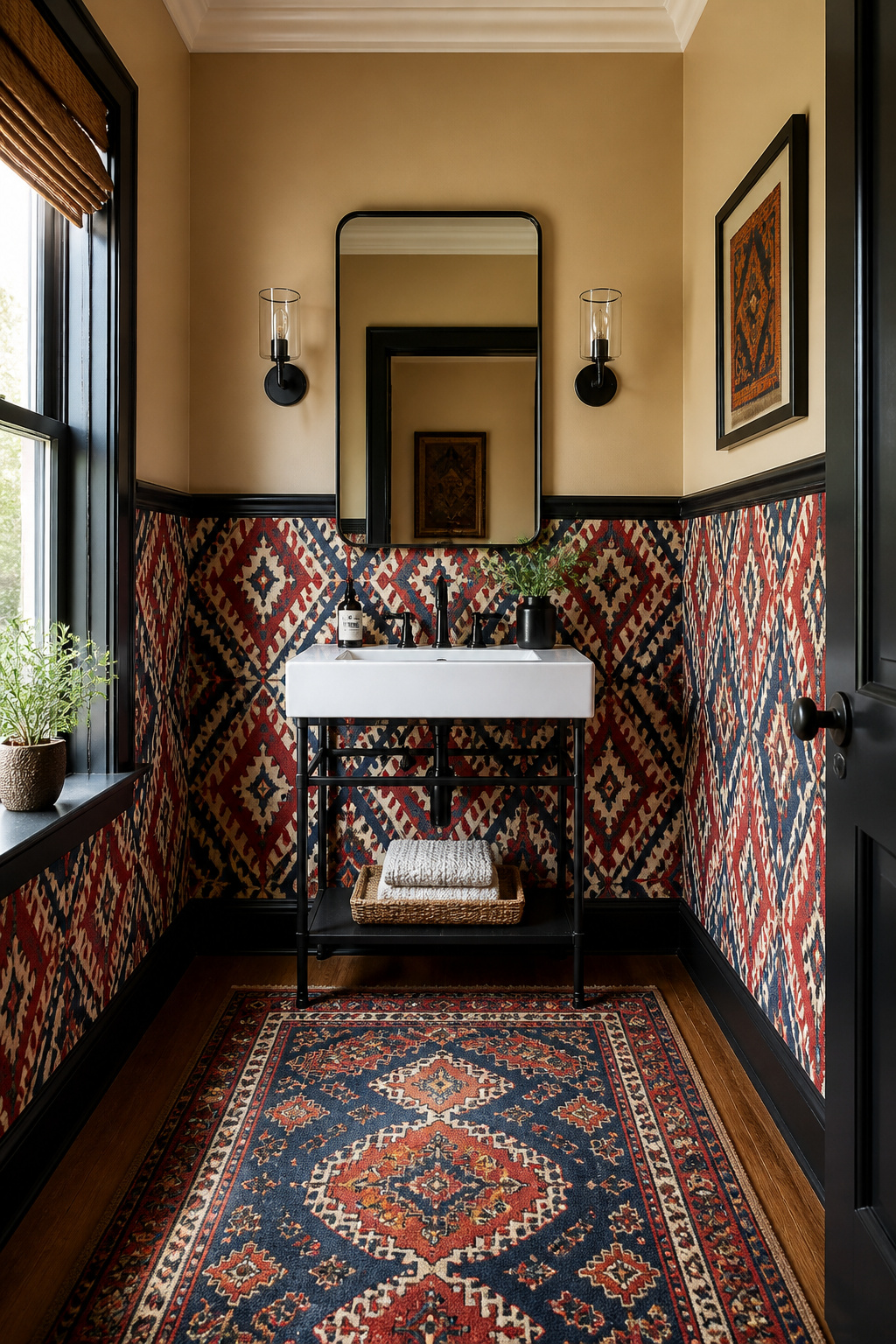
Scale changes how this translates to a bathroom. Large Konya-style diamonds work beautifully on a full wall but can feel heavy overhead, so reserve ceiling application for smaller-repeat variants. A kilim-pattern ceiling — the “fifth wall” approach — works best in a powder room with otherwise plain walls. On walls, the crisp, high-contrast geometry reads clearly even from a few feet away, an edge over busier or more delicate florals in a tight bathroom.
The Faux Wainscot Trick
One practical favorite: installing kilim-print wallpaper only on the lower third to half of the wall, capped with a chair rail. This mimics a wainscot effect while limiting material cost and humidity exposure near the floor. The upper wall stays a simple paint color while the patterned lower section takes the visual risk. Watch out for choosing a kilim motif at random without understanding it may reference a specific regional tradition. Sourcing from retailers who credit the region by name adds real authenticity.
12. Watercolor Wildflower Wallpaper for a Soft Bohemian Bathroom Touch
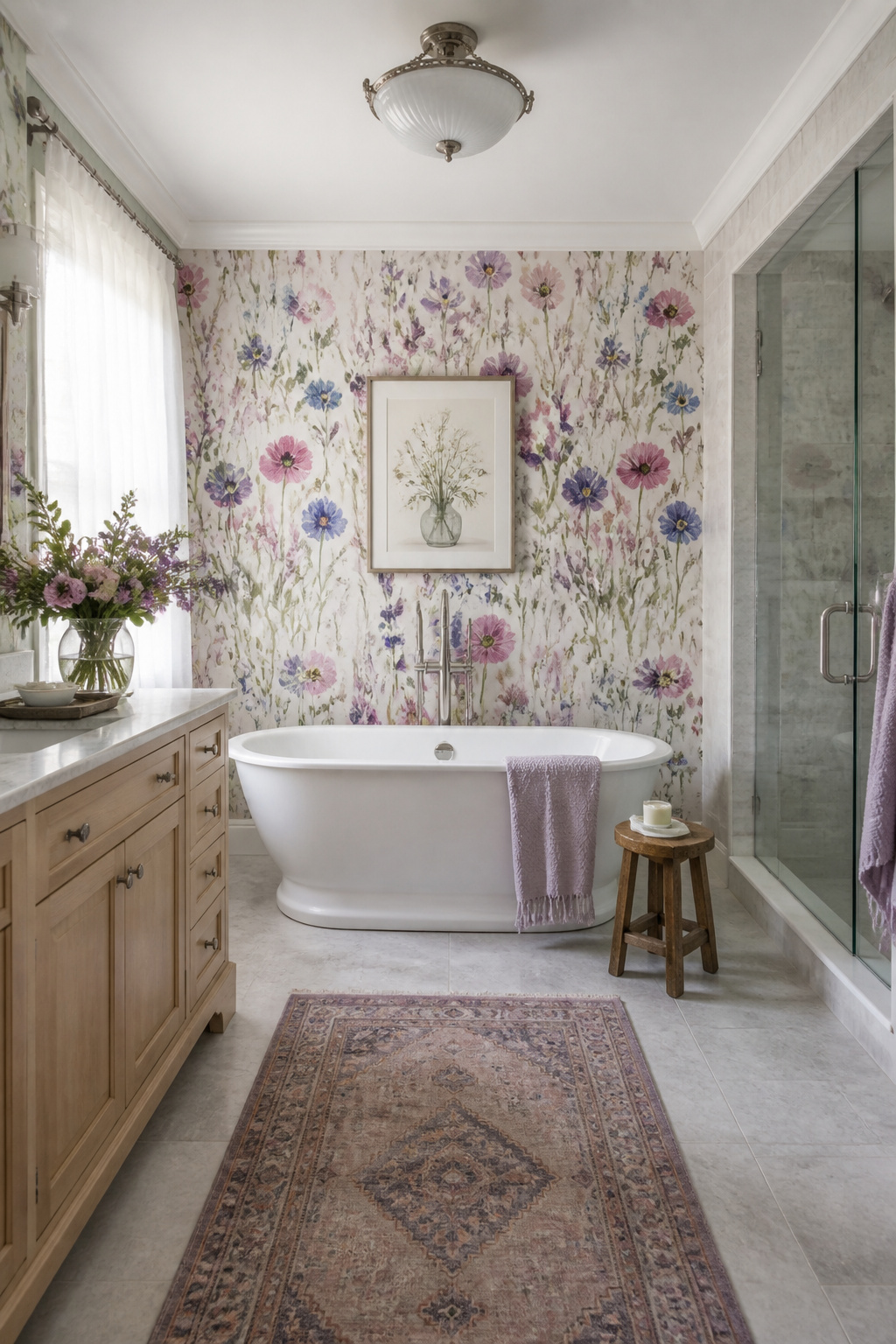
Not every bohemian bathroom needs to shout. Watercolor florals soften the whole pattern-mixing approach because their diffused, bleeding-edge technique reads as gentle rather than bold. That’s a real contrast to the crisp lines of block-print or kilim-inspired patterns elsewhere on this list. Soft pink, purple, and blue tones create a serene, inviting atmosphere. The style also pairs naturally with cottagecore and modern farmhouse sensibilities for anyone blending bohemian with something softer.
How Hardware Finish Shifts the Mood
Hardware finish actually shifts the entire mood of this print. Brass adds warmth and pulls out any gold or warm-pink undertones in the floral. Chrome or brushed nickel, in contrast, gives a cooler, cleaner read that suits a palette leaning toward blue or lavender. One practical note: self-adhesive vinyl watercolor wallpaper generally works in humid bathrooms, but not every peel-and-stick line is rated for direct-shower-adjacent walls. Check the moisture rating before installing it there. That’s the most common oversight with this pattern.
Density Changes the Effect
A neutral base — soft white, cream, sand, driftwood — keeps the floral as accent rather than overload. Dense, all-over coverage creates an immersive garden effect best suited to a full wall behind a tub. Scattered, sparse sprig prints, by contrast, suit a smaller powder room where full saturation might feel busy.
13. Indigo Batik Wallpaper for Rich Bohemian Bathroom Color
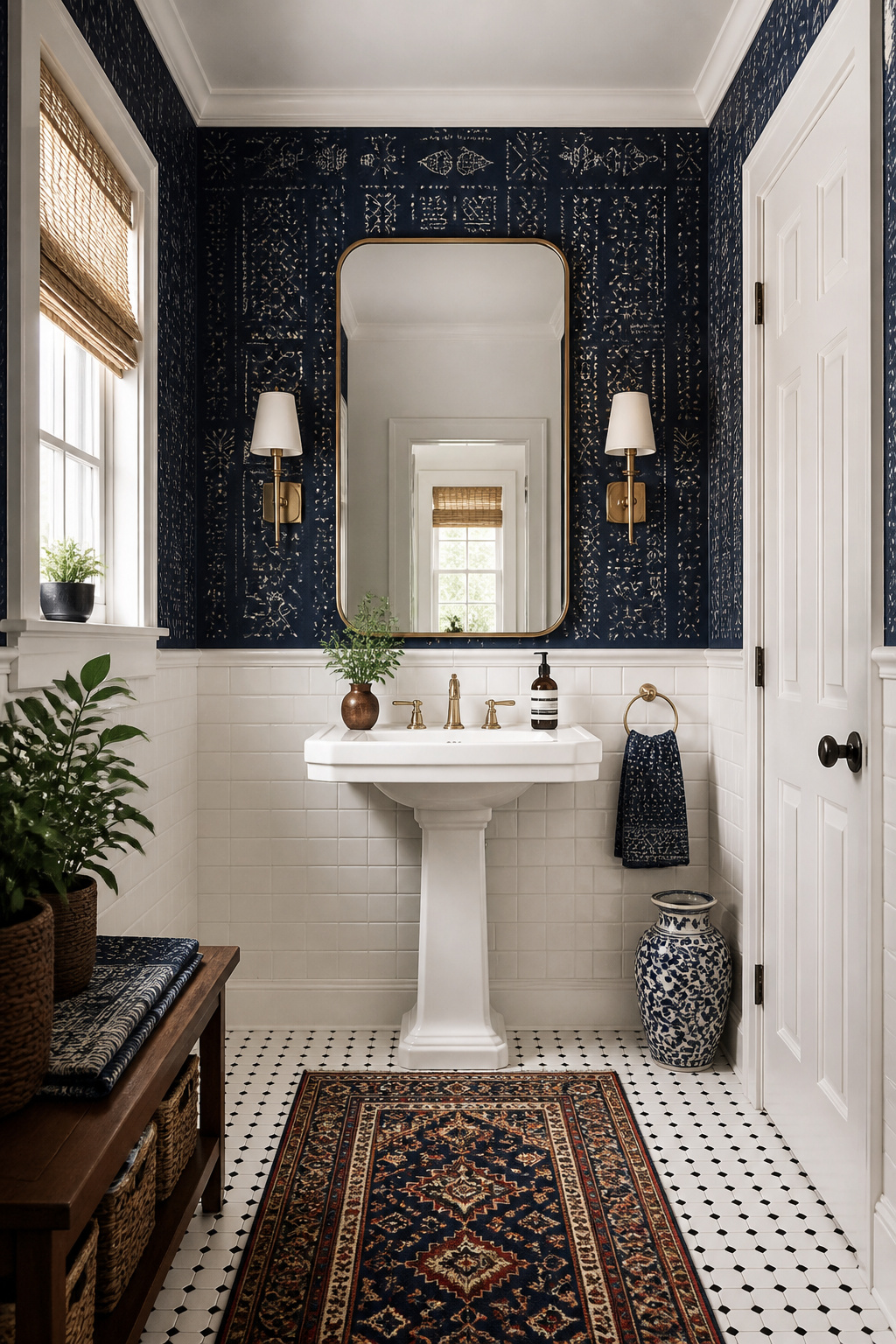
Batik’s defining technique is wax-resist dyeing. Hot wax is applied to fabric with a pen-like tool called a canting. The fabric is then dyed, and the waxed areas resist color to form the pattern. Indigo dye itself actually originated in India, not Java. Pekalongan, a UNESCO-recognized city on Java’s north coast, became the largest indigo exporter in Southeast Asia, though. That’s why the Indonesia-India connection sits at the center of this fabric’s history. UNESCO recognized batik as Intangible Cultural Heritage in 2009. Indigo, meanwhile, is one of the oldest dye colors on Earth. It traditionally symbolizes protection and harmony with nature.
A Deliberate Color, Not Just a Dark One
That symbolism is worth bringing into how you frame the choice. Deep indigo isn’t just a dark color in a small room. It’s a deliberate selection tied to tranquility and protection. To keep it from reading as heavy, balance the saturated blue with a high ratio of white or cream. Hang a mirror directly opposite the indigo wall, too, to bounce available light back through the color.
Getting the White-to-Indigo Ratio Right
A roughly 60/40 or 70/30 white-to-indigo ratio keeps the room balanced rather than overwhelming. White should dominate in tile, trim, and fixtures, with indigo as the rich accent. White subway tile specifically, rather than colored or patterned tile, lets the batik’s wax-resist detailing stay the focal point. It’s the same principle behind balancing bold color with plenty of white tile anywhere else in the house. The mistake to avoid is pairing saturated indigo with an equally dark vanity or floor. Without a light counterbalance somewhere in the room, the cumulative effect reads heavy instead of rich.
14. Peel-and-Stick Bohemian Wallpaper for Renters
Modern peel-and-stick wallpaper uses pressure-sensitive adhesive rather than water-activated paste. That’s exactly why humidity alone doesn’t compromise the bond the way it can with traditional paper. That distinction is the whole reason it makes bold bohemian pattern accessible to renters. It installs and removes without damaging walls or paint. Brands like Tempaper offer steam-resistant lines marketed specifically for bathroom use, with bohemian-pattern collections priced around $30 per roll (roughly 20.5 inches by 16.5 feet).
Working Around Sinks and Toilets
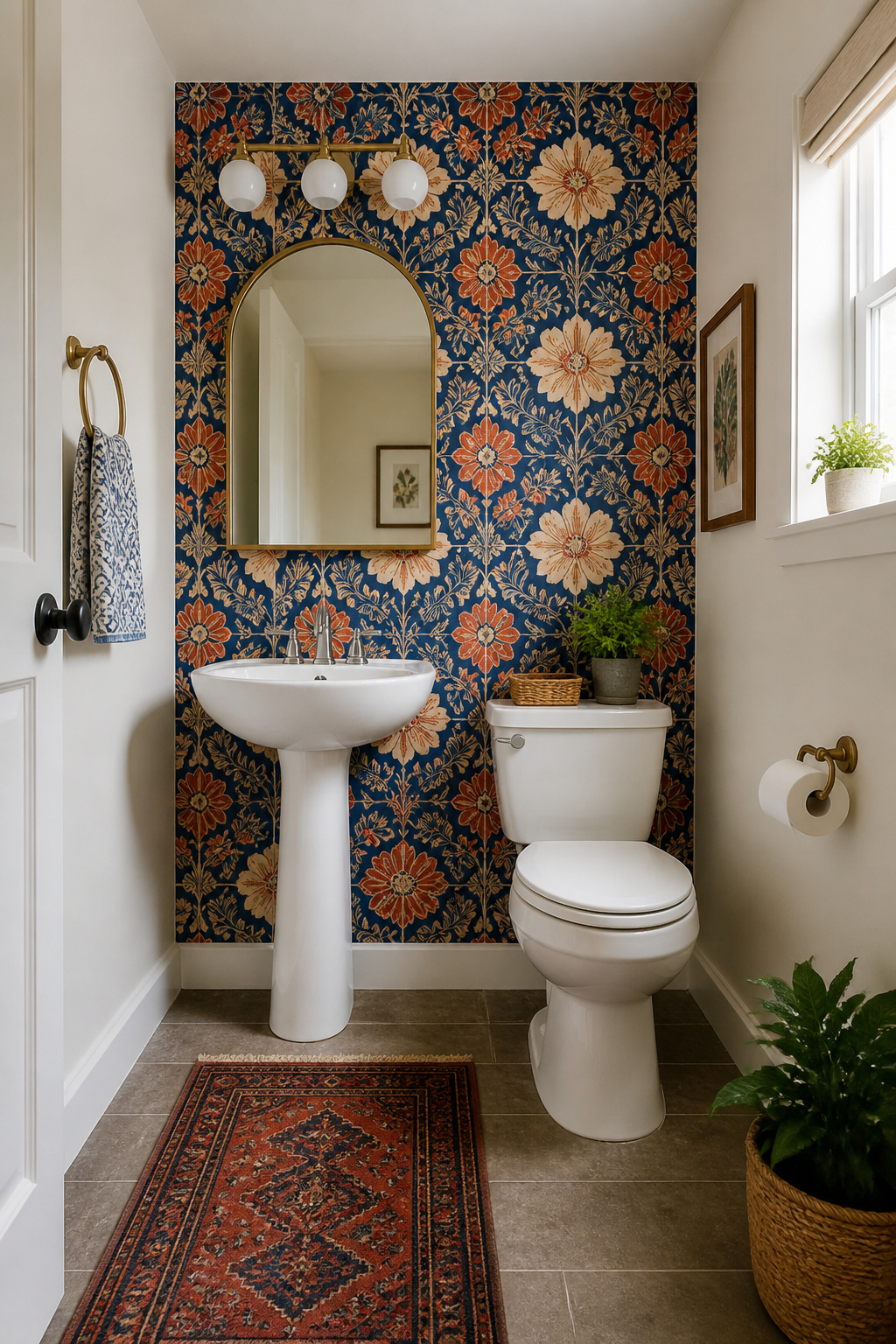
Installation around fixtures is where most of the actual skill lives. Around sinks, cut with about a quarter-inch of excess material at the edges. Then trim precisely with a sharp blade rather than cutting exactly to the line on the first pass. Around a toilet, disconnect the water supply and remove the tank lid for full access instead of maneuvering paper around an installed tank. Leave a small gap, even half an inch, at the floor behind the toilet and at the tub or shower surround. Those are the spots most likely to collect moisture and where peeling typically starts first.
How Long It Actually Lasts
With proper ventilation and prep on clean, dry, fully cured walls, full coverage typically lasts three to five years before peeling or fading shows up. Low-humidity powder rooms stretch that considerably longer than a steam-heavy full bath ever will. A single accent panel reduces both material cost and humidity exposure. It’s a smart middle option if you’re nervous about full commitment, and the logic applies no matter which bohemian wallpaper pattern you land on.
15. Mixed-Pattern Accent Wall: The Most Eclectic Bathroom Wallpaper Bohemian Approach
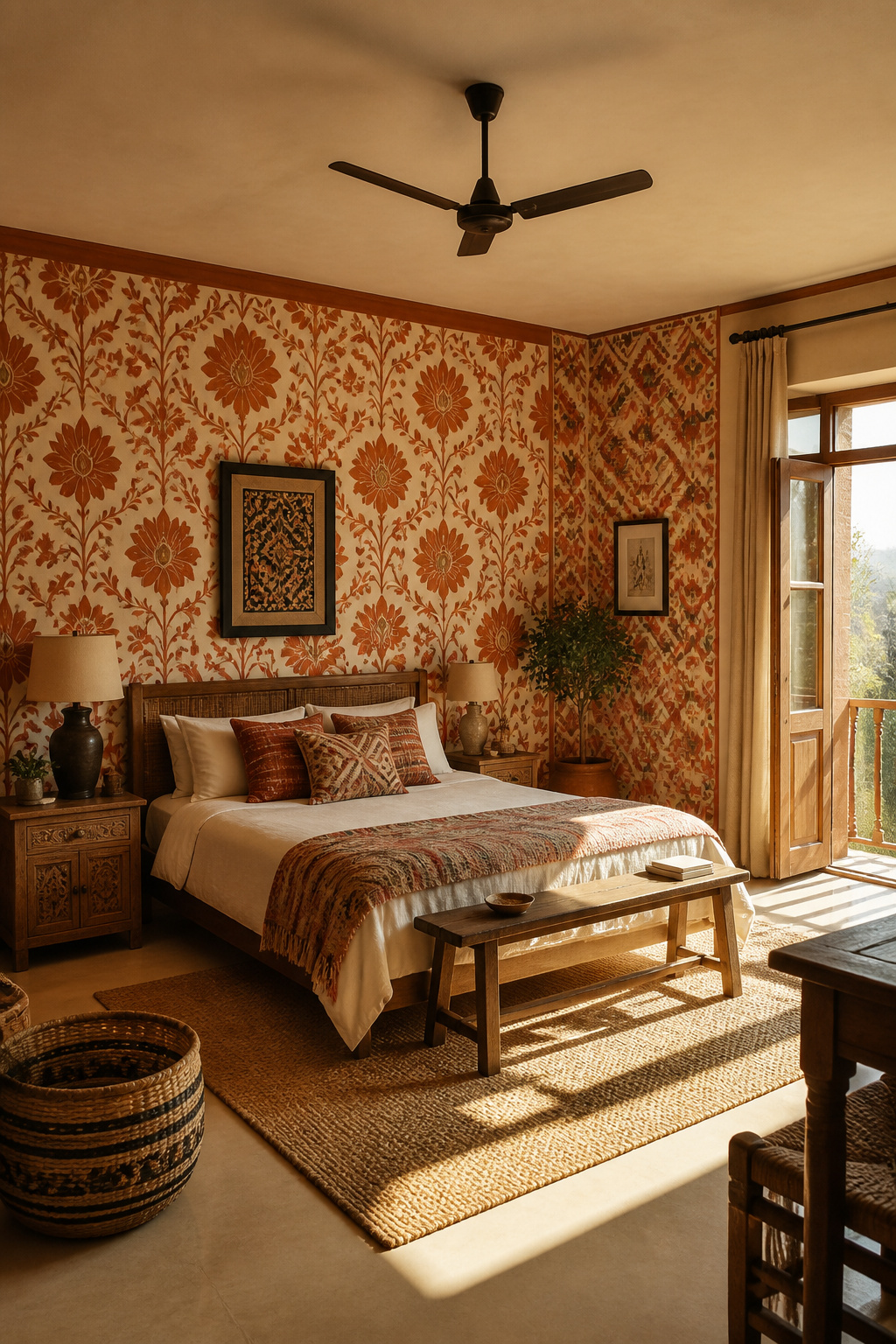
If you can’t choose just one pattern from this list, there’s a real technique for combining several without the result feeling chaotic. The core principle is finding a common thread between designs, usually a consistent color palette or a shared motif or scale, rather than random clashing. A large-scale pattern like a botanical jungle print pairs well with a smaller-scale geometric like kilim or trellis when both share a similar color scheme. It’s the combination of scale contrast and color consistency that reads as curated rather than cluttered. In bohemian interiors, prints like ikat, paisley, or global textile motifs are traditionally mixed with natural textures. Rattan and jute are common choices, used instead of a second printed pattern. This same color-thread logic applies to building a cohesive boho design throughout your home, not just within one room.
Building a Color Thread First
Pick one dominant color or two complementary ones first. Then select patterns that all contain it, like terracotta plus block-print floral plus kilim geometric. That beats starting from “patterns I like” and forcing a color match afterward. A reliable formula: one large-scale pattern, one small-to-medium geometric, and one solid or near-solid textured surface like grasscloth, all sharing the same two or three colors. Test swatches side by side before buying full rolls. Patterns that look coordinated in isolated product photos can clash once juxtaposed on a wall.
Where to Contain the Mix
Reserve true multi-pattern mixing — two or more wallpapers in the same sightline — for a single wall, keeping the rest solid or tiled. A half-wall split is a more controlled way to mix than covering full walls with two prints: patterned paper below a chair rail, a second pattern above it. This is the riskiest approach on this list. The most common misstep is layering three or more bold patterns with no shared color thread and no neutral breathing room between them.
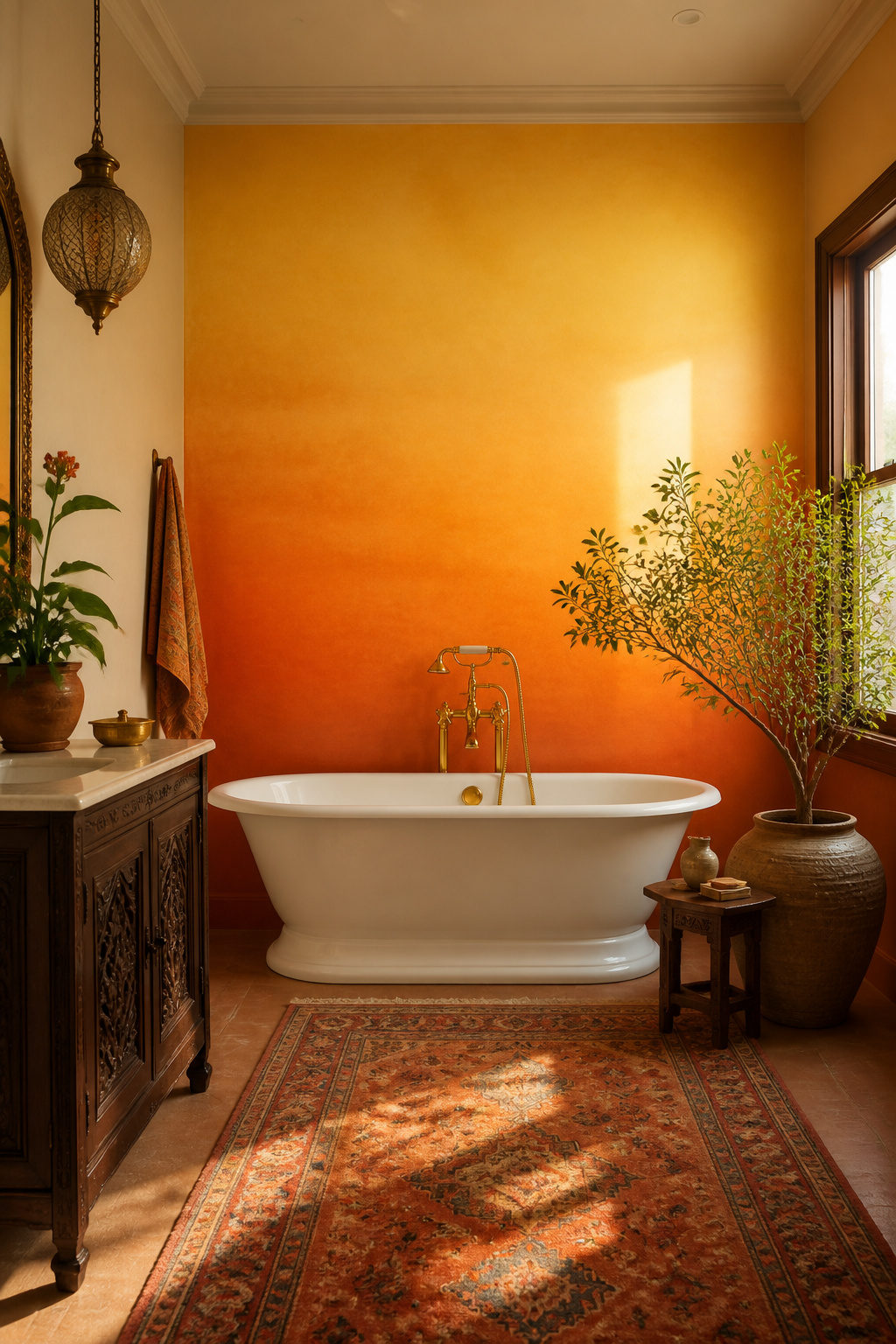
16. Sunset Ombre Wallpaper for a Dreamy Boho Bathroom Retreat
There’s a small but useful distinction buried in this category’s name. True ombre technically refers to a single-color fade from dark to light. A genuine sunset gradient, by contrast, blends multiple distinct hues into one another. Most products marketed as “sunset ombre” wallpaper are actually the latter, multi-hue version. The sunset color palette had its peak social-media moment around 2019 to 2021. Rather than fading out, though, it’s matured into a lasting design staple. Modern UVgel print technology now produces noticeably better fade resistance and smoother color transitions than older gradient methods.
Getting the Gradient Orientation Right
Installation orientation deserves real attention here. Most sunset gradients transition from a deeper tone at the bottom to a lighter tone at the top, or vice versa. That orientation has to be checked panel by panel. Reversing even one panel breaks the gradient illusion entirely, and it’s the single most common mistake with this style. A vertical gradient works best on a single full-height wall, while a horizontal gradient suits a long, narrow bathroom wall better. Pair the gradient’s direction with the room’s actual light source. Placing the lightest part nearest a window reinforces, rather than fights, the space’s natural light pattern.
Warm or Cool Palettes
Warm sunset gradients in orange, pink, and gold suit a bathroom built around energizing morning routines. Cooler dusk-to-night gradients in teal, purple, and navy, on the other hand, suit an evening-relaxation bathroom. They pair especially well with the celestial sun-and-moon wallpaper from earlier on this list for anyone wanting a cohesive after-dark mood across the whole room. Both palettes are commonly available in peel-and-stick and traditional paste formats from PVC-free, eco-friendly suppliers, so sustainability doesn’t have to be a trade-off here.
How to Choose the Right Bohemian Bathroom Wallpaper for Your Space
With sixteen directions on the table, the deciding factor usually isn’t taste. It’s fit. Start with your room’s actual size and light. Medium-to-large-scale patterns generally outperform small, busy repeats in compact bathrooms, since wide-reaching shapes invite the eye to travel rather than registering as clutter. Half-baths and powder rooms can support bolder color and pattern commitment than a larger full bath. In a bigger room, it’s often smarter to reserve the boldest print for a single accent wall. If your bathroom is north-facing or naturally dim, lean toward warmer-toned patterns — terracotta, rust, warm block print — to counteract cool daylight. Bright, sun-drenched bathrooms, however, can handle cooler, higher-contrast prints without feeling flat.
Matching Material to Moisture Level
Material is the practical half of the decision. Vinyl, especially Type II commercial-grade, is the most steam-resistant option and the standard choice for full baths with showers. Non-woven, paste-the-wall material is more breathable and suits better-ventilated rooms. Grasscloth is the most moisture-sensitive of the three and belongs in low-humidity powder rooms rather than near a shower. Peel-and-stick tolerates humidity well in ventilated spaces, typically lasting three to five years, but it should stay out of direct splash zones. Budget by room size, not just per-roll price: most bathrooms need two to five rolls. Standard vinyl or non-woven runs $15 to $50 per roll, and premium designer prints climb past $60.
Test Before You Commit
Before ordering a full quantity, get a physical sample and tape it to multiple walls in your actual bathroom. Live with it for three to five days across different times of day, since screen colors rarely match the printed product exactly. If you’re going peel-and-stick, test the sample’s adhesion for a full 24 hours on your real wall surface first. Older or textured walls can affect how well it holds. This is the one step in choosing bathroom wallpaper bohemian style that’s easy to skip, and it’s genuinely worth the extra week. Trust what the swatch tells you over what the product photo promised.