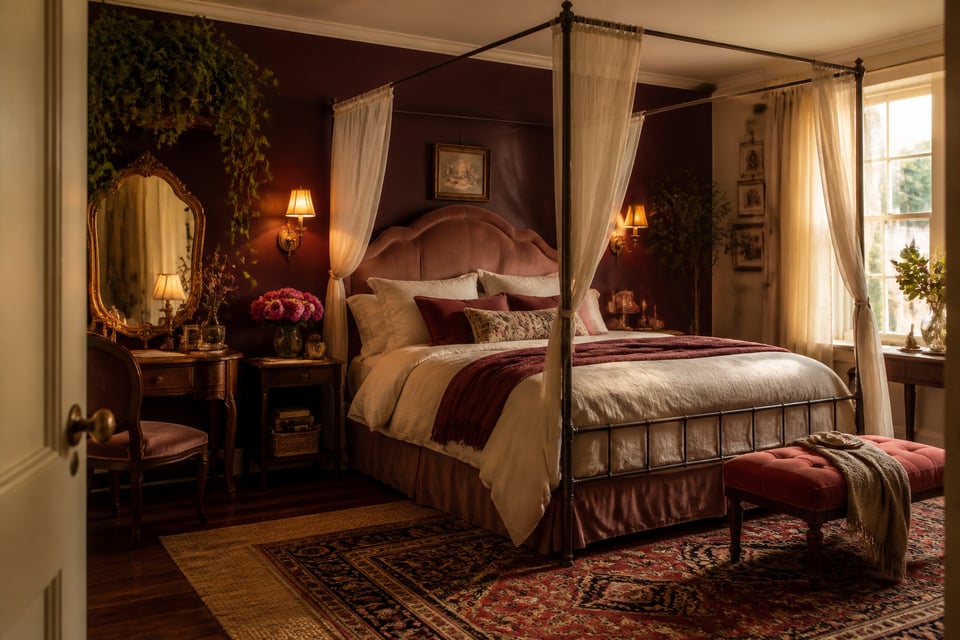
There’s a particular feeling you get walking into a bedroom that’s been designed with real intention — the way the light seems to soften before you’ve even touched a switch, the scent that greets you before you’ve noticed the flowers on the nightstand, the textures that make your hands reach out almost involuntarily. Romantic bedroom decor isn’t about replicating a hotel suite or following a single aesthetic to the letter. It’s about layering sensory experiences until the room itself feels like an embrace.
As someone who works with color and textile as primary tools, I’ve seen firsthand how the right combination of velvet, warm light, and a single bold color decision can transform the most ordinary bedroom into a space that feels genuinely intimate. None of these changes require a full renovation. Most require nothing more than a clear sense of what you want the room to feel like — and a willingness to commit to it.
These 16 romantic bedroom decor ideas range from structural decisions (a canopy, a headboard, a color palette) through the kind of sensory layering that pulls everything together. You don’t need all sixteen. But chances are, four or five of them will speak directly to the bedroom you’ve been picturing.
1. A Draped Canopy Bed With Sheer Flowing Panels
The canopy is the oldest romantic gesture in bedroom design, and it has endured precisely because it works on an architectural level — it defines the bed as a space within a space, turning sleep into something that feels ceremonial rather than merely functional. You don’t need a Victorian four-poster to get this effect.
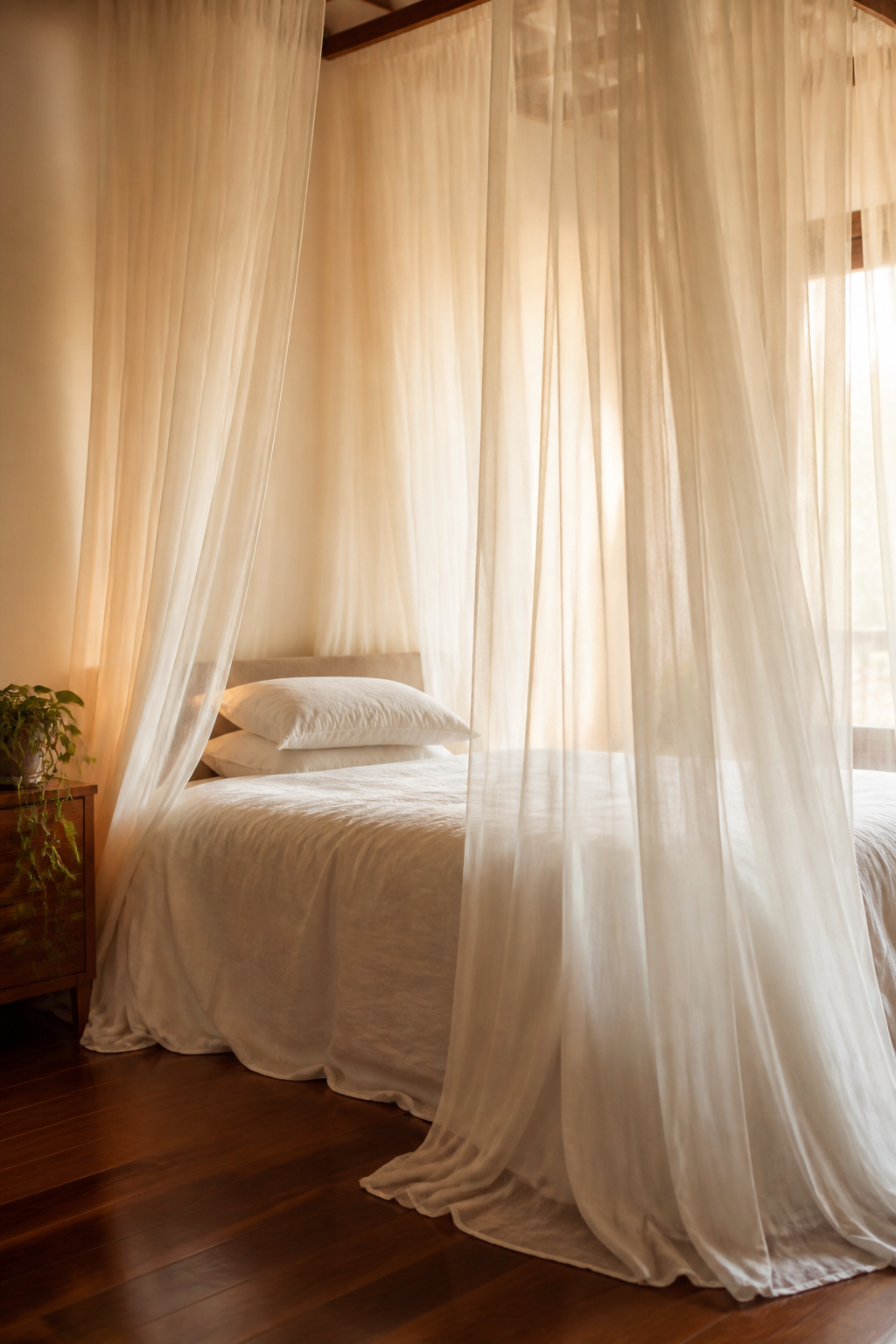
The most accessible version involves mounting two curtain rods to the ceiling, one on each side of the bed, and hanging floor-length sheer panels from them. Voile is the best fabric choice here — it’s lightweight enough to fall in long, fluid columns rather than bunching awkwardly, and it lets light through in a way that feels ethereal rather than opaque. For standard 9-foot ceilings, mount the rods about 8 inches from the ceiling so the panels reach the floor with a slight pool.
For an actual four-poster frame, the current generation of metal canopy beds (brands like Zinus and Walker Edison make affordable versions) offer the structural elegance without the weight and price of antique wood frames. That said, the DIY ceiling-rod approach often looks even more romantic because the panels hang more freely. Use ivory or blush voile for warmth, or a deep jewel-tone organza if your bedroom palette can carry the drama.
Working With Lower Ceilings
The one honest caveat with canopy panels is height. In rooms with 8-foot ceilings, ceiling-mounted rods can feel claustrophobic rather than cocooning. The solution is to go with a single rod centered above the headboard — letting the panels fall on either side of the headboard rather than surrounding the full bed. This creates the visual suggestion of a canopy with far more breathing room.
2. Velvet Bedding: A Romantic Bedroom Decor Staple Worth Every Penny
Velvet bedding does something no other fabric manages quite as effortlessly: it changes color depending on which way you’re looking at it. That directional quality — the way a plum duvet appears violet from one angle and almost black from another — is exactly what makes velvet bedding feel so unmistakably expensive, even when it isn’t.
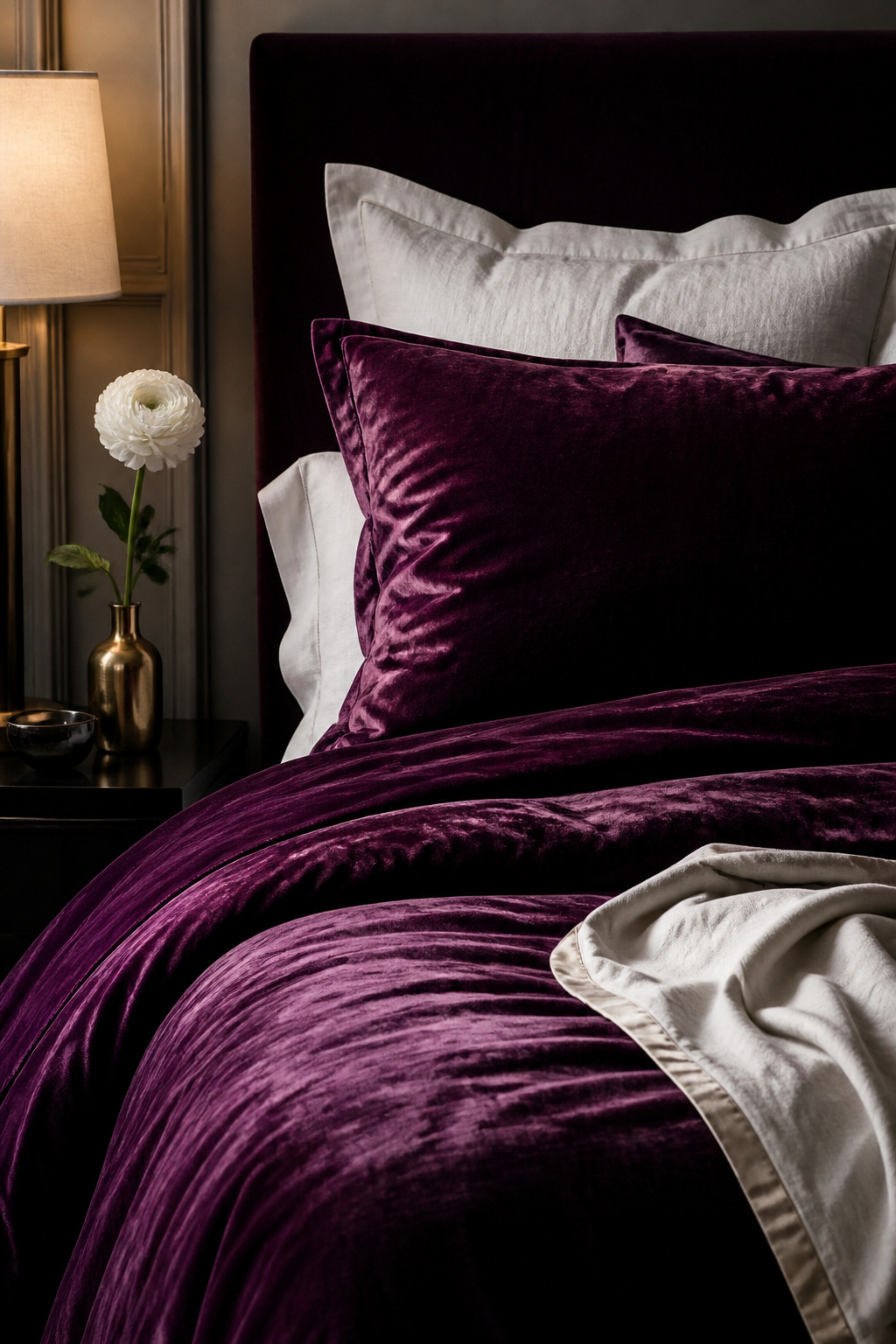
For the best effect, choose a velvet duvet cover with a weight of at least 100 grams per square meter — lighter than this and the fabric can look flat and polyester-adjacent. The richest colors for romantic bedroom decor are deep plum, dusty rose, forest green, and a warm burgundy, all of which pick up light beautifully. Pair with crisp white or ivory linen euro shams for contrast; the difference in texture between the velvet and linen reads as intentional rather than mismatched.
In terms of care, most velvet duvet covers are machine washable on a cold, gentle cycle — but check the label, as some require dry cleaning. The main maintenance issue isn’t washing; it’s lint. Keep a lint roller nearby and smooth the nap in one direction after you make the bed in the morning to maintain that characteristic sheen.
3. Dimmable Pendant Lights for Intimate Mood Setting
If there’s one change that transforms a bedroom more completely than any other, it’s lighting. Specifically, swapping overhead lights for dimmable pendants brings the light source down to face level, eliminates the overhead shadow cast by ceiling fixtures, and gives you full control over the atmosphere — from bright enough to read by, to dim enough to feel genuinely romantic. Romantic bedroom lighting deserves real attention.
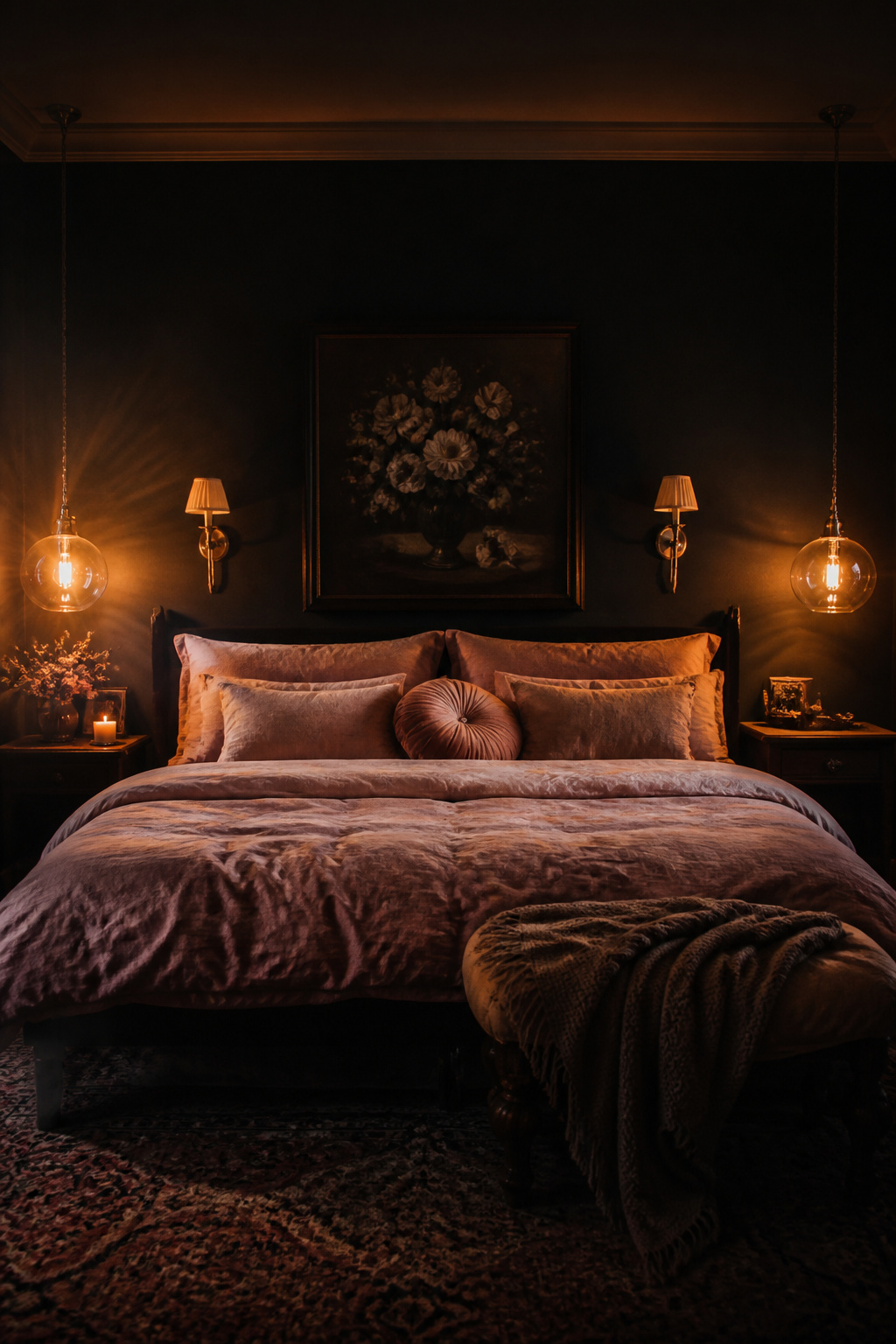
The technical details matter here: choose bulbs with a color temperature between 2700K and 3000K — this is the warm amber range that mimics candlelight rather than the cooler, more clinical 4000K+ temperatures used in office lighting. LED filament bulbs in this range are worth seeking out, as they combine the warm visual quality of incandescent bulbs with modern energy efficiency. Pair them with a dimmer switch (Lutron Caseta is the wireless option that doesn’t require rewiring) and you can shift from reading-bright to fully romantic in one motion.
For ceiling-hung pendants flanking the bed, position the bottom of the shade at roughly 6 to 8 inches above the nightstand surface. This puts the light source at the right level to illuminate the space without shining in your eyes when you’re lying down.
4. A Blush and Burgundy Color Palette That Warms Every Wall
The psychology of warm color in a bedroom is well documented. Deep burgundy activates a sense of enclosure and security — the cave-like comfort that our nervous systems associate with safety — while blush pink introduces lightness and softness that prevents the palette from feeling heavy. Together, they’re one of the most emotionally effective color combinations available for a romantic bedroom.
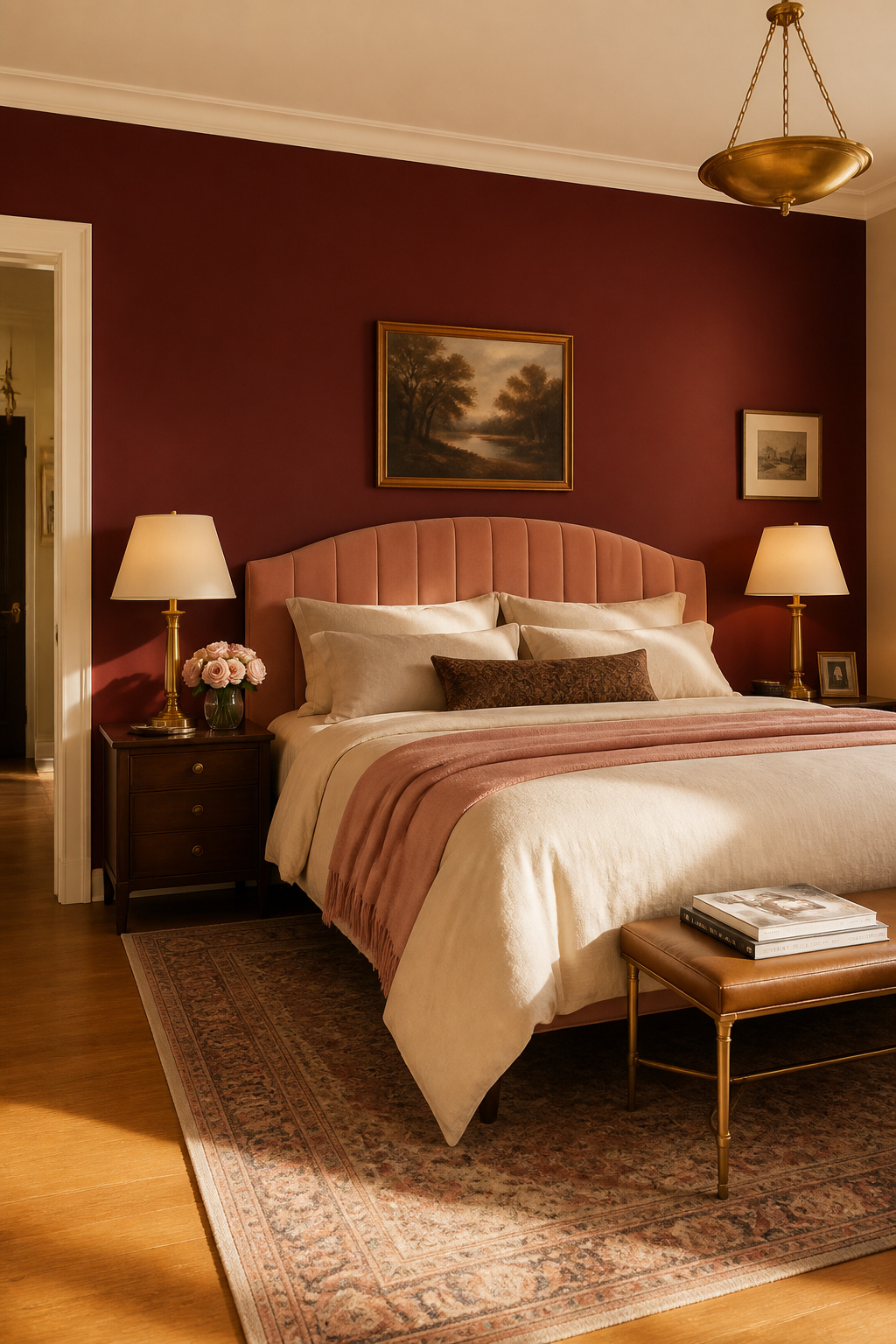
The most approachable application is a single accent wall behind the headboard in a deep burgundy or blackberry — Farrow & Ball’s Preference Red or Benjamin Moore’s Bordeaux Rouge are both excellent starting points. The rest of the room stays in ivory or warm white, which keeps the palette from feeling intense. Carry the blush through the bedding, throw pillows, and curtains, and pull in brass or warm gold hardware for the lamps, mirror frames, and drawer handles.
For those who prefer something calmer, the same logic applies at lower saturation: a dusty rose wall with ivory and pale gold creates an equally romantic but considerably softer result. If you want to see how neutral alternatives read before committing, neutral bedroom paint colors can serve as a useful point of comparison. For deeper inspiration on the full bedroom palette, bedroom paint colors covers the complete spectrum from muted to saturated.
The metallic accents are non-negotiable. Brass and gold amplify the warm quality of both burgundy and blush in a way that chrome or nickel cannot — the cooler metals read as clinical next to warm reds, whereas gold adds an almost candlelit quality to the whole room.
Getting the Balance Right
The practical rule is to commit fully to the accent wall rather than testing it with a half-hearted semi-gloss. Deep reds and burgundies need two to three full coats in an eggshell or matte finish to read with the depth that makes them romantic. A single thin coat in burgundy often looks flat and pinkish, which is the opposite of the effect you want.
5. Botanical Prints That Bring Romantic Bedroom Decor to Life
Plants and florals carry cultural weight in romantic bedroom decor across almost every tradition — in Indian design, marigolds and lotus motifs appear in bridal chambers; in Victorian England, pressed botanical illustrations were among the most treasured bedroom artworks. The connection between natural imagery and romance isn’t decorating trend; it’s something much older and more instinctive.
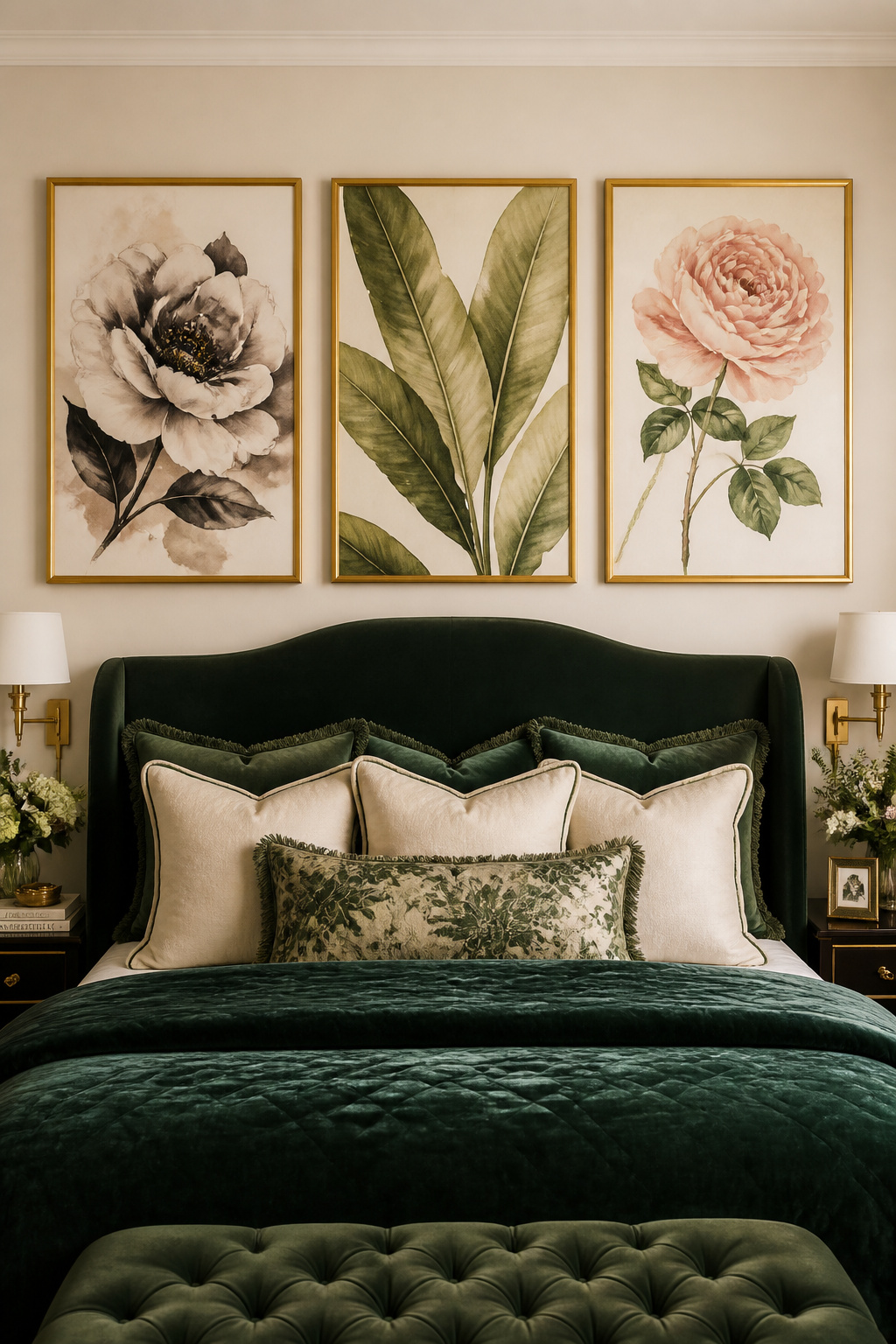
For maximum impact, go larger than instinct suggests. Most people choose botanical prints that are too small for the bedroom wall, and the result is a scattering of small images that reads as tentative rather than intentional. A single oversized peony print — 24 by 36 inches or larger — above the headboard has more presence than six smaller ones arranged in a grid. Alternatively, a horizontal triptych of three prints in the same frame style creates a statement wall that feels curated rather than crowded.
Gold frames are the best choice for romantic bedroom decor because they warm the prints and tie them to the brass and copper hardware elsewhere in the room. If you’re mixing print styles, unify them through the frame. The prints themselves can be as varied as an ink-wash botanical, a soft watercolor, and a pressed-plant illustration — but matching frames make them read as a collection.
For a more tactile approach, mix a framed print with a woven botanical tapestry in the same color family. The contrast between a flat printed image and a textile with physical texture brings a richness to the wall that flat art alone can’t achieve.
6. Mirrored Furniture for Soft, Glamorous Reflection
Mirrored furniture amplifies light in a bedroom the way nothing else does — not just bouncing it around, but multiplying it, creating the sense that the room is lit from several sources simultaneously. This is particularly effective in bedrooms with candles or warm lamps, where the mirrors pick up that amber glow and distribute it throughout the space.
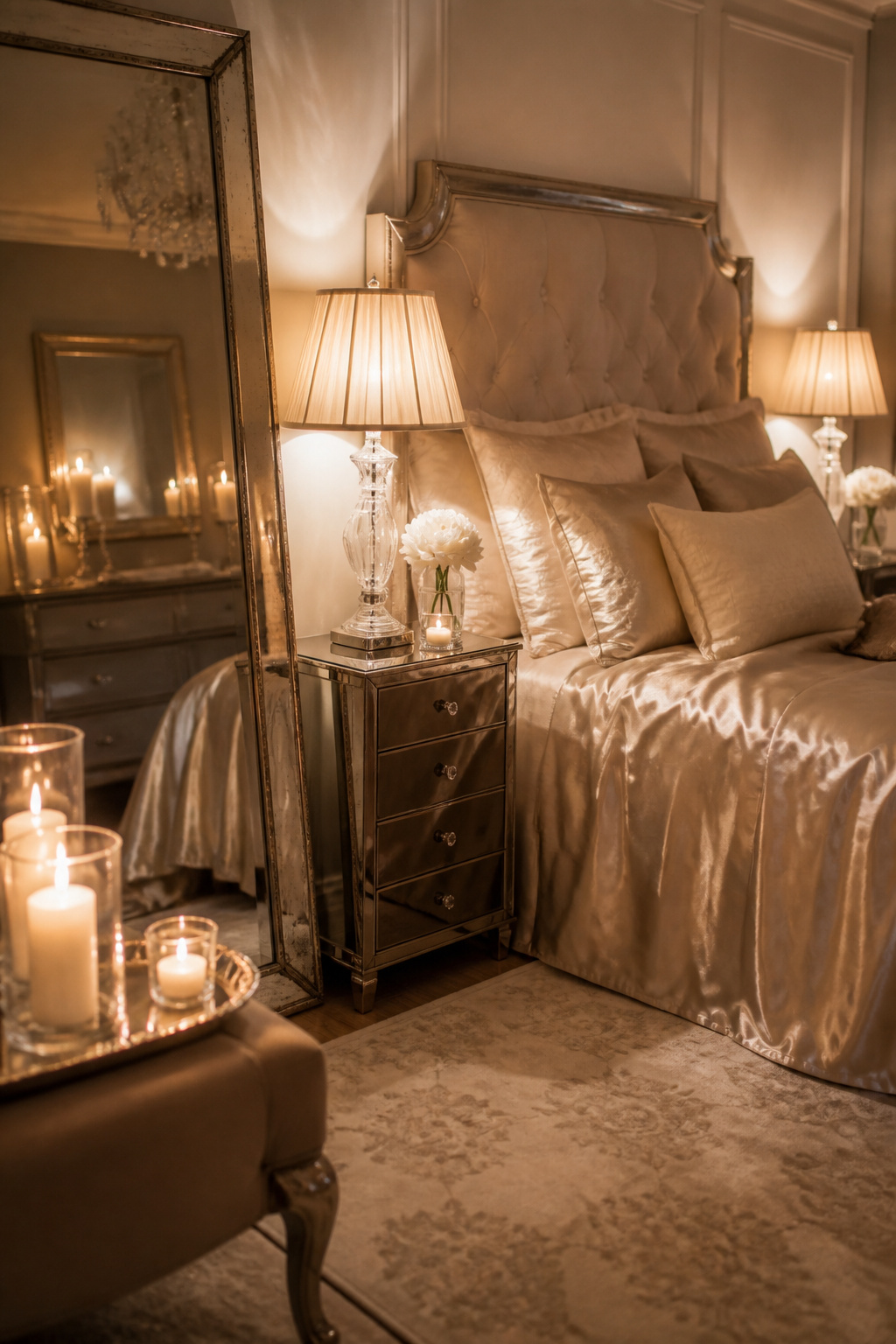
The critical distinction when choosing mirrored bedroom pieces is between clear mirror and smoked or antiqued mirror. Clear mirror is precise and cool; it reflects everything with laboratory accuracy and can make a room feel bright in a way that runs counter to romance. Smoked or antiqued mirror has a slight golden or gray tint that diffuses reflections softly — it picks up candlelight and warms it rather than sharpening it. For a romantic bedroom, smoked or antiqued glass is almost always the better choice.
The pieces that work hardest in this style are nightstands and a free-standing floor mirror. A mirrored dresser can work, but only if the other surfaces in the room are mostly matte — a room full of mirrored surfaces becomes unsettling rather than glamorous. One large antiqued mirror leaning against a wall, paired with two smaller mirrored nightstands, is the right proportion for most bedrooms.
7. Layered Throw Pillows in Rich, Mixed Textures
The pillow arrangement on a romantic bedroom bed isn’t decorative excess. It’s a signal — a visual shorthand that this is a bedroom where comfort has been given real thought. The layering of different textile weights, from the weight of a velvet cushion to the coolness of a silk accent pillow to the rougher texture of a linen euro sham, creates the kind of tactile richness that makes a bed look genuinely inviting rather than merely made.
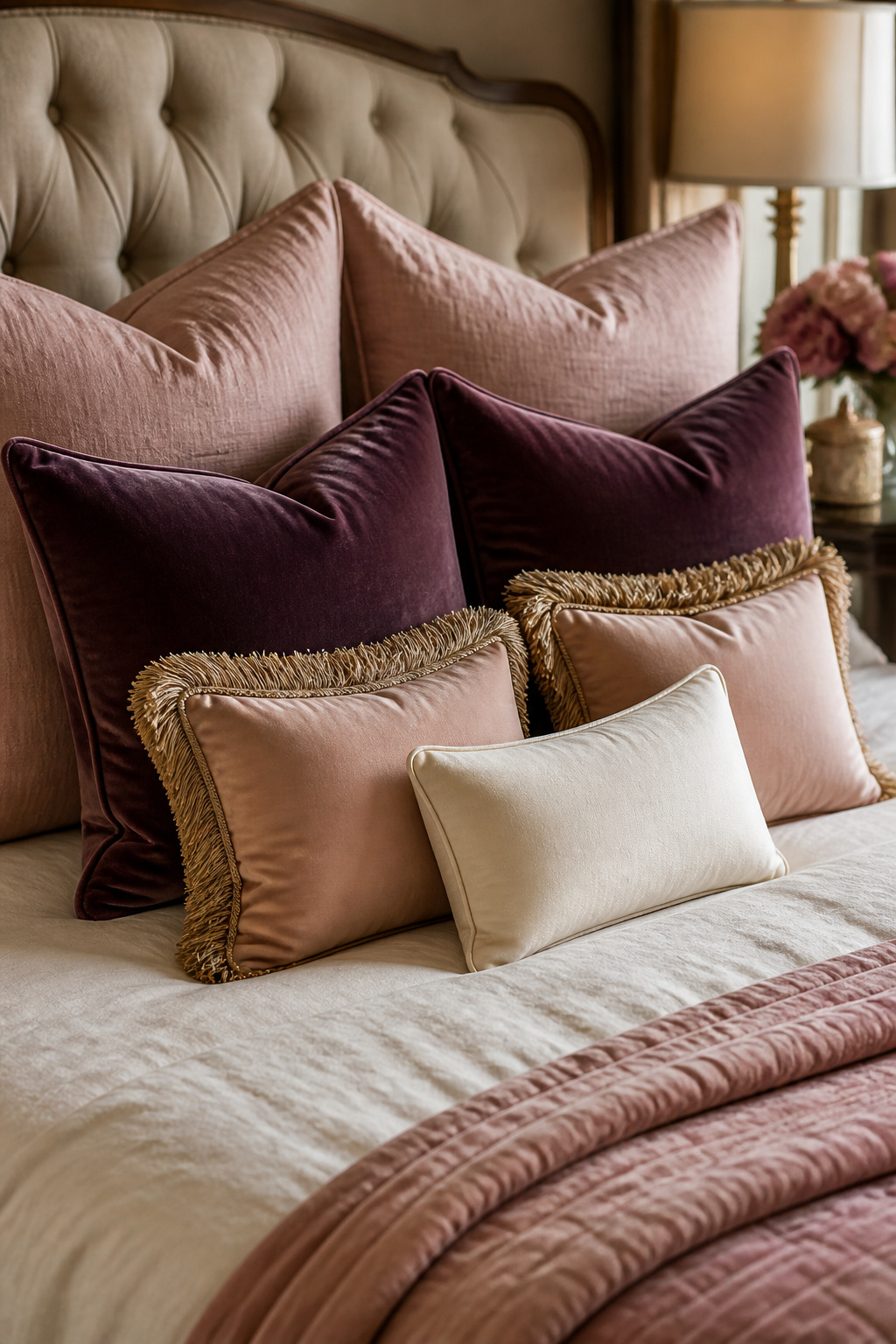
The formula that works consistently: two oversized 26-inch euro shams at the back (linen or cotton in a neutral), two standard sleeping pillowcases in the accent color (velvet is ideal here), two smaller 18-inch accent pillows in a contrasting fabric (silk, embroidered, or a jewel-tone solid), and one small boudoir or kidney pillow at the front center. That’s seven pillows total — which sounds like a lot but looks balanced rather than excessive when the sizes are properly graduated.
The palette discipline is what makes it work. All the pillows should share at least one color from the room’s main scheme, even if the textures are radically different. Pull a thread of ivory through all of them — even if only as a trim — and the arrangement reads as designed. For more ideas on layering bedroom decor furniture pieces that work in combination, the approach to textiles is very much the same.
Keep odd numbers for accent pillows at the front of the arrangement. Two feels flat; three feels considered.
8. Layered Rugs for Romantic Bedroom Decorating on Any Budget
The space directly beside the bed is where romantic bedroom decorating proves its depth. When you step off the mattress onto a soft, patterned rug rather than a cold floor or a plain jute mat, the sensory experience changes — and that transition happens at the most private moments of the day.
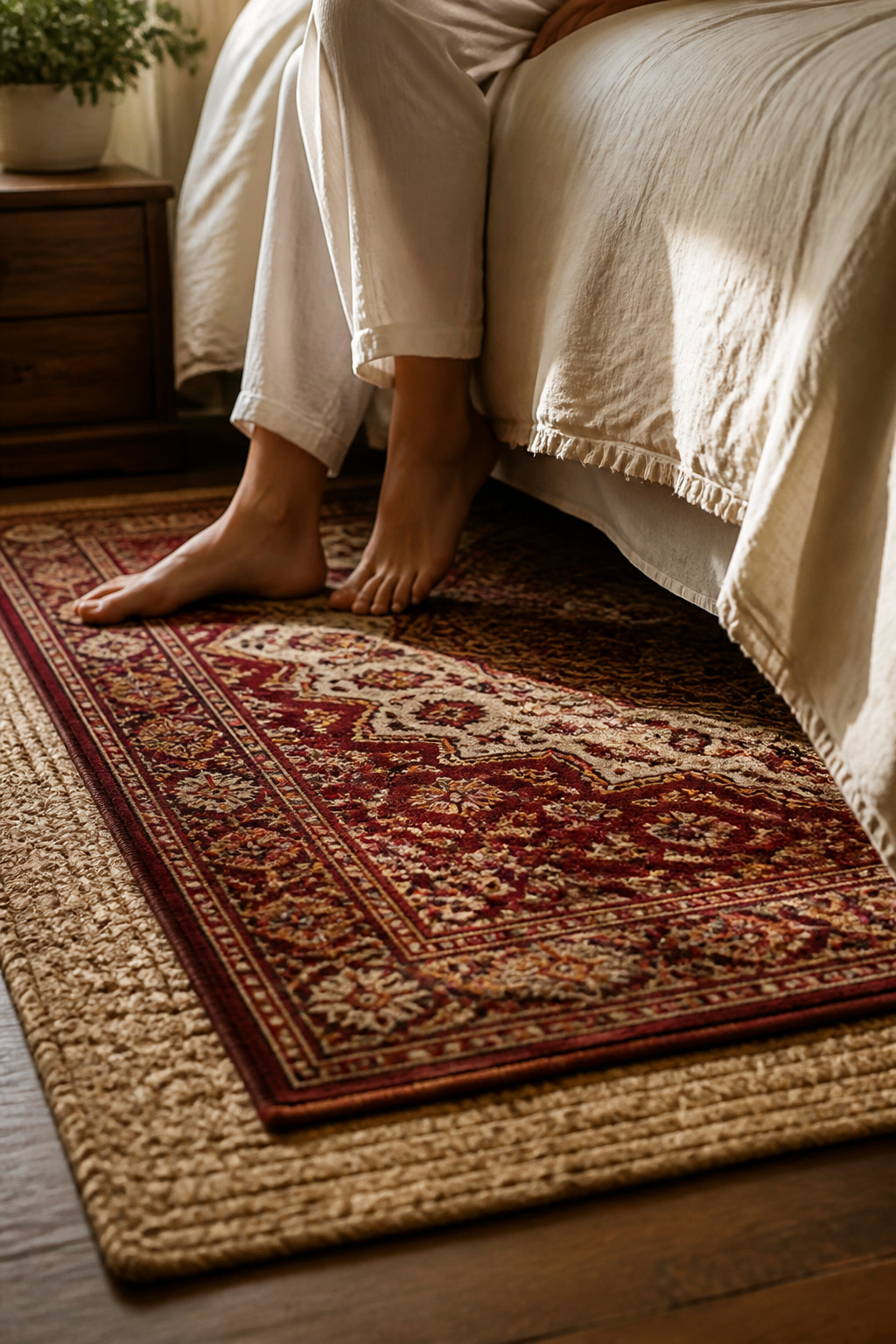
The two-layer formula is straightforward. A large natural jute or sisal rug — 8 by 10 feet for a queen bed, 9 by 12 for a king — provides the structural base layer and extends at least 18 inches on each side of the bed. On top of this, center a smaller, softer rug: a vintage Persian in burgundy and ivory is the most romantically effective choice, but a tufted wool rug in any warm solid or geometric pattern works just as well. The 5-by-8-foot size sits cleanly atop the larger base rug with enough jute visible at the edges to create the layered effect.
For budget-conscious romantic bedroom decorating, the base layer doesn’t need to be expensive — IKEA and H&M Home both sell serviceable jute rugs for under $100. The statement comes from the top layer, where a vintage market or Etsy find in a Persian or Moroccan style adds the pattern and visual richness. Spend where it’s seen and felt; save on what’s mostly hidden.
9. An Antique-Style Vanity Table With a Statement Mirror
A bedroom vanity table is one of the most underrated pieces of romantic bedroom decor, and not primarily because of how it looks. It’s because of what having one does to how the room is used. A dedicated place to sit, to apply perfume, to arrange your hair before bed, makes a routine feel ceremonial. That quality of attention — the daily ritual elevated to something worth the right furniture — is at the heart of what romance in a space actually means.
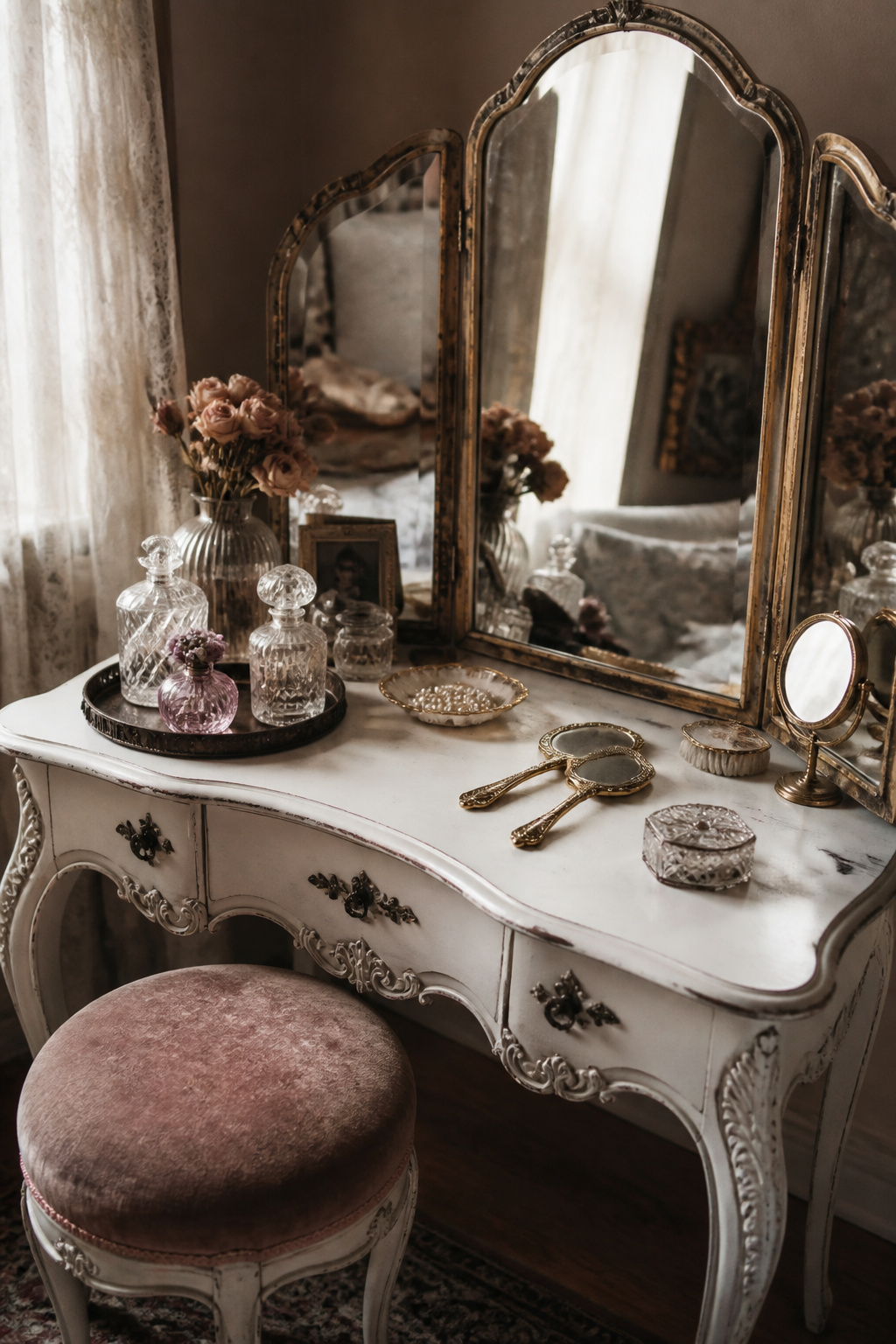
Look for a piece with curvilinear lines — the cabriolet or Queen Anne leg, the serpentine front, the curved apron — rather than straight, rectilinear modern construction. These curves signal a different relationship with function; they prioritize beauty alongside utility. Estate sales and online consignment sites (Chairish is particularly good for this) consistently offer better options than retail furniture stores at comparable or lower prices.
The mirror matters enormously. A tri-fold mirror at eye height when seated (the center of the mirror should be approximately 30 to 34 inches from the floor when you’re seated) is the most functional option. A single oval or arch-top mirror in a carved gold frame is the most romantic. Style the surface with three to five objects that have genuine personal meaning — a crystal perfume bottle, a small vase of dried flowers, a jewelry dish — and leave the rest of the surface clear.
10. Fresh Flowers and Trailing Indoor Plants as Living Decor
There is something that no arrangement of objects can replicate: the quality of attention a living plant requires. Fresh flowers and growing plants communicate abundance and care in a way that is immediately and viscerally felt, even if the observer can’t articulate why. For romantic bedroom decor, that quality of living presence changes the whole feeling of the room.
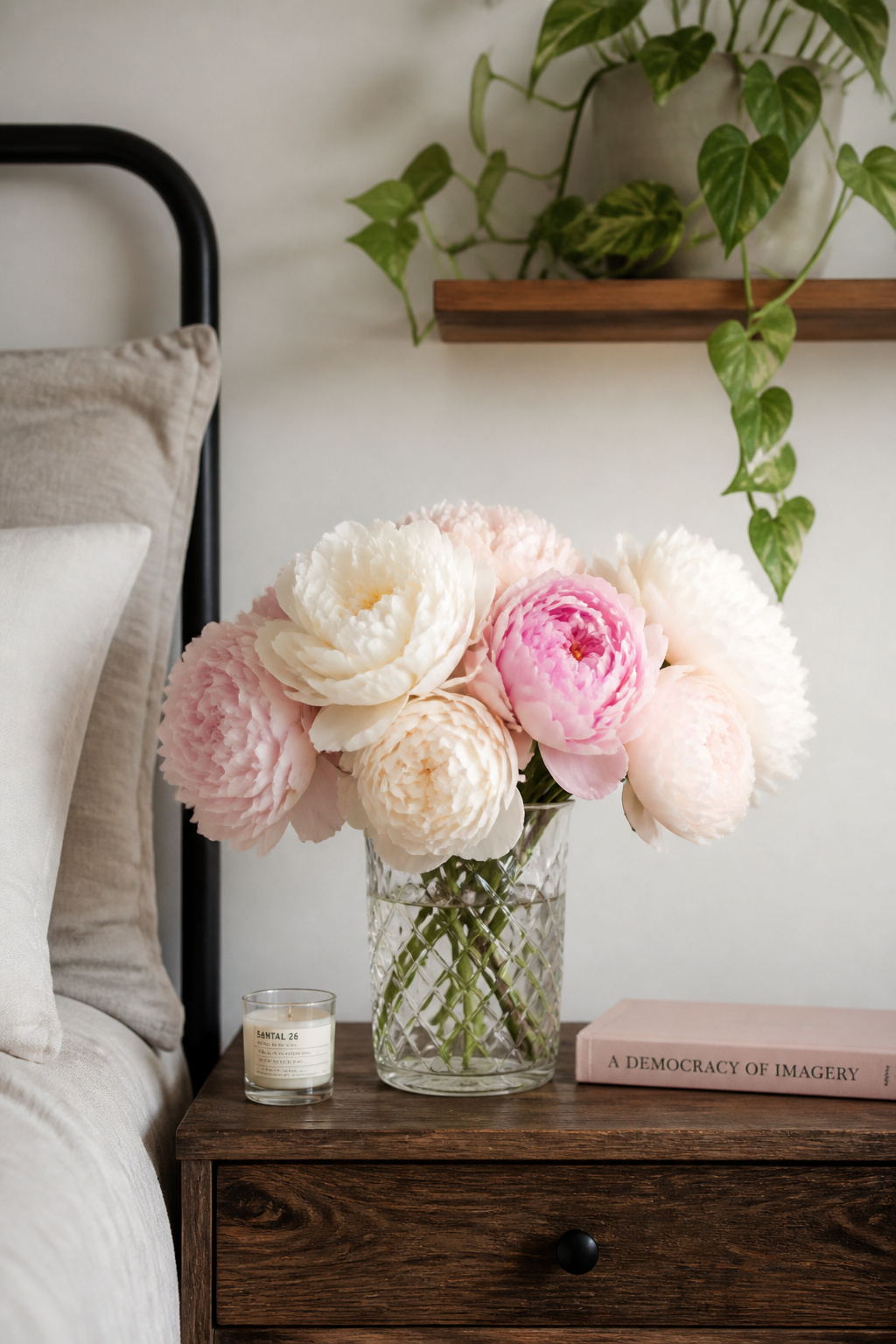
For romantic bedroom decor, peonies are the most effective cut flower available: they open slowly over three to five days, fill the room with a gentle fragrance, and in full bloom have a lush, almost excessive quality that reads as genuinely generous. Cream, blush, and deep pink varieties all work in warm bedroom palettes; keep them in clean water changed every two days and away from direct sunlight to extend their life.
For ongoing living decor between fresh flower deliveries, a trailing pothos on a wall-mounted shelf brings the same quality of living presence without the upkeep. Pothos tolerates low light, irregular watering, and the slightly drier air of a bedroom without complaint. One practical note: avoid lilies in the bedroom if you’re planning to sleep with the flowers in the room overnight. Their fragrance — lovely in a larger space — can become overwhelming in an enclosed bedroom for eight hours.
11. Candlelight Wall Sconces — Timeless Romantic Bedroom Decor
Wall sconces occupy a specific role in the history of romantic bedroom decor that no other light source has managed to replace. They provide light at exactly face height, which is the most flattering angle at which to be lit. They eliminate the overhead shadow that ceiling fixtures cast. And they evoke, however subtly, the quality of firelight — the oldest human experience of warmth and safety after dark.
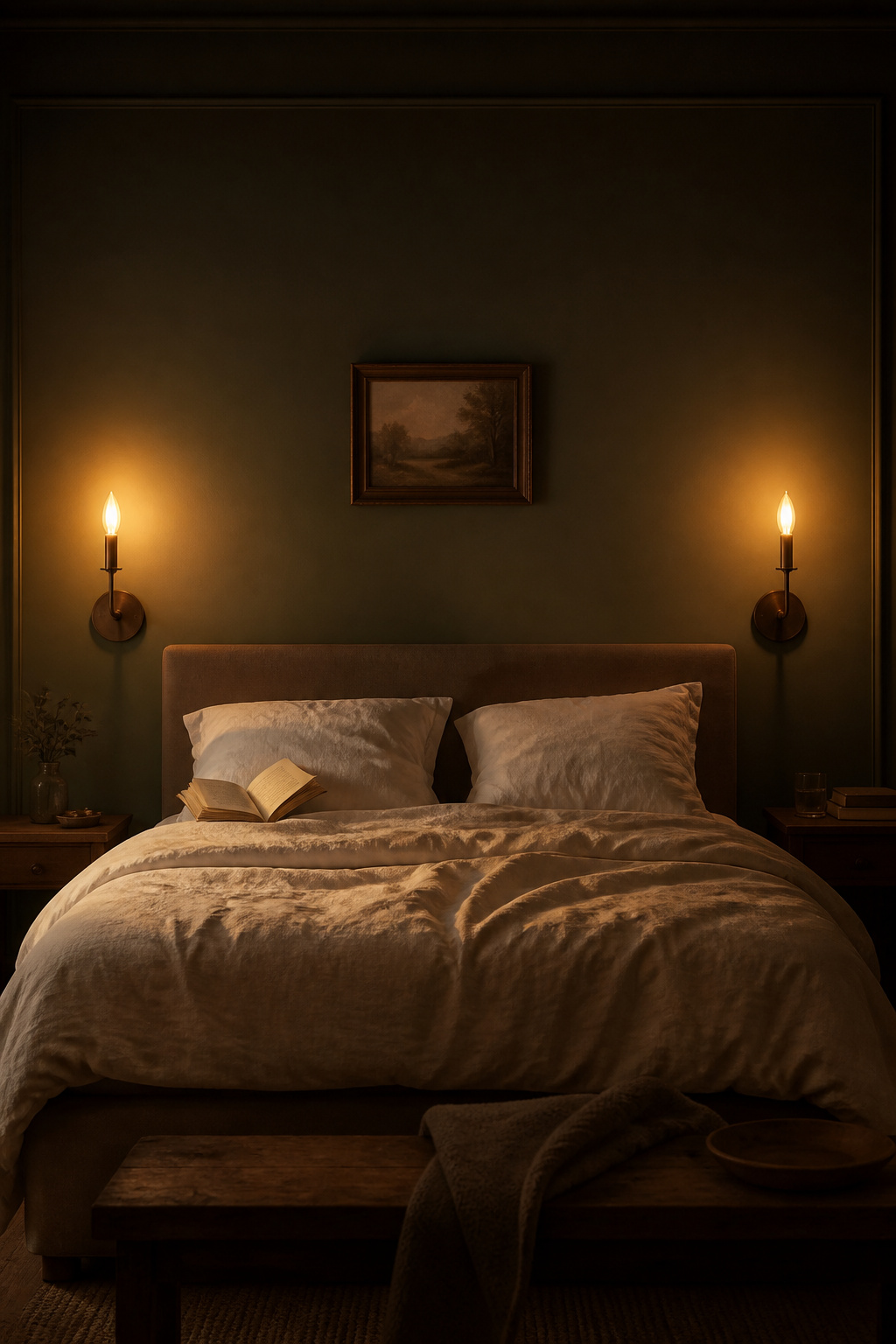
The installation specifications for bedside sconces are specific enough to be worth knowing precisely. Mount them at 60 to 65 inches from the floor — this puts the center of the light source at the right height for someone sitting up in bed, without being so high that the light shines down rather than across. Position them 30 to 36 inches out from the center of the headboard on each side, which places them directly above the nightstand zone.
For more bedroom lighting inspiration covering chandeliers, floor lamps, and pendant options, there’s a full exploration of layering strategies that work in tandem with sconces. In terms of bulbs, LED flame-tip candelabra bulbs produce the closest equivalent to wax candlelight without the fire risk — they flicker slightly at the tip and cast a warm amber glow that’s far more romantic than a standard round LED. And if the prospect of electrical work is a barrier, plug-in sconces require no wiring at all and can be positioned with a single screw into the wall.
The Case for Layering Multiple Sources
The most effective approach to romantic bedroom lighting uses sconces as the primary ambient source, supplemented by a bedside lamp for reading and one or two candles for atmosphere. This three-source layering means no single element has to work too hard, and you can adjust each independently to shift the mood.
12. Silk and Satin Curtains for a Luxurious Window Finish
Silk responds to light differently from any other curtain fabric. Move past a silk curtain panel toward a window, and the fabric goes from opaque to translucent, from ivory to gold, from flat to luminous — all in the space of two or three steps. That quality of physical response to light is what makes silk, or a convincing faux-silk satin, one of the defining materials of romantic bedroom decor.
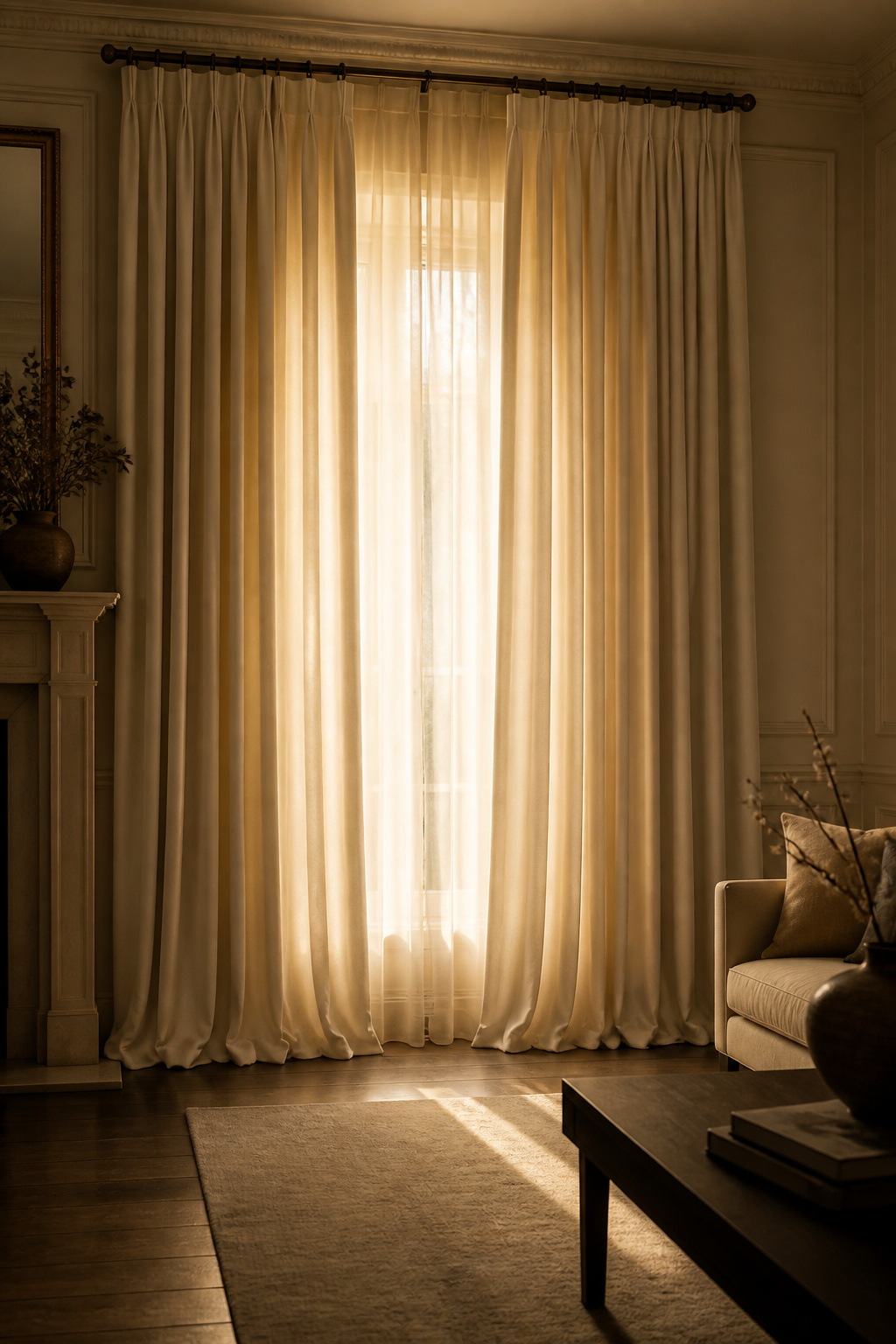
The installation detail that separates professional results from DIY-adjacent ones is the rod placement. Mount the rod 4 to 6 inches above the top of the window frame (not directly above it, but several inches above), and extend the rod 6 to 12 inches past the frame on each side. This creates the impression of a much larger, more architecturally significant window than actually exists. Then hang the curtains from floor to ceiling regardless of where the window starts.
For the fabric itself, faux silk (a high-quality polyester satin) achieves roughly 80 percent of the visual effect of genuine silk at around 20 percent of the cost. Look for panels described as “satin,” “faux silk,” or “duchess satin” — the key quality indicator is the sheen, not the fiber content. Layer a sheer voile panel beneath the satin for daytime softness; at night, draw the heavier panels and the room feels entirely enclosed.
13. A Tufted or Carved Statement Headboard as the Room’s Anchor
The headboard is the visual center of the bedroom. Every other romantic bedroom decor decision — the canopy, the bedding, the sconces, the color palette — either supports the headboard or competes with it. Getting this piece right sets the foundation for everything else.
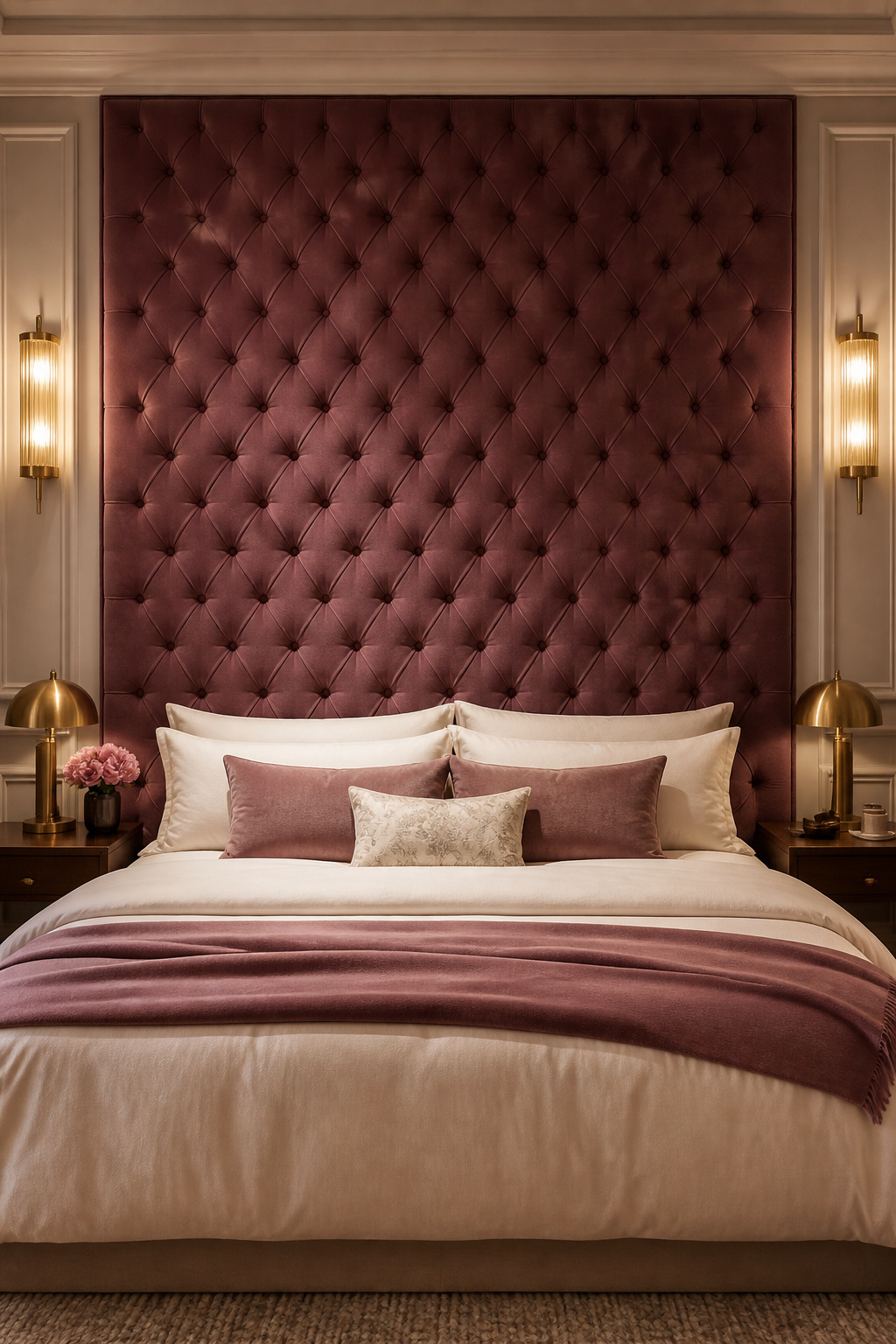
For the most romantically effective headboard, button-tufted velvet is the clear first choice. The tufting creates both visual depth (the alternating light and shadow across the fabric surface) and a sense of craft — it’s unmistakably handmade, with each button requiring individual placement. A height of 60 to 80 inches is the sweet spot for drama: tall enough to make a statement against the wall, but not so tall that it crowds out ceiling space in standard 8-foot rooms. Dusty mauve, deep teal, and a warm forest green are the velvet colors that work best alongside most romantic bedroom color palettes.
For bedroom ideas for couples that take the headboard as a starting point, the most effective approach is to choose the headboard before anything else and build the textile palette around it. If carved wood is preferred over upholstered velvet — a Chinese-influenced carved headboard or an Indian-style hand-carved panel can be deeply beautiful in this context — the same proportional rules apply.
The DIY option deserves honest consideration. An upholstered plywood headboard requires a sheet of 3/4-inch plywood cut to your desired shape, 3-inch foam cut to match, batting, and your chosen fabric stapled to the back. The total material cost for a king headboard is typically under $150, and the result looks indistinguishable from retail versions selling for $400 to $600.
Choosing Between Tufted and Carved
Tufted upholstered headboards are the warmer, more sensory choice — touch-inviting and soft-looking even from across the room. Carved wood headboards have a sculptural quality that tends to suit rooms with harder surfaces (stone floors, plaster walls) where the carving provides the room’s primary softness. For most bedrooms, upholstered wins.
14. A Gallery Wall of Memories: Romantic Bedroom Ideas for Couples
A gallery wall is one of the oldest and most effective romantic bedroom ideas for couples, and the reason is simpler than most decorating advice acknowledges: a bedroom that contains images of the people in it is a bedroom that feels inhabited, personal, and chosen — which is exactly how romantic bedroom decor should feel.
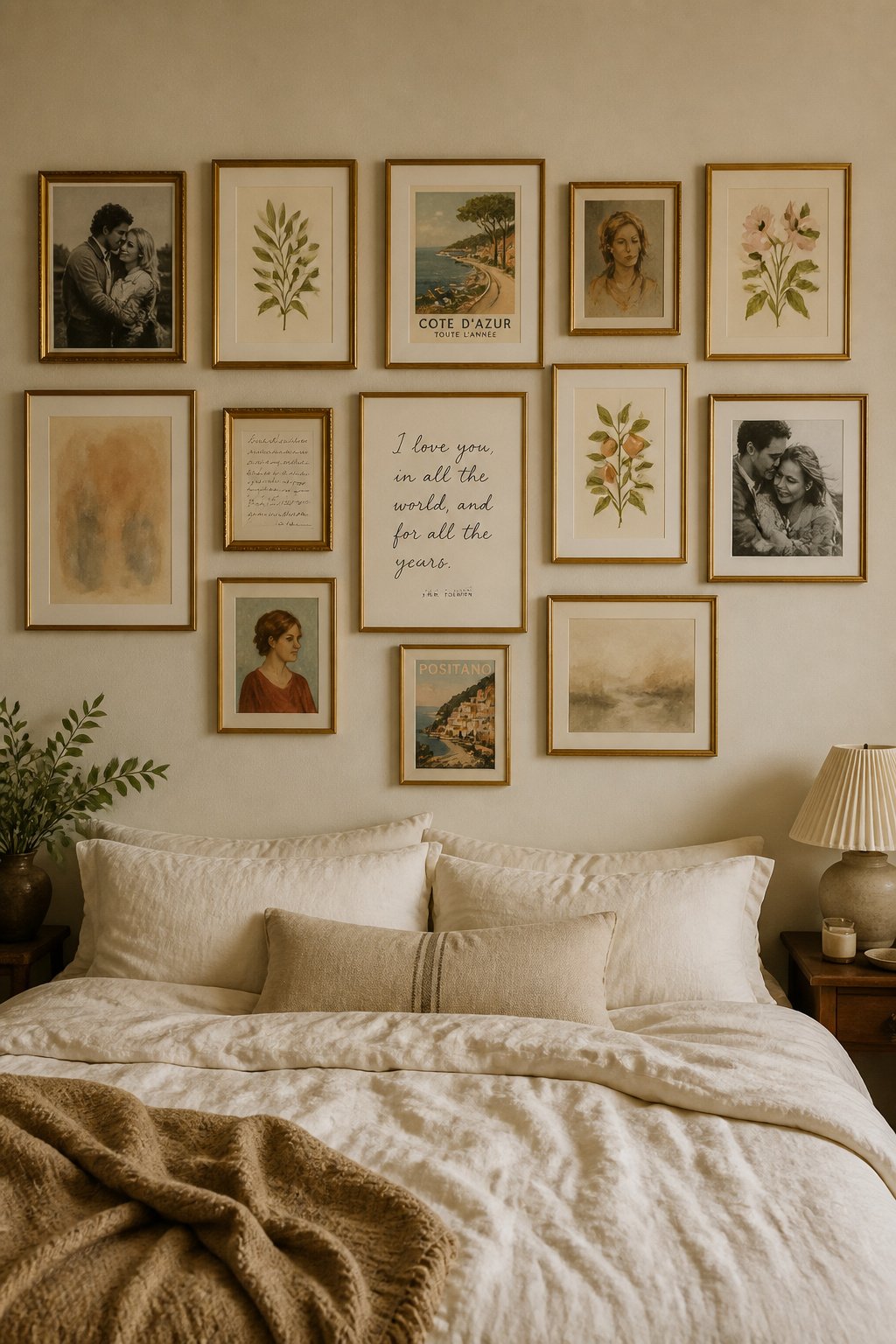
The composition principle for bedroom gallery walls is to mix personal photographs with art prints rather than using exclusively one or the other. All photographs creates something closer to a family photo wall; all art creates a beautiful but impersonal space. The combination — your own photographs printed at 5 by 7 or 8 by 10 inches, interspersed with botanical or abstract prints — creates a wall that tells a story about the people who sleep in the room.
Frame color should be consistent even if the frame style varies. All gold, all black, or a mix of antique and modern gold reads as curated. A mix of black and gold, or wood and metal, reads as accidental. For the arrangement itself, lay everything out on the floor first, photograph it, and then replicate the layout on the wall. Center the overall composition at 57 to 60 inches from the floor. For more bedroom wall decor ideas covering mirrors, textiles, and sculptural approaches, the gallery wall is one option among many that work at this scale.
Command strips are the right choice for renters — each standard Command strip holds up to 4 pounds, sufficient for most framed prints at the sizes we’re working with.
15. Scented Candles and Reed Diffusers for Sensory Ambience
Scent reaches the emotional brain faster and more directly than any other sensory input. This is documented neurological fact: the olfactory system has a direct connection to the limbic system in a way that vision, sound, and touch do not. For romantic bedroom decor, this means that getting the fragrance right can shift the feeling of a room in ways that no visual change fully replicates.
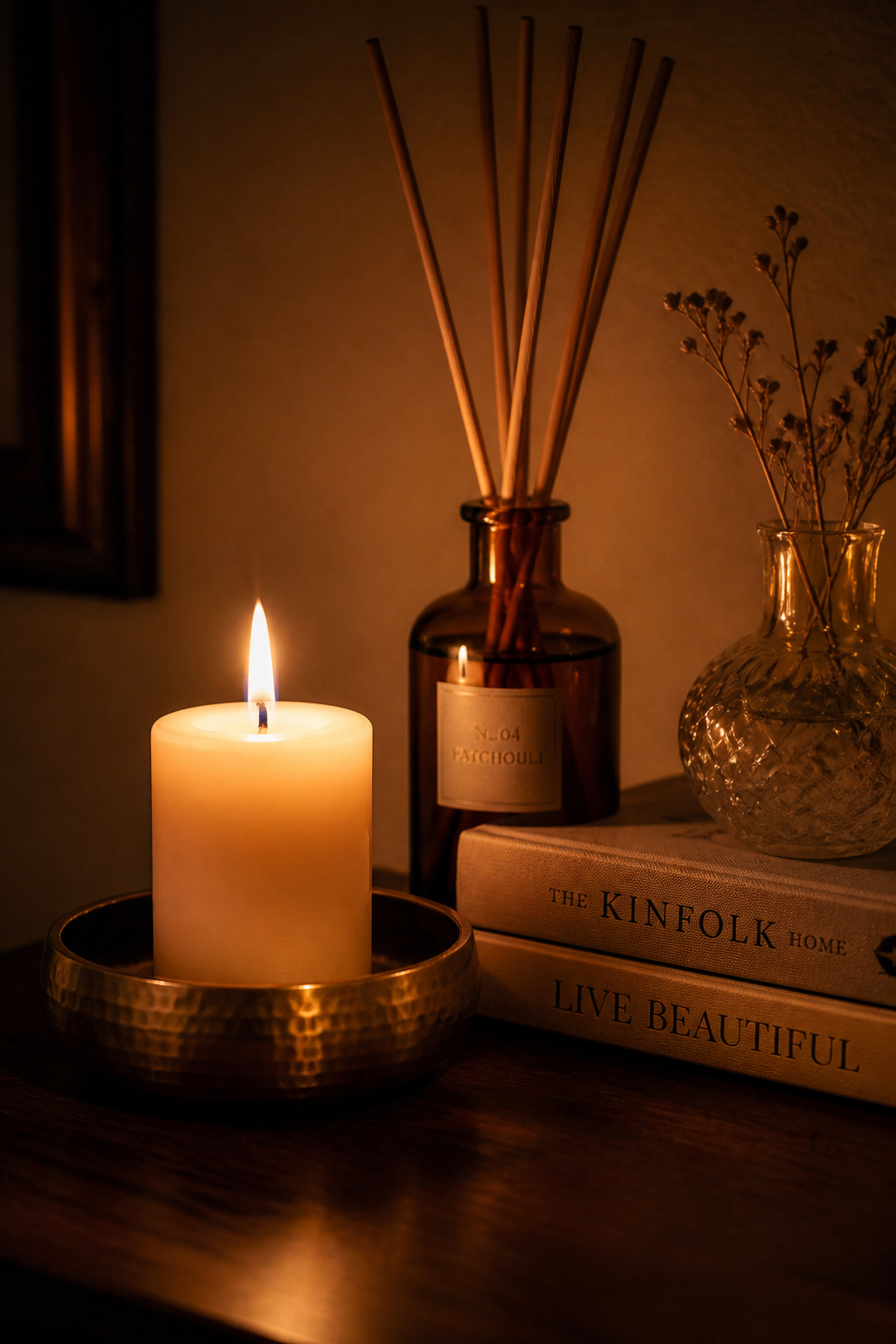
The most effective romantic fragrance notes for a bedroom are rose, sandalwood, ylang-ylang, and vanilla — individually or in combinations. Rose carries obvious connotations but also has a genuinely calming effect on the nervous system that supports the kind of relaxation that romance requires. Sandalwood adds a warm, woody base that prevents lighter floral notes from reading as sweet. Vanilla is the most universally comforting note in the palette — and comfort is, in the end, the precondition for romance.
For specific products, Diptyque’s Baies candle (a blend of blackcurrant and rose) and Brooklyn Candle Studio’s Love Potion (rose and sandalwood) are among the most effective single-candle options available. For ongoing background fragrance, a reed diffuser in the same scent family as your candles creates a layered approach — the diffuser provides continuous subtle presence, while the candle provides intensity when you want it. Don’t burn candles for more than two to four hours at a sitting; beyond this, the fragrance becomes oversaturated and loses its effect.
Also: resist the urge to layer multiple different fragrances. One candle and one diffuser in the same scent family, kept to one area of the bedroom (typically the nightstand or dresser), is enough.
16. Vintage-Inspired Bedside Tables With Personal Touches
The bedside table is the most personal piece of furniture in the house. What you keep beside your bed — the things you reach for last before sleep and first upon waking — constitutes a kind of autobiography. For romantic bedroom decor, this means that the styling of the bedside table matters disproportionately to its size.
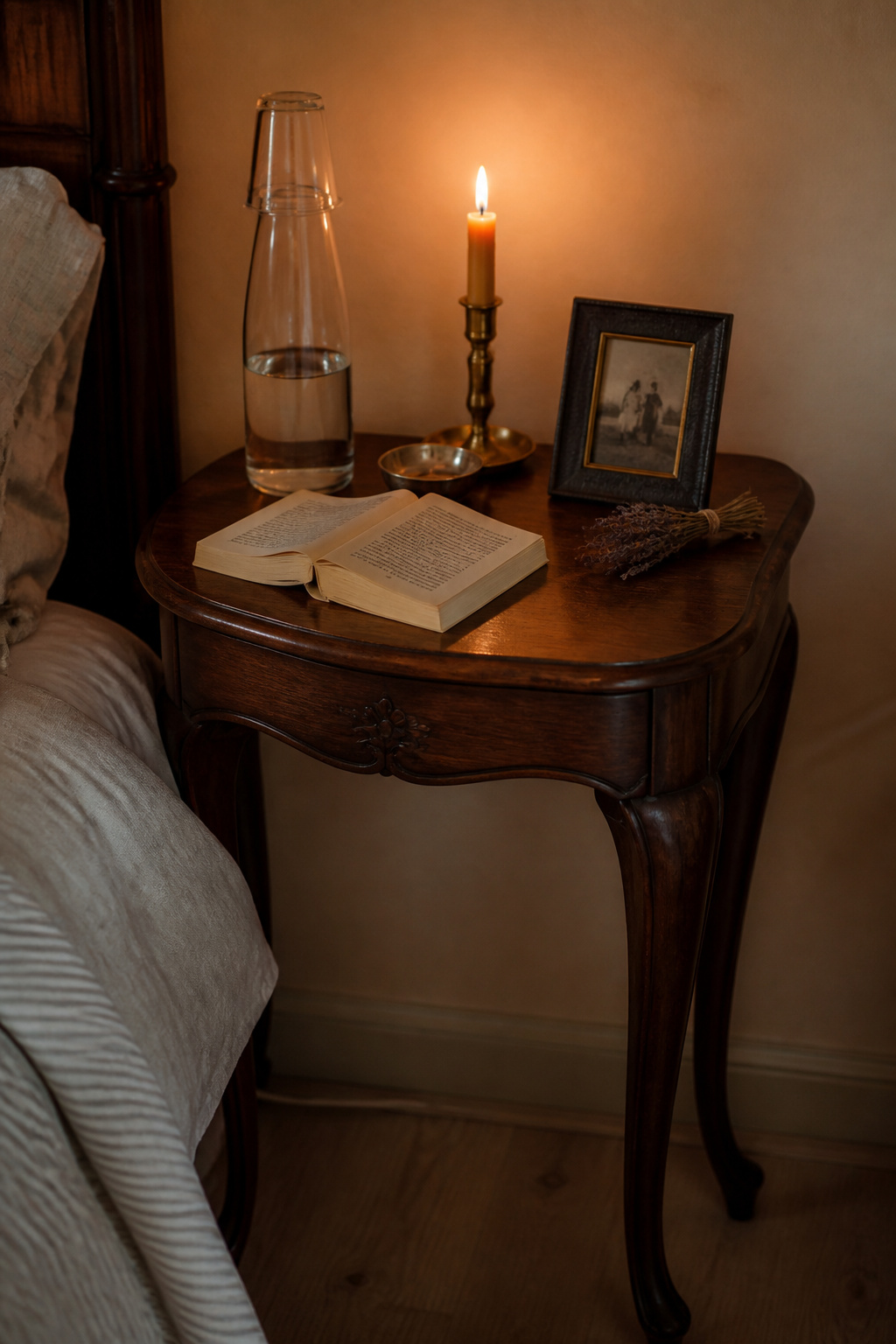
For the piece itself, look for Victorian-era side tables or French provincial-style tables with curved legs, turned posts, or carved aprons. Estate sales consistently yield beautiful examples for $30 to $80 — genuinely the best source for this specific style. Online, Chairish and eBay’s antiques category are worth checking weekly, as good pieces move quickly.
For the surface styling, a formula that avoids both cluttered and sterile: a lamp (or candle if a lamp lives on the other side), one carafe and glass for water, your current reading, one small personal photograph or meaningful object, and one small living element (a fresh flower or a dried posy of lavender). Five things at most, in that mix. Mismatched bedside tables — same height, different style — can look entirely intentional if the objects on each surface are styled with equal care.
Putting It All Together: Your Romantic Bedroom Decor Plan
The most common mistake in approaching romantic bedroom decor is attempting to change everything at once and discovering that nothing feels different because nothing feels chosen. The bedroom that genuinely feels romantic is almost always the product of sequential decisions made with real intention, each one building on the last.
Start with structure. A canopy, a statement headboard, or a dramatic accent wall — pick one, and commit to it fully. These are the changes that alter the fundamental character of the room, and they create the framework everything else builds against. Then address lighting: install a dimmer, add a sconce, swap in warmer bulbs. The lighting change will make you understand your structural choice differently, and probably suggest the next move.
From there, the textile and sensory layers can come in over time. Velvet bedding, a layered rug, silk curtains, fresh flowers on the nightstand — none of these require simultaneous investment. In fact, living with each change long enough to understand what it contributes tends to produce better results than a single overhaul. You’ll discover that you care less about the gallery wall than you thought, and more about having the right fragrance in the room every night.
The best romantic bedroom decor always reflects the people who inhabit it. Not a Pinterest board, not a hotel room, and not someone else’s idea of what romance looks like. The specific flowers you love, the colors that genuinely make you feel something, the photograph that matters to you — these are the elements that can’t be sourced and can’t be styled by someone else. Start with those, and build outward from there.