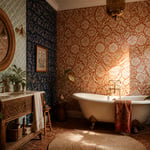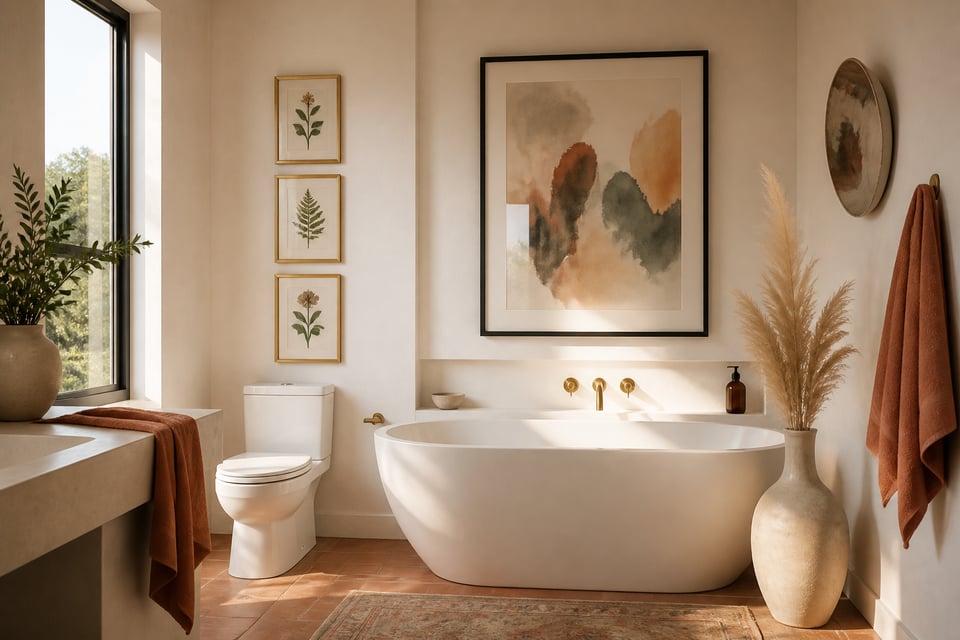
The bathroom is the most underestimated canvas in your home. People spend thousands on kitchen splashbacks and living room feature walls, then hang a single mass-produced print above the toilet and call it done. But bathroom art ideas, when executed with genuine intention, land with a force that art in larger rooms rarely achieves — because in this small, ritual-laden space, you actually stop and look. You look every morning. You look while the water heats up. You look in the quiet of a long soak.
I’ve spent years working with colour, cultural art, and the way a single well-chosen piece can change the emotional register of a room. What I keep discovering is that the bathroom rewards boldness more than any other room in the house. It is small enough that one strong piece does everything. It is private enough that you can take risks you might hesitate over in the living room.
From botanical gallery walls and hand-painted ceramic mosaics to monsoon-palette textiles and shadow box displays, these seventeen bathroom art ideas span every budget and aesthetic. Some will take an afternoon. Others will send you to a maker’s market or down an Etsy rabbit hole. All of them are worth it.
1. Botanical Print Gallery Wall as a Nature-Inspired Anchor
Watercolour botanicals in soft greens and whites are the most chosen bathroom art type among interior designers, and it is not hard to understand why. The visual softness of a watercolour wash contrasts beautifully with the hard geometry of tiles and the reflective hardness of fixtures — it brings something alive into a room otherwise dominated by manufactured surfaces. As bathroom art ideas go, this is the one with the most room for interpretation: a single framed specimen above the toilet is just as valid as a full gallery wall spanning a blank bathroom wall.
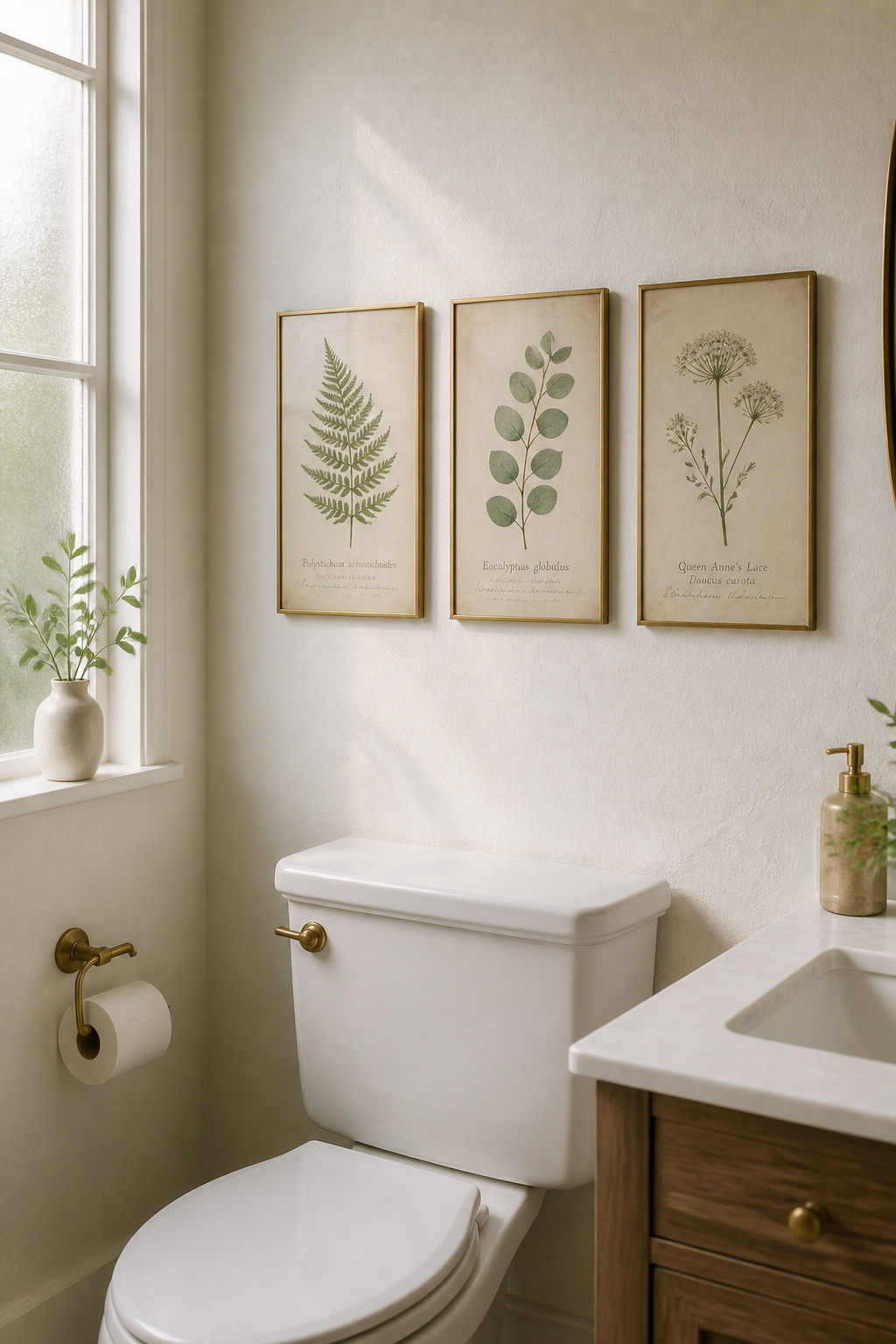
Building a gallery wall with botanicals requires a little planning before you hang a single nail. Lay everything out on the floor first within a tape outline matching your wall zone, photograph from directly above, and use that image as your hanging reference. Keep 2-4 inches between frames for a tight, intentional look, and aim for the visual centre of the group at 57-60 inches from the floor. The largest frame goes at the centre; smaller pieces build outward from it in a loose staggered arrangement — not in a rigid row, which reads as décor rather than collected art.
For sourcing, vintage herbarium plates from the 18th and 19th centuries are available through eBay and specialist botanical art dealers — look for hand-coloured engravings with visible plate marks. Contemporary illustrators sell on Society6 and Etsy; filter by ‘archival ink printing on acid-free paper’ if you want longevity in a humid space. And for bathroom use specifically, always choose prints sealed behind glass or acrylic. Open canvas botanical prints warp within weeks in a poorly ventilated bathroom.
2. Framed Pressed Flowers: Vintage Botanical Art for Bathrooms That Feels Collected
There is something compelling about pressing a living flower between heavy pages and framing it so that it lasts for decades. Pressed botanical art turns the ephemeral into the permanent — which is exactly the right philosophy for a bathroom, a room built around the rituals of renewal.
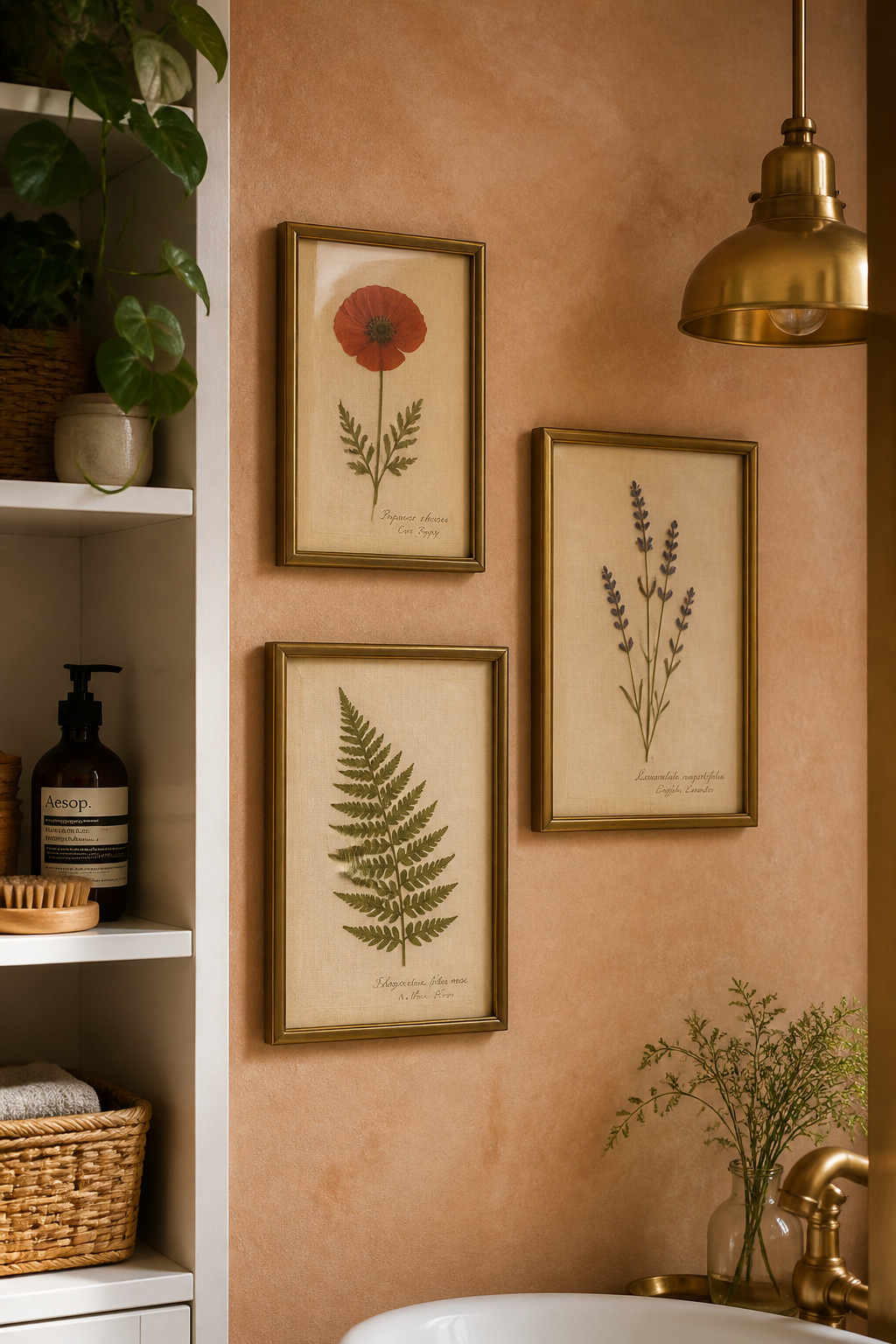
The highest-end version of this idea is a genuine vintage herbarium specimen: pressed plants mounted on aged paper with handwritten Latin species names, often hand-coloured. Nineteenth-century examples appear through estate sales and specialist dealers for $40-200, and they carry a visual layering — botanical detail, aged paper, hand inscription — that mass-produced prints simply cannot replicate. For a solid comprehensive bathroom wall art guide covering framing considerations, that resource is worth bookmarking before you buy frames.
If you want to make your own, the process is straightforward: press flowers between heavy books for 2-4 weeks, arrange on acid-free card, and seal behind UV glass in a closed frame. Sealed glass is essential — moisture causes pressed petals to wilt and develop mildew within weeks in an unprotected frame. For arrangement, groups of three work better than pairs — odd numbers create visual movement. Arrange them in a loose triangle rather than a rigid row, and keep the whole grouping at least 24 inches from the shower.
3. Abstract Watercolor Art to Add Quiet Drama Without Competing With Tile
Abstract watercolour is one of the most versatile bathroom art ideas precisely because its inherent softness — bleed edges, transparent washes, irregular colour distribution — does something clever with the room’s dominant surfaces. It contrasts rather than competes. Tile is rigid, geometric, and repetitive. A watercolour wash is none of those things.
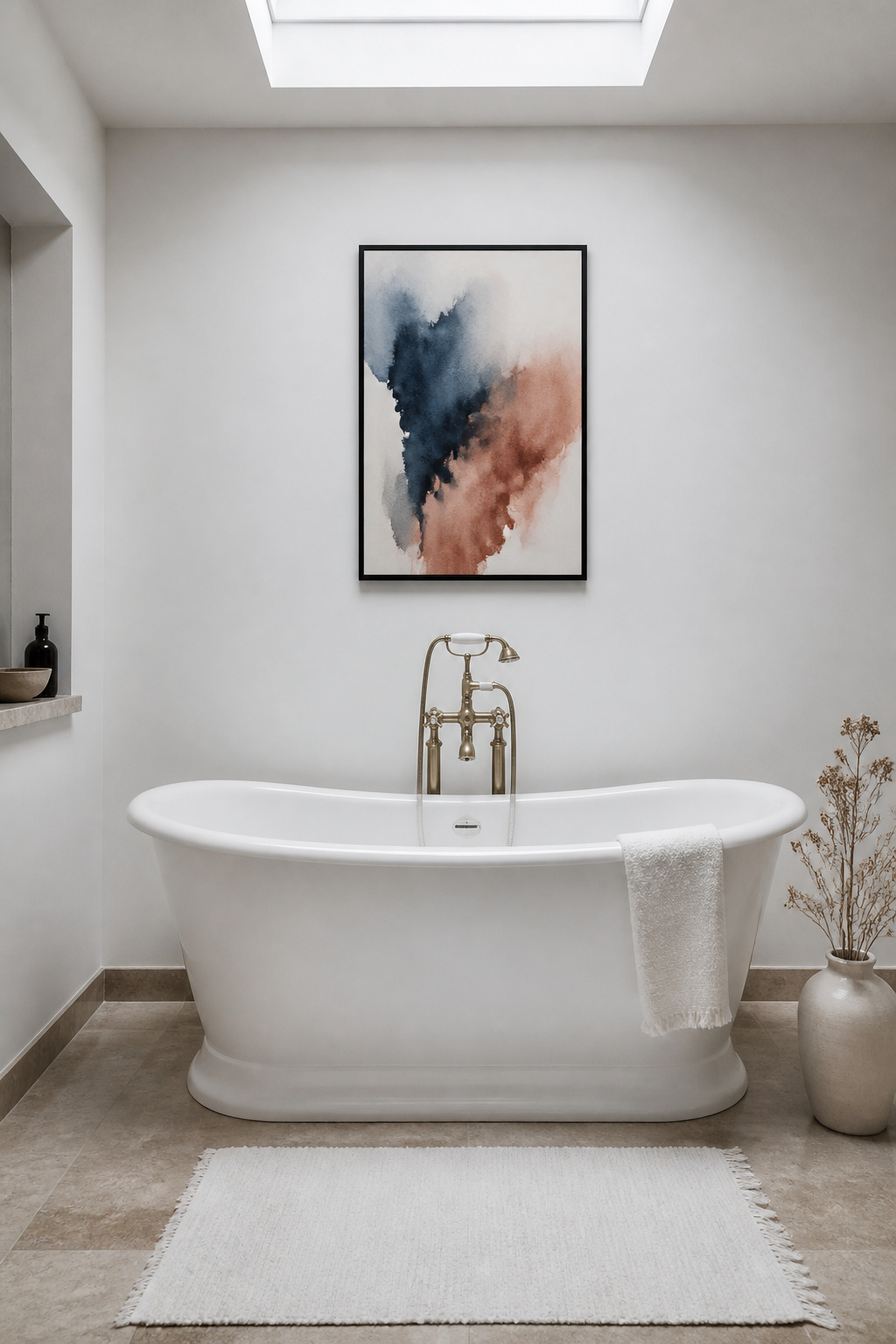
Blues and greens are the dominant colours in the most effective bathroom watercolours because they echo water itself. But in 2026, warm terracotta and indigo washes have emerged as a compelling alternative — deeper, more saturated, and more surprising in a context where people expect blue. The most practical approach to colour selection is this: pull one tone from your tile grout or fixture finish and look for a print that contains that tone. That single connection is enough to make the piece read as chosen rather than placed.
For format: A4 or A3 prints in quality frames work well in powder rooms. A 40x60cm print creates good presence above a towel rail without overpowering the wall. Look for ‘giclee’ or ‘archival inkjet’ printing — pigment-based inks resist fading far longer than dye-based alternatives. And for bathroom placement, behind waterproof and humidity-resistant wall art options matter more than the print’s price. A giclee print on archival paper behind UV glass is genuinely indistinguishable from an original at normal bathroom viewing distances.
4. Mandala and Geometric Prints for a Meditative, Pattern-Rich Bathroom
The word ‘mandala’ comes from Sanskrit — it means ‘circle’ or ‘center’ — and for thousands of years in Hindu and Buddhist practice, mandalas have served as visual meditation tools representing the universe. In Tibetan tradition, they are created from coloured sand in rituals lasting days, then ceremonially destroyed. The finished print you hang is a permanent echo of something traditionally impermanent. As a bathroom art idea, this cultural depth is part of what makes mandala art so appropriate for a room of daily ritual.
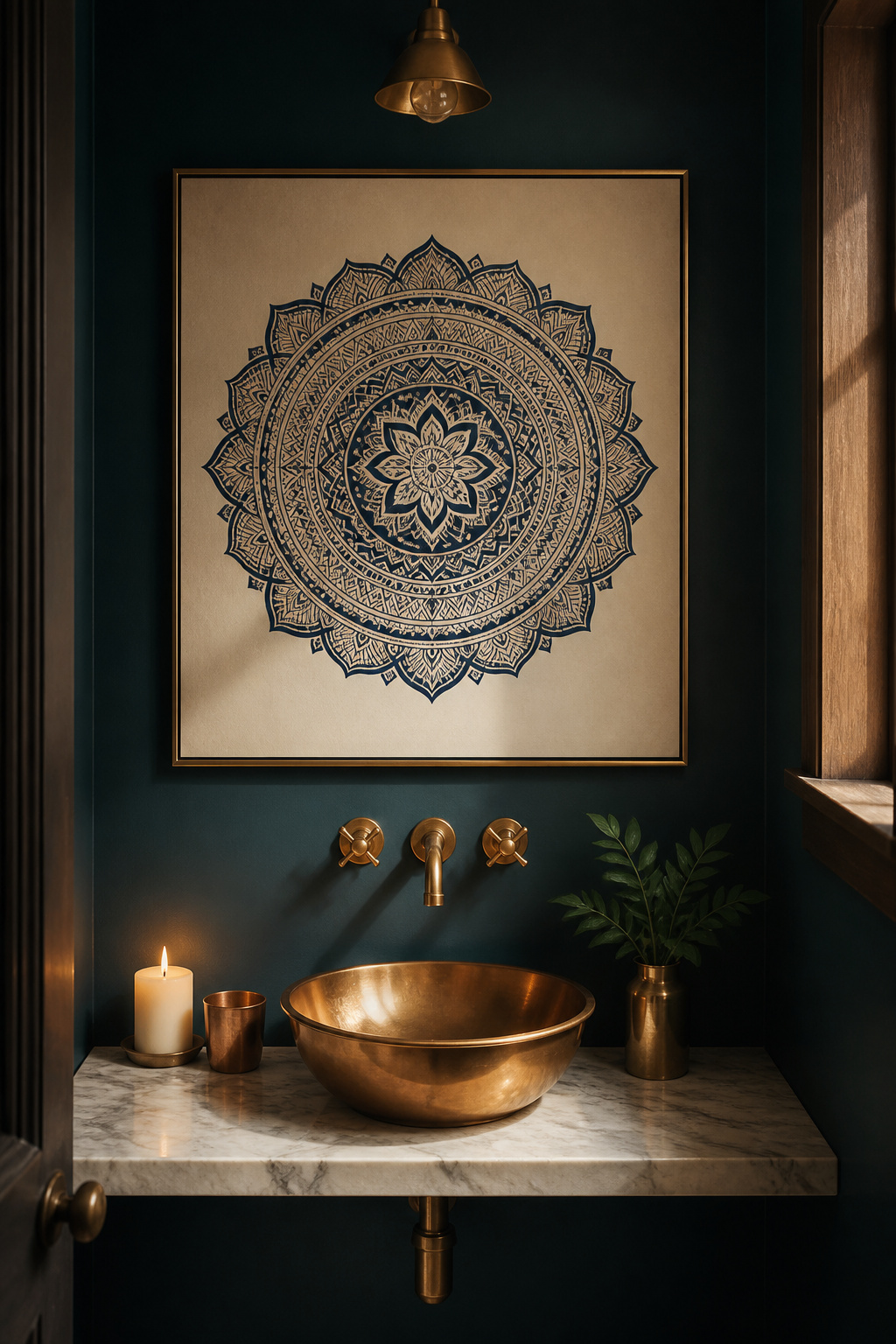
That philosophical quality is what makes mandala art so well-suited to a bathroom. This is the room where you brush your teeth, wash your face, perform the small rituals that structure your day. Radial symmetry creates a visual stillness — the eye finds the centre and rests there, rather than moving restlessly around the composition.
Scale decisions matter more here than most people expect. One large mandala — 18-24 inches — as a solo piece above the toilet or on the wall opposite the vanity reads as a deliberate statement. Clusters of smaller mandalas tend to read as busy and less intentional. If your tile is already geometric or patterned, choose a mandala with soft organic curves rather than sharp geometric edges — the contrast reads better than competing geometries fighting for the same visual register. For a humidity-tolerant option, laser-cut metal mandalas (steel or aluminium) add sculptural depth and are entirely moisture-resistant. Kufi Studio and similar artisan metalwork suppliers offer pieces that work as both print and sculpture.
5. Bathroom Wall Art in Brass and Black Frames: How Metal Choices Change Everything
Frame selection is the most underrated decision in bathroom art, and metal finish is the most powerful variable within it. The same print in a brass frame and in a matte black frame are, in effect, two different pieces of art. They sit differently in the room, they reference different aesthetics, and they interact differently with the other surfaces around them.
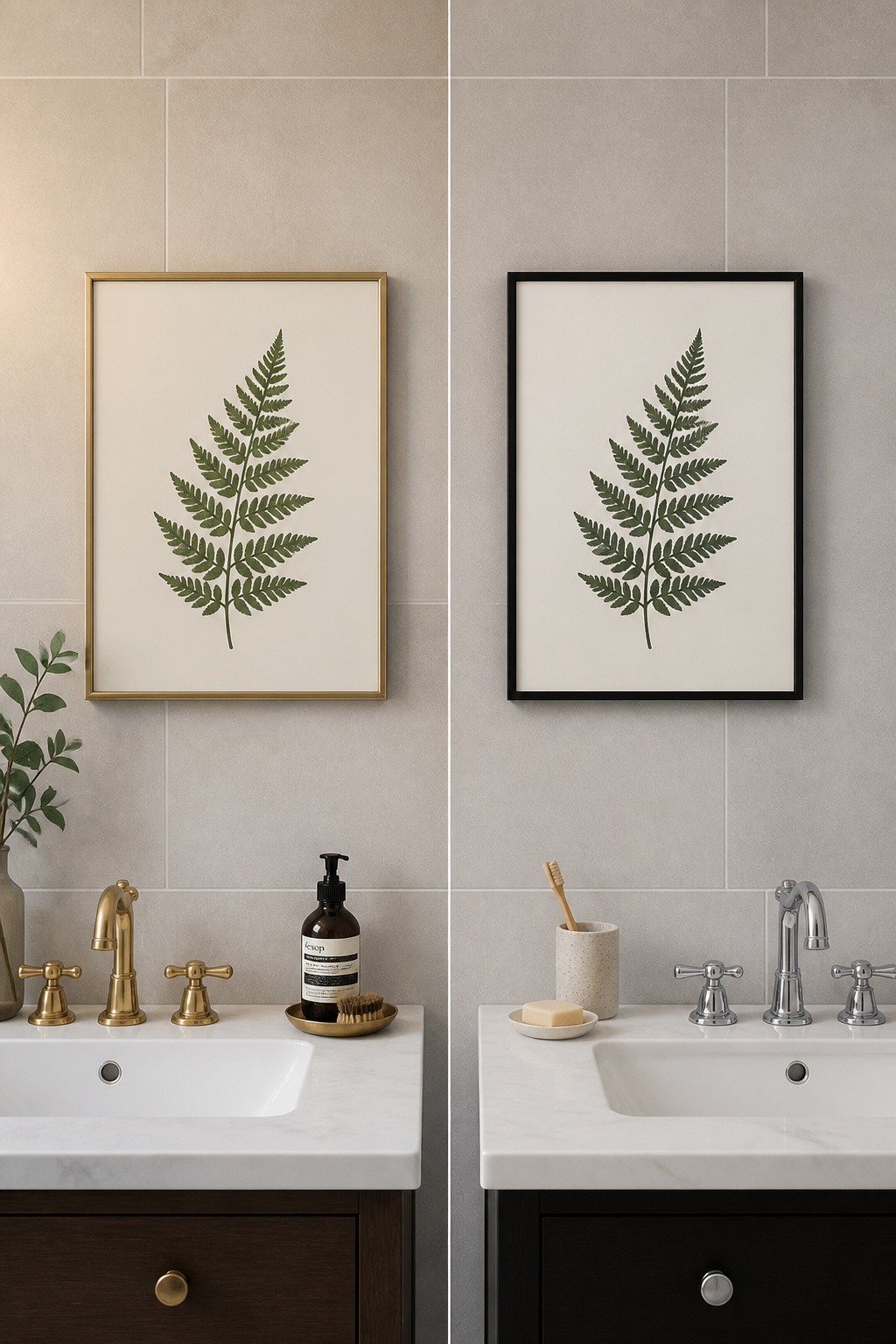
Brass frames warm every art type they hold. They suit botanical prints, cultural watercolours, and textile-inspired work. Matte black frames are the most neutral and versatile — they work with cool, warm, and neutral art palettes and suit contemporary, industrial, and Scandinavian bathroom aesthetics equally well. The single most important rule is to match your frame finish to your tap finish — brass frames with brass taps, matte black frames with matte black fixtures. This single coordination makes even modest prints look considered. For different bathroom wall art styles that work with different fixture finishes, the choice of frame finish is always the first decision, not the last.
One practical upgrade that most people skip: spray-paint cheap frames. Rust-Oleum and Krylon both make metal-finish sprays that give charity shop finds a professional result in 20 minutes. IKEA’s RIBBA frames accept standard print sizes and cost $5-15; spray-painted matte black or satin brass, they are visually indistinguishable from boutique options. The one material to avoid for bathroom frames is MDF-core — it swells and warps in humidity within months even when sealed. Choose solid wood, metal, or acrylic.
6. Hand-Painted Ceramic Tiles as a Living Mosaic on Your Bathroom Wall
A group of hand-painted tiles arranged as a mosaic on a blank wall is a fundamentally different kind of art from anything you can hang in a frame. The edges are irregular. Each tile is slightly different from the next because the glaze was applied by hand. And unlike a print, this bathroom art idea becomes part of the room’s architecture — it does not just sit on the wall, it belongs to it.
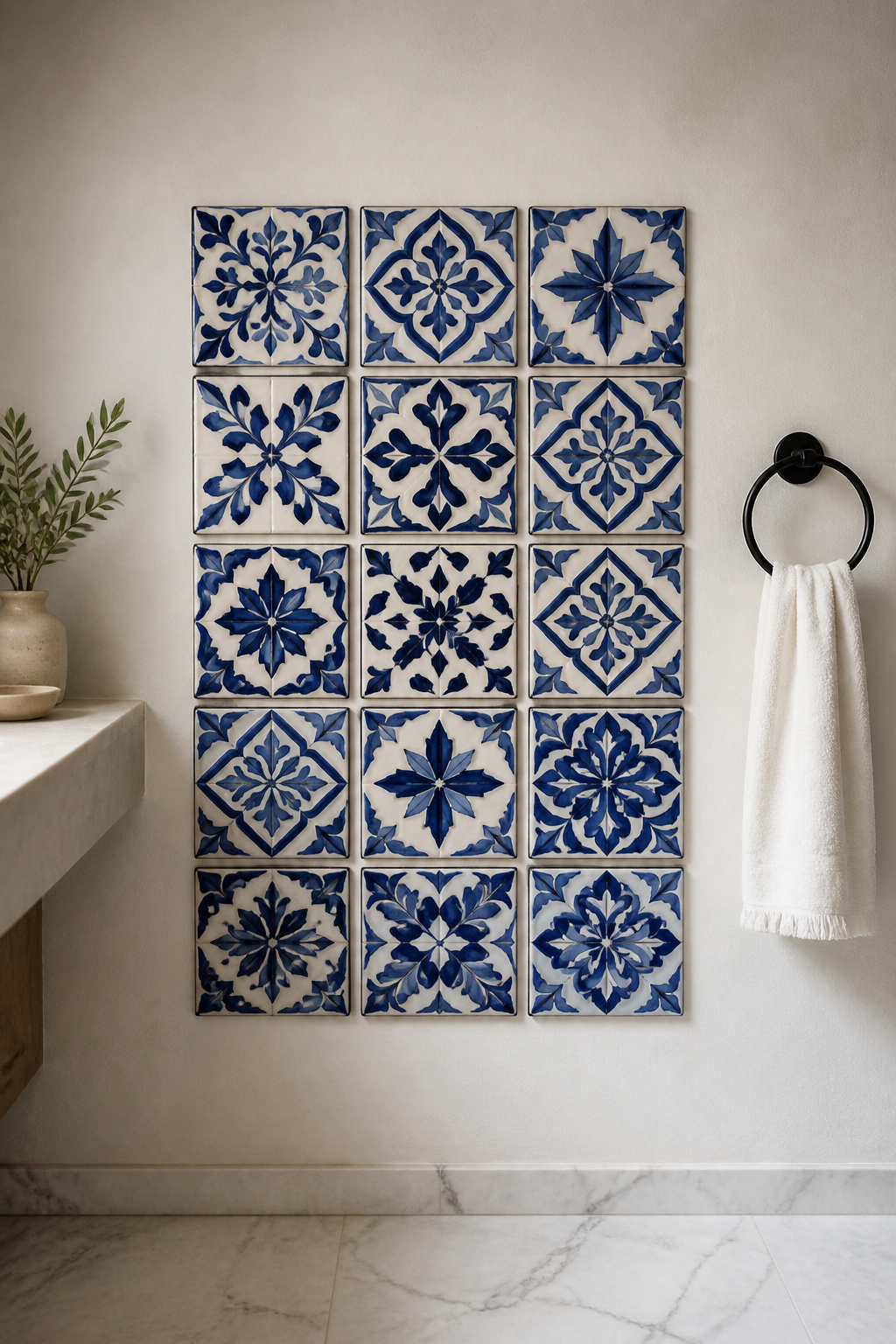
Artisans at quality tile studios begin with bisque-fired ceramic bodies, applying glazes using traditional brushes. Each colour requires a separate firing; complex pieces go through multiple kiln cycles. The result is surfaces fired above 1000°C that resist moisture and fading for decades. For sourcing: Mercury Mosaics (handmade artisan ceramic from around $12-20 per tile), Riad Tile (Moroccan-inspired hand-painted artisan ceramic from $8-15 per tile), and Fireclay Tile (USA-made custom work) are the strongest options. For bathroom tile ideas that transform ordinary spaces, hand-painted artisan tiles are among the most impactful available.
For installation: use high-quality ceramic wall tile adhesive on a properly waterproofed, level surface. Grout colour dramatically affects the result — white grout with Moroccan-style tiles reads as traditional; charcoal grout with the same tiles reads as contemporary. Keep grout lines tight — 1/16 to 1/8 inch — because wider gaps fragment the composition. This is art, not flooring.
7. Art for Your Bathroom From Local Artisans and Independent Makers
There is a quality that handmade art by a known maker has that no purchased print can replicate. You know a specific person made the specific object. That knowledge changes how you look at it every morning — it is not just decoration, it is a relationship with a maker’s process, skill, and intention.
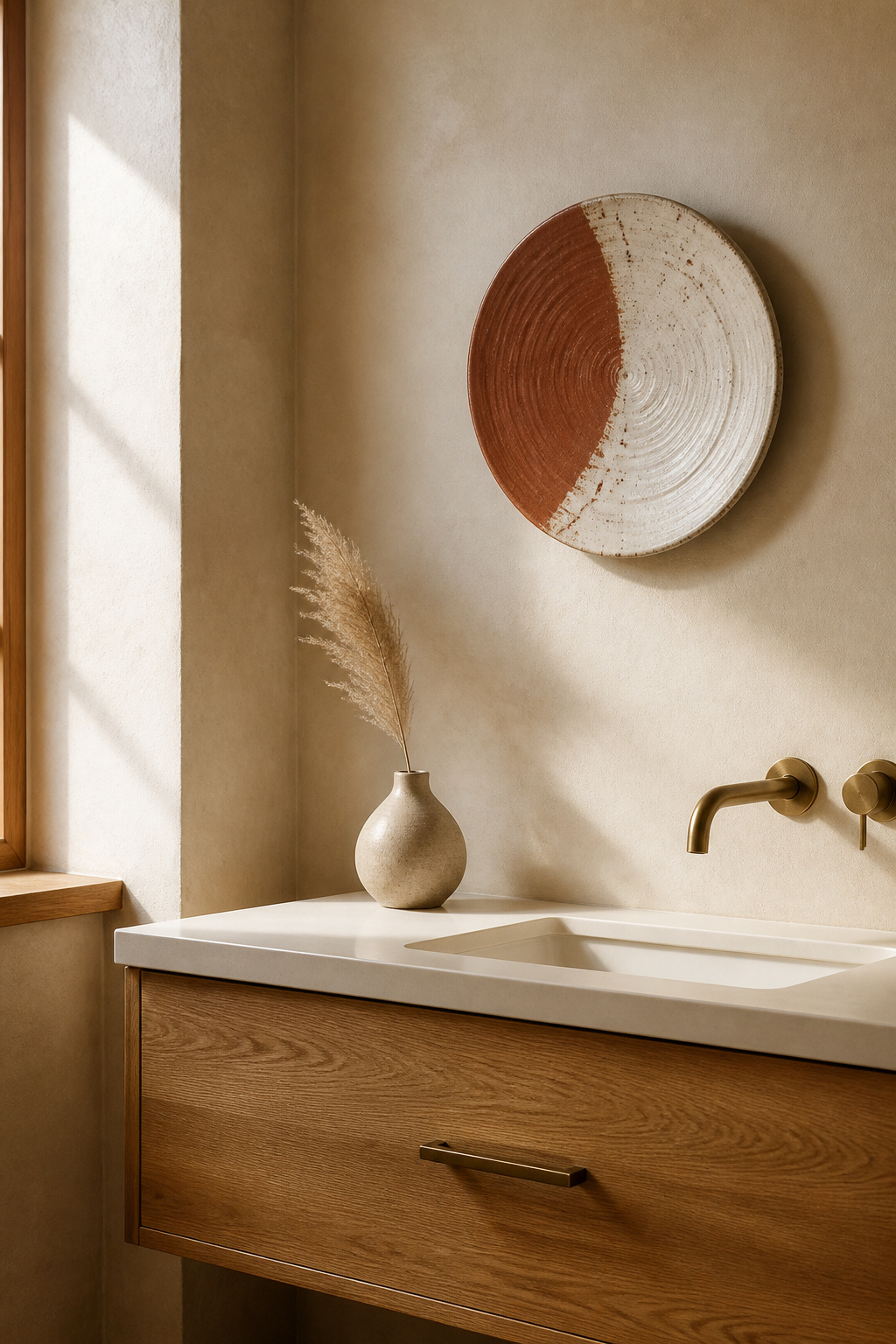
The 2026 design conversation is entirely focused on provenance and personality. Designers are moving away from retail chains toward pieces with genuine story and craft identity. A hand-thrown ceramic wall piece from a local ceramicist, a small textile from an artisan market, a framed original drawing from a regional gallery — these are the real luxury statements now. The bathroom, as a small room, is the ideal place for a single genuinely unique art object. For creating a simple bathroom decor sanctuary with real character, one artisan-made piece with genuine provenance achieves more than any amount of mass-produced styling.
To find independent makers: local maker markets and craft fairs are the best source. Search for regional ‘ceramic markets’ or ‘artisan design fairs’. On Etsy, filter by location and by ‘handmade’; look for studios with defined styles rather than generic sellers with hundreds of product variants. For commissions, brief the artist on room dimensions, existing colour palette, and bathroom environment specifically — a good maker will help you choose the right medium for a humid space.
8. Macramé and Woven Wall Hangings That Move Art Beyond the Frame
Macramé brings something to a bathroom that no flat print can: texture, warmth, and the subtle movement of natural fibre that shifts as air circulates. The interplay of knotted cords casts small shadows that change through the day as light moves across the wall. Textile-based bathroom art ideas like this introduce a sensory dimension — something you want to touch as well as look at — that framed work simply does not have.
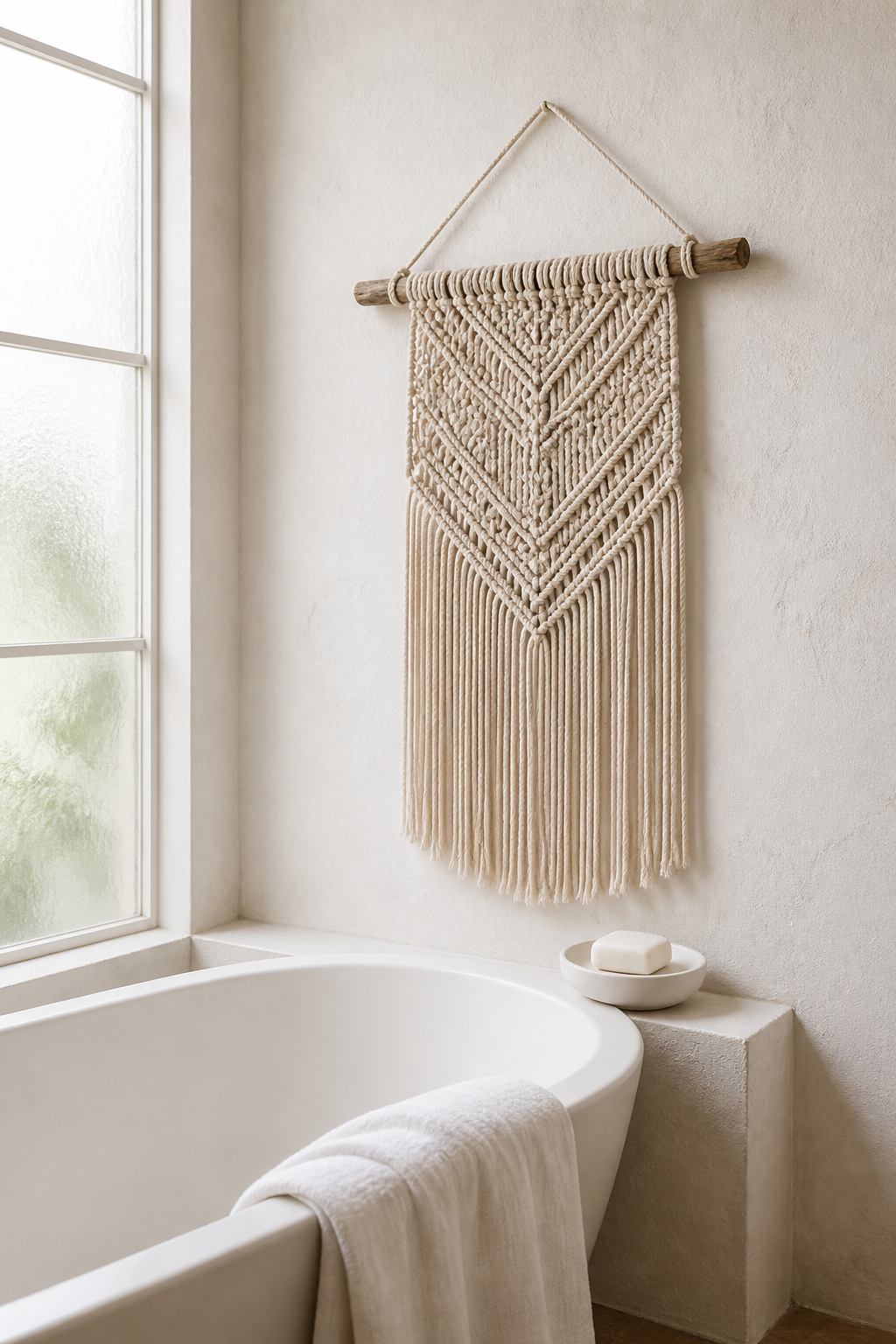
The key to macramé in a bathroom is fibre choice. Mercerised cotton — treated for reduced moisture absorption — and hemp are the two materials that genuinely hold up in humid conditions. Avoid standard jute, which absorbs moisture readily, develops mildew within months in consistently humid bathrooms, and deteriorates. For a poorly ventilated bathroom, polyester braided rope is visually indistinguishable from cotton at normal viewing distance and is entirely waterproof — a practical compromise. For more boho wall decor ideas that embrace wabi-sabi, woven textile art has a similar organic warmth that carries well across different rooms.
Choose pieces with a tight, dense knot structure rather than loose open weaves — dense knotting resists moisture absorption better and dries more quickly if condensation reaches it. Placement rule: at least 36 inches from any primary moisture source. Maintenance is simple: dust every 2-3 months with a hairdryer on cool setting held 12 inches away; spot clean with distilled water and castile soap, blot dry immediately. Never soak a mounted piece.
9. Bathroom Gallery Wall: Mixing Photography, Print, and Object Into One Display
The matching set — three prints from the same artist in the same size with the same frame — is the gallery wall approach that looks like it came from a showroom, because it did. The more interesting path is the mixed-media gallery wall: different mediums, different depths, different origins, unified by one or two shared elements rather than by uniformity.
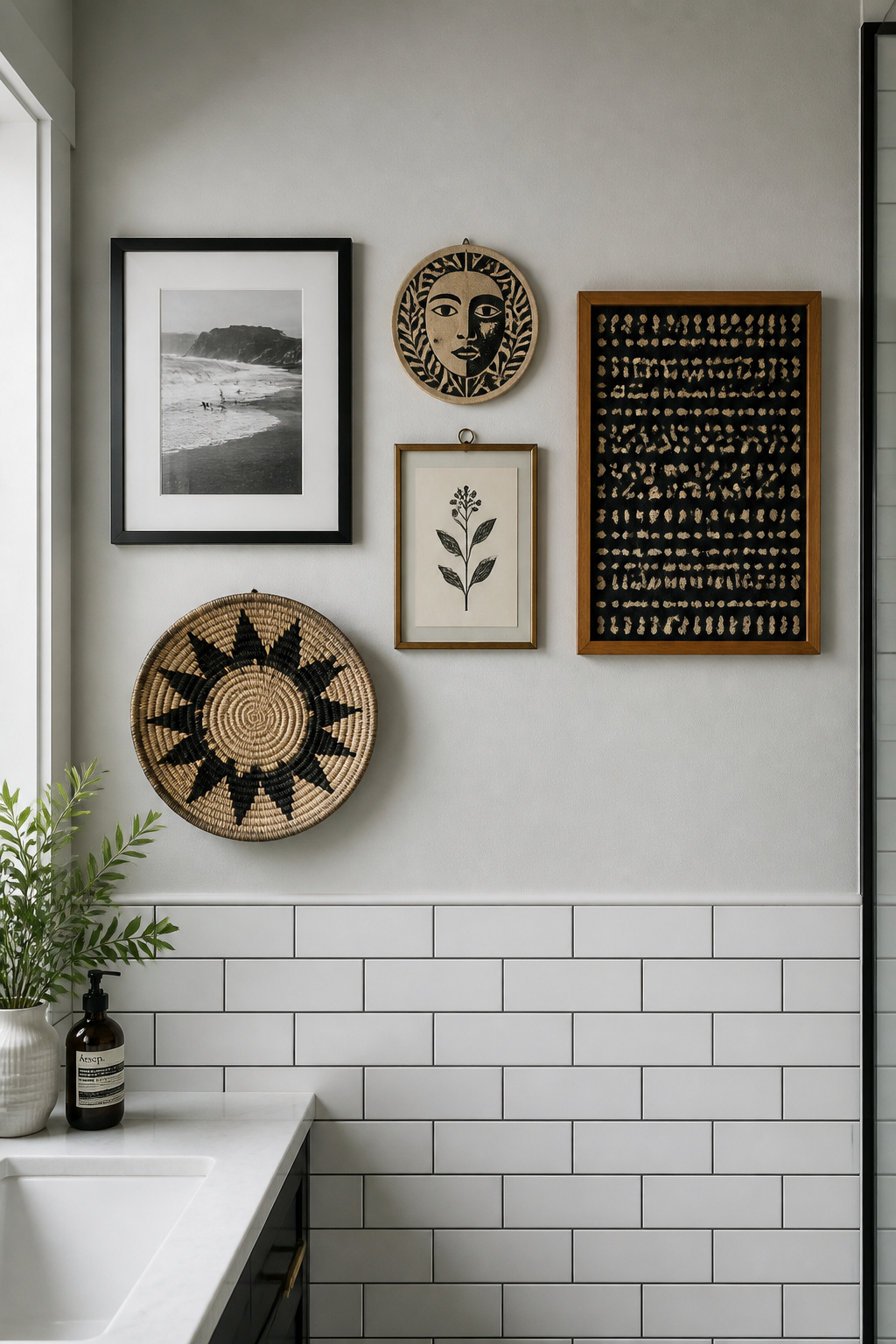
In 2026, leading designers are actively mixing flat prints with dimensional objects — small ceramic wall plaques, woven textile pieces, dried botanical stems in thin frames. The gallery wall should invite touch as well as sight. The editorial constraint that makes this work is usually a single shared colour story or a shared material element — all frames the same metal, for example. For bathroom gallery wall ideas and layout tips, the difference between a great display and an overwhelming one is almost entirely in this editing discipline.
Layout method: mark out the wall dimensions on the floor with masking tape. Lay all pieces within that zone. Photograph from directly above. Use that image as your hanging reference. Start with the largest piece; build outward maintaining 2-3 inch gaps. For the wall itself, the kraft paper template method saves hours and unnecessary holes: trace each frame onto kraft paper, cut out, tape to the wall, adjust until satisfied, then mark and drill.
10. Batik and Block-Print Textiles: Framed Fabric Art With Cultural Depth
Block-printed fabric from Rajasthan or Javanese batik framed and hung on a bathroom wall brings a cultural density that no mass-produced print can rival. This is a bathroom art idea that rewards some research — the more you understand what you are looking at, the more you see in it every morning.
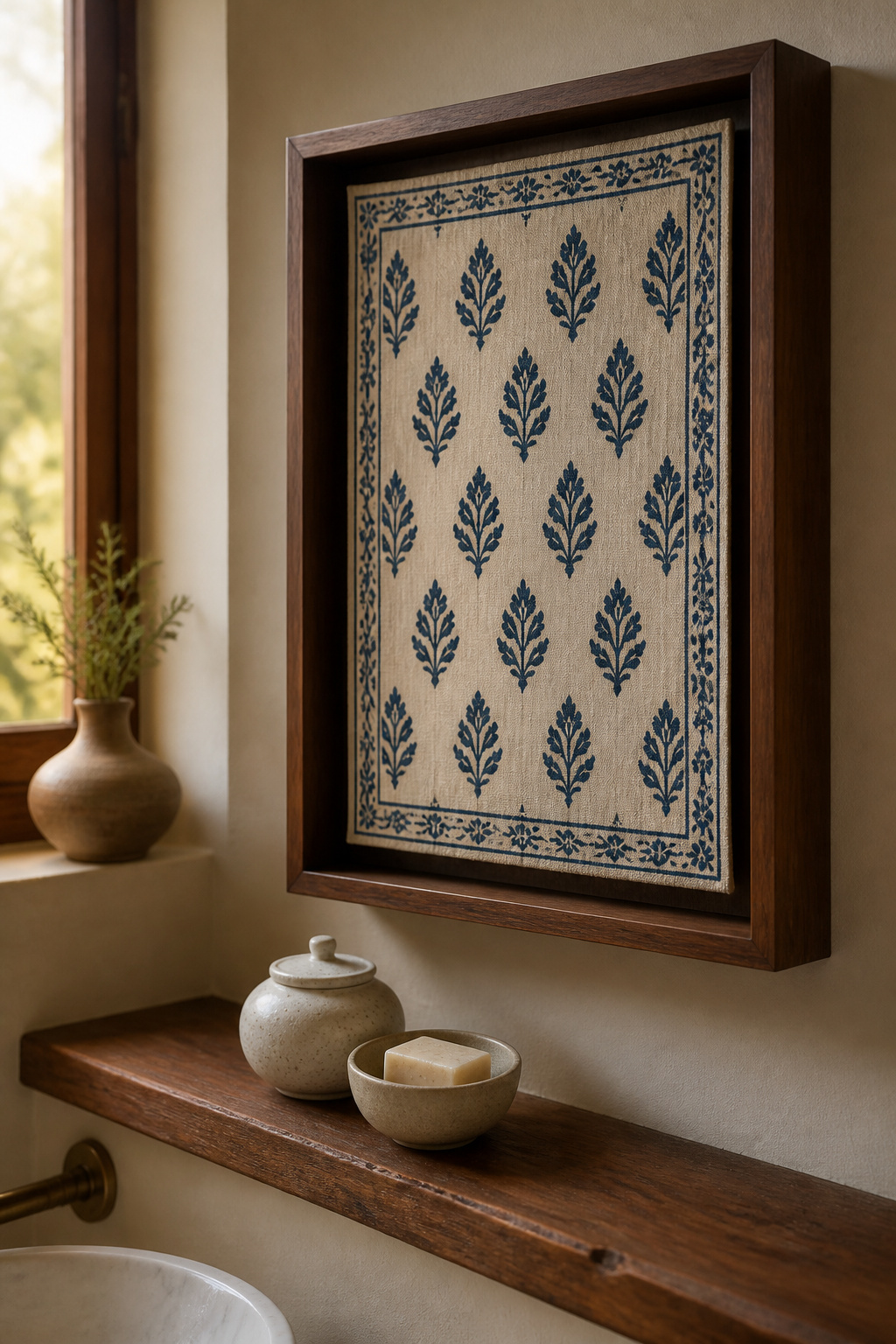
These are living craft traditions — block-printing using carved wooden stamps dipped in natural dye, batik using wax-resist dyeing with characteristic crackle lines — and the evidence of the hand is visible in the slight variations between repeats, the subtle irregularities of the dye uptake. The crackle lines in genuine batik are a quality marker; mass-produced machine prints lack them entirely. For framing fabric, stretching on a canvas stretcher bar frame gives the cleanest gallery mount. For bathroom placement, behind glass is preferable — it protects the fabric from humidity over months and years. Source authentic pieces through platforms like Gaatha (Indian artisanal marketplace) and Novica, which connect buyers directly to artisans.
Use acid-free backing board regardless of framing method — standard cardboard causes acid migration that yellows natural fabric within a few years. Look for natural fibre base (cotton or silk), slight variation between repeats, and natural-dye colours — muted earthy tones rather than synthetic brightness.
11. Antique Mirror Clusters as Functional Wall Art That Expands the Space
A well-chosen antique mirror does something no print or painting can: it brings light into the room and multiplies it. A cluster of vintage mirrors on a bathroom wall — unified by paint finish or frame material, varied in shape and size — works as a single large artwork while also expanding the perceived dimensions of the space.
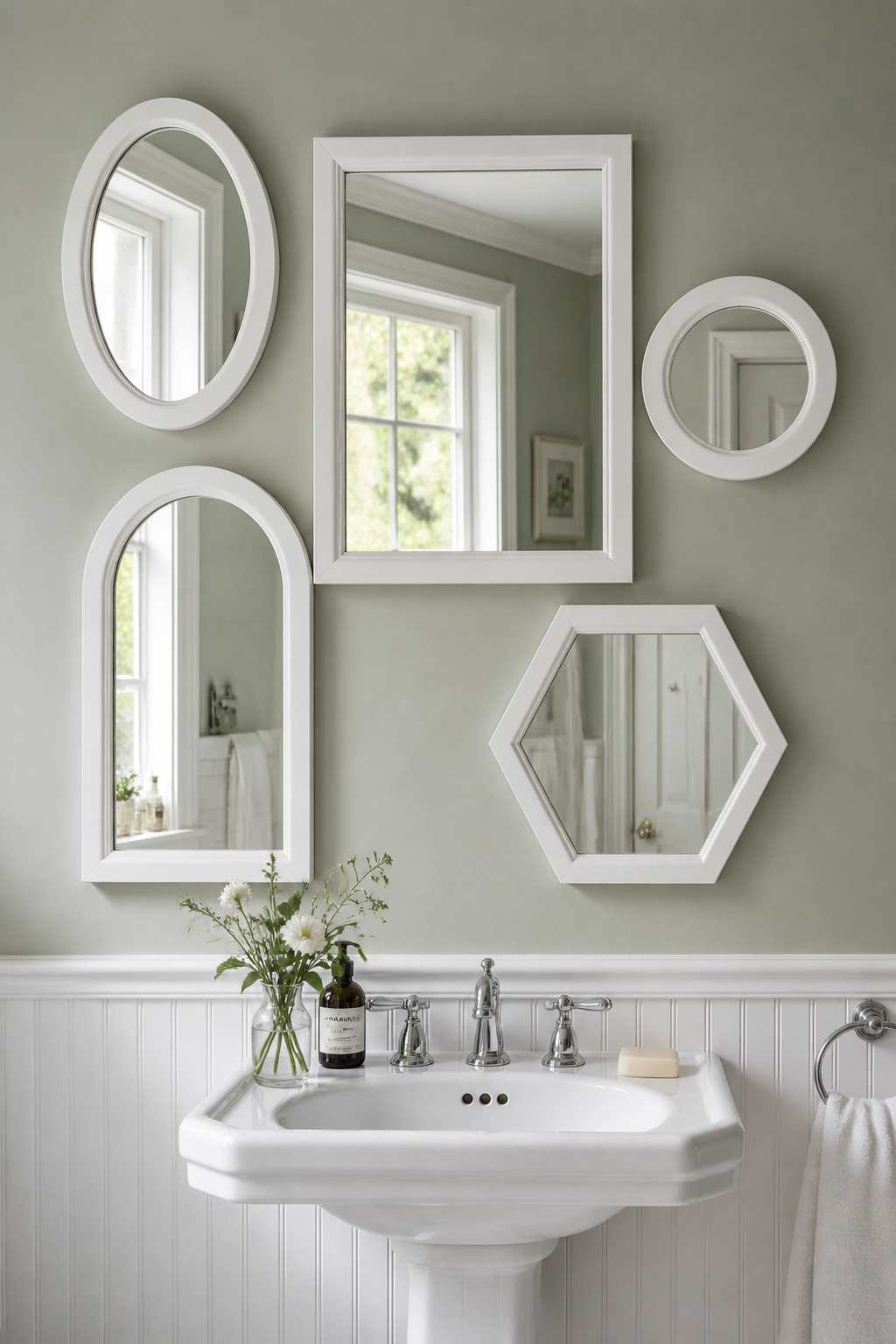
Genuine antique mirrors (pre-1940) have a soft, slightly imperfect reflective quality that new mirrors lack. The aged glass reflects with warmth rather than perfect clarity — it adds atmosphere rather than simply showing what is in front of it. For how bathroom mirrors function as wall art, the distinction between a utility mirror and an art object is almost entirely about frame quality and age of the glass.
To build a cluster: unify mismatched vintage frames by painting them all the same colour — matte white, matte black, or a single metallic tone. Arrange as you would a gallery wall: largest piece as the anchor, smaller pieces orbiting. Mix shapes deliberately — one oval with two rectangular pieces, or one arched mirror with two small circular ones. Flea markets and antique fairs are the best source for varied vintage mirrors at reasonable prices ($20-80 per piece for good frames). For humid bathrooms, prefer metal-framed vintage mirrors over elaborate gilded-wood frames, which can develop surface issues in consistently humid conditions.
12. Bathroom Art Ideas on a Budget: Affordable Prints That Punch Above Their Weight
The most consistently useful piece of advice about budget bathroom art is this: spend the money on the frame, not the print. A $15 print in a quality solid wood or metal frame looks better than a $50 print in a plastic or MDF-core frame. The frame is what the eye reads first. The print is what it reads second. These bathroom art ideas on a budget work because the investment goes in the right place.
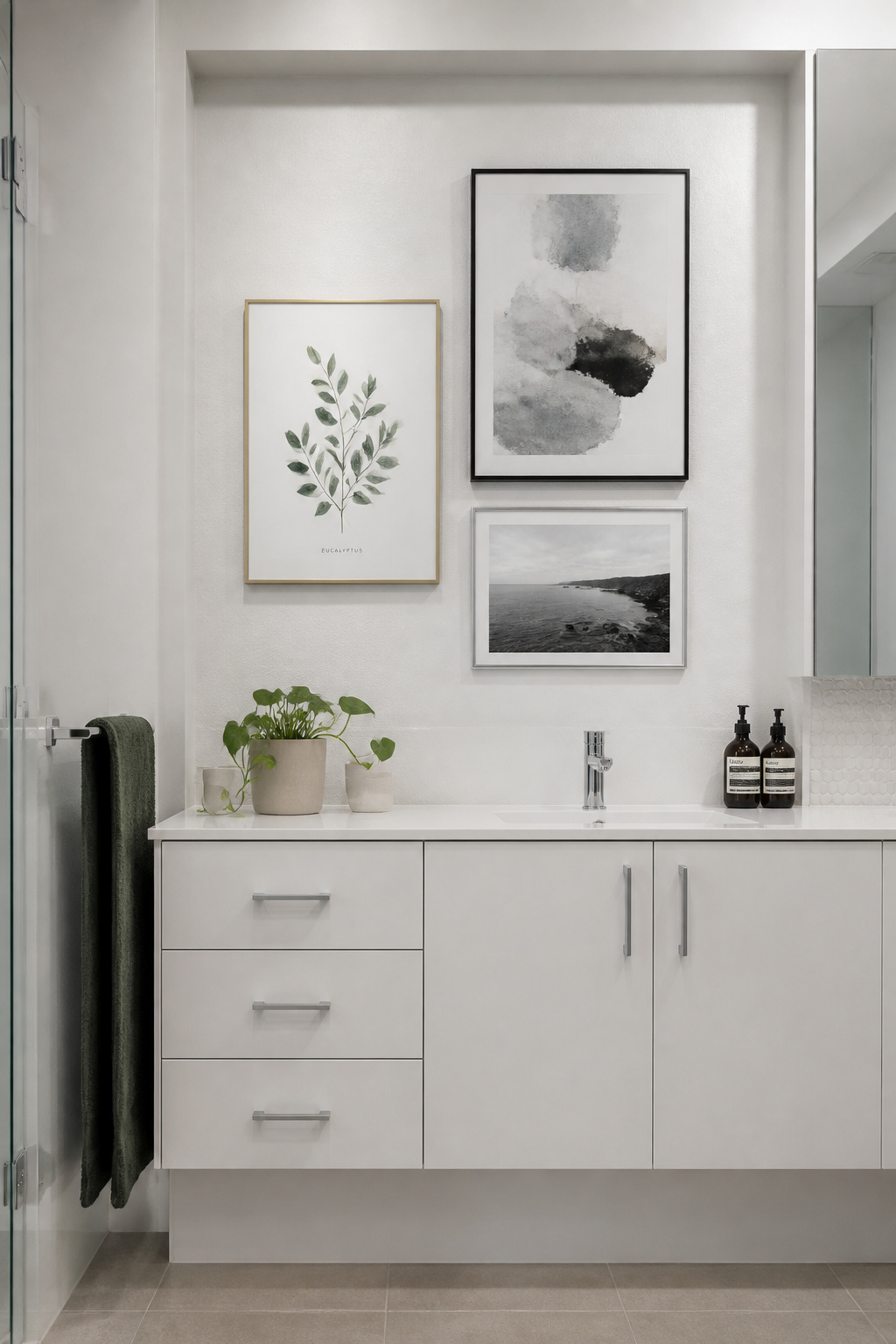
For prints under $30 that are genuinely worth having: Society6 offers artist-designed prints from $15 in paper format. Desenio (Sweden-based) has clean minimalist prints from $12-25, particularly strong in botanical and abstract. Etsy digital downloads are the most economical option — pay $2-8 for the file, have it printed at a local photo lab on archival paper, total cost under $15. Minted connects buyers with independent artists and delivers archival prints from $18-35 with excellent quality control. For more approaches to genius budget bathroom makeovers, smart art sourcing is consistently one of the highest-impact and lowest-cost changes available.
For DIY art that looks genuinely sophisticated: the Metropolitan Museum’s open access collection makes 1.5 million artworks free to download and use — print one at a photo lab and frame it properly. A monochromatic watercolour wash on decent watercolour paper (one colour, graduated from dark to light) requires no painting skill, takes 20 minutes, and reads as deliberate abstract art.
13. Sculptural Wall Pieces: 3D Art That Holds Its Own Against Humidity
Sculptural bathroom art ideas are underused in most homes, which is a pity because the bathroom is actually the ideal room for them. Three-dimensional wall art creates depth and shadow play that flat prints fundamentally cannot replicate. And the materials that survive bathroom humidity — glazed ceramic, cured resin, marine-grade metal, sealed hardwood — are also the materials that make compelling sculpture.
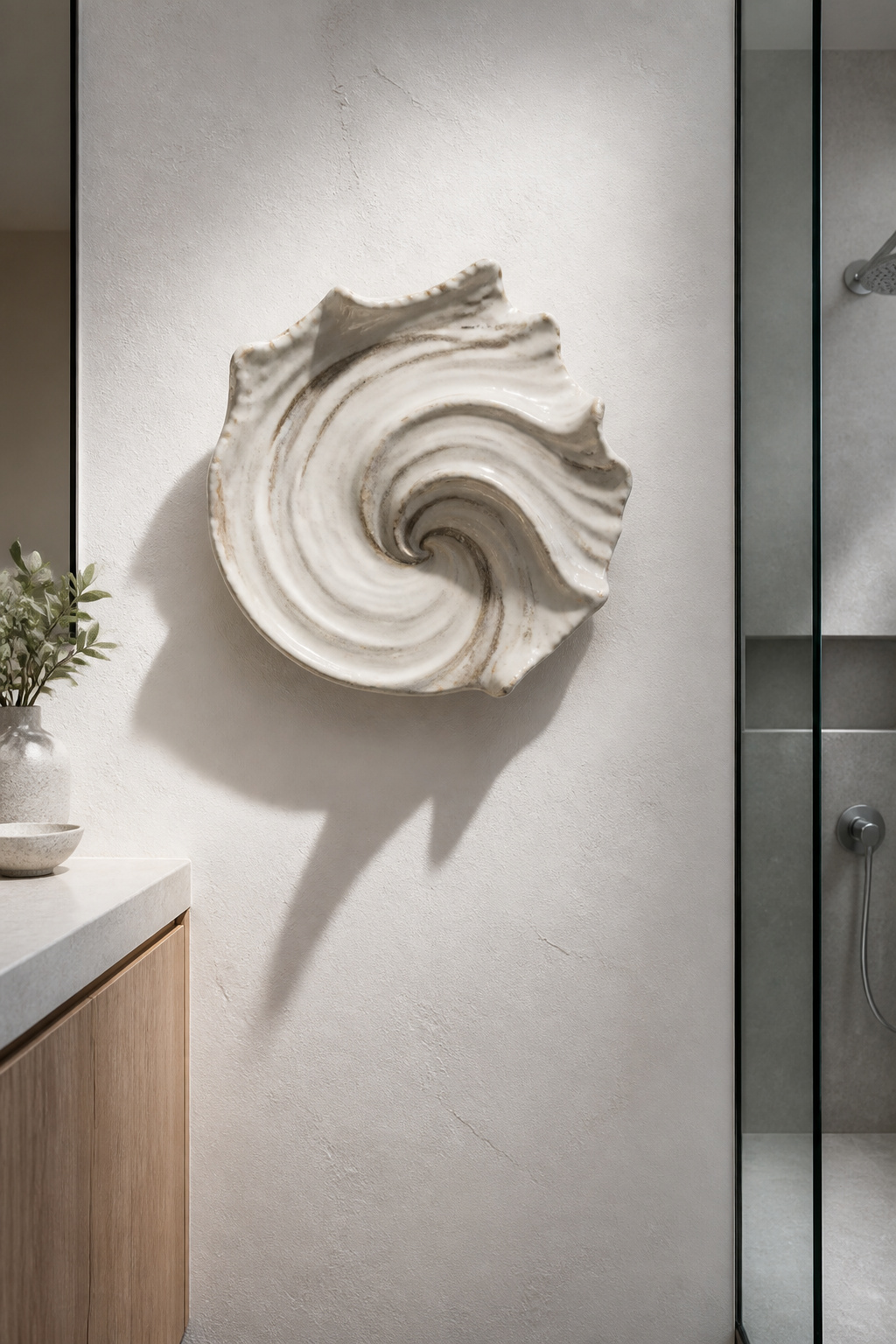
A ceramic wall sculpture in a bathroom with natural light is never quite the same twice — the shadows it casts shift as the angle of the light changes through the day. There is a quality to sculpture that static images, however beautiful, do not have. Cured resin is fully waterproof; marine-grade stainless steel and aluminium thrive in humid environments. For sealed wood, teak, white oak, or sapele with marine-grade oil finish are appropriate — avoid unsealed softwood, which warps within months.
Placement: eye level, 60-66 inches from the floor, at least 18 inches from any direct water source. Above the toilet is the most underused wall in most bathrooms and the ideal location for a single sculptural piece — sufficient wall space, always visible on entering the room. For a small bathroom, one 8-12 inch sculptural piece is enough to function as the room’s art statement without competing with its architecture.
14. Shadow Box Displays With Shells, Botanicals, and Found Objects
Shadow box bathroom art ideas are the most personal on this list. A shadow box containing shells from a specific beach, pressed flowers from a specific garden, and a photograph of the place makes an art object that no print or painting can rival in terms of personal meaning. It is intensely specific to you, to a moment in your life, to a place you have been.
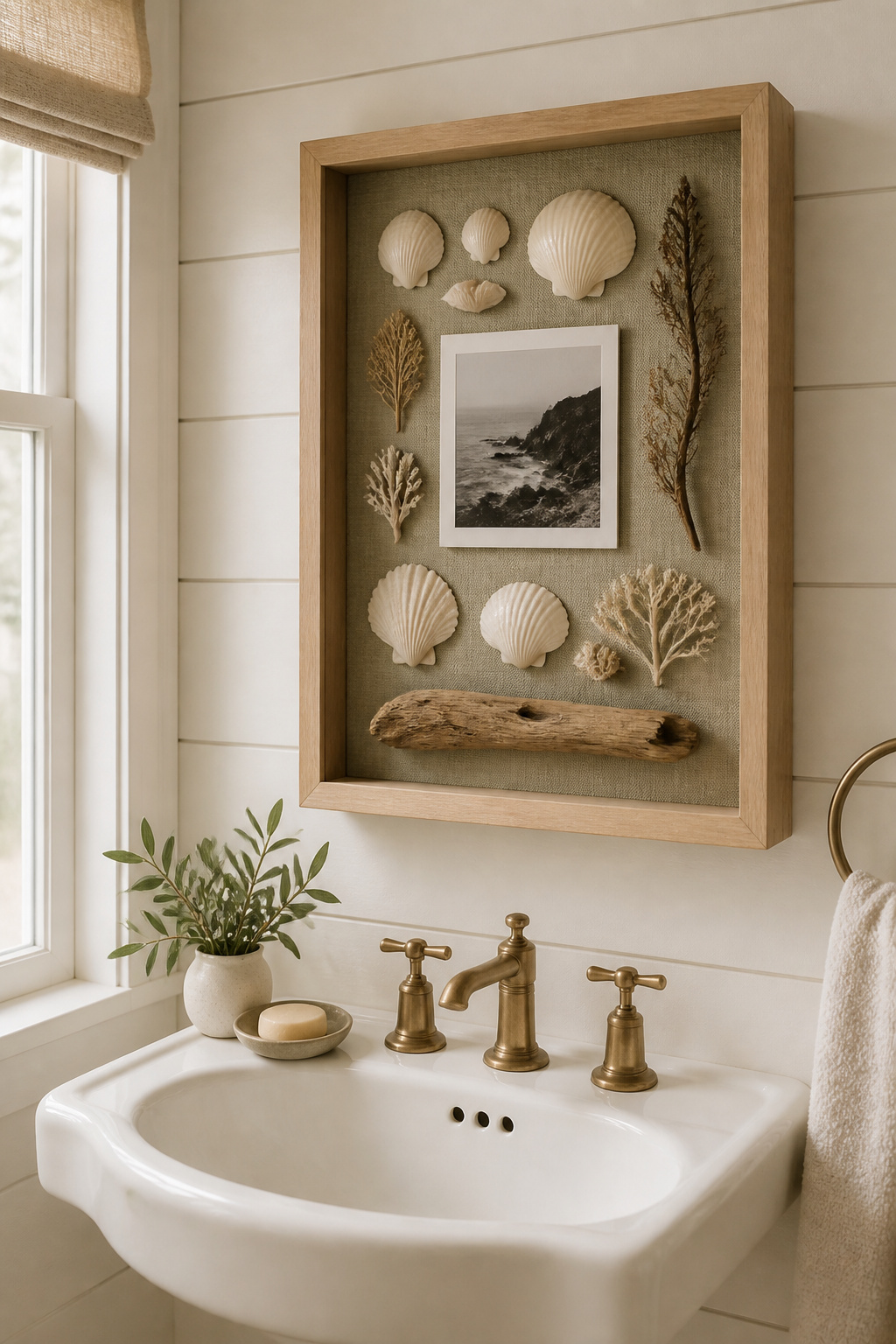
The narrative shadow box — objects that together tell the story of a place, a journey, or a relationship — is the highest form of the genre. Before you start, choose a story you want the box to tell, then find the objects that tell it. Standard shadow boxes run 1-3 inches in depth; choose based on your largest object with at least 1 inch clearance from the glass front. Cover the backing board with fabric (linen or burlap for texture) rather than leaving it as bare cardboard — bare backing makes the objects look like an exhibit rather than art.
Use E6000 or Gorilla Clear Grip adhesive for shells and heavier objects — hot glue is unreliable for anything over 50g in humid conditions. Seal all natural objects with Krylon Crystal Clear matte sealant before mounting. And one underrated detail: in a poorly ventilated bathroom, place a small silica gel packet behind the backing board to absorb any internal moisture. Condensation can build inside an unsealed shadow box within weeks.
15. Bathroom Wall Art Inspired by Monsoon Color Palettes and Global Textiles
Deep indigo, terracotta, saffron gold, smoky jade — this is the 2026 colour story that interior designers are calling the monsoon palette, and it connects directly to Indian, Southeast Asian, and North African design traditions. These are not trending pastels. They are saturated, warm, and rich — colours with depth and weight that transform a room’s emotional register immediately.
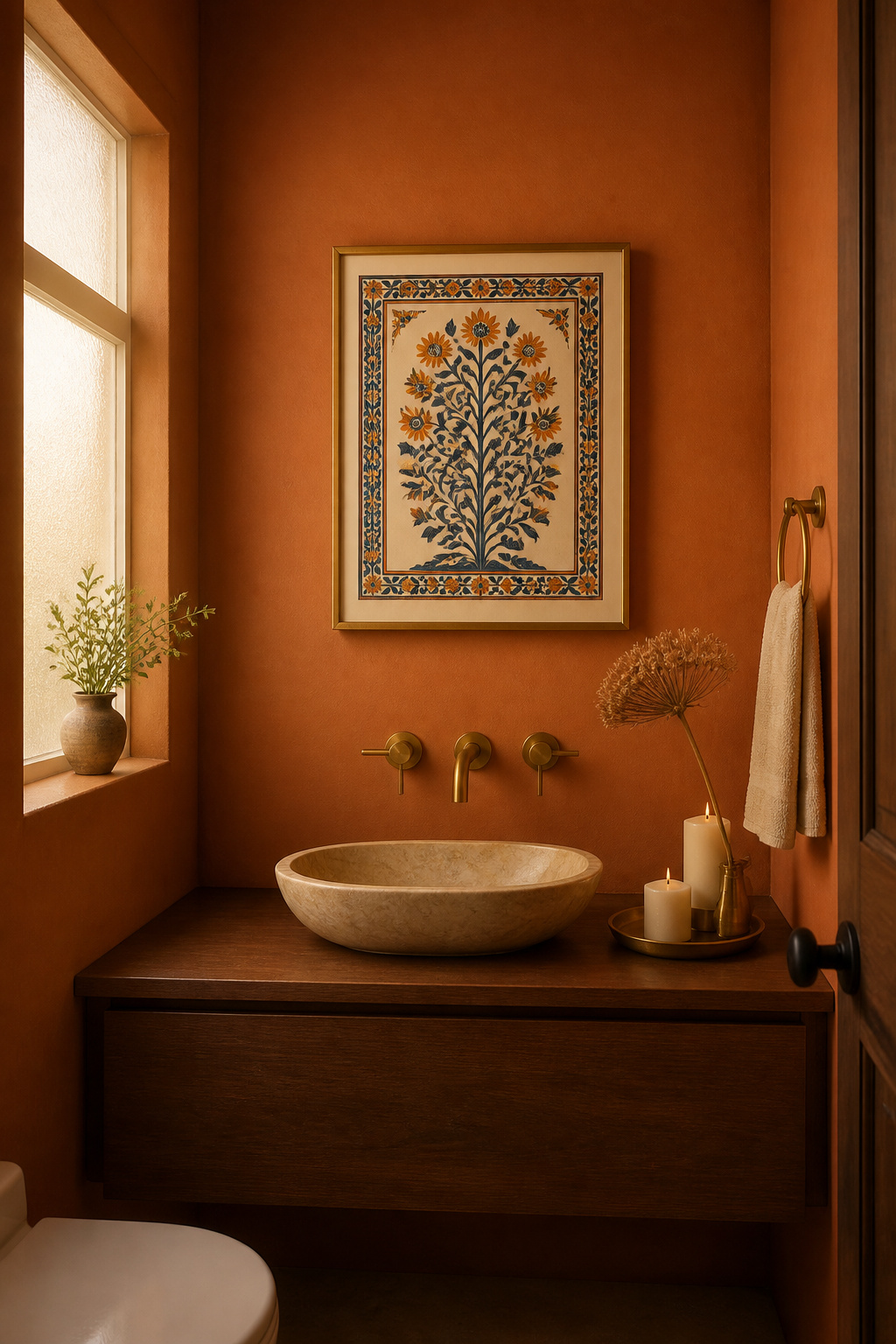
Indigo references Indian natural dye and block-printing traditions that stretch back centuries. Behr’s 2026 Color of the Year is Hidden Gem (a smoky jade); saffron gold is part of what trend researchers call the ‘joy injection’ palette. A single framed piece in any of these tones — against white or neutral bathroom tile — warms the whole room from clinical to enveloping. The key is to use one bold piece as the anchor and let everything else defer to it. If the art is saffron, keep towels in off-white or terracotta, not in another saturated colour. For small bathroom decor ideas that maximise space, one bold colour anchor is almost always more effective than many softer pieces.
For sourcing globally inspired art with genuine cultural integrity: platforms like Gaatha and Novica connect buyers directly to artisans from the cultural traditions they work in. The distinction between inspired-by and extracted-from matters — look for sellers who describe the cultural context of their work and who have a clear maker identity.
16. Typography and Calligraphy Art That Actually Works in a Bathroom
Most word art in bathrooms is poor. You know the kind: ‘Relax’ in a sans-serif font on white card in a plastic frame. The problem is not that typography is a bad medium for bathroom art ideas — it is that most bathroom typography art is neither good typography nor genuine art. It is a mass-produced sign masquerading as both.
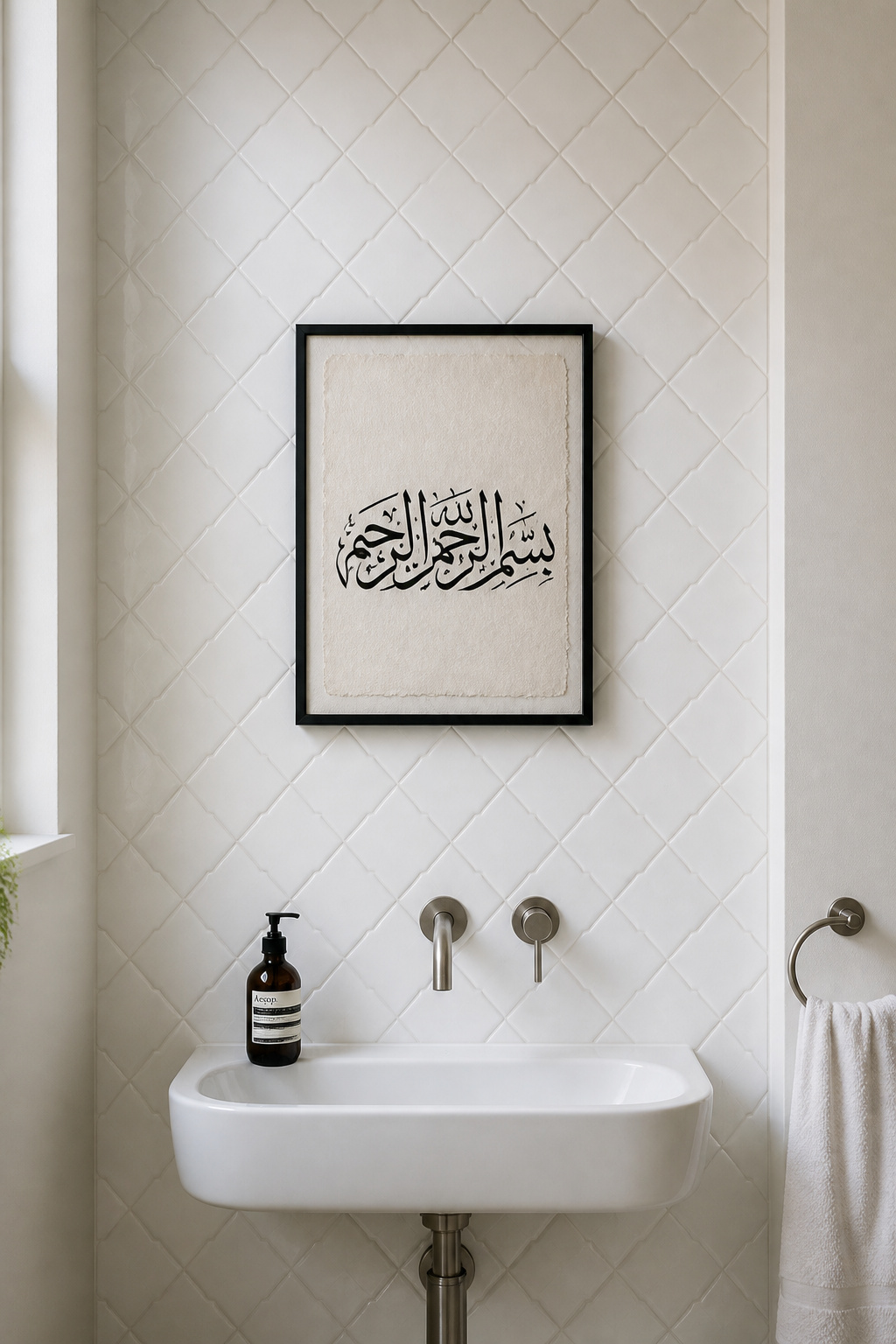
Genuine calligraphy — hand-formed letterforms in a living tradition — is categorically different from generic word art. Islamic calligraphy has a 1,400-year history as the highest art form in Arabic culture; an ancient Arabic proverb states ‘purity of writing is purity of the soul’. A Quranic verse in Thuluth or Naskh script by a trained calligrapher is fine art. So is Devanagari rendered in traditional brush calligraphy, or Japanese shodo. The test for any typographic art: does the piece work as a visual composition even if you cannot read it? If yes, it is art. If not, it is a sign.
For sourcing: Neanour (UK-based) offers Islamic calligraphy art at a quality tier clearly above the generic market. Etsy is strong for commission-based calligraphy from trained practitioners. One critical caution: do not use online Arabic or Devanagari generators for art you plan to display — they typically display letters without correct joining logic, and the result appears incorrect to native readers. Always source from trained calligraphers for scripts from living traditions.
17. Maximalist vs. Minimalist: Knowing Which Bathroom Art Approach Suits Your Space
The question is not whether you prefer maximalism or minimalism in the abstract. The question is what your specific bathroom can bear. And the answer comes from reading the room before you buy a single piece of art — before you choose between bathroom art ideas that call for one strong piece and those that call for many.
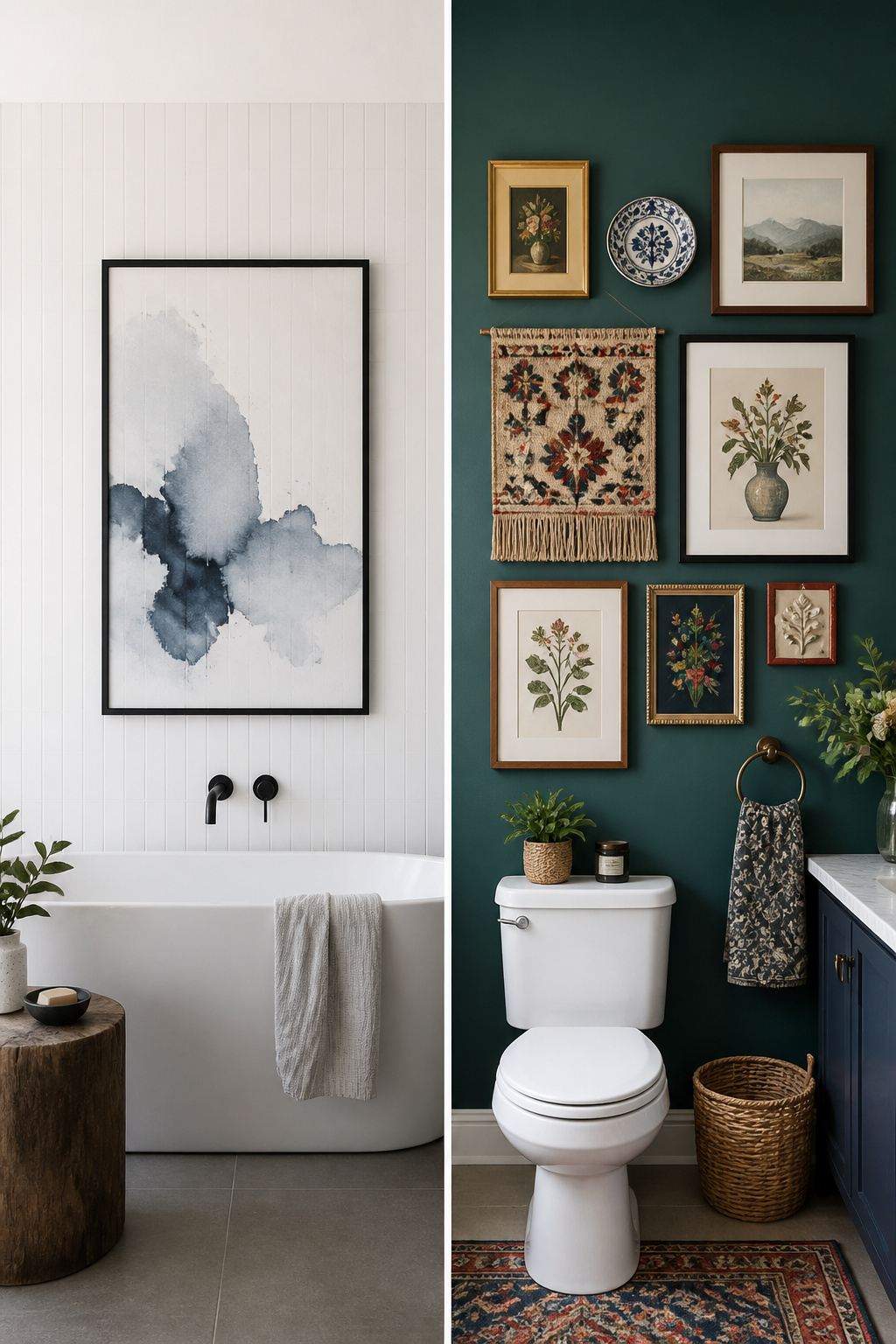
Low ceilings — under 8 feet — respond better to a single vertical piece or a two-piece vertical stack that draws the eye upward. A horizontal gallery wall in a low-ceilinged bathroom emphasises the ceiling’s proximity rather than counteracting it. Patterned tile almost always calls for one piece of art that provides contrast in medium rather than additional pattern. A textile against patterned tile, a sculptural piece against grid tile, one abstract print against Zellige — all work because they contrast rather than compete. For timeless bathroom design principles that inform these decisions, the guidance there aligns closely with this framework.
The single-piece rule always works. One correctly sized, well-chosen, properly framed piece of bathroom art in a spot that was previously bare does more for a bathroom’s character than any other decorative decision. The editing test is simple: remove one piece from your current display and live without it for a week. If you miss it, put it back. If you don’t, it was surplus. Negative space around a single strong piece gives the art room to breathe and the eye somewhere to land.
Choosing the Right Bathroom Art Ideas for Your Space and Personal Style
Before you buy anything, assess the room. Not with a designer’s checklist, but with honest attention to what you actually see.
Light levels first: a bathroom with a single small window and only artificial lighting needs art that reads well in warm, low light — bold-framed botanicals, abstract washes with dark anchoring tones, sculptural pieces with surface texture. A bright bathroom with natural light can carry softer, more delicate work. Humidity zones next: map where steam concentrates in your space. The 24-36 inch radius around your shower and bath is a high-humidity zone. Paper art, textile art, and shadow boxes all belong outside that radius. Sculptural ceramic, sealed resin, and metal art can go closer. And wall scale: measure before you buy. For walls under 30 inches wide, nothing should exceed 16 inches in its longest dimension. For walls over 48 inches, smaller pieces look lost and need the anchoring presence of a group.
Start with one piece. Choose one bathroom art idea you genuinely respond to, hang it, and live with it for a month before adding anything else. This single practice — patience before accumulation — prevents the ‘purchased in one go’ look that undermines even the best individual pieces. Whichever bathroom art ideas from this list call to you, let them lead to something you truly want to look at every morning. The bathroom is the one room in the house where a single art object, chosen and placed with real intention, can change how you feel about the space entirely. Start there.