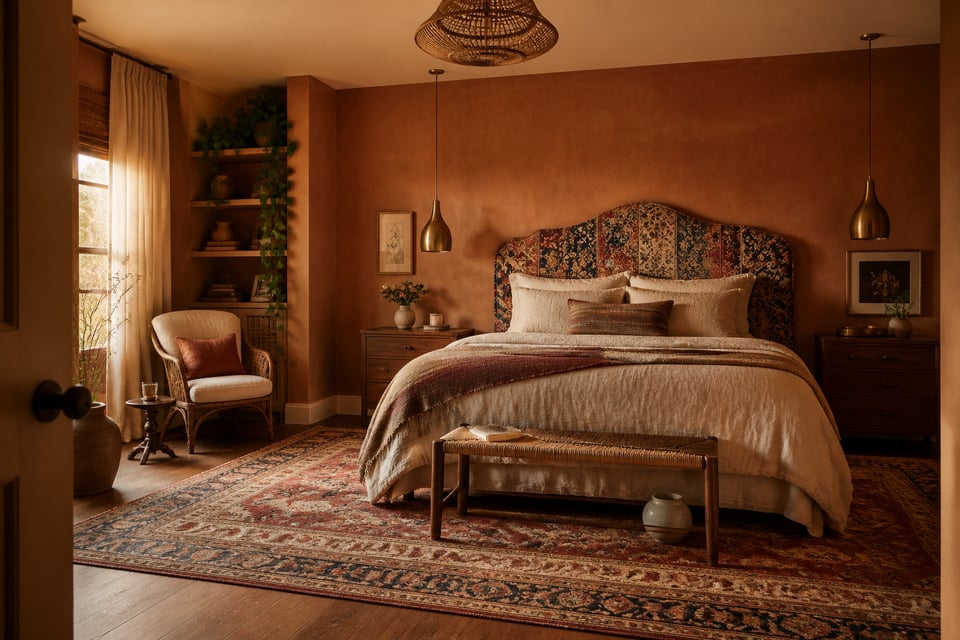
There’s a moment — maybe you’ve had it — when you walk into someone else’s bedroom and feel it. Good bedroom design ideas are behind that feeling. Not just see it, but feel it. The room has a personality, a warmth, a sense that the person who lives there actually thought about it. Then you go home, look at your own bedroom, and realise it’s just… a room where you sleep.
That gap between a bedroom that exists and one that genuinely reflects you is smaller than it looks. I’ve helped dozens of readers close it, and the solutions almost never involve a complete overhaul. More often, it’s one strong choice — a bold textile, a pendant light in the right position, a rug that finally fits the space — that shifts everything else into place.
These 15 bedroom design ideas cover a real range: some are visual statements, some are quietly practical, some are about craft and material. All of them have transformed actual bedrooms. A few you might start this weekend. Some require saving up for something genuinely worth owning. What they share is this: every one of them changes how a bedroom feels to be in, not just how it looks in a photograph.
1. A Bold Accent Wall That Sets the Entire Bedroom Design Tone
The most useful thing an accent wall does is give the eye somewhere to land. Without it, a bedroom can feel pleasant but unfocused — like a room decorated by committee rather than someone with actual opinions. Get it right and the accent wall does half the room’s design work for you.
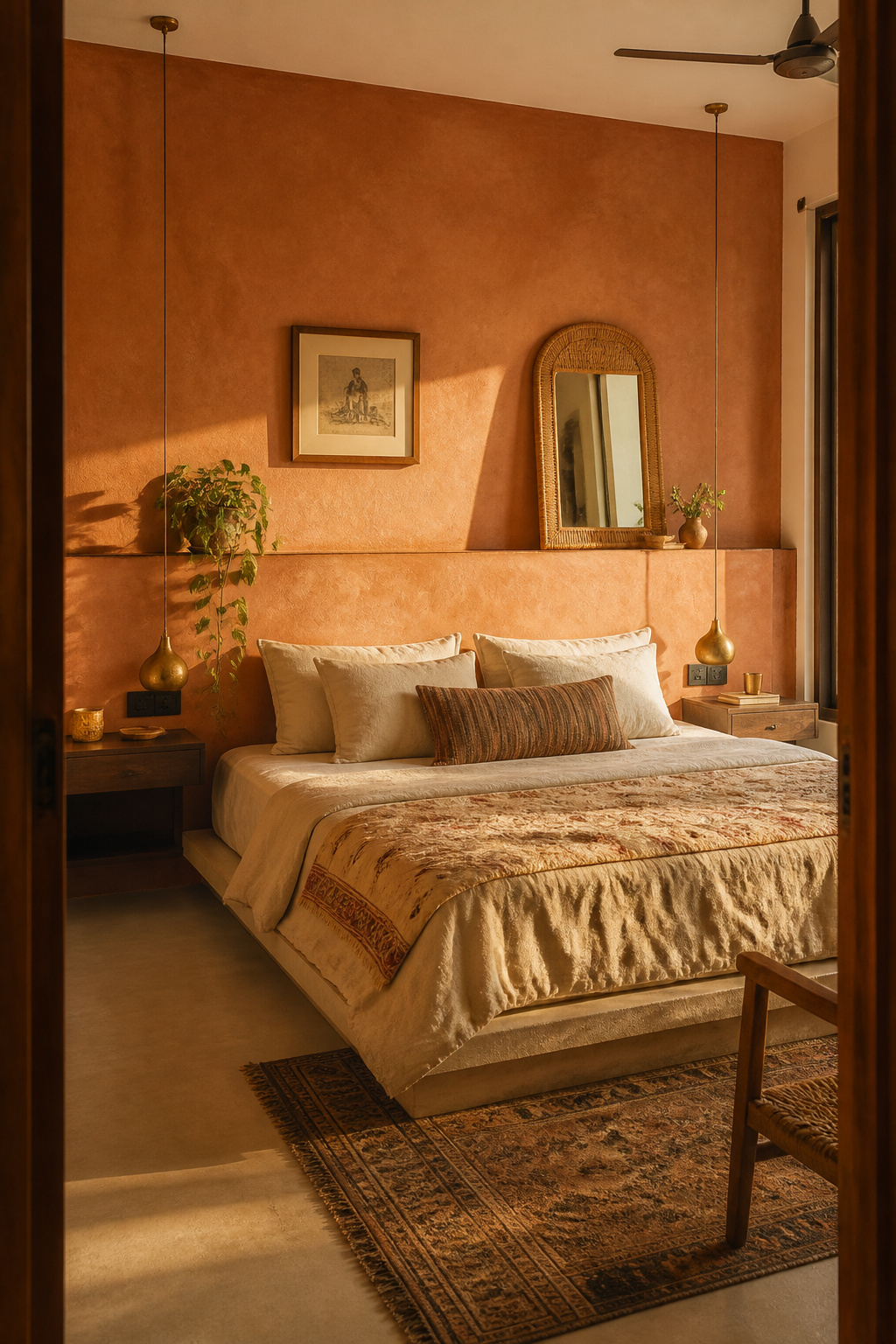
In 2025, the most compelling bedroom design ideas aren’t about a coat of paint in a deeper shade. They’re textured — limewash, grasscloth, fluted wood paneling, or natural stone veneer — and the visual depth they create is simply not achievable with flat paint. Limewash is the most accessible of these. It’s a mineral-based application that goes on in overlapping strokes, dries lighter than it looks wet, and produces a mottled, organic surface that feels ancient in the best possible way. Two or three thin coats, a good limewash brush, and you have a wall with genuine character.
For wallpaper, the 2025 direction is natural materials: grasscloth woven from sea grass and jute, or silk-backed papers with a subtle sheen. These age well, which matters — a wallpaper you’ll want to live with for a decade is a better investment than a graphic print you’ll tire of in three years.
Placement matters as much as material. The headboard wall is your accent wall. Not a side wall, not the wall opposite the door — the wall your bed sits against. That’s where the eye goes first and rests longest. For more bedroom accent wall ideas beyond just paint and wallpaper, the range of techniques and color combinations available is genuinely surprising.
2. Layered Textiles for a Rich, Inviting Bedroom Atmosphere
The layered bed is one of those bedroom design ideas that has become its own design language — and Jasmine here will tell you it’s one she grew up with, in a home where every quilt told a story about where it came from. A bed with three well-chosen textiles looks like it was styled; the same bed with six random layers looks chaotic. The difference is discipline within abundance.
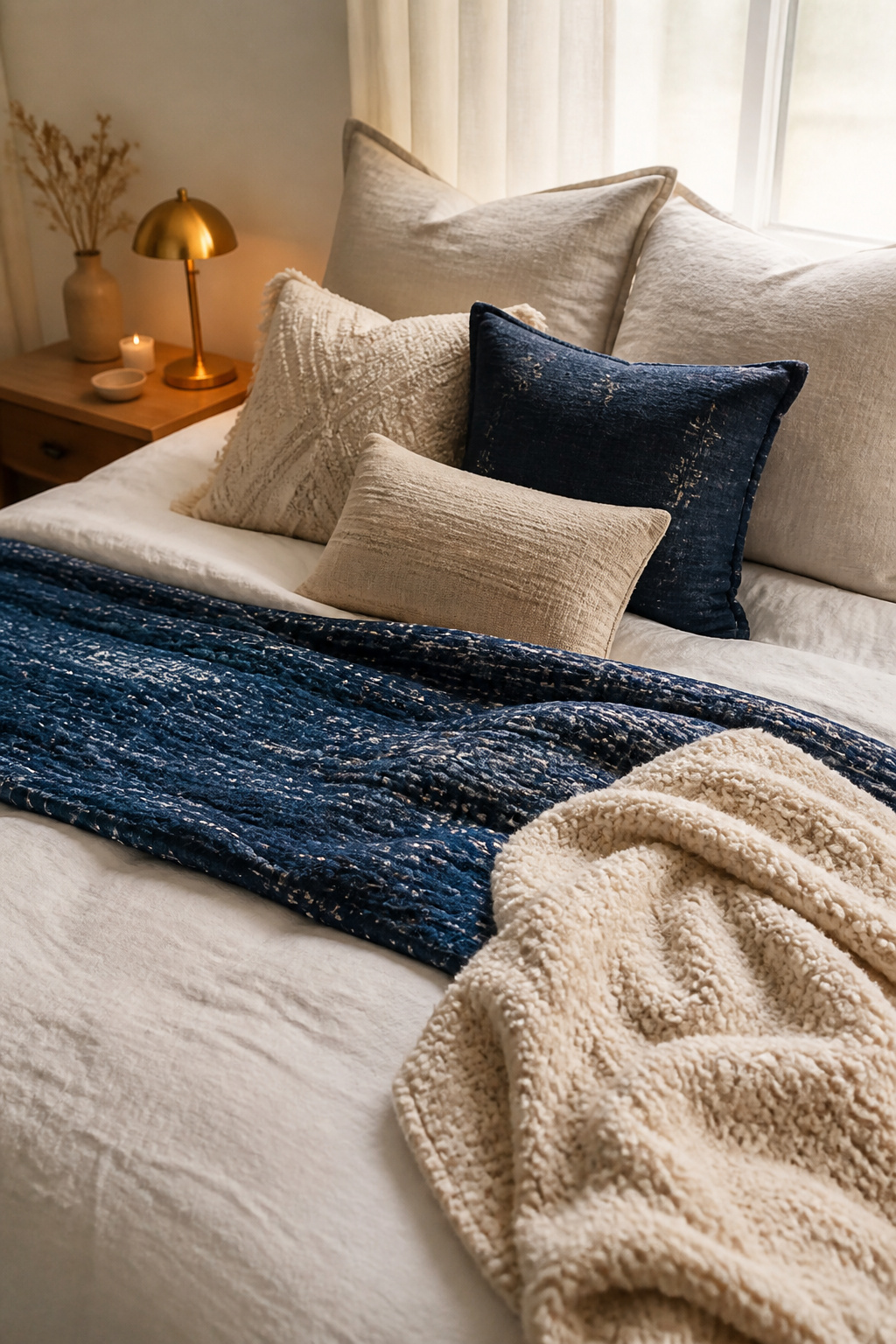
Start with sheets worth having. The layers touching your skin deserve the investment — Egyptian or Pima cotton in a 300-500 thread count range, or good linen, which softens with every wash and regulates body temperature for both warm and cool sleepers. This base layer is invisible when the bed is made but determines how the room feels to live in rather than just look at.
Add one mid-layer with texture: a kantha quilt is the piece I reach for most often. These are hand-stitched quilts made in Rajasthan and West Bengal, traditionally from layered cotton saris, running-stitched by artisans in a meditative rhythm that leaves the surface with subtle, rippled texture. Under a bedside lamp, the stitches catch the light like ripples across a pond. For the outer layer — a boucle or chunky-knit throw draped asymmetrically at the foot — contrast is the goal. Smooth linen against nubby boucle, or cool cotton against warm wool.
For further ideas on layering textiles in a boho bedroom specifically, the combination of rugs and throws applies the same multi-layer logic across the whole room rather than just the bed.
The colour limit is firm: choose 2-4 shades and let texture do the rest. More colours than that and the layering reads as cluttered even when the pieces are beautiful individually.
3. Statement Pendant Light Over the Bed or Reading Nook
Here’s one of the bedroom design ideas that instantly frees up nightstand space, raises the room’s perceived sophistication, and gives you the kind of ambient light that makes everything look better after dark. A pendant light hanging beside — or in pairs, flanking — the bed does all three.
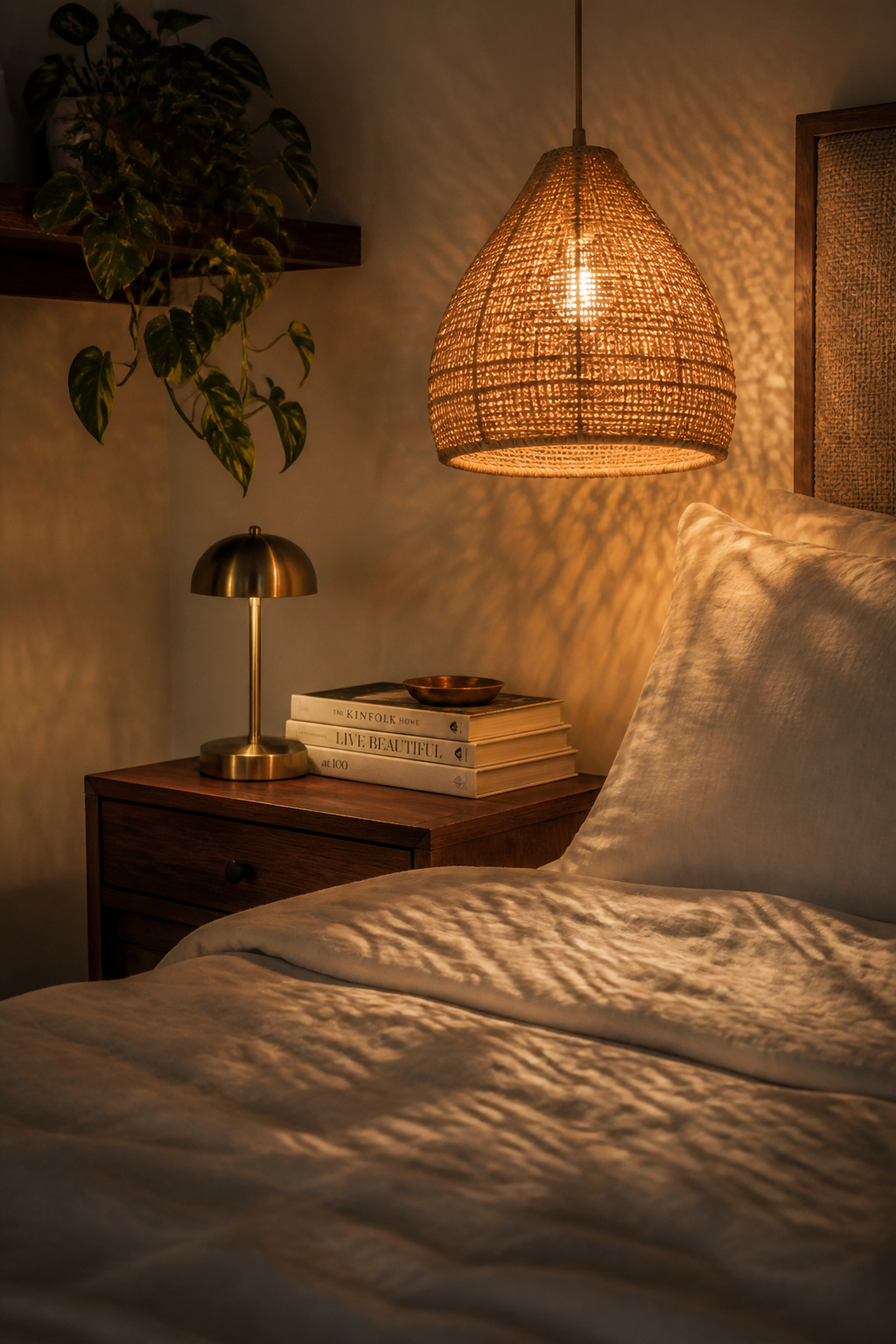
The height is specific: 30-50 cm (12-20 inches) above the nightstand surface for bedside pendants. This puts the light source at the right level to illuminate a book without casting harsh shadows across the room. For a centred overhead pendant, you want a minimum of two metres (7 feet) from floor to fixture — enough clearance to feel spacious rather than oppressive.
Always wire in a dimmer. Bedroom pendant lighting without a dimmer is a problem: at full brightness it’s too harsh for winding down; you need the ability to drop it to 30% for evening warmth. Pair this with warm-white bulbs at 2700-3000K — cooler light above 4000K will signal your brain to stay alert rather than relax.
For style: rattan woven pendants create warm, organic light that suits natural-material rooms beautifully. Brass fixtures work in almost every bedroom style — they add warmth without demanding any particular aesthetic. Paper pendants (in the Noguchi tradition) diffuse light most softly of all and are worth the occasional dust that collects inside. If you want to go further with bedroom light sourcing and styling, bedroom lighting inspiration covers pendants, sconces, and layered ambient schemes in real bedrooms.
4. A Curated Gallery Wall as a Bedroom Design Centerpiece
The gallery wall above a bed is one of the bedroom design ideas that sounds straightforward until you’re standing in front of 11 random frames on the floor trying to figure out why it doesn’t look right. The answer is almost always this: you’re missing the unifying thread.
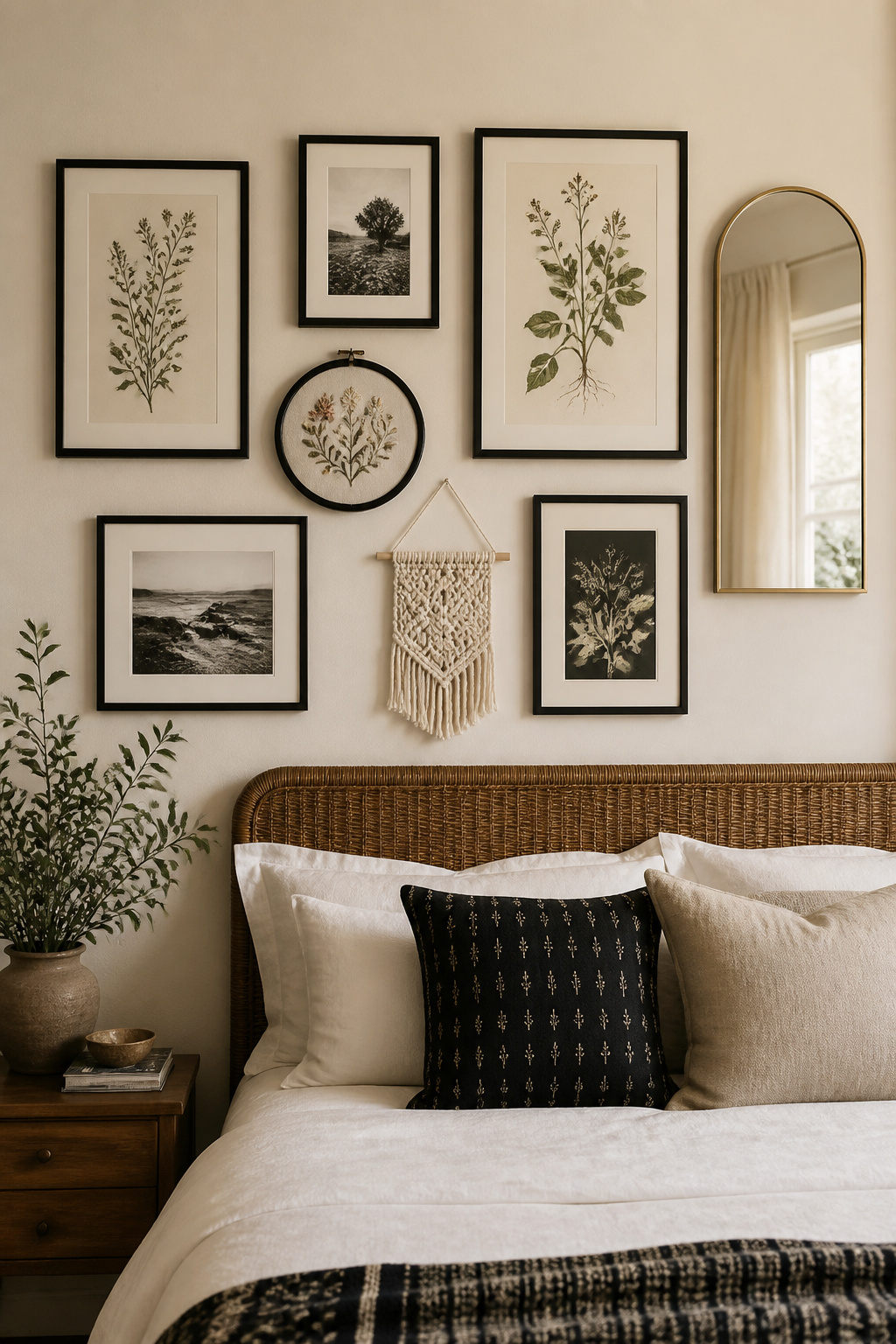
Pick one thing to keep consistent and let everything else vary. In practice, that means either a consistent frame finish — all black frames, all natural oak, all brass — regardless of art style inside them. Or a consistent art style — all botanical illustrations, all abstract prints, all photography — regardless of frame. The moment you mix both (varied frame colors AND varied art styles) the wall starts to look assembled rather than curated.
Height: centre the entire composition at 57-60 inches from the floor to the middle of the arrangement. For above a headboard specifically, the gallery should extend no wider than the headboard plus 6-8 inches either side. The art shouldn’t float into empty wall on either side of the bed — it should feel like it belongs to the piece below it.
My personal favourite additions to any gallery wall are woven and embroidered pieces: a small macramé panel, an embroidery hoop, a fragment of hand-block-printed textile in a simple frame. These add dimension that a flat print simply cannot — they have texture and catch light and shadow in ways that photographs don’t.
Layout: lay everything on the floor first, photograph it, transfer to wall using paper templates with a little painter’s tape. Do not skip the floor step. The template method takes 20 extra minutes and saves hours of filling nail holes.
5. Platform Bed With Built-In Storage for Space-Smart Style
If you’ve been stacking things under your bed in plastic bins, this bedroom design idea — a platform storage bed — solves the problem cleanly and makes the room look intentional rather than improvised. The built-in drawers replace an entire dresser in a smaller bedroom, which is a significant square footage gain.
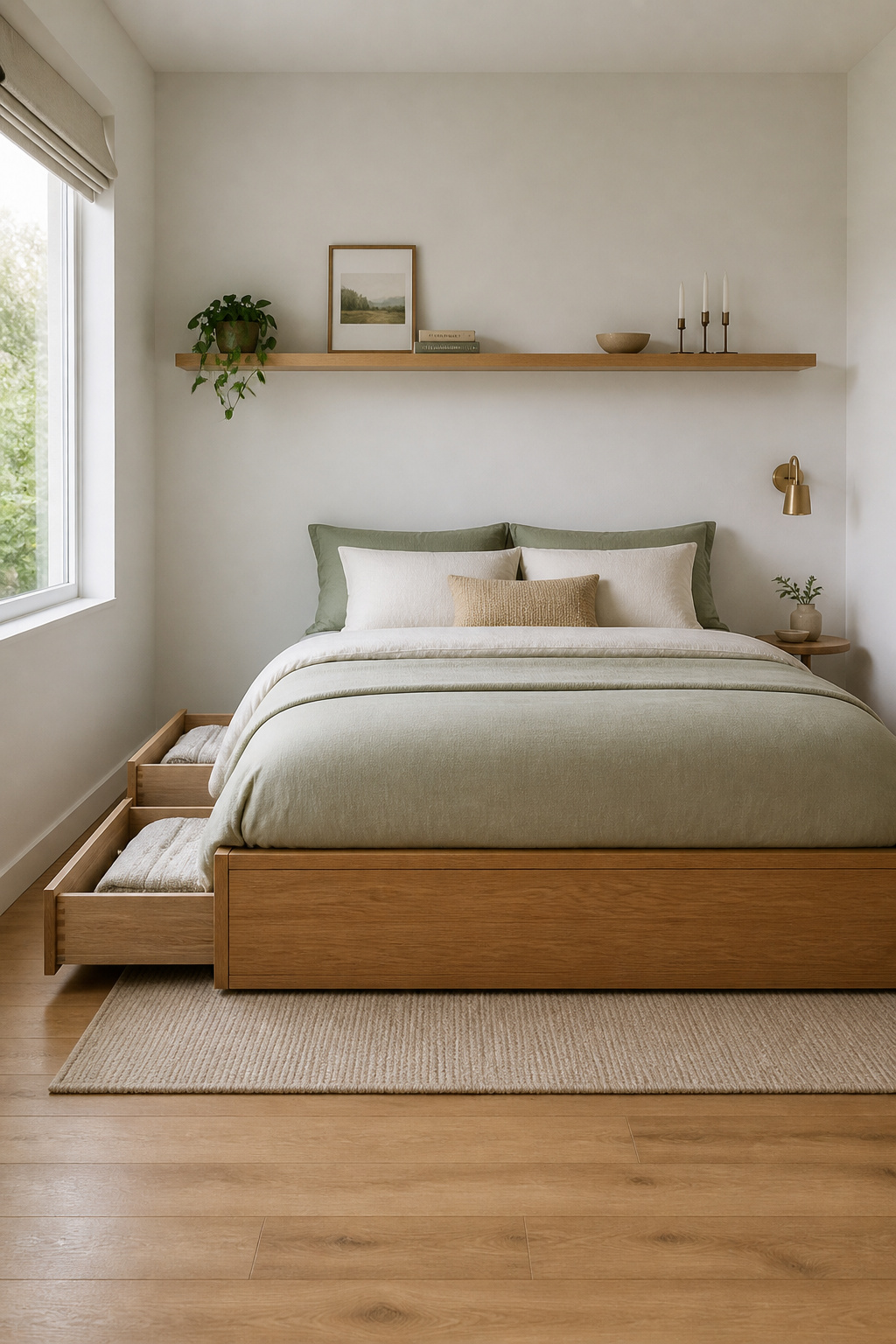
Platform beds also sit lower than traditional bed frames — no box spring required — which gives the ceiling more apparent height and keeps sight lines open. In a room under 9 feet, this matters. The lower profile makes the room feel taller, not shorter.
Quality separates the useful storage bed from the frustrating one. Check for dovetailed drawer joints — the joinery where two angled, interlocking cuts hold the drawer together without metal staples. Run your fingers across the joint: dovetails feel like tight, interlocking fingers. Stapled joints show metal and gaps. The difference takes eight seconds to assess and tells you everything about how long the piece will last. Full-extension, soft-close drawer slides are the other non-negotiable — full extension means you can actually access the back of the drawer, soft-close means the drawer doesn’t slam and wake your partner.
For drawer configuration: side-rail drawers are easier to access but slightly smaller; foot-of-bed drawers are wider and ideal for folded linens, spare pillows, and bulky items. For truly comprehensive bedroom furniture storage ideas beyond the bed itself, the combination of built-in storage with wall-mounted shelving creates a bedroom that stays organised without visible clutter.
6. A Handcrafted Textile Headboard With Block Print or Embroidery
The headboard is where many of the best bedroom design ideas live — it’s the most design-impactful piece of furniture, which is why it’s also the one most people settle for rather than choose. A standard upholstered headboard is fine. But a headboard that comes from somewhere — one made with craft traditions that have existed for centuries — changes the room entirely.
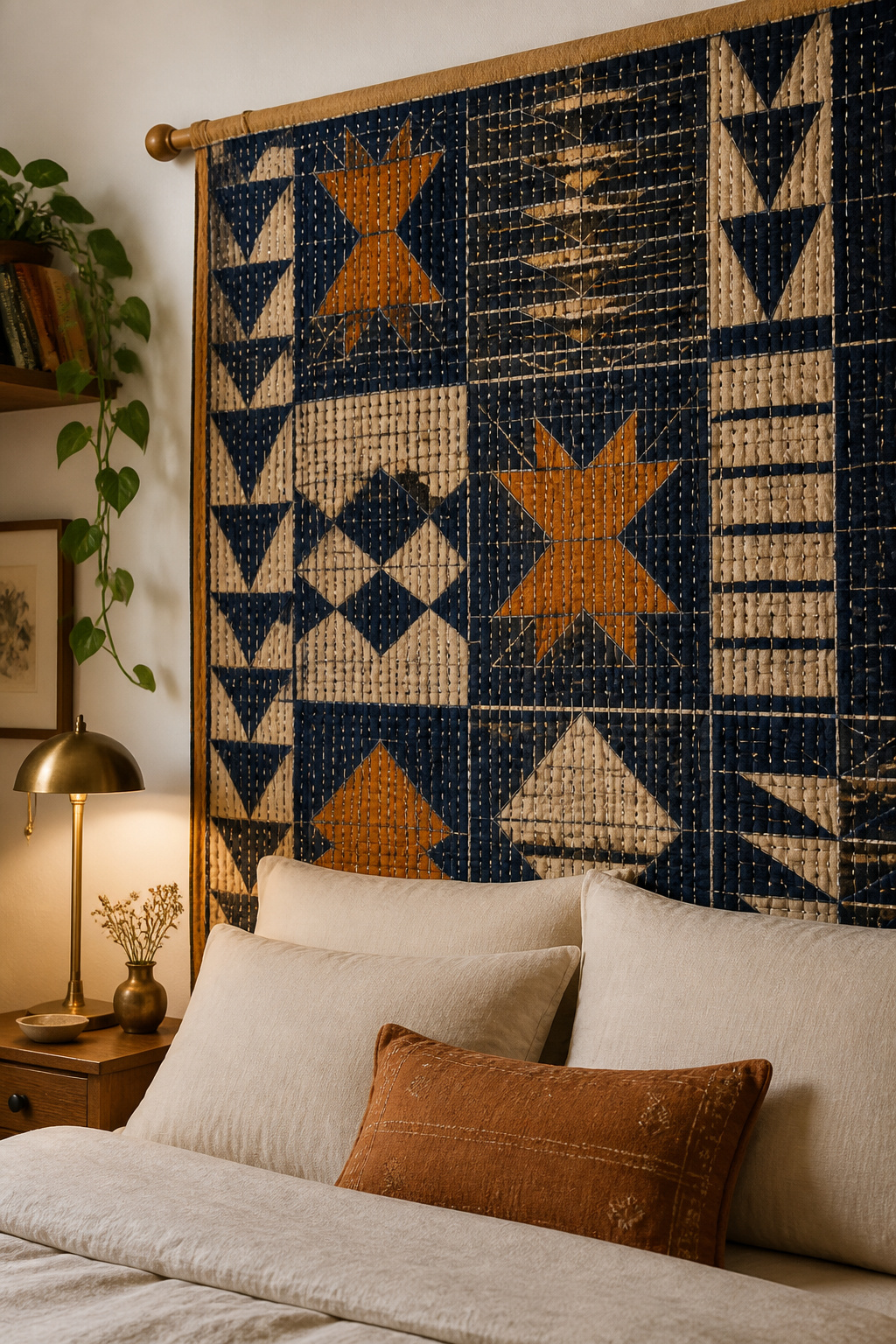
In the textile traditions I grew up around, the headboard concept already existed — it just wasn’t called that. A large kantha quilt hung behind a sleeping surface, a block-printed panel pinned above a charpoy, an embroidered ceremonial cloth displayed at the head of a guest bed. These are all the same gesture: the most beautiful, most meaningful textile placed where the eye goes first.
For a contemporary bedroom, a queen or king kantha quilt hung from a curtain rod makes a headboard that costs $60-150, can be swapped seasonally, hand-washes beautifully, and carries actual artisanal history. Kantha quilts available from Rajasthan-based craft cooperatives are hand-block-printed and running-stitched — the stitches made with the same hand motion artisans have used for generations. The geometric and floral patterns in indigo, rust, and saffron coordinate naturally with almost any base color.
For something more fixed: hand-block-printed cotton panels stretched over a canvas frame create a headboard that reads as fine art and costs a fraction of manufactured alternatives. Mirror-work embroidery from Gujarat (shisha work, where small mirrors are stitched into the fabric) adds a reflective sparkle that catches the light beautifully. More on combining eclectic bedroom design inspirations with global textile elements if this direction appeals — the styling logic translates to the rest of the room too.
7. Mix-and-Match Nightstands for an Eclectic Bedroom Design Look
Among bedroom design ideas, the matched nightstand pair — same piece, both sides — is the safe choice. It’s also, for many bedrooms, the wrong choice. Matching nightstands in a room with personality feel like they’re trying to tidy up a debate before it starts.
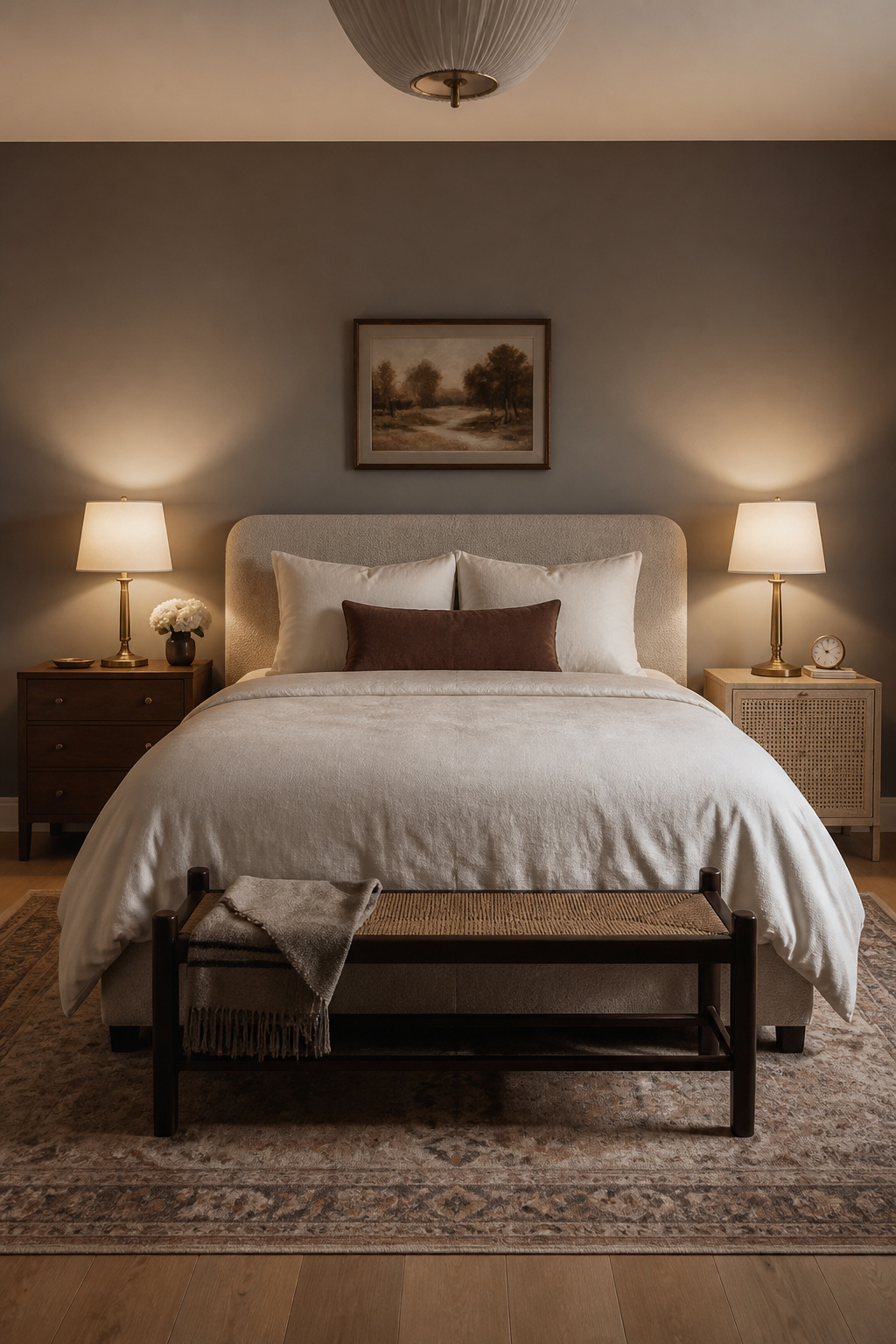
Interior designers now actively recommend mismatched nightstands, on the condition that they still ‘talk to each other.’ This is the important nuance: the goal isn’t random asymmetry, it’s intentional variation. Two nightstands that share a height but differ in style. Two that share a material but differ in shape. Two that share a hardware finish but differ in everything else. One element in common is enough to read as deliberate.
The most reliable anchor: identical lamps. Same shade, same height, one on each nightstand. Even if the tables themselves look completely different, matching lamps above them creates the visual balance the room needs. The eye reads the pair as a unit even when the pieces aren’t.
Height is the one thing that genuinely matters for function: the nightstand surface should sit within 2-4 inches of the mattress top. Lower than this and reaching for a glass of water becomes an inconvenience; higher and the nightstand begins to feel like a side table rather than a bedside piece.
When does symmetry win? In formally decorated rooms where matched pairs are part of the aesthetic logic, and in very small bedrooms where visual noise already feels pressured. In those cases, the symmetrical pair is actually the more sophisticated choice — the restraint is the design move.
8. Rattan and Wicker Accents for a Warm, Natural Bedroom Feel
Rattan bedroom design ideas had a difficult few years of being everywhere at once — every fast-furniture brand selling woven headboards and pendant lights in the same configurations, until the look became generic before it became tired. That’s over. Used selectively, natural rattan is exactly what it always was: a warm, organic material with genuine craft history that brings texture without requiring a particular aesthetic identity.
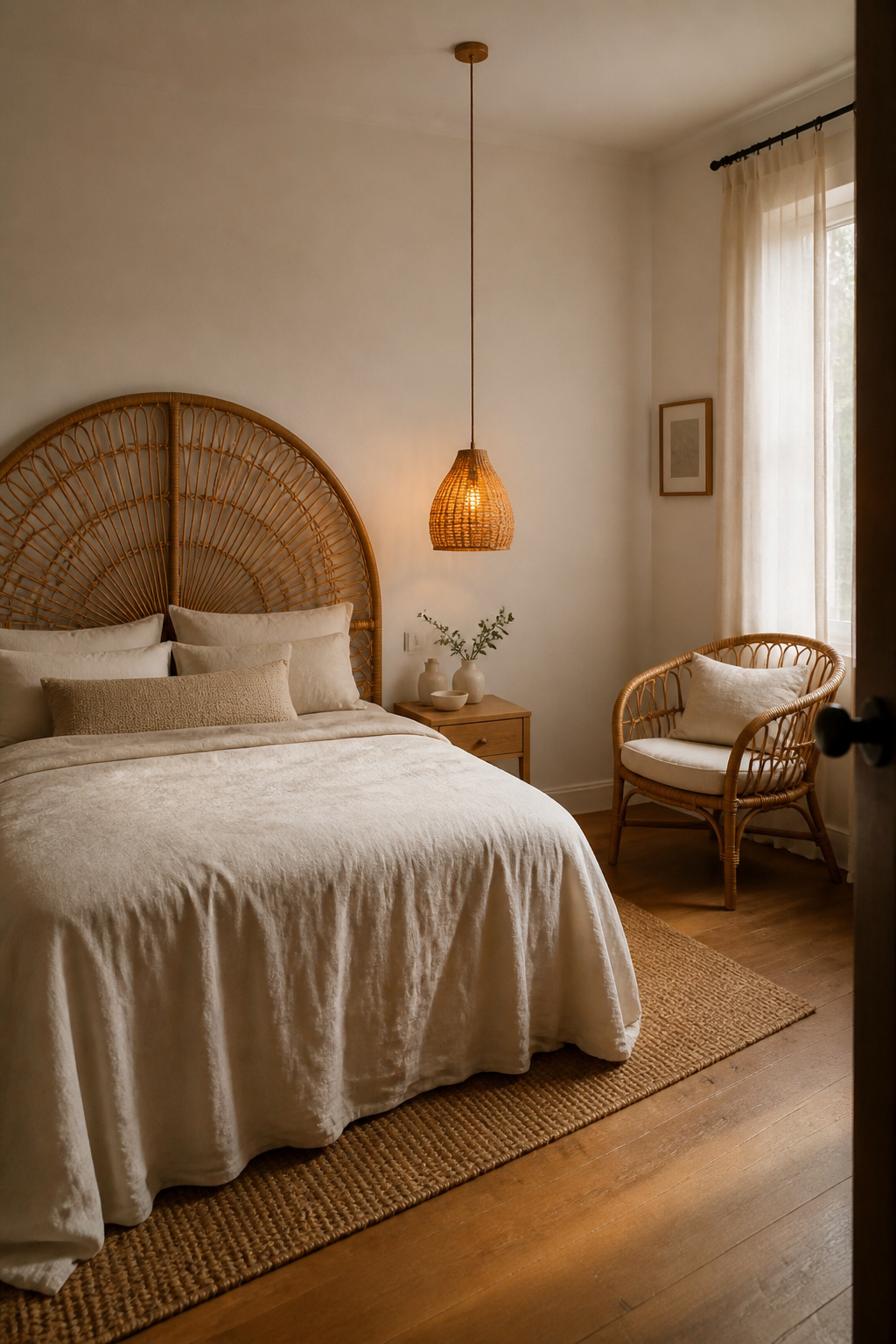
The distinction matters: rattan is the material (a solid tropical vine, Calamus rotang, harvested by hand in Southeast Asia), and wicker is the weaving technique (which can use rattan, bamboo, reed, willow, or synthetic fiber). Natural rattan is solid and dense; bamboo is hollow and actually stronger. When you’re buying bedroom furniture, what you want is natural rattan for indoor pieces — it has warmth that synthetic wicker simply doesn’t replicate.
An arched rattan headboard remains one of the most impactful uses of the material in a bedroom: it reads as furniture, adds architectural presence, and pairs naturally with linen bedding and warm neutrals. A rattan pendant light is the other high-return application — the woven structure filters light rather than directing it, creating a soft, dappled quality in the room beneath it.
Care is straightforward: dust weekly, clean marks with a barely damp cloth and a drop of mild dish soap, and never soak the fibers. The one enemy of natural rattan is very dry air — in heated winter rooms below 35% humidity, the canes dry and crack. A little linseed oil applied once a year, or a humidifier running in winter, keeps it supple. Avoid direct sunlight; UV exposure bleaches and dries natural rattan faster than anything.
9. A Canopy Bed With Sheer Drapes for Dramatic Visual Impact
Among bedroom design ideas, there’s something about a canopy bed that refuses to be modest. It’s a commitment — a piece of furniture that announces itself from the doorway and changes what the room is capable of feeling like. For that reason, it belongs in a bedroom where drama is welcome.
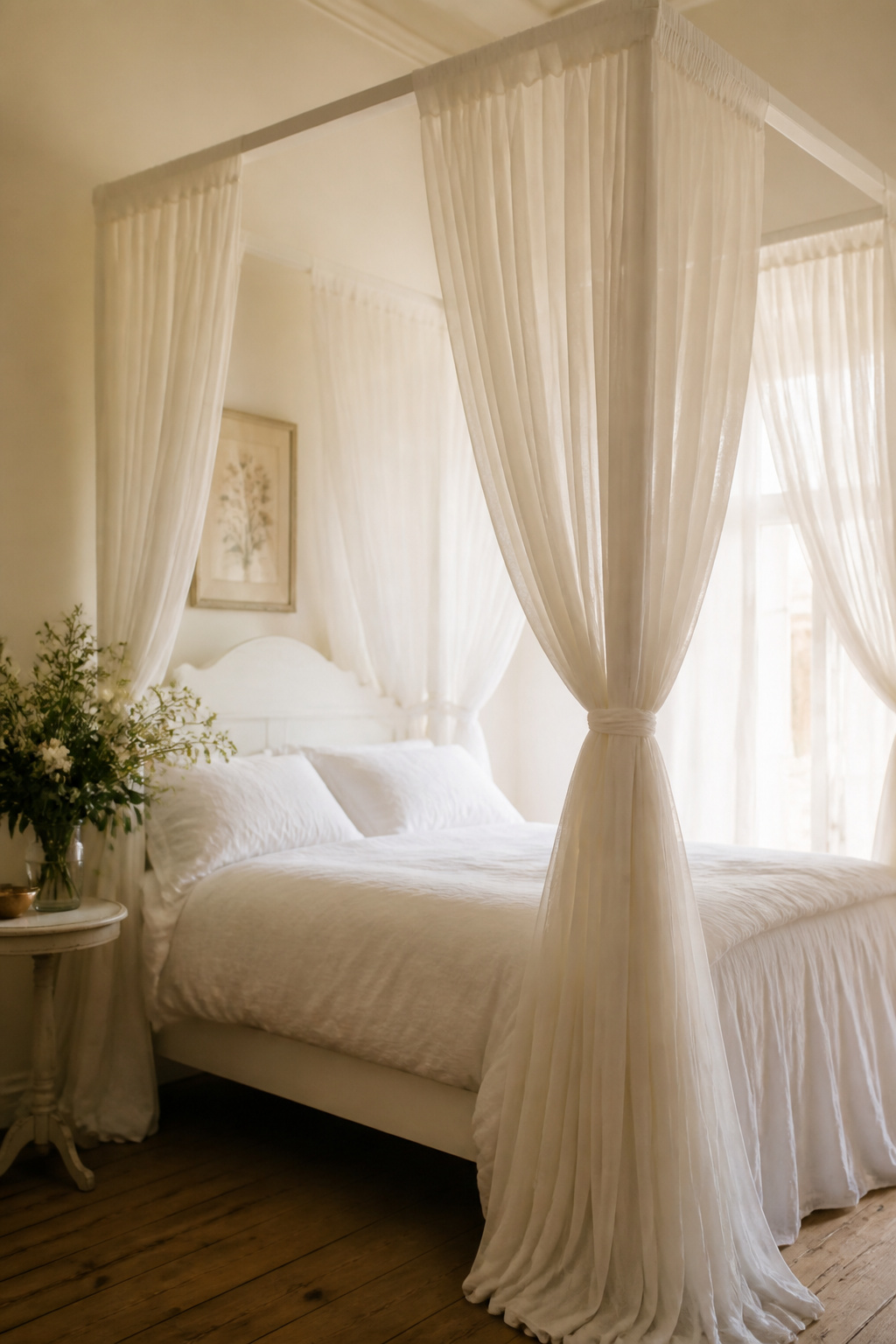
The ceiling height requirement is the first question to answer honestly. Most full canopy frames stand 7-8 feet at the highest point; you want a minimum of 12 inches between the top of the frame and your ceiling. That means 8.5-9 feet minimum ceiling height for a full four-poster canopy. Below that, the room starts to feel compressed rather than dramatic.
If your ceilings are shorter, the ceiling-mount approach achieves the same visual effect without the height requirement: install a simple 6-foot curtain rod directly on the ceiling above the bed, hang four panels of sheer voile from it, and let them puddle slightly on the floor. The silhouette is identical to a full frame; the cost is under $100.
Fabric choice determines the register of the whole thing. Voile is the most practical: lightweight, semi-sheer, machine-washable, drapes softly without bulk. Organza is slightly crisper and more formal — beautiful over a dark wooden bed if you want something closer to a theatrical effect. Muslin, undyed and raw, reads as rough-luxe and pairs naturally with global textile aesthetics and kantha quilts. Heavy curtain fabric ruins the canopy concept entirely — the lightness is the point.
10. Jewel-Toned Velvet Cushions: A Classic Bedroom Ideas Power Move
Velvet cushions are bedroom design ideas that living rooms rarely allow — a pairing that genuinely works. In a bedroom, velvet cushions are handled perhaps twice a day — when the bed is made and when you collapse into it at night. They maintain their pile for years. In a living room, the same cushions would be crushed and marked within months.
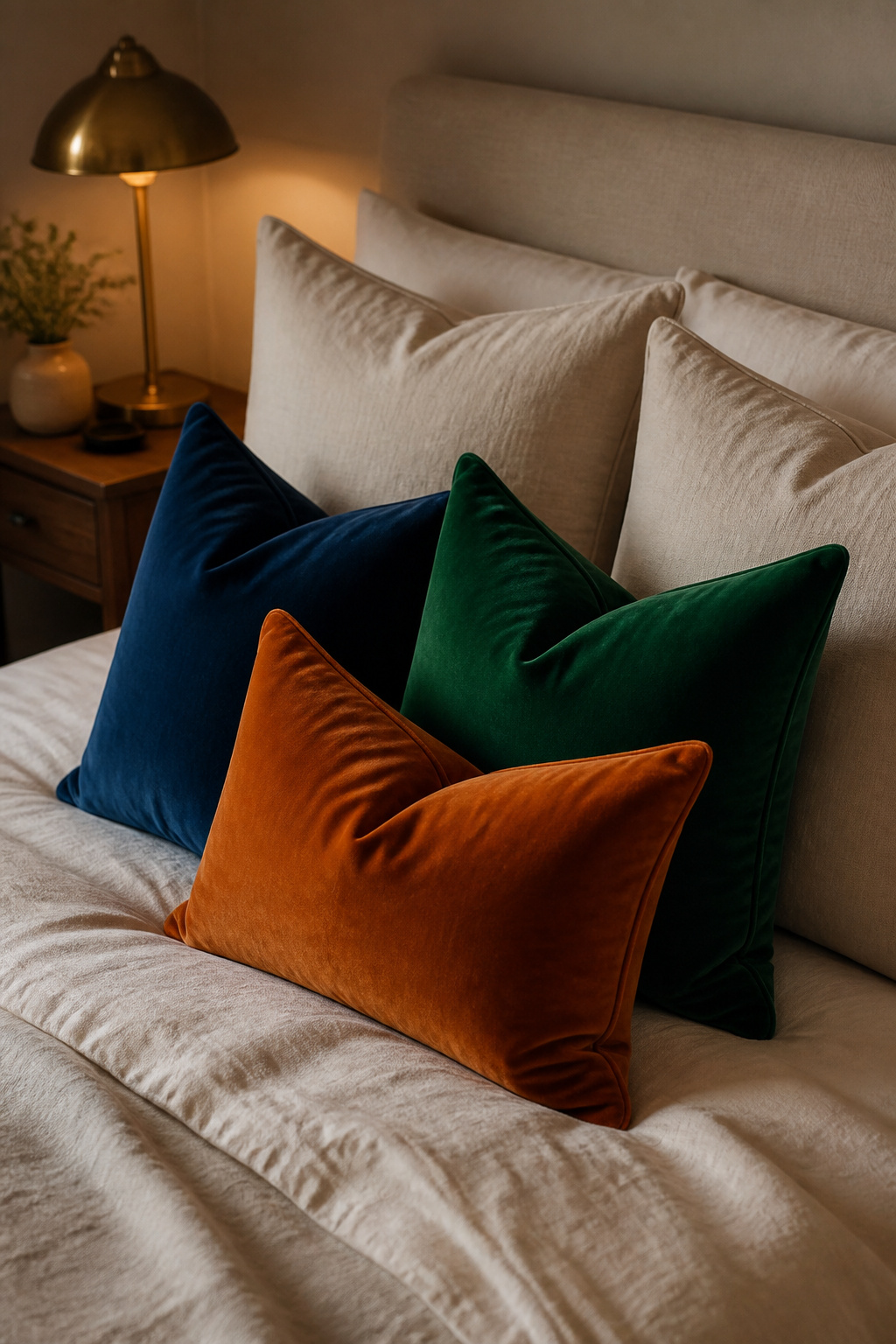
Jewel tones in velvet work because the material’s pile direction means the cushion appears darker or lighter depending on the angle and light. An emerald velvet cushion in a lamp-lit bedroom at night isn’t just green — it’s shifting between forest and sage as you move around it. This dimensional quality is impossible to replicate in flat fabric, which is why velvet jewel tones look so much better in person than in photographs.
Specific pairings worth knowing: emerald green on cream or natural linen, with brass or gold accents — a combination that reads as regal and warm simultaneously. Sapphire blue against warm walnut or oak furniture — the cool blue and the warm wood create natural balance that neither needs the other to justify. Amber and topaz on a charcoal or grey base — the orange undertone cuts through cool grey in a way that feels confident rather than clashing.
The formula for cushion quantity: 2 Euro shams (26×26 inches) + 2 standard cushions (20×20) + 1 lumbar pillow for a queen or king bed. Five total, with the jewel-toned velvet pieces as 2-3 of them against neutral bedding. The neutral provides the canvas; the velvet provides the punctuation. Overloading the bed with jewel tones at every layer removes the contrast that makes them work.
11. A Statement Rug That Anchors the Entire Bedroom Space
The most common rug mistake in a bedroom isn’t the wrong pattern or the wrong color — it’s the wrong size. Walk into any of the bedroom design mistakes I’ve encountered, and most of them share one feature: a rug that’s obviously too small, floating in front of the bed like a bath mat that wandered into the wrong room.
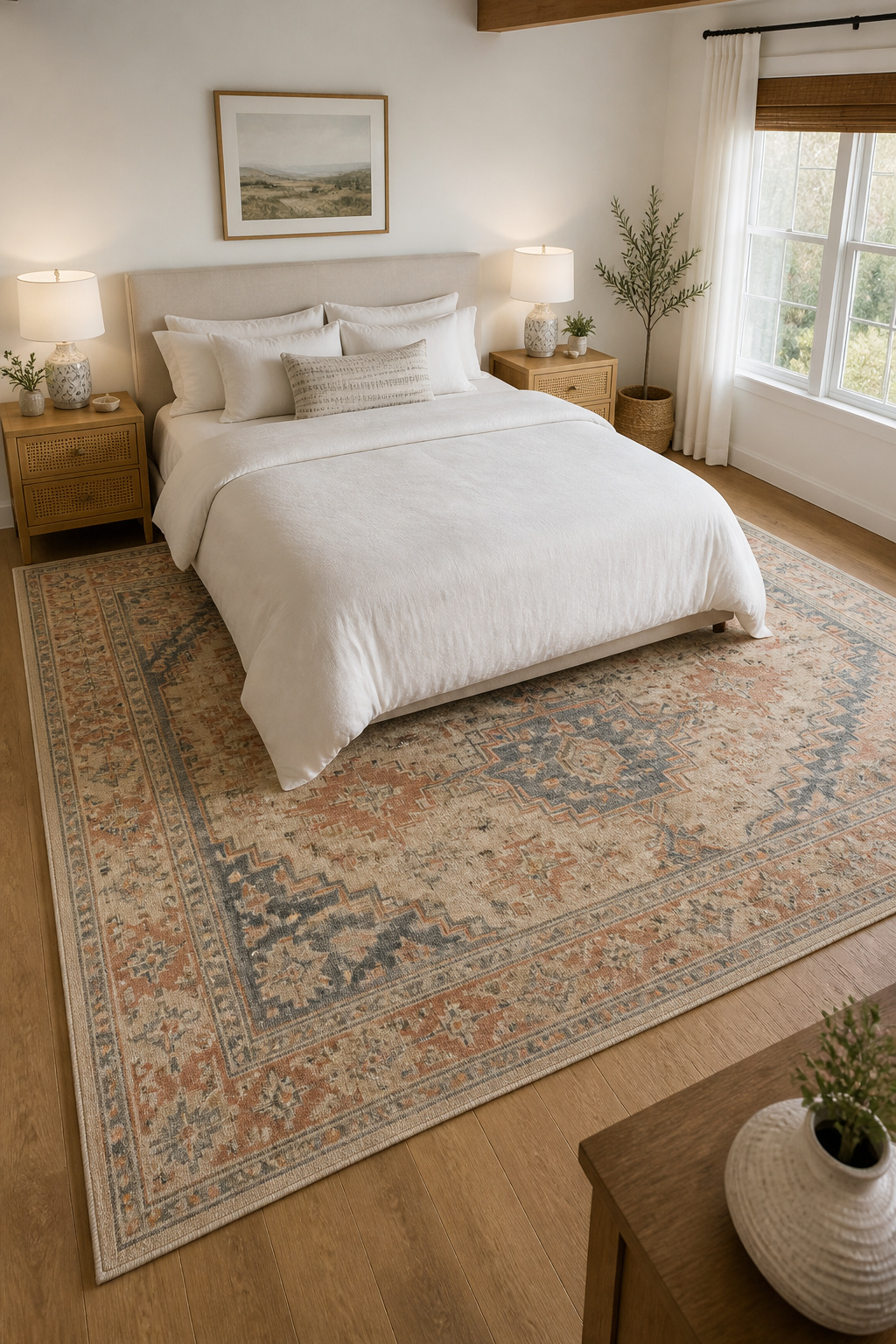
The correct size for a queen or king bed: the rug should extend 18-24 inches beyond each side of the bed frame and at the foot. Both nightstands sit fully on the rug. When you place your feet on the floor in the morning, they land on something warm. This is the functional test — if your feet hit bare floor when getting out of bed, the rug is undersized.
In practical terms: a queen bed needs minimum an 8×10 foot rug, placed starting two-thirds under the bed. A king bed needs a 9×12 minimum. Leave 6-12 inches between the rug edge and the walls — a rug touching the walls on multiple sides makes the room feel enclosed.
For material: wool is worth the investment in a bedroom. It’s naturally soil-resistant, maintains its pile for decades (genuine Persian and Turkish rugs made 50 years ago still feel luxurious), and is far warmer underfoot than synthetic alternatives. Low pile (under half an inch) vacuums easily and suits allergy sufferers. High pile or shag feels wonderful underfoot but collects dust quickly and requires a vacuum with adjustable height settings. For ideas on layering rugs over existing bedroom flooring, the same logic that applies to layering rugs over carpet or wooden floors over carpet or wooden floors applies: the under-layer is your foundation, the top rug adds pattern and warmth.
12. Mirrored Furniture to Brighten and Expand a Bedroom
The mirror is one of the bedroom design ideas where the design claims that sounds like an exaggeration until you experience it in a small room. Mirrors genuinely create depth perception — your eye reads the reflection as additional space — and strategically placed mirrors bounce natural light into darker corners that windows can’t reach directly.
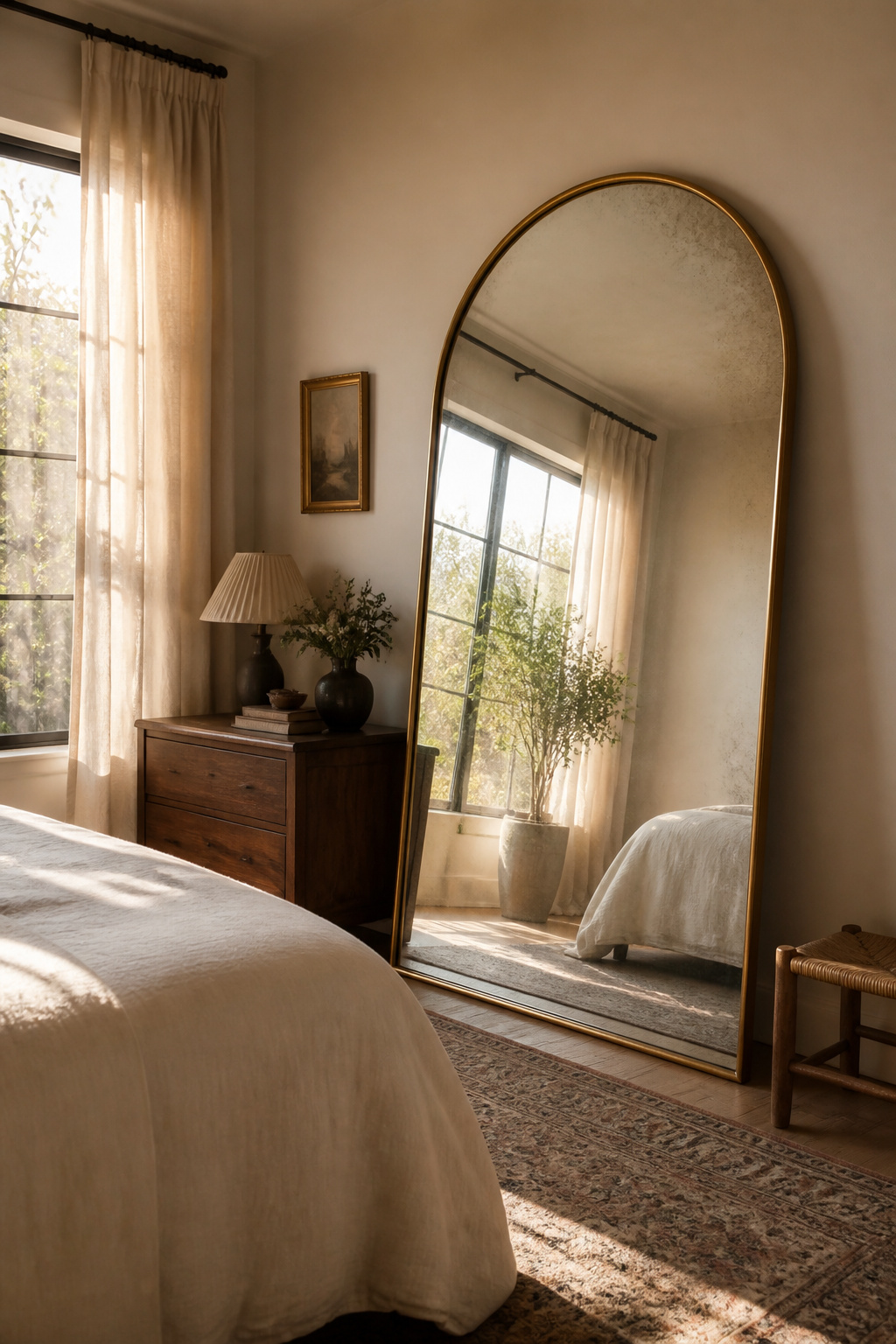
The placement rules matter here. A mirror directly facing the bed is the one configuration most worth avoiding — both feng shui tradition and sleep hygiene research converge on this point, suggesting that a reflective surface facing the bed keeps visual stimulation active in a space designed for rest. A large floor mirror propped against a side wall, or a mirrored dresser positioned where it reflects a window, achieves all the light and space benefits without the sleep disruption.
Antique mirror finish — slightly foxed, with darkened edges and an aged quality — reads as far more sophisticated than pristine modern mirror in a bedroom context. The imperfection is the point. It references European grandeur without the clinical brightness of clear mirror, which can feel cold in a space designed for warmth.
The frame transforms a mirror from bathroom fixture to furniture. An arched brass frame, a carved wood surround, a rattan-wrapped edge — any of these make the mirror a considered object rather than an afterthought. One large mirror is more effective and more sophisticated than multiple small mirrors scattered across the wall. For further bedroom decor furniture styling ideas that incorporate reflective surfaces alongside soft furnishings, the combination of mirrored and matte surfaces is one of the more reliably successful design contrasts available.
13. Botanical Prints and Indoor Plants for Bedroom Design Freshness
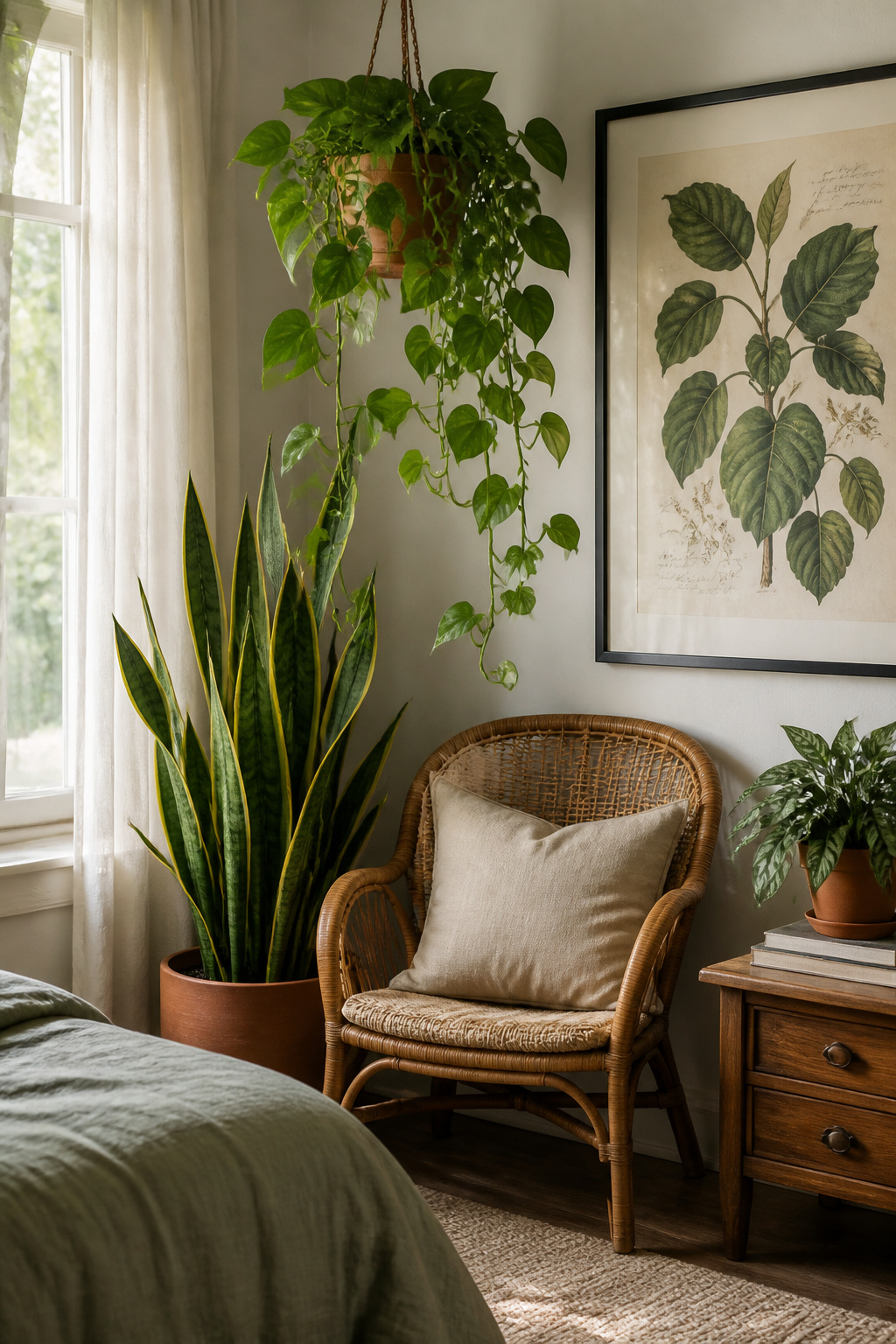
Botanical bedroom design ideas work differently than plants elsewhere in the home. Here, they’re not background greenery — they’re companions. A bedroom is a personal space, visited twice a day with full attention, and a living plant in that space adds a kind of continuity that a print or a painting can’t replicate. Watching a pothos trail further along a shelf over months, noticing the new leaves on a snake plant — this is biophilic design at its most intimate.
The Reality About Air Purification
The honest word on air purification: NASA’s 1989 clean-air study (the origin of the “plants clean your air” claim) was conducted in sealed chamber environments nothing like a ventilated home. Real-world air purification via houseplants would require dozens of plants per room. The actual value of bedroom plants is aesthetic and psychological — and that’s genuinely valuable enough without the inflated claim.
Best Low-Light Plants for Bedrooms
For low-light bedrooms: the snake plant is the most forgiving choice in existence. It tolerates dim corners, releases oxygen at night rather than during the day, and needs watering perhaps monthly in winter. Pothos trails beautifully from a shelf or hanging planter and survives conditions that would kill almost anything else. The peace lily, NASA’s favourite for ammonia and benzene absorption, thrives in shade and droops visibly when it needs water — the plant equivalent of a self-timer.
For botanical prints: a single large-format piece (A1 or bigger) of a botanical illustration has more visual impact than six smaller prints of individual plants. Vintage scientific illustration style — the kind found in 18th and 19th century herbarium drawings — is timeless and pairs with almost every aesthetic register. For bedroom plants for a lush green space and how to use hanging plants, trailing plants, and floor plants together in a bedroom, the layering principle from textiles applies here too.
14. Brass and Copper Accents for a Warm, Glowing Bedroom Atmosphere
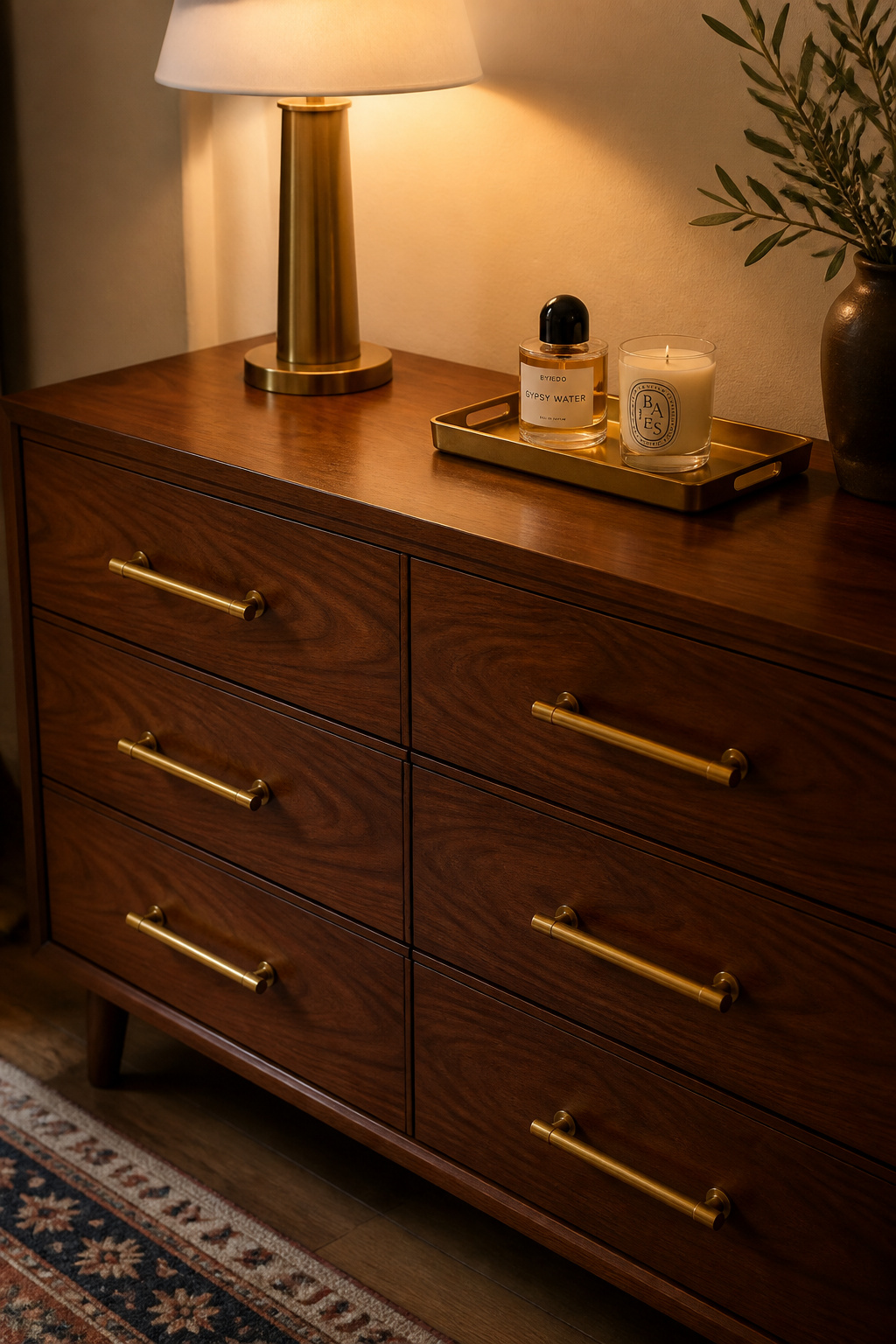
This is one of the bedroom design ideas where the impact is most noticeable after dark. Evening light in a room with brass accents is simply different. The warm metals pick up and amplify the yellow-orange spectrum of lamp light in a way that chrome and nickel never do. Chrome reads cool and clinical after dark; brass reads warm, amber, intimate. If your bedroom feels fine in daylight but loses something after the sun goes down, brass is often the answer.
Unlacquered vs. Lacquered Brass
The unlacquered vs. lacquered distinction is worth understanding. Unlacquered brass — raw, without a protective coating — oxidises gradually over 6-18 months, developing a warm amber-brown patina. Designers call this a “living finish” because it continues to change, deepening over years. Some people love this; others find the maintenance (occasional polishing to slow or reverse the patina) irritating. Lacquered brass stays bright and unchanging, requires no maintenance, and suits high-touch applications like drawer pulls and door handles.
In a bedroom specifically: unlacquered brass on picture frames, lamp bases, and decorative trays is low-contact enough that the patina develops slowly and attractively. For drawer hardware, lacquered is the practical choice.
Hardware upgrades deserve a special mention because they’re wildly undervalued as a transformation tool. Replacing plastic or chrome knobs on an existing dresser with solid brass bar pulls costs $3-12 per piece and takes fifteen minutes. The visual change to the piece — and through it, to the room — is disproportionate to the effort. This is the project I recommend to anyone who feels their bedroom needs work but doesn’t know where to start.
For mixing metals: give brass the dominant position (60% of metal in the room) or use it as a clear accent (20-30%). The 50/50 split — equal amounts of brass and another metal — reads as indecision rather than intention.
15. Vintage Dresser as a Bedroom Focal Point With New Hardware
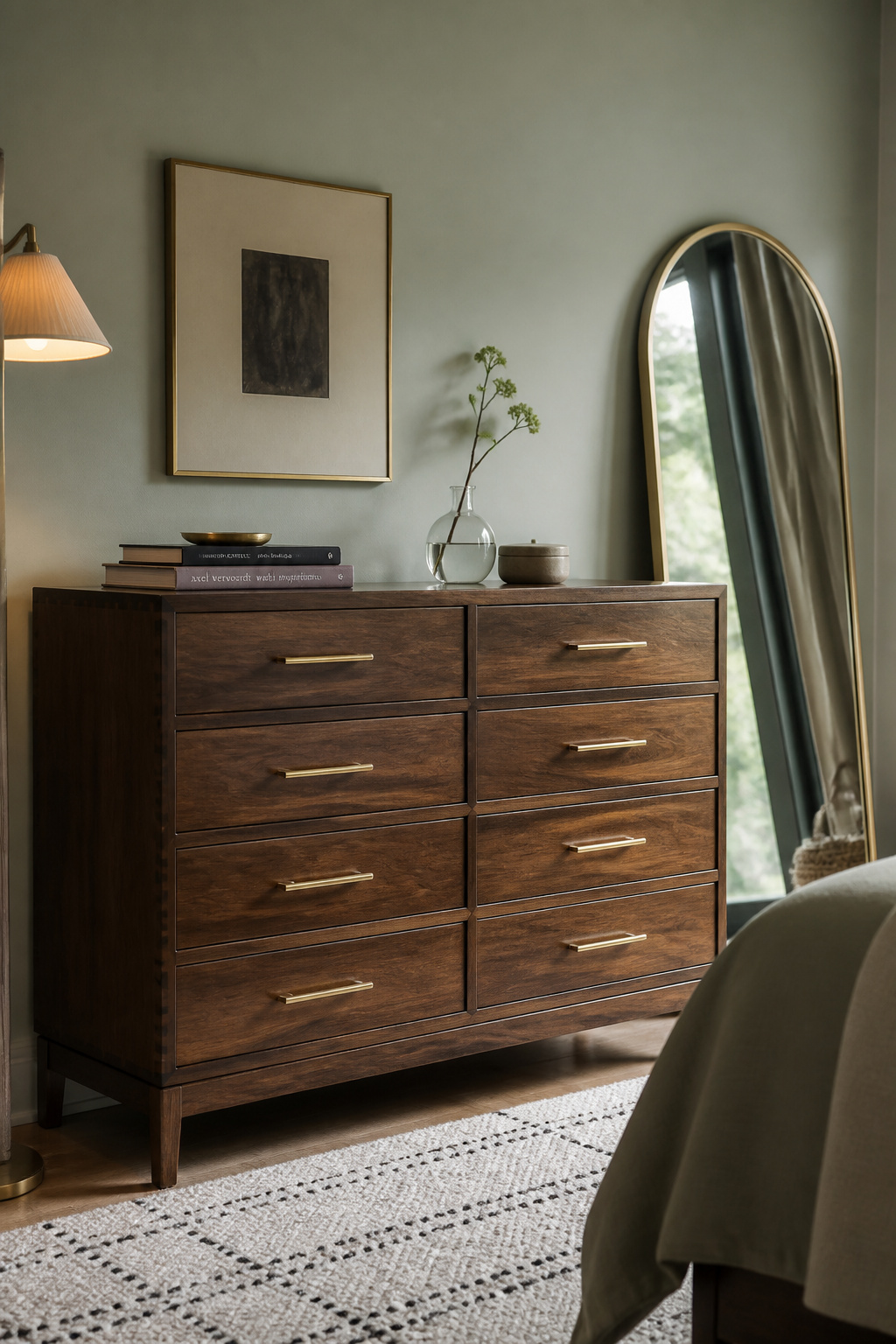
The vintage dresser is one of the bedroom design ideas with the highest return on patience. Pre-1990 solid wood dressers are among the most undervalued objects in the furniture market. A $75-200 estate sale piece made from walnut, maple, or oak in the 1960s-80s uses hardwood from old-growth trees that grew slowly, with tight grain and genuine density. The dovetail joints holding those drawers together have been working for 40-60 years and will continue to work for another 40. The $999 flat-pack version from a contemporary retailer will show drawer failure within five years — the particleboard expands in humidity, the plastic slides wear, the MDF edges chip.
Where to Find and What to Check
Finding these pieces takes patience but not expertise. Estate sales are the best source: families pricing to clear rather than to profit, with pieces still in the rooms where they’ve always lived. Facebook Marketplace and Craigslist on Sunday afternoons, when sellers want things gone, offer the best negotiating conditions. On Chairish and 1stDibs you’ll find verified pieces with clear provenance, though the prices reflect that curation.
The quality check takes eight seconds: open a drawer and look at the joints. Dovetails — angled interlocking cuts, tight and flush — confirm solid wood construction. Metal staples and visible gaps confirm particleboard or plywood that you should walk away from.
Once you have the piece, the hardware upgrade transforms it. Measure the existing hardware hole spacing center-to-center before ordering — standard vintage spacings are 3 inches, 3.75 inches, or 5 inches. Brass bar pulls at $8-25 each on a walnut or oak dresser create a piece that reads as intentional rather than inherited. For painted dressers, ceramic or porcelain knobs in cream or sage read beautifully. If the hole spacing is unusual, use a single centred knob rather than a pull — one hole, no re-drilling.
Choosing Your Bedroom Design Style and Making It Your Own
The hardest part of implementing bedroom design ideas isn’t choosing them — it’s narrowing them to one starting point. Fifteen options is too many to act on simultaneously, and trying to do everything at once is how rooms end up feeling busy rather than beautiful.
Two practical questions clarify the path fast: What’s the constraint — your ceiling height, your natural light, your budget, your time? And what’s the one thing your bedroom is missing most — storage, warmth, visual drama, calm, cultural expression? Each answer points toward a different place to start.
If budget is tight, the hardware upgrade on an existing dresser or finally getting the rug size right are both transformations under $150 with outsized visual return. If you have an afternoon and nothing to spend, the textile layering exercise — rearranging what you already own and folding a throw differently — costs nothing and is often revelatory about what the bed actually needs.
If you want one change with the most sweeping impact: the accent wall. It changes the entire room’s register — from neutral to particular, from anyone’s room to yours — and the materials cost between $40 for limewash paint and $200 for a quality wallpaper panel. Everything else in the room begins to look more intentional once the wall has an identity.
A bedroom that feels genuinely yours doesn’t need to be finished all at once. In my experience, the rooms that feel most alive are the ones that accumulated slowly — one good piece, one considered choice, one layer added when the timing was right. Start with the bedroom design idea that excites you most and let the room grow from there.