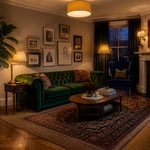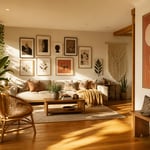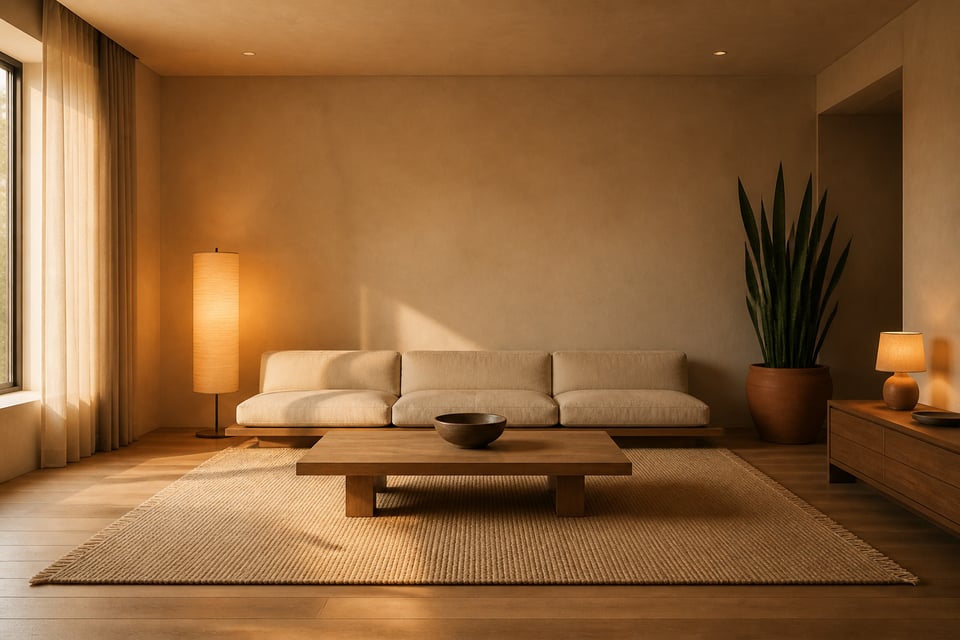
There is a Japanese concept called ma — the intentional space between things. It is the closest translation for what genuinely simple living room decor actually does. Ma is not about having less. It is about giving what remains enough room to mean something. Most living rooms are not cluttered because their owners lack taste. They are cluttered because no one explained that the pause between objects is as important as the objects themselves.
Akira Tanaka has spent over a decade helping clients translate Japanese design philosophy into homes that are genuinely calm. These are not Japanese-themed rooms. They are spaces that feel designed rather than assembled. What follows are 16 approaches drawn from that practice. They are honest, specific, and ordered so you can apply them one at a time without dismantling your room all at once.
1. The Art of Ma: Empty Space as Simple Living Room Decor
The living room that stopped feeling like a waiting room the moment everything unnecessary was removed — that transformation was not the result of better furniture. It came from understanding ma.
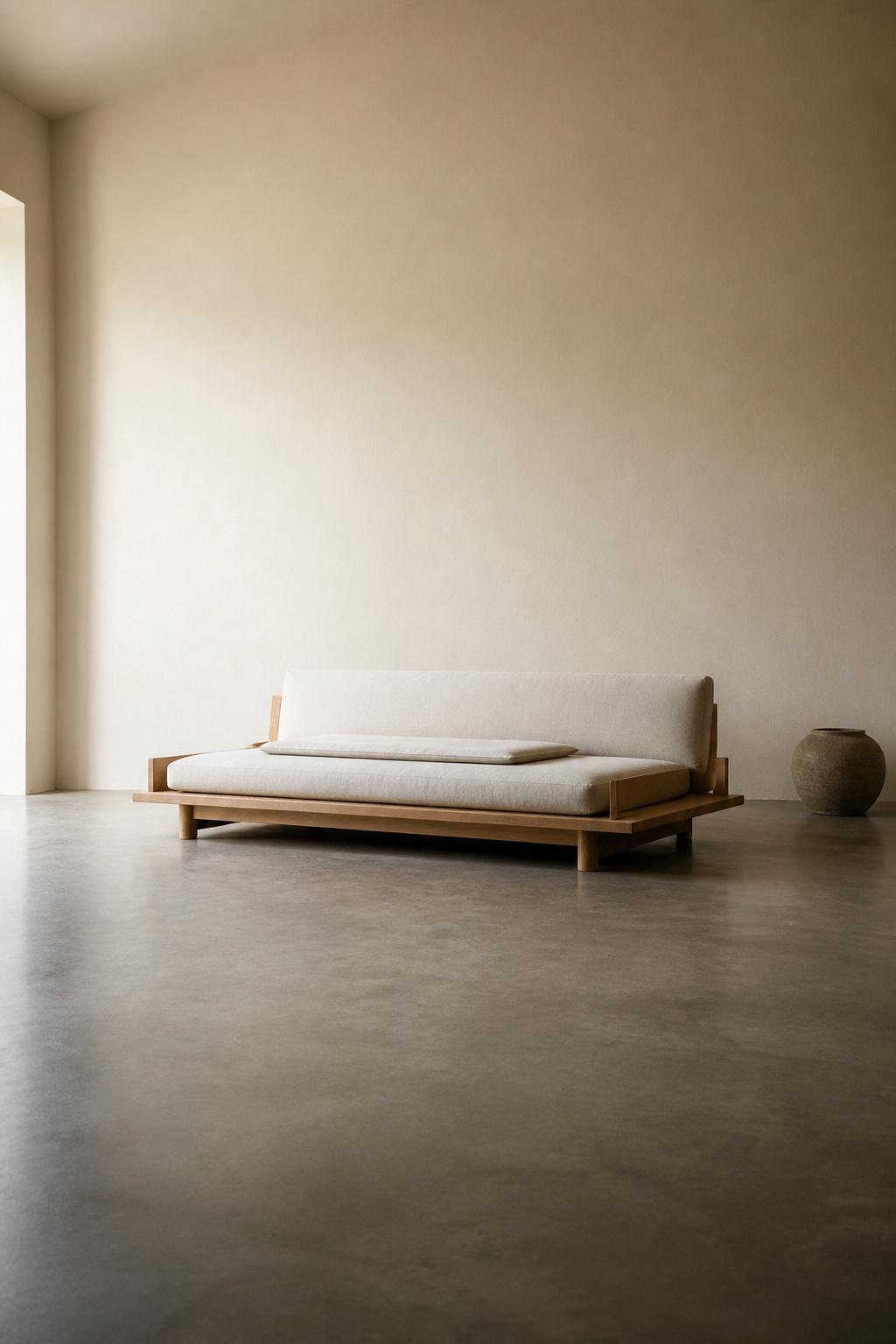
Ma (間) is negative space treated as an active material, not an absence. In Japanese design, the gap between a sofa and a lamp is a design decision — as is the bare section of wall between two pieces of art, and the empty shelf in a built-in. The Western instinct is to fill. The Japanese instinct is to ask: what can I remove so that what remains has authority?
A minimalist living room built on ma might contain a single sofa or pair of low chairs, a coffee table, one side table, a storage element, and lighting. That is the complete furniture list. Every wall with untouched surface is ma. When every wall carries art, shelving, and decor, the room loses its capacity to rest.
The test is simple. Stand at your room’s entrance and photograph it. Wherever the eye finds no resting point between objects, that zone needs editing — not rearranging. The goal is not austerity. It is intention: each remaining object earns its space because its absence would be felt.
2. Neutral Palettes That Allow a Living Room to Breathe
Cool whites sound like minimalism until they are lived with. Under morning light, they read cleanly. Under the warm cast of an evening lamp, they turn blue-grey and feel institutional. Warm whites, creamy beiges, and plaster tones do the opposite. They shift flatteringly as light changes throughout the day. That is why designers reach for them consistently in rooms used from morning through evening.
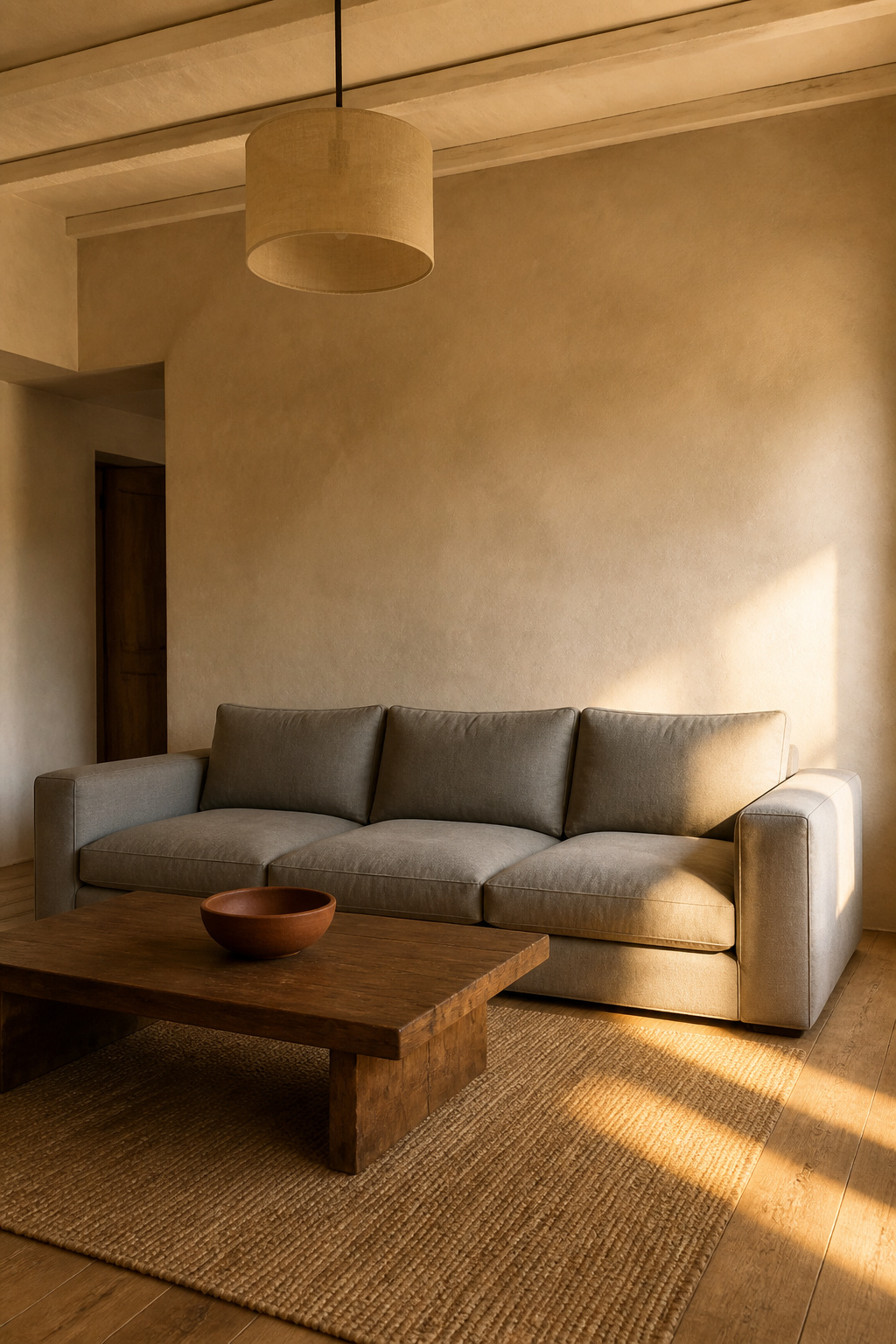
Japanese design tradition rarely uses stark white. The preferred neutrals are warmer: plaster, rice paper, aged wood, weathered linen. These tones carry a little history already. For other calm, neutral-led approaches, the timeless coastal living room aesthetic applies the same principle — a palette that reads as thought-through rather than defaulted to.
The 60-30-10 rule, adapted for a minimal neutral scheme: 60% creamy beige on walls and the dominant furniture piece, 30% warm grey or oat in the sofa and rug, 10% terracotta or muted sage in small vessels and textiles. The rule is a ceiling, not a floor. A room using only two tones (80/20) reads as even more deliberately considered.
Depth in a neutral scheme comes from surface variation, not color variation. A smooth plaster wall next to a rough linen sofa next to a matte ceramic vessel creates visual richness. That is what calm looks like when it has something to say.
3. One Statement Piece Over Many: The Minimalist Living Room Principle
The principle of kanso — one of the seven Zen aesthetic concepts applied to space — is the elimination of what is unnecessary so that what remains has authority. A well-chosen sofa with clean lines commands a living room. No collection of accessories can replicate this. Scale matters here. One large, well-proportioned piece anchors more effectively than several small ones negotiating for visual dominance.
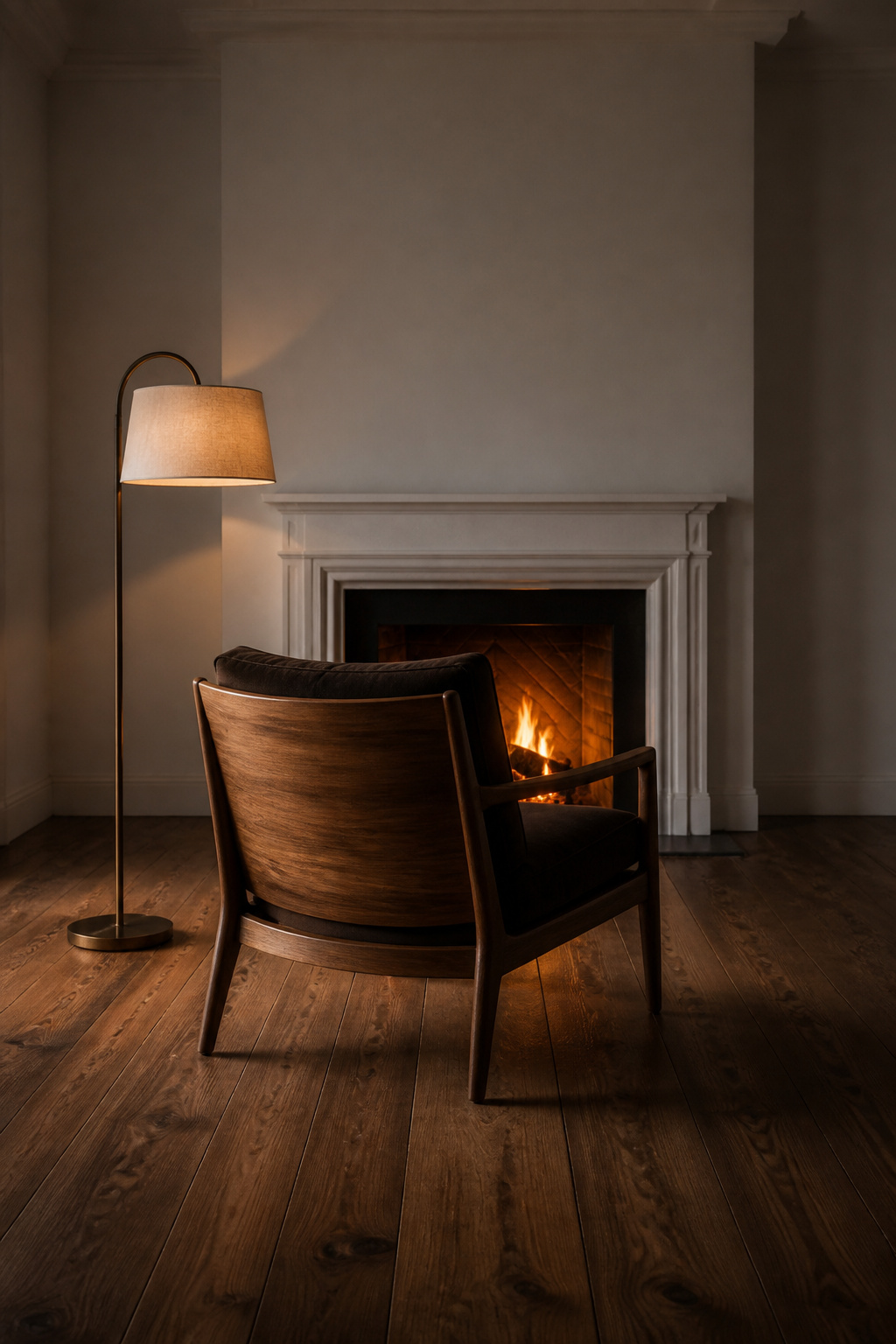
Every living room has a focal point. Sometimes it is architectural: a fireplace, a picture window, a high end-wall. Sometimes it is imposed. Find it before placing a single piece of furniture. Orient the primary seating to face or frame it. Everything else in the room supports this arrangement rather than competing with it.
If no architectural focal point exists, create one. A large floor-level media unit, a single oversized artwork, or a dramatic floor lamp in a corner all work. What to avoid: the accent wall that draws focus away from everything else while claiming to anchor it. In a minimal room, a feature wall in a slightly deeper tone of the same palette — not a contrasting color — provides visual grounding without the competition.
One more thing. When assessing whether a piece has earned its place, ask not whether you like it but whether its absence would be felt. If the honest answer is no, it is a candidate for removal.
4. Simple Living Room Decor That Starts With Intentional Furniture Placement
This is the intervention most rooms need before any purchase. It costs nothing. Pulling your sofa 10 to 18 inches away from the wall is the single most impactful rearrangement available in a standard living room. It creates a floating arrangement that reads as professionally considered. It also makes the room feel, paradoxically, larger.
Sofas pushed against walls separate seating from the center of the room. The effect is a perimeter arrangement — furniture lining the edges with an unused center. It reads like a waiting room regardless of what is on the walls. Even 6 inches of clearance between sofa back and wall is enough to shift how the room reads.
The conversation cluster has an optimal distance: 4 to 8 feet between facing seats. Research on household behavior suggests that moving a sofa into this conversational range increases household interaction frequency by up to 40%. Beyond 10 feet, people disengage or raise their voices. The coffee table should sit 16 to 18 inches from the sofa — close enough to reach without leaning, far enough to walk past without turning sideways.
Traffic flow is the skeleton beneath any good layout. Maintain 36-inch walking paths through the room and 12-inch breathing gaps for secondary routes. If guests have to turn sideways to pass the sofa end, the layout is fighting the room. Rearrange before you replace. Simple living room decor starts here.
5. Natural Linen and Cotton Textiles for Understated Warmth
Linen is made from flax fibres. It does something synthetic blends cannot: it becomes softer with each wash rather than pilling or degrading. By its third year, a quality linen cushion cover has developed a softness and character — a natural fading at stress points, a gentle relaxation in the weave — that mass-produced polyester mimics from day one and never improves beyond.
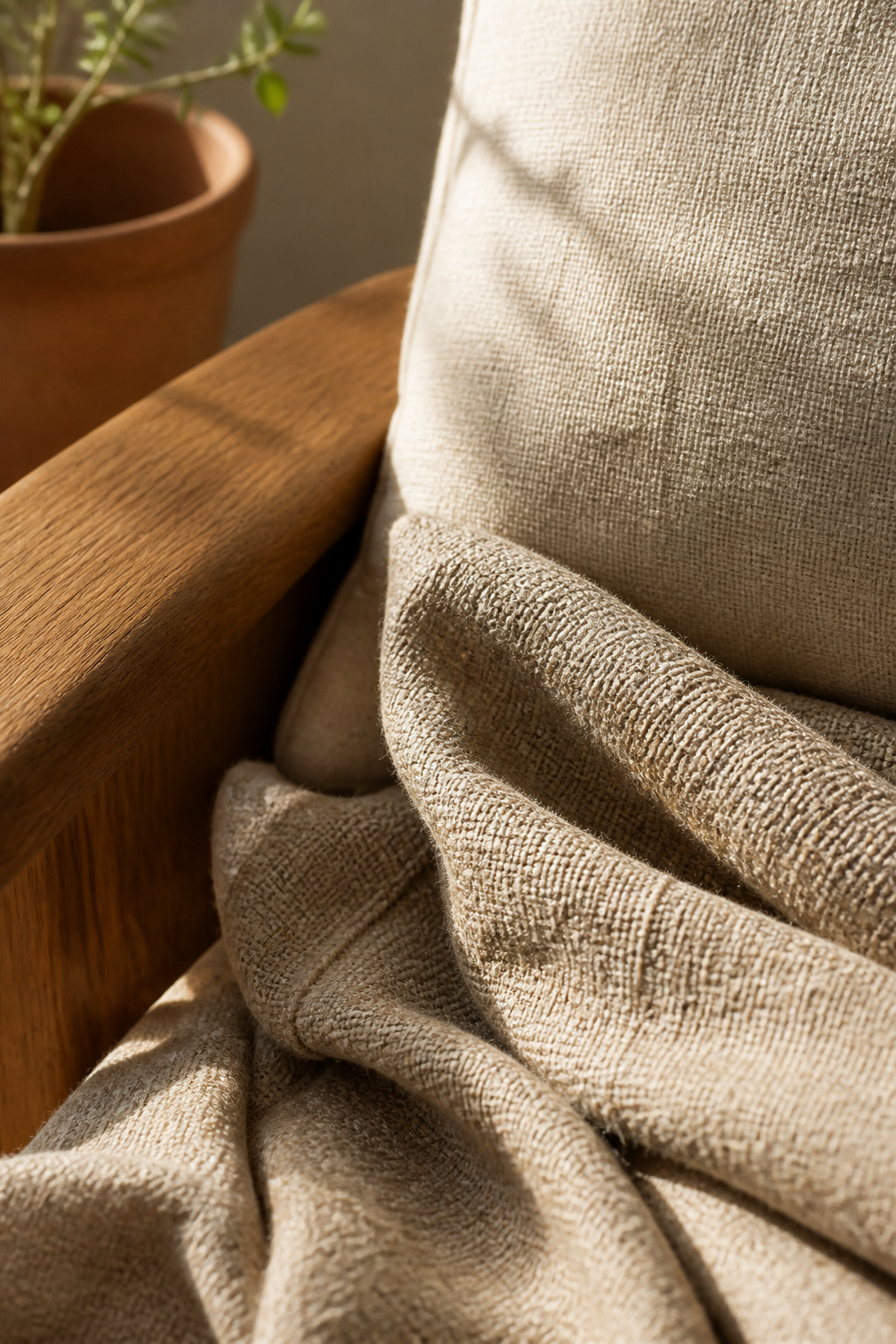
This is the wabi-sabi case for natural textiles. The beauty is not in the pristine state but in how they age. Slub linen has intentional thick-and-thin variations in the yarn. It catches light differently at different points. Raw, loosely woven cotton has an organic roughness that sits beautifully against smooth plaster or polished wood. The contrast is textural, not colorful. This is why a room with natural textiles looks richer than one with expensive synthetics.
For those already working with layered textiles in other rooms, the principle holds everywhere. Much as layering textiles in a boho bedroom favors natural materials for textural depth, the same logic applies to simple living room decor.
Care is simpler than most people expect. Air and sun over constant washing. Shake cushion covers outside and let them breathe in natural light. Line-dry rather than tumble-dry on high heat, which weakens cellulose fibres over time. Rotate cushions every few weeks to even wear. Natural textiles rewarded with this kind of attention last ten to fifteen years. They look better at the end than they did at the beginning.
6. Wood, Stone, and Paper: Wabi-Sabi Materials for Calm Living Spaces
Wabi-sabi is routinely reduced to a decorating style. It is, in fact, a philosophy of imperfect and transient beauty. The crack in a ceramic proves its handmade origin. The grain knot in a table marks where a branch once grew. Materials that age honestly outperform pristine manufactured surfaces in every room they enter.
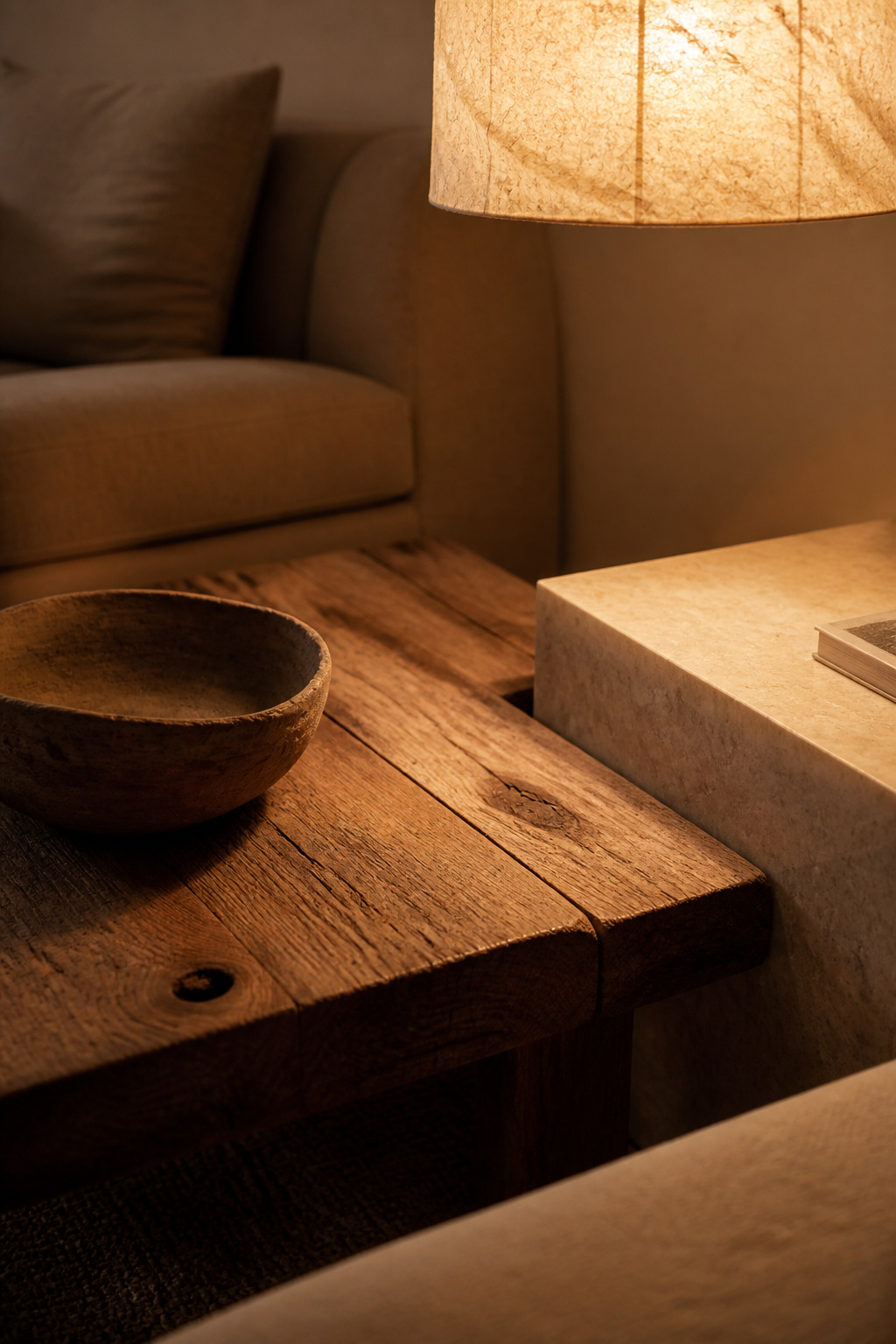
Wood grain is the most accessible starting point. A plain oak coffee table with visible grain and knots tells a story that no composite veneer can replicate. Stone — whether as a side table surface, a fireplace surround, or a single sculptural piece — brings geological time into the room. Veining and mineral inclusions are marks of authenticity, not defects. Washi paper, Japan’s handmade paper tradition, can arrive in lampshades, framed as wall art, or layered as a translucent room divider. Its irregular fibres filter light in a way that manufactured materials never achieve.
Sourcing does not require specialist suppliers. Reclaimed wood for shelving and furniture is available through architectural salvage companies at $8 to $20 per board foot for quality oak or pine. Natural stone slab for a coffee table top can come from stonemason off-cuts. These are pieces too small for countertops but perfect for smaller furniture, often at 40 to 60% below standard pricing. A terracotta piece from a local potter runs $30 to $80 and dramatically outperforms mass-produced alternatives in character.
The material contrast principle: pair one rough surface with one smooth. Rough wood grain next to smooth plaster, matte ceramic next to polished stone, loose linen next to sealed concrete. Two rough textures together compete. One rough and one smooth — the textured material becomes the character element.
7. A Single Area Rug as the Anchor of Simple Living Room Decor
The most reliably executed-incorrectly element in a living room is the area rug. A rug that lives only under the coffee table — with no sofa legs on it — looks like a bathmat that wandered in from another room. It fragments the seating area instead of unifying it. And it costs the same as a correctly sized rug while doing a fraction of the work.
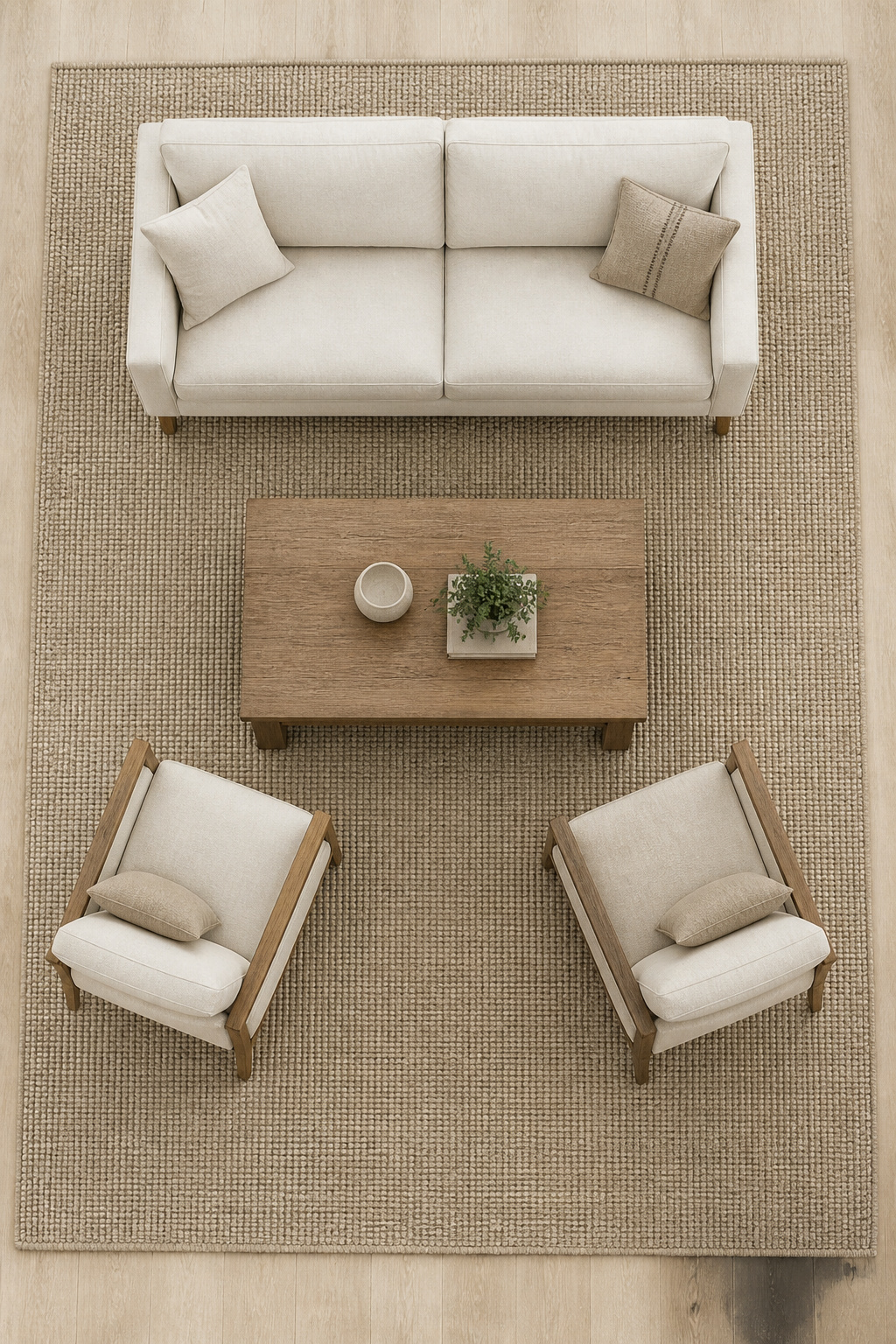
The starting rule: 9×12 feet for a standard three-seater sofa grouping. A 9×12 works with front-legs-on or all-legs-on arrangements. It reads as correctly scaled in most living rooms. An 8×10 works for smaller groupings. Anything smaller needs to prove it belongs. The front-legs-on arrangement — all seating pieces with their front two legs on the rug — is the classic approach. It requires a smaller rug than all-legs-on while achieving the same visual unity.
The common rationale for undersizing is cost. A single correct-sized rug at $300 reads more considered than two small rugs at $150 each. This is one of the areas where restraint in quantity and investment in quality produce a dramatically better result.
Material selection is practical. Wool is warm, naturally dust-resistant, and ages gracefully — it has lanolin that resists staining and develops a gentle patina with use. Jute is earthier and less soft underfoot. It costs $150 to $400 for an 8×10 and connects naturally to wabi-sabi material schemes and simple living room decor goals. Flatweave cleans easily, works under rolling furniture, and suits households with pets. All three are honest materials.
8. Soft Layered Lighting That Replaces the Harsh Overhead
A single overhead fixture makes a living room feel institutional. Downward shadows fall on faces, depth disappears, and flat even illumination removes the dimension a room needs to feel like a home. The Japanese andon-style lighting tradition solves this. Light sources sit low — at eye level or below — creating warm pools that draw people inward.
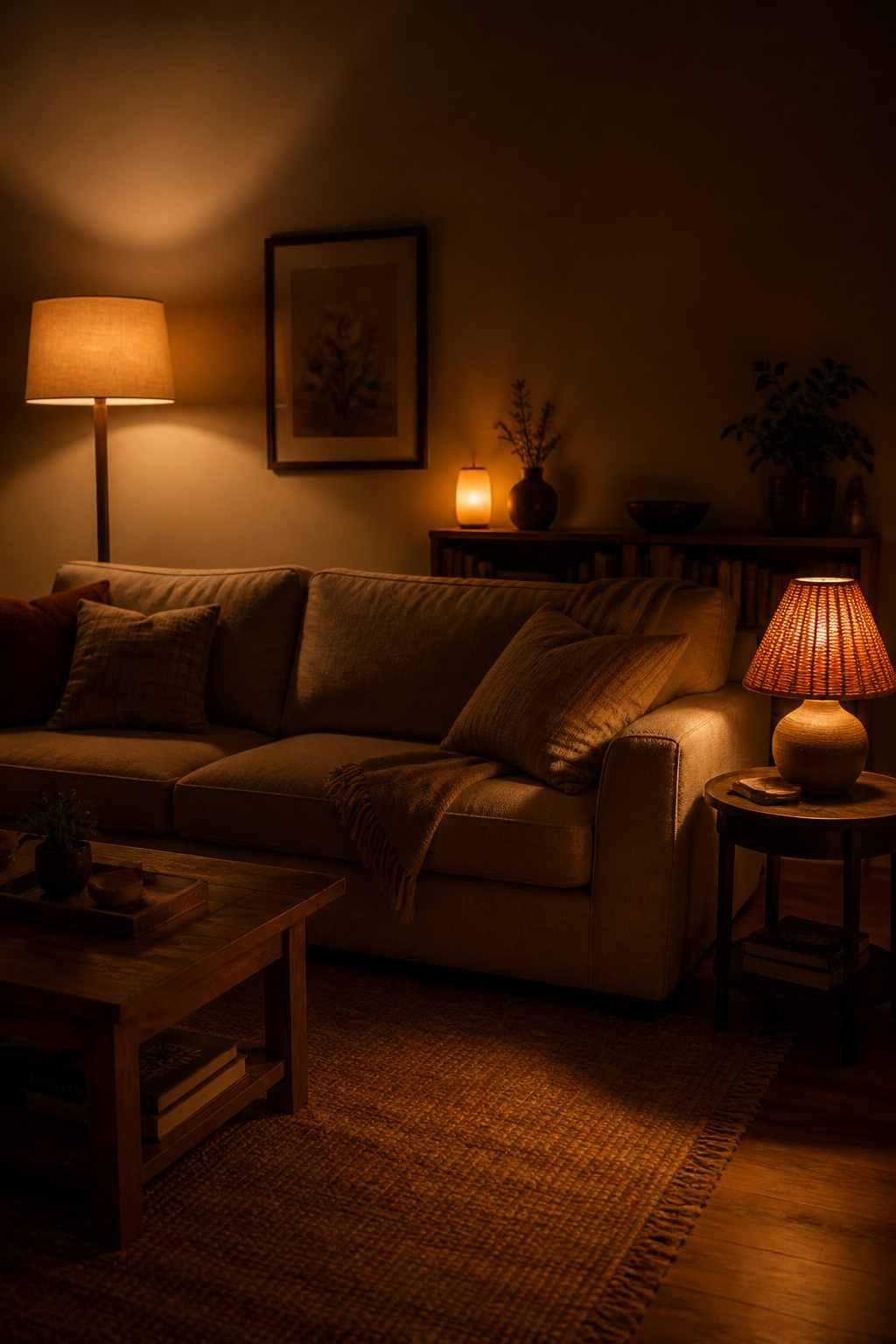
The three-source rule for a living room: ambient (soft overall fill from one or two floor lamps), task (a focused lamp next to a reading chair), and accent (a small lamp on a shelf or sideboard). The minimum effective setup: one warm floor lamp at the sofa end, one table lamp on a side table or console, and one small accent source. All three should operate independently of the overhead light. This allows them to replace it entirely on evenings when the overhead is switched off.
For anyone building a lighting scheme from scratch, layered living room lighting principles maps the exact method with specifics on height and placement.
Color temperature is not decorative preference — it is physiology. All sources should fall between 2700K and 3000K. This is the residential sweet spot for relaxation. Mixing a 2700K floor lamp with a 4000K ceiling fixture creates a visual incoherence the eye registers even when the mind does not name it. Shade material amplifies warmth. Linen, frosted glass, and rattan diffuse light into a gentle glow. Clear glass and bare metal create hot spots.
9. Purposeful Shelves: Displaying Less to Show More
In traditional Japanese interior design, the tokonoma is a recessed alcove designed to display a single scroll, flower arrangement, or ceramic piece. Never more than one. The emptiness around the object is not background — it is the display itself. The object has more presence because of what it is not competing with.
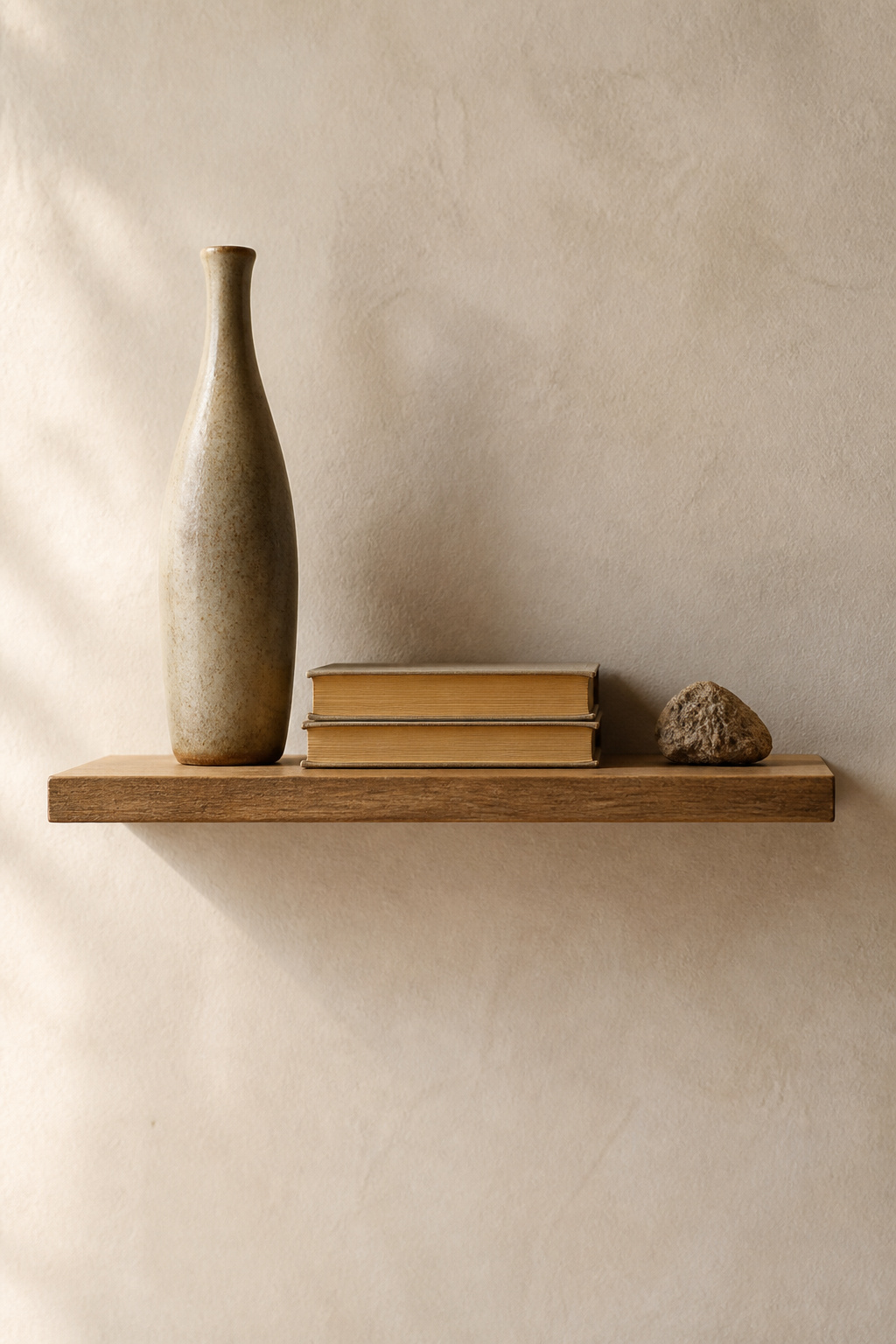
The rule of odd numbers in shelf styling follows the same logic. Three objects per shelf zone, varied in height. A tall ceramic vessel, a medium wooden object or book stack, a small textural piece at low height — the arrangement has visual movement because the eye cannot rest symmetrically across it. Even numbers pair up and go still. Odd numbers keep the eye moving.
Books on shelves in a minimal room: curated, not comprehensive. Remove dust jackets. Books without jackets read as a collection of spines rather than a catalog of competing graphic designs. Limit displayed books to those genuinely referenced or loved. For living room wall decor ideas with intentional display, the principle that governs shelves governs walls: fewer objects, more considered, more space between them.
An empty shelf in a minimal room is an editorial statement, not an oversight. The negative space it provides gives the occupied shelves more authority. When assessing a shelf’s contents: if removing one object would not be felt as a loss, remove it. The shelf is finished when every remaining piece has earned its position.
10. Simple Living Room Decor Ideas for Compact Apartment Spaces
The mistake most often made in small living rooms is buying smaller furniture. A room full of small-scale pieces looks like a room that has given up on itself. Scale-appropriate furniture — a full-sized sofa, a correctly sized rug, one generous light fixture — makes a compact room look designed. Small furniture makes it look compromised.
Multi-function furniture genuinely helps in a small space. A storage ottoman sized 36 to 48 inches long replaces a coffee table and eliminates visible storage in one move. Throws, remote controls, and media accessories disappear inside it. Nesting tables have a near-zero footprint day-to-day. They expand when guests arrive or a working surface is needed. A quality set costs $80 to $250 and lasts for decades.
For thoughtful apartment living room ideas that go beyond furniture choices, vertical storage is the next move. Floating shelves at 7 to 8 feet store without consuming floor space. A tall narrow bookcase (12 inches deep, 72 inches tall) holds the same volume as a wide unit in a fraction of the footprint.
The single highest-impact intervention in a small living room costs very little. A full-length mirror placed opposite a window doubles the perceived light level and creates depth without any structural change. The frame should match the room’s material palette — raw wood, plain rattan, or simple metal. Lean it against the wall rather than hang it. This allows repositioning as the simple living room decor evolves.
11. The Low Coffee Table: Grounding Your Space With Japanese Influence
When the average height of furniture drops, the ceiling height effectively increases. More visual space above the furniture line creates openness and calm. Japanese interior design built its aesthetic around floor-level living precisely because the psychological effect of lower furniture is demonstrably more restful. This principle translates into any living room, regardless of style.
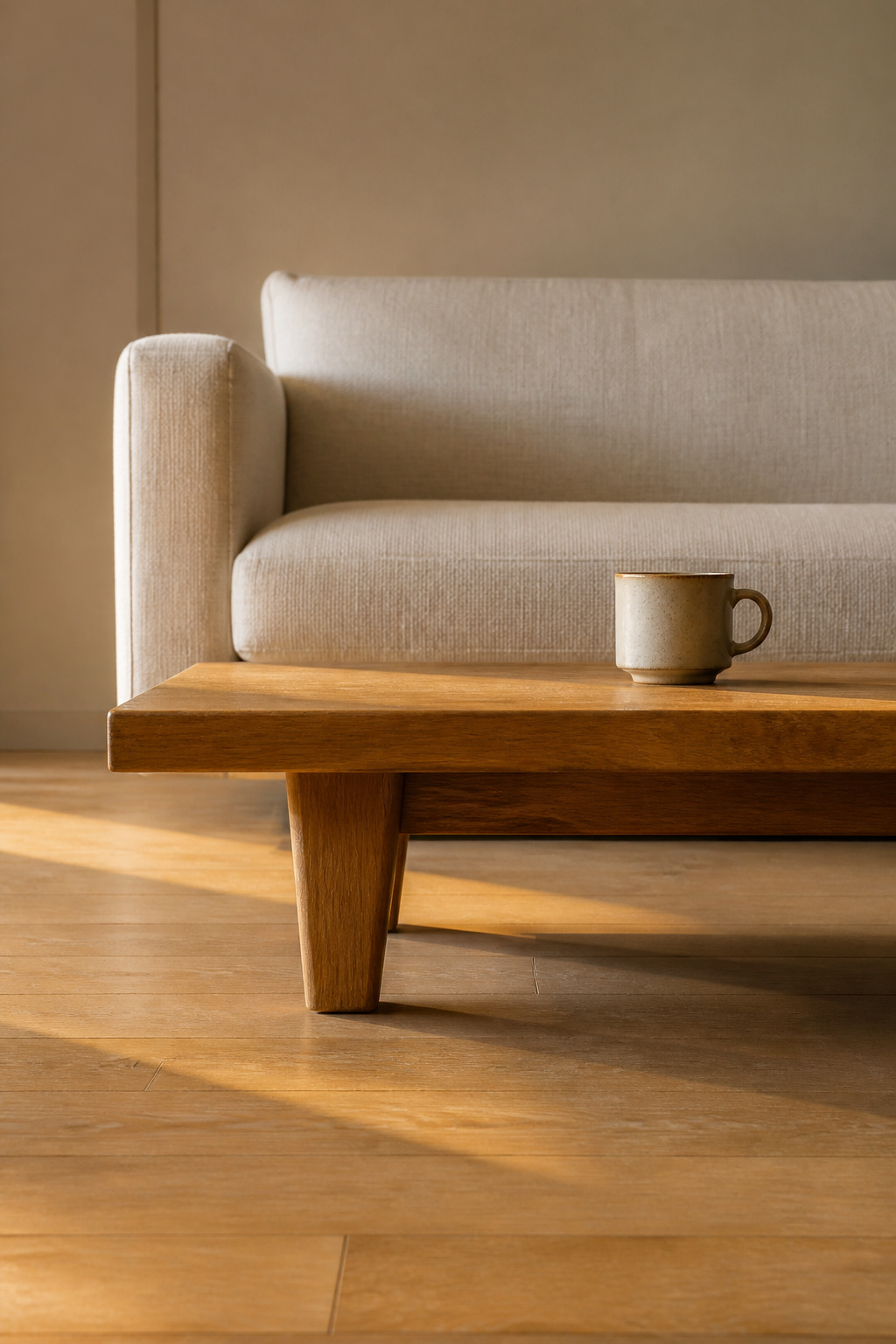
The coffee table height rule: within 1 to 2 inches of the sofa seat cushion height. Standard Western sofas sit at 17 to 19 inches from the floor. An 18-inch coffee table is the sweet spot for most. This creates a comfortable reaching distance without requiring the user to lean down uncomfortably. It also keeps the room’s horizontal emphasis intact.
The traditional chabudai — the Japanese low dining table, typically 10 to 16 inches high — is designed for floor seating with zabuton cushions. Adapted for Western sofa rooms, that height is too low. The 16 to 18 inch range bridges the two traditions. Solid wood (oak, walnut, teak) is the most versatile choice. It brings warmth, ages well, and works across Japanese, Scandinavian, and natural-material aesthetics.
For something with more visual weight: a stone-top table (marble, travertine, slate) on a simple metal or wooden base adds material gravity and grounding. Expect $300 to $800 for a quality piece 48 inches long. Rattan coffee tables cost less ($150 to $350) and are the lighter choice — literally and visually — for smaller rooms where a solid wood piece might feel heavy.
12. Indoor Plants as the Only Ornament Your Room Needs
The case for one large plant over five small ones is partly visual and partly philosophical. Five small plants scattered across a room create a high-maintenance impression and visual fragmentation. One specimen plant — a snake plant at four feet, a fiddle-leaf fig at five, a ZZ plant with a full polished canopy — commands a corner with the authority of sculpture. And it requires, on average, watering once every two to three weeks.
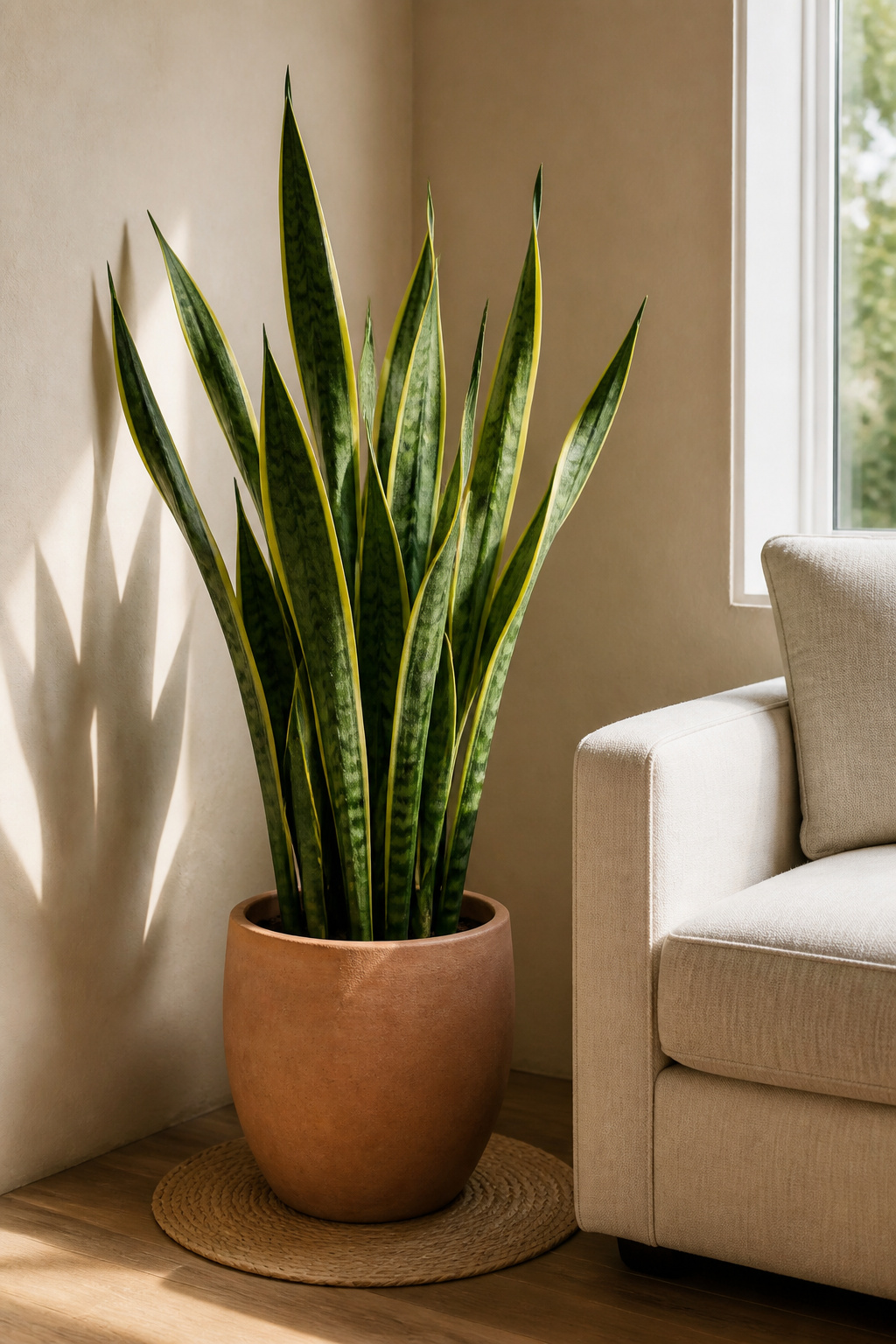
The three most reliable low-light living room plants. Snake plant (Sansevieria): grows in bright, medium, or low light; water only when the top inch of soil is dry; architectural vertical leaves with silver variegation that read as intentional as any object in the room. Pothos: trails, climbs, or fills its pot depending on training; slows growth in low light without dying; water when the top inch dries. ZZ plant: tolerates purely artificial light; water every two to three weeks when soil is completely dry; waxy dark green leaves with a polished quality.
Pot choice matters as much as plant choice. Unglazed terracotta is breathable and provides natural drainage. It brings warmth and connects to the natural material palette. Celadon-glazed ceramics have a quiet aged green-grey tone that sits well in neutral schemes. Plain matte white is the safest universal choice. Avoid high-gloss, printed, or novelty pots — they compete for attention instead of supporting the plant.
If a cluster of small plants is preferred over a single specimen, keep the pots uniform in style and group them closely. A scattered collection across multiple surfaces reads as accumulated rather than curated.
13. Simple Living Room Decor With a Quiet Corner for Stillness
In Japanese design, the concept of kokoro — the spirit or essence of a space — holds that different zones within a home serve different purposes. Naming them through design gives permission to use them as intended. A stillness corner in a living room names quiet, individual activity as equally valued as group conversation. It is a design statement about how the room is meant to be inhabited.
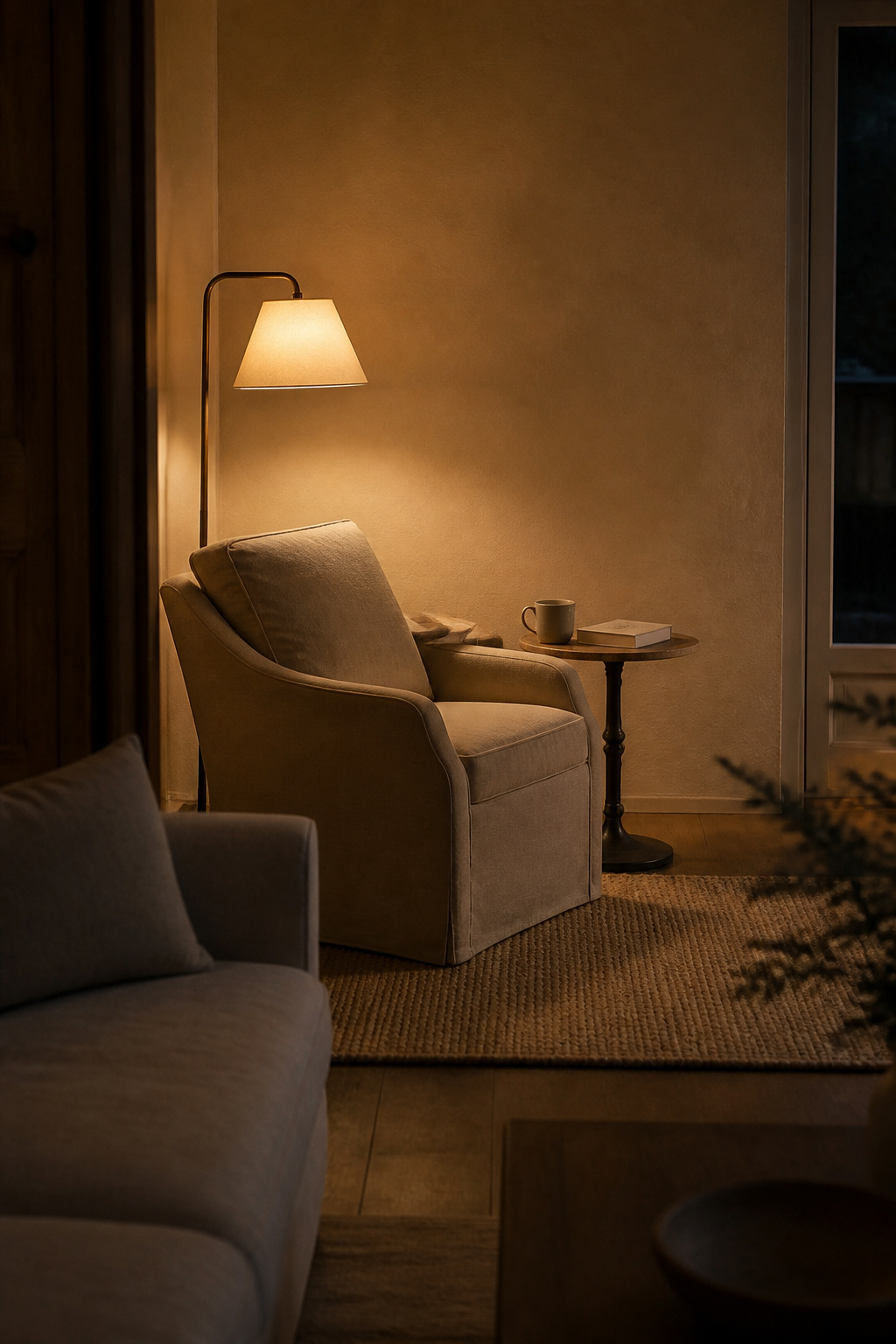
The formula is not complex. One comfortable armchair with proper back support for extended sitting, a floor lamp positioned over the left or right shoulder, a small side table at armrest height for a book and a cup. The chair should face away from the main sofa grouping or sit perpendicular to it. This subtle angle signals individual use rather than group conversation. A small rug (even a 4×6 foot piece) under the chair grounds the corner as its own zone without competing with the main area rug.
The density of the chair’s cushion matters more than its appearance. Look for 1.8 to 2.0 lb foam density, or down-wrapped foam for a softer initial feel. In a minimal palette, the corner’s throw or cushion can introduce one subtle variation from the room’s main tone — a slightly deeper warm note, or a textural contrast like chunky knit against smooth linen. This is simple living room decor as philosophy: a room that contains space for a different quality of time.
The integrity of this corner depends on consistency. No bags thrown on the chair. No cables draped across the table. A stillness zone loses its function within weeks if it becomes a landing pad.
14. Hidden Storage That Keeps Every Surface Clean
Surface cleanliness in a minimal living room is not a function of owning fewer things. It is a function of having somewhere considered to put them. The room that feels perpetually cluttered despite regular tidying is usually missing one structural piece: somewhere to send objects that are not in use.
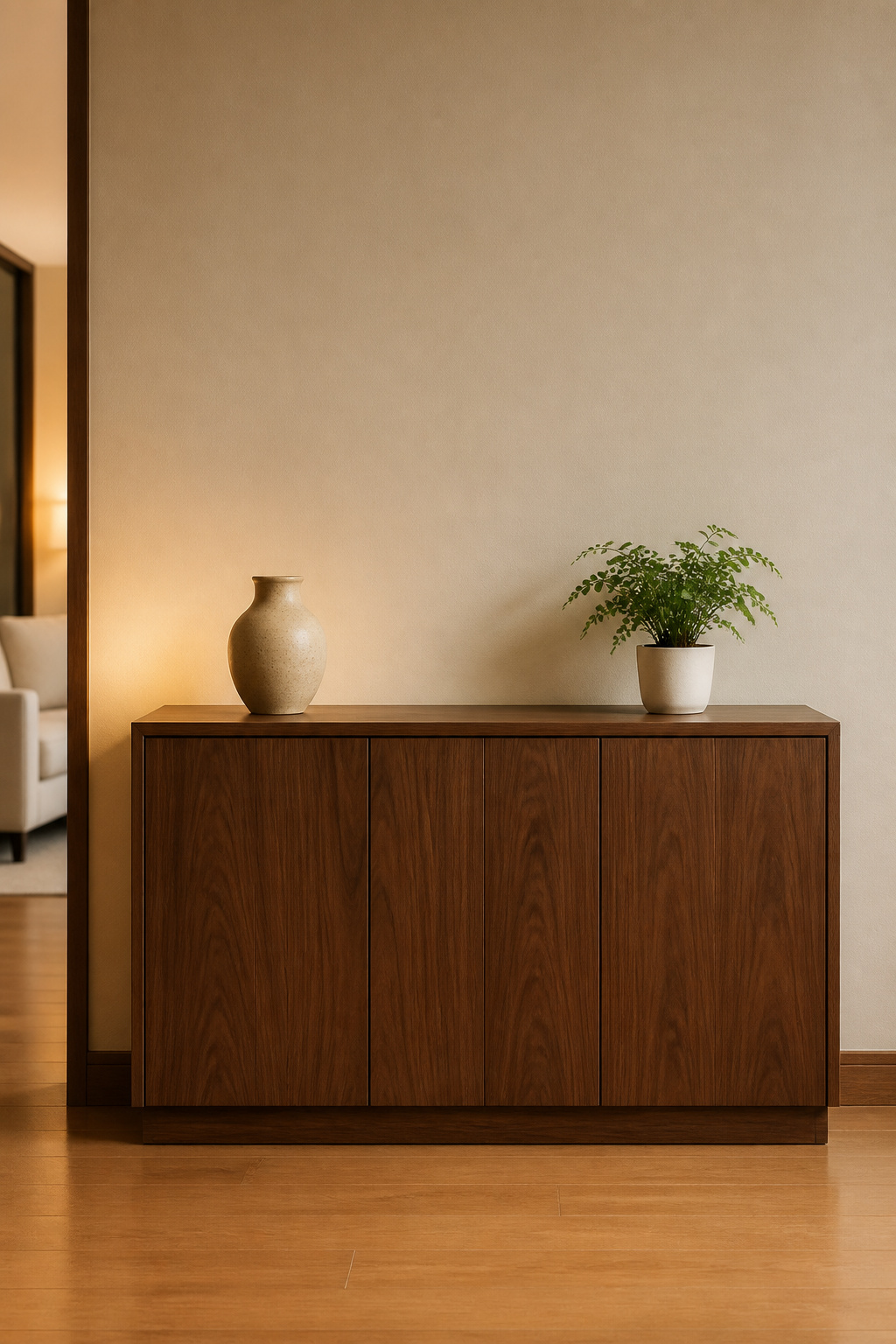
A storage ottoman sized 36 to 48 inches long holds throws, board games, media accessories, and children’s toys in one footprint. It eliminates the need for any visible storage in the seating zone. A media console with closed-door lower sections conceals routers, game consoles, and cable boxes. The surface stays clear for one or two considered objects. Built-in cabinetry costs $800 to $2,500 per linear foot installed. That price point eliminates all subsequent freestanding storage needs and creates a seamless wall that reads as architectural rather than decorative.
The one-in-one-out rule governs surfaces. Every surface in a minimal room has a defined maximum: two objects on the coffee table, three on the console. A new ceramic displaces an existing one — it does not join it. The discipline is less about restriction than about maintaining the ratio of object to space that defines the room’s character. For the same approach applied elsewhere, bedroom furniture storage ideas extend the same principles to other rooms where surfaces need to stay clear.
Cables are the final piece. Visible power strips, HDMI runs, and charging cables are the most common reason a designed living room fails visually. Cable raceways (white or wood-finish plastic channels, $15 to $40 for a 10-foot run), furniture with integrated cable ports, and flat cable protectors under rugs solve this cleanly and cost very little relative to their visual impact.
15. Pillow and Throw Discipline: Textile Layering Without the Clutter
The minimalist sofa formula: two pillows at each outer end of a three-seater (four total), in two different sizes — a 22-inch square at the back, an 18-inch lumbar or smaller square at the front — and one throw, folded neatly over one arm. That is the complete arrangement. The restraint is the design statement.
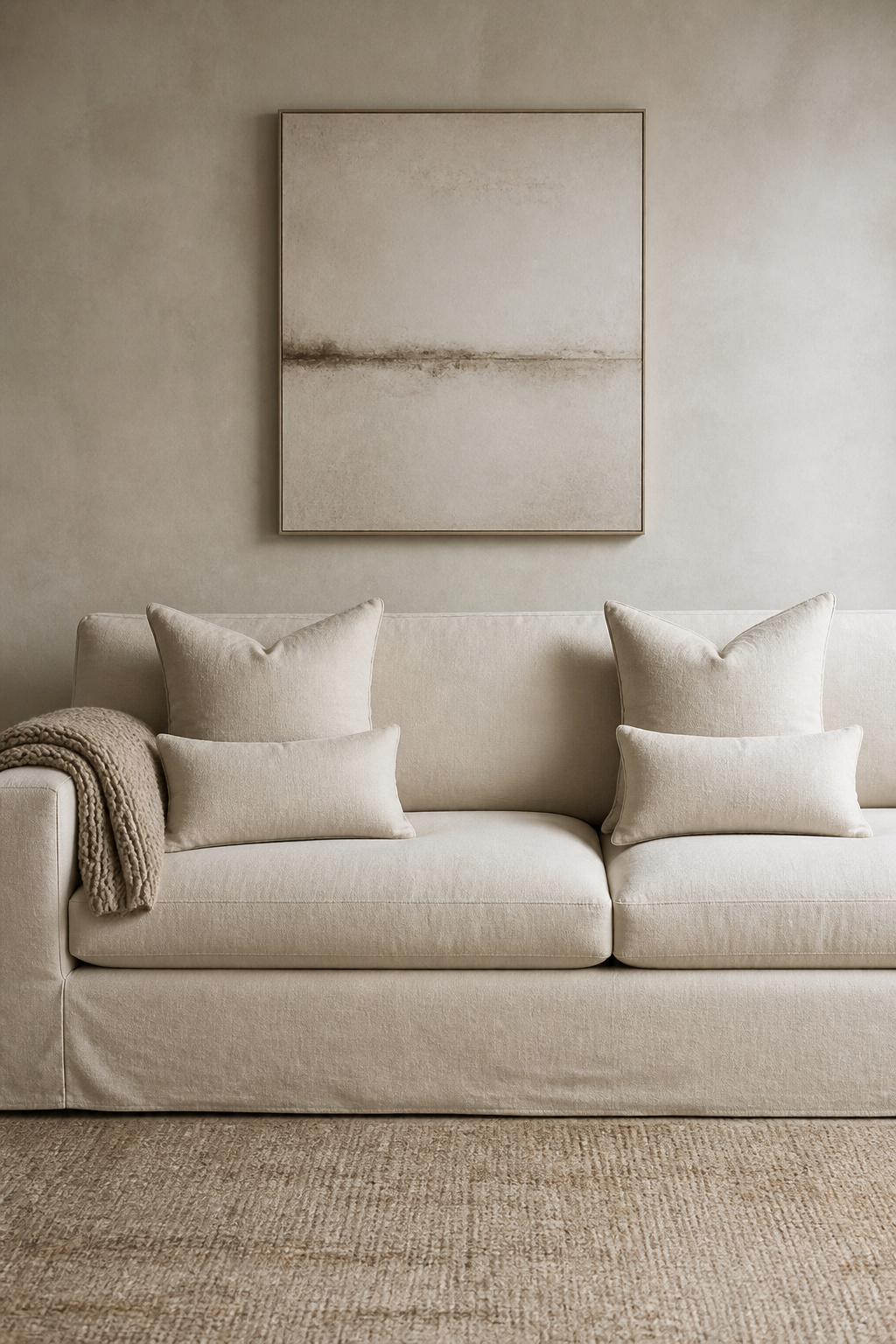
For the most minimal approach: two identical pillows at each end, same size, same fabric. The repetition reads as intentional. The absence of variety reads as confident. Odd numbers (three or five pillows) create a more relaxed arrangement for casual rooms. Even numbers sit more formally. In a Japanese-influenced space, the formal quality of an even-numbered arrangement suits the considered character of the room.
Choose pillows through material contrast, not pattern matching. A smooth velvet pillow next to a rough linen pillow in the same neutral tone reads as richer than two patterned pillows in different colors. Avoid purchasing cushions as a set — they produce the catalog effect the minimal room is trying to avoid. The throw should contrast materially with the sofa fabric: a chunky knit throw on a smooth linen sofa, a smooth woven throw on a textured boucle sofa.
Extra textiles — off-season throws, spare cushion covers — live in the storage ottoman or a linen-lined basket under the console. Wash and store them in breathable cotton bags before seasonal rotation, never in plastic, which traps moisture in natural fibres. The discipline of textile storage is part of the seasonal living practice: the right textiles for the current season are on the sofa. Everything else is out of sight.
16. Simple Living Room Decor That Shifts With the Seasons, Not Trends
Shun (旬) is the Japanese concept of peak appropriateness — the right ingredient at the right season, the right design for the right moment. Applied to interior design, shun means the living room should acknowledge the season being lived in. Not maintain the same appearance in January and July.
This is not a case for buying new things four times a year. It is a case for building a curated capsule — a set of rotating objects that cycle in and out of view as the season changes. Four swaps are sufficient: cushion covers (same inserts, different covers), throw weight (linen for summer, wool for winter), one changed vessel on the coffee table, and one seasonal plant or foliage stem in a ceramic vase. A one-time investment in two sets of covers ($40 to $80) and two throws of different weights ($60 to $120) supports years of seasonal rotation without a single additional purchase.
In winter: warmer textures (wool, chunky knit), slightly deeper tones in accent objects, candles as the primary scent and light source, a single branch of winter foliage. In summer: lighter textiles (linen, cotton), natural grass or rattan accessories, fresh-cut stems in a ceramic vase, windows unobstructed by heavy drapes. The permanent objects do not change: sofa, coffee table, rug, main lamps, floor plant, primary artwork. These are the room’s bones.
Four to eight rotating objects are all the room needs to acknowledge that time is passing. A capsule approach also prevents the accumulation that undermines every minimal room. Each new seasonal addition replaces — rather than joins — its predecessor. This is simple living room decor that stays alive without growing.
Finding Your Version of Simple: Where to Begin
The Japanese principle of danshari — refuse, discard, separate — applies to the living room edit as a practical first step. Remove everything from surfaces. Then reintroduce objects one at a time, placing each back only when it has a clear reason to be there. Most rooms find their natural calm at 30 to 40% fewer surface objects than they started with. The first edit is always the most revealing.
After that, the question is which of these sixteen approaches addresses the friction point that matters most right now. If the room feels visually overwhelming despite recent tidying, start with item 1 — the ma edit. Do the remove-and-reintroduce process before buying or rearranging anything. If the room feels dark or cold in the evenings, start with item 8. Two warm lamps at 2700K cost less than any furniture change and transform the atmosphere immediately. If the room feels cluttered despite genuine editing, start with item 14. The problem is usually not too many objects but nowhere considered to put them.
Simple living room decor is not a destination arrived at once and maintained effortlessly. It is a practice — a set of considered relationships between objects, space, light, and season that you revisit as the room is lived in. The rooms that hold their calm over years are those where every object has been asked, repeatedly, to justify its presence. The rooms that do not are those where objects arrived and were never questioned again.