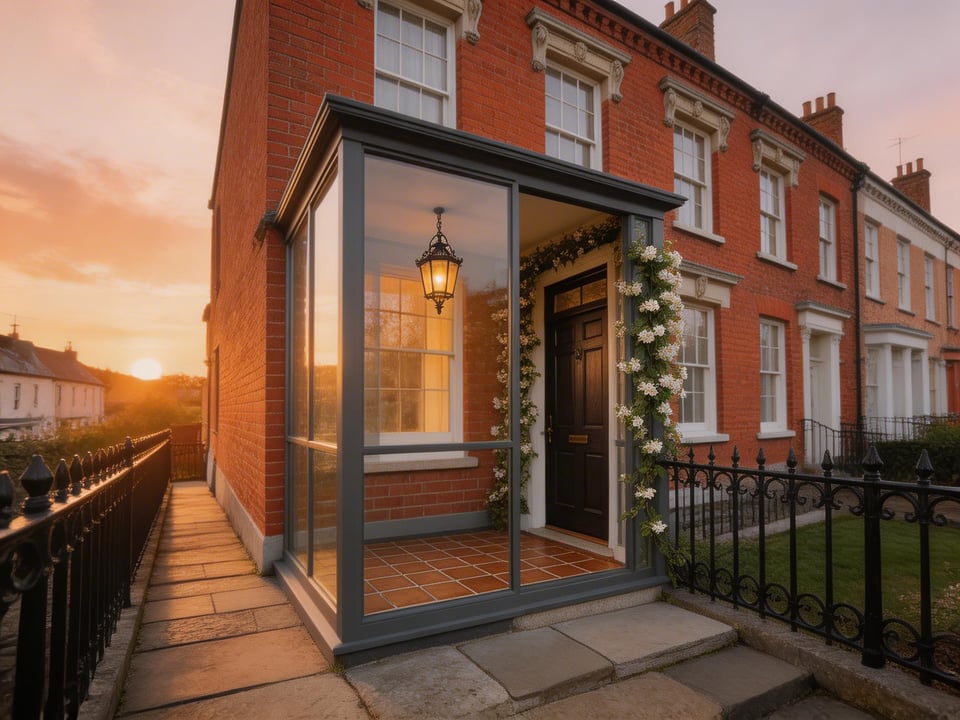
The porch is the sentence your house speaks before you open the door. Most British homes are muttering something unintelligible — a scuffed mat, a broken step, a pair of bin bags and a terracotta pot that gave up on its plant three winters ago. A well-considered porch remodel changes all of that. It signals, from twenty metres away, that someone inside this house actually cares. Emma Blake has spent a decade working with British properties from Victorian terraces to Edwardian semis, and her view is consistent: the porch is the most underinvested space in British domestic design, and it rewards attention disproportionately to the money spent. These 17 ideas range from the structural (glazed panels, new flooring) to the finishing (door hardware, a climbing plant trained to frame a doorway) and work across property types and budgets. There is no good reason for your porch to look like an afterthought.
1. Glazed Veranda Panels That Open Up the Front Elevation
A glazed porch enclosure adds something a plain doorstep cannot: a threshold. In Victorian and Edwardian domestic architecture, the porch existed as a decompression zone — a place where outdoor coats came off, boots found their corner, and the world outside was left at the door before the hall was entered. Fitting glazed panels reinstates that logic, and the kerb appeal effect is immediate.
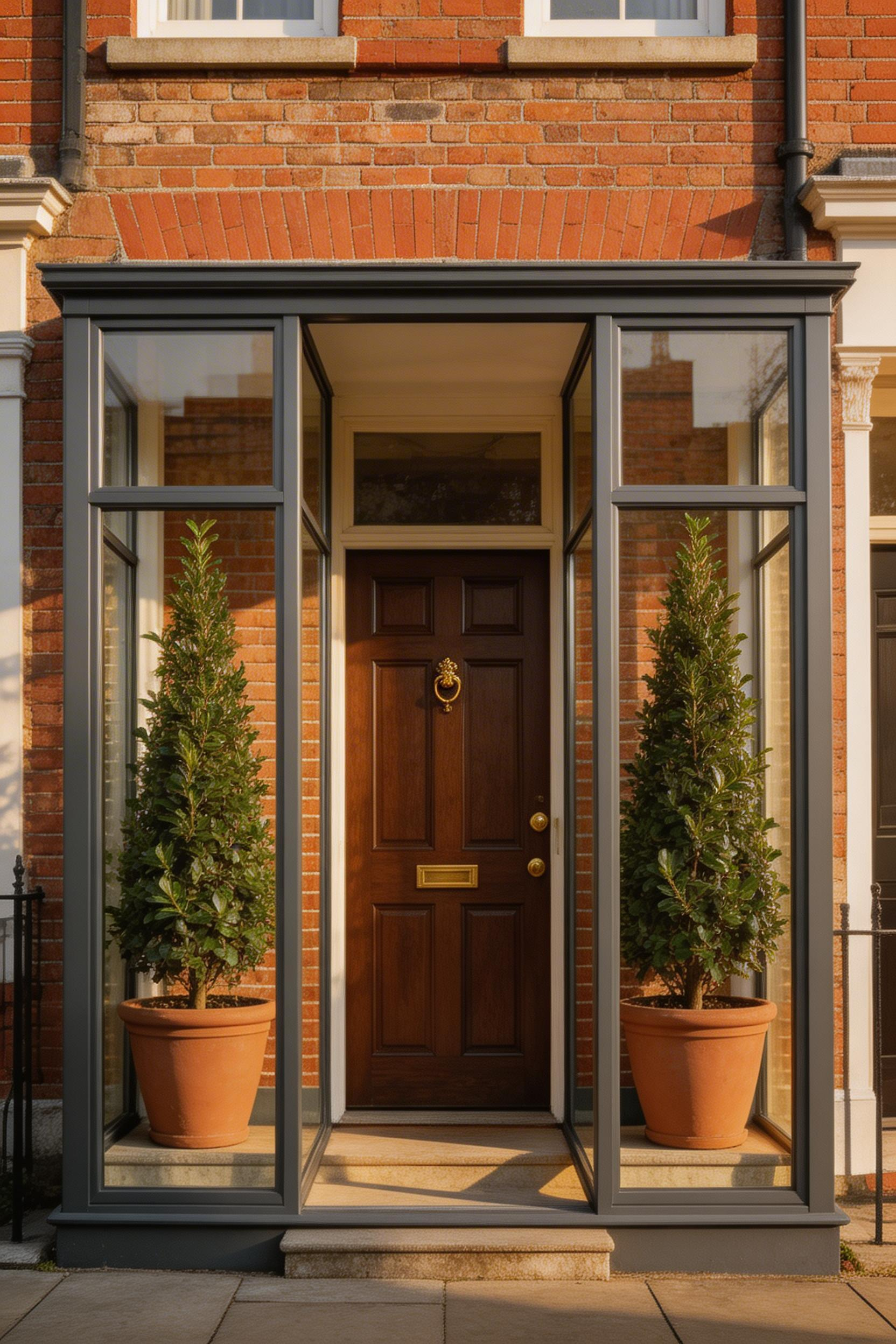
For Victorian and Edwardian properties, slim-sightline aluminium in heritage colours — anthracite grey, black or dark bronze — reads as period-appropriate in a way that white uPVC simply does not. Conservation officers will often object to white uPVC on character properties regardless of its technical compliance, so if your house falls within a conservation area, get the colour specification confirmed in pre-application discussions before ordering anything.
Costs run from around £2,500 for a modest 2 m² enclosure to £8,400 or more for a full-width glazed porch on a period property — that range assumes a professionally installed timber or aluminium system, not supply-only. In terms of planning, a porch addition stays within permitted development as long as the external ground-floor footprint does not exceed 3 square metres and no part rises above 3 metres. Exceeding either dimension triggers a full planning application, so measure carefully before commissioning.
The practical upside is often more persuasive than the aesthetic one: a glazed porch lobby adds a genuine thermal buffer to the hall, which matters considerably in houses built before cavity walls became standard. You can find plenty of front porch decor ideas to work with once the structure is in place, but get the enclosure right first.
2. Reclaimed Quarry Tiles for a Classic Porch Remodel Floor
Victorian quarry tiles have been used on British entrance halls and porches since the 1870s. They are unglazed, fired at high temperature, and extremely dense — the original industrial flooring tile, made to take deliveries, mud and decades of boots without flinching. Finding reclaimed versions is straightforward if you know where to look, and the result is a floor that no modern substitute can convincingly replicate.
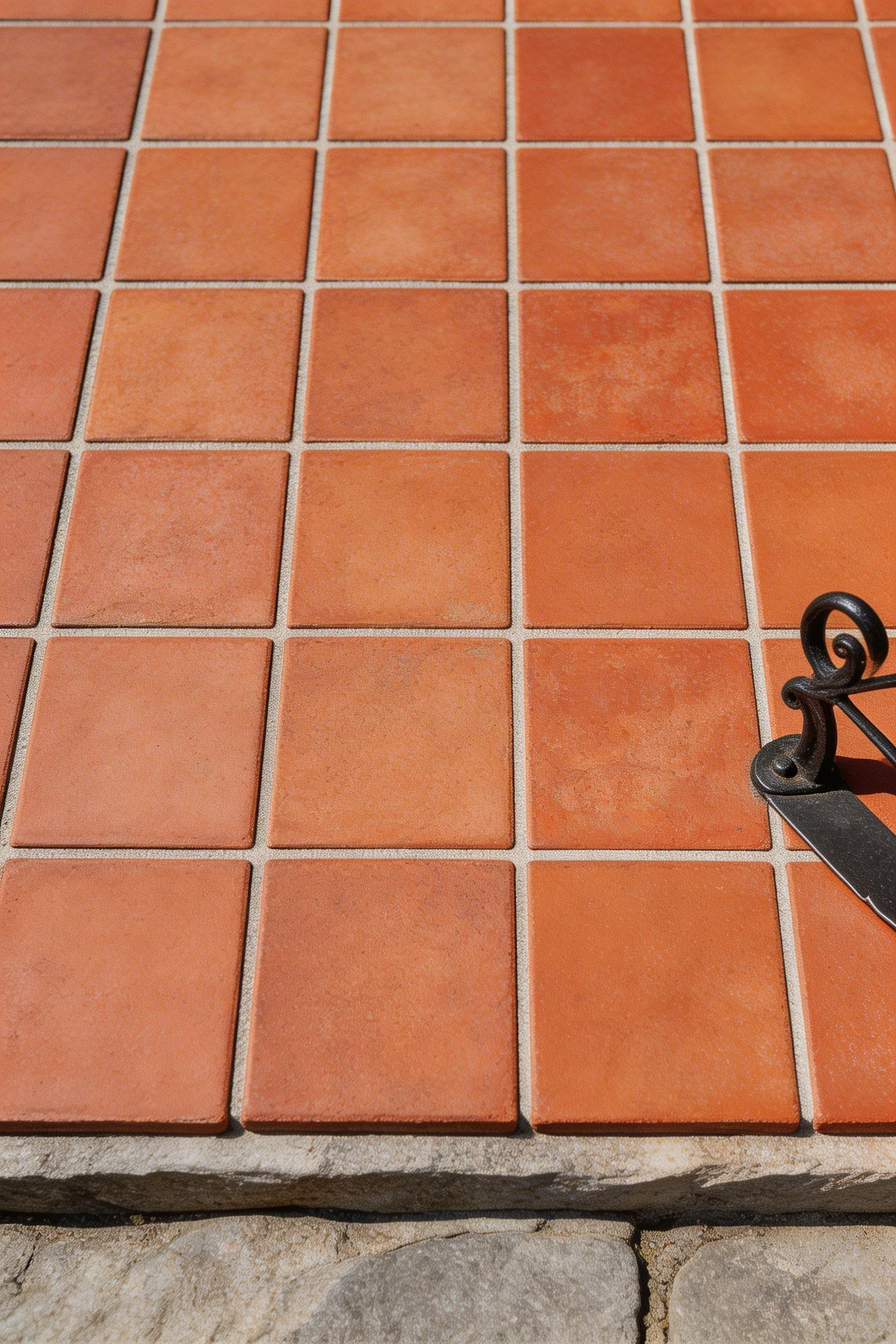
The most common reclaim sizes are 6×6 inches, 8×8 and 9×9 inches; the latter reads as more expansive in a small porch and was used in grander Victorian properties. Authentic Reclamation in Stonegate, East Sussex and Warwick Reclamation both stock thousands of period quarry tiles in common sizes. Order 15–20% over your measured area to account for breakage, cutting and batch variation — tiles from different demolition sites can vary by 2–3mm in thickness, which affects the laying bed thickness.
Sealing is optional but worth considering for the transition strip at the front door. Use a micro-porous impregnating sealer rather than any film-forming product; a surface sealer alters the matte appearance and eventually peels as moisture pushes through the tile from below. For laying on an uneven substrate — and Victorian porch floors are rarely level — use a flexible cement-based adhesive on a solid bed rather than spot-bonding. Spots of adhesive leave hollow areas that crack under heavy foot traffic.
The restoration economics are sound: an original quarry tile floor in good condition is cited by estate agents across London and the South East as a reliable positive selling point. If the tiles that come up during the porch remodel are still structurally sound, a professional restoration and seal is often a better decision than replacement.
3. Wrought Iron Railings With Heritage Detailing
There is something about cast iron railing that does a disproportionate amount of architectural work. A set of period-pattern railings anchors a Victorian terrace to its streetscape and communicates, with very little effort, that the property has been taken seriously. The opposite is equally true: standard galvanised tube railing on a property that deserves better reads as a refusal to engage with the architecture.
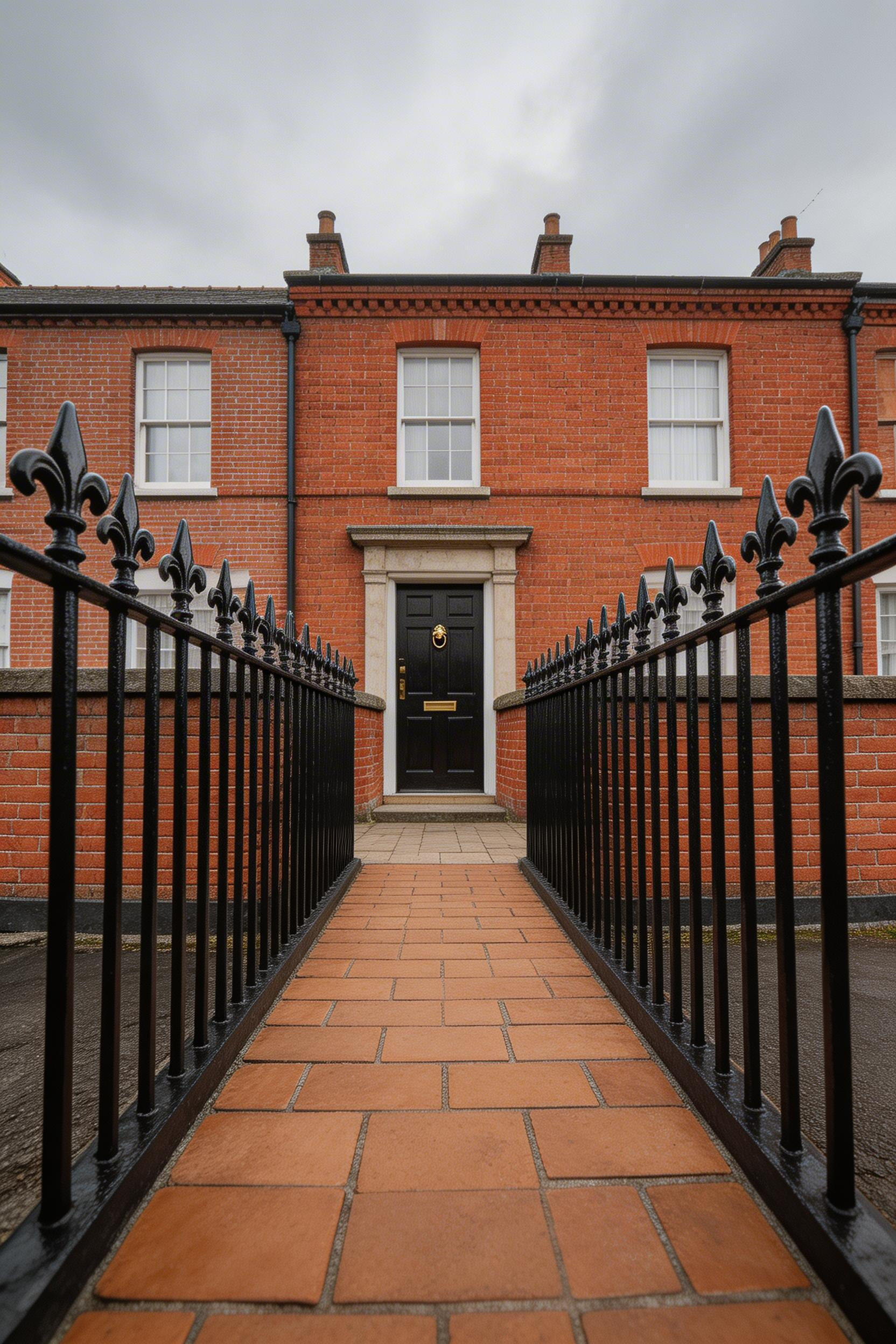
The Victorian Emporium produces cast iron railings taken directly from an 1897 foundry catalogue — the patterns (arrow heads, fleur-de-lys, ball tops) are historically verifiable for properties built 1860–1910 and cast by the same lost-wax process used in original manufacture. British Spirals & Castings holds a library of thousands of period profiles and can match existing railings on listed or conservation area properties from photographs and measurements, which is invaluable when a section needs replacing without disturbing the rest.
True wrought iron is rarely made today; most products described as such are mild steel (fabricated by hand) or cast iron (from moulds). For coastal locations or properties exposed to driving rain, specify hot-dip galvanising before powder coating — a 70-micron zinc base layer that significantly outlasts the powder coat above it. For colour, gloss black (RAL 9005) coordinates with virtually every British brick colour; dark bronze (RAL 8019 or similar) softens the contrast against pale Bath stone or Cotswold limestone.
Avoid heritage green unless you have documentary evidence it was used on your property. It was not a widespread railing colour before the 1880s, and it looks incongruous on a standard Victorian terrace regardless of how period it feels in a catalogue.
4. Built-In Bench Seating With Integrated Storage Below
Every porch accumulates the same things: shoes, bags, coats that didn’t make it inside, post that didn’t make it anywhere. A built-in bench solves the chaos structurally rather than cosmetically. It integrates into the architecture in a way that a freestanding coat rack and shoe tidy never will, and in a small space, that architectural coherence is the difference between a porch that looks designed and one that looks managed.
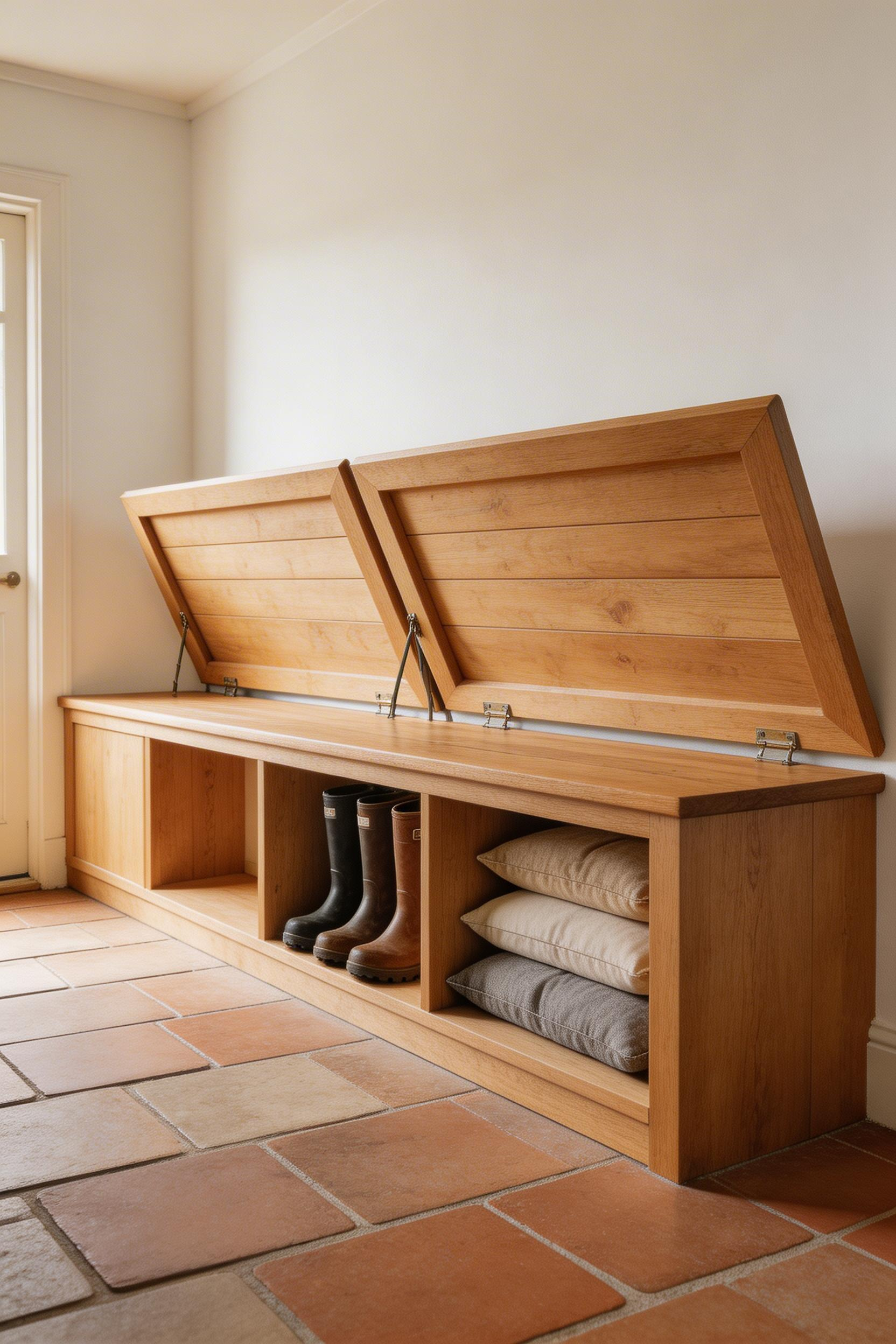
The storage compartment below the seat — accessible via a hinged lid — earns its keep immediately: two or three pairs of wellies, outdoor cushions, a folded buggy, or seasonal equipment all disappear neatly. Frame in exterior-grade softwood (TR26, pressure-treated) and face the visible surfaces in oak, accoya or hardwood to match the porch flooring. Standard seat height is 450mm; seat depth should be at least 380mm for comfortable use and 400–450mm internally for useful storage volume. Use stainless steel or hot-dip galvanised fixings throughout — standard zinc-plated screws corrode within 18 months in a damp porch environment.
The hinge is where most storage benches fail. Piano hinges (full-length continuous hinges) distribute the load across the entire lid edge and prevent the warping and hinge-failure that three-point hinges cause on a heavy lid. For the cushion, Sunbrella (solution-dyed acrylic) carries a 5-year fade warranty and cleans with soap and water; fill with open-cell reticulated foam rather than standard polyurethane — it drains completely after rain rather than retaining water and becoming mouldy. For more ideas on seating material and specification, the porch furniture guide for style and comfort is worth reading before you commit to a build.
5. Tongue-and-Groove Ceiling in Traditional Painted Bead Board
The ceiling is the part of the porch remodel that most people forget until they look up. In an enclosed or partially covered porch, an unfinished ceiling — bare joists, crumbling plaster, or worse — undoes every other improvement. A tongue-and-groove bead board ceiling is the historically correct treatment for British Victorian porches and covered verandas, and it costs considerably less than its visual impact suggests.
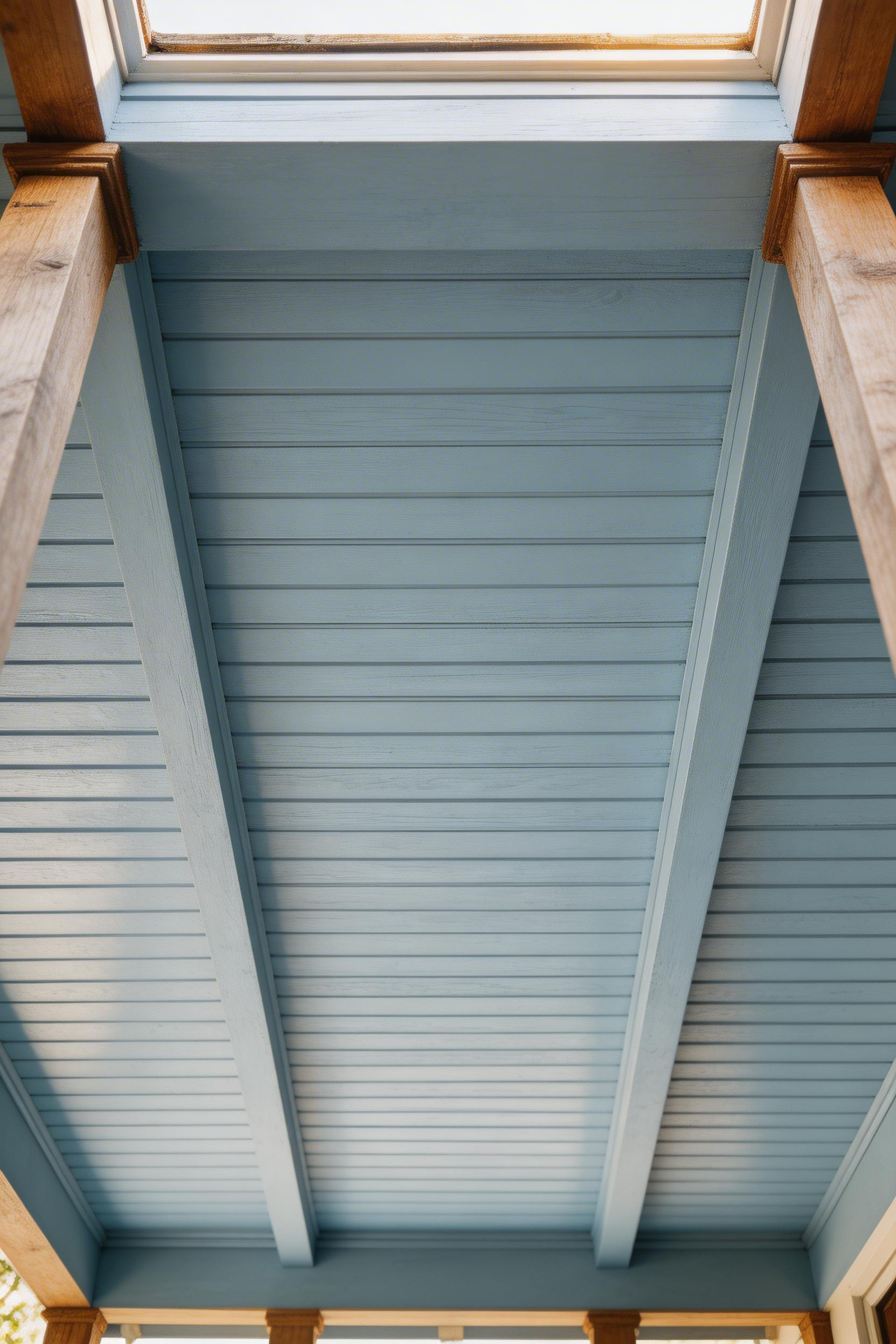
Standard bead board runs in V-grooved or rounded-bead profiles; the most authentic for British Victorian porches is a 65–75mm face width with a small rounded bead, run lengthways with the direction of the porch. Solid pine is traditional but requires thorough preparation and sealing on all four sides before installation — a step most installers skip, and the reason most painted pine porch ceilings cup, bow and discolour within three years. PVC bead board (Royal or TruExterior) is the honest modern alternative: moisture-resistant, insect-proof, and available pre-primed. The look is identical at ceiling height.
Colour and Finish for a Covered Ceiling
For colour, the soft grey-blue associated with porch ceilings in the American South — known as haint blue, originating with Gullah Geechee communities — translates readily to British use. Farrow & Ball’s Borrowed Light (No.235) and Pale Powder (No.204) are close equivalents; Little Greene’s Pale Lupin and Air Force Blue sit in the same register. The effect is part sky, part ceiling: it extends the feeling of the porch visually and works well against most British brick tones. Use an exterior satin finish rather than matt — matt holds condensation marks on a semi-sheltered ceiling; satin repels them.
Leave 2–3mm gaps between boards for seasonal movement. A bead board ceiling fitted tight in dry summer conditions will buckle and bow in a British autumn. Also consider a 150mm diameter hit-and-miss wall vent in a fully enclosed glazed porch to manage condensation during temperature changes.
6. A Porch Renovation That Begins With the Right Front Door
The front door is the element that governs every other decision in a porch renovation. Its colour, material and proportions set the register for the tile colours, railing finish, lantern specification and climbing plant selection. Getting the door wrong means everything else fights it.
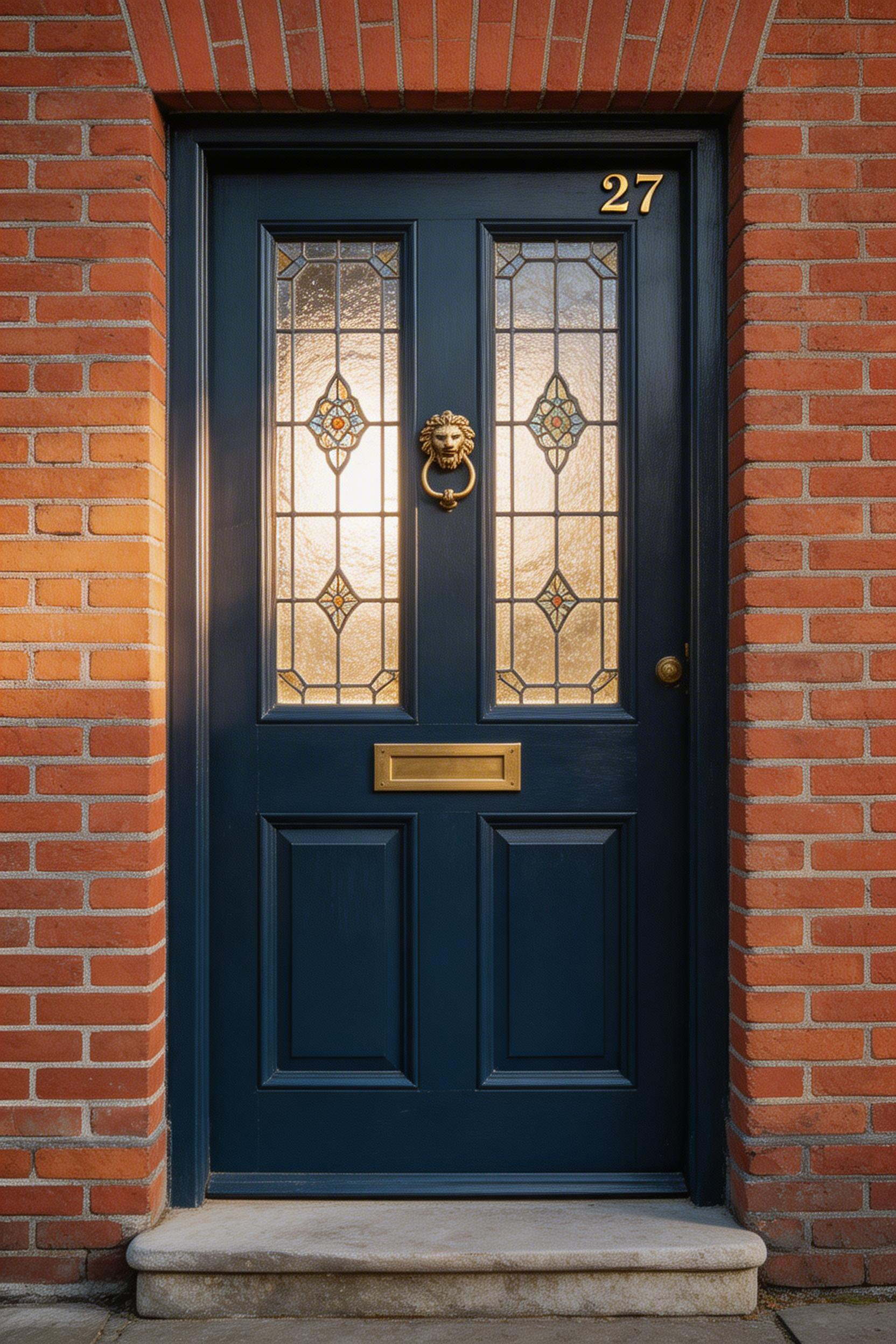
Victorian front doors (1837–1901) are typically four- or six-panel with fielded panels; stained glass appeared in the upper panels from the 1880s, and a transom light above the door was standard on terraced houses. Edwardian doors (1901–1914) tend to have four panels with a decorative glazed upper section, more ornate leading patterns, and a fanlight above. Before any porch renovation, the key question is whether the original door is still in place and whether it can be restored. Original 150-year-old joinery, properly attended to, almost always outperforms any reproduction in both quality and character.
Door Colour and Hardware Choices
Colour: late Victorian doors were most commonly bronze green, Venetian red or woodgrained; Edwardian and interwar doors ran to black, green, or from the 1920s, brighter tones. Modern heritage choices defensible on period properties include Farrow & Ball Railings (an almost-black navy), Hague Blue, Mole’s Breath and Pigeon — all chosen in situ against the brick and stonework rather than from a swatch card indoors. A quality replacement period door from a specialist costs £1,800–£4,500 supply; bespoke hardwood starts at £2,500–£5,000 installed.
For hardware: Victorian door furniture was solid polished brass. From 1900, black ironmongery became fashionable alongside Arts and Crafts wrought iron. On a Victorian terrace, unlacquered brass is period-correct and ages far more elegantly than lacquered brass, whose coating chips outdoors within 2–3 years. The Period Ironmonger and Architectural Decor supply verified period sets. These front porch decor ideas are worth reading alongside the door specification.
7. Climbing Plants and Timber Trellis for a Garden Room Entrance
The British have always understood that a well-trained climber does for a front door what no paint colour or hardware choice can: it makes the house look as though the garden has grown up to meet it. The selection and placement decisions are less instinctive than they appear, however, and a badly chosen or poorly fixed climber is worse than none at all.
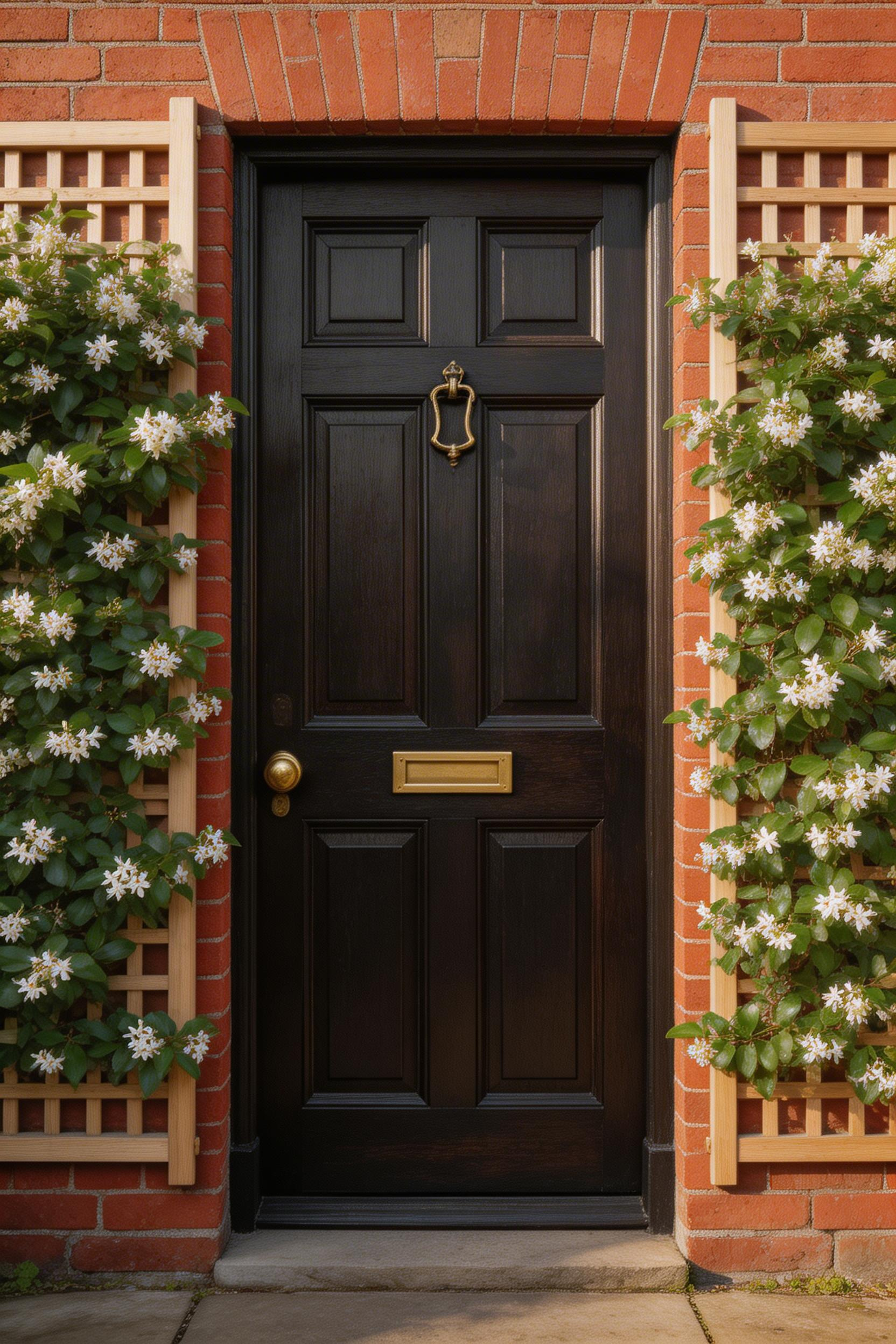
Trachelospermum jasminoides (star jasmine) is the first choice for a south- or west-facing porch. It is evergreen, heavily scented from June to August, and produces a dense screen of glossy foliage year-round. Hardy to around -10°C in a sheltered position, though it may shed some leaves in a very hard winter. For north-facing or partially shaded aspects, Clematis armandii is the better option: it flowers in February and March, tolerates shade well, and needs only a light post-flowering trim. Rosa ‘Zéphirine Drouhin’ is worth adding to the list for east-, south- or west-facing walls — it is thornless, repeat-flowering in pink, and rooted in the British town garden tradition.
Fixing the Trellis Without Damaging Masonry
For the trellis, fit it on 25–30mm stand-off battens rather than flush against the wall. The air gap allows the plant to twine behind the structure and prevents moisture sitting trapped against the masonry. Fix with stainless steel expansion anchors into mortar joints rather than drilling into brick faces. Plant at least 45–60cm from the wall base to avoid the dry, alkaline rain shadow zone that causes establishment failure for most wall climbers. Vertical garden porch ideas for a living entrance cover trellis systems in more detail.
In the first two growing seasons, tie in lateral shoots manually to horizontal wires at 450mm intervals. Once established, both star jasmine and Clematis armandii need only an annual light trim to maintain a framed shape around the door.
8. Lantern-Style Pendant Lighting for Evening Kerb Appeal
Porch lighting is almost always the last thing considered in a porch remodel and the detail that works hardest for nine months of the British year. From October to June, your porch is experienced at dusk as often as it is in daylight. A well-chosen lantern changes that experience considerably.
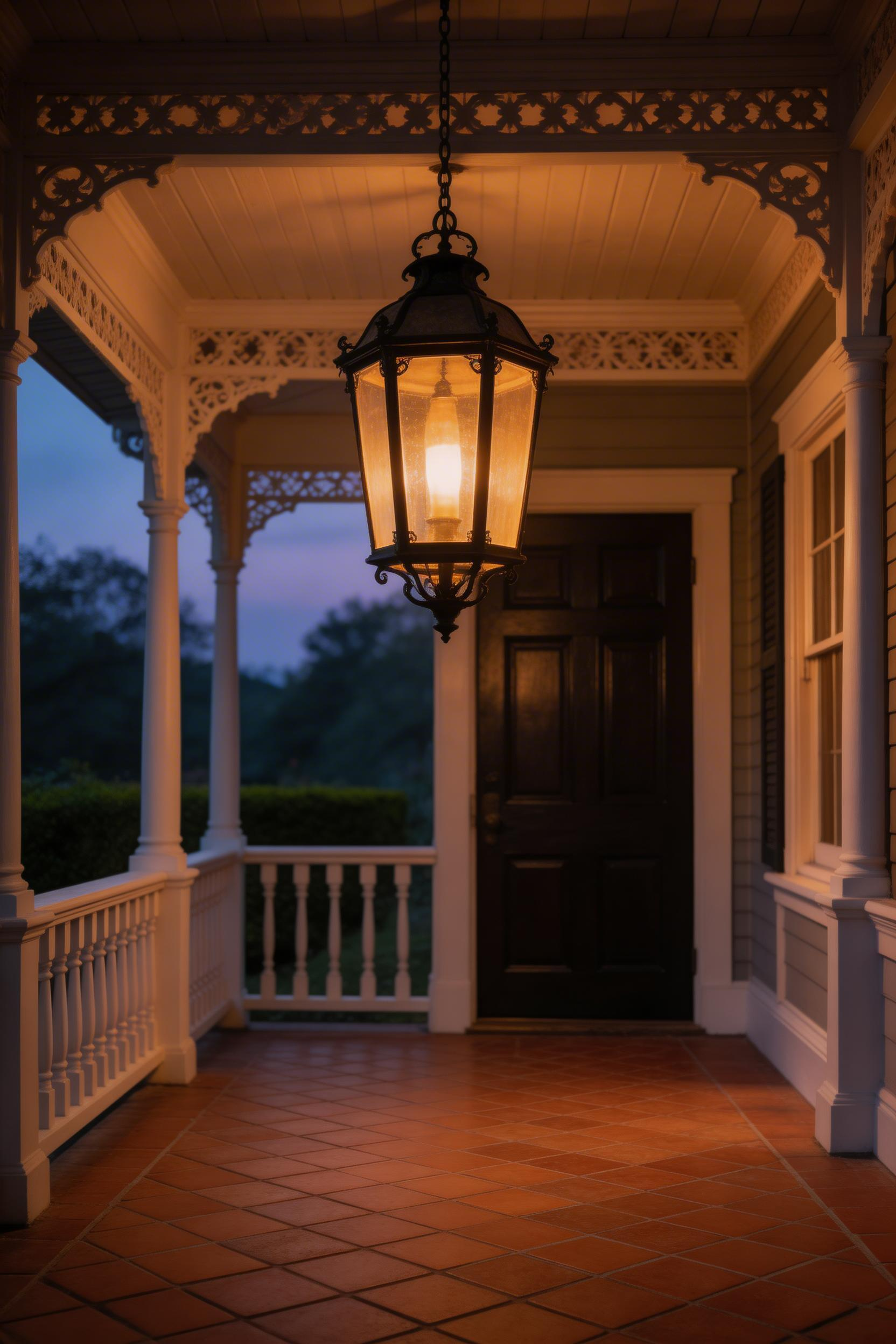
A hanging porch lantern — pendant rather than wall-mounted — creates a stronger architectural statement and echoes the tradition of oil lanterns that hung in Victorian and Edwardian covered porches. These porch lighting ideas to illuminate your evenings are worth reading before you make a final selection, but the fundamentals hold consistently: get the IP rating right, get the scale right, and choose a warm white source.
For a covered or partially sheltered porch, IP44 is the minimum required rating — protected against splashing water from any direction. IP65 is only necessary for fittings completely exposed to direct rainfall. Jim Lawrence produces handcrafted heritage lanterns including the original Barnham design — gothic-inspired, made in Suffolk, available in black, brass and antique brass — all IP44 rated and suited to covered porch use.
Sizing and Light Temperature
Sizing: a general rule is that lantern height should be 1/4 to 1/3 of the door height. For a standard 2,000mm door, that means 500–650mm lantern height — larger than most people instinctively choose. The difference between a fitting that commands the space and one that looks like a candle stub is exactly this scale relationship. For a narrow porch under 1m wide, a single centred pendant works best; for a wider covered porch over 1.2m, a pair of matching wall lanterns flanking the door is more period-appropriate. Use warm white LED at 2,700K in a clear or amber-tinted lantern — it reads as incandescent from the street. Cool white at 4,000K+ looks institutional.
9. Exposed Brick or Painted Stone Feature Wall Inside the Porch
An exposed brick wall inside a porch is either well-executed or poorly executed, with very little in between. The quality of the brick beneath the plaster is the determining factor. Hard Victorian engineering brick — dense, fired at high temperature — weathers exposure beautifully. Soft hand-made bricks or stocks are better left covered.
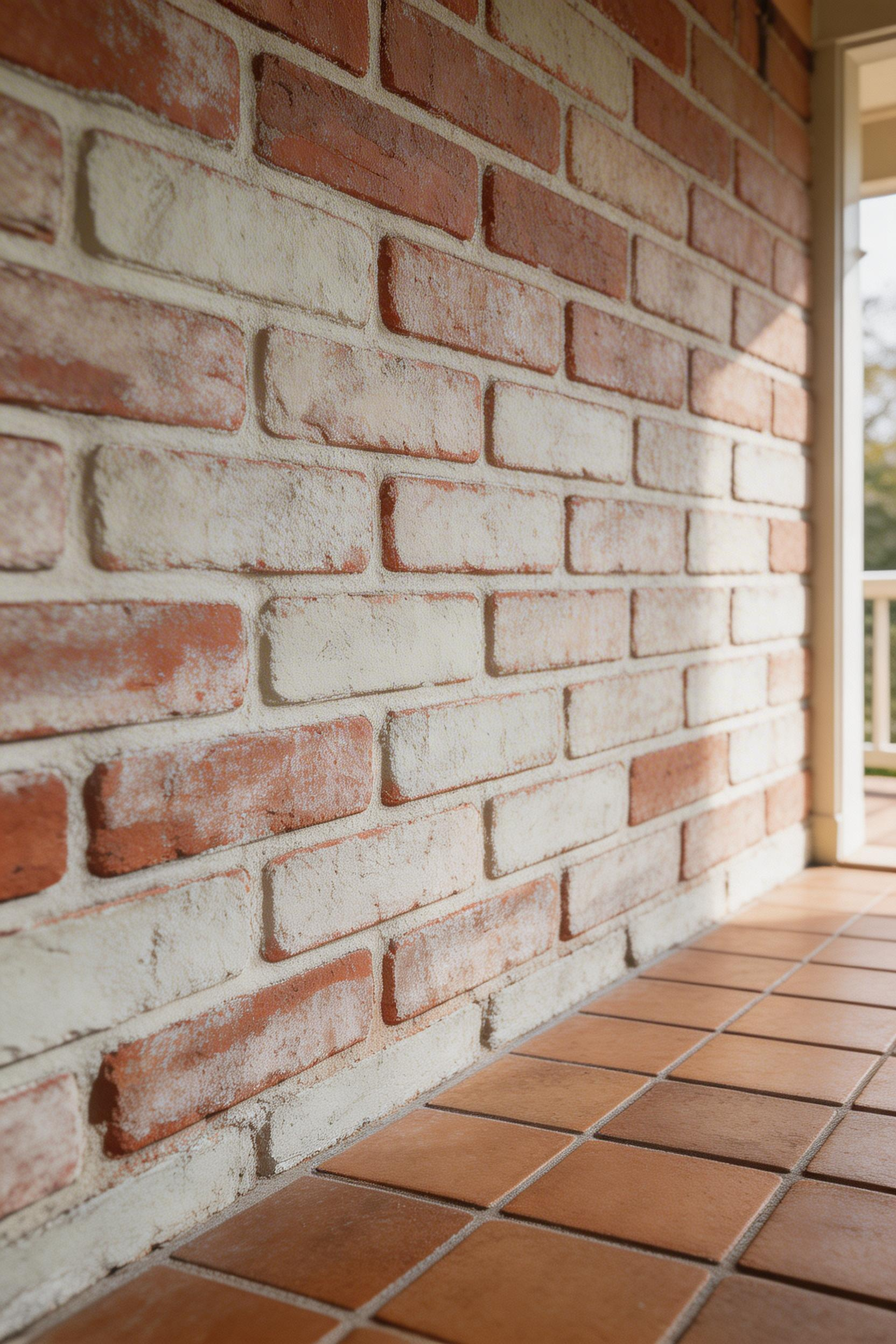
Before exposing any internal porch brickwork, check that the pointing is sound and that the brick face is not spalling. If the pointing contains Portland cement rather than lime, remove it carefully and replace with natural hydraulic lime (NHL 2 or NHL 3.5 depending on exposure) before any decorative treatment.
For painting, the rule is breathability. Never apply a film-forming acrylic masonry paint to Victorian brickwork. The moisture that naturally moves through old masonry has nowhere to go; pressure builds behind the coating and the face eventually blows off. Keim Soldalit (exterior) and Keim Innotop (interior) are mineral silicate paints that chemically bond to masonry, are completely vapour-permeable, and carry 15–25 year durability ratings. Beeck Calcidan Limewash is a natural marble-lime paint with excellent breathability and a soft, irregular finish that suits period properties — applied in 3–4 thin coats, it builds a naturally varied surface that conventional paint cannot replicate.
For colour, off-white and pale stone tones from Keim’s heritage palette read as extensions of the exterior masonry rather than imposing a new scheme. Deep saturated colours work on porch walls but need careful coordination with the door colour to avoid the two competing at close range.
10. The Porch Makeover Case for Black-and-White Geometric Tile
Few decisions are as reliably rewarding in a porch makeover as a properly executed black-and-white tessellated floor. These geometric patterns — typically an octagon-and-dot or penny-round configuration — were introduced in Victorian hallways and porches from the 1870s and have been reproduced continuously ever since. Their graphic contrast reads clearly even in small, dark entrance spaces and ages well both aesthetically and structurally.
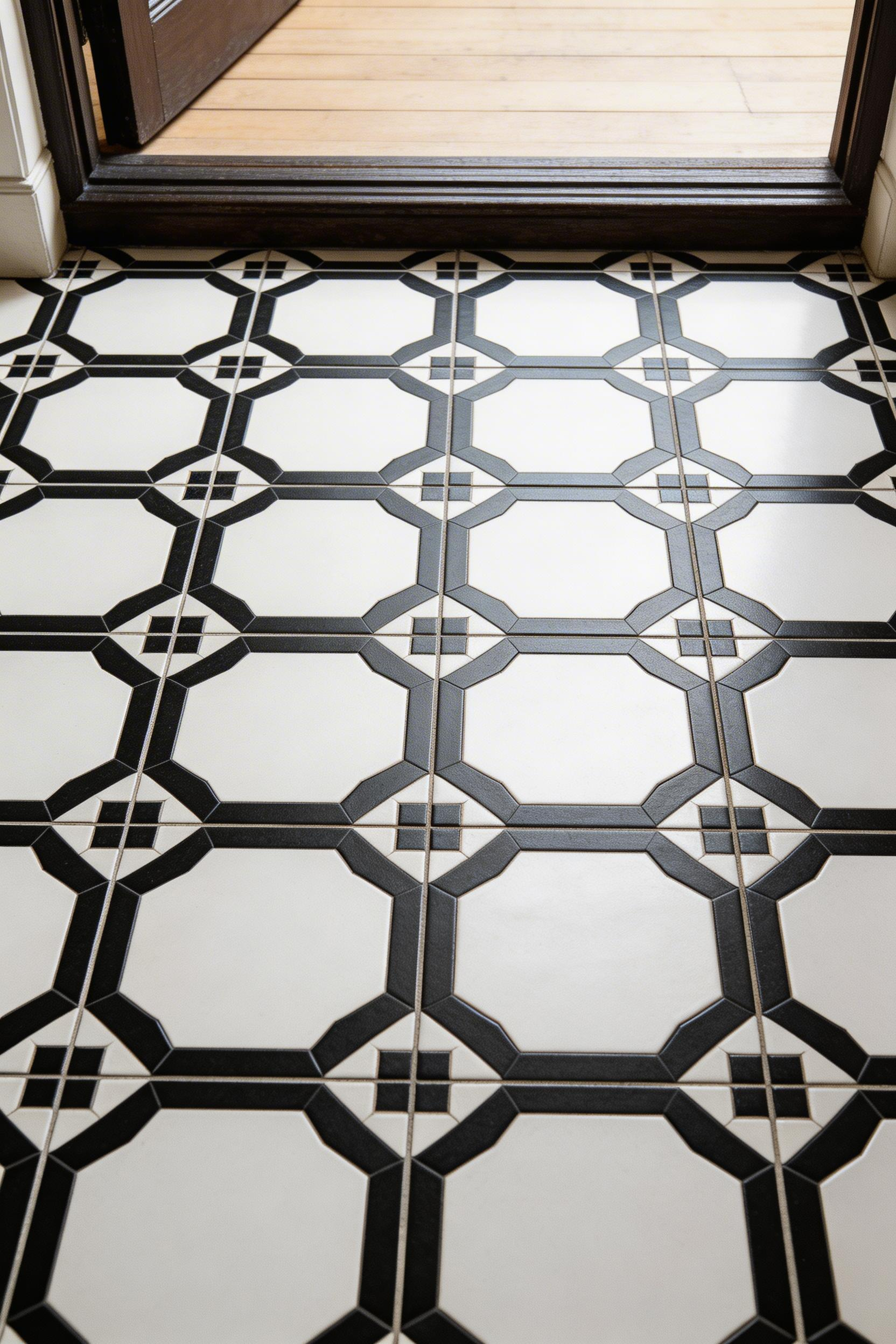
Bert & May produce encaustic cement tiles hand-poured by a fourth-generation family of artisan makers in Spain, with crushed marble aggregate for durability. Their Black Salon Tile (Old Iron & Brighton Stone) is 20×20cm, 1.8cm thick, and naturally slip-resistant. For a wetter or more exposed porch entrance, porcelain reproductions from Original Style or Topps Tiles Victorian Collection offer higher slip ratings (R10+) and better stain resistance; they are slightly harder in character than cement tiles but genuinely durable. Ceramic tiles are not suitable for an external-facing porch floor — they are porous and may crack when frost reaches the substrate.
Planning the Layout
Starting layout from a wall edge, rather than from the centre of the porch, is the most common mistake in tessellated tile laying. It results in awkward partial tiles at the most-noticed positions — the doorstep edge and the transition to the hall floor. Find both centre lines of the porch, dry-lay the full pattern before setting any tiles, and adjust the starting point until cut tiles fall at the least-visible margins. Use grey grout rather than white: white grout in a busy entrance requires sealing every 6–12 months and still looks grey-speckled within a season of use.
11. Outdoor-Grade Wicker and Rattan Furniture for the Open Porch
Natural rattan deserves an honest word before anyone buys it for an outdoor porch. It looks extraordinary indoors and in warmer climates; it deteriorates rapidly outdoors in Britain. As a palm-vine material, rattan is hygroscopic — it absorbs moisture, swells, weakens the weave and eventually breaks down through the wet-then-dry cycle that characterises a British porch through autumn and winter. The practical and visually comparable alternative is HDPE synthetic rattan woven over powder-coated aluminium frames.
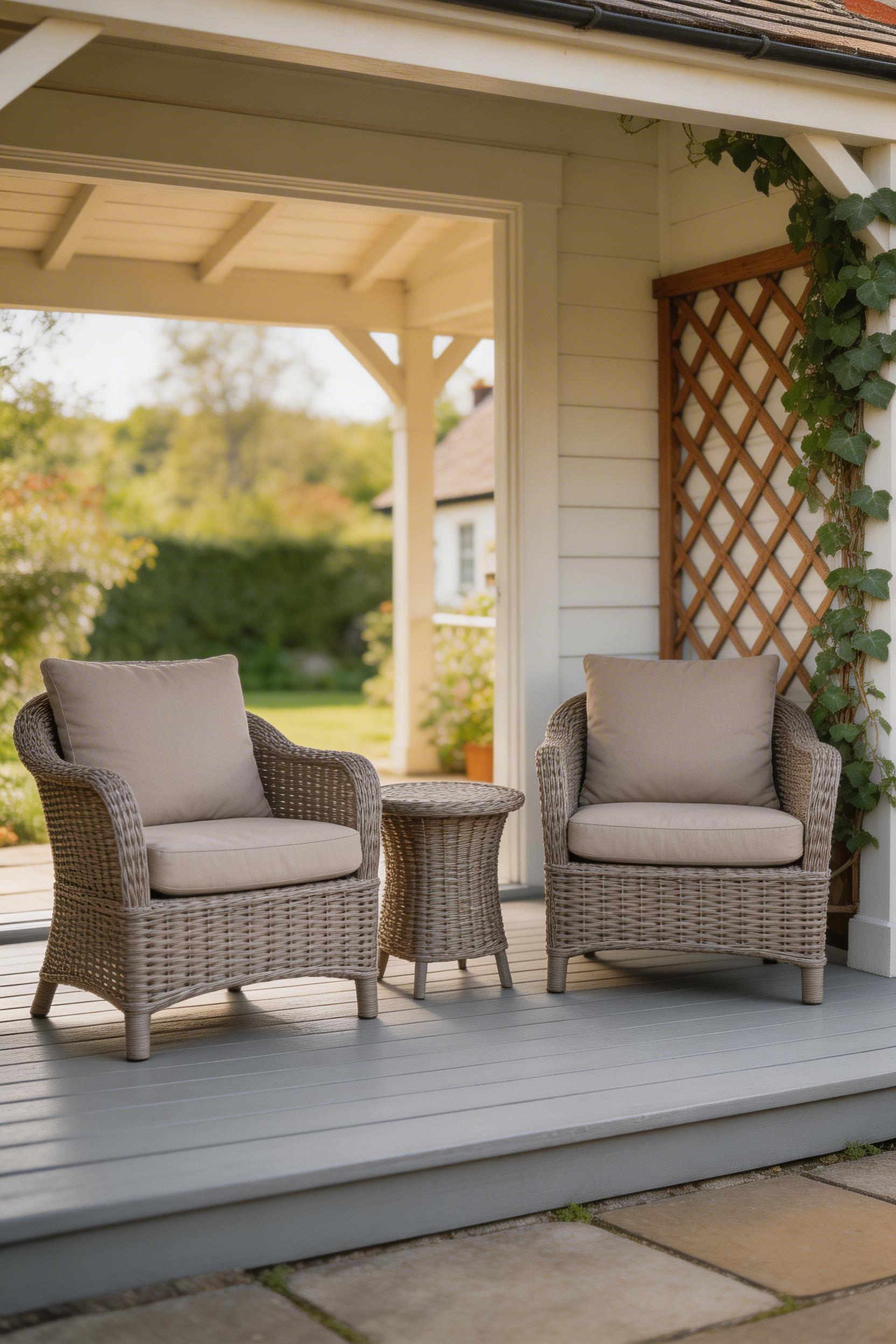
At quality levels, HDPE rattan is indistinguishable from natural at arm’s length. Bramblecrest uses HDPE exclusively, woven over aluminium frames, and backs the furniture with a 5-year warranty; Kettler offers similar construction with bistro-scale sets proportioned for compact British outdoor spaces. Both can be left out year-round, though a waterproof cover between seasons reduces UV exposure on cushion fabrics.
For shallow porches — and most British front porches are shallow — allow a minimum 900mm clear circulation path between any furniture and the door swing. In practice, a standard two-seater sofa at 750mm depth leaves almost nothing on a standard front porch. A single armchair or a matched pair of low chairs with a 70cm diameter side table is the arrangement that works. Small porch decorating ideas to maximise style has worked through these proportions in detail.
For cushion fabrics, Sunbrella (solution-dyed acrylic) carries a 5-year fade warranty and cleans with a weak bleach solution — the dye goes through the fibre, not just on the surface. Use open-cell reticulated foam for cushion pads: it drains completely rather than retaining water the way standard polyurethane foam does, which becomes mouldy after the first season outdoors.
12. Painted Porch Floorboards in Heritage Exterior Gloss
Original Victorian softwood floorboards, if structurally sound, are denser than most modern regularised softwood and respond well to a quality paint system. Painting an existing timber porch floor rather than replacing it is both the preservation-conscious choice and usually the more cost-effective one. A professional paint job costs £200–£600 for a typical porch floor; replacing boards with engineered hardwood or composite runs £800–£1,800. There is also a historical logic to it — the painted deal floor was standard in sculleries, passages and service entrances throughout Victorian town houses.
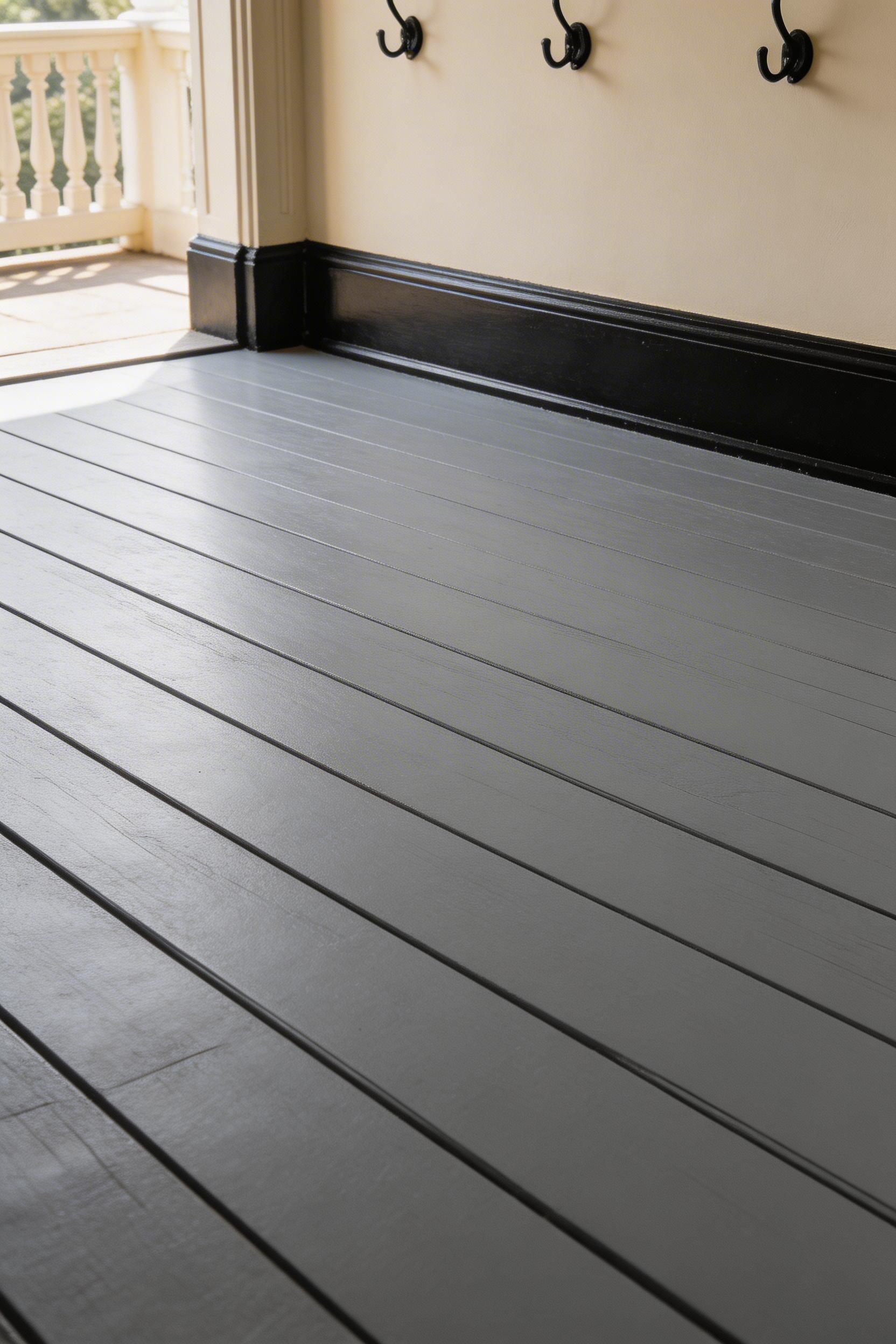
For exterior-facing timber porch floors with any rain exposure, use a dedicated exterior floor paint — not Ronseal Diamond Hard Floor Paint, which is specified for interior use and will peel outdoors within a season. Leyland, Johnstone’s Trade and Sadolin Exterior are all appropriate for exposed timber floors. Before any of that, preparation earns its keep: sand to 120 grit, vacuum, wipe with white spirit and wait for it to fully evaporate, apply knotting solution (Liberon Knotting Pale or Zinsser BIN) over every visible knot, then prime with the appropriate basecoat. Ninety percent of premature porch floor paint failures trace back to skipped preparation rather than product quality. You can also look to the broader entrance scheme for colour inspiration when planning the porch floor.
For colour, slate/dark grey coordinates with almost every Victorian brick tone; inky navy works as a sophisticated alternative to black against cream-painted walls. Stone and buff tones create a visual continuity between a quarry tile path outside and the painted floor inside, which is worth considering if both surfaces are part of the same remodel.
13. A Porch Remodel That Opens Directly onto the Garden
A rear porch sits in a different design register to a front entrance. Where the front porch announces the house to the street, a rear porch is a private transaction between the interior and the garden — and a well-considered porch remodel at the back can transform how the whole ground floor is used through spring and summer.
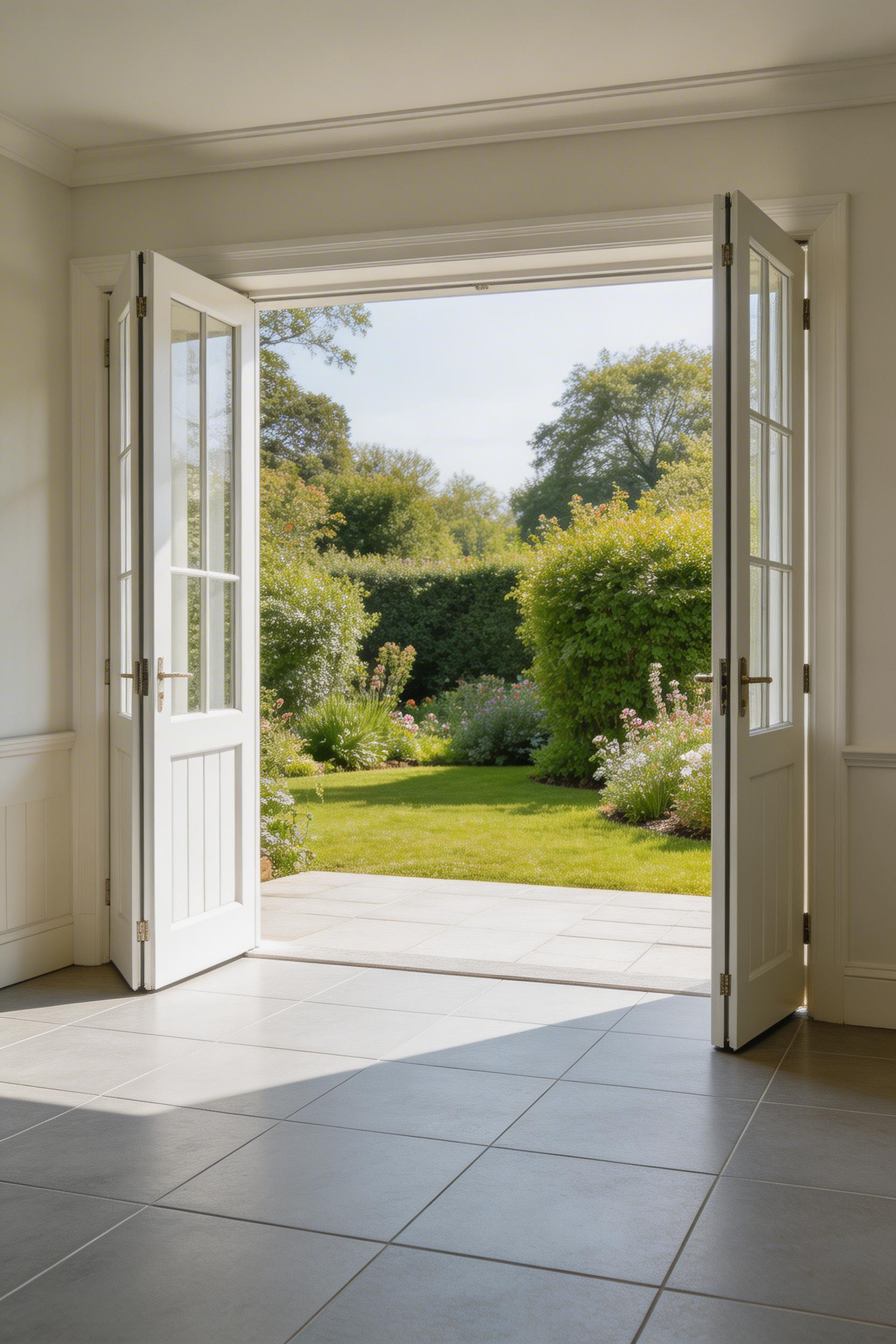
The key design decision is whether to treat the space as an extension of the interior (matching flooring, full insulation to Part L) or as a garden room (robust materials, lower thermal specification, plants). For most British households, the garden room approach produces a more usable result: a porch with bifold or French doors open to the terrace is used; a fully insulated extension that happens to have garden views is used slightly differently.
Choosing the Right Door for a Rear Opening
For the door opening: bifold doors require a minimum 1.8m width to function effectively — the panels need space to stack. For narrower openings from 1.2–1.8m, sliding doors give slimmer sightlines and are generally less expensive. French doors (two outward-opening casements) are the most traditional choice for a porch connecting to a walled garden and sit naturally within the British architectural tradition. For all of these, level threshold is a legal requirement under Part M of the Building Regulations: total threshold height should not exceed 15mm, with any upstand over 5mm chamfered. Specify this at tender stage — it cannot be added retrospectively without considerable effort.
For flooring, large-format porcelain (600×600mm or 600×900mm) running from inside the porch to the garden terrace without interruption creates the most convincing indoor-outdoor continuity. Specify R10 for the interior zone and R11 for the exterior. You can also take ideas from these deck ideas to transform your outdoor space when planning the terrace that connects directly to the rear porch. Seal the transition at the threshold line with a silicone movement joint rather than a metal threshold bar for the cleanest visual result.
14. Stained or Painted Timber Columns to Define the Porch Structure
A porch column is a load-bearing element with significant decorative potential that most porch remodels either ignore or replace with something inappropriate. Getting the profile right for the property’s period is the first decision; the finish is secondary but closely related.
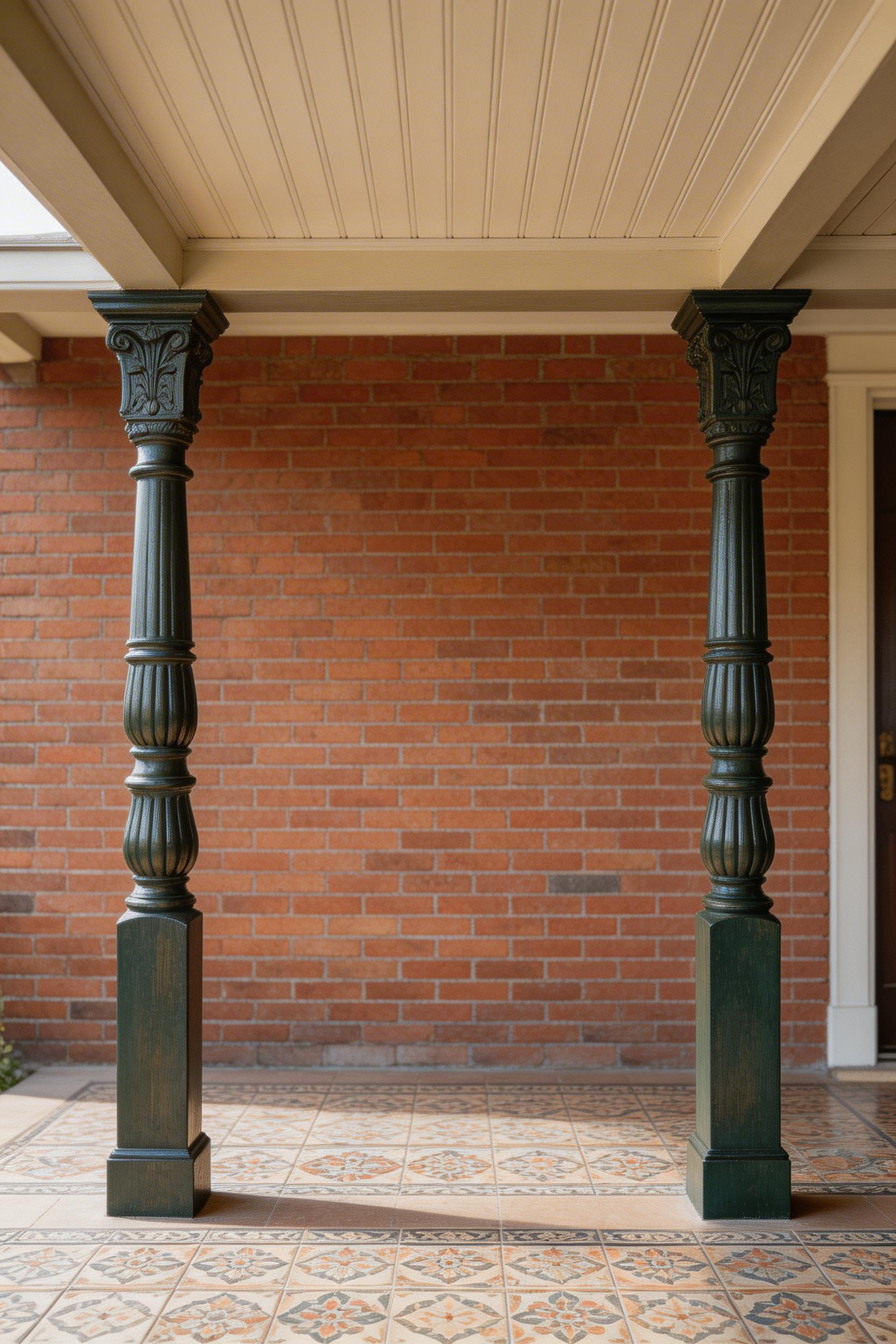
Turned columns — lathe-turned decorative profiles with vase, bobbin or ring shapes — were standard on Victorian terrace porches from the 1860s onwards. Cheshire Mouldings and Richard Burbidge supply a range in softwood; both can advise on historically appropriate options for a specific property period. Fluted columns reference the classical tradition and appear in Edwardian revival work and in grander Victorian houses with a more formal architectural language. Square-tapered columns with simple chamfer detail are associated with the Arts & Crafts movement (1890–1915) and suit rendered or roughcast elevations.
For finish, a penetrating stain system consistently outperforms paint on exterior joinery. Stains move with the wood; film-forming paints crack when timber expands and contracts with seasonal moisture changes. Sadolin Classic as a basecoat followed by Sadolin Extra gives 4–5 years between maintenance cycles on well-prepared timber. Maintenance, in this system, means a light clean and a topcoat application — not stripping and starting from scratch.
Column Replacement Safety Note
Before removing a load-bearing column, always prop the roof structure with an adjustable steel Acrow prop on a spreader plate. Even a light timber porch roof can deflect within hours of column removal. If only the base section is rotted, an epoxy consolidant (Repair Care Dry Flex 4) and a half-column repair section can often salvage the original profile, preserving the match and avoiding full replacement. Rotted column bases almost always trace back to a drainage or flashings problem at the foot; fix the cause before installing any replacement.
15. Period Stained Glass Sidelight Panels for the Front Door
Stained glass sidelights — narrow windows flanking the front door — were standard in Victorian and Edwardian town houses from around 1880. Their function was exactly what it remains today: they allow diffuse daylight into the hall without sacrificing the visual privacy that a solid wall preserves. In a well-executed porch, a period sidelight changes the light quality of the entire entrance — even in a north-facing porch, the coloured and scattered light creates a perceptibly different quality of brightness.
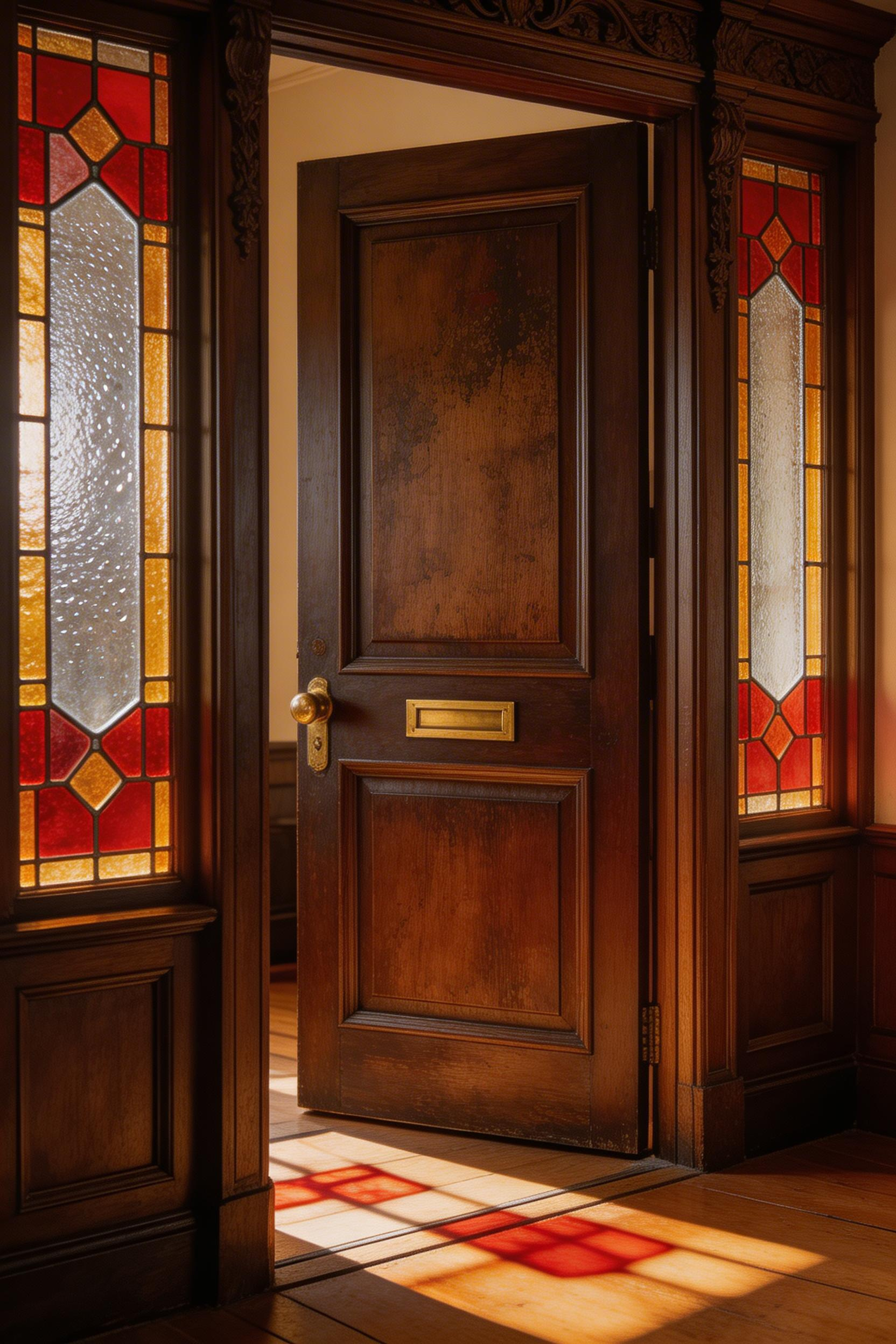
The most common Victorian pattern for terraced house sidelights is a lead grid with coloured margin glass (red or amber border, clear central panel). Edwardian examples tend to be more elaborate — flowing Art Nouveau foliage, stylised flowers, geometric leaded patterns that reflect the period’s taste for decorative craft. For sourcing original panels, English Salvage lists reclaimed Victorian and Edwardian stained glass door panels online; SALVO is the most comprehensive database when you are trying to match a specific pattern.
Reproduction panels made with hand-floated glass — carrying the natural bubbles, fissures and irregularities of period glass — are indistinguishable from originals at any realistic viewing distance. Light Leaded Designs and The Stained Glass Doors Company both make traditionally leaded reproduction sidelights to exact measurements and can match glass surviving in the fanlight above the door.
A practical caveat: single-glazed original leaded lights lose significant heat. Both Cotswood Doors and The Stained Glass Doors Company offer double-glazed units with the leaded pattern encapsulated between the panes — visually identical to single-glazed, thermally comparable to modern double glazing. In a conservation area, a reproduction leaded light is almost always approvable where plain double-glazing in a standard unit would not be.
16. Porch Renovation Priorities for Listed and Period Properties
A porch renovation on a listed building or in a conservation area requires a different kind of planning — and a different kind of contractor. The most common and expensive mistake is assuming that a porch is too small to attract planning scrutiny, carrying out the work, and then receiving an enforcement notice. Size is irrelevant for listed building consent: any alteration affecting the character of a listed building requires it, regardless of scale.
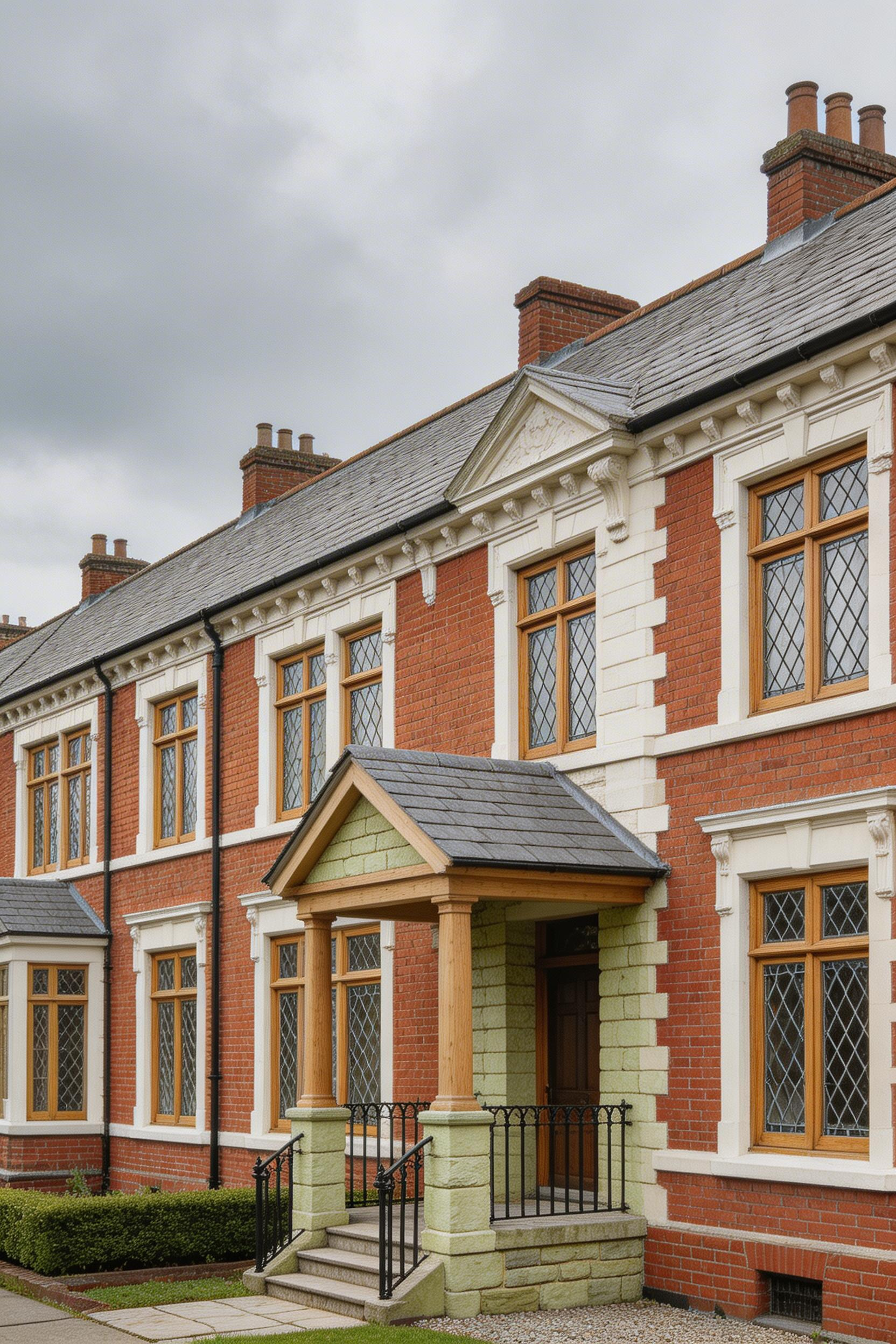
Permitted development allows a porch addition without a planning application provided the external ground-floor footprint does not exceed 3 square metres, no part rises above 3 metres, and the porch sits at least 2 metres from any highway boundary. In conservation areas, Local Planning Authorities can issue Article 4 Directions that withdraw permitted development rights entirely, meaning even minor porch works on unlisted properties need a formal application. Always verify with the LPA before any design work is committed. Some front yard landscaping ideas to complement your porch can be implemented without consent, which is useful to know if the broader streetscape matters to the project.
Materials and Contractors for Heritage Work
Materials that conservation officers reliably approve: lime mortar (NHL 2 or NHL 3.5), traditional lead flashings, natural slate, solid timber, hand-made clay tiles, and original or reproduction leaded lights. Materials that are consistently refused: uPVC in any colour on listed buildings and in most conservation areas, OPC cement mortar on lime-built walls, modern concrete roof tiles in place of natural slate, and spray-foam insulation in roof voids.
Finding the right contractor is as important as the design specification. The Society for the Protection of Ancient Buildings (SPAB) maintains a regional Craftspeople Register with verified traditional building skills; Historic England’s Find a Professional service lists accredited conservation architects. A builder who specifies lime mortar and hot-dip galvanised fixings as a matter of course, without prompting, is a better indicator of real competence than any certification.
17. Statement Door Hardware and Knocker as the Final Detail
Door hardware is the element of a porch remodel that a visitor examines at close range. They touch the knocker. They read the numbers. Their hand is on the handle. At this distance, the quality of materials and the coherence of the selection communicates everything that the wider porch scheme can only suggest from the pavement. A heritage porch with original tiles, period railings and a restored door, finished with cheap zinc die-cast hardware, reads as unfinished. The same porch with a solid-brass matched set reads as complete.

The Matched Set Principle
The matched set principle holds consistently: knocker, letter plate, pull handle, numerals and bell push should all be in the same metal and finish. Mixing polished brass knocker with chrome bell push and black numerals is not an expression of individuality — it reads as a series of separate buying decisions, and it undermines the coherence of everything around it.
Victorian door hardware was solid polished brass. Unlacquered solid brass develops a natural patina over 6–18 months, darkening to a warm honey-antique tone that ages well and requires only an occasional wax (Brasso or Renaissance Wax) to maintain. Lacquered brass looks bright indefinitely until the lacquer chips, which typically happens within 3–7 years outdoors; once chipped, the exposed patches tarnish rapidly and the combination looks considerably worse than naturally aged unlacquered brass. Antique bronze (brass with a hand-applied dark patination) suits Arts & Crafts and more rustic property styles and is more maintenance-free than polished brass in a garden-facing setting.
Quality matched sets from Door Furniture Direct (antique brass heritage range), British Ironmongery (hand-finished cast brass postal knockers) and The Period Ironmonger (Victorian and Edwardian verified designs) run £200–£350 for a complete set — letter plate (minimum 250mm × 38mm under BS EN 13724), knocker, pull and numerals — and will outlast every other element of the porch remodel with minimal attention. This is not the element to value-engineer.
Making Your Porch Remodel Work for Your Property and Budget
The correct sequence for a porch remodel is structure before surface, always. Address structural and damp issues first — rotted columns, failing roof, damp substrate; fix the building envelope next (glazing, doors, flashings); then lay hard floor surfaces; install electrical work (lighting, bell, PIR); decorate last (ceiling, walls, painted floor); and add furniture, plants and hardware at the very end. The most common sequencing mistake is painting walls before the floor is laid — tile-cutting dust and adhesive contaminate any paint finish and the work has to be done again.
For budget allocation on a full porch remodel on a Victorian terrace: roughly 40% to structural and builder’s work, 25% to floor and ceiling finishes, 20% to door, glazing and lighting, and 15% to furniture, plants and hardware. A complete transformation — new floor, restored door, glazed panels, lantern, bench and climbing plant — runs £4,000–£12,000 professionally installed. A selective update focused on the highest-impact elements (floor, door hardware, lantern, front door colour and a trained climber) can be done for £800–£2,500.
Spend on the front door, the floor tiles and the lighting — these have the highest impact and the closest scrutiny from everyone who arrives. Save on the bead board ceiling (well within DIY competence with the right preparation), bench cushions (a made-to-measure cover over quality open-cell foam is considerably cheaper than a ready-made outdoor cushion), and climbing plants (star jasmine from a 2-litre pot at around £15 and three growing seasons will cover a door frame as thoroughly as a £45 specimen from a garden centre). The porch remodel that rewards is the one built from clear priorities and well-executed decisions.