Most people believe you need a professional kitchen designer to get kitchen cabinets ideas right. Home renovation shows repeat it. Design blogs insist on it. Here’s what they’re not telling you: the most transformative kitchen cabinet decisions are nearly always straightforward ones. I’ve spent a decade consulting on British kitchens at every price point, and that pattern holds. They don’t require a budget of £30,000 or months of planning. These 15 kitchen cabinets ideas cover everything from a weekend paint project to a considered structural choice. Each one is specific, proven, and achievable. Because the best kitchen cabinet idea isn’t the most expensive one. It’s the right one for your room.
1. Two-Tone Cabinets: Upper and Lower in Contrasting Colours
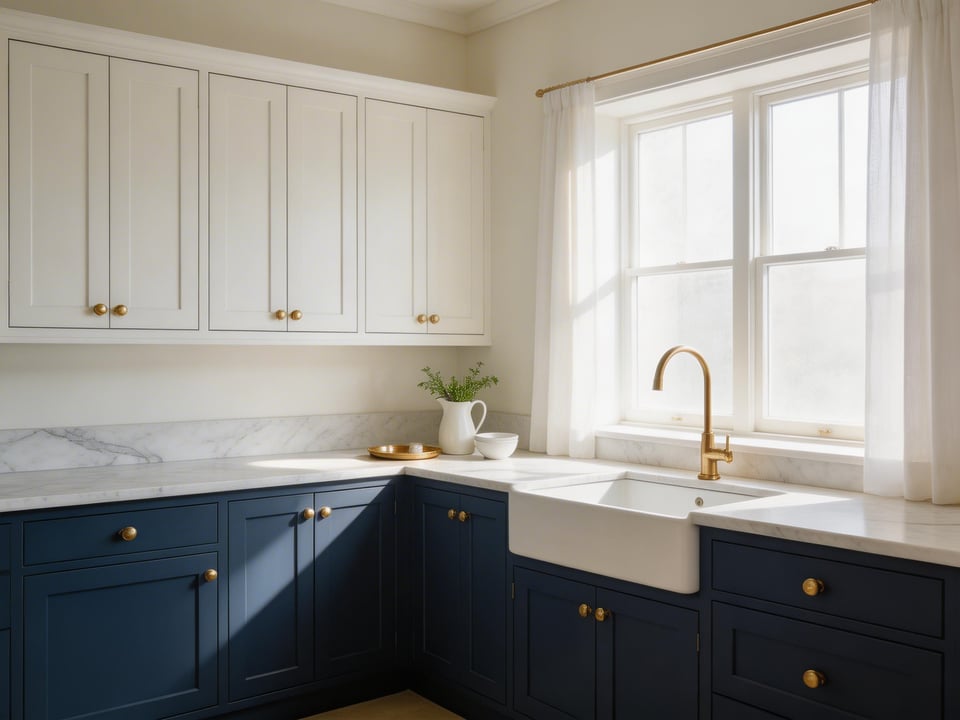
Two-tone kitchen cabinets ideas remain one of the most-searched renovation moves for good reason. They deliver visual depth without any structural changes. The concept is simple: your upper cabinets are one colour, your lowers are another. So the effect, when done well, is a kitchen that feels considered and layered rather than monotonously uniform.
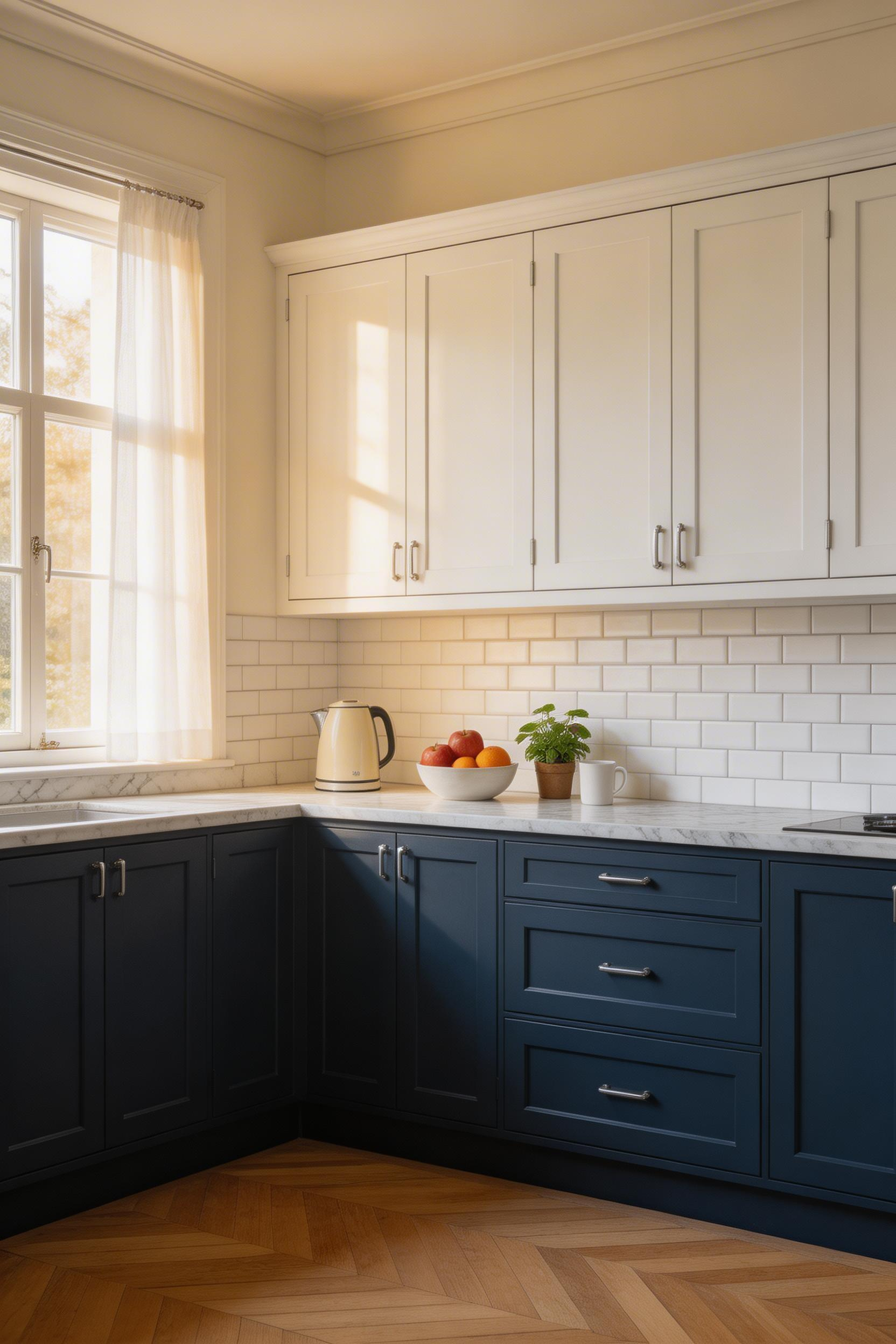
The standard approach pairs lighter uppers with a darker lower cabinet. Think white, cream, or sage on top; navy, forest green, charcoal, or slate blue below. Darker lower cabinets anchor the room and, helpfully, are less prone to showing scuffs and fingerprints. Lighter uppers keep the space open and bright where your sight-line tends to rest.
Choosing the Right Contrast Level
One rule matters most: the colours need to be genuinely different. Aim for at least two to three shades apart on the scale. Subtle tone-on-tone two-tone (pale grey uppers, slightly less pale grey lowers) rarely reads as intentional. It just looks like two batches of paint that didn’t quite match.
The combination that has dominated British kitchen renovations since 2022 is Farrow & Ball’s Hague Blue No. 30 on lowers with All White No. 2005 on uppers. It costs around £60 per 2.5 litre tin in full gloss. For a 10-cabinet kitchen, expect to spend roughly £250-£350 in paint. That’s a small investment for how much it changes the room. Houzz’s 2024 Kitchen Trends report found two-tone cabinets in 31% of high-engagement renovation photos. That’s not a passing trend. It’s a well-established direction.
The colour break falls naturally at the worktop level, which creates a visual boundary that the eye reads as intentional. Start with the lower cabinet colour first. Get that right before choosing the upper. Picking both simultaneously usually produces two competing favourites rather than a resolved pair.
2. Open Shelving on One Wall as a Break from Full Cabinetry
Open shelving has been divisive in kitchen design for a decade. But the debate largely misses the point — the problem isn’t open shelving itself; it’s installing it everywhere. Used as one deliberate run in an otherwise closed kitchen, open shelves lighten a heavy layout. They’re among the smartest kitchen cabinets ideas for visual relief without a full renovation.
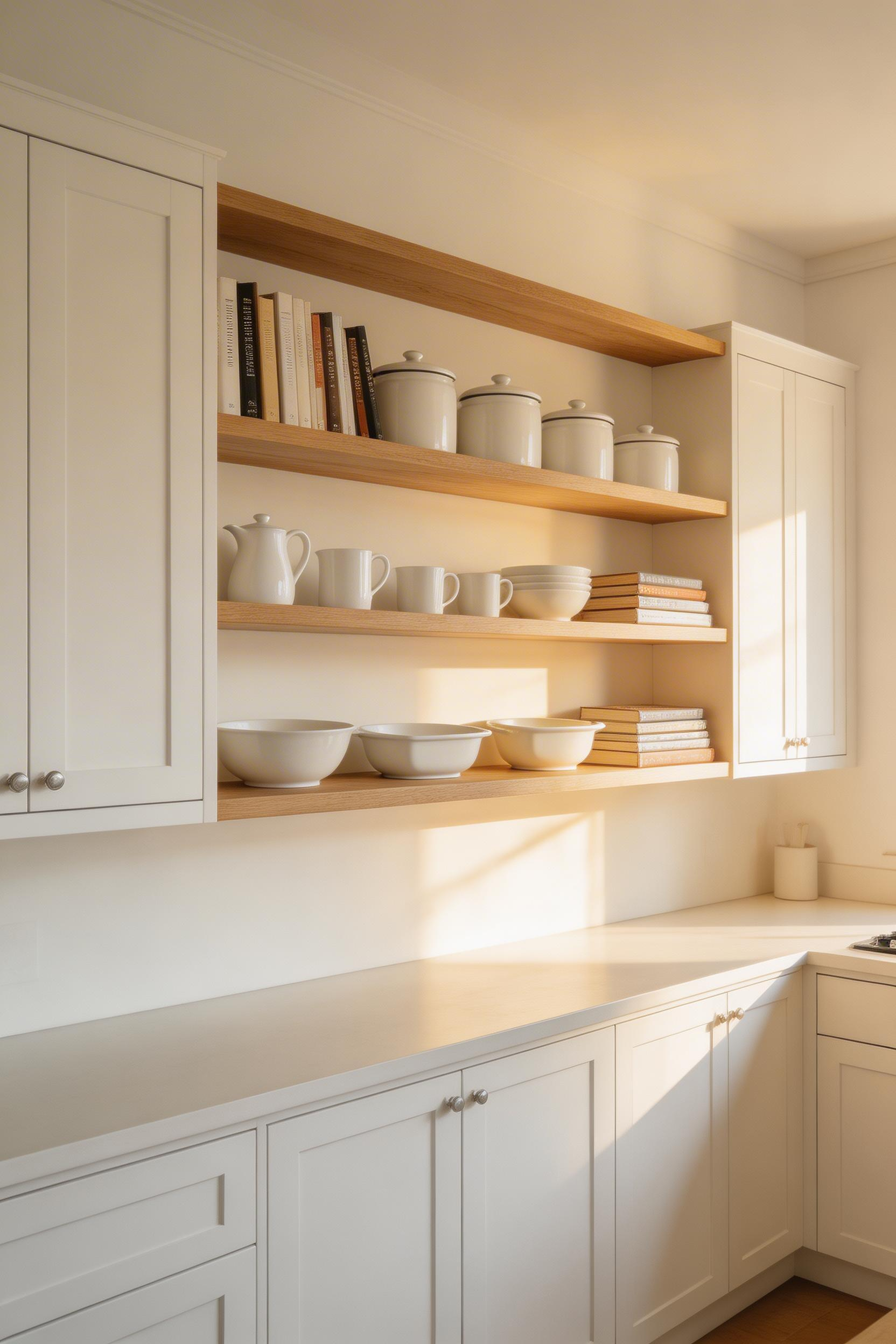
The practical version of this idea is a single floating shelf run above a coffee station or beside a window. Solid oak or pine shelves are the most durable and easiest to clean. Aim for 250-300mm depth — enough for standard plates and glasses without creating an awkward protruding ledge. Budget options start at around £25 per shelf from IKEA. Proper hardwood from suppliers like Holloways of Ludlow runs £95-£200, but it won’t bow under the weight of your dinner service.
What Goes on Open Shelves
The edit required is the same as styling a bookshelf. White or uniform ceramics work. Matched glassware works. Cookbooks work. Mismatched Tupperware, open cereal boxes, and the random accumulation of a working kitchen do not. A 2023 Houzz survey found satisfaction with open shelving dropped 40% in kitchens where it covered more than one wall. Single-wall installations kept high satisfaction ratings across all demographics.
Brackets need to anchor into wall studs or use specialist hollow-wall fixings rated for 20kg or more per bracket. Minimum two brackets for shelves up to 800mm; three brackets for anything longer. Before committing, rest a piece of board across a couple of jam jars on the counter. Style it and live with it for a week. Most people discover within days whether they’re actually going to keep a real shelf looking presentable.
3. Shaker-Style Doors: The Cabinet Profile That Never Dates
Shaker cabinetry began with the American Shaker religious community in the eighteenth century. Their design philosophy was simple: make it plain, make it useful, make it to last. It maps almost perfectly onto what a kitchen cabinet door should be. Shaker-style doors remain the UK’s most-fitted kitchen profile. They account for roughly 42% of new kitchen installations, according to British Kitchen and Bathroom Association data from 2023.
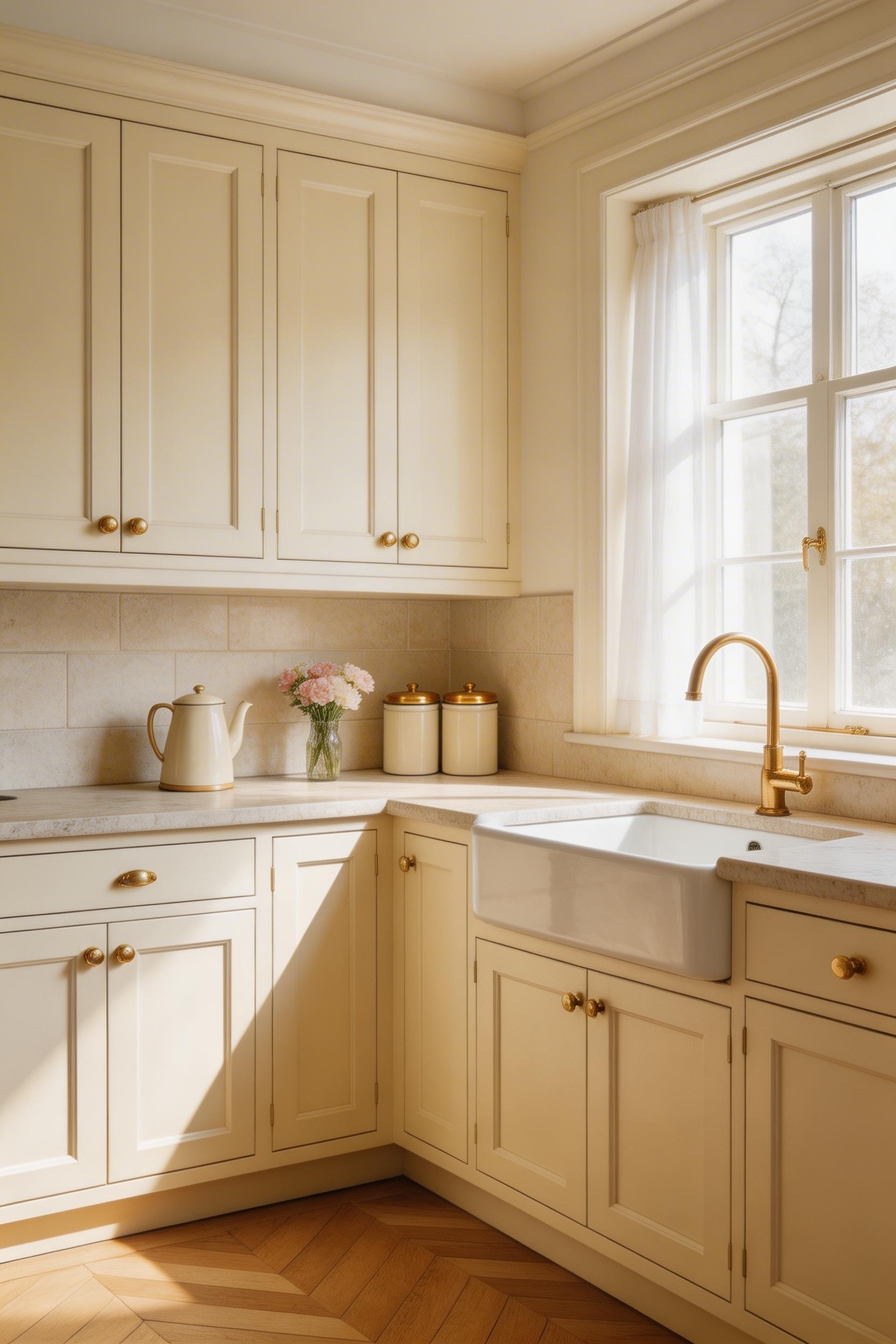
The profile is a recessed centre panel within a flat frame, with a recess of typically 10-12mm. That precise depth affects how the door catches light. The shadow line created by the recess is what gives shaker doors their characteristic quality.
Where Shaker Works (and Where It Doesn’t)
Shaker doors work across farmhouse kitchens, contemporary kitchens, traditional kitchens, and coastal designs. They’re less coherent in ultra-minimalist, handleless layouts where flat slab doors are the more honest choice. A handleless shaker door is something of a design contradiction — the hardware-ready profile sits oddly without the hardware.
Specification matters at every price point. Howdens’ Greenwich Shaker range is Britain’s most-installed shaker door, starting around £100-£200 per door at trade pricing and available next-day. IKEA’s BODBYN doors fit standard SEKTION carcasses for £18-£55 per door — an honest shaker profile at a budget price. At the premium end, DeVOL kitchens in Leicestershire are handmade in England. They’re widely considered the gold standard of British shaker cabinetry, starting from £30,000 for a full kitchen.
Pay attention to the frame width when comparing options. A 70mm frame reads as traditional; a 50mm frame sits more comfortably in contemporary spaces. The detail changes the character of the whole kitchen.
4. Replacing Cabinet Doors Without Touching the Carcasses
The most overlooked kitchen cabinets idea is also one of the most cost-effective: replace only the doors and leave the carcasses untouched. A door-only replacement is known in the trade as a kitchen facelift. According to a Which? survey, it delivers 60% of the visual impact of a full replacement at roughly 25% of the cost.
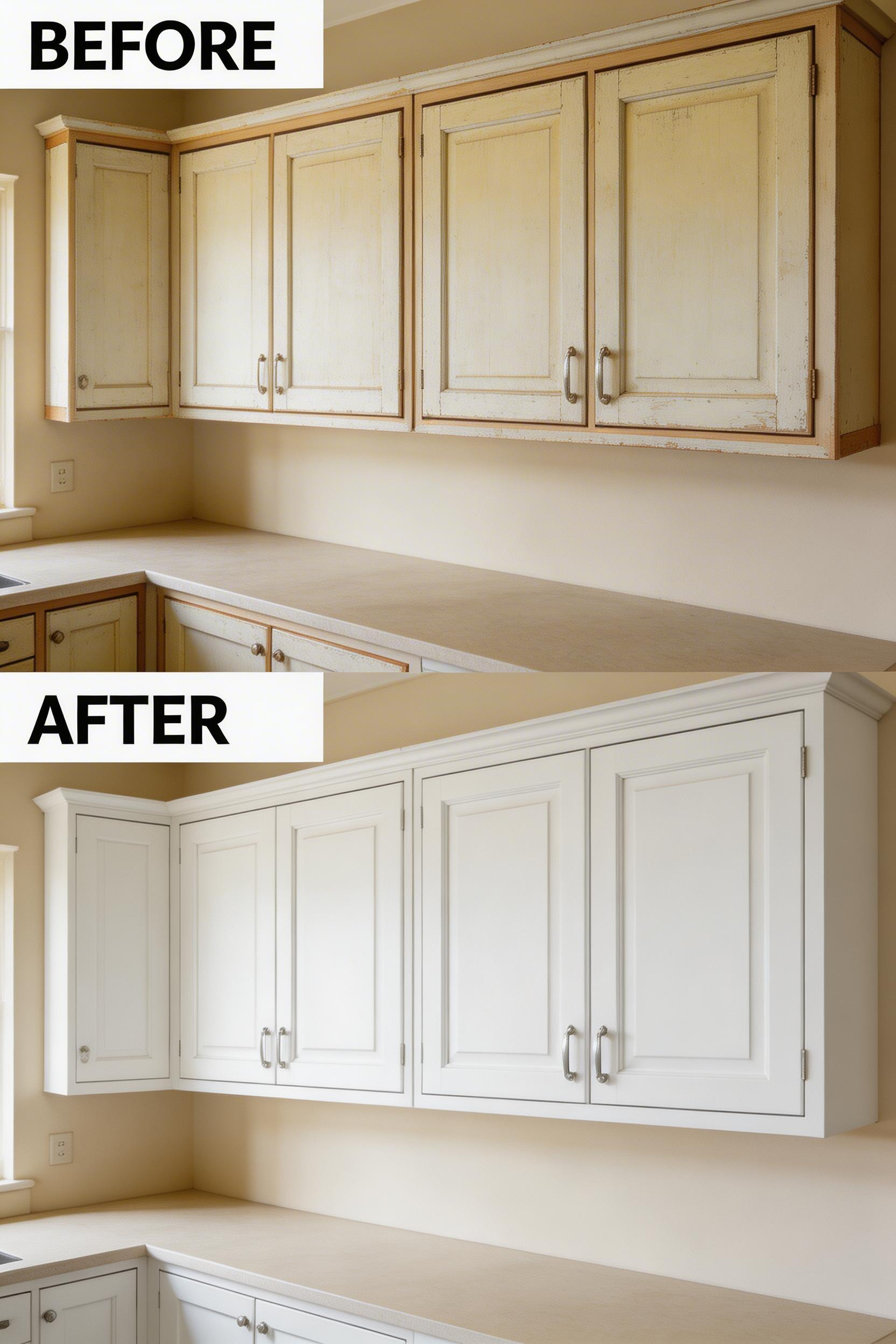
This works when the existing carcasses are structurally sound. Check for solid chipboard or MDF construction, squareness (no twisting), no water damage, and hinges that are in good condition or replaceable. The main UK suppliers of replacement-only doors include Doors2U, Just Doors UK, and Trade Kitchen Doors. Finish options include pre-primed painted MDF, vinyl-wrapped, real oak veneer, and acrylic gloss.
The Process and What to Watch For
Budget options start at around £12-£35 per door from Doors2U for pre-primed MDF that you paint yourself. Just Doors UK offers vinyl-wrapped doors colour-matched to Farrow & Ball and Little Greene ranges at £25-£60 per door. That’s considerably faster if you want a specific paint shade without doing the painting work yourself. Trade Kitchen Doors’ real oak veneer doors start at £45-£90 — a warmer look than vinyl imitations, and noticeably so in natural light.
The technical requirement is precise measurement: door width and height to within 1mm. Also confirm that your existing hinges are European standard — 35mm Blum or Hettich is the most common type. If your hinges are old surface-mounted types, budget for Blum CLIP top BLUMOTION soft-close hinges while you’re at it. They cost £4-£8 per hinge. Order one sample door before committing to the full kitchen quantity. Door colours photograph very differently from how they look in real light, and texture matters enormously in kitchen conditions.
5. Glass-Front Cabinet Doors for Light and Display
Glass-front kitchen cabinets are among the most photogenic kitchen cabinets ideas. That’s also why they’ve been slightly over-used in the last five years. Done with some restraint, they remain a genuinely useful design move. Done on every wall unit, they start to look like a showroom.
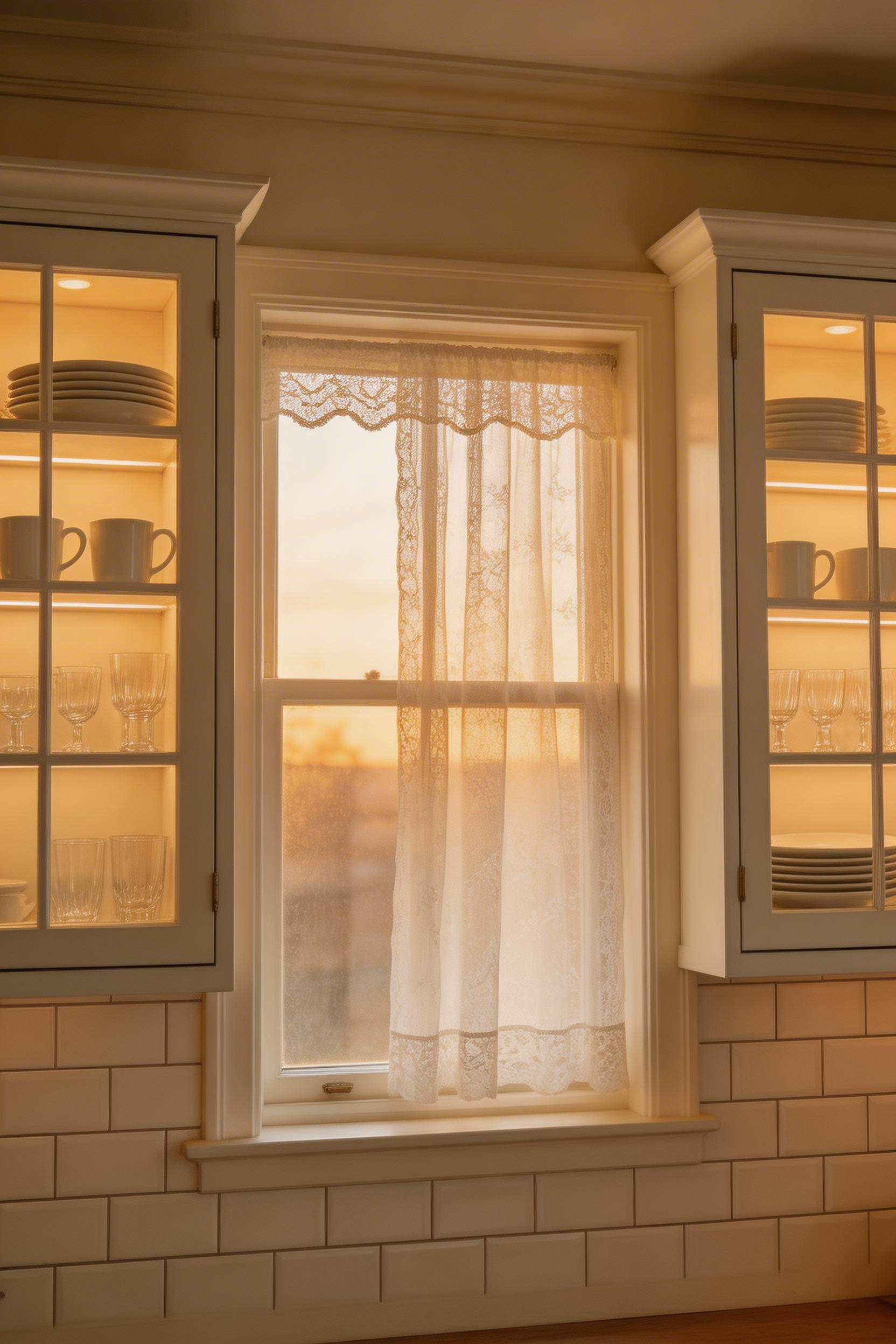
The variables worth understanding: clear glass shows everything and demands neat storage. Reeded or fluted glass — parallel vertical grooves pressed into the glass — obscures the contents while letting light through. That’s considerably more forgiving in a real working kitchen. Frosted glass gives more privacy; seeded glass (with air bubbles pressed in) suits farmhouse and vintage kitchens particularly well.
Lighting the Interior
Installing a small LED puck light or LED strip inside each glass-front cabinet transforms the effect from daytime to evening. Without interior lighting, glass-front cabinets look fine in daylight but look like dark boxes at night. Häfele’s LED interior cabinet strips start at £15-£35 per metre and are straightforward to fit. Use 3000K warm white — the cooler temperatures make ceramics look clinical rather than inviting.
One or two glass-front cabinets deliver the effect without overwhelming the kitchen. Position them where they have the most impact — flanking a window, or above the main preparation area. Glass panels should be a minimum of 4mm toughened glass for safety. If you’re converting existing solid doors, a cabinetmaker needs to rout the centre panel and re-glaze. A 2023 Rightmove listing analysis found homes with glass-front kitchen cabinets sell 2.1% faster than comparable kitchens without them. That’s a modest but measurable signal.
6. Painting Kitchen Cabinets: Colours That Hold Up in 2026
Painting kitchen cabinets is the kitchen cabinets idea with the widest range of outcomes. Done well, it’s spectacular. Skip the preparation, and you get a sticky, peeling disappointment. The colour conversation usually gets all the attention. In reality, the process matters more than the colour.
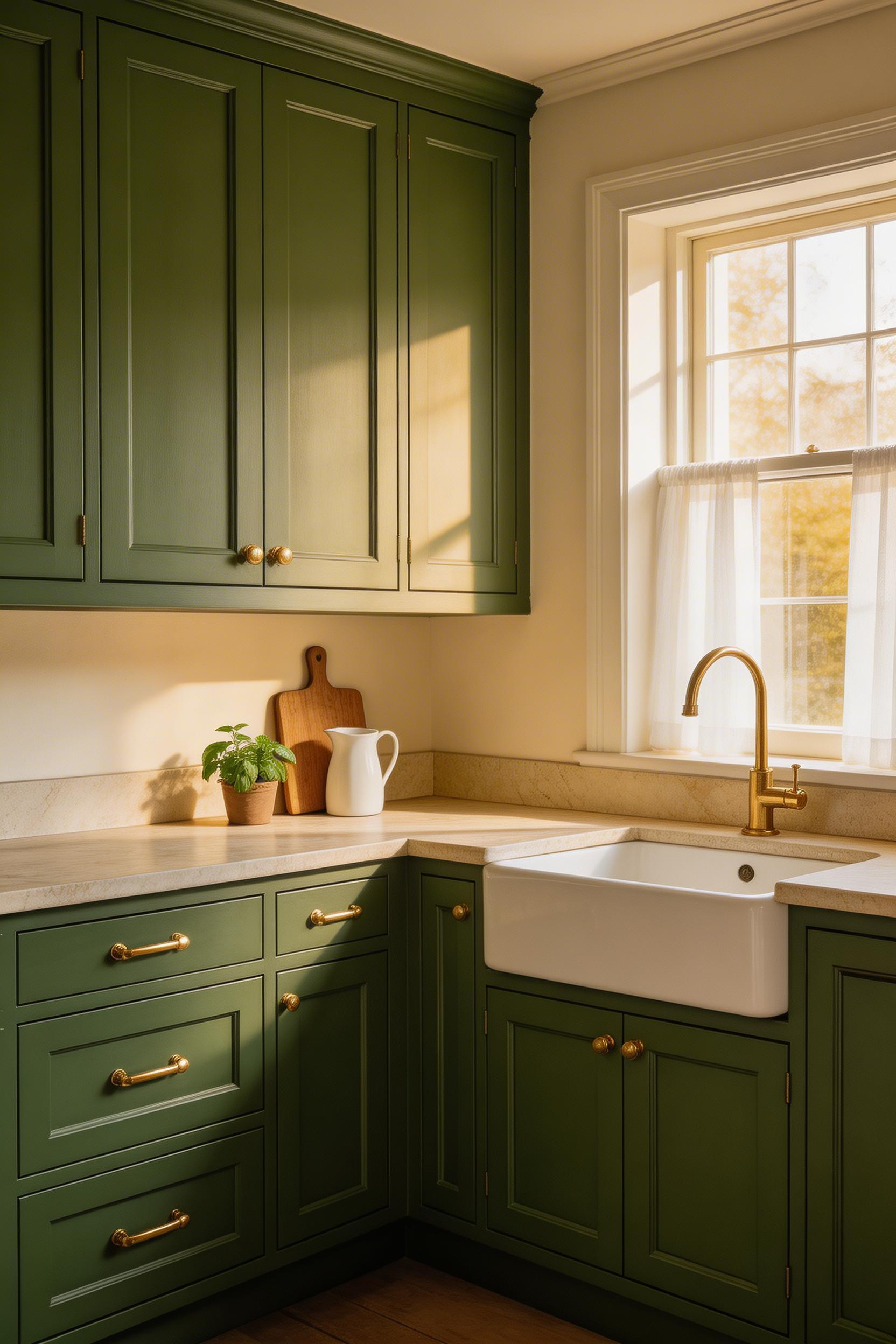
Green has overtaken grey as the leading kitchen cabinet colour across the British market. Specifically, forest greens and sage greens have driven a genuine shift in kitchen design since 2023. Farrow & Ball’s Duck Green, Obsidian Green from Little Greene, and Archive from Fired Earth lead the palette. Hague Blue (F&B No. 30) remains the most-requested deep cabinet colour in British renovations. It’s rich without being oppressive, and it works with everything from marble worktops to butcher’s block. According to Farrow & Ball, Hague Blue sales increased 28% following the 2024 kitchen design awards.
The Process That Makes It Last
The finish for kitchen cabinets must be full gloss or satinwood — not eggshell, which isn’t durable enough for a surface wiped down daily with various cleaning products. The process: clean with sugar soap, sand with 180-grit, apply Zinsser BIN shellac primer (£22 per 500ml). Skipping the primer is the single most common reason painted cabinets fail within two years. Sand again with 240-grit, then apply two coats of gloss or satinwood with a foam roller rather than a brush. Brush marks show very badly on flat cabinet doors.
Sample the colour on the actual cabinet door, not on a wall swatch. The horizontal plane of a cabinet door catches light completely differently from a vertical wall, and what looks beautiful as a paint sample can appear flat and dull on a door.
If you’re planning green kitchen cabinets specifically, there’s a full guide to shades and combinations worth reading before you commit.
7. Floor-to-Ceiling Cabinets for Maximum Storage and Visual Height
The gap above standard wall cabinets is one of the great missed opportunities in British kitchens. Standard wall units in the UK stop at around 2100-2200mm, leaving 300-700mm of dead space above — a perfect ledge for collecting grease and dust, useless for anything else. Floor-to-ceiling kitchen cabinets close this gap. Counterintuitively, they make the ceiling feel higher, not lower.
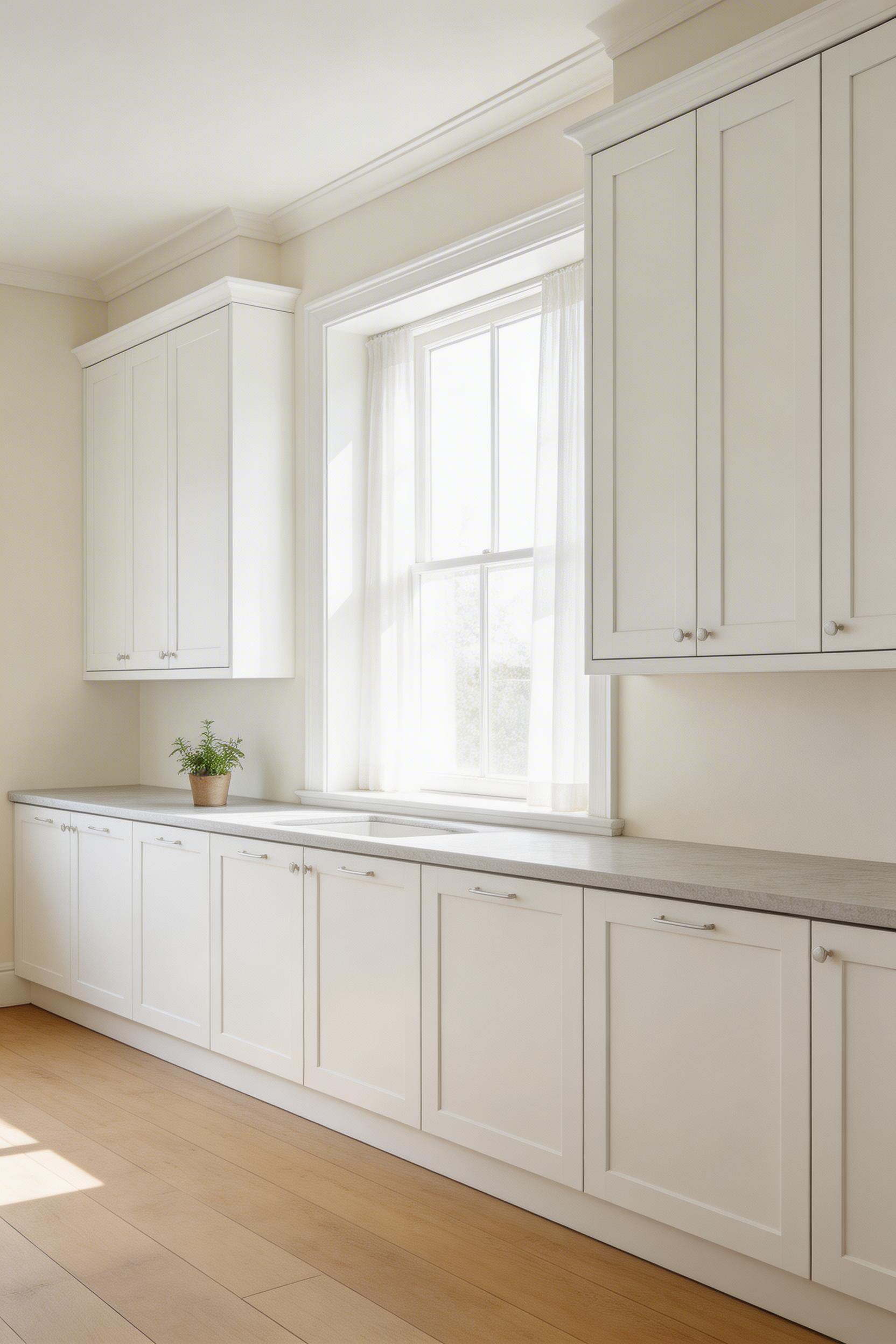
The practical uplift is significant: ceiling-height cabinets typically provide 30-40% more linear storage than standard-height units. The top section — above 2100mm — is best used for seasonal items, rarely-needed appliances, and spare bottles. IKEA’s SEKTION tall cabinets reach 2020mm, which gets close to a standard 2400mm ceiling with a small painted filler panel above.
Making the High Sections Accessible
The access problem is real. Without a mechanism, the top 300mm of a ceiling-height cabinet is effectively a hidden shelf. Blum’s AVENTOS HK lift-up mechanism (£80-£150 per pair) opens the upper section upwards. No more reaching into the back of a high shelf. Kesseböhmer’s pull-down shelf system (£200-£400 per unit) brings upper shelves physically down to working height.
Also, watch the visual balance. Floor-to-ceiling cabinets on one side of a kitchen can feel like a filing cabinet if the opposite side isn’t balanced — either with an open shelf run, a window, or a more open layout. A Rightmove property analysis found ceiling-height cabinetry adds 1.5% to property value in London and 0.8% in regional UK markets.
8. Handleless Cabinet Doors: A Clean Look That Earns Its Keep
Handleless kitchen doors now represent 38% of new kitchen door sales in the UK. That’s up from 22% in 2019, according to KBSA industry data. That’s a significant shift in a short time. The appeal is clear: a kitchen without visible hardware looks genuinely clean and uninterrupted. But the practical performance of handleless cabinets varies significantly depending on which system is behind the look.
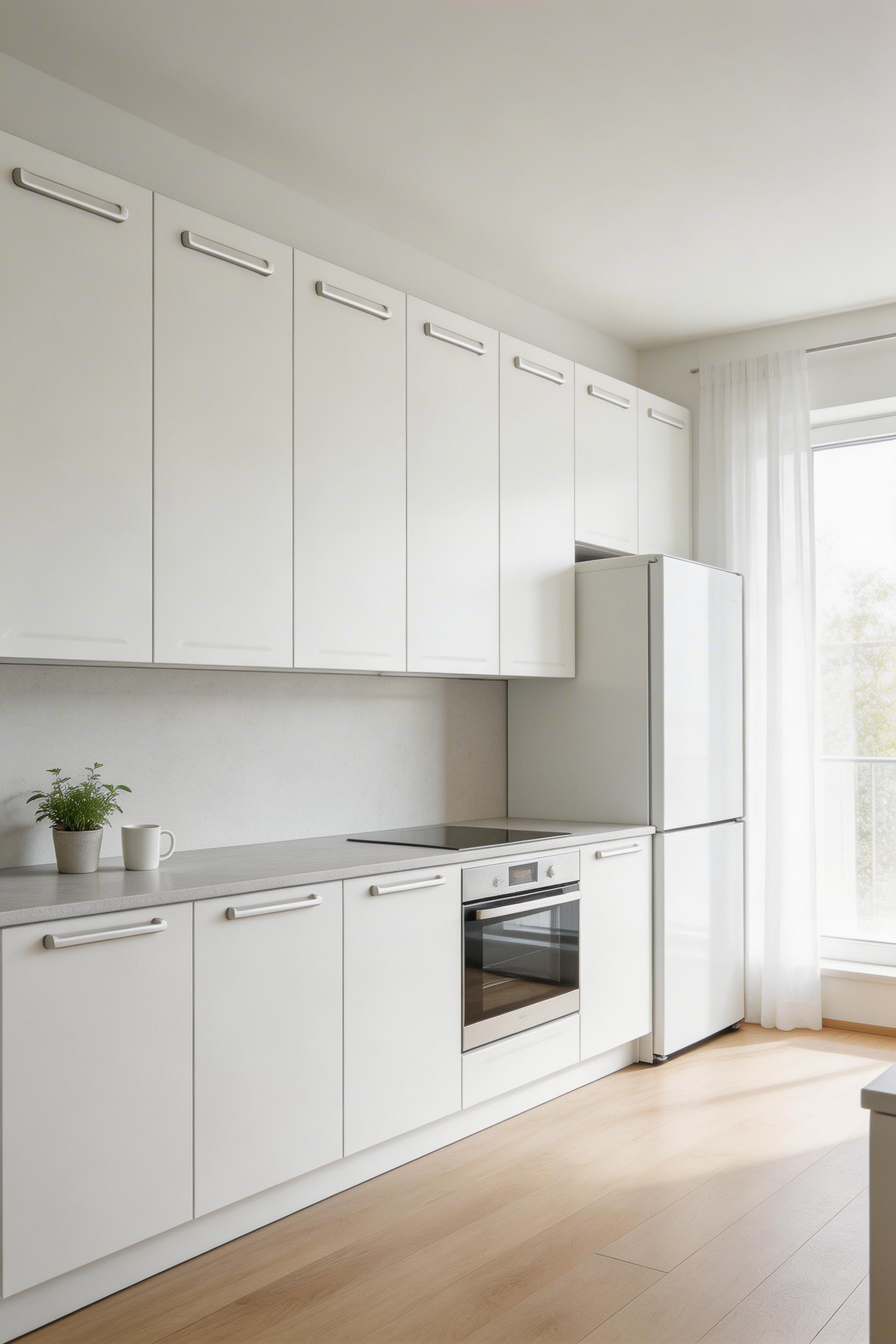
Two systems deliver the handleless effect. J-pull is a routed groove along the top or side of the door that your fingers hook into — mechanically simple, no moving parts, works reliably every time. The drawback is that the groove collects grease in a busy kitchen and can be irritating to clean. Push-to-open uses a spring mechanism — Blum’s TIP-ON system is the most common. It pops the door open with a press for a genuinely seamless look. However, it requires precise alignment and the latch can wear out over years of use.
Where Handleless Works (and Where It Doesn’t)
Handleless doors suit contemporary, Scandinavian, and minimalist kitchens. They look awkward paired with traditional or farmhouse designs — a handleless shaker door is something of a contradiction in terms. The good news is that considering kitchen cabinet hardware for more traditional or transitional kitchens opens up a much wider world of choices, from cup pulls to knurled brass knobs.
If you’re going handleless in a family kitchen, test the push-to-open mechanism in realistic conditions: saucepans in both hands, slightly greasy fingers, a toddler attempting to help. Some systems require a precise push point. It’s much harder to locate in practice than in a showroom. Blum’s TIP-ON adapters (£8-£15 per door) add push-to-open to existing Blum hinges without replacing carcasses. That’s a useful mid-renovation option.
9. Statement Island Cabinets in a Contrasting Finish
If the perimeter kitchen cabinets are the workhorses, the island cabinet is the one that can do something more interesting. Treating the island as a separate furniture piece is one of the kitchen cabinets ideas that interior designers reach for most reliably. Different colour, different material, different leg style — it reliably works. Neptune found 68% of their customers who chose a contrasting island colour said it was their most pleasing post-installation decision.
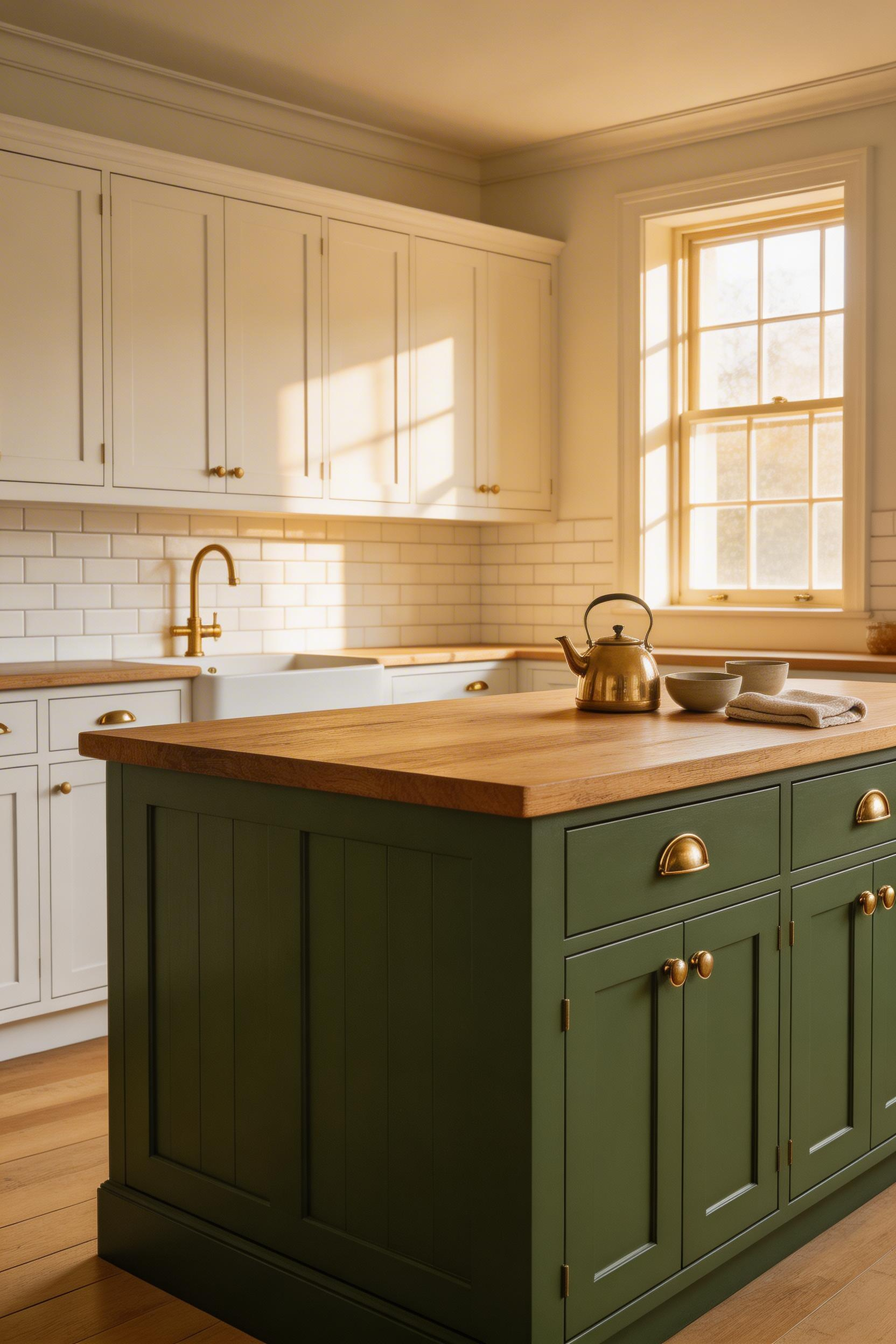
Common combinations that work: white perimeter cabinets with a navy or forest green island; painted perimeter cabinets with a natural oak or walnut island; grey perimeter with a brass-handled cream island. The island finish needs to contrast, not compete. Pick a tone from the same family, or use a deliberate warm/cool contrast.
The Furniture Look with a Practical Budget
The leg detail is the most effective single move to make an island read as furniture rather than a built-in. Even four turned wooden legs on a standard IKEA SEKTION island changes the entire character of the room. The gap between the cabinet base and the floor is what the eye uses to categorise something as furniture rather than fitted cabinetry. Superfront makes leg kits that fit directly onto IKEA carcasses, turning a standard £150 IKEA base into something that looks considerably more considered.
At the premium end, Plain English bespoke islands start from around £8,000 and are genuinely furniture in every sense — real wood legs, painted in any colour, with proportions that make standard built-in kitchens look quite flat in comparison. Neptune’s Suffolk island (from £4,500) sits in the mid-market. But the IKEA-with-aftermarket-fronts approach can produce a convincing result for £500-£2,000 for the island base — a very different proposition from the £30,000+ bespoke route. The minimum clearance around a kitchen island is 900mm on each side. Below that, the kitchen becomes genuinely difficult to use.
10. Fluted and Reeded Cabinet Fronts for Texture Without Pattern
Fluted cabinet fronts arrived in kitchens from the bathroom. They’ve moved firmly into kitchen design over 2023-2025. The driver is a wider appetite for tactile surfaces after nearly a decade of flat slab doors. Google Trends data shows ‘fluted kitchen cabinets’ searches increased 340% between 2021 and 2024 in the UK and US combined. That’s not a blip.
Fluting and reeding are technically distinct: reeding is convex ridges, fluting is concave grooves. In kitchen design, however, the terms are used interchangeably. Standard flute pitch is 25-30mm between groove centres with a groove depth of 3-5mm. Shallow fluting reads as elegant; deep fluting starts to look overdone.
Using Fluting as an Accent
The most effective application is one run of fluted fronts, not the whole kitchen. A fluted island base cabinet or a single tall larder in a fluted finish adds texture without overwhelming the room. Used on all cabinets, the groove pattern becomes oppressive — and cleaning it in a busy kitchen is a genuine irritation.
Plykea makes fluted birch ply fronts for IKEA SEKTION carcasses (£120-£200 per door), which are popular for island panels. Superfront’s fluted oak veneer fronts (£150-£280 per door) work well in natural-material kitchens where the organic quality of real wood matters. If you want fluting in a specific paint colour, Naked Doors’ primer-ready MDF fluted fronts (£45-£85 per door) are the UK-made budget option. One caveat: fluted fronts photograph beautifully, which is partly why they’ve proliferated on social media. In person, in a busy kitchen, they need a simpler context — plain worktop, no busy backsplash — to read as considered rather than fussy.
11. Under-Cabinet Lighting as a Practical and Aesthetic Upgrade
LED under-cabinet lighting was ranked the top kitchen upgrade for perceived value in the 2024 Houzz Home Study. Fifty-four percent of respondents cited it. That’s a striking number for something that typically costs less than £200 to install. The reason it scores so highly is that it solves a real problem while also looking very good.
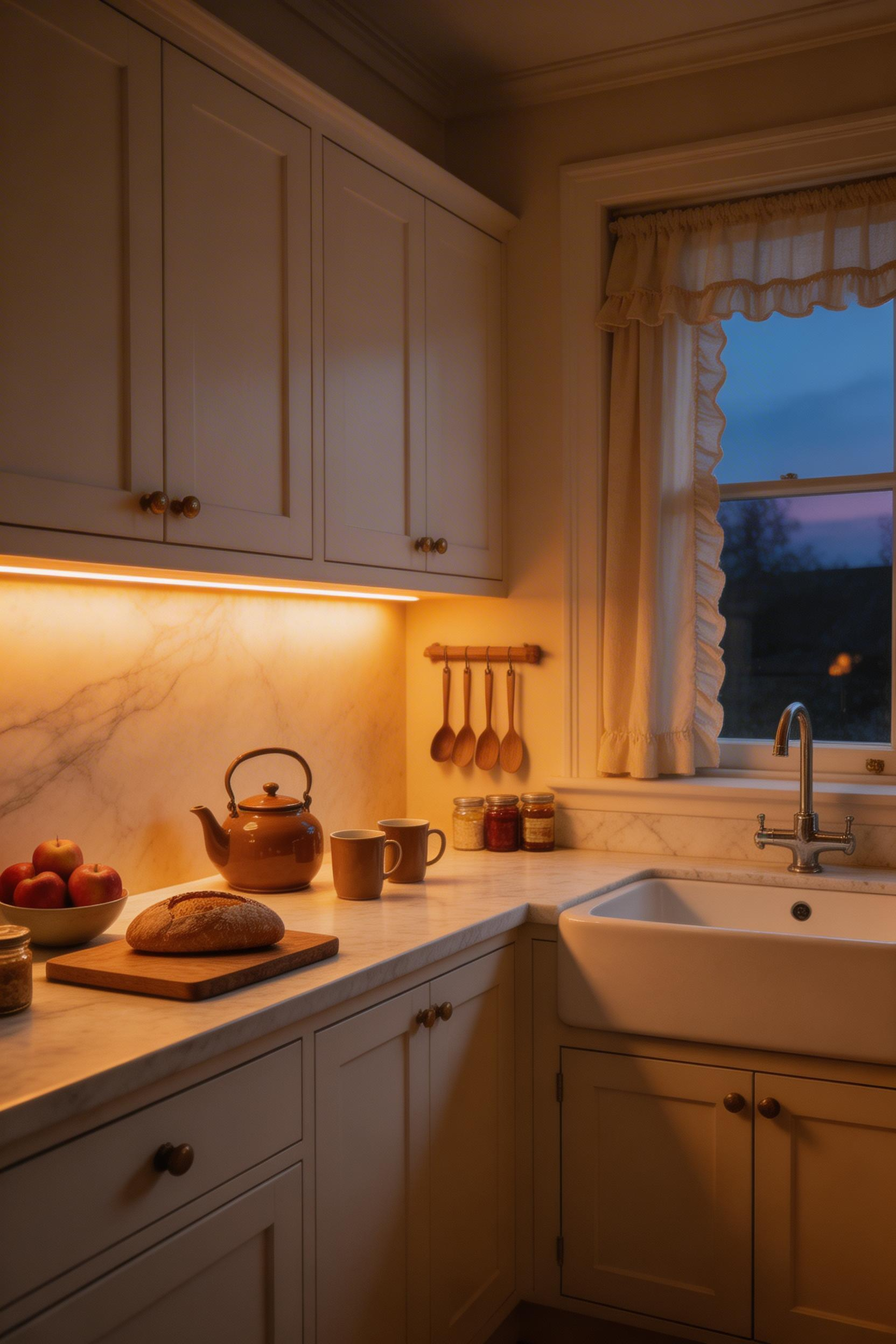
Standard ceiling lights and pendant lights both create shadow on the worktop directly below wall cabinets. Under-cabinet LEDs eliminate this shadow and illuminate exactly where food preparation happens. Colour temperature matters. 2700K (warm white) creates a warm, restaurant kitchen glow. 4000K (cool white) is clinical and makes a kitchen feel like an operating theatre. Stay between 2700K and 3000K.
Strip Lights vs. Puck Lights
LED strip lights give even illumination along the full worktop length — better for food preparation. LED puck lights give pools of light — better for display shelves. For kitchen use, strips are almost always the right choice. Install in an aluminium diffuser channel with a frosted cover to prevent visible LED dots and hot spots, and position the strip at the rear of the cabinet underside rather than the front to avoid glare.
Philips Hue Lightstrip Plus (£80-£120 for 2m) is the app-controlled, dimmable version. It connects to Alexa and Google and doubles as mood lighting. Integral LED warm white strips (£15-£30 for a 5m reel) are the reliable budget option. Häfele Loox strips (£35-£70 for 2m with driver) are the trade-quality choice. Kitchen designers specify them widely for their good colour consistency across batches. Run the under-cabinet circuit on a separate switch from your ceiling lights. The ability to have only the under-cabinet lighting on in the evening — kitchen tidied, wine poured — is one of the best quiet improvements a kitchen renovation can make.
12. Inset Cabinet Doors for a Furniture-Quality Finish
Of all the kitchen cabinets ideas that signal quality to someone who knows what they’re looking at, inset doors are the most reliable indicator. Inset doors sit flush within the cabinet frame rather than overlapping it. The result is a look that more closely resembles furniture than a standard fitted kitchen. Search interest for ‘inset kitchen cabinets’ grew 180% in the UK between 2020 and 2024. The continued influence of unfitted kitchen aesthetics drove that growth.
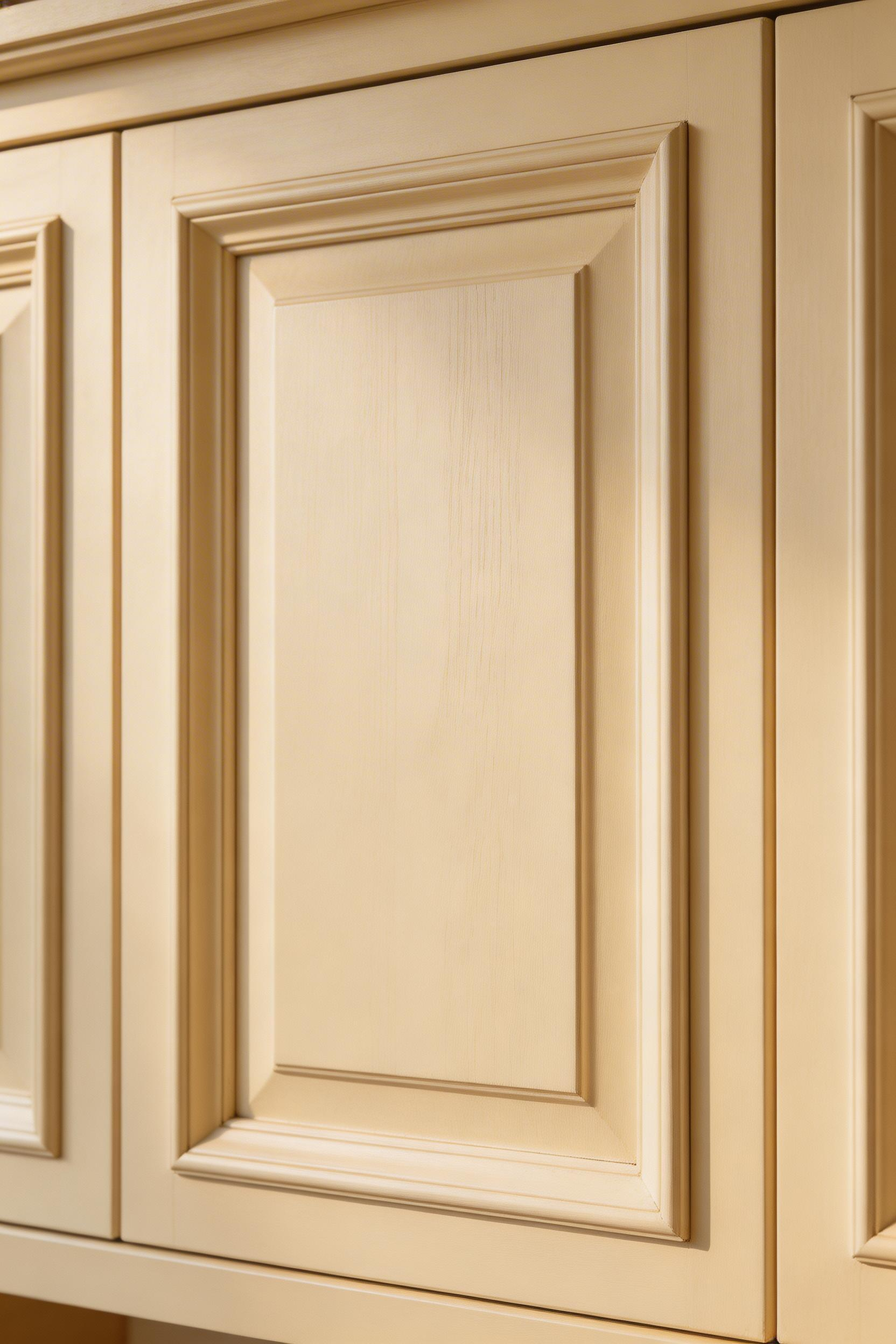
Standard overlay doors (the market norm) overlap the carcass by 18mm or more. They’re faster to fit, more tolerant of alignment issues, and easier to make. Inset doors require precise carcass construction with face frames — an additional framing rail across the front of the carcass, typically 40-50mm wide. The door-to-frame gap needs to be 1.5-3mm per side. Anything larger looks sloppy; anything smaller means doors swell shut in summer humidity.
Where to Use Inset for Maximum Effect
You don’t need to inset the whole kitchen to get the effect. For small kitchen ideas where budget is tight, inset on just the island base cabinet or the tall larder — the most visible locations — delivers the furniture-quality signal in the spots where it’s most noticed. The rest of the kitchen can be standard overlay without most people noticing the difference.
DeVOL kitchens in Leicestershire are the UK’s best-known exponent of inset construction, with kitchens starting from £30,000. Plain English, from £40,000, is the other benchmark. Both are handmade and have long lead times. For those working to a different budget, Blum does produce an inset-specific version of their CLIP top hinge (£6-£10 per hinge), available through Häfele and specialist joinery suppliers — which makes a bespoke carpenter build to inset specification a viable option if the cabinetmaker is skilled.
13. Mixing Cabinet Materials: Wood, Painted, and Metal in One Kitchen
The most sophisticated kitchen cabinets ideas tend to involve more than one material. Mixing wood-fronted cabinets with painted units and metal-accented pieces looks effortless when well-resolved. When it isn’t, it looks chaotic. The governing principle is the same one that applies to mixing materials in clothing: dominant (60%), secondary (30%), accent (10%).
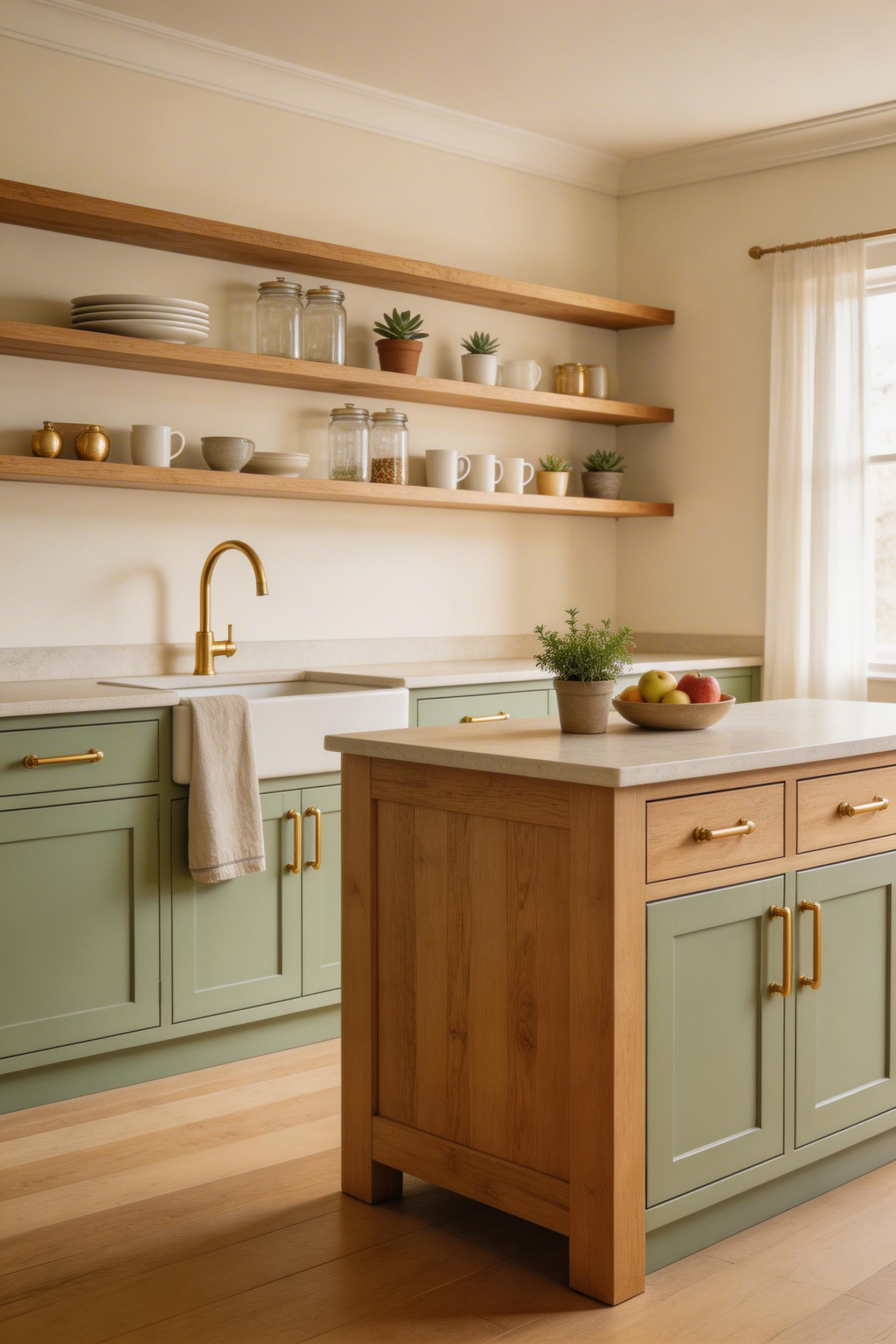
Houzz reported kitchens mixing two or more cabinet materials received 45% more saves than single-material photos in 2024. The most successful combination in contemporary kitchens is painted lowers (dominant) paired with a natural wood island or open shelving run (secondary), with metal detail introduced through hardware (accent). Oak works with warm greys, navy, cream, and sage. Walnut suits darker painted cabinets better. Birch ply is warmer and less formal than oak — a useful material when painted cabinets are already quite cool-toned.
Maintenance for Wood Cabinet Fronts
Wood fronts in a kitchen need annual maintenance. A coat of hardwax oil — Osmo Polyx or Rubio Monocoat — applied once a year protects the surface from steam, cooking oil, and moisture. Unfinished or poorly finished wood fronts will stain and warp within 18 months in a working kitchen — it’s not a question of if, but when.
Superfront’s natural oak fronts for IKEA run £90-£180 per door. Reform Kit oak doors (a Danish brand, £180-£250 per door) are slightly more architectural in quality. Plykea’s birch ply fronts (£80-£160 per door) are the warmer, more relaxed option. The mixing rule that matters most: run a thin strip of the same wood as a shelf or worktop somewhere else in the room. It creates a visual throughline that makes the material mixing look resolved rather than undecided. Also, consider modern kitchen design principles if you’re working toward a contemporary mixed-material look — the combination of materials needs a coherent underlying style to hold together.
14. Corner Cabinet Solutions That Actually Get Used
Corner cabinets are the most wasted storage in most kitchens. They’re also the most complained about. A YouGov survey found that 41% of homeowners named their corner cabinets as the most frustrating kitchen storage element, ahead of inadequate drawer depth (29%) and insufficient pantry space (22%). The standard L-shaped internal shelf is largely inaccessible. Items pushed to the back are genuinely lost for months.
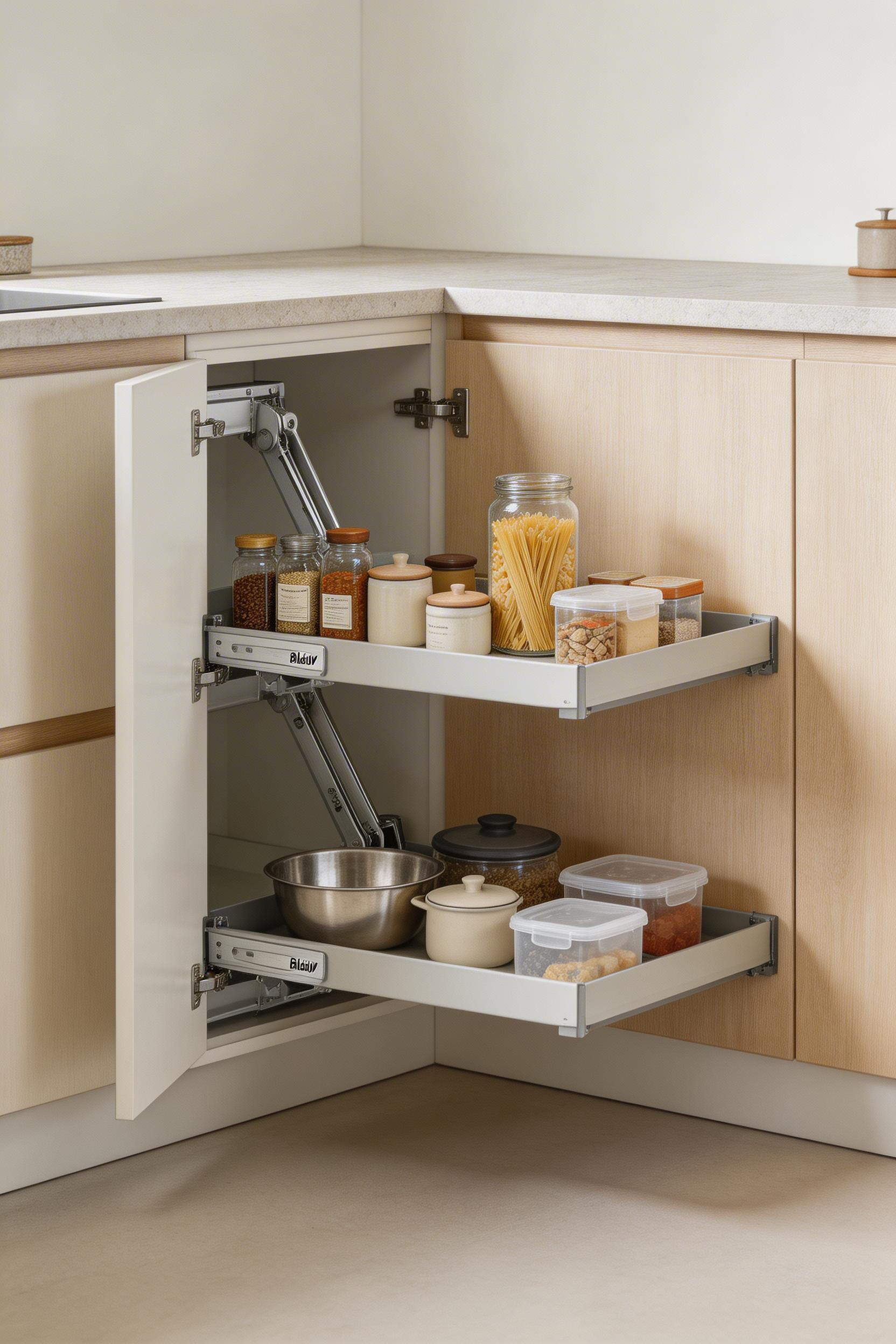
Each option has honest trade-offs. Lazy susans are the cheapest fix at £80-£200 fitted. They’re mechanically reliable and rotate to bring items forward. The limitation is that round shelves in a square cabinet always waste corner space — you’re recovering perhaps 50% of the volume. Magic corners — Blum SPACE CORNER, £200-£350 for the hardware kit — use a hinged pull-out frame that retrieves nearly the full corner depth. They’re genuinely excellent when correctly installed. Le Mans pull-outs use crescent-shaped shelves that swing out when the door opens — they work well but require specific carcass dimensions.
The Honest Assessment
Before specifying any corner solution, ask yourself honestly: how often will you actually access that corner? If the answer is infrequently, the simplest approach is sometimes a deep shelf for bulky items — large pots, infrequently-used appliances — with a clear front so you can see what’s there. The most expensive corner mechanism isn’t necessarily the most useful one.
Hettich’s InnoTech Atira corner pull-out (£180-£280) is a solid alternative to the Blum SPACE CORNER in some carcass configurations. IKEA’s UTRUSTA rotating shelf (£40-£70) is the honest budget option — basic but reliable. Check carcass dimensions carefully: magic corner door width minimum is 450mm; Le Mans hinge-side clearance requires at least 400mm. The corner cabinet solution that gets used is always better than the one that’s impressive in specification but awkward in daily life. For a broader view of how farmhouse kitchen cabinets handle storage in traditional layouts, that’s worth reading if you’re working in a farmhouse style where corner solutions often need a less industrial aesthetic.
15. Colour Drenching: Matching Cabinet Paint to Walls and Ceiling
Colour drenching is the kitchen cabinets idea that fully commits. Applying the same colour to cabinets, all four walls, and the ceiling creates an immersive effect that smaller, more cautious paint choices simply cannot. Farrow & Ball saw a 52% increase in sales of their colour drenching sample kits in 2023. Several leading interior publications had featured the technique that year.
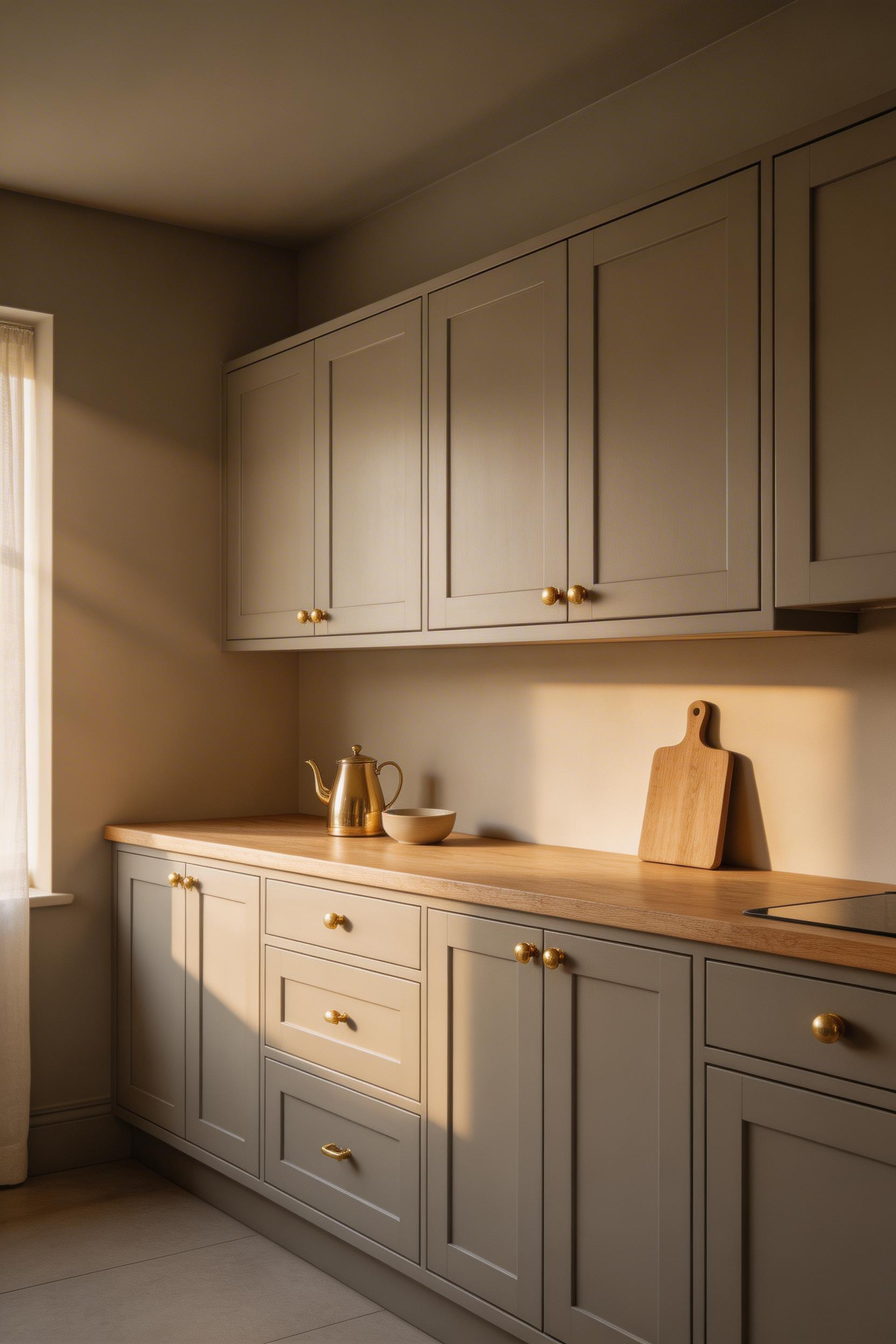
In a kitchen, the drench means cabinet colour carried to all four walls and the ceiling. The worktop and floor remain in a contrasting material to anchor the space. Farrow & Ball’s Mole’s Breath (a mid grey-brown), Cooking Apple Green, and Stone Blue are among the colours that suit kitchen drenching most naturally. Little Greene’s Normandy — a warm off-white — is a forgiving entry point for those not quite ready to commit to a full-saturation drench.
The Light Requirement
Colour drenching in a kitchen needs natural light. If your kitchen faces north or sits in a basement, test the drench colour at different times of day — over a full week — before committing. What looks warm and enveloping in a south-facing room can feel like a cave in a north-facing one. The finish separation also matters. Use full gloss on cabinets, estate eggshell on walls, dead flat on the ceiling. The contrast in sheen level creates distinction between surfaces even without any colour contrast — without this, the room can feel flat in a less pleasing way than it feels immersive.
Farrow & Ball’s Dead Flat in the matching cabinet colour for walls and ceiling (£45 per 2.5 litre) paired with Estate Full Gloss on the cabinets (£60 per 750ml) gives the full effect. The same pigment batch across both paints ensures the colour reads consistently. That matters more than you’d expect when everything in the room is the same shade. If you’re considering blue kitchen cabinets as your drench colour, Stone Blue and Hague Blue from Farrow & Ball both survive the full drench treatment particularly well.
The Right Kitchen Cabinets Idea for Your Kitchen
Not every kitchen needs every idea on this list. The most useful kitchen cabinets ideas are the ones that solve the specific problem your kitchen actually has.
If the kitchen feels heavy and closed, open shelving on one wall or glass-front doors on two upper cabinets will do more than a full renovation. If storage is the frustration, floor-to-ceiling cabinets and a properly fitted corner solution will recover meaningful space. If the kitchen looks dated but the bones are good, a door-only replacement with fresh hardware is consistently the highest-return intervention relative to cost.
The quality signal that matters most — inset doors, mixed materials, a contrasting island — can be applied to just one section of the kitchen and still change the character of the whole room. You don’t need to do everything at once, and in my experience, the kitchens that age best are the ones that were built with restraint: one or two ideas executed very well, rather than every current trend present simultaneously.
Start with the one change that would most improve how the kitchen works for you, not just how it photographs. A kitchen is used three times a day. Getting the practical decisions right matters more than any colour choice.