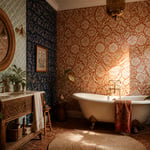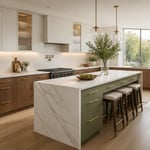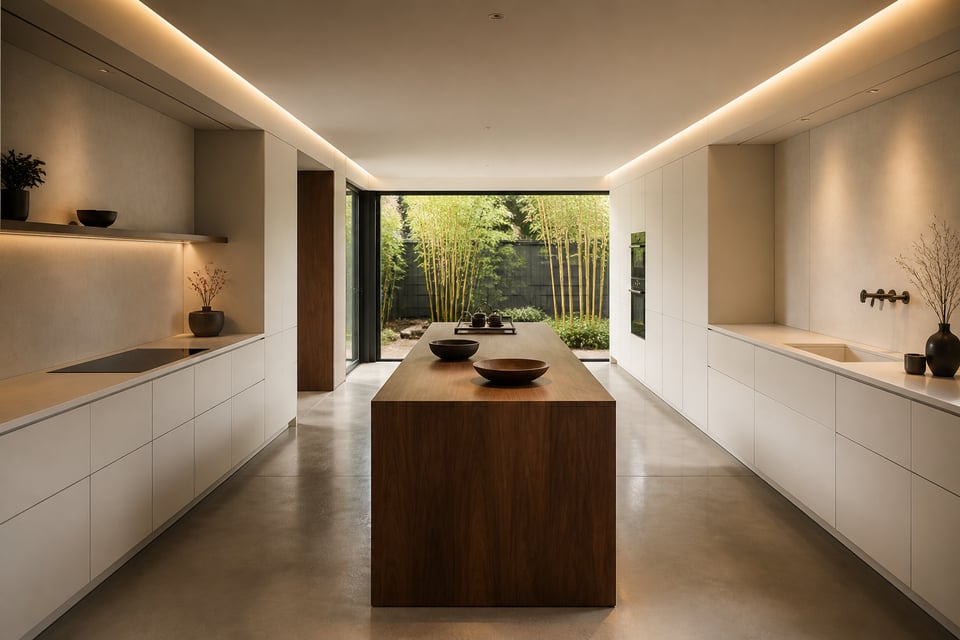
The minimalist kitchen is not about deprivation—it is about intention. When you remove what does not serve, what remains speaks with clarity. In Japanese aesthetics, this principle is called *ma*: the power of empty space. The space between objects becomes as important as the objects themselves. A minimalist kitchen embodies this philosophy, creating not just a functional workspace but a sanctuary for daily life.
This approach draws from Japanese design traditions rooted in Zen Buddhism, where simplicity opens pathways to clarity and peace. A calm kitchen supports a calm mind. Removing visual clutter reduces cognitive load. What you see—and what you deliberately choose not to see—shapes how you move through the space and how you feel within it.
The 17 ideas that follow transform your kitchen through the lens of Japanese minimalism, *wabi-sabi* (finding beauty in imperfection), and *mono no aware* (the gentle sadness in recognizing impermanence). Each idea addresses both form and philosophy, material and spirit. Together, they compose a kitchen that is serene by design, purposeful in every detail. These are not merely aesthetic choices—they are philosophical commitments to how you wish to live and move through your daily rituals.
1. Handle-Free Cabinetry for a Seamless Minimalist Kitchen Look
The absence of hardware is not a limitation—it is a philosophical choice. When you remove handles, you remove visual interruption. What remains is pure surface, and surface becomes canvas.
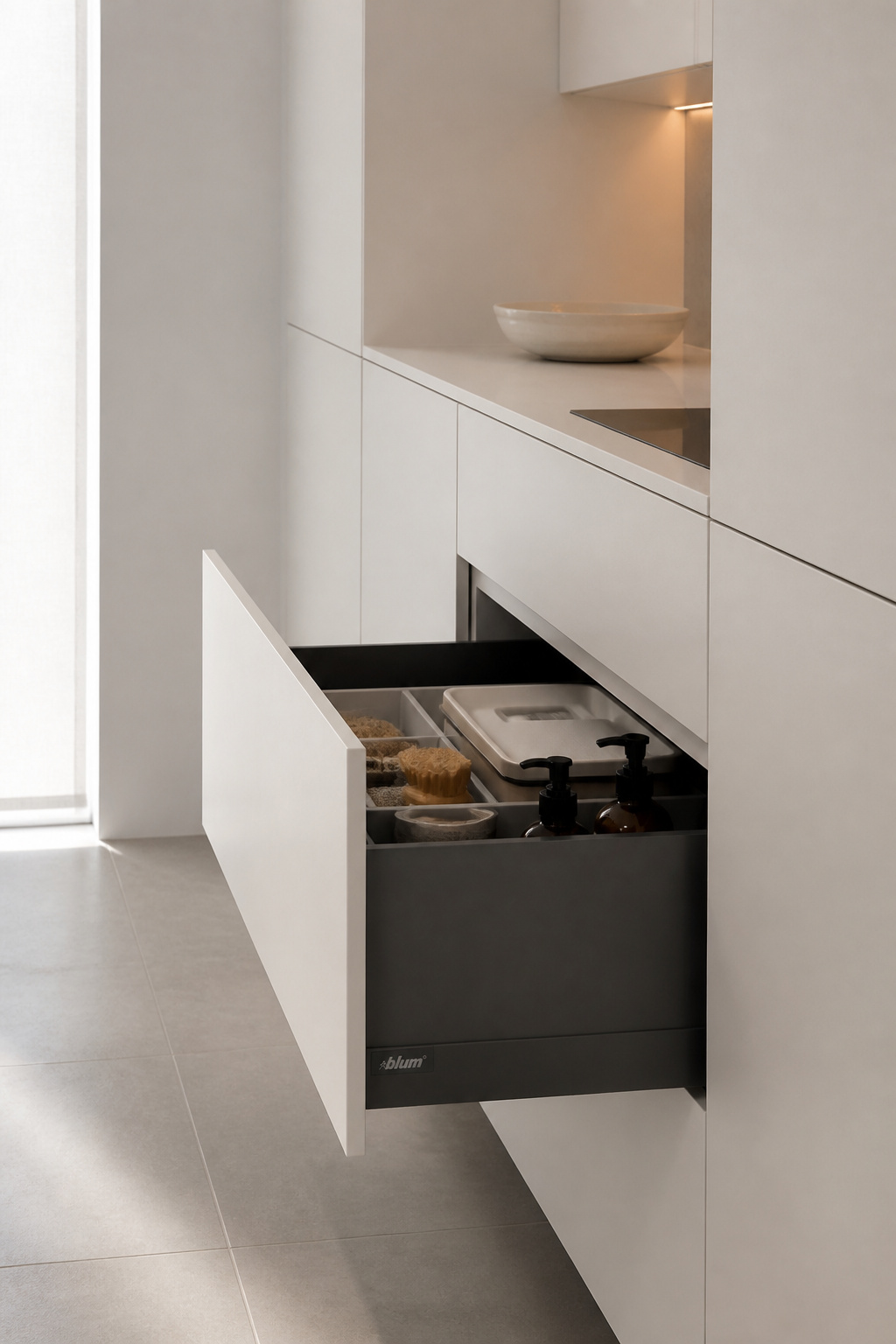
Handle-free cabinets use push-to-open systems, most famously the Blum Legrabox TIP-ON BLUMOTION. A light touch on the cabinet front opens the drawer with soft-close technology. The installation is toolless and elegant: the mechanism installs beneath the drawer box without modifying the front panels. For kitchens seeking electrical sophistication, SERVO-DRIVE systems offer motorized opening—a whisper-quiet gesture that feels almost weightless.
The cost for handle-free systems across a typical kitchen ranges from $2,000 to $6,000 installed. What you gain is visual rest. Every surface feels continuous. Hardware does not interrupt the rhythm of the cabinetry. In Japanese terms, this embodies *ma*—the principle that emptiness creates form, that negative space is as important as the solid. Your eye moves across the kitchen without catching on protrusions, without visual static from handles and knobs.
Installation follows European precision standards. Push-to-open mechanisms work with any cabinet front material: painted wood, natural veneer, lacquered surfaces, even glass. The mechanism sits beneath, completely invisible. Your installer simply needs to understand that European push-open systems follow different fastening conventions than American cabinet hardware—a small detail that prevents confusion during the build.
2. A Single-Material Palette That Anchors the Whole Room
When your countertop, backsplash, and perhaps even your flooring share one material, the kitchen breathes differently. Visual unity creates psychological calm. Your eye does not fragment across surface boundaries; instead, it travels continuously through unified material.
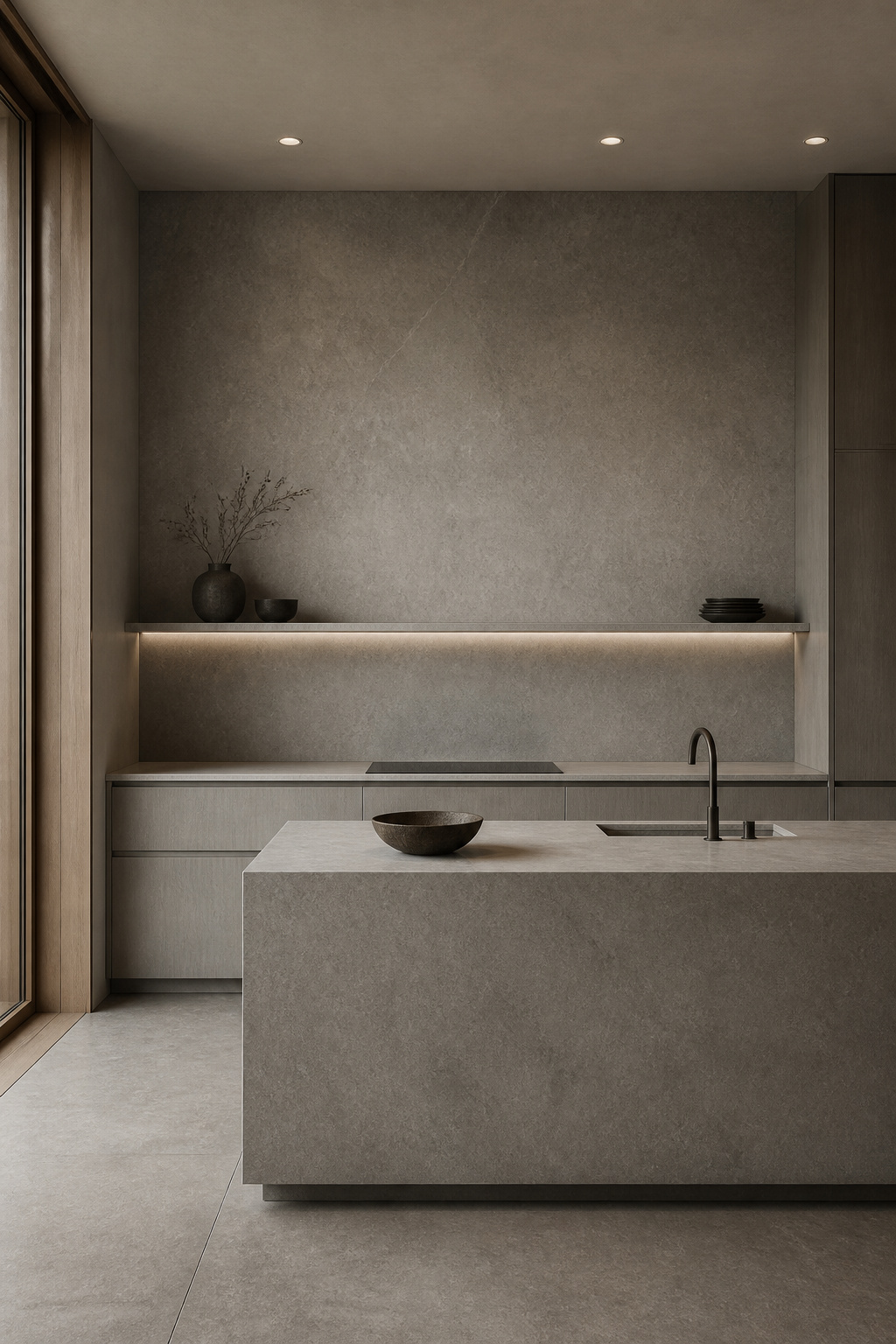
Dekton is a revolutionary ultra-compact surface made from quartz, glass, and porcelain sintered together using exclusive particle technology. It arrives in massive slabs—126 inches by 55 inches—allowing for single-surface installations without seams. The psychological effect is profound: your eye moves across one continuous plane rather than fragmenting across multiple materials and grout lines. Dekton comes in four finishes: matte (natural look), X-Gloss (luminous and reflective), Velvet (velvety tactile touch), and Textured (subtle surface variation suggesting natural stone). A typical kitchen’s Dekton countertop costs $3,000 to $4,000 installed. The material requires no sealing, no risk of etching, and virtually no maintenance—qualities that align beautifully with minimalist philosophy.
Alternatively, polished concrete, raw stone, or high-quality engineered quartz can serve as your single material anchor. The key principle: *one material, unified presence*. When counters, walls, and floor speak the same material language, the kitchen becomes a unified composition.
3. Integrated Appliances Hidden Behind Flush Cabinetry Panels
In a minimalist kitchen, appliances should disappear. Panel-ready refrigerators, dishwashers, and microwave drawers integrate flush behind cabinet doors, maintaining the kitchen’s visual continuity. Instead of chrome and stainless interrupting your design, you see only cabinetry.
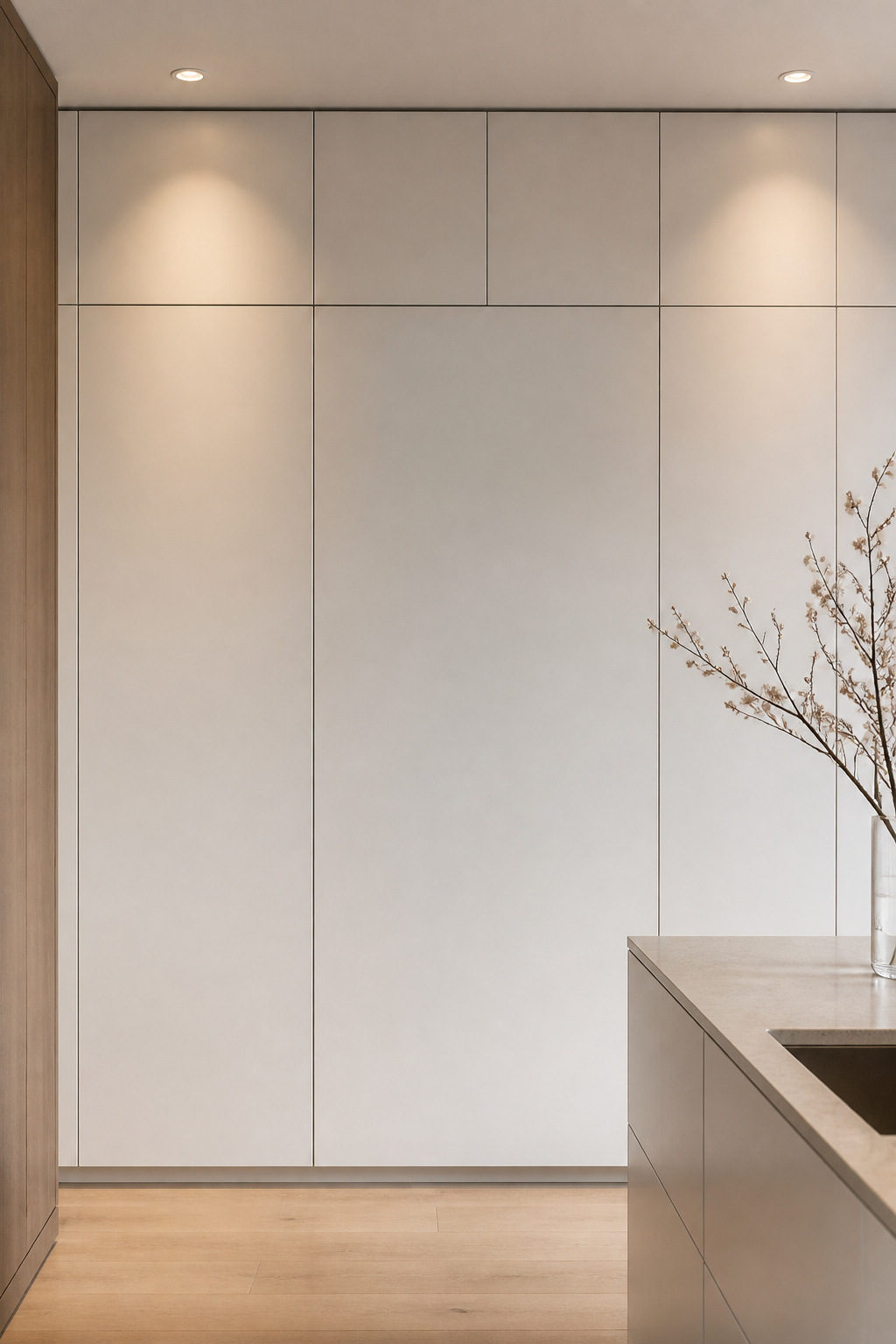
Miele represents the pinnacle of this approach, with heritage in German engineering dating to the 1920s. Their MasterCool refrigeration line features Push2Open technology—no handles, no visual apparatus. Press the front panel gently and the door releases. The refrigerator itself vanishes behind cabinetry that matches your surrounding cabinets perfectly. The visual result is remarkable: instead of a white box interrupting your kitchen’s design, you see only architecture. The kitchen feels like a unified design statement rather than an appliance collection attempting to function together.
Gaggenau, a German manufacturer established in 1683 in the Black Forest region, exemplifies Bauhaus-influenced design philosophy: form and function unified, artistic design combined with engineering precision. Their built-in appliances carry a 20-30% cost premium over standard models, but the invisibility they achieve justifies the investment. A panel-ready refrigerator from these premium brands costs $5,000 to $8,000 for the appliance and integration work.
4. Open Shelving With Deliberate Negative Space
Open shelving in a minimalist kitchen follows strict discipline. The principle is *ma*: the Japanese concept of intentional emptiness creating rhythm and lightness. Without this restraint, open shelving becomes visual clutter—a museum of dishware. With discipline, it becomes serene art.
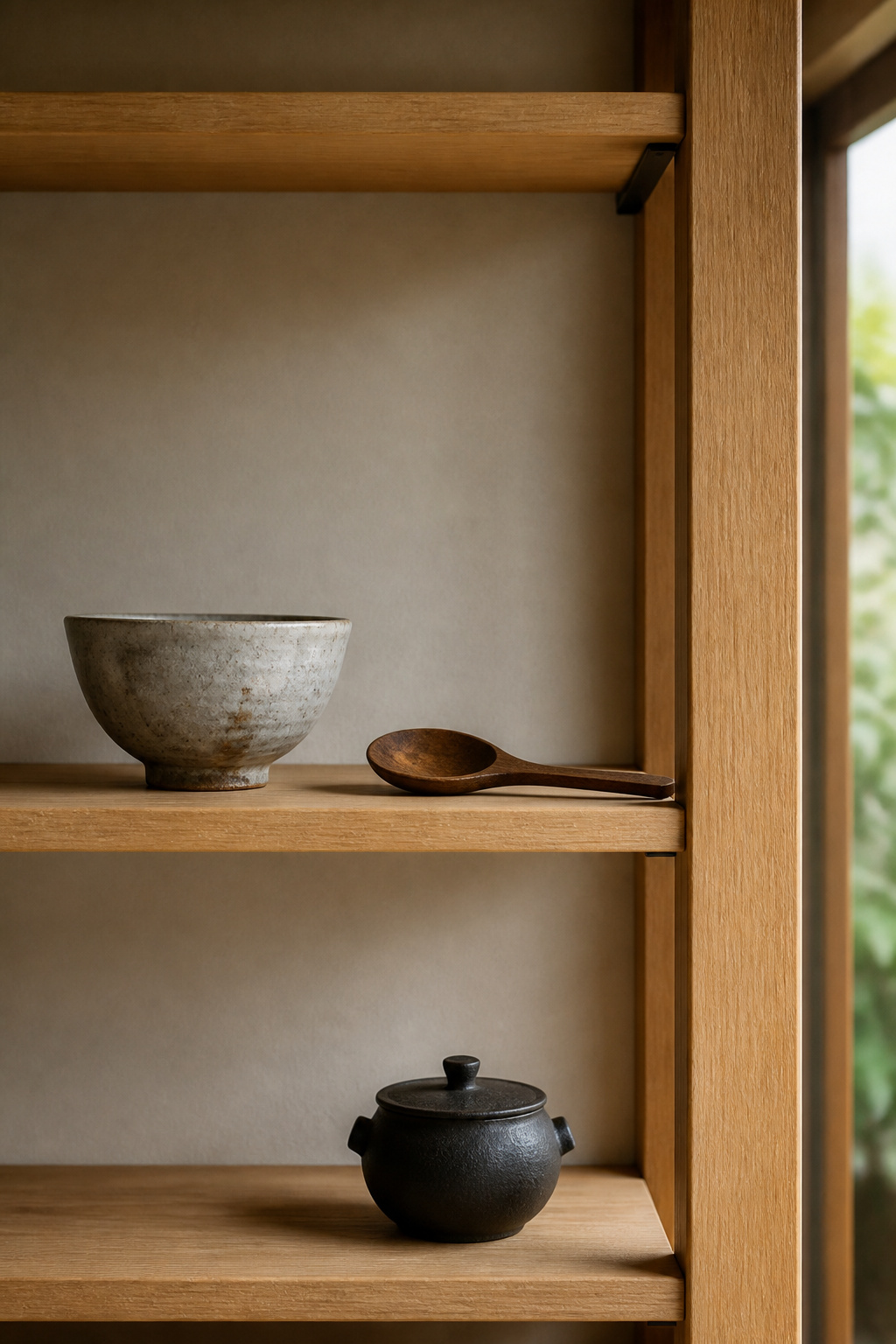
When you use open shelves, treat them like a *tokonoma*—the Japanese alcove in a tea house where a single scroll or flower arrangement is displayed in contemplative isolation. Few items. Generous gaps. Aim for 60-70% empty shelf space. This ratio feels counterintuitive to Western eyes accustomed to shelf maximization, but the result is profound: the shelf feels breathing rather than crowded. Your kitchen feels larger and more serene. The empty space becomes as important as the objects displayed within it.
Display only what you use daily or what embodies *wabi-sabi* beauty: a handmade ceramic bowl with uneven glaze, a single wooden spoon showing grain and age, a cast-iron pot weathered by use. Each visible object should earn its place through function or contemplative beauty. This practice develops your curatorial eye—you learn to see what truly deserves visibility.
5. Minimalist Kitchen Ideas Using Raw Concrete Surfaces
Concrete carries *wabi-sabi* in its essence. The hairline cracks, the subtle discoloration, the way light plays across its surface—these are not flaws. They are the material’s character, the visible record of time and craftsmanship. Concrete, properly treated, becomes a philosophical material: it demonstrates that imperfection can be beautiful.
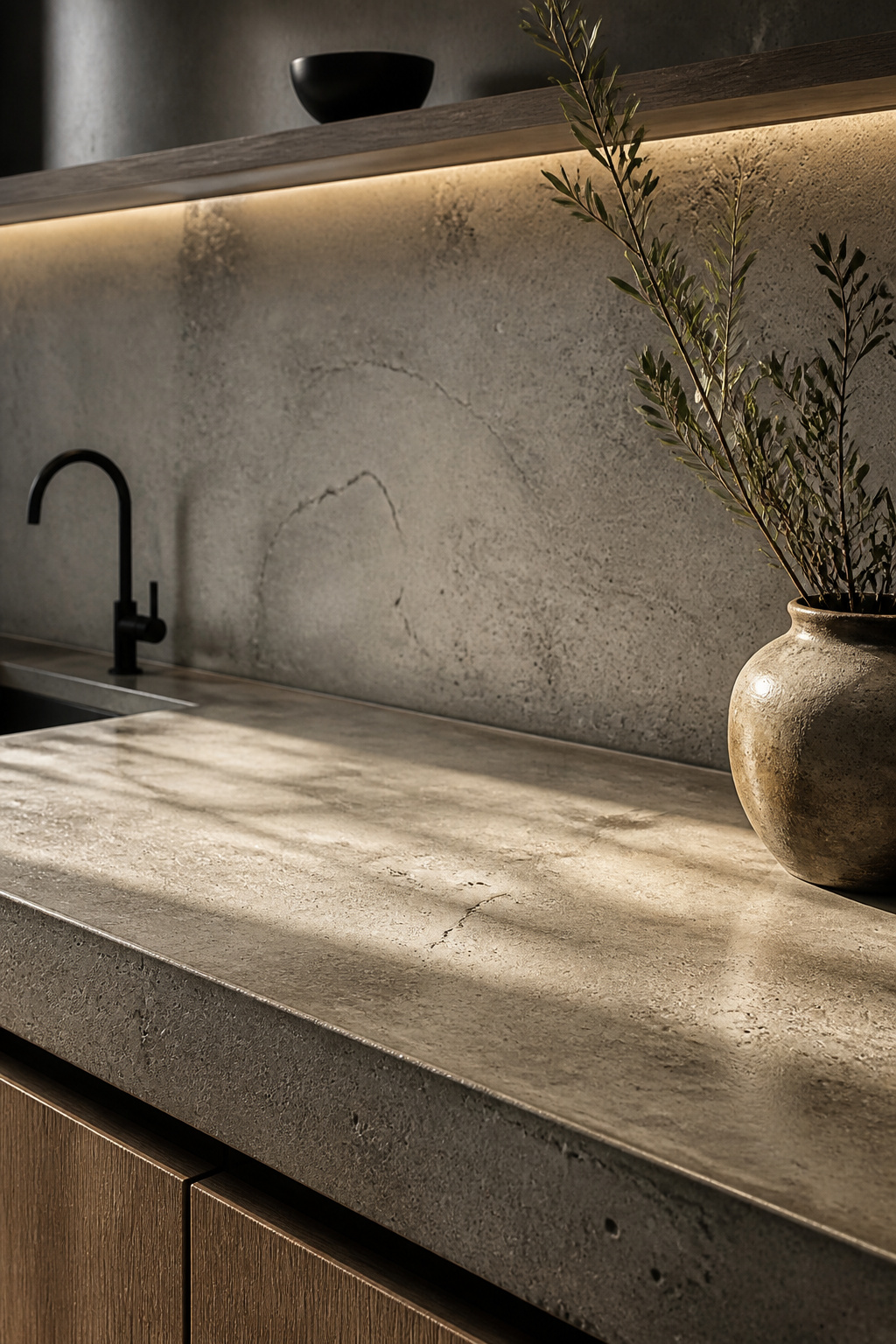
Polished concrete countertops cost $100 to $150 per square foot installed, with labor representing the majority of that cost. A full kitchen typically runs $8,000 to $12,000. The material requires annual sealing to preserve appearance and protect against stains, but this maintenance becomes part of the *wabi-sabi* philosophy: caring for imperfect materials as they age and deepen with use. You are not fighting against concrete’s nature; you are honoring its evolution.
Each concrete countertop develops its own personality. Water marks accumulate in the grain. Subtle color variations emerge from the mineral composition and curing process. Natural striations tell stories of the pour and setting. Artisanal providers like Cheng Concrete specialize in this aesthetic, understanding concrete not as utilitarian material but as design surface with philosophical depth.
6. A Deep Single-Basin Sink as the Kitchen’s One Focal Point
In a minimalist kitchen, the sink becomes the one functional sculpture. A single deep basin (24-30 inches deep) replaces the standard divided double sink. This single aperture becomes your visual anchor—the one element that demands attention not through ornamentation but through proportional presence.
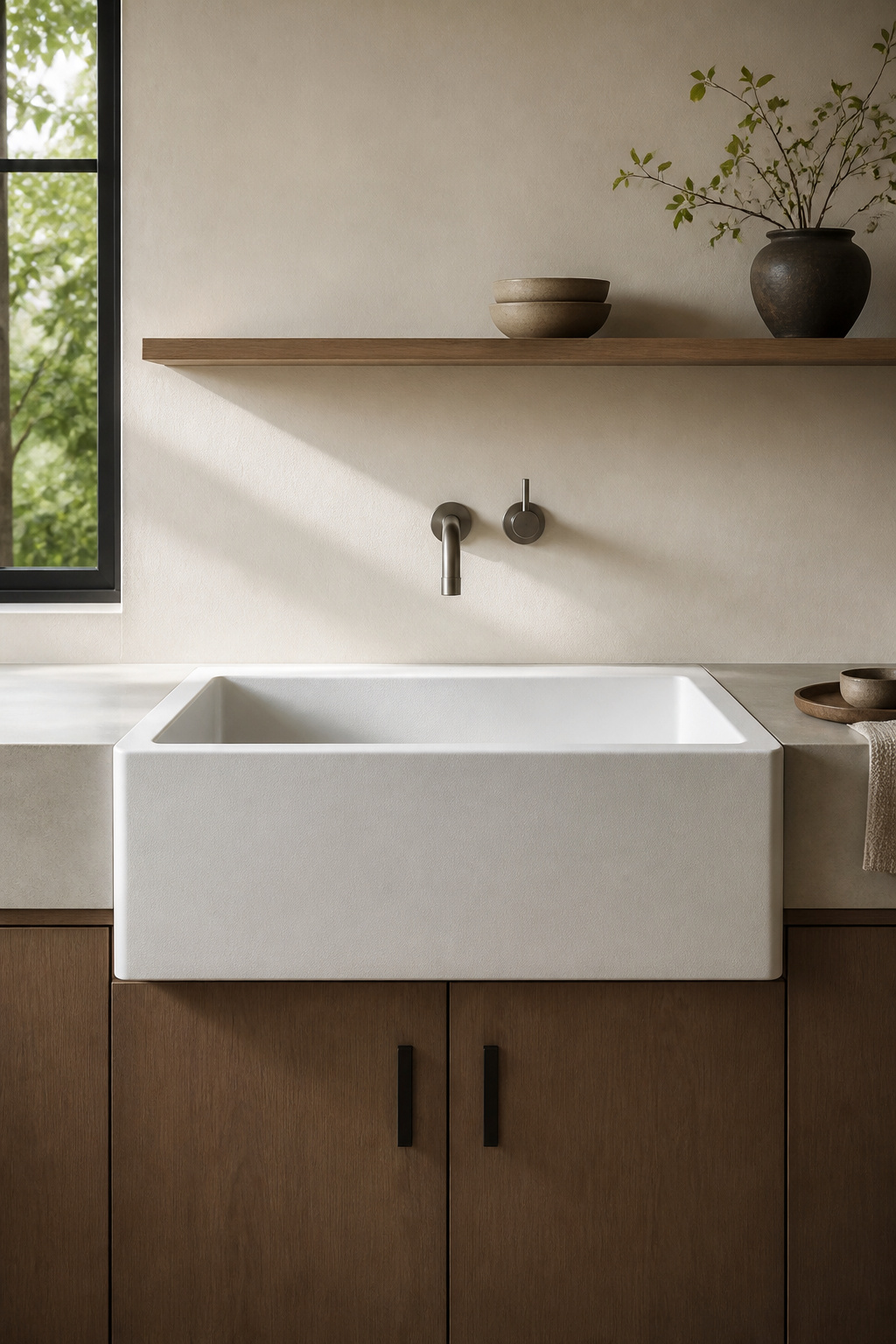
Shaws fireclay sinks in their Shaker line exemplify minimalist sink design: rectangular form, squared-off edges, clean lines. Available in 30-inch, 33-inch, and 36-inch widths, these undermount or apron-front configurations eliminate visual bulk. The depth allows you to handle larger cookware without awkward angling. A Shaws fireclay sink costs $1,500 to $2,000 installed. The material itself is durable and develops patina—another *wabi-sabi* element.
The deep single basin invites contemplation. Handwashing becomes a moment of presence rather than rushed function. The sink itself becomes a design element rather than an appliance. When you stand at your sink, you are not distracted by a divided basin or stainless steel details. You are present with water, with the simple act of cleaning, with the moment.
7. Understated Ceiling Lighting That Disappears Into the Surface
Lighting in a minimalist kitchen serves function while remaining visually invisible. Recessed linear systems distribute light across the ceiling without visible fixtures. The light itself becomes the design element, not the mechanical apparatus producing it.
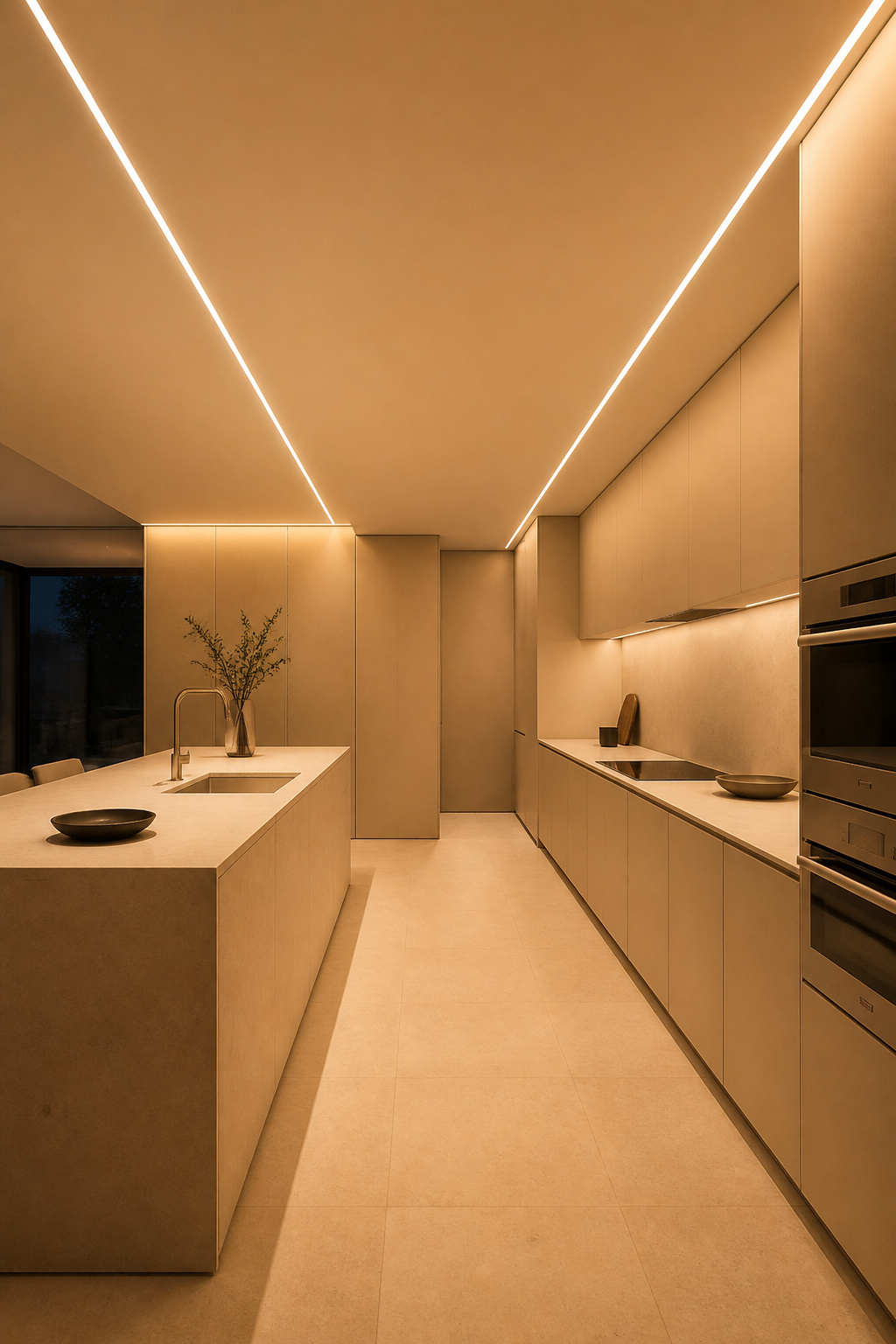
OKT Lighting’s Slim Series offers ultra-slim profiles in widths from 4 inches to 8 feet, with selectable color temperatures: 3000K (warm white), 3500K (neutral), and 4000K (cool white). For minimalist kitchens, 3000K provides ambient warmth without yellowing the space. Cooper Lighting’s CL Recessed Slot Linear Series and Nook Lights offer similar sophistication. These systems feature durable aluminum frames and acrylic diffusers combining style and function.
A quality integrated lighting system for your entire kitchen costs $3,000 to $5,000. Installation creates continuous runs of light across the ceiling, with flanged and flangeless trim options. The result: illumination without visible light source. The ceiling feels unified rather than punctuated by downlights. Proper positioning ensures no shadows on your work surface while keeping all hardware invisible from normal standing position.
8. The Discipline of Limiting Your Kitchen to Two Tones
Most minimalist kitchens use exactly two colors. White cabinetry with natural walnut. Black lower cabinets with white uppers. Gray cabinetry with warm oak accents. This restraint feels revolutionary in an age of color maximization and design maximalism.
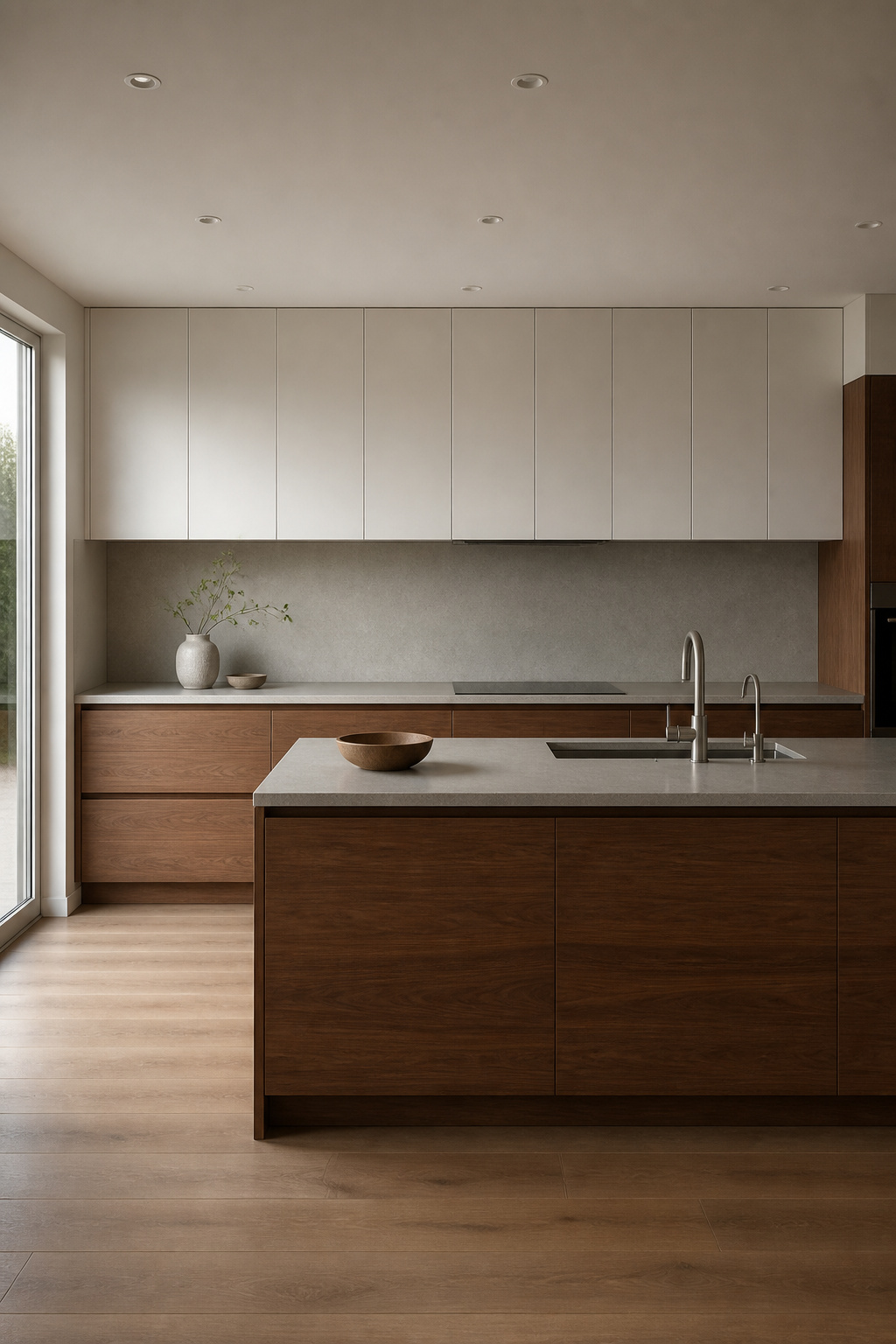
Two-tone discipline prevents color fatigue. Your eye rests on the interplay between your two chosen colors rather than navigating multiple hues. The psychological effect is calm. The design effect is focus: color contrast creates focal points without multiplication of visual elements. You are not competing with yourself for visual attention.
Classic combinations endure because they work: white + natural wood (walnut, white oak, cherry) creates warmth within minimalism. Black + white creates graphic drama with serene restraint. Gray + warm wood bridges cool and warm, contemporary and traditional. Consider matte finishes over glossy to avoid visual glare and maintain contemplative mood.
9. Clean Kitchen Ideas: Drawer Inserts That Eliminate Counter Clutter
A cluttered counter is a cluttered mind. The solution is not to see your kitchen gadgets at all. They belong in hidden drawers beneath integrated inserts, organized by function but out of sight. This is the minimalist solution to the reality of kitchen function: embrace the tools, but hide the clutter.
Blum Legrabox drawers ($150-400 per drawer installed) feature push-to-open fronts that align with your handle-free cabinetry system. Hettich’s InnoTech and AvanTech systems offer modular organization: the OrgaTray 630 steel dividers accommodate cutlery, gadgets, and tools; OrgaTray 270 wooden inserts add warmth; railing systems secure bottles and plates during drawer opening. Customize each drawer to your specific items, your specific rhythms, your specific kitchen life.
The typical kitchen contains 24-40 items requiring daily organization: gadgets, appliances, linens, tools. When all these disappear into drawers, your counter becomes empty. Research from the National Kitchen & Bath Association shows that efficient organization reduces meal prep time by 30%, but the deeper benefit is psychological: an empty counter creates mental clarity and visual serenity.
10. A Poured Resin Floor That Removes Visual Interruption
A seamless floor eliminates visual breaks that fragment your kitchen’s sense of unity. Epoxy or polyurethane resin creates completely continuous surfaces without seams, joints, or grout lines. The floor becomes plane rather than patchwork.
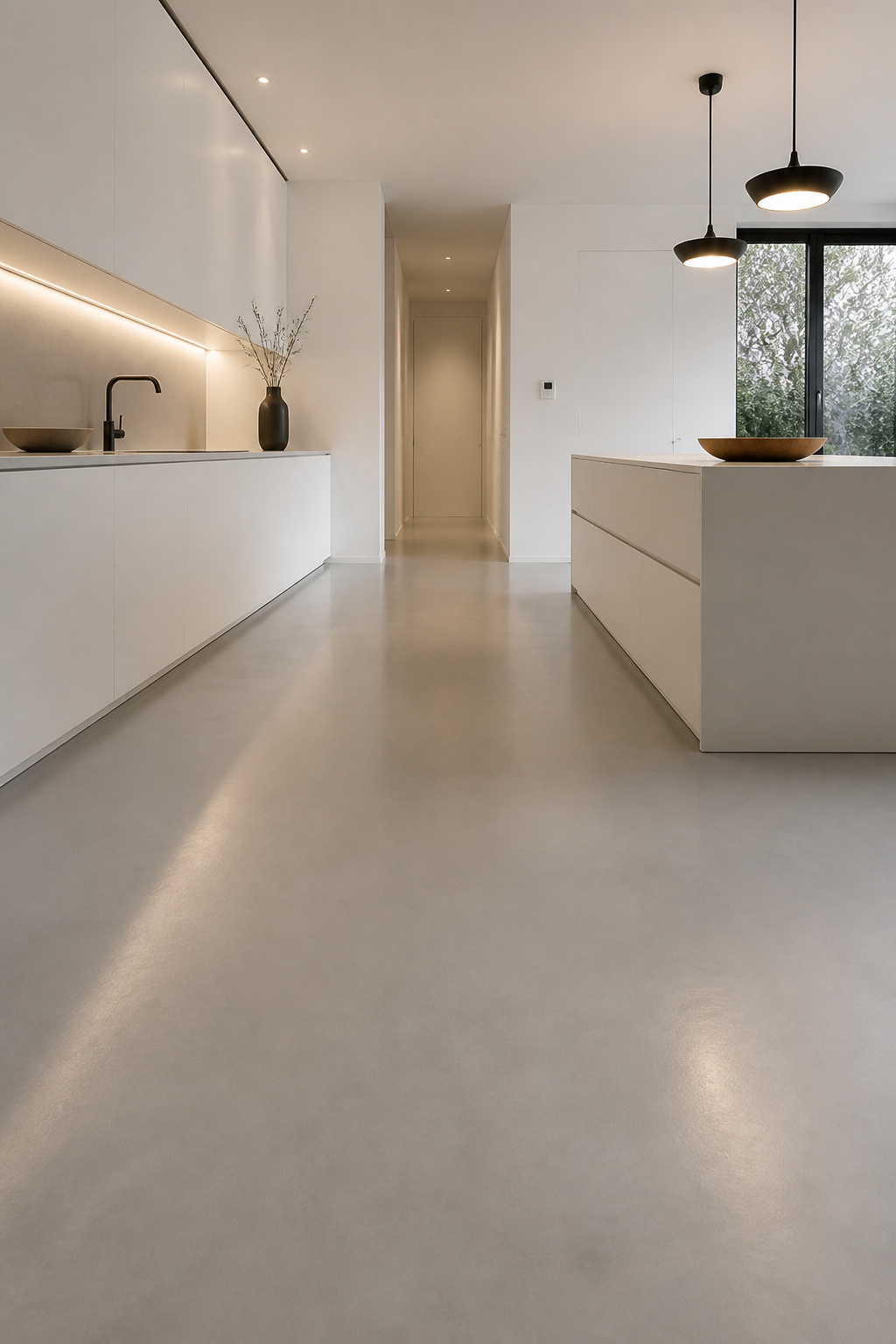
Installation costs range from $4 to $10 per square foot installed, with a typical kitchen floor running $4,000 to $8,000. The process is methodical: your installer evaluates the existing floor for moisture issues (critical in kitchens), applies the resin system in multiple layers, and allows 24-72 hours curing time before the floor becomes fully functional. Some finishes cure faster than others. Plan accordingly.
The seamless surface is profoundly practical: its non-porous nature blocks bacteria; it resists spills and stains without requiring special sealants; it supports heavy foot traffic without degrading. But aesthetically, the magic is the absence of line breaks. Your kitchen floor reads as one unified plane rather than a collection of tiles or boards. This continuity creates architectural serenity.
11. Minimalist Kitchen Design With Warm Natural Wood Accents
Pure white or gray minimalism can feel cold, institutional, emotionally austere. Wood humanizes the space. White oak ($40-80 per board foot) offers neutral warmth with pronounced grain that speaks to nature’s variation. Walnut provides richer color and luxury feeling, though at considerably higher cost. Even a single walnut island within white cabinetry transforms the entire kitchen’s emotional temperature from stark to inviting.
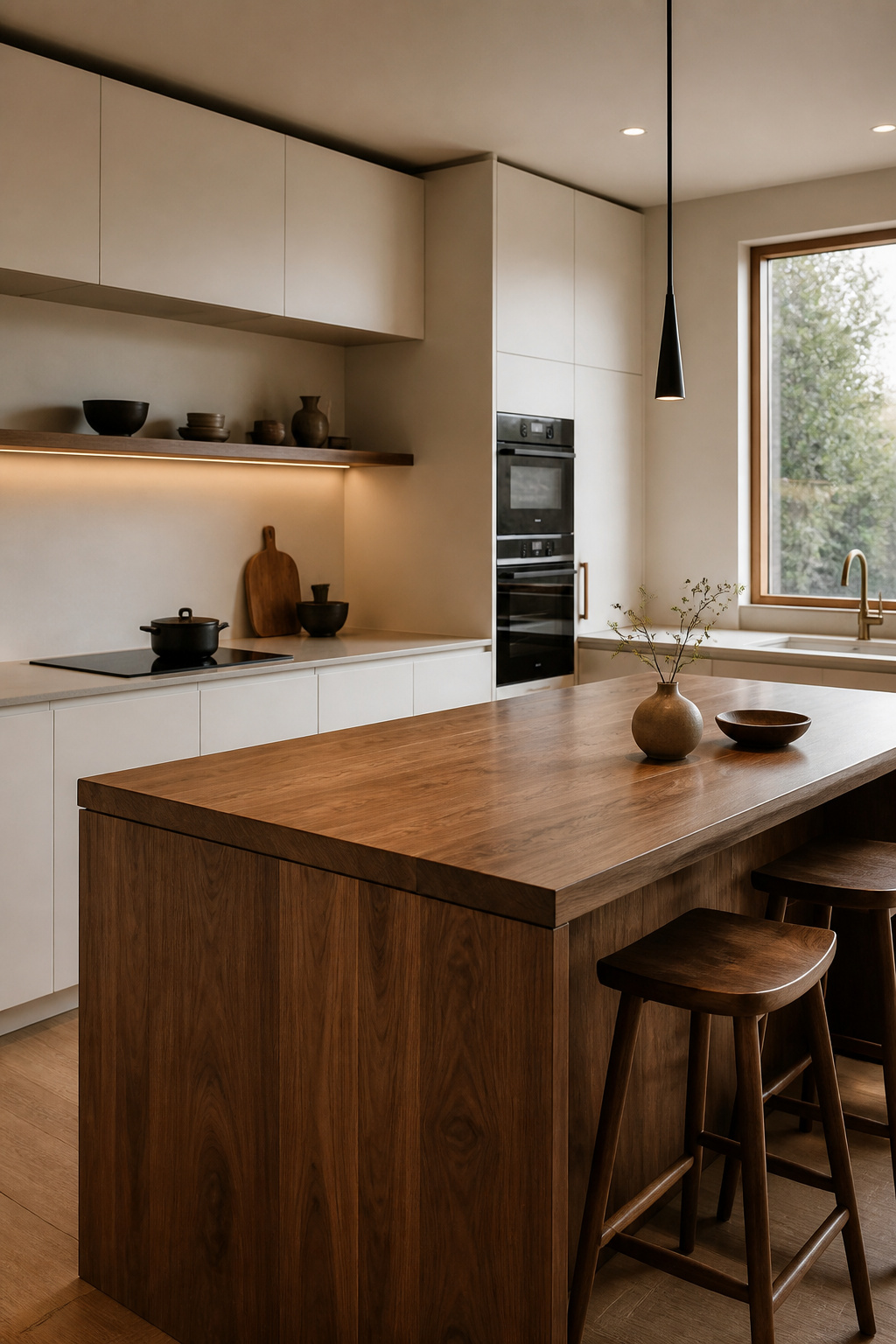
Natural wood aging embodies *wabi-sabi*: the grain develops subtle patina, color deepens from sun exposure, the surface tells stories of time and use. What appears as imperfection—color inconsistency, grain variation, subtle marks—becomes the source of beauty. A wood counter at 10 years is more beautiful than at installation.
Pairing is crucial: white or light gray cabinetry with warm wood tones creates visual interest without chaos. The wood becomes design accent rather than overwhelming presence. Consider 70% white/gray to 30% warm wood as a rough proportion.
12. Wall-Mounted Taps and Recessed Hardware for Pure Lines
Wall-mounted faucets free the sink area of visual clutter. Instead of hardware protruding from the deck or sink rim, the tap itself emerges from the wall. Your sink becomes a clean sculptural element, the focus of attention rather than the faucet’s mechanical apparatus.
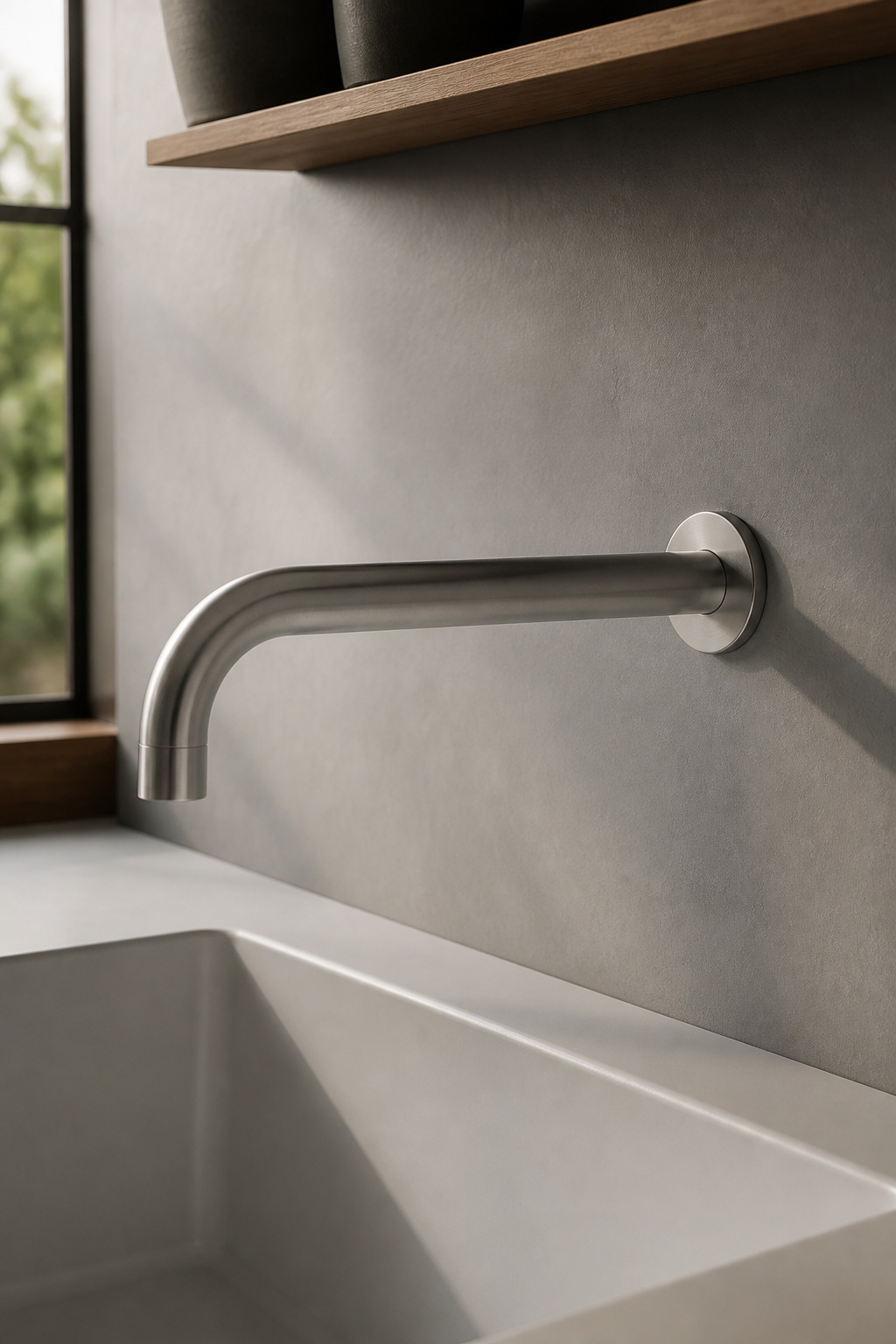
Dornbracht represents this philosophy at its highest expression. Founded on principles of ritual and human-centered design, their wall-mounted kitchen mixers cost $2,000 to $4,000, with each design considered as carefully as a sculpture. Their TARA collection exemplifies minimalist kitchen philosophy. Axor (by Hansgrohe), designed with celebrated designers like Philippe Starck, offers the AXOR Uno philosophy: Purist simplicity, balance, self-evident function.
Installation requires wall reinforcement behind your backsplash (to support the extended cantilever), which your plumber should understand follows European fastening conventions. The visual reward is substantial: your sink counter becomes uninterrupted plane, the tap itself becomes minimal sculptural element.
13. The Deliberate Restraint of What Stays on the Counter
A Japanese tea house does not display every utensil. Only what serves the present moment remains visible. Your kitchen counter should reflect the same discipline: 3-5 items maximum. This is not asceticism—it is curatorial practice.
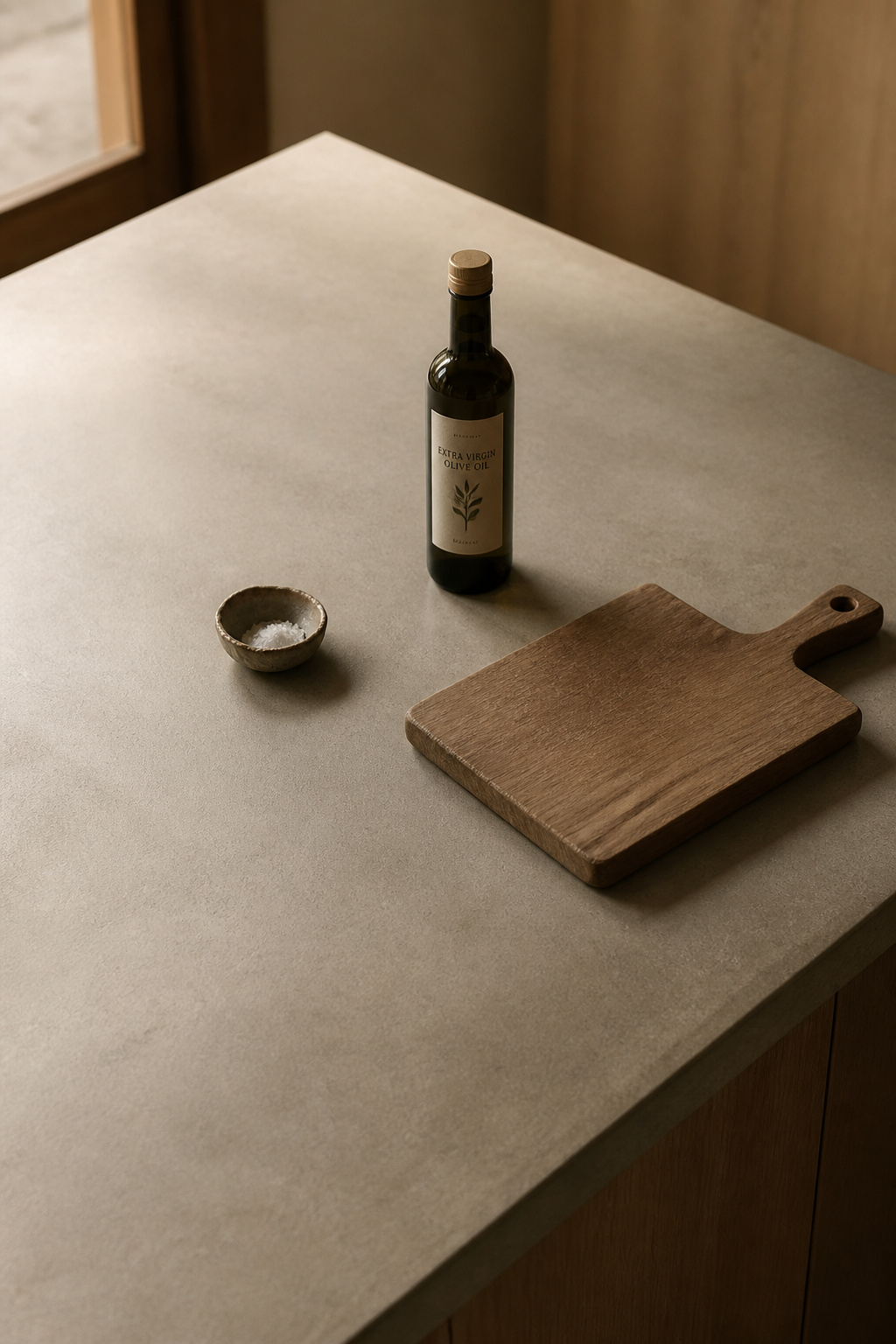
What belongs on your counter? Perhaps a small ceramic dish of coarse salt, a bottle of your finest oil, a single ceramic vessel holding wooden spoons or bamboo chopsticks. Perhaps a wooden cutting board. Perhaps a single tea kettle. Everything else belongs hidden: small appliances in cabinets, gadgets and utensils in drawers, food items behind closed doors.
This philosophy emerges from the *mizuya*—the traditional Japanese tea preparation room—where cleanliness and clarity allow contemplation. An empty counter invites presence in your kitchen. The eye rests. The mind settles. You move through your space with intention rather than distraction.
14. Minimalist Kitchen Ideas Using Stone Slabs as Statement Material
A single stone slab creates visual drama through material monolith rather than pattern multiplication. Quartzite—especially Super White or Taj Mahal varieties—costs $57 to $170 per square foot. A full kitchen typically runs $10,000 to $15,000. The material is denser than marble, less prone to staining and etching, yet delivers that luxurious stone presence that architects and designers prize.
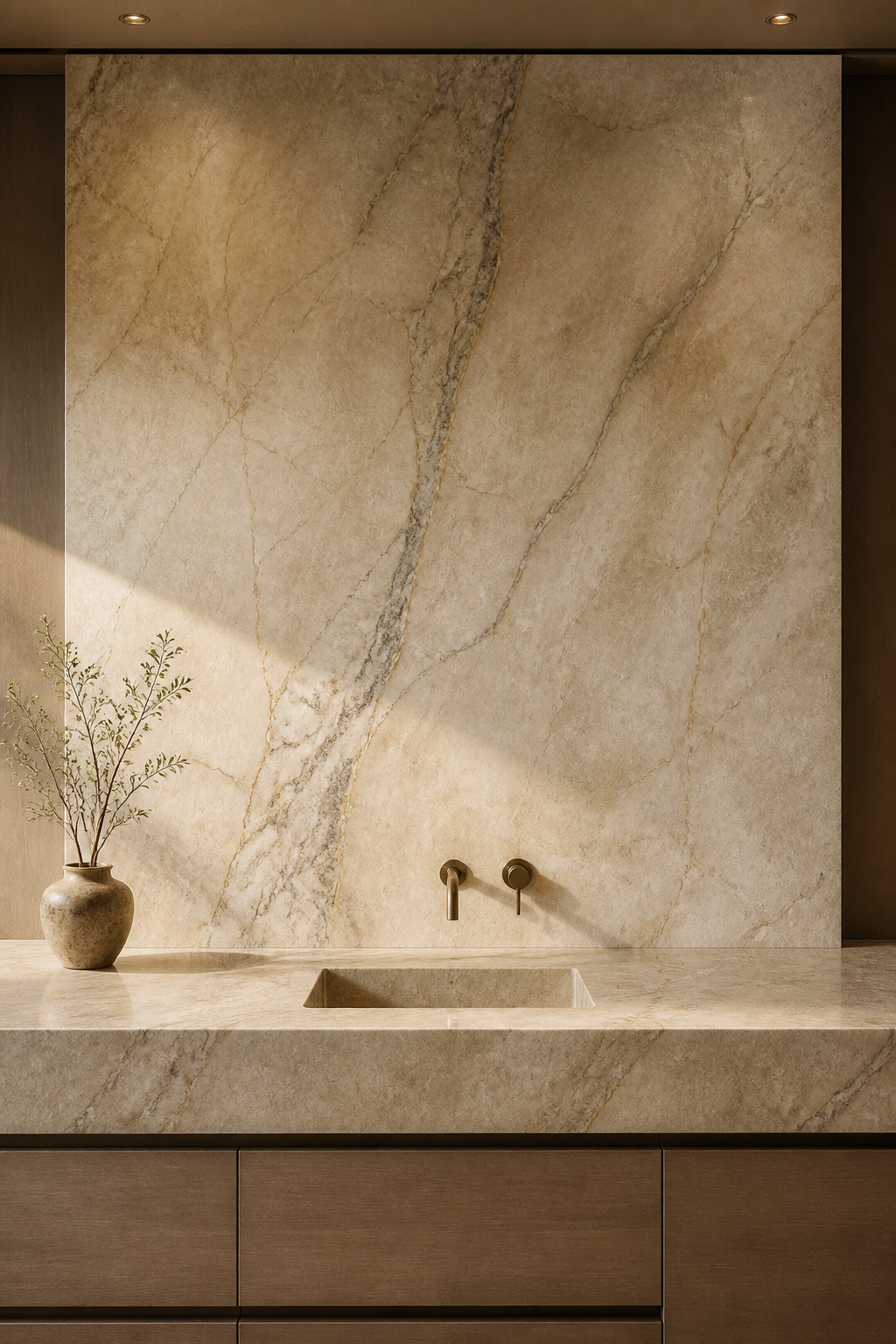
The veining in natural stone becomes design feature. Marble’s dramatic Calacatta veining reveals hidden worlds within the stone. Quartzite’s subtle stratification shows mineral layers compressed over geological time. These variations become beauty elements rather than uniformity-breaking flaws. This again embodies *wabi-sabi*: imperfection and variation become the very source of beauty.
A single continuous slab from counter to backsplash creates maximum visual impact. The eye follows one material surface upward, the architecture becoming unified sculpture. No horizontal lines interrupt the vertical journey.
15. Integrated Under-Cabinet Task Lighting, Positioned Below Eye Level
Task lighting should never announce itself. LED under-cabinet systems with warm 3000K color temperature position light bars beneath your upper cabinetry, shining downward onto your counter. The fixtures remain invisible unless you crouch to look for them specifically. The light is felt, not seen.
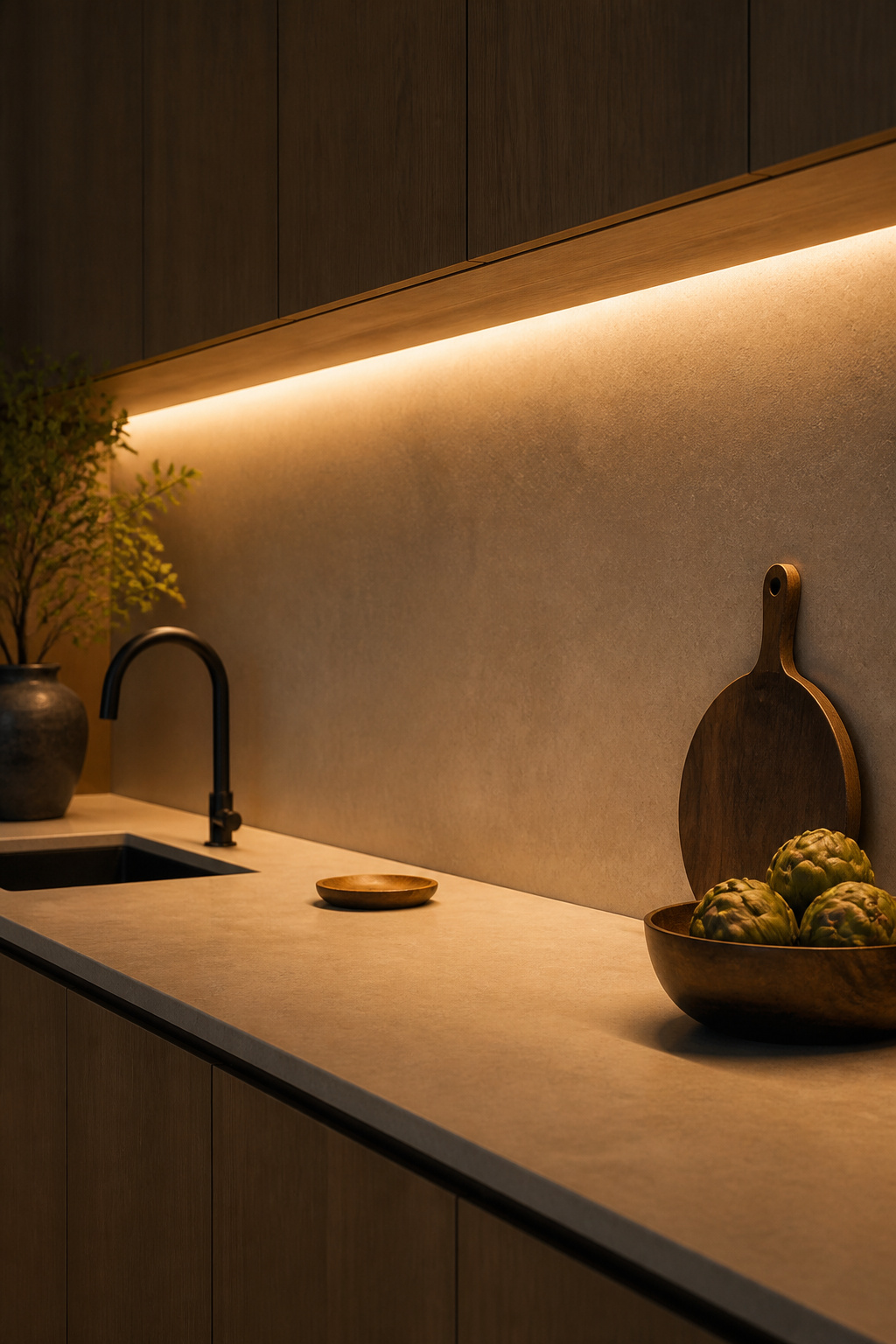
Kichler Lighting, AspectLED, and similar manufacturers offer low-profile designs with frosted diffusers that eliminate glare and diode imaging (the visible dots that appear in cheaper fixtures). A complete integrated system costs $800 to $2,000. Recessed installation hides the fixture entirely while delivering precise task illumination exactly where you work—at counter level, where your hands perform preparation work.
The philosophy: light becomes element, not fixture. Your workspace receives the illumination it needs while the source remains conceptually invisible. Dimming systems allow you to adjust warmth and intensity throughout the day, matching your emotional needs.
16. Refrigeration Panels That Disappear Into Surrounding Cabinetry
The refrigerator is your kitchen’s largest appliance. Panel-ready models eliminate its visual presence entirely. Miele’s panel-ready refrigerators, particularly those featuring Push2Open (no handles), disappear behind custom cabinet panels that match your surrounding cabinetry exactly. You can forget the refrigerator is there—aesthetically and functionally.
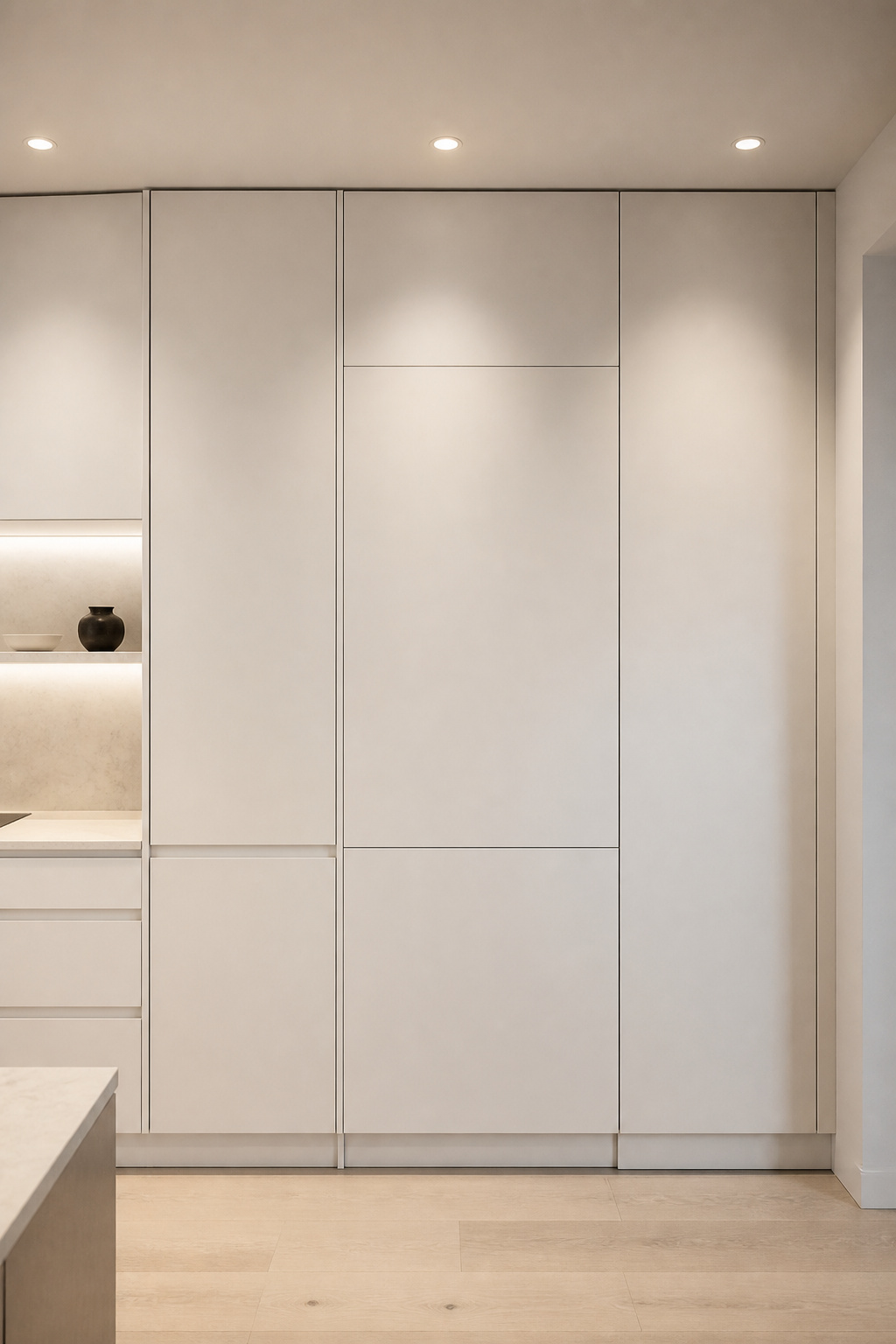
The recently introduced Miele Built-Under Refrigerator Drawers maintain this philosophy at the base level: refrigeration becomes integrated drawers that read as part of your cabinetry system rather than separate appliance. You open them as you would any other drawer. The cost—$5,000 to $8,000 for panel-ready integration—seems significant until you realize you’ve solved your kitchen’s largest visual obstruction.
Absence becomes presence in minimalist design: the invisible refrigerator becomes more powerful design statement than any visible appliance ever could be.
17. Wabi-Sabi Material Choices: Imperfection as Intentional Design
The final principle underlying every minimalist kitchen is *wabi-sabi*: the Japanese aesthetic finding beauty in imperfection, impermanence, and incompleteness. Rather than fighting material aging, embrace it as deepening rather than deterioration.
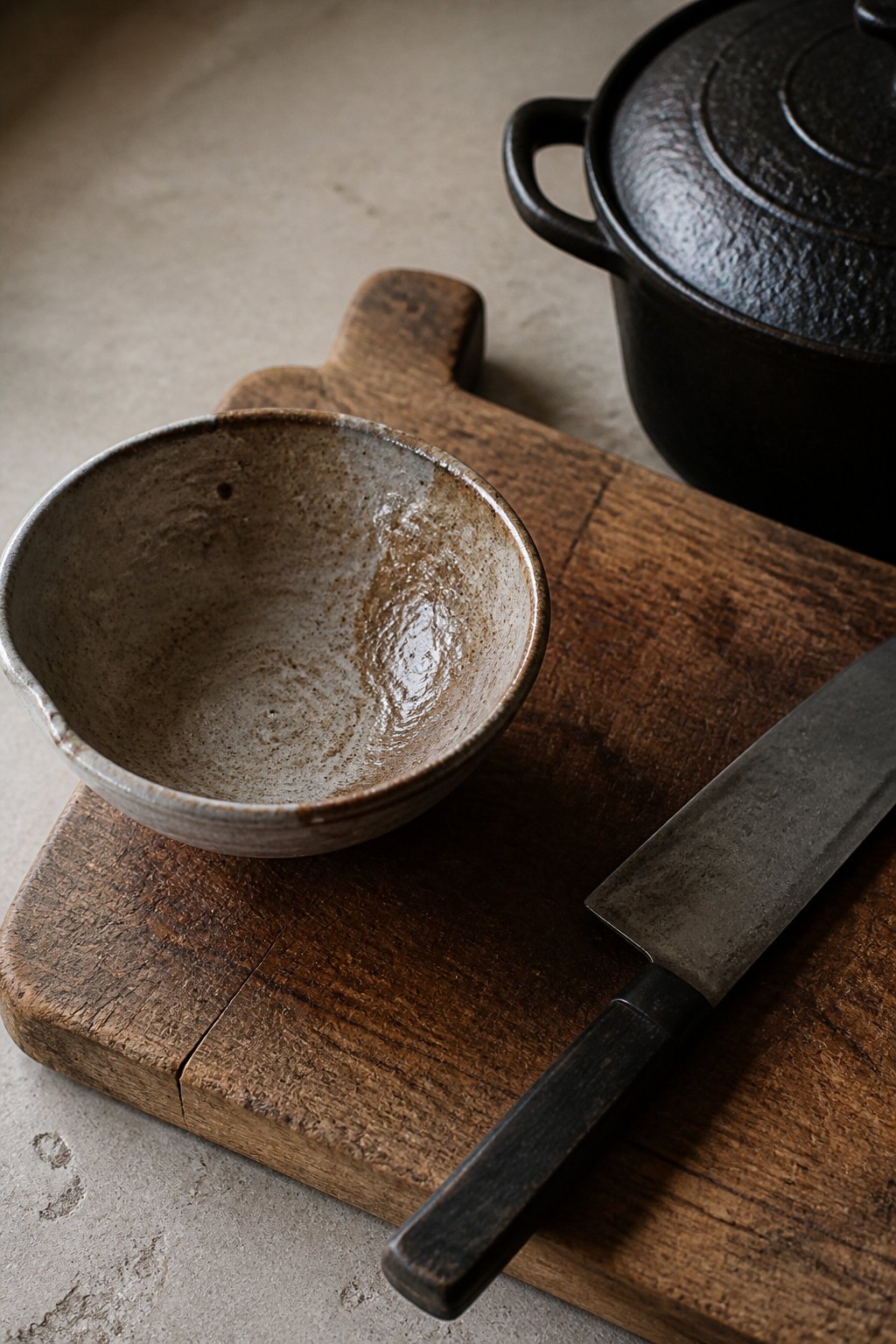
Concrete develops subtle color variation and patina. Wood surfaces soften and deepen in tone. Natural stone develops mineral character that becomes more visible over years. Metals acquire gentle oxidation. These changes represent not deterioration but maturation. Objects improve with age. A 20-year-old wooden kitchen counter is more beautiful than at installation.
In your kitchen, this means choosing materials that develop beauty through use: handmade ceramics with uneven glazes, rough-edged stone that catches light differently at each angle, weathered wood shelving that shows grain as surface finishes wear, cast iron that darkens and seasons with each meal prepared. A single hand-thrown ceramic bowl on display becomes more beautiful each year as its glaze ages. A wooden cutting board develops character from use—the scars of knives becoming the patina of life.
This philosophy liberates you from the burden of perfection. Imperfection is intentional. Time is welcome. The passage of years enriches rather than diminishes. You are not preserving a moment in amber; you are participating in the living evolution of your kitchen.
Choosing Your First Minimalist Kitchen Starting Point
You need not transform your entire kitchen at once. Begin with one principle. Choose handle-free cabinetry first, living with that transformation before adding others. Or start with clearing your counter, removing all items and returning only what serves daily life. Perhaps you begin with a single stone slab countertop, experiencing how material monolith creates visual unity.
Minimalist kitchens develop through practice and lived experience. They are not static destinations but ongoing philosophical practices. Each item you remove, each surface you simplify, each decision you make toward intentionality strengthens the whole. You will discover what you truly need. You will learn what brings you joy. You will develop your own expression of minimalism.
Japanese aesthetics teach us that the most profound beauty often emerges not from what we add, but from what we have the discipline to remove. Your kitchen, simplified through these 17 minimalist kitchen ideas, becomes not just a functional workspace but a sanctuary—a place where every surface, every material, every absence speaks to intentionality and calm.
Begin where your heart calls you. The journey toward your first truly minimalist kitchen starts with a single choice: the choice to make space for what matters.