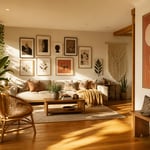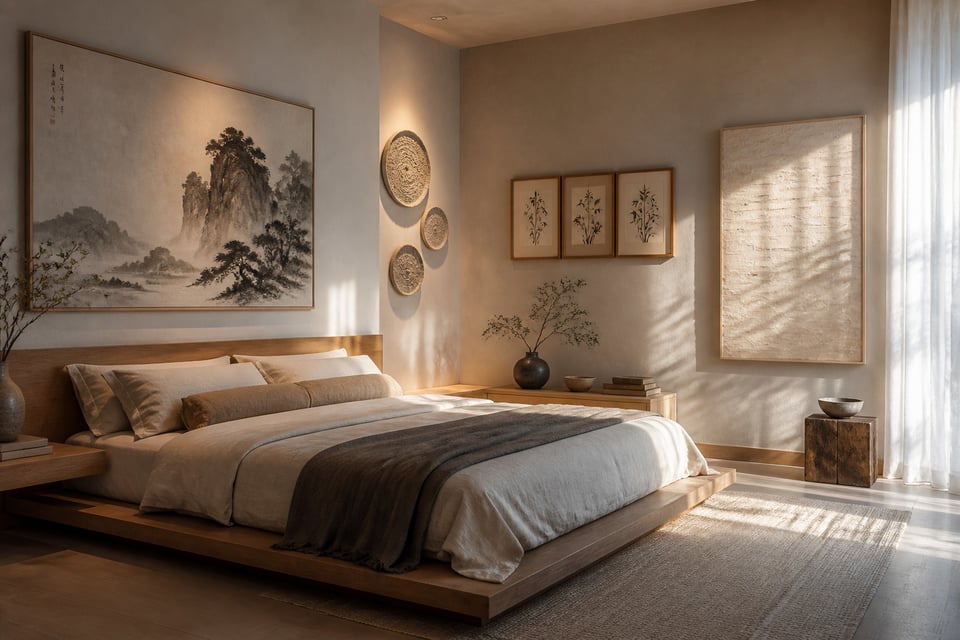
In Japanese design philosophy, ma — the concept of negative space — holds that what is absent from a wall is as meaningful as what is present. A single, deliberate piece of simple bedroom art communicates something a wall covered in frames cannot: that you chose this, here, for a reason. The bedroom, more than any other room, deserves that kind of intention. It is the first thing you see in the morning and the last before sleep, and the art you place there enters your peripheral awareness every single day.
After twelve years working with Japanese-influenced interiors, I have found that simple bedroom art is rarely about spending less or doing less — it is about attending more carefully. The choices here range from a brushwork canvas that holds the spirit of Zen practice to pressed botanicals with the quiet authority of Victorian herbaria, from an ink wash print that gives a small room visual depth to an origami mobile that turns air currents into movement. Each idea was chosen for how little it asks of the eye and how much it returns in calm. Some cost almost nothing; a few require a call to a ceramicist. All fifteen are an argument for restraint over accumulation.
1. Single-Stroke Brushwork Canvas: A Japanese Take on Simple Bedroom Art
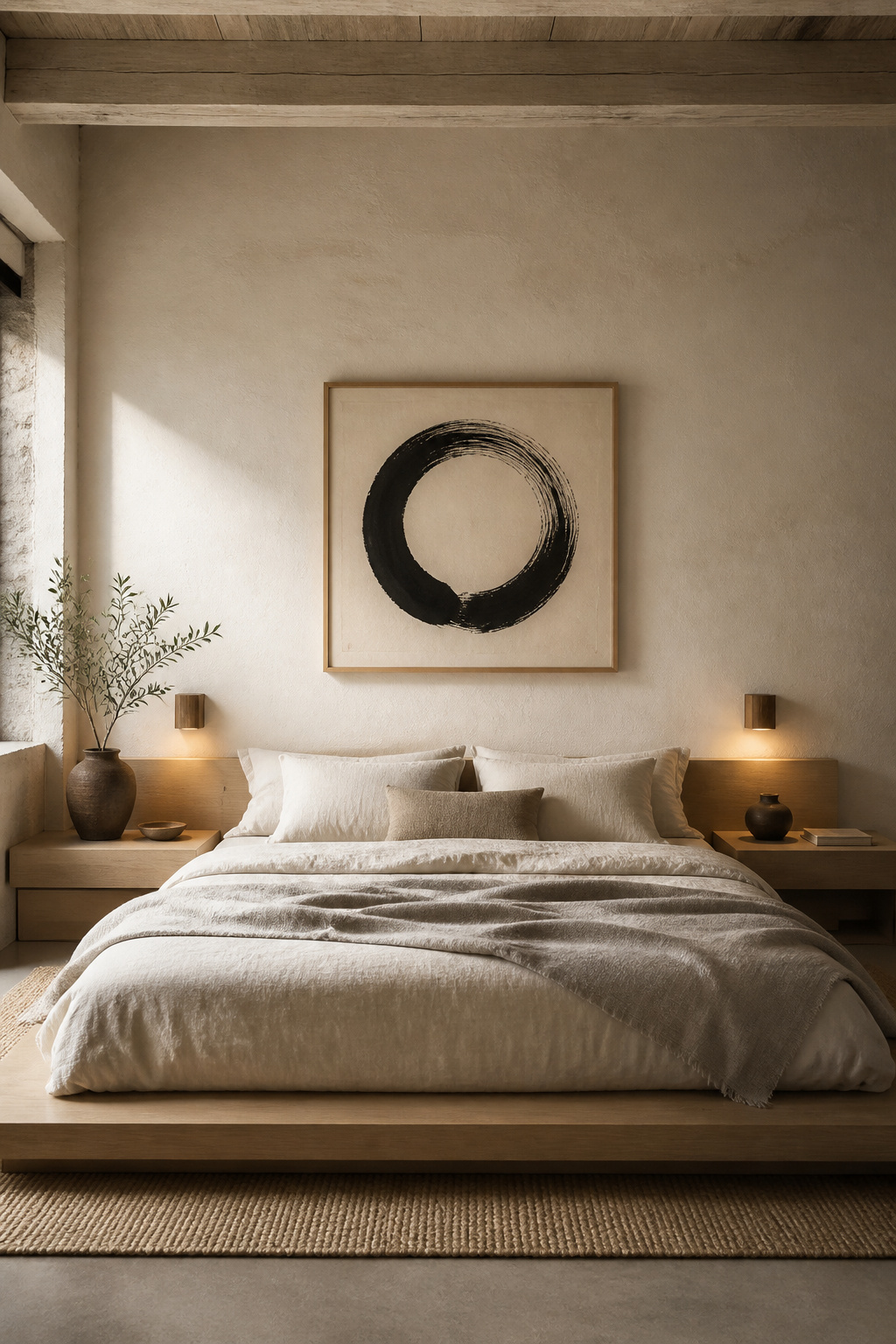
The ensō — a Zen circle drawn in one or two uninhibited brushstrokes — is among the oldest forms of meditative wall art. Not of the viewer, but of the maker, is the demand involved. The single stroke must be painted without hesitation, correction, or repetition. What results is a moment of full presence captured in brushwork: the circle is both complete and incomplete, open and closed, depending on how the brush was moving when it left the paper.
Finding and Framing Your Brushwork Canvas
What makes a hand-painted ensō different from a printed reproduction is visible to anyone who looks. The brush pressure varies across the arc, ink pools where the stroke slows, and the gap where the circle opens or closes is never quite the same twice. These are not flaws — they are the point. A printed ensō on glossy photo paper destroys the meditative quality entirely; always request matte finish, and if possible an original rather than a reproduction. House of Koyomi and various Etsy studios sell hand-painted originals in the $25–$150 range.
For a bedroom, scale matters more than most people expect. A 70x70cm piece centered above the bed works as a room anchor — it becomes the wall, rather than sitting on it. The same design at 30x30cm reads as an afterthought. For DIY: use 300gsm watercolour paper or traditional washi, genuine sumi ink, and a flat wash brush 3–4cm wide. Framing should stay quiet: raw oak or ash in the 8–12mm width lets the brushwork dominate. Unframed on a picture ledge — the IKEA Mosslanda shelf works well — allows repositioning and pairs naturally with a small ceramic object beside it.
2. Framed Pressed Botanicals for Quiet Walls That Never Overwhelm
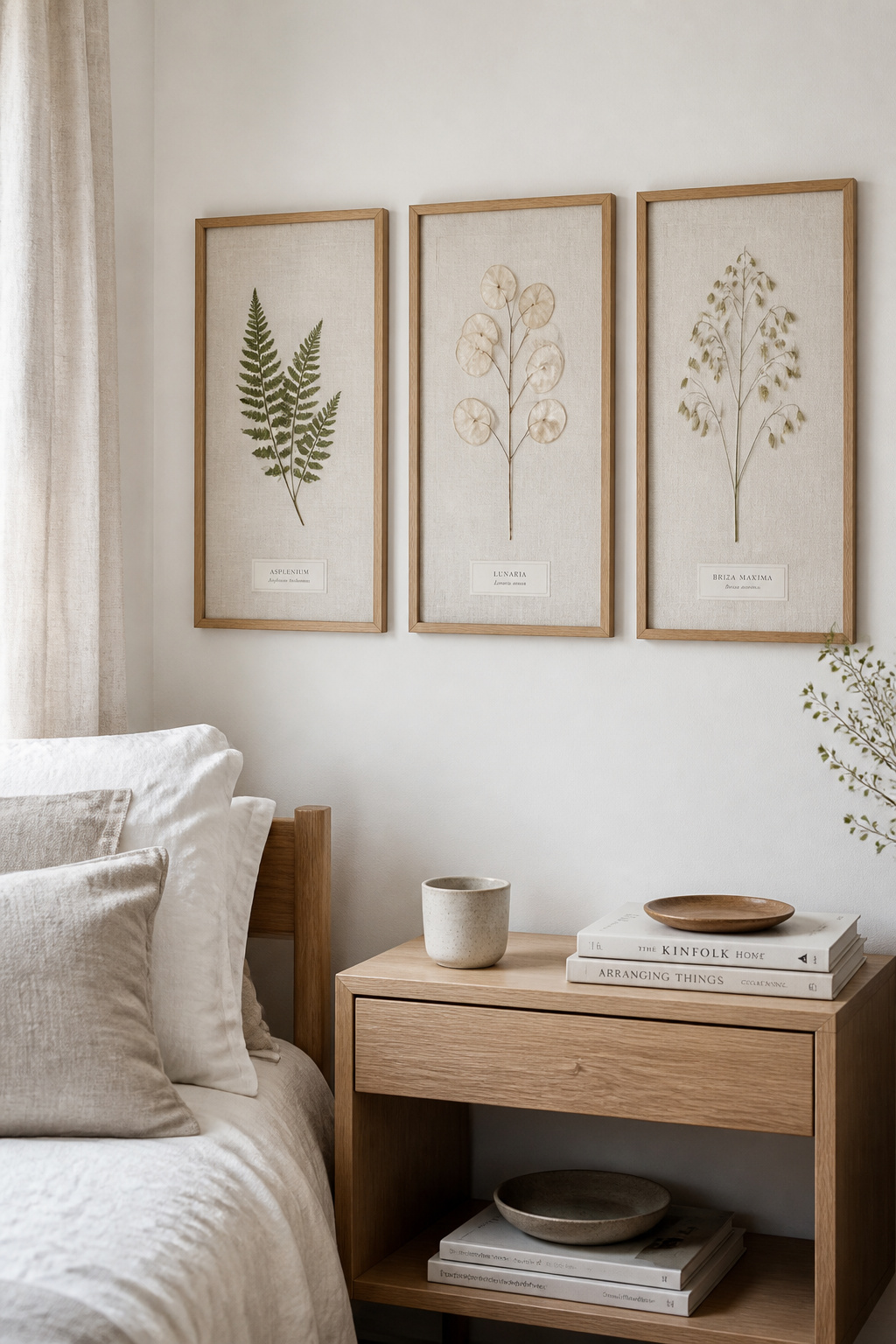
Pressed botanical art has roots in the Victorian herbarium tradition — scientific specimen collections pressed between acid-free paper, cataloguing plant life with the seriousness of natural history. The aesthetic authority that tradition lends to a framed fern or lunaria seed pod is real, even if the viewer cannot name it. There is something unmistakably considered about a pressed plant, properly framed.
Pressing, Buying, and Framing Your Botanicals
Botanicals work in bedrooms because they are still, organic, and undemanding. Unlike a strong graphic print, they invite slow looking — the eye wanders the stem structure of an Asplenium fern or the translucent membranes of lunaria pods without finding a destination. That aimless, gentle engagement is exactly right for a bedroom wall. Ferns, lunaria, Briza maxima grasses, cosmos, and daisies all press well; multi-petal flowers tend to brown unevenly unless dried flat.
For DIY pressing: place the specimen between sheets of parchment paper inside a heavy book, add weight on top, and wait six to eight weeks. Rushed pressing produces brittleness. Use archival PVA or methylcellulose adhesive; standard white glue causes yellowing within two to three years. Ready-made pressed botanicals from Etsy run £15–£50 for a framed piece, comparable to the material cost of a good archival frame.
For framing, a natural linen mat board adds tactile warmth without the sterile feel of standard white. Thin natural wood frames — ash or oak — suit the botanical tradition best. A set of three identically framed botanicals in A4 creates an intentional grouping above a bedside table that rewards looking without demanding it.
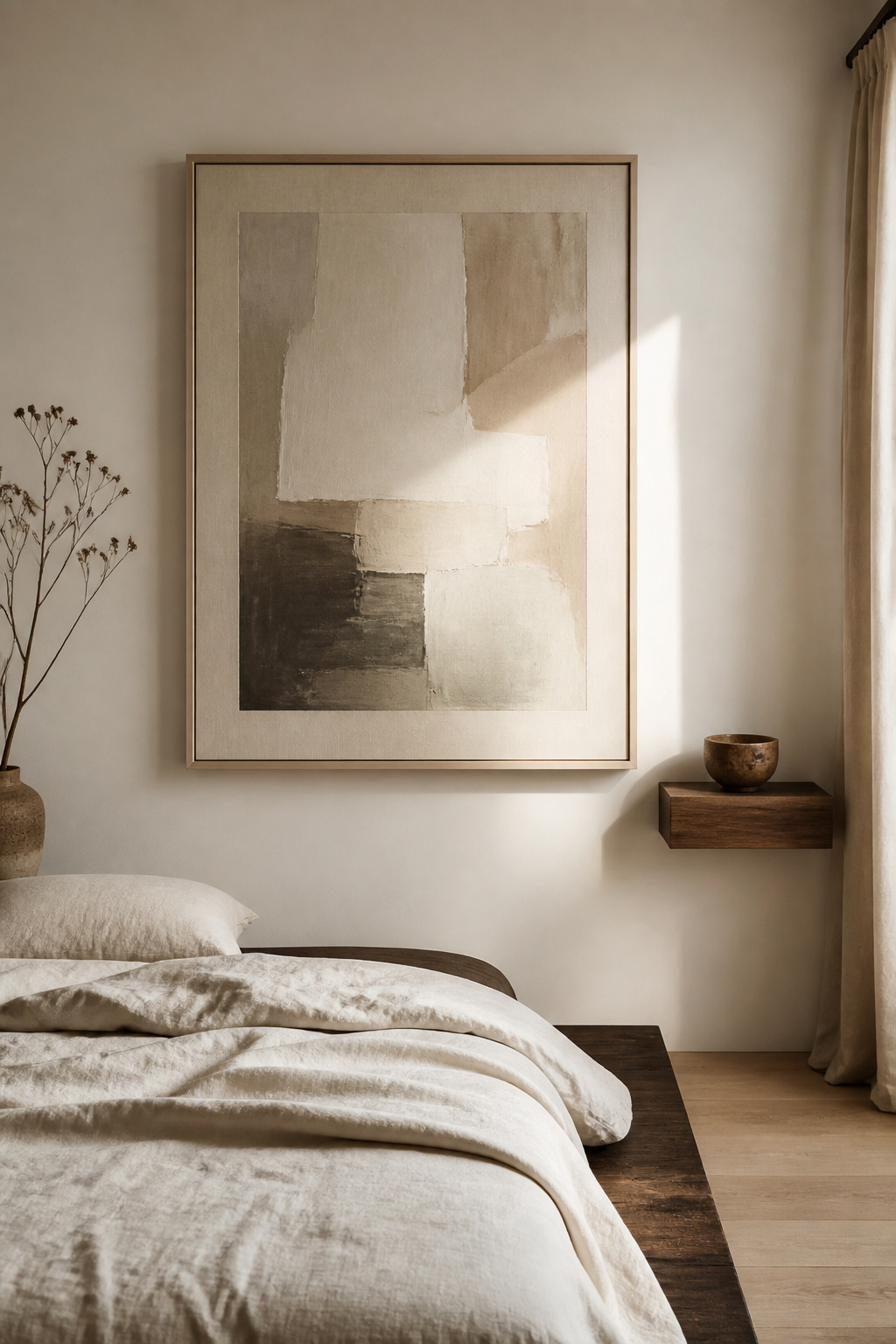
3. Wabi-Sabi Abstract Print With Textured Linen Matting
The word wabi-sabi is used carelessly now — applied to anything beige or slightly imprecise. Leonard Koren’s 1994 book *Wabi-Sabi for Artists, Designers, Poets and Philosophers* offers a more rigorous definition: it celebrates imperfection, impermanence, and incompleteness. In wall art, this translates to abstract prints that look as though time was involved in making them — not a beige rectangle printed at a factory, but a piece where a drip, a smear, or the resistance of paper against brush is evident in the finished surface.
Recognising Genuine Wabi-Sabi Art and Framing It Well
Genuine wabi-sabi art carries visible texture. Raised brushwork, paper grain that reads across the image, earthy restricted tones of beige, grey, and soft white in asymmetric compositions that leave significant negative space — these are the visual markers. Red flags when buying: digital prints on photo paper labelled wabi-sabi but with perfect edges and no texture; vivid colours; compositions that look manufactured. If it could have been made in five minutes in a graphics programme, it is not carrying the weight the label implies.
Sizing for bedrooms: 18×24 inches (46x61cm) or 20×28 inches (51x71cm) — large enough to anchor the wall without overwhelming a standard room. The framing choice is critical. A standard white mat creates sharpness that is too clinical for wabi-sabi aesthetics. A linen mat board from Nielsen Bainbridge adds physical texture at the framing stage that mirrors the textured quality of the print, creating a cohesive object rather than just a picture in a box. The additional cost is £5–£15 per frame over a standard mat — entirely worth it. This type of simple bedroom art rewards the patient eye far more than the quick glance — and it sits well within the broader category of minimalist bedroom wall art.
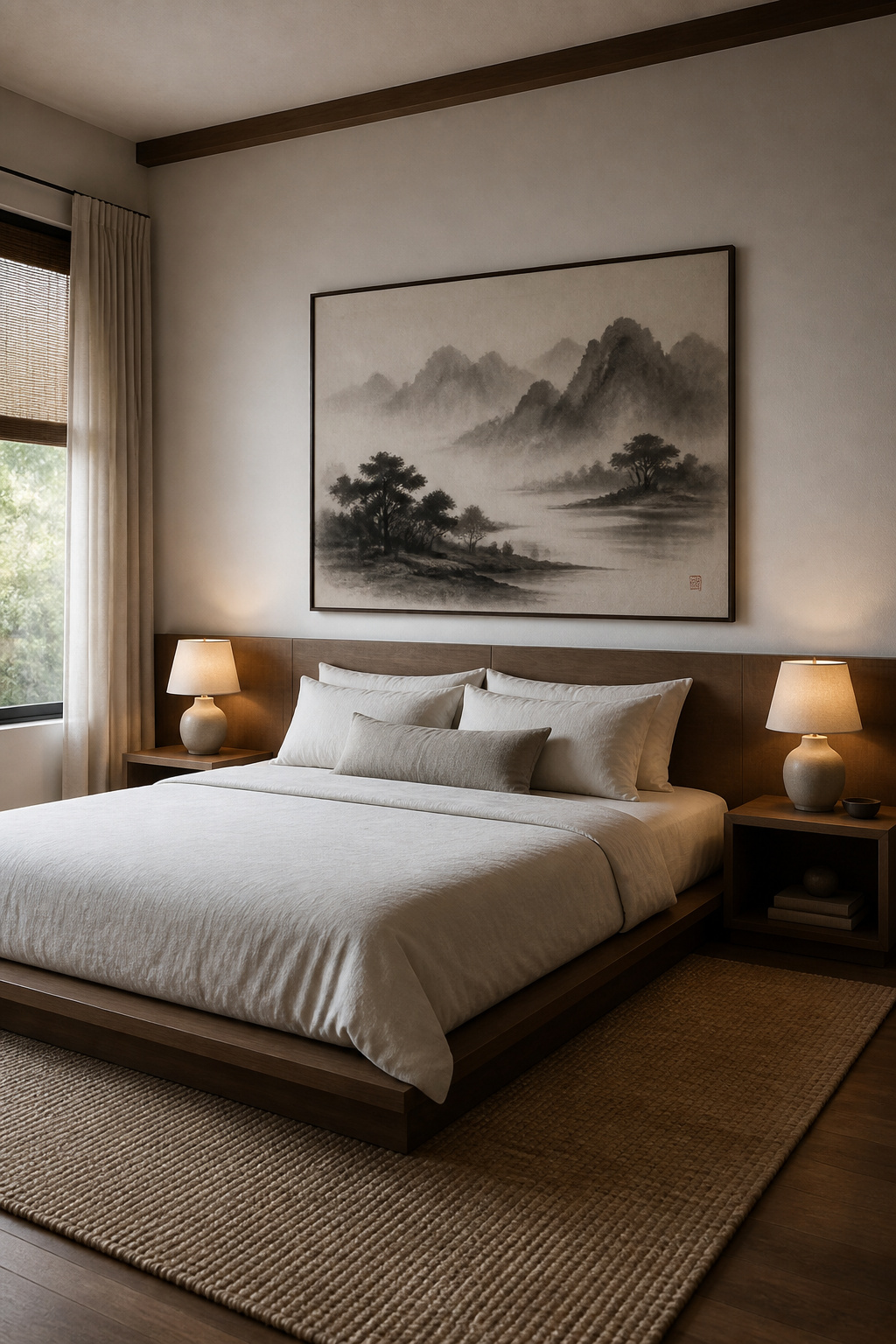
4. One Oversized Print: How Simple Bedroom Art Can Define the Whole Room
A gallery wall in a small or mid-size bedroom is almost always a mistake — not because gallery walls cannot be beautiful, but because the eye in a bedroom needs somewhere to land and rest. Multiple frames give it too many separate decisions to make. One large print solves this. It creates a focal point above the bed that the eye returns to naturally, and it reads as an architectural element rather than decoration.
Sizing, Sourcing, and Hanging Your Oversized Print
The sizing rule is specific: art width should equal 60–75% of the headboard or bed width. For a double bed (140cm), that means 85–105cm of art. For a queen (157cm), 94–118cm. Standard large print sizes that work: 24×36 inches over a queen; 30×40 inches over a king. Vertical placement matters too: the bottom edge of the art should sit 4–6 inches above the headboard top. Art hung higher floats adrift from the bed and loses its architectural function.
Affordable oversized sources: Society6 unframed prints from 18×24 inches for $25; Desenio from £10–£30 at 50x70cm; IKEA Björksta frames up to 140x100cm with frame included. A DIY poster rail — clamp-style, from £5 — grips an unframed print and removes the frame entirely for a cleaner look. For small bedroom wall art situations — low ceilings, narrow walls — a wide horizontal print in landscape orientation makes the ceiling feel higher by drawing the eye laterally. The frame you choose changes the reading of the print more than most people realise before they hang it.
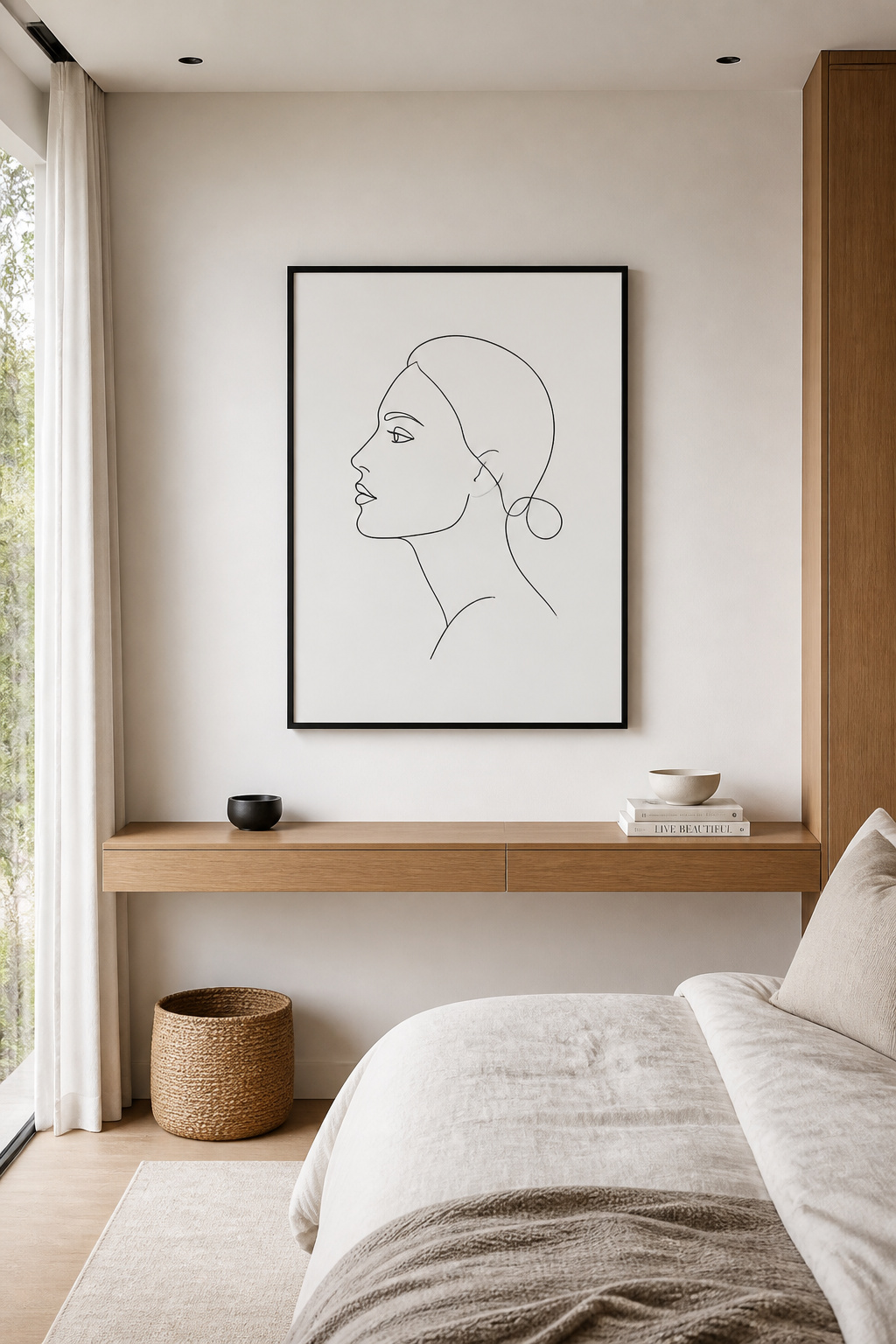
5. Minimalist Line Art Portrait in Black and White
The continuous-line portrait — a drawing technique in which the pen never leaves the paper, producing a face in one unbroken gesture — has roots in Picasso’s single-line works from the 1940s. His face studies and *Dove of Peace*, 1949, are the touchstone for this form: the cultural reference gives it more weight than its apparent simplicity implies.
Sourcing Simple Bedroom Art Line Prints and Choosing the Frame
Faces and figures in a bedroom feel personal and humanizing without being photographic. A line drawing implies presence without identity — which works equally well in a shared bedroom or a private one. The kinetic quality of a continuous line draws the eye naturally, tracing the path of the pen.
Etsy printable downloads (search ‘continuous line art portrait’) are among the most affordable bedroom art prints available, running $3–$12 for instant PDF files; print at home on A3 fine art paper or take the file to a print shop. Society6 ships prints from 8×10 inches up to 24×36 inches at $15–$80 depending on size and finish. For a custom commission, search #lineart on Instagram to find illustrators; a custom A3 original ink drawing typically costs £40–£150.
Frame choice changes the feeling significantly. A matte black frame reinforces the ink lines and creates a strong edge — best on white or cream walls. A white frame softens the graphic quality and makes art and frame read as a single wall object, better on coloured walls. Natural oak or ash adds warmth, ideal for Japandi or warm-neutral palettes. Download resolution matters if printing large: anything below 300 DPI will show pixelation at scale, and pixelated lines destroy the precision that makes this form worth hanging.
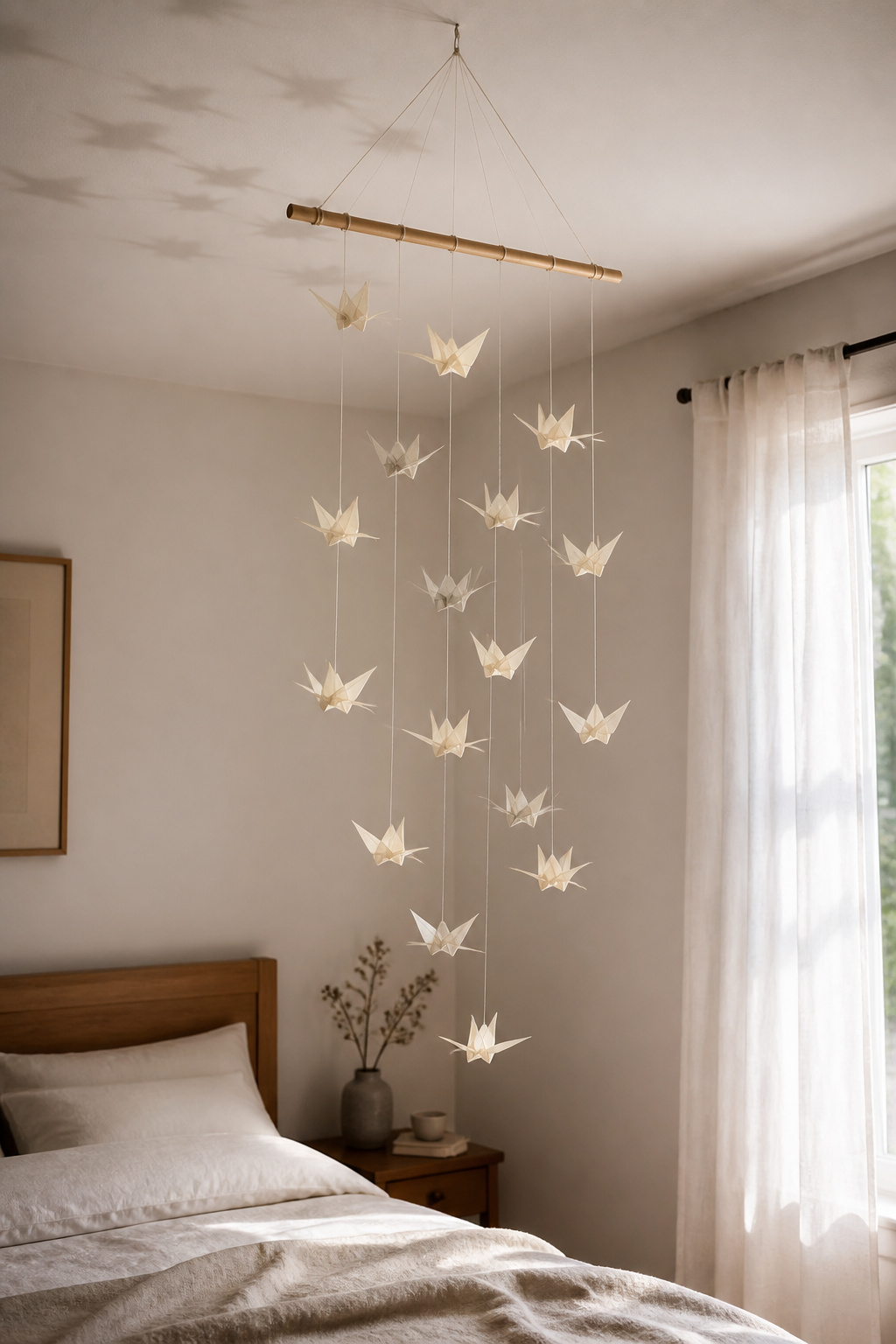
6. Origami Mobile: Light Bedroom Art Ideas That Move With the Room
The senbazuru tradition — folding one thousand paper cranes as a wish for health, longevity, or peace — gives origami mobiles a cultural depth that few other bedroom art ideas can match. A bedroom mobile of twelve to twenty cranes in washi paper is not merely decorative. It is participatory: the act of folding is meditative, the finished piece moves with the room’s air, and the shadow play it casts on the wall changes from morning to evening as light angle shifts.
Making Your Washi Paper Mobile: Materials and Hanging
In Japanese design, movement in a space signals life and breath. For mindfulness practitioners, the slow rotation of a mobile provides a visual anchor — similar to a candle flame — without the fire risk. Shadow play from a hanging mobile changes throughout the day as light angle shifts; the shadows are part of the art as much as the cranes themselves.
Fold from 15x20cm or 20x20cm washi paper squares. Cranes (tsuru) are the most culturally significant form; origami leaves, six-pointed stars, and geometric pyramids also hold their shape on thread. Washi is superior to standard origami paper for mobiles: its long fibres resist tearing at fold lines and its translucency creates a glow effect in natural light.
Hang 30–40cm below ceiling level — low enough to catch air movement, high enough to clear anyone standing nearby. Thread 3–5 forms per strand, varying strand lengths from 20cm to 45cm. A 30cm bamboo skewer works as the top bar. Washi tape attaches to ceilings without leaving marks on plaster — important for anyone renting.
7. Handwritten Calligraphy Panel as Meditative Art for Your Bedroom
Generic inspirational text prints are visually exhausting because they demand agreement. Shodo (Japanese calligraphy) creates an entirely different relationship between viewer and text. The kanji for wa (harmony), sei (stillness), ki (energy), or mu (nothingness) are visually beautiful without requiring translation — and for those who know the meaning, they carry a density of cultural reference that a printed sans-serif quote cannot approach.
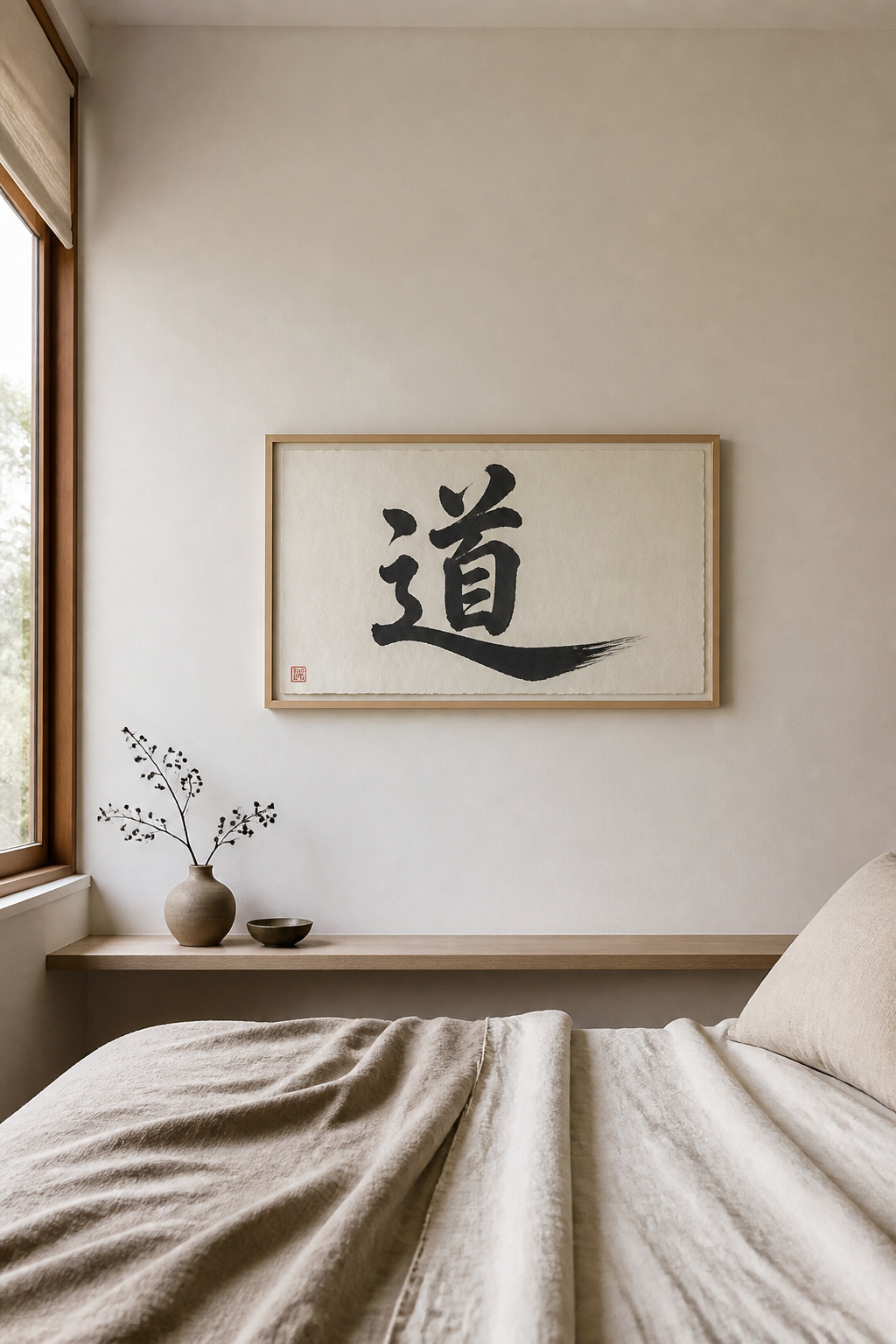
Commissioning a Calligraphy Panel: Styles, Sources, and What to Ask For
Shodo is a meditative practice as well as a visual art form. The act of writing with a brush and sumi ink requires complete presence — a wandering mind produces hesitation visible in the stroke. The finished piece carries the energy of that presence. Each character is unique not because the calligrapher made a mistake, but because the stroke was made at a specific moment, with a specific breath.
For wall art, Gyosho (semi-cursive) style is the most expressive — flowing enough to carry visual movement but recognisable. Sosho (full cursive) is highly abstracted and works well as pure visual form even for viewers who cannot read Japanese script at all. Custom commissions via Etsy (search ‘custom Japanese calligraphy’) run $40–$200 for a hand-painted piece on washi or watercolour paper. Standard framed calligraphy size: approximately H35cm x W65cm — wide enough for one to three characters with appropriate negative space. When commissioning: specify Gyosho or Sosho style, request a translation certificate, and confirm the paper is acid-free. Machine-translation errors produce genuine embarrassment; verify with multiple sources before ordering. As simple bedroom art, a calligraphy panel above the bed creates a daily anchor of meaning without any visual noise.
8. Washi Paper Wall Panel: Texture as the Art Itself
Washi — Japanese handmade paper designated as UNESCO Intangible Cultural Heritage since 2014 — is made from kozo, gampi, or mitsumata plant fibres using techniques passed down through the Echizen and Ogawa-washi traditions. Genuine washi has visible fibres running through it, a surface irregularity that machine-made paper lacks entirely, and a slight translucency that gives it a wall presence unlike any canvas print.
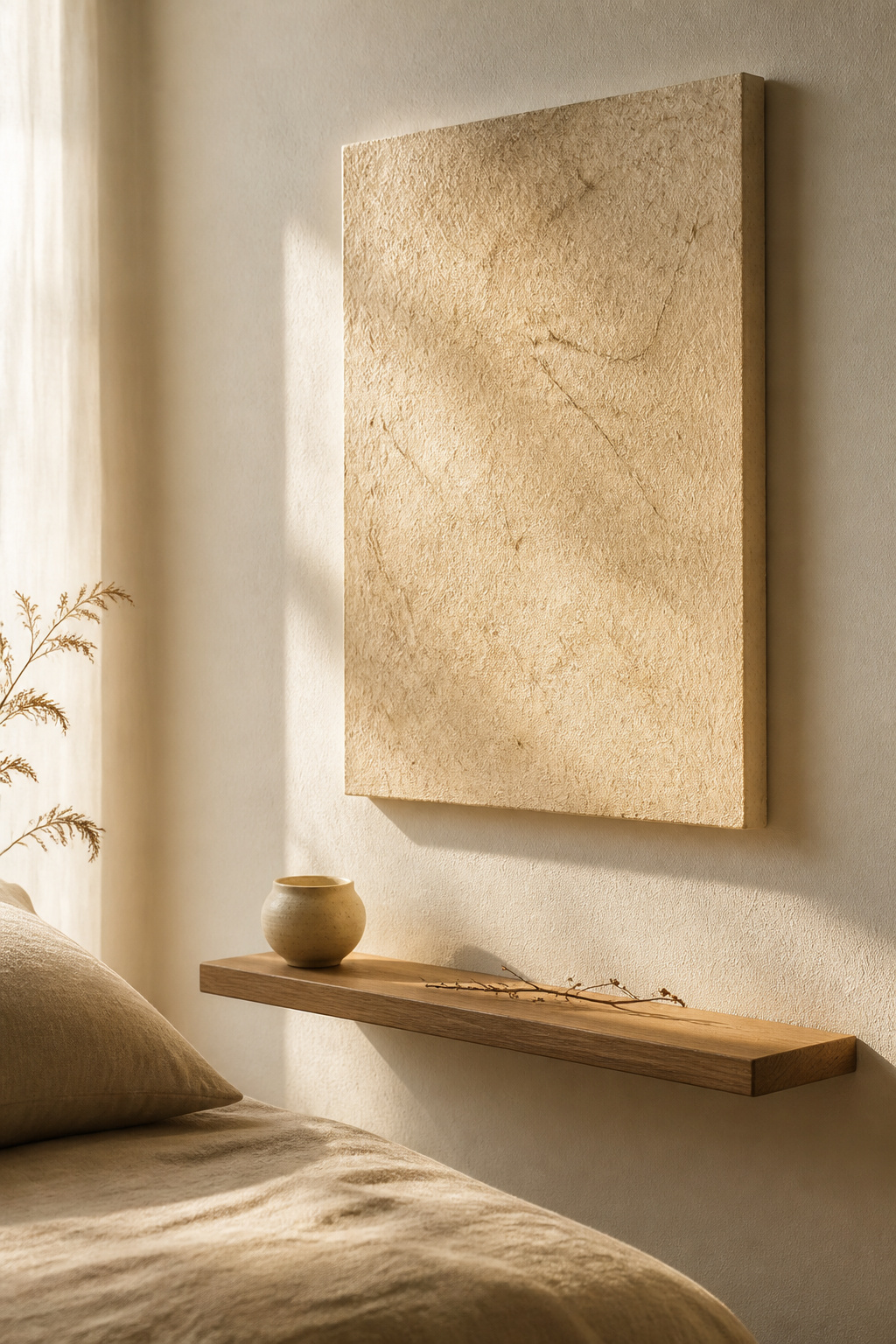
Mounting and Displaying Washi as Bedroom Wall Art
The translucency is the critical property. Against a lit wall, a washi panel glows softly. In shadow, it reads as a textured opaque surface with remarkable depth. Unlike canvas or print-on-paper art, a washi panel has no image content to interpret — the material itself is the entire aesthetic. In a bedroom already containing considered furniture and intentional absence, this is often the most honest form of simple bedroom art: a thing that is only what it is.
Mounting options vary in reversibility. The canvas stretcher bar method — purchasing bars from Blick Art Materials and hand-stretching the washi, securing with archival wheat-starch paste — creates a museum-quality presentation that can be changed without damage. A shadow box frame with a 2–3cm standoff creates depth and catches side light beautifully. Dry mounting on foam board with spray adhesive is easiest but permanent.
Awagami Factory produces washi in natural ivory, pale cloud grey, soft sage green, charcoal, and indigo. Natural ivory is the most versatile single choice: warm white with visible fibre texture, compatible with cream, grey, and natural wood tones. Layering two sheets of different weights creates depth visible only close-up that reads as surface complexity from across the room.
9. Ink Wash Landscape Print: Simple Bedroom Art With Atmospheric Depth
Sumi-e ink wash painting is a 1,300-year tradition in East Asian art — mountains, water, mist, and bamboo rendered through tonal gradation and negative space rather than colour or detail. The technique relies on what painters call the happy accident: water moving through wet ink creates soft edges and organic forms that cannot be fully controlled. The painter works with the ink’s natural behaviour, not against it.
Sizing Your Simple Bedroom Art Ink Wash Print and Matching It to the Room
In a bedroom, a sumi-e landscape creates visual distance — the eye travels into the painting, following the receding planes of ink through a mountain valley or along a river bank. This psychological sense of depth makes even a small room feel less bounded. Unlike a graphic print or bold colour piece, an ink wash landscape never competes with furniture or textiles. It simply adds space where wall was.
A reproduction giclee on the right paper captures tonal nuance extremely well — the minimum specification is 300 DPI on 230gsm matte fine art paper. Hahnemühle Photo Rag 308 and Canson Infinity are the industry benchmarks; both render the delicate grey values of diluted sumi ink without colour cast. Original paintings on Saatchi Art and Etsy run $50–$500 depending on size and artist; originals show visible brush texture under raking light that no giclee can fully replicate.
The landscape subject should complement the room’s light. North-facing bedrooms (cooler light) work beautifully with mountain and mist landscapes. South or east-facing rooms benefit from river or ocean panels, which soften brightness and add a meditative, cooling quality. Size matters significantly: a minimum of 50x70cm is needed for the depth effect to function. A small sumi-e print reads as a thumbnail.
10. Three-Frame Micro Gallery in Matching Matte Black
The rule of three in visual design: three objects create a triangular sightline that the eye moves between, more dynamic than two (static) or four (which creates grid pressure), more considered than five or more. Three frames in a bedroom is enough to show curation without overwhelming. The negative wall space between and around the frames remains active and breathing.
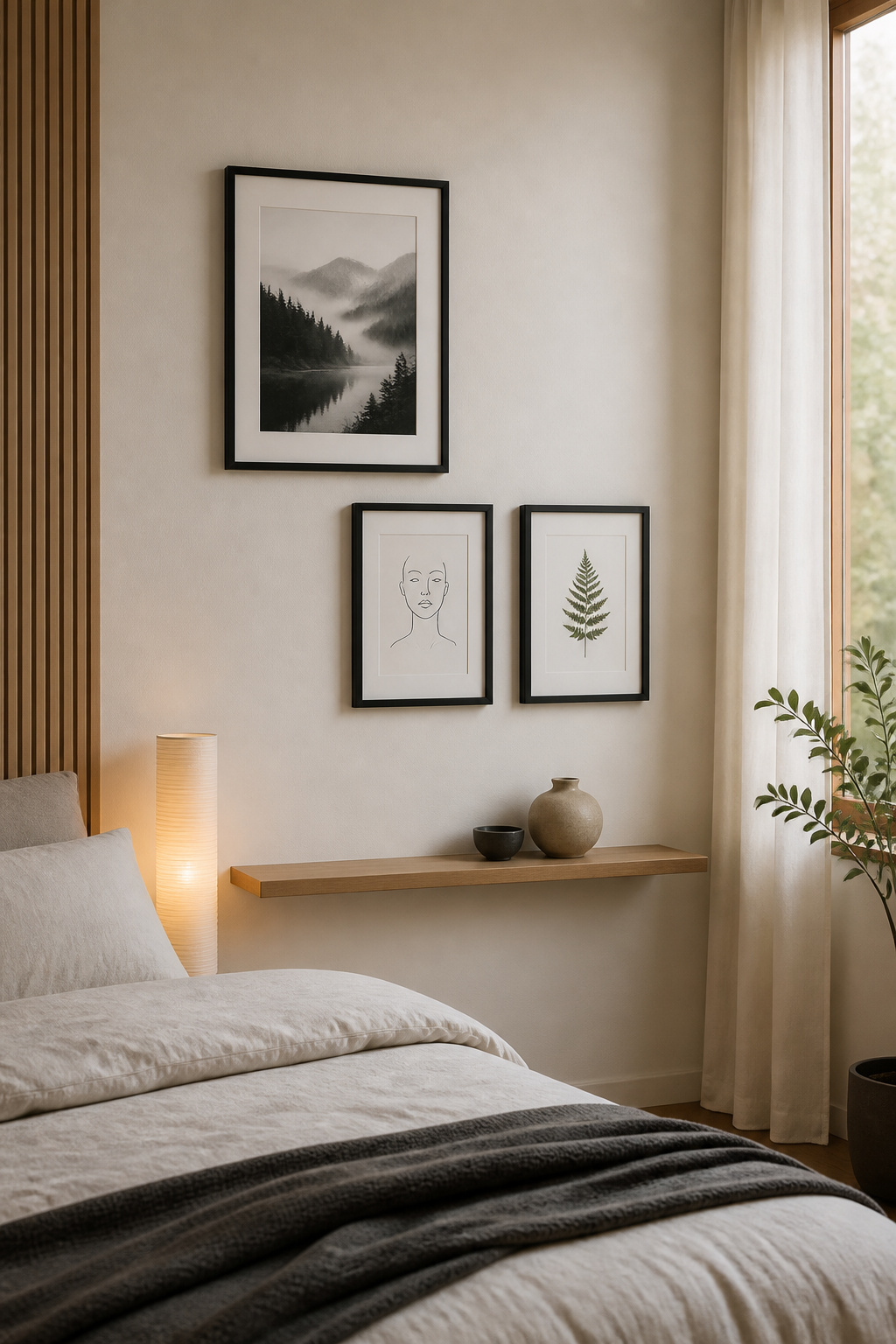
What Goes Inside Each Frame and How to Hang the Trio
Arrangement options: a linear horizontal row is most minimal, works above a bed or along a long wall; a vertical stack suits tall narrow spaces; a triangular formation — one above two below — is most dynamic. Avoid the instinct toward symmetry: in a small grouping, symmetry looks deliberate but static. Asymmetry looks found and considered.
Spacing is precise: 4–5cm between frames creates a grouped look. Less than 3cm reads as crammed. More than 7cm and the grouping dissolves into three separate objects rather than a collection. Total width of the grouping should follow the 60–75% rule — for a double bed, that means keeping the full arrangement to 90–120cm including gaps.
The best content combination for a minimalist bedroom: one black-and-white photograph (grounded and real), one line drawing (gestural and human), one small botanical print (natural and organic). Three different image types create a quiet conversation — the kind of Japandi bedroom art arrangement that is considered without being rigid. Three photographs of the same type compete rather than converse. Consistent mat colour and consistent frame finish — all matte black is the most versatile choice — unify the trio even when content varies. Using different frame finishes creates visual clutter in a minimalist setting, not personality.
11. Vintage Map Prints as Simple Bedroom Art With a Sense of Place
Maps as bedroom art operate differently from abstract or figurative work. They invite the viewer to locate themselves in the world — a map of the city where something happened, a coastline that carries memory, an 1800s atlas page of a country one intends to visit. This relationship to place is contemplative rather than purely aesthetic. The viewer is not being shown something but being asked to consider something.
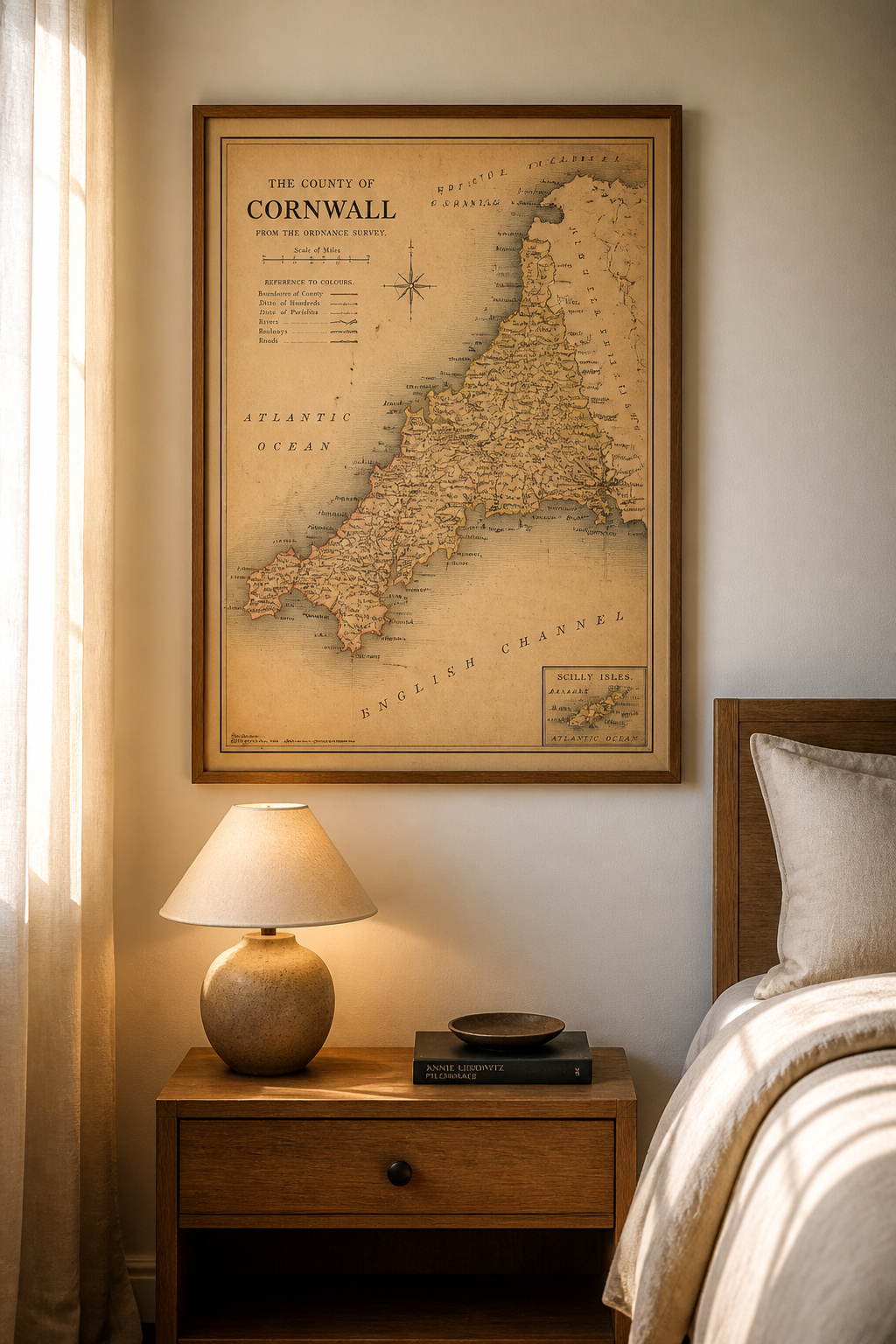
Sourcing and Printing Your Vintage Map
The cartographic grid — lines of longitude and latitude, hatched coastlines, measured distances — creates a visual pattern the eye can explore without being directed. Historical maps in sepia and muted ochre tones are warm-neutral and compatible with virtually all minimalist bedroom colour schemes. They sit comfortably beside natural wood, linen, and washi without demanding their own corner of the visual hierarchy.
The David Rumsey Historical Map Collection holds over 131,000 maps available free under Creative Commons licence — the Export button on any map page downloads a high-resolution file sufficient for printing at A1 in many cases. Old Maps Online searches across forty institutional collections internationally. For professional printed versions of Rumsey maps, Reprint Mint is the official print partner, offering sizes up to 24×36 inches with custom framing.
Sepia-toned prints age most gracefully and pair naturally with raw wood frames. Original colour maps with vivid territorial boundaries can be busy unless the palette is genuinely restrained. The most important material choice: print on matte fine art paper. Glossy paper makes a historical map look like a souvenir reproduction; matte paper makes it look like the real thing. Print minimum A2 — anything smaller reads as a document rather than bedroom art.
12. Ceramic Wall Discs as Sculptural Bedroom Wall Art
A flat print absorbs light uniformly. A ceramic disc two to four centimetres deep creates shadow pockets that change as light direction shifts across the day — the same piece reads differently at 7am under raking east light than it does at noon. It is in constant slow transformation, which is a different relationship to art than a photograph offers.
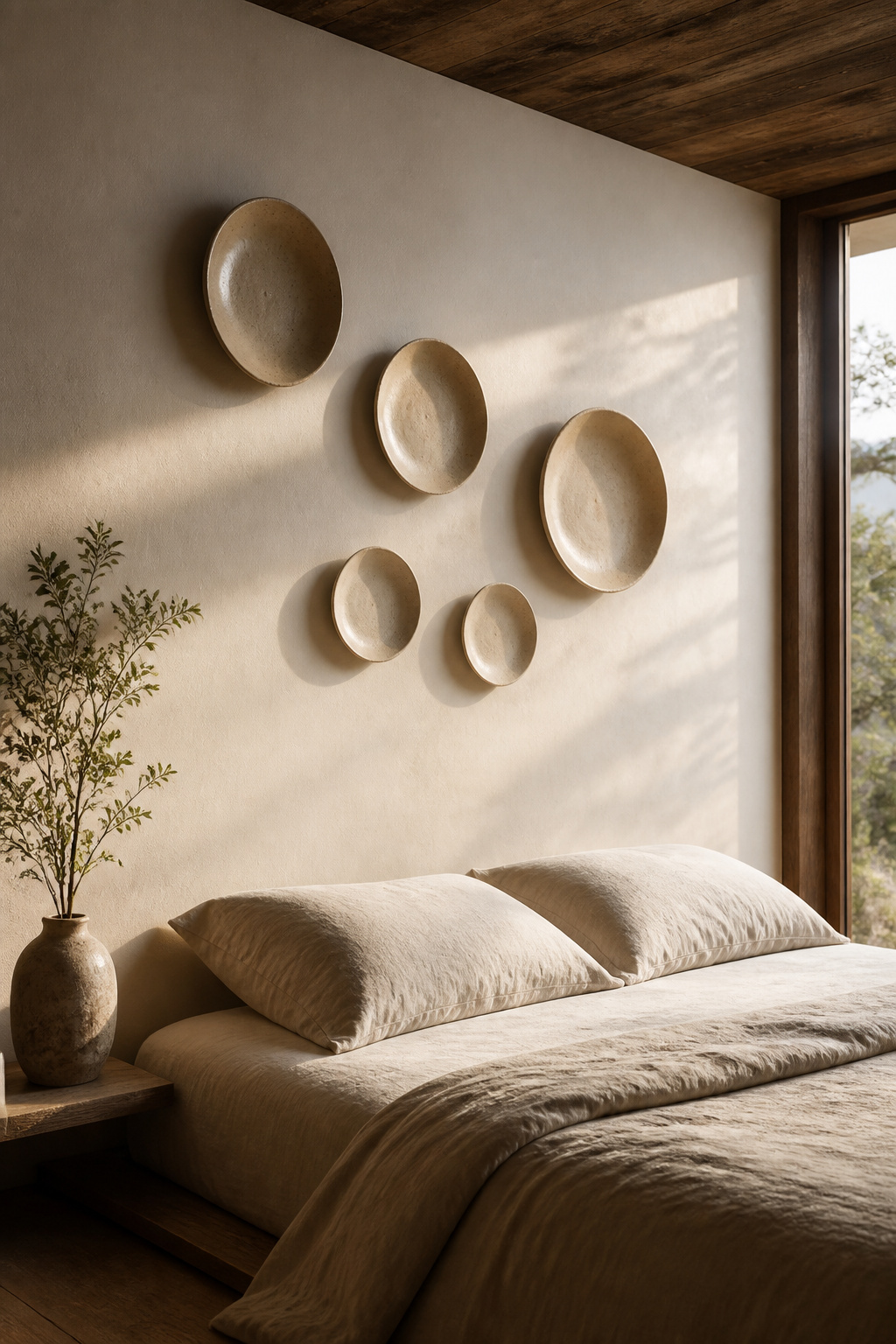
Sourcing and Arranging a Ceramic Disc Cluster
The Mingei folk craft movement in Japan — which placed ordinary, handmade beauty at the centre of its aesthetic — is the philosophical ancestor of contemporary studio ceramic wall art. A hand-thrown disc carries the marks of being made by a specific hand: the slight irregularity of wheel-thrown form, the variation in glaze that firing introduces. These qualities matter in a bedroom art context specifically because they resist reproduction.
Individual hand-thrown discs from Etsy studios run £25–£150 each depending on size, glaze, and maker reputation. MuddyHeart offers handmade ceramic wall art in thirteen neutral colours; MAAP Studio takes bespoke commissions. A set of three discs from a local ceramicist typically costs £80–£200 for the set.
Arrange in odd numbers — three or five — and always asymmetrically. The highest disc should not be in the centre; vary heights and horizontal positions to create a constellation rather than a grid. Spacing: 8–12cm between disc edges for a natural cluster; wider than 20cm and the grouping dissolves into separate objects. For north-facing bedrooms with limited directional light, a low-voltage LED at 2700K, angled at 30–45° to the wall, activates the ceramic surface and creates the shadow play that makes this bedroom wall art worthwhile.
13. Macramé Fiber Panel as Budget-Friendly Art for Your Bedroom
Contemporary minimalist macramé has largely shed the overwrought boho associations of the early 2010s. A monochrome cotton rope panel in a geometric square-knot or half-hitch diagonal pattern reads as textile art: tactile, natural, dimensionally interesting, and genuinely unobtrusive in a calm bedroom.
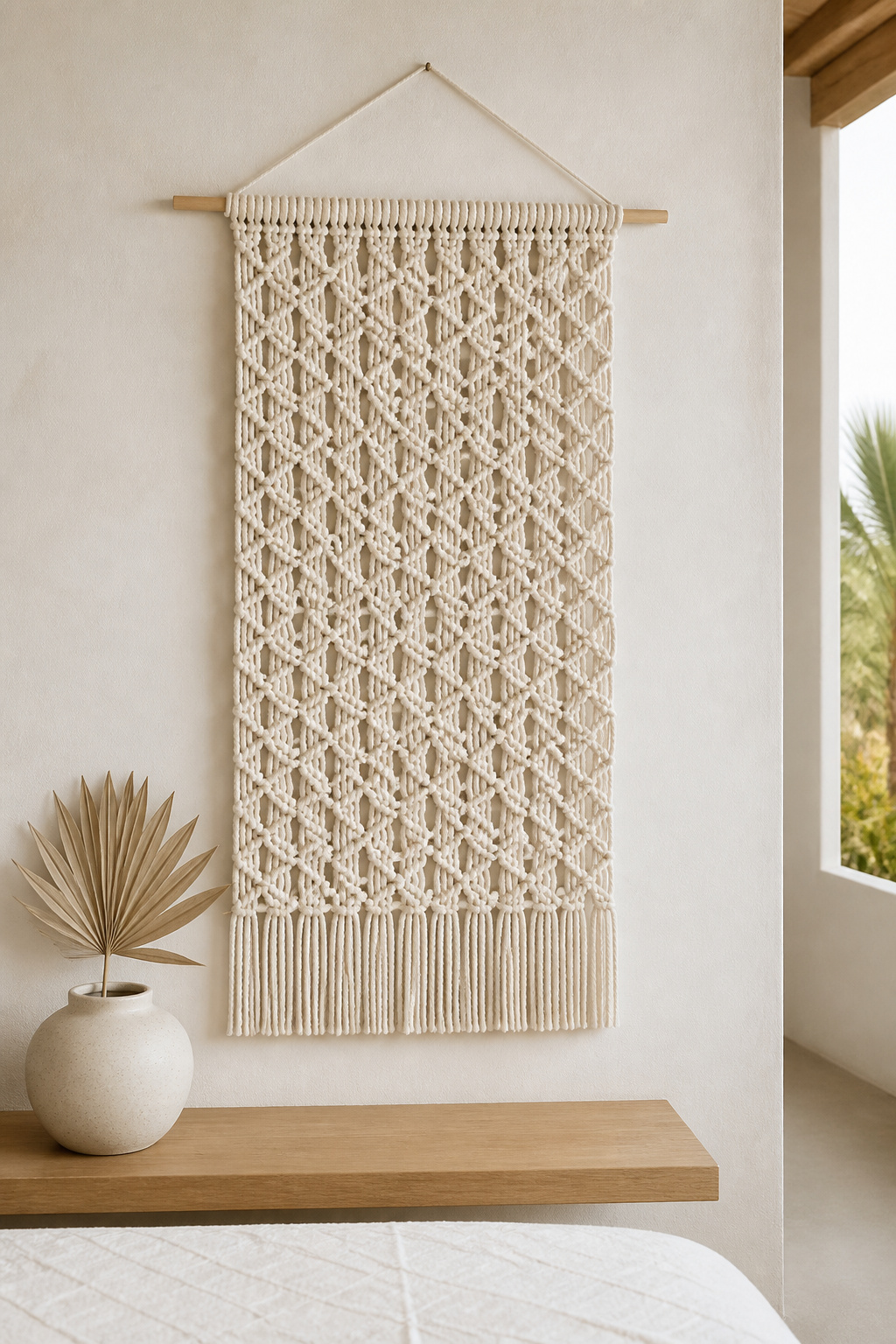
Budget Simple Bedroom Art: DIY vs. Ready-Made Macramé
The knotting tradition predates the 1970s revival by several centuries — Arab weavers in the 13th century developed decorative knotwork; sailors knotted rope on long voyages. This history gives the form more authority than its recent commercial associations suggest. For a minimalist bedroom, discipline is the key: natural cotton off-white, undyed jute, or a single dyed colour matching the room’s palette. Any multicoloured panel shifts the register from textile art to craft project.
Three-ply cotton rope at 3mm or 5mm diameter is the standard material — soft, takes knots cleanly, holds form without becoming rigid. Five-ply rope creates more pronounced knot texture and holds its shape better in higher-humidity rooms. Jute is rougher and more rustic, prone to shedding fibres, acceptable but less refined.
Recommended bedroom panel size: 40–50cm wide by 70–100cm tall. Etsy stores sell simple geometric panels at £35–£90 for ready-made pieces; beginner DIY kits — cord, dowel, and pattern included — run £15–£25 and can be completed in three to five hours. Measure wall space carefully before ordering: macramé stretches visually wider than it measures due to fringing, making this one of the most forgiving and accessible simple bedroom art options on any budget.
14. Black-and-White Photography Print for Intentional, Uncluttered Walls
Colour photography competes. A vivid seascape in a cream-and-linen bedroom palette becomes a visual disruption regardless of composition quality. In monochrome, the same scene becomes a tonal echo — the subject reduced to its structure, the palette removed from competition. Tonal reduction is precisely what allows black-and-white photography to function as bedroom art in a way that colour photography rarely achieves.
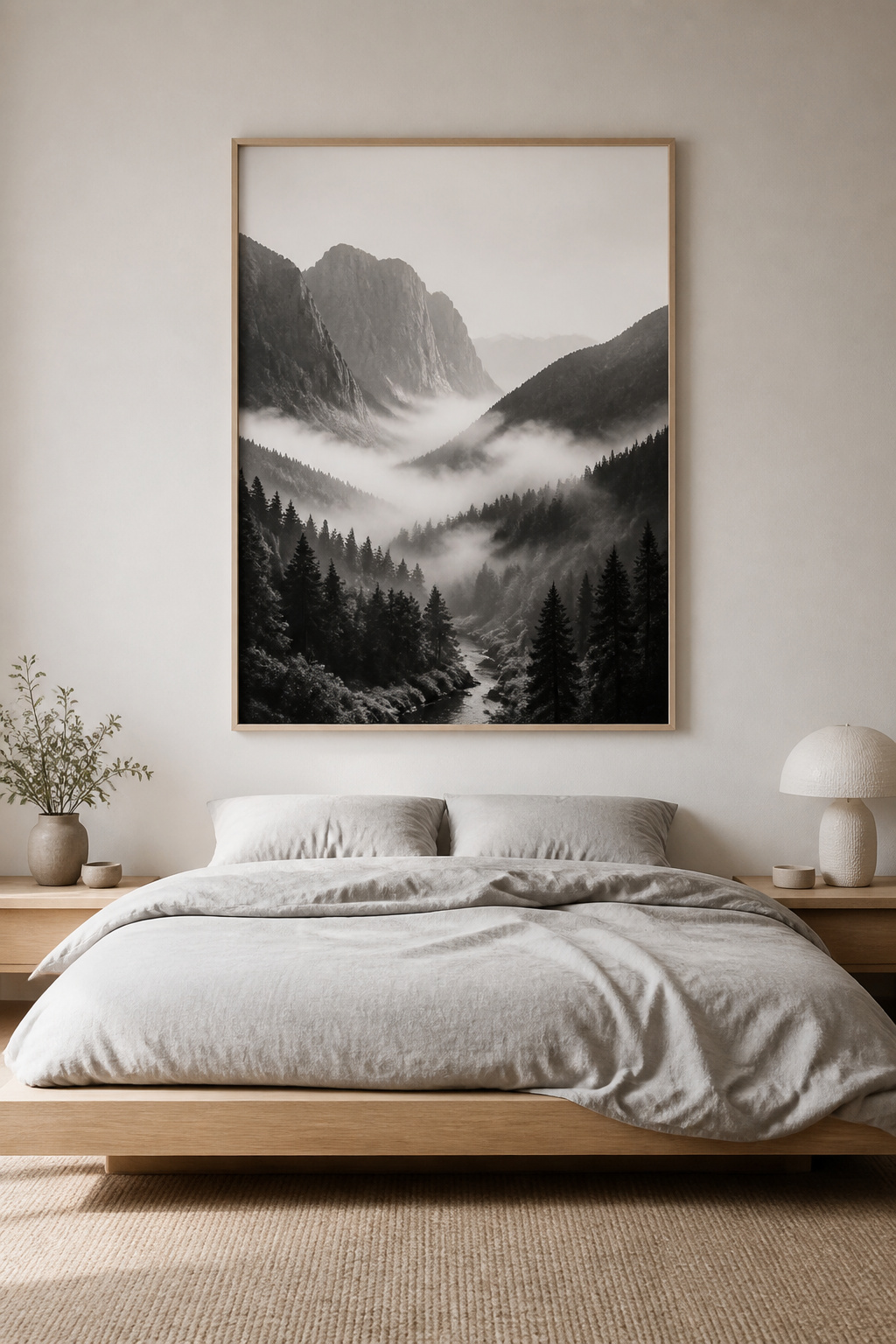
Printing Your Own Photos vs. Buying from an Artist
The Ansel Adams tradition of zone system printing — mapping a ten-tone range from pure black to pure white — demonstrates how much visual depth is available within a monochrome image. Contemporary fine art photographers working in this tradition produce genuinely museum-quality prints. The difference between a good black-and-white print and a greyscale-converted snapshot is immediately visible: the range, the texture, the way the tonal extremes sit against each other.
For self-printing: 300 DPI minimum at the intended print size. Hahnemühle Photo Rag 308 is the industry standard: cotton content, warm white, beautiful tonal gradation. Hahnemühle FineArt Baryta 325 creates silky blacks with a darkroom-paper aesthetic. WhiteWall and Prodigi both offer Hahnemühle print services for professional results at accessible prices.
Subject selection matters in a sleep environment. Misty landscapes, architectural details, close-up nature textures — bark, stone, water surface — and abstract forms like sand dunes all work well. Avoid anything with implied narrative tension: ambiguous human subjects, wildlife mid-action, weather drama. The bedroom should not create narrative questions the resting mind races to answer. Start at A3; use A2 for a feature wall piece. A single A4 photograph looks like a document, not bedroom art.
15. Bamboo Frame Nature Series: Simple Bedroom Art on Any Budget
A two- or three-print nature series in matching bamboo frames can sit comfortably under £50 while reading as considered, cohesive bedroom wall art. The material logic matters: bamboo grows to harvestable size in three to seven years compared to twenty to eighty for hardwoods. It aligns with the Japanese design principle of working with natural processes. Natural variation in bamboo grain means no two frames are identical — a small wabi-sabi detail that matters in a minimalist space.
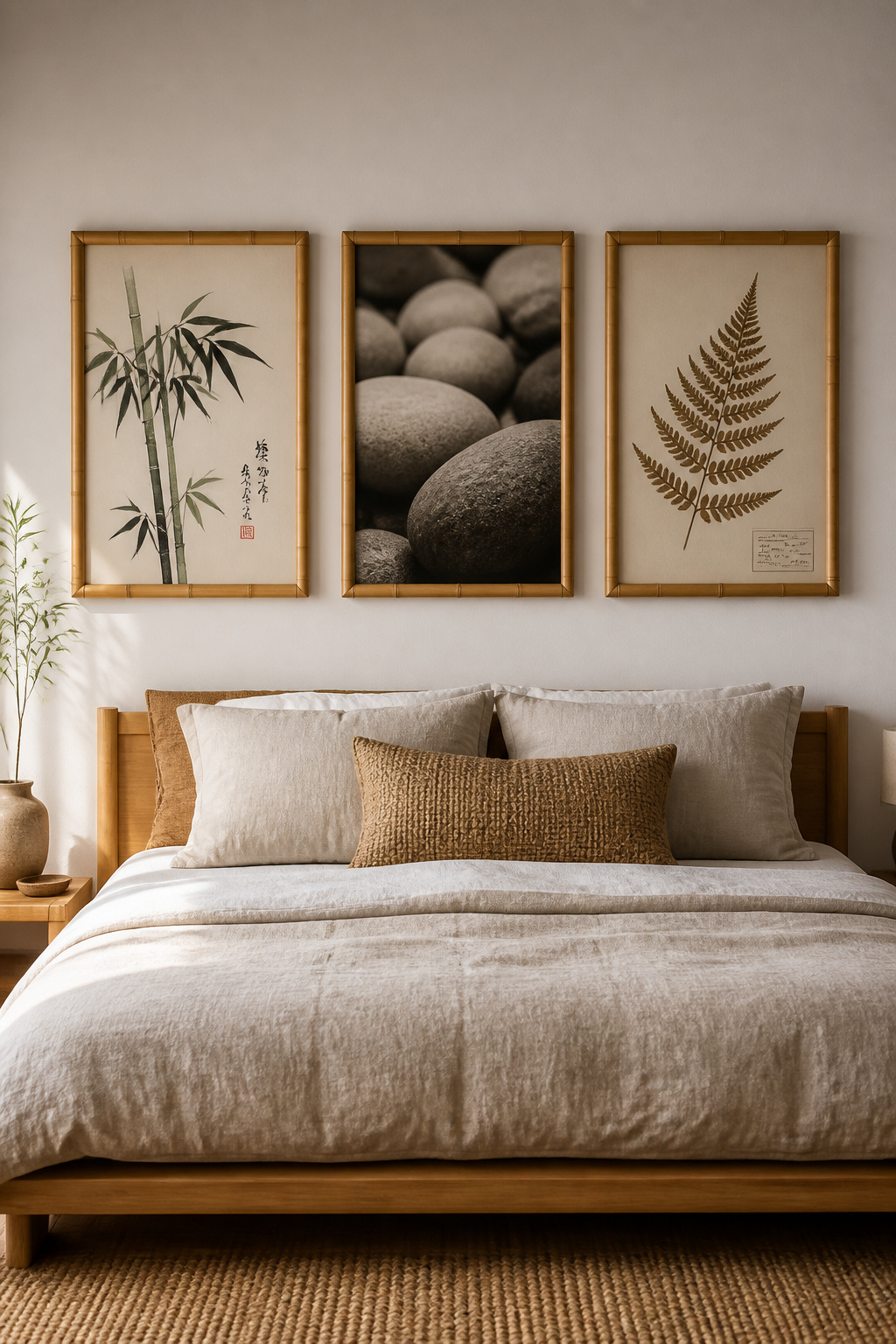
Building Your Nature Series: Cohesion, Content, and Free Prints
The series format works because cohesion comes from palette and scale, not subject identity. Same palette — all monochrome, or all in tones of green and grey-brown — different subjects: leaf, rock, water; or branch, cloud, stone. Each print is related but reveals something the others do not, which rewards the kind of slow looking a bedroom encourages. Frame all three at the same size — A3 or 30x40cm works well above a double bed headboard — with consistent mat treatment.
For free, legally downloadable print content: Rawpixel’s Public Domain section holds thousands of high-resolution vintage botanical prints and Japanese woodblock prints for personal use. The Rijksmuseum Open Access collection makes over 700,000 images available for free, including Hiroshige and Hokusai woodblock prints in very high resolution — some of the most beautiful simple bedroom art you will ever hang, for the cost of ink and paper. Unsplash provides modern photography under open licence; searching ‘minimal nature’ or ‘Japanese landscape’ finds contemporary images compatible with a minimalist series.
Bamboo frames in natural finish run £5–£15 per frame. Do not print three unrelated subjects and expect them to read as a series: the prints must share a visual language — palette, style, scale — or they read as three separate accidents that happen to share a wall.
Choosing Your Simple Bedroom Art: A Slow Approach Before You Buy
The most useful question before choosing bedroom art is not what do I like, but what does this particular wall need. Stand in the bed — not in the doorway, not at the foot — and look at the wall from where you actually rest. That resting-eye-level view is what matters most, and it is the view that most art purchasing ignores.
The practical decision between one large piece, a trio of smaller prints, and a single handmade object — the full range of bedroom wall decor ideas covered here — often resolves through room size. One large print is best for beds wider than 140cm — it creates a single focal point and requires less placement precision. A trio works better in smaller bedrooms and beside tables; it is more flexible for future rearrangement but requires more planning. A single handmade object — a ceramic disc cluster, a washi panel, a macramé piece — is the right choice when the bedroom has adequate image content and what it lacks is texture and dimension.
Before committing to any simple bedroom art purchase, use the painter’s tape test: cut paper to the intended dimensions, tape it to the wall, and live with the outline for three days. Reassess on day one (novelty), day two (habit), and day three (honest evaluation). For colour pieces, hold a swatch against the wall under both natural daylight and warm LED evening light — colours shift dramatically between the two. For texture decisions, photograph the wall and mock the piece digitally before buying.
The test costs nothing, takes five minutes, and regularly saves people from a purchase they would have regretted. Commitment anxiety is the real reason most bedroom walls remain bare: the fear of choosing wrong. Three days with a paper rectangle usually dissolves it.