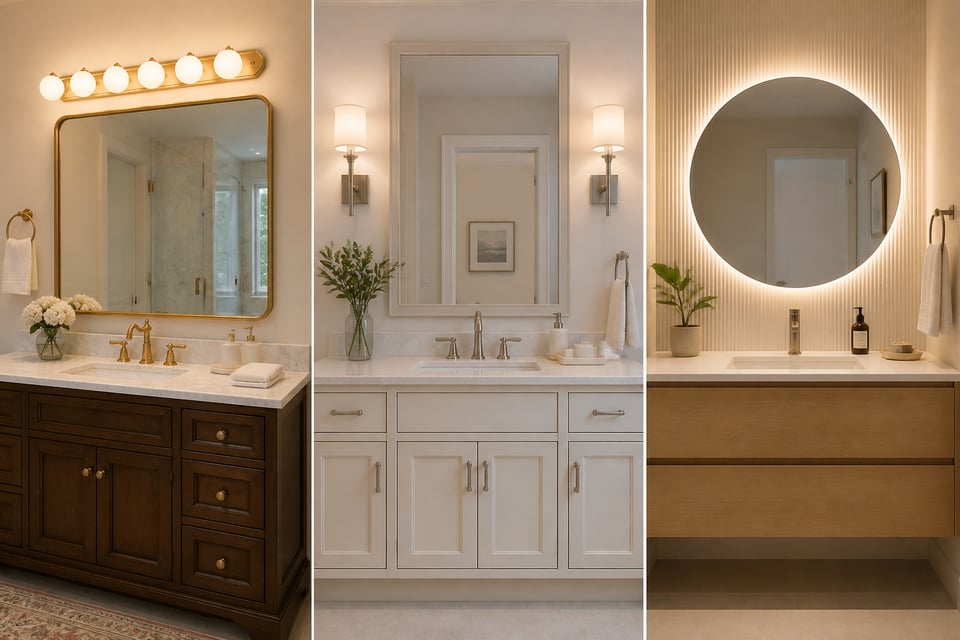
There’s a particular misery to getting ready in bad bathroom vanity lighting — the kind that sits directly overhead, turns your face into something resembling a police interrogation subject, and makes you question every makeup decision you’ve ever made. Bathroom vanity lighting is the variable that determines whether your bathroom functions or merely exists, and it’s routinely treated as an afterthought, slotted in during the final week of a renovation when the budget is already exhausted.
The good news is that getting it right doesn’t require a designer or a significant outlay. It requires understanding what the light actually needs to do — illuminate your face from the correct angle, at the right colour temperature, with enough brightness to be useful — and then choosing a fixture that fits your style, your space, and your ceiling height. These seventeen bathroom vanity lighting ideas cover the full range, from the historic format that’s barely changed in a century to smart systems that adjust colour and brightness on demand.
1. Hollywood Strip Lighting: The Original Bathroom Vanity Lighting Classic
The Hollywood-style bulb strip was born in the backstage dressing rooms of the 1920s, where stage performers needed even, accurate illumination to apply makeup that would read correctly under theatrical lighting. Nearly a hundred years later, the format is essentially unchanged — because it works.
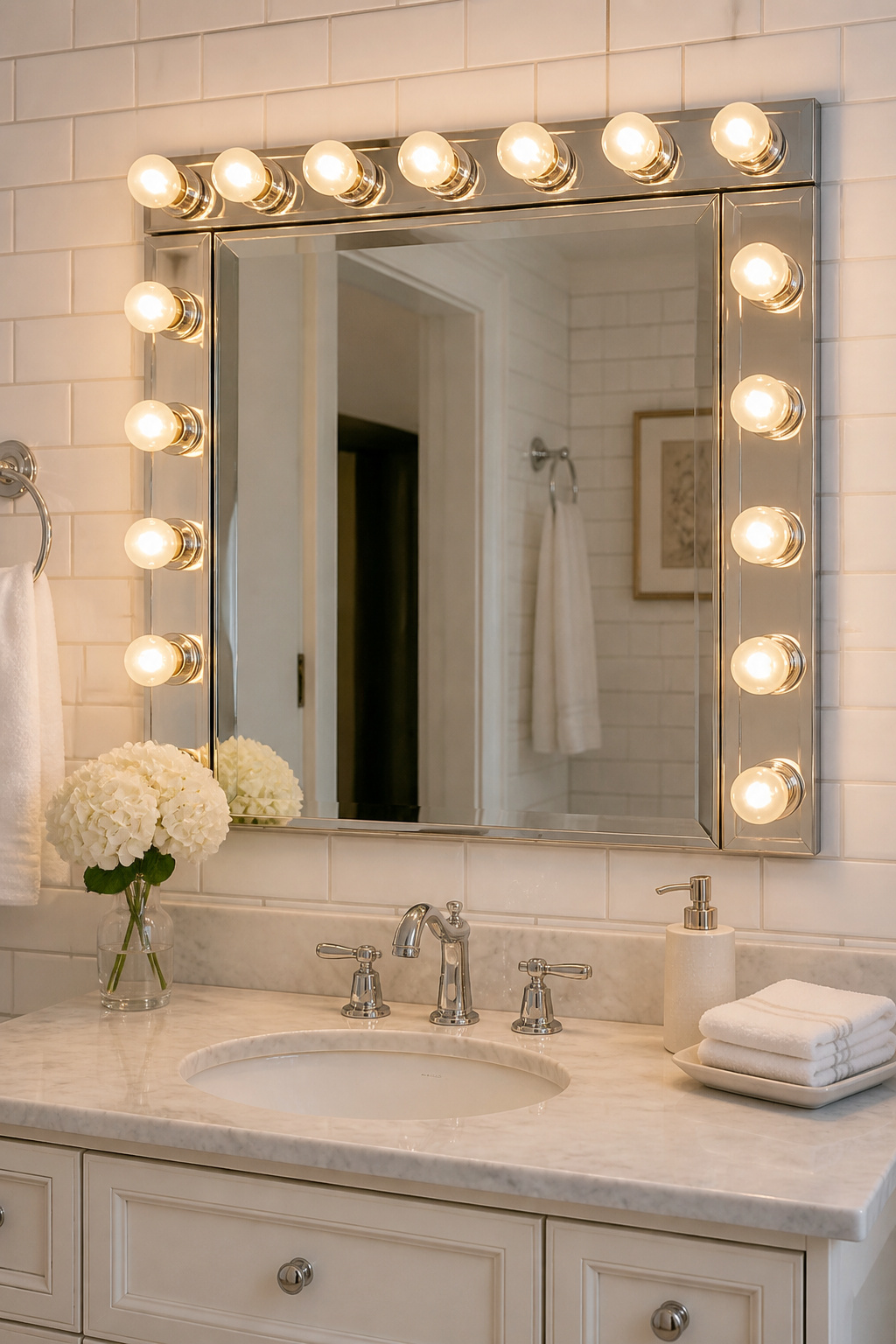
By positioning multiple light sources around the mirror at face height rather than above it, the strip eliminates the directional shadows that make conventional overhead lighting so unflattering. Standard strips run 24 to 36 inches wide and space bulbs 4 to 6 inches apart, delivering even cross-illumination without hot spots or dark zones. The colour temperature question is worth settling early: 2700K to 3000K is the practical sweet spot — warm enough to be flattering, accurate enough for everyday use. CRI 90 or above is non-negotiable for face-level tasks, since anything lower distorts colour rendering and guarantees mismatched makeup in daylight.
Modern versions use LED globe bulbs in brushed brass or polished nickel holders — dimmable filament-style LEDs that replicate the original aesthetic at around 5% of the energy draw of tungsten. Prices run from £40/$50 for basic five-bulb strips to £200/$250 for designer versions in unlacquered brass. The one sizing rule: match or slightly undersize the fixture relative to mirror width. A strip wider than the mirror looks unbalanced; one fitted to it looks considered.
2. Side-Mounted Sconces That Eliminate Unflattering Shadows
The single most useful thing you can do for your bathroom mirror is put the lights beside it rather than above it. Side-mounted sconces flanking the mirror deliver cross-illumination — light arriving from both sides simultaneously — which eliminates the downward shadows that gather under brows, nose, and chin when the source is overhead. The IESNA identifies side-flanking as the most effective layout for vanity mirror tasks, which is the sort of institutional endorsement that’s useful to have when convincing a contractor to move an electrical box.
Mounting height is specific enough that guessing usually goes wrong. The centre of the sconce should sit 60 to 65 inches from the finished floor — below 60 inches risks lighting the chin, above 65 inches starts casting downward shadows again. Spacing is equally precise: leave 4 to 5 inches between the mirror edge and the inner face of the sconce, which on a 36-inch mirror puts the centres approximately 27 to 30 inches apart.
Style-wise, sconces arrive in three families worth knowing. Arts and Crafts designs use mica, slag glass, or hammered metal — period-authentic for craftsman or heritage bathrooms. Mid-century sconces favour bare globe bulbs in brass or cylindrical chrome, popular in 2025/26 for their clean geometry. Contemporary options run from drum shades to minimal half-cylinder mounts, covering virtually every aesthetic from rustic to hotel-modern. If bathroom mirrors are doubling as decorative focal points as well as task surfaces, side sconces are the format that elevates the mirror without competing with it.
3. Pendant Lights Above a Double Vanity Sink
Pendants in bathrooms are the design choice that looks extraordinary in the right conditions and slightly unfortunate in the wrong ones. The right conditions include a ceiling height of nine feet or higher, a mirror mounted high enough on the wall, and a bathroom zone that permits decorative pendants without requiring IP65-rated fittings. The wrong conditions are, broadly, everything else.
When they work, they work beautifully. Two pendants above each sink of a double vanity — rather than one centred fixture — provide better task illumination while reading as architectural. Shade choice matters: seeded glass diffuses light softly and tolerates moisture; metal dome shades in brushed brass or matte black are the most moisture-resistant; rattan is fashionable but genuinely problematic in steam-heavy rooms, absorbing moisture and warping over time.
The IP rating requirement is worth understanding before purchasing anything. UK Zone 2 requires minimum IP44; Zone 1, directly above a bath or shower, requires IP65. US NEC requires the bottom of any pendant to hang at least eight feet above the highest point of the bathtub’s walls. The practical lesson: always verify the fixture rating and bathroom zone before falling in love with a specific shade, since returns are rarely straightforward on made-to-order pendants.
4. LED Backlit Mirrors That Serve as Bathroom Lighting
The backlit mirror makes the most sense for those who want to eliminate the fixture-plus-mirror combination entirely. One element serves both functions, the installation is clean, and in a bathroom with limited wall space, it’s often the only practical option for achieving proper illumination without crowding the walls.
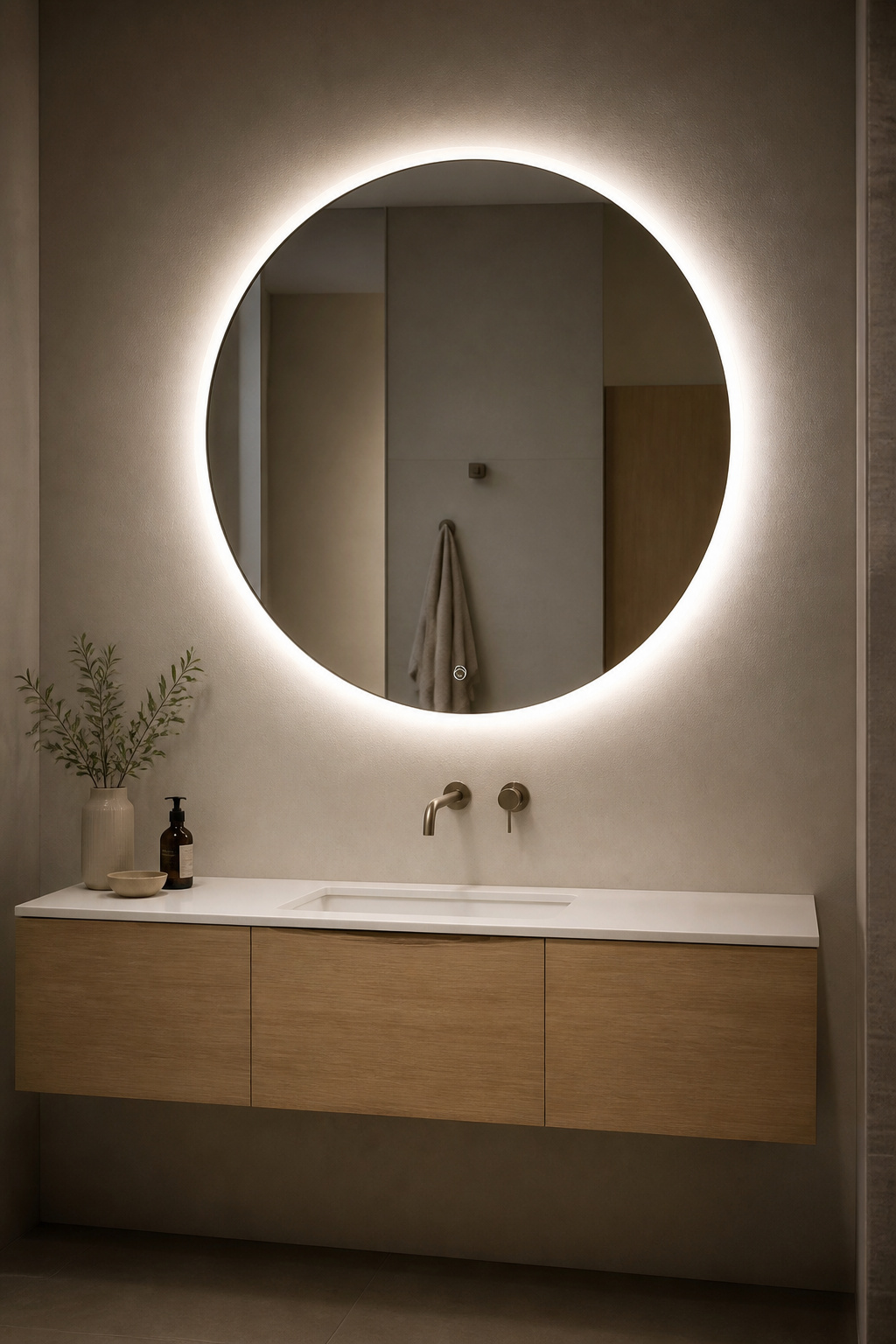
The distinction between backlit and edge-lit is worth making. Backlit mirrors project light from behind the mirror edge, creating a halo effect — flattering and spa-like, less precise for task illumination. Edge-lit models have LEDs within the mirror’s edge, producing more even face illumination. Neither replaces dedicated side sconces for precision grooming, but both outperform a single overhead fixture by a meaningful margin.
The specifications that matter: CRI 90 or above (Krugg’s Icon range meets this standard; their 2835 LED strips deliver 4.6 times the brightness of standard mirror LEDs), an integrated dimmer with at least ten steps, and a built-in demist pad if the bathroom sees regular hot showers. Dual-CCT models — switchable between 2700K and 6000K via touch sensor — cost 20 to 30% more but allow the same unit to serve a morning grooming session and a relaxing evening bath without compromise. Round backlit mirrors used as mirrors that function as statement wall art above simple vanities create a deliberate tension between the circular form and straight-edged cabinetry that reads as more sophisticated than it costs.
5. Industrial Edison Bulb Fixtures With Character and Warmth
The industrial bathroom is, in many ways, a reaction against the relentless refinement of the spa-style aesthetic that dominated the 2010s. Where the spa bathroom favoured smooth tile, chrome fixtures, and warm neutrals, the industrial bathroom celebrates exposed pipe, concrete, reclaimed timber, and the deliberate roughness that says the space has a history even if it was built last year.
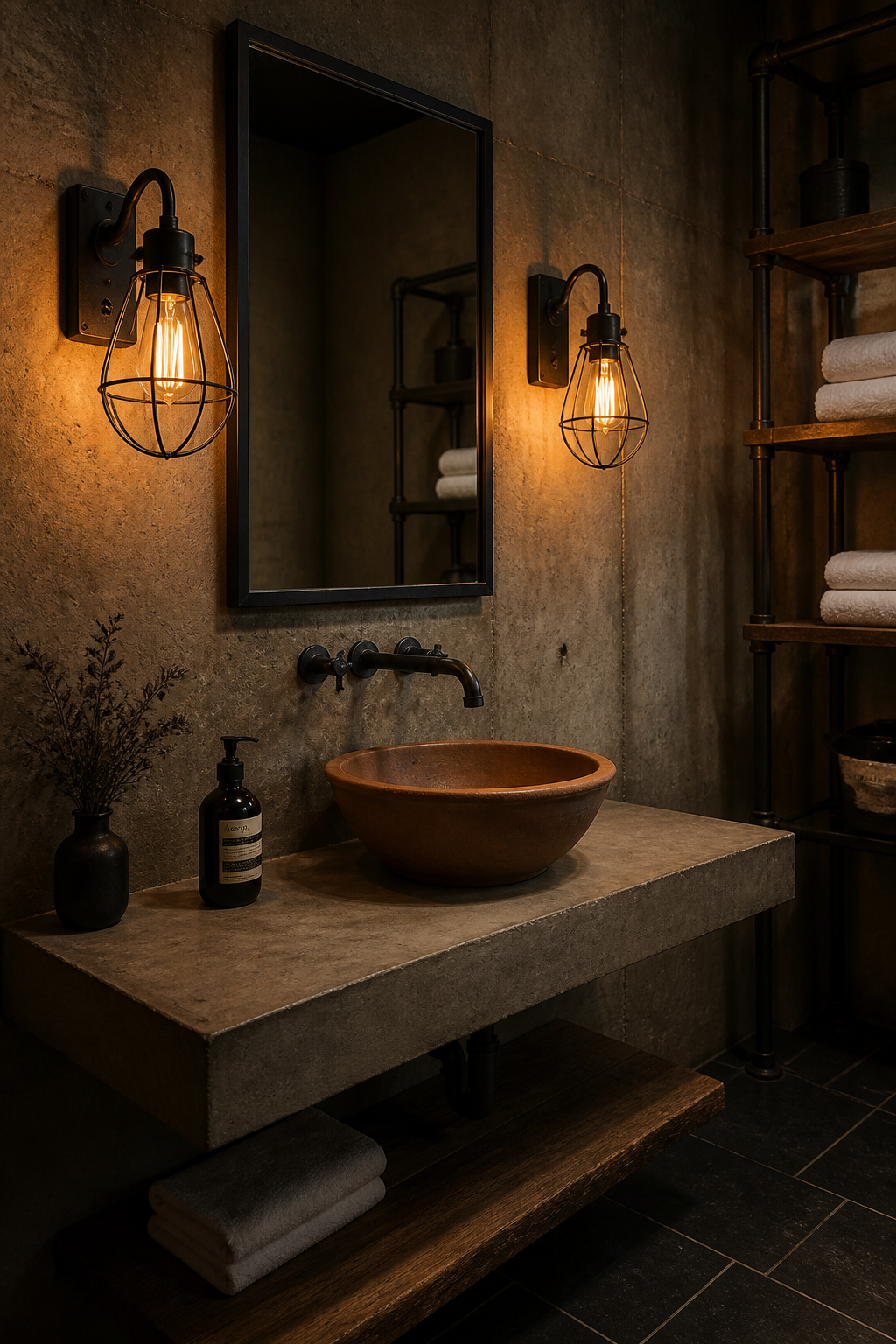
In this context, the Edison bulb fixture earns its place by being honest about what it is. The exposed filament bulb — now reproduced in LED form at roughly 5% of the energy consumption of tungsten — projects warm amber light at around 2200 to 2400K. That’s lower than recommended for precise grooming, making these fixtures better suited to a secondary or guest bathroom where atmosphere matters more than makeup accuracy.
The two main families are pipe-style and cage-style. Pipe-style wall mounts use threaded black iron pipe as the arm — the hardware is the point, suiting loft conversions and converted industrial spaces. Cage-style fixtures enclose the bulb in a metal cage, a slightly more finished reading for industrial-rustic or mid-century applications. Both are accessible: pipe-style bars from £35/$45, cage sconces from £25/$35. Technical note: LED filament bulbs require a leading-edge or LED-rated dimmer. Standard trailing-edge dimmers cause audible hum and inconsistent dimming.
6. Brass Globe Bulb Bathroom Vanity Light for Transitional Spaces
The decline of chrome as the default bathroom finish has been one of the quieter design shifts of the past half-decade. In its place, unlacquered brass and brushed warm metals have taken the aspirational position — and not arbitrarily. Unlacquered brass develops a natural patina over time, each mark and colour shift adding character rather than registering as wear.
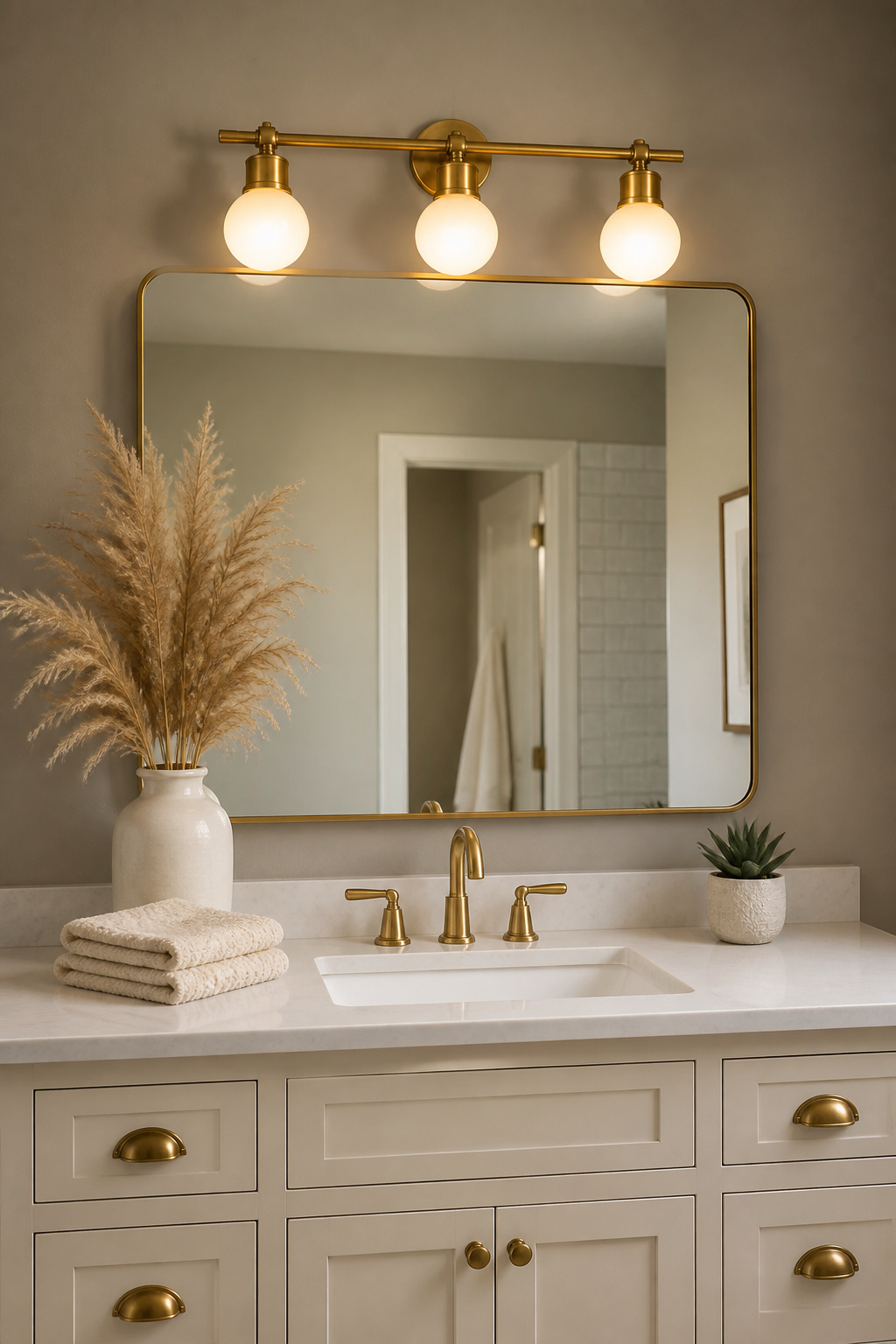
The globe bulb bar in warm brass is the format most associated with this shift. For a single vanity 24 to 36 inches wide, a 3-light bar in 24 to 30 inches suits the scale — CB2’s Marra 3-light polished unlacquered brass globe bar is a widely referenced mid-market option. For a double vanity, a 5- or 6-light bar or two 3-light sconces flanking each sink both work. Hinkley, Progress Lighting, and Savoy House all offer brass globe bars running £120 to £300/$150 to $380. If you’re interested in where bathroom hardware is heading more broadly, the current wave of bathroom vanity trends covers the picture well.
The metal mixing principle is straightforward: warm metals (brass, aged bronze, unlacquered copper) mix naturally; cool metals (chrome, polished nickel) form a separate family. Matte black can anchor either. The error to avoid is warm brass fixtures alongside cool chrome faucets — the undertones fight in a way that reads as oversight rather than intention.
7. Linear LED Bars: Minimalist Bathroom Vanity Lighting Done Right
The case for the linear LED bar is essentially an aesthetic argument dressed in practical clothes. A single horizontal LED element above the mirror eliminates the visual clutter of individual bulb sockets, arms, and canopy plates — the fitting reads as one continuous architectural line rather than a light fixture that needed to be installed somewhere. In a bathroom working hard for minimalism, that is not a small distinction.
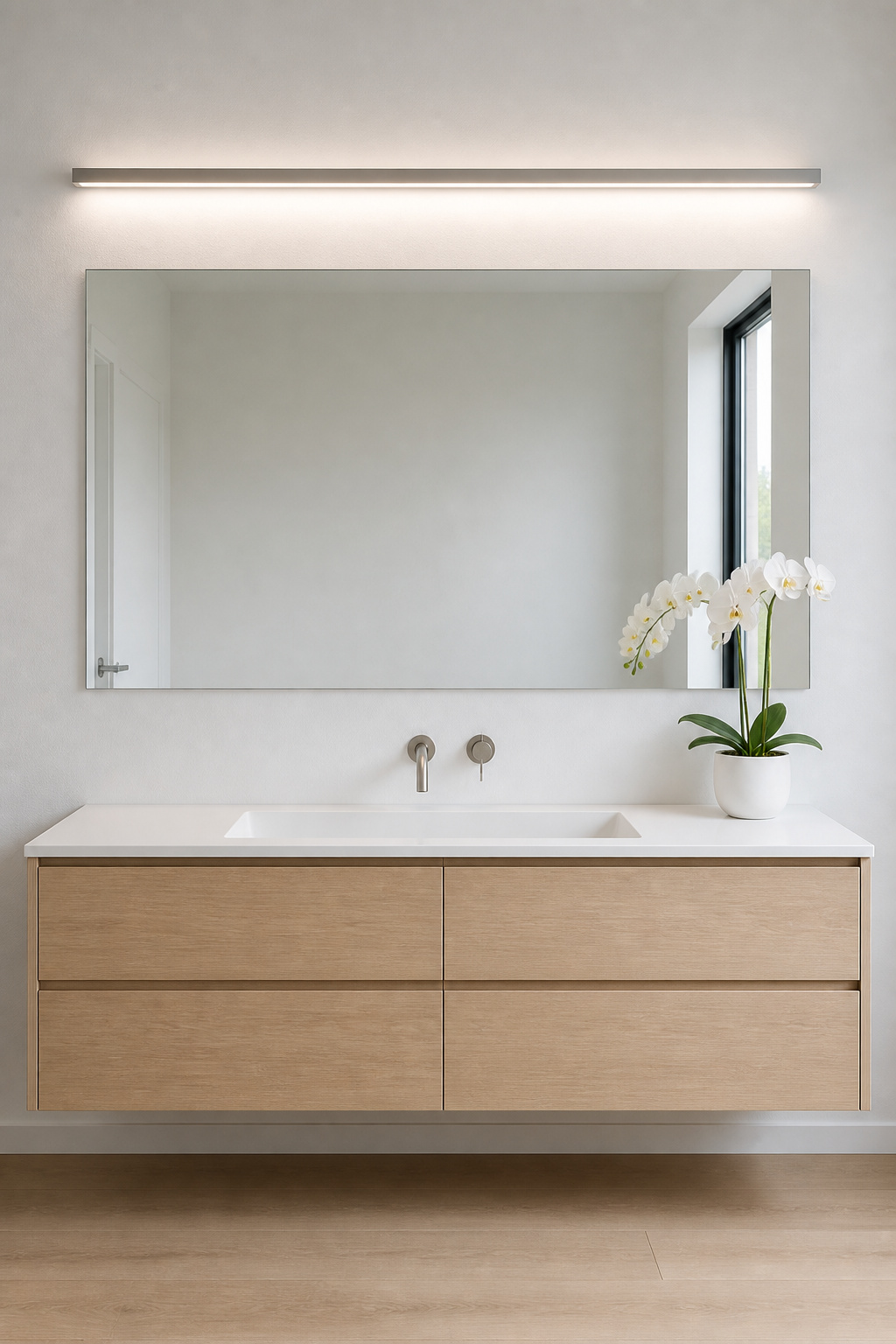
Available in 18, 24, 36, and 48-inch lengths, the standard guidance is to match or slightly undersize relative to mirror width. Lithonia Lighting, Sunco Lighting, and LUXRITE all offer bathroom-rated bars in the 24 to 40 watt, 1700 to 2200 lumen range with damp-location ratings. The LUXRITE 24-inch bar in brushed nickel offers five switchable CCT options between 2700K and 5000K at CRI 90 — covering the full range from warm ambient to daylight-accurate task light. There’s a coherent body of bathroom vanity lighting principles around when each CCT suits each use case, if the decision feels more complex than it initially appears.
The installation distinction between flush (no visible gap between bar and wall) and floating (a shadow gap) produces a meaningfully different visual result: flush reads as architectural, floating reads as more consciously designed. Both use the same backplate — the choice is essentially a question of how much the fixture should announce itself.
8. Nautical Lantern Sconces for Coastal-Style Bathrooms
The maritime design tradition arrived in residential bathrooms through the great ocean liner interiors of the 1930s and 1940s, then through the English coastal cottage, and eventually into the broader coastal aesthetic that has maintained its popularity for three decades without serious sign of retreat. The nautical lantern sconce is among the most faithful elements of that tradition — originally designed for salt air and moisture, which translates directly to the bathroom environment.
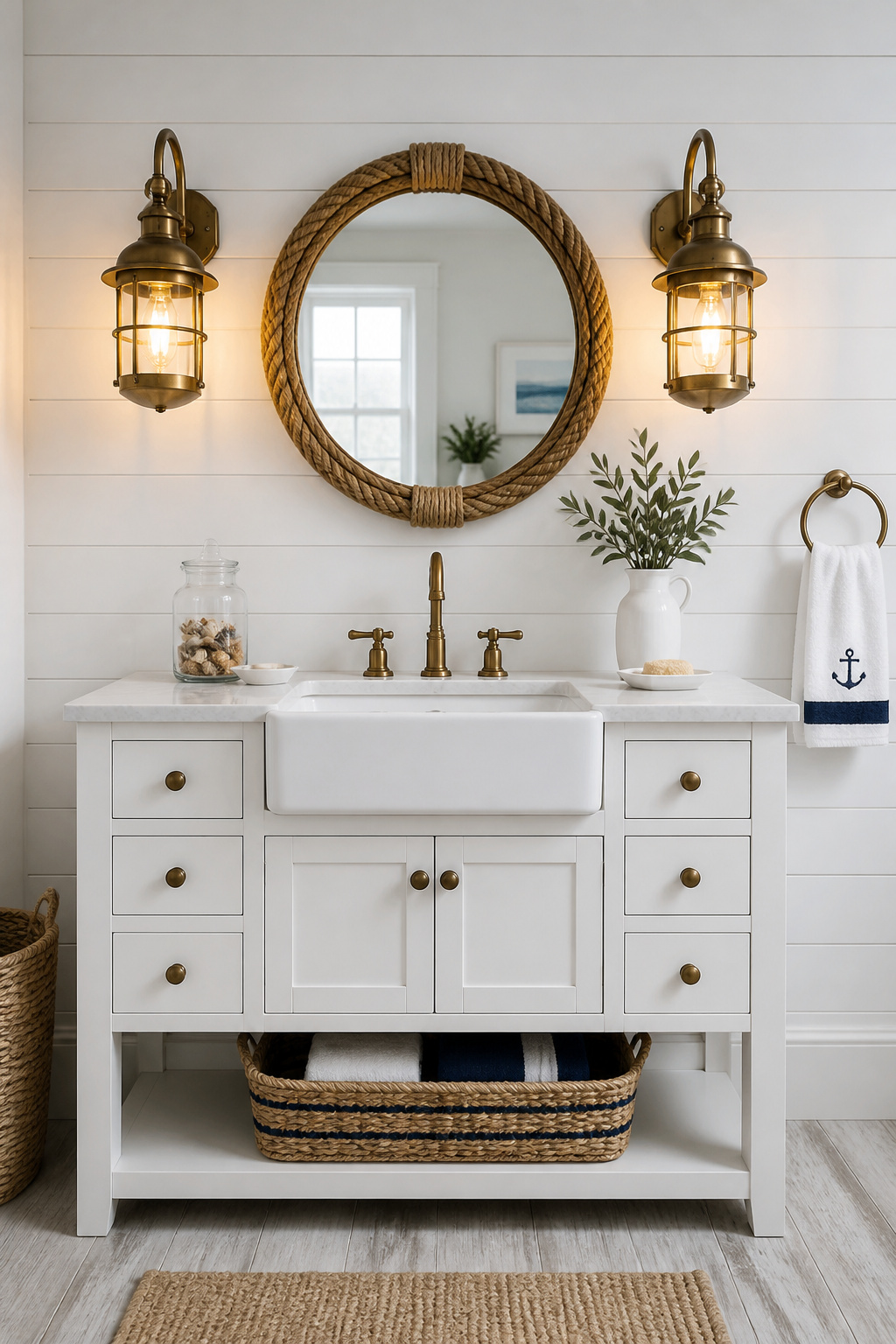
In finish terms, the choice tells you a great deal about the room’s direction. Aged or antique brass is the historically authentic reading, correct for Georgian, Victorian, or traditional coastal homes. Galvanised steel or brushed nickel suits contemporary coastal rooms with cooler palettes — greys, crisp whites, muted blue-greens. Oil-rubbed bronze sits between them: warmer than nickel, less formally traditional than aged brass, and considerably more forgiving of water spots.
The restraint question is the real design challenge. One pair of lantern sconces flanking a mirror is a considered choice. Add rope mirrors, ship-wheel towel hooks, and a lighthouse print above the bath and you’ve drifted into themed retail territory. Choose the lantern in a finish that appears elsewhere in the room — aged brass that echoes faucet hardware, for instance — rather than introducing it as a standalone decorative statement. For a full approach to coastal bathroom renovation ideas that extends well beyond the lighting, there’s more to work with in that direction.
9. Recessed Downlights as Supplementary Bathroom Vanity Lighting
The recessed downlight is among the most misunderstood fixtures in residential bathrooms. Installed directly above the mirror, it replicates exactly the illumination problem it was presumably trying to solve — overhead light casting downward shadows under brows, nose, and chin. Recessed downlights are not bathroom vanity lighting. They are ambient lighting that happens to be near the vanity, and understanding that distinction is most of the work.
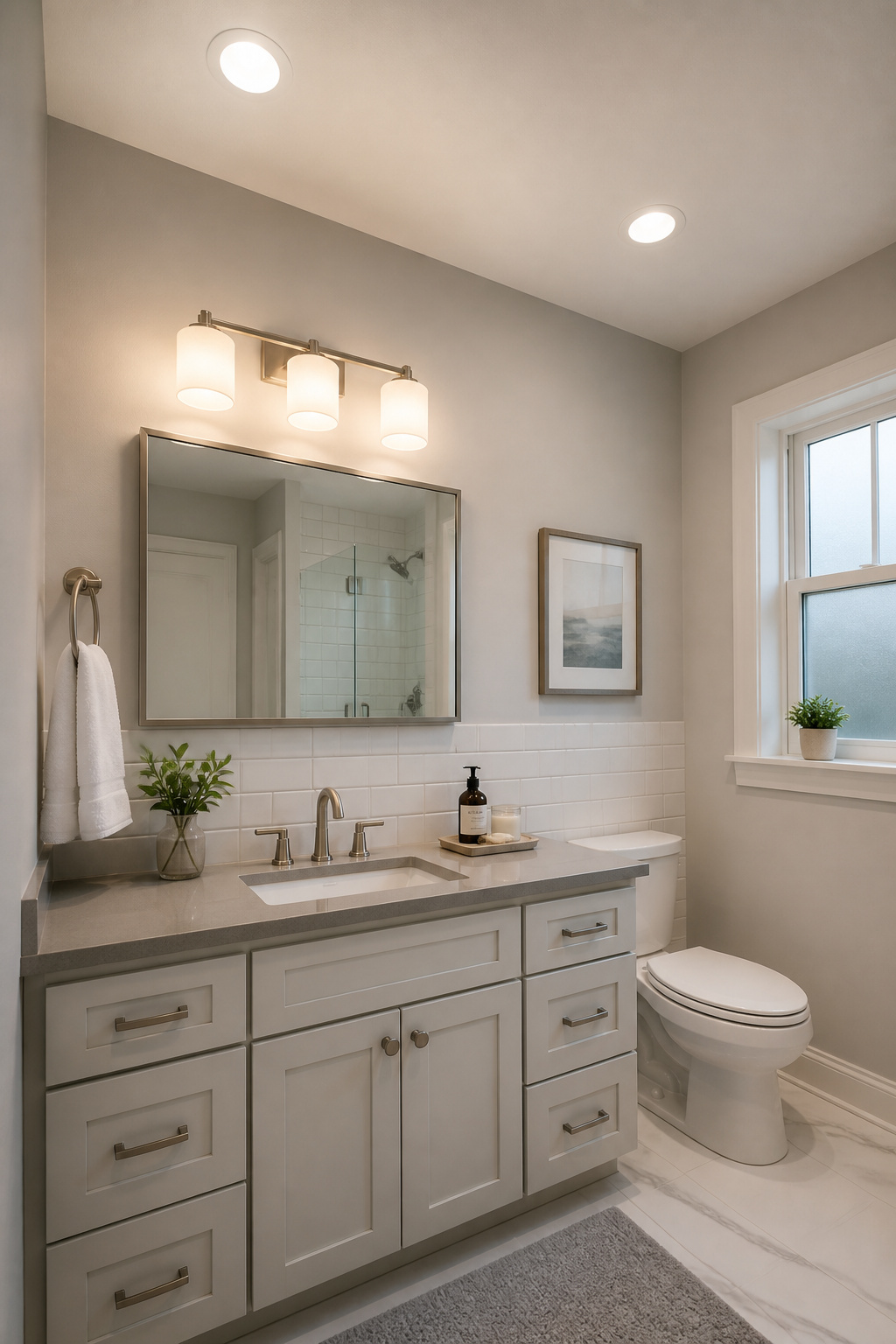
The correct role for a recessed downlight in a bathroom is as the ambient fill layer in a properly layered scheme. The vanity fixture handles face-level task illumination; the recessed fixtures handle the rest of the room. For this to work, the two systems need separate dimmer circuits — a single switch controlling both makes the layered approach pointless.
Positioning matters. A recessed fixture placed 24 to 30 inches out from the vanity wall (rather than directly above it) provides useful fill light without recreating the overhead shadow problem. The electrical specifications to verify: IC-AT rating is required in most modern constructions where insulation is present above the ceiling. UK Zone 1 requires IP65-rated recessed fixtures; Zone 2 requires IP44 minimum. US wet-location and damp-location ratings map broadly to the same geographic zoning. Getting thoughtful bathroom storage organisation right in the same renovation pass is worth considering — lighting and storage decisions interact when shelving positions intersect with recessed fixture locations.
10. Art Deco Globe Clusters That Make the Mirror a Focal Point
The Art Deco bathroom had a very specific visual proposition: geometric precision, theatrical contrast, and the confident glamour that didn’t ask permission. The first wave ran through the 1920s and 1930s — hex tile floors, chrome fittings, bold pendant fixtures. The contemporary revival preserves the geometry while lightening the palette, producing bathrooms that reference the source material without committing entirely to period reproduction.
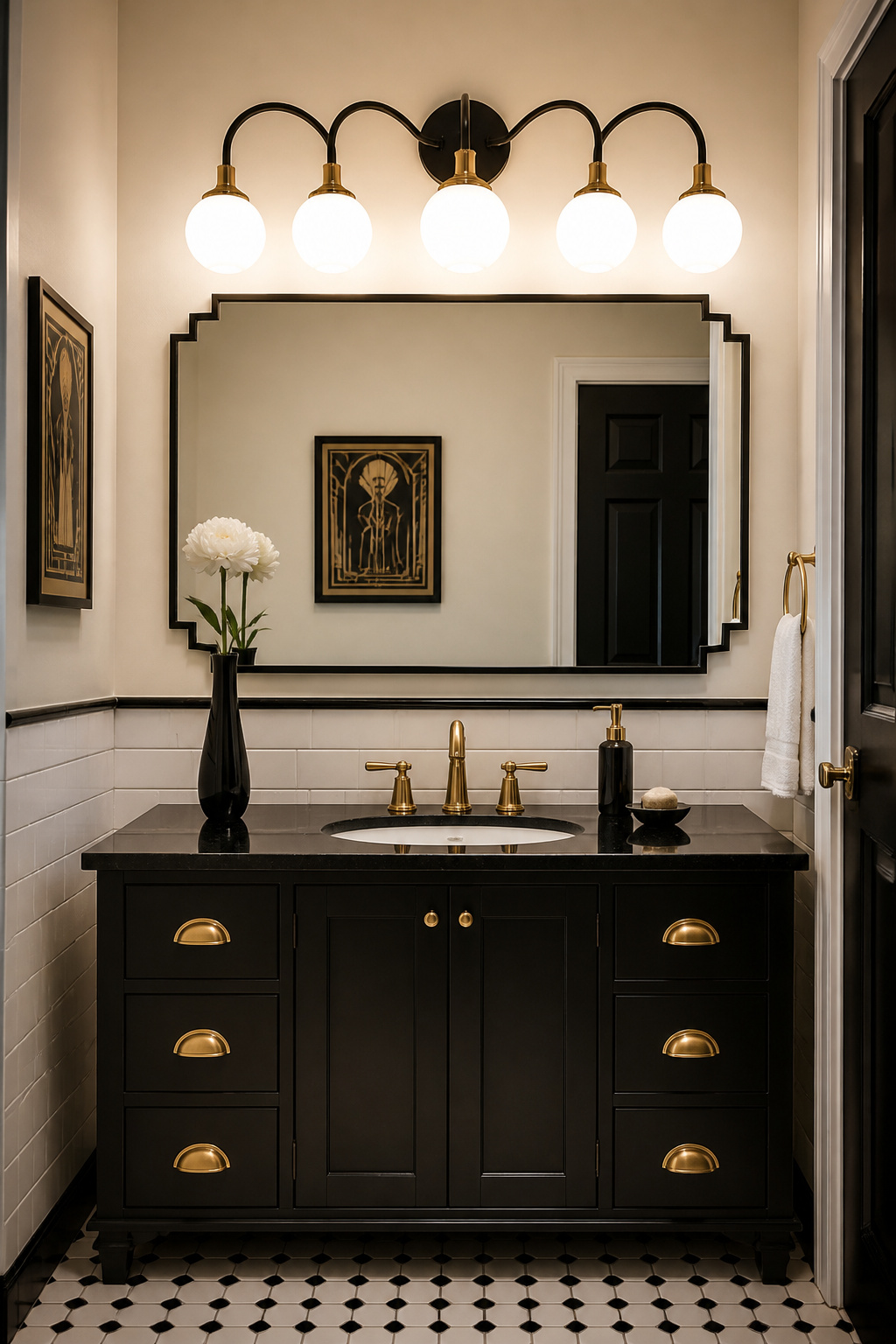
The multi-globe cluster fixture carries the most Art Deco visual information. A 3-light cluster suits mirrors up to 36 inches wide; a 5- or 6-light cluster scales to double vanities or large statement mirrors. Arm length determines theatrical weight: shorter arms (4 to 6 inches) read architectural; longer arms (8 to 12 inches) read more expressively decorative. Galleria Lighting’s 6-light Cluge in modern gold with matte opal globes sits at $180 to $220 and delivers the Art Deco geometry without the full period commitment.
The finish-and-glass combinations produce meaningfully different results. Matte black frame with gold sockets is the sharpest contemporary reading — works in monochrome bathrooms with brass hardware and white tile. Polished chrome arms with opal white globes is the most traditionally Art Deco response, referencing the great ocean liner bathrooms of the 1930s. Brushed nickel with frosted glass is the most versatile version — holds the geometric reference without the theatrical commitment.
11. Task Lighting Solutions for His-and-Hers Double Vanities
A double vanity used simultaneously by two people is, functionally, two separate workstations that happen to share a counter. A single light source serving both positions is a daily negotiation dressed up as bathroom design — one person’s preferred brightness becomes the other’s problem, and neither gets the illumination they actually need.
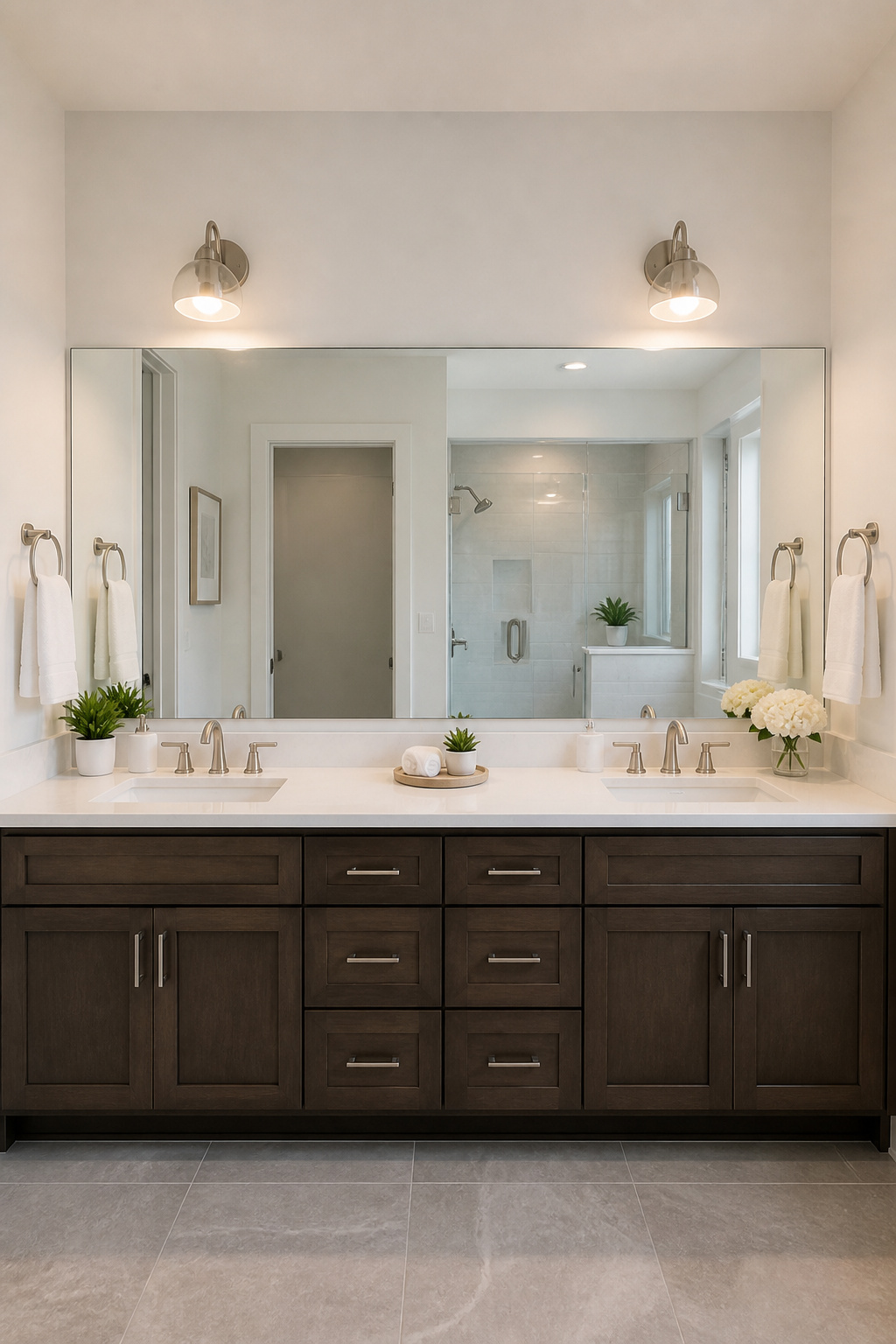
The solution is independent lighting zones at each sink position, running on separate dimmer circuits. Twin sconces above each mirror position provide the best task illumination and most flexibility, though they require symmetrical mirror placement and aligned electrical boxes — a consideration worth raising early in any renovation. A single long bar (48 to 60 inches for a 60-inch double vanity) is simpler to install and cleaner in appearance, but creates a zone of lower illumination at the vanity’s centre. The Hollywood strip across the full mirror width is the most even solution — the format professional dressing room designers have used for exactly this configuration for a century.
LED dimmers need to be specified for LED loads — trailing-edge (reverse phase) dimmers are generally preferred for LED compatibility. Smart dimmer switches (Lutron Caseta, or dimmers compatible with Philips Hue) add app and voice control without requiring the fixtures themselves to be smart. The minimum load issue: some LED dimmers require a minimum wattage to operate correctly — verify the dimmer specification against the total LED wattage on that circuit before purchase.
12. Frosted Glass Sconces for Diffused Bathroom Vanity Light
Frosted and opal glass sconces are, arguably, the most forgiving bathroom vanity lighting choice available. The diffused light that passes through frosted glass flatters skin tones, reduces harsh contrasts, and creates a softness that most bathrooms benefit from — without sacrificing the useful illumination that makes vanity lighting functional rather than merely atmospheric.
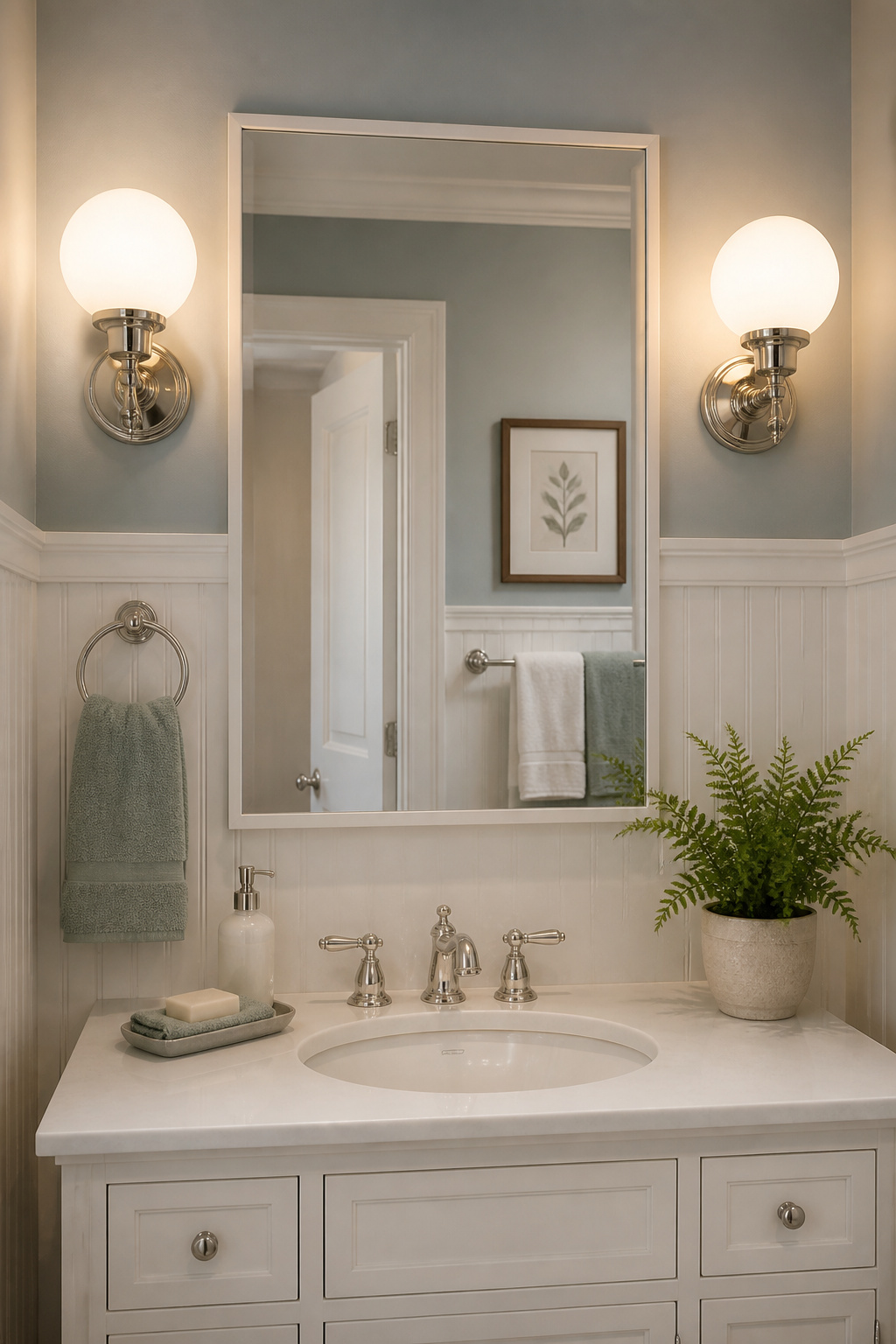
The distinction between frosted and opal glass is worth making. Frosted glass scatters light in multiple directions while remaining slightly translucent — the bulb shape is still faintly visible. Opal glass (the dense, milky white variety) completely obscures the bulb and produces a lamp-like glow. Opal is more diffusing and softer; frosted is slightly more directional and therefore more useful for task work. Worth considering based on how much precision grooming the bathroom needs to support.
Classic shapes translate well into frosted finishes. The schoolhouse globe — round shade, flat rim — is the most versatile silhouette, working in traditional, transitional, and farmhouse bathrooms without strain. The drum shade is clean and contemporary, suited to straight-line geometry. The globe sconce, a round shade on a simple wall mount, is common in hotel bathrooms for good reason: it reads as deliberately considered without announcing the price. Sconce height should be roughly one-quarter to one-third of the mirror height — a 36-inch tall mirror suits sconces 8 to 12 inches tall.
13. Rustic Wrought Iron Fixtures for a Farmhouse Bathroom
The farmhouse bathroom has a clear point of view about materials (honest, durable, natural), a consistent palette (whites, creams, warm neutrals, dark iron), and a settled vocabulary that doesn’t require much interpretation. Within that vocabulary, the lighting fixture is among the most visible design decisions in the room. The wrong fixture — a chrome bar, a polished nickel globe cluster, anything smooth or metropolitan — undercuts the aesthetic with a single purchase.
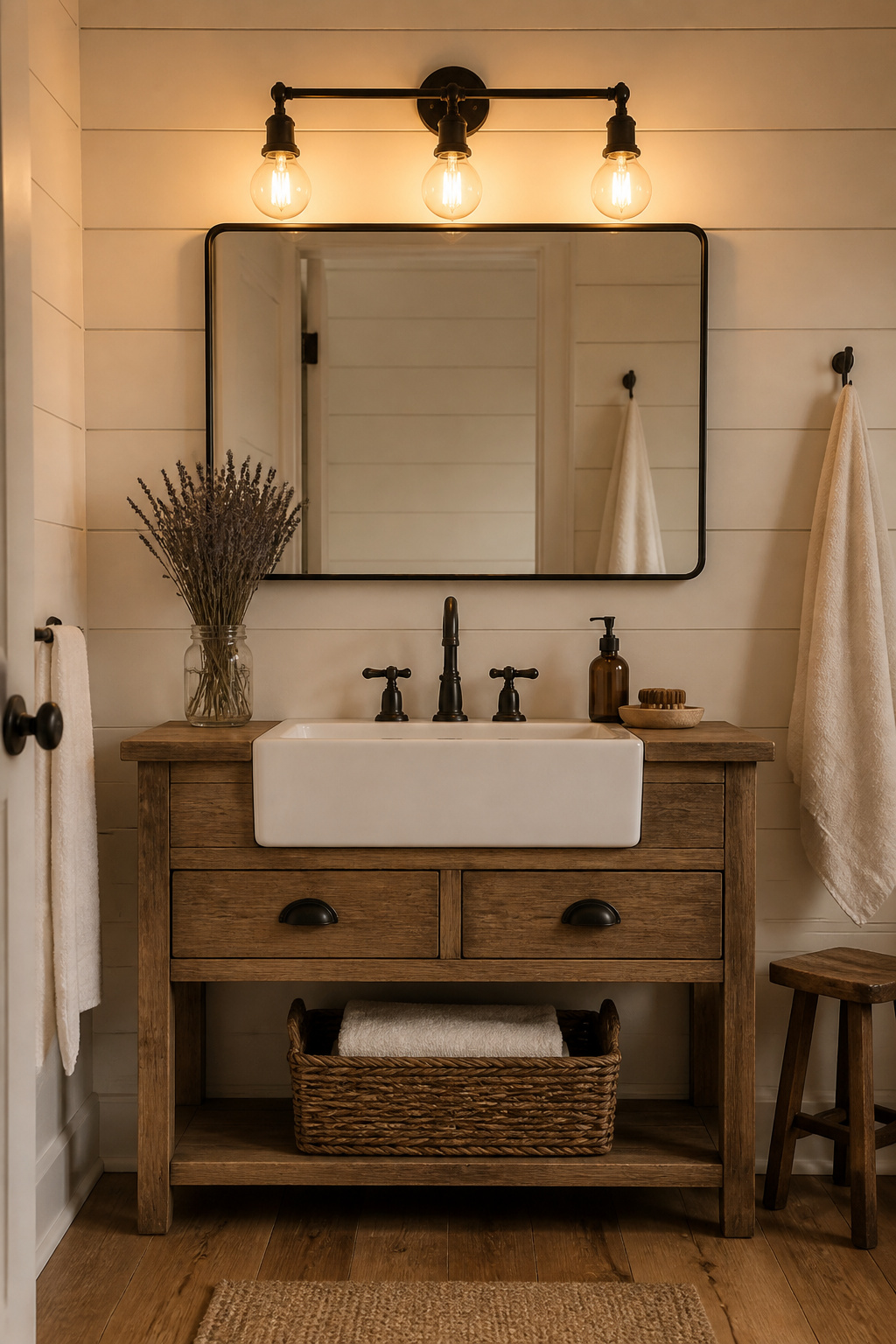
Wrought iron and oil-rubbed bronze vanity fixtures are accessible across a meaningful price range. The Westinghouse Iron Hill 3-light bar in oil-rubbed bronze runs £60 to $80 and measures 29 inches wide — a well-specified mid-market option. Kira Home’s Beacon 3-light oil-rubbed bronze is comparable at £55 to $75, slightly warmer in finish. The designer tier (Hinkley, Progress Lighting farmhouse collections) offers the same form in powder-coated iron with warmer undertones, running £120 to $180. For a broader sense of how the farmhouse aesthetic works across the whole room, farmhouse bathroom decorations that earn their place covers the full picture.
Edison-style globe LEDs at 2200 to 2700K align with the honest-materials philosophy and cast a genuinely warm amber light that suits the palette. Bright white LEDs at 4000K in a wrought iron farmhouse fixture produce an incongruence that takes the room slightly out of register with itself. One technical note: genuine oil-rubbed bronze has warm copper highlights that shift in different light. Cheap imitations are flat dark brown powder coat — the difference is visible in person in a way product photography rarely captures.
14. Smart Dimmable Bathroom Vanity Lighting With Colour Control
The practical case for smart and tunable bathroom vanity lighting is stronger than it might initially appear, and it comes down to a single observation: a bathroom serves dramatically different functions at different times of day. The 6am grooming session and the 10pm relaxing bath are using the same fixture and, in most bathrooms, the same inflexible 100% brightness. Smart and tunable lighting resolves this without requiring two separate fixtures.
Philips Hue’s Adore lighted vanity mirror is the most integrated solution — a round mirror with a ring of warm-to-cool white LEDs, controlled via app, voice, or a paired dimmer switch, tunable from 2200K to 6500K. The practical benefit is genuine: cool bright light supports alertness and accurate colour assessment in the morning; warm dim light supports the transition toward sleep in the evening. Lutron Caseta dimmers (£45 to $60 per switch) represent the most reliable smart dimmer system for LED loads, compatible with Alexa, Google, and Apple HomeKit. The Lutron Aurora dimmer is a retrofit clip that fits over an existing switch and works specifically with Philips Hue smart bulbs — the lowest-disruption upgrade option for existing bathrooms.
The critical installation note: smart dimmer switches require dimmable LED bulbs. Non-dimmable LEDs on a dimmer circuit either produce constant fixed brightness or constant flickering. Verify the bulb specification before installing any dimmer circuit, since this is a frequent and frustrating post-installation discovery.
15. Crystal and Chandelier-Style Bathroom Vanity Lights for Glamour
The bathroom chandelier is a commitment. It requires sufficient ceiling height, a floor plan large enough to not make the fixture seem trapped, a damp or wet location rating, and an interior design context strong enough to earn the theatricality. When all those conditions are met, it’s one of the most striking statements available to a bathroom renovation.
On sizing: chandeliers suit bathrooms of at least 100 square feet, though a mini chandelier (12 to 18 inch diameter) can work in smaller rooms if proportioned carefully. The NEC requirement is fixed: the bottom of the fixture must hang at least 7.5 feet above the open floor, and at least 8 feet above the highest point of the bathtub’s walls. For a vanity installation, mounting the bottom at approximately 7 feet from the floor keeps it clear while maintaining visual presence.
Acrylic crystals are significantly lighter than lead crystal, break-resistant, and moisture-tolerant — the practical choice for most residential bathrooms. Genuine lead crystal refracts light more dramatically, but the weight requires structural mounting and non-rusting hardware (nickel or chrome, not iron). The design context matters as much as the fixture: a crystal chandelier above a plain white vanity on white tile reads as impulse rather than intention. Pair it with marble countertops, dark cabinetry, or statement tile to anchor the theatrical choice in something grounded.
16. Polished Nickel and Chrome Bathroom Vanity Lighting That Never Dates
Chrome and polished nickel are the finishes that designers reach for when they want bathroom lighting to stay out of the way of time. White marble and polished chrome is a combination seen in bathrooms built in 1930, 1990, and 2025 without any of them looking particularly period-specific — which is either a great achievement or a slightly dull one, depending on your appetite for risk.
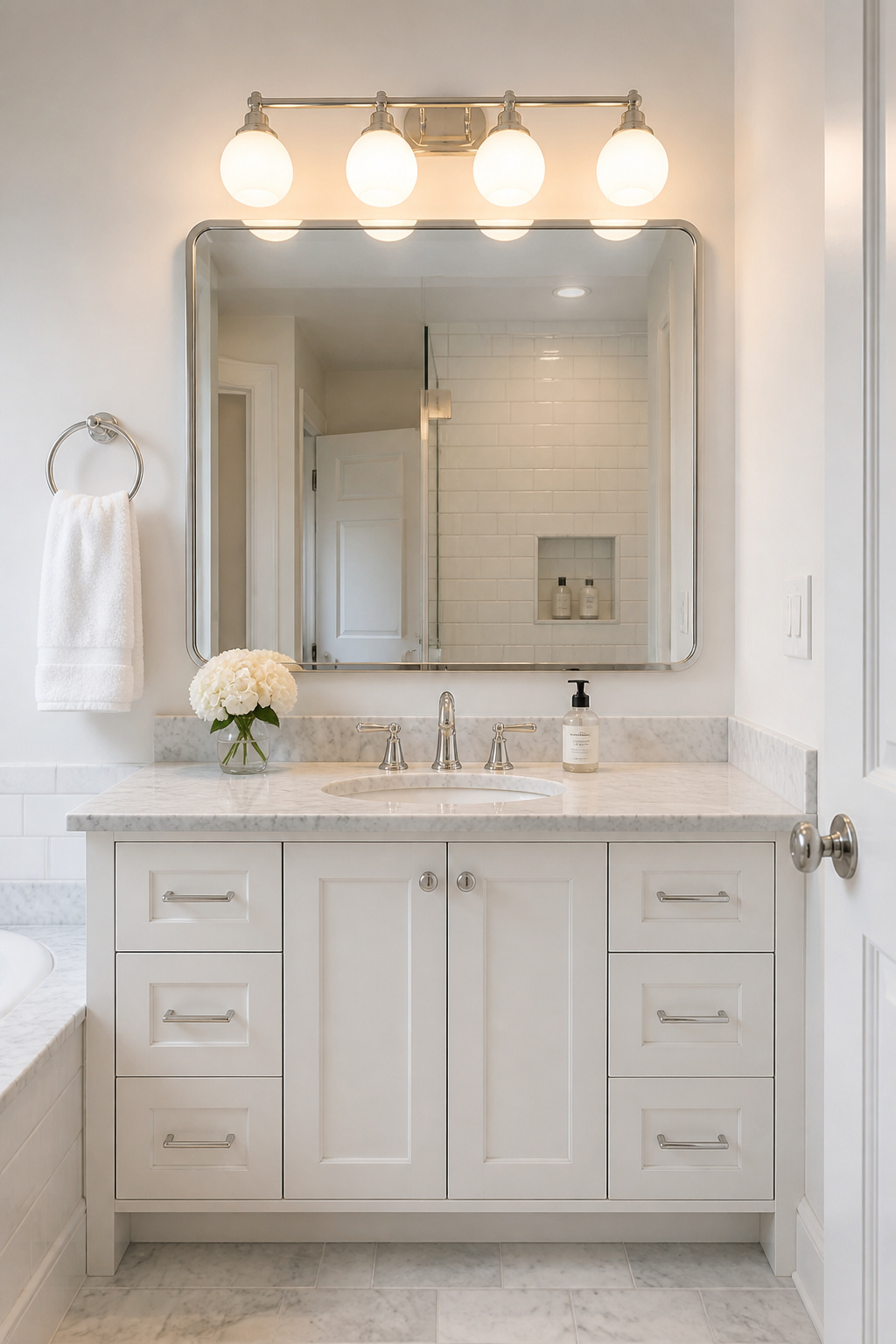
The distinction between polished nickel and chrome is real and matters for matching. Chrome has a pure, cool silver with blue undertones — reflective, formal, unmistakably contemporary. Polished nickel has a very slight warm gold undertone — similar reflectivity but warmer in character, sitting closer to traditional and transitional aesthetics. The functional difference is maintenance: chrome shows every water spot and needs regular polishing to maintain its mirror-like quality. Satin nickel (the brushed version) shows virtually no water spots — wipe with a damp microfiber cloth and it’s done. This is not a trivial consideration in a bathroom used by more than one person.
Price range is wide enough to suit most budgets. Budget tier (£25 to $30): basic 3-light chrome bars from Westinghouse and Globe Electric, adequate for rental renovations and secondary bathrooms. Mid-market (£80 to $120): Sea Gull Lighting and Progress Lighting both offer substantial, well-built fixtures in polished and satin nickel. Design tier (£180 to $300+): Visual Comfort and Circa Lighting offer the same essential forms in premium-quality metal with finish depth that photographs don’t fully convey. The error to avoid: mixing polished chrome fixtures with satin nickel faucets — the difference in sheen reads as an oversight rather than contrast.
17. Plug-In Vanity Lighting: Renter-Friendly Bathroom Light Fixtures
The plug-in sconce is the bathroom lighting solution that the rental market created and the home décor industry has only recently caught up with. For anyone renting, sharing owned space, or simply unwilling to involve an electrician in a fixture change, the plug-in format converts an available outlet into a wall sconce with no wiring, no permits, and no security deposit risk.
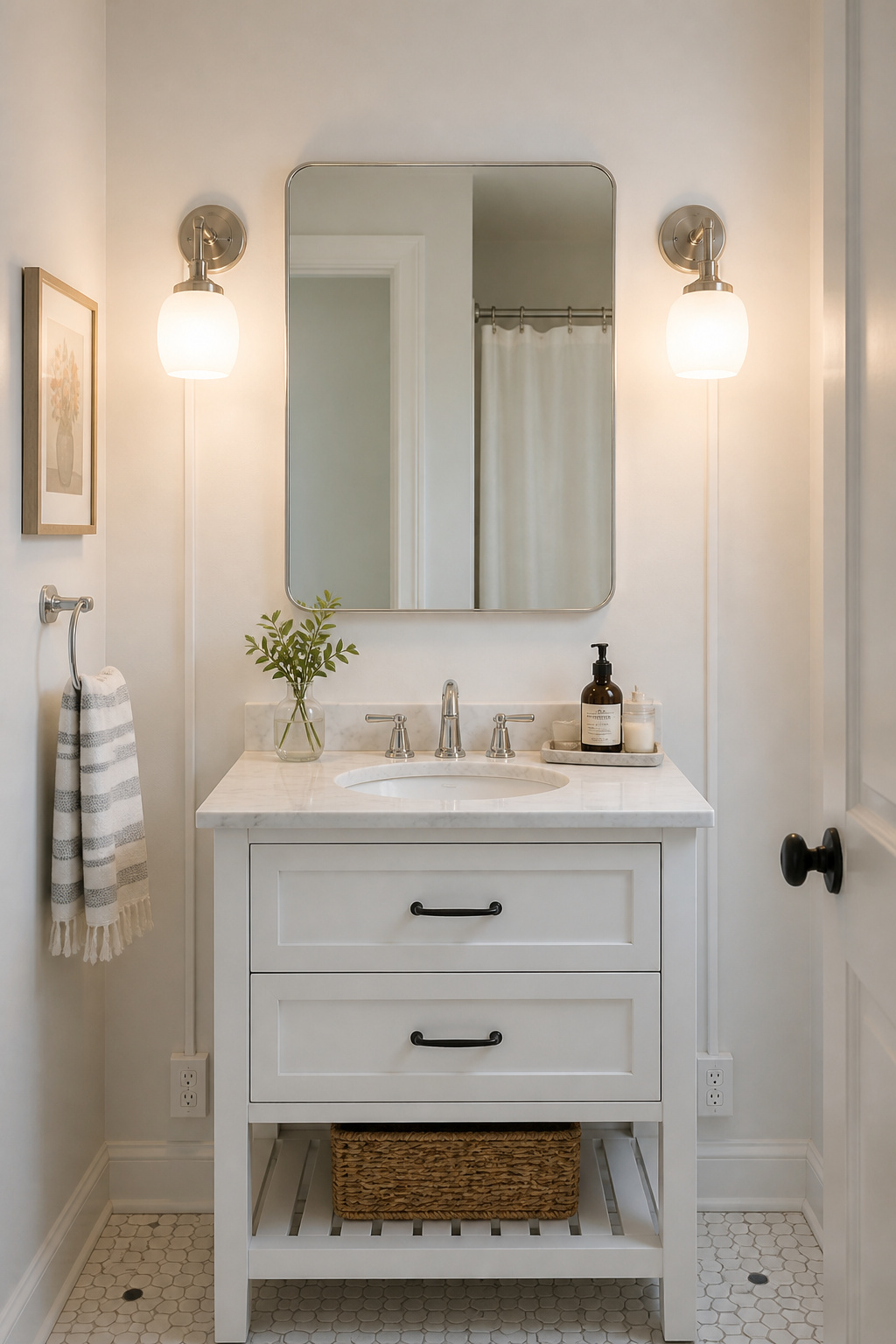
The quality gap between plug-in and hardwired sconces has closed considerably. Kira Home, DEWENWILS, and similar brands now offer genuinely attractive fixtures rather than compromise options. The Kira Home Beacon plug-in in brushed nickel with a schoolhouse glass shade (£55/$65) looks convincingly hardwired when the cord is managed correctly. The DEWENWILS plug-in pair (£40/$50 each) includes a paintable cord sleeve and reads at a level above its price. Wayfair’s plug-in vanity lighting category is the most practical starting point — filter by plug-in within bathroom vanity lighting to see the full range. For a DIY bathroom vanity makeover on a budget, plug-in sconces are among the most impactful changes available without any professional involvement.
The cord management question separates a thoughtful plug-in installation from something that looks temporary. A bare cord running from sconce to baseboard outlet announces that something is being worked around. Paintable cord raceways — adhesive-backed channels with elbow joints for 90-degree turns — run £8 to $15 and disappear once painted to match the wall. Route the cord along the architectural lines the baseboard and trim already take: down from the sconce, along the wall, into the baseboard run to the outlet. Managed correctly, it reads as hardwired to any casual observer.
Choosing the Right Bathroom Vanity Lighting for Your Space
The decision sequence that narrows the field most quickly starts with mirror configuration, then ceiling height, then finish, then budget — in that order, because each decision eliminates options in the next category.
Mirror configuration (single, double, or full-wall) determines whether you need one fixture or two, and whether flanking sconces are practical. Ceiling height and bathroom zone determine which fixture types are available at all: low ceilings and Zone 1 restrictions remove chandeliers, pendants, and some long-arm sconces from the running. Finish should match existing hardware — faucets and shower fittings in one finish, with lighting consistent across vanity and accent positions — or follow a deliberate mixed-metal logic with warm metals in one family and cool metals in another.
For bathroom size as a guide: small bathrooms (under 50 square feet) work best with a single bar or strip above the mirror or one centred sconce. Medium bathrooms (50 to 100 square feet) benefit from flanking sconces at mirror level with recessed downlights on a separate dimmer for ambient fill. Large bathrooms and master suites (100+ square feet) justify the layered approach — vanity sconces for task, recessed for ambient, and a statement pendant or chandelier for visual interest, each on an independent circuit.
Good bathroom vanity lighting is the thing that makes the bathroom feel finished — and the first thing you notice when it’s wrong. Starting with the decision sequence above and working through it systematically produces a bathroom you don’t have to think about again, which is, after all, the point.