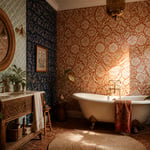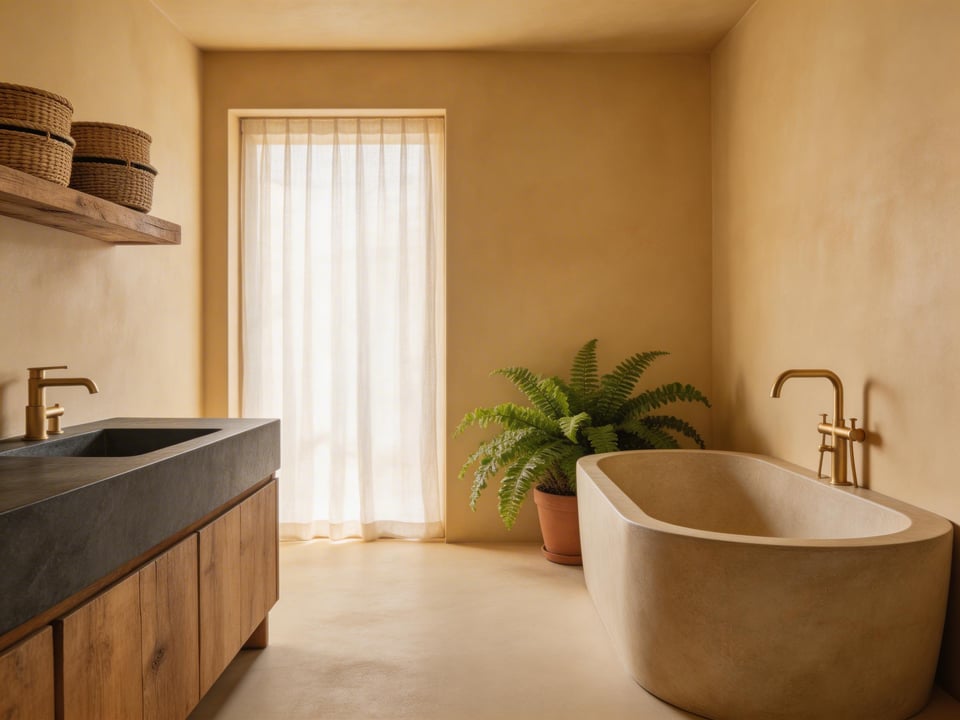
Close your eyes for a moment and picture a bathroom that feels nothing like a bathroom. The floor is cool river stone underfoot. The walls carry the soft, uneven texture of tadelakt plaster in a tone somewhere between warm ash and damp sand. A large fern sits beside the tub in a hand-thrown ceramic pot. The only scent is cedar — real cedar, not the synthetic approximation that comes in a white plastic bottle. You pick up a towel that feels genuinely different, heavier, more honest than anything in the linen cupboard of a hotel.
This is what bathroom organic ideas actually mean when they’re working. Not a scented candle and a pebble dish from a homeware chain, but a considered collection of natural materials that ground a space in something real. The bathroom is the room we enter first thing every morning and last thing every night. It sets the tone for how we begin the day. So it deserves more thought than it typically gets.
These 15 bathroom organic ideas cover texture, material, scent, light, and colour. Some are simple and immediately accessible. Others require real commitment. All of them share the same underlying logic: choosing what nature produces over what factories manufacture, and accepting the beautiful imperfections that come with it.
1. Live Moss Wall Panels: A Standout Bathroom Organic Idea for Texture and Air Quality
There is something almost physiologically calming about seeing moss on a wall. Perhaps it is the association with forest floors and rock faces — places where the pace of life is slower and the air is different. Bringing that texture indoors is one of the most considered bathroom organic ideas available, and the options range from genuinely low-maintenance to truly hands-free.
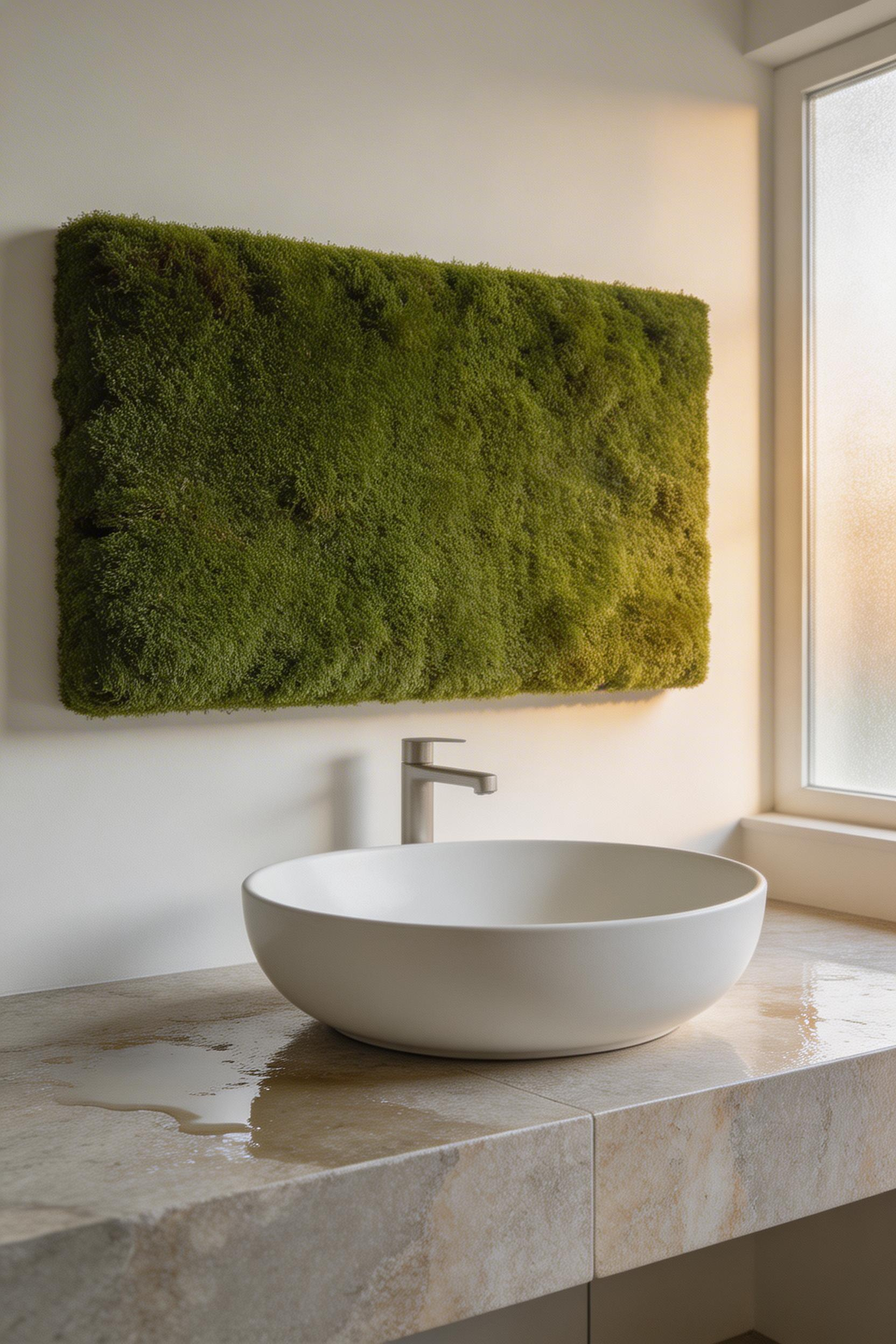
Preserved moss panels — freeze-dried and treated with glycerin — require zero watering and survive in rooms with no natural light. Leucobryum glaucum (cushion moss) and Thuidium delicatulum (fern moss) are the species most commonly used for preserved applications because they hold their soft, rounded form. The panels typically come in 12×12 or 24×24 inch sections and can be cut to fit unusual wall dimensions.
Choosing Between Preserved and Living Moss
Living moss walls are possible in bathrooms with a skylight or strong indirect light from a south-facing window, but they require misting and occasional trimming. For most standard bathrooms, preserved is the honest choice. It holds its texture for eight to twelve years and costs between $45 and $85 per square foot from suppliers like Mossify.
One practical benefit that gets overlooked: moss panels absorb sound. In a small, hard-surfaced bathroom where every sound reverberates, a modest panel installation can reduce echo by 30 to 40 percent. That alone is worth considering, even apart from the visual effect.
2. River Stone Flooring and Pebble Shower Insets
The best case for river stone in bathroom design is entirely sensory. Standing on smooth, rounded basalt pebbles first thing in the morning produces a different quality of awareness than standing on ceramic tile. It is the kind of detail that does not photograph well but transforms the daily experience of a room.
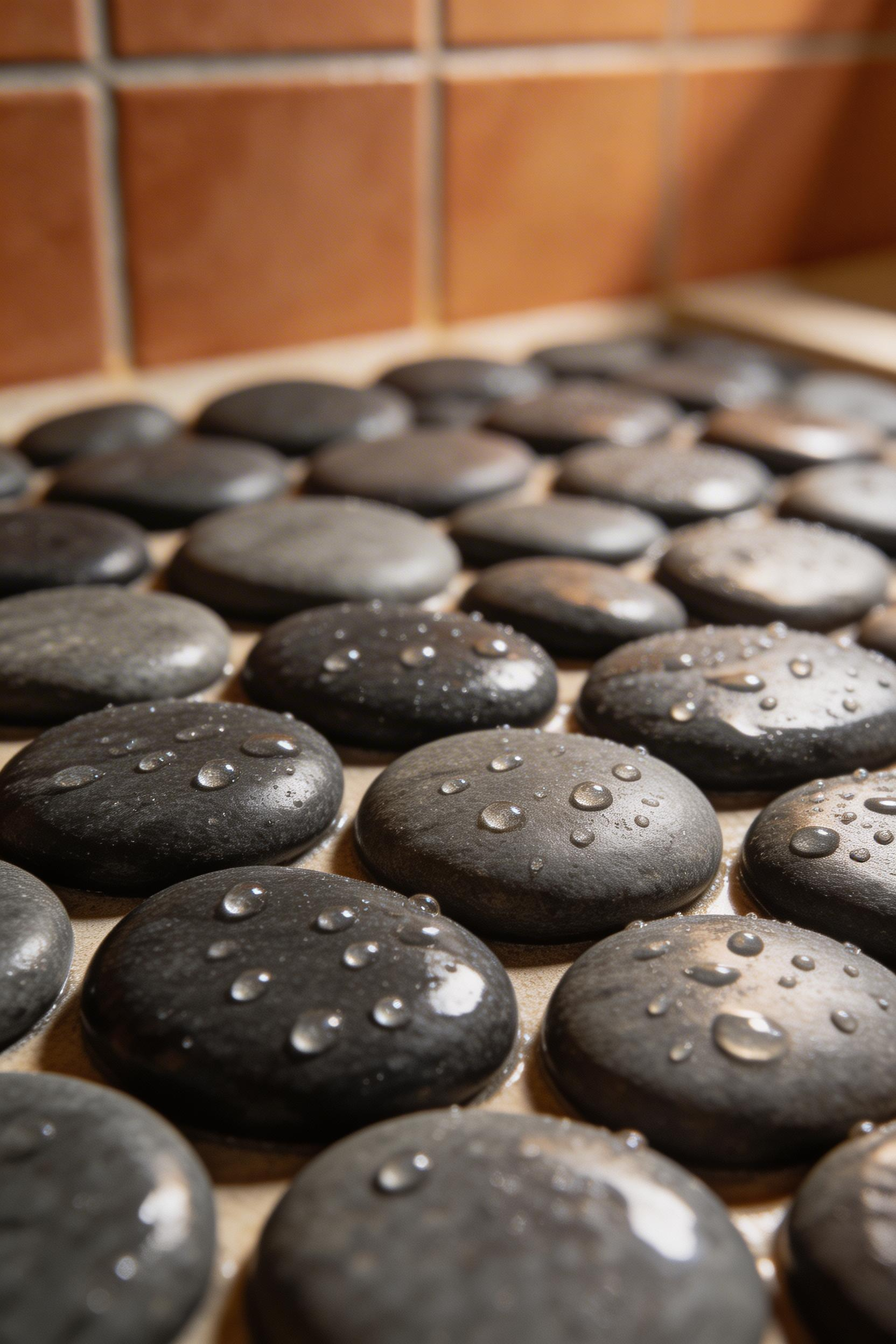
Pebble mosaic tiles come in mesh-backed 12×12 inch sheets, which makes installation relatively straightforward. Basalt, quartzite, and slate pebbles are the most practical choices. They are denser than limestone or sandstone. Softer stones absorb moisture over time and deteriorate — basalt and quartzite do not. MSI Basalt Black Pebble Mosaic tiles cost around $6.50 per square foot; Anatolia Zen Basalt runs $8 to $11 per square foot.
Slip Resistance and Practical Scale
Natural tumbled stone typically achieves a wet DCOF between 0.55 and 0.72. This is well above the ANSI minimum of 0.42 for wet floors. However, consider the scale of application carefully. A pebble floor across the entire bathroom feels heavy and becomes tiring to stand on for extended periods. A 24-inch inset at the shower entry, or a feature strip running the width of the shower floor, is the more refined approach. The installation requires cement board substrate (not drywall), polymer-modified thinset, and epoxy grout sealed before grouting. Plan for roughly $8 to $15 per square foot in labour on top of materials.
3. Teak and Bamboo Wet-Area Furniture
Most wood has no place in a bathroom. The humidity cycles — from dry night air to post-shower steam — cause swelling, cracking, and eventual deterioration in almost every species. Teak is the exception. It contains natural silica and rubber in its cell structure. That makes it the wood of choice for boat decking since the sixteenth century. It is also the only hardwood genuinely suitable for regular water contact.
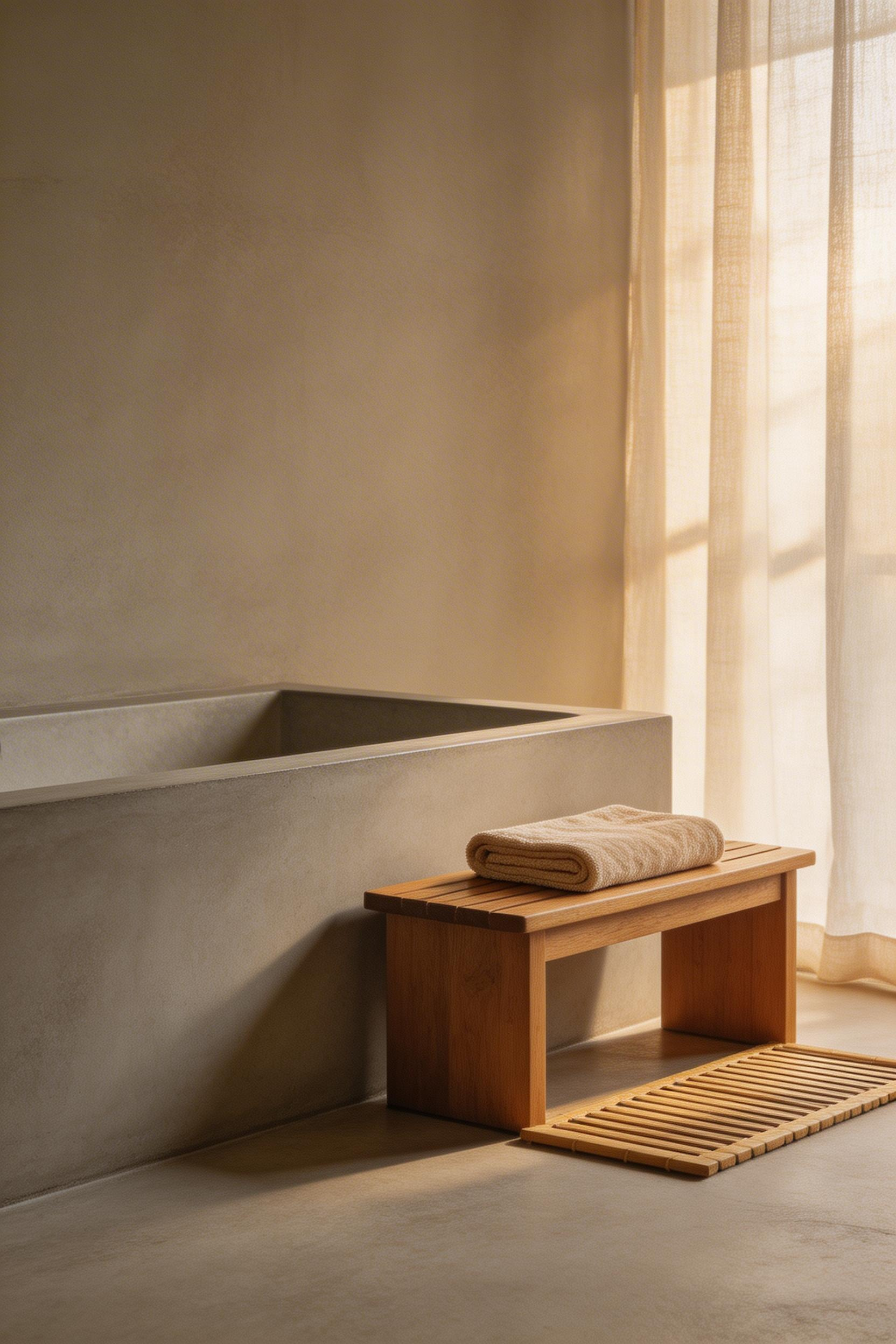
A good teak shower stool sits around $145 to $220 from suppliers like Teak Warehouse. The FSC certification matters here — plantation teak from Indonesia or Costa Rica is widely available and avoids the ethical concerns around old-growth sourcing. Indoor teak treated annually with pure teak oil (not tung oil blends) stays a warm honey-brown. Left untreated, it will grey attractively over 18 to 24 months, which is a perfectly valid choice.
Bamboo as a Supporting Material
Bamboo is technically a grass — its moisture resistance varies considerably depending on how it has been processed. Solid-slat bamboo bath mats (Oceanstar, around $25 to $45) drain well and hold up in normal bathroom conditions. However, they benefit from quarterly treatment with food-grade mineral oil. For anything in direct water contact — a shower stool, a bath caddy — choose teak. Bamboo works better in supporting roles: a bath mat, a shelf for display items, a small side table away from the shower zone. The price difference between teak and bamboo is real, but so is the durability gap.
4. Organic Cotton and Linen Towels: The Textile Foundation of Bathroom Organic Ideas
Towels are the most frequently handled textile in a bathroom, and they set the tactile character of the space more than any other element. Swapping standard cotton terry for GOTS-certified organic cotton waffle weave or stonewashed linen transforms the feel of every morning routine. It is not a dramatic shift. But it accumulates the way better materials always do — quietly, daily, over years.
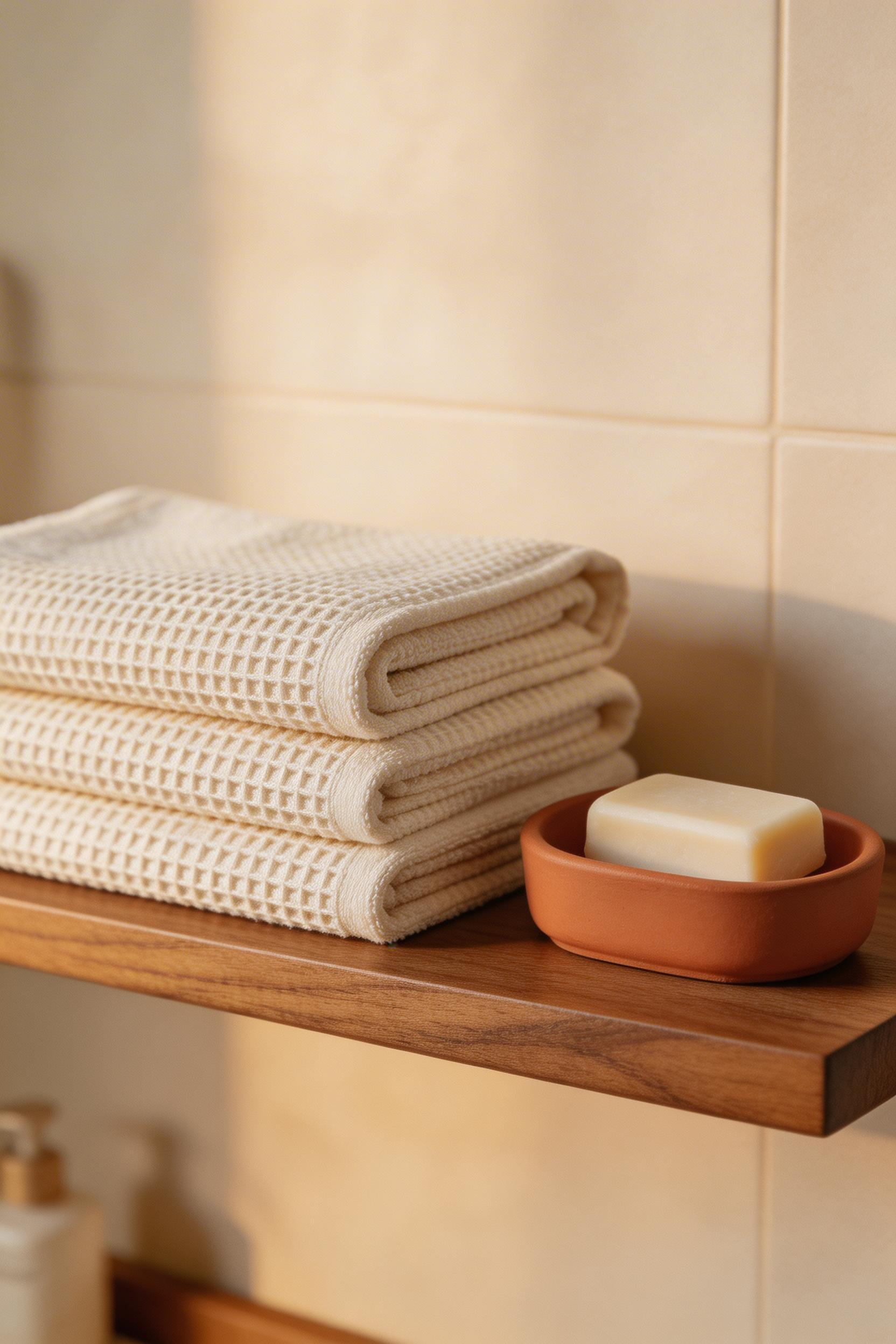
GOTS certification (Global Organic Textile Standard) guarantees that no synthetic pesticides were used in the fibre production. For towels, GSM matters more than thread count: 400 to 500 GSM gives a lighter, quick-drying towel; 600 to 900 GSM delivers the dense, spa-weight feel. Coyuchi Organic Terry Towels at $28 to $58 per towel are among the most reliable options. Parachute’s Waffle Bath Towel in organic cotton ($39 to $49) dries faster and drapes more elegantly on a towel rail than terry.
The Linen Case
Linen towels improve with every wash. The fibres soften and gain character over time. This is the precise opposite of most towels that pill and lose their loft after 30 cycles. Solwang Danish linen towels ($35 to $55) are handwoven and naturally dyed. One practical note: wash organic cotton and linen towels without fabric softener. Softener coats the fibres and reduces absorbency. A quarter-cup of white vinegar in the rinse cycle maintains softness without any coating effect.
Keeping the Palette Coherent
Two sets of towels in the same palette, rotated on display, do more for the organic bathroom idea than a single expensive set. The moment you introduce bright white hotel cotton alongside natural stone and warm wood, the effect breaks. Coherence in the textile palette is a form of editing, and editing is the central skill in this kind of design.
5. Raw Plaster Walls for an Earthy, Tactile Finish
Flat, painted drywall is the default bathroom wall finish. However, it has none of the qualities that organic design depends on. No depth. No texture. No surface that absorbs and reflects light differently at different times of day. Plaster finishes change all of that. They give walls a living, slightly imperfect quality that paint alone cannot replicate. The texture exists in the material itself, not on top of it.
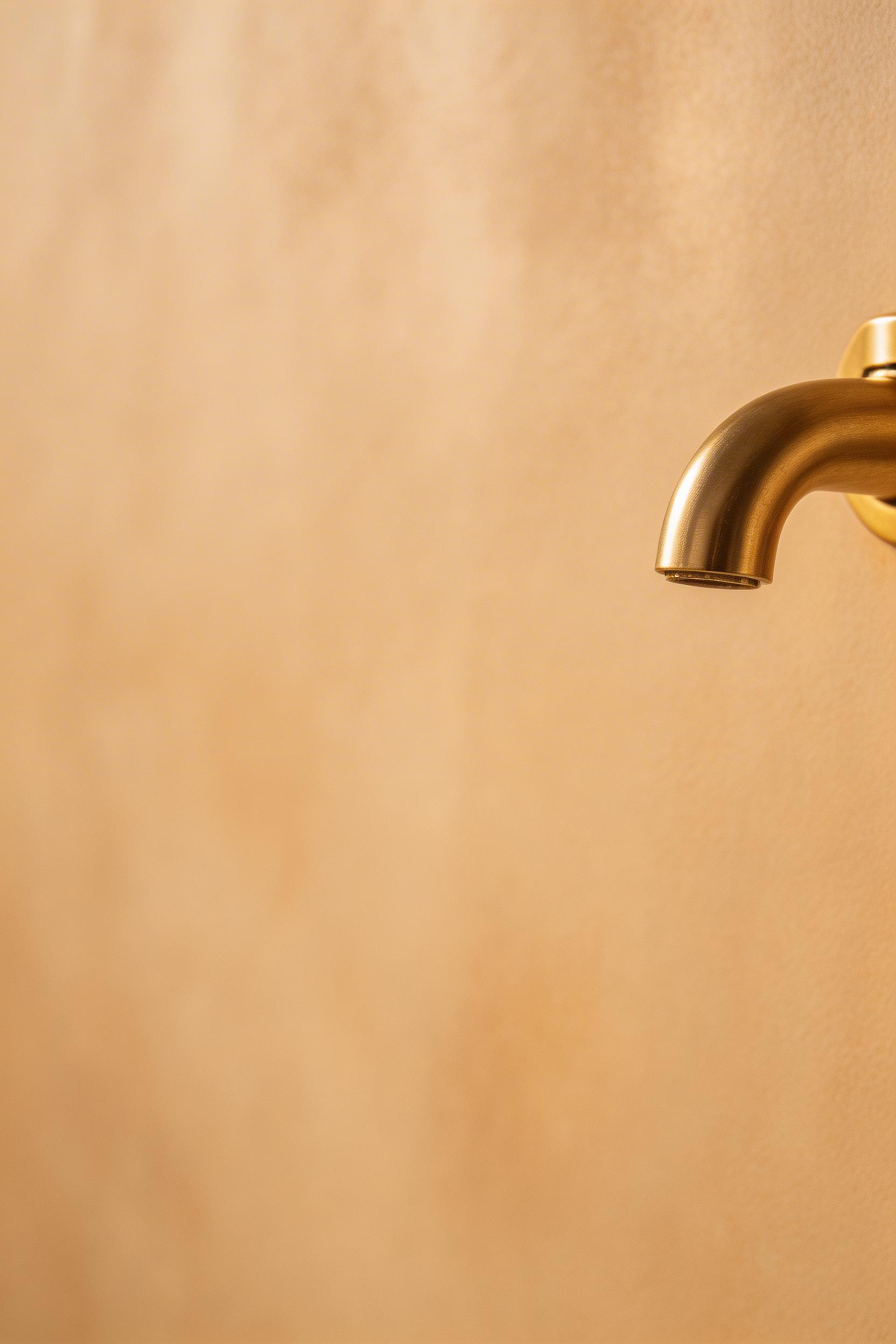
There are three main options. Limewash paint (like Portola Paints Roman Clay, $10 to $15 per square foot applied) penetrates the wall surface. It creates a depth and variation that flat paint cannot achieve. It is also the most DIY-accessible option of the three. Venetian plaster (marmorino or stucco veneziano) requires a steel trowel and more skill, and needs a protective wax coat for bathroom use. Tadelakt is the most serious choice. It is the traditional Moroccan lime plaster — waterproof, naturally antimicrobial, and the most authentic surface for organic bathroom walls. However, it costs $90 to $130 per square foot installed. Apply it only with a specialist who has done it before.
Why Lime Works in a Bathroom
All lime-based plasters have a pH above 12, which inhibits mold and bacterial growth at the wall surface. Beyond the practical benefit, lime absorbs moisture from the air and releases it as conditions change. This property is called hygroscopicity. It makes lime a genuinely functional choice for steamy environments — not just a decorative one. For most people, limewash is the right starting point. Save tadelakt for a builder who has actually done it before.
6. Freestanding Stone and Concrete Bathtubs
A freestanding bathtub is already a statement. A freestanding tub in stone, concrete, or stone-composite is something else entirely — it reads as a sculptural object first and a piece of bathroom furniture second. The mass and weight of the material create a psychological experience that acrylic simply cannot. The relationship between water inside and solid stone outside is one of the most distinctly organic sensations available in any domestic bathroom.
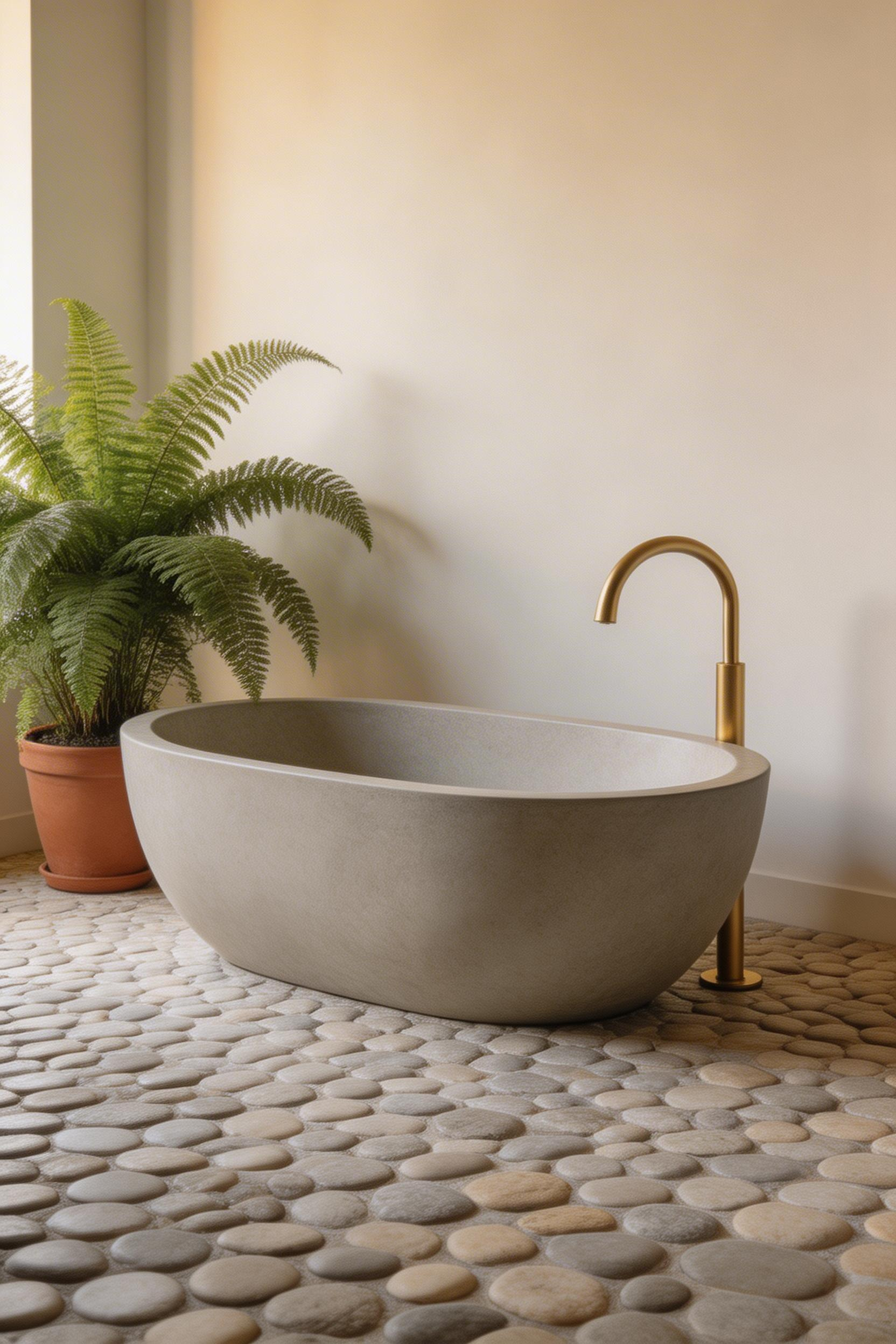
Solid carved stone tubs (limestone, travertine, granite) weigh between 450 and 900 kilograms. Floor reinforcement is often required. Lead times from specialist carvers run 8 to 16 weeks, so plan ahead. Stone resin composite tubs are the practical bridge. Stone powder mixed with resin produces a material that looks and feels similar to carved stone. But it weighs a third as much. Badeloft’s BW-06 stone resin bath ($1,800 to $2,400) is a widely used reference for this category. For those with the budget and the structure for it, Wabi Stone Carving’s custom limestone tubs ($4,500 to $9,000) are genuinely different objects.
Heat Retention and the Bathing Experience
Stone has a naturally low thermal conductivity. It takes longer to warm than acrylic — fill a stone tub with hot water and it will draw heat initially, which is worth accounting for. However, once the stone mass is warm, it retains heat far longer: 30 to 45 minutes versus 15 to 20 for a standard acrylic bath. For anyone who values a long soak, that difference is not small. It is the kind of thing that changes how often the tub gets used.
7. Indoor Plants That Genuinely Thrive: A Key Bathroom Organic Idea
The bathroom plant advice that circulates online is often wrong. Succulents and cacti — frequently recommended — need dry air and direct sunlight, which a standard bathroom provides neither of. The same is true of many popular houseplants that people instinctively reach for. The plants that actually work in bathrooms are the ones that evolved in humid, low-light forest environments: ferns, pothos, prayer plants, and air plants.
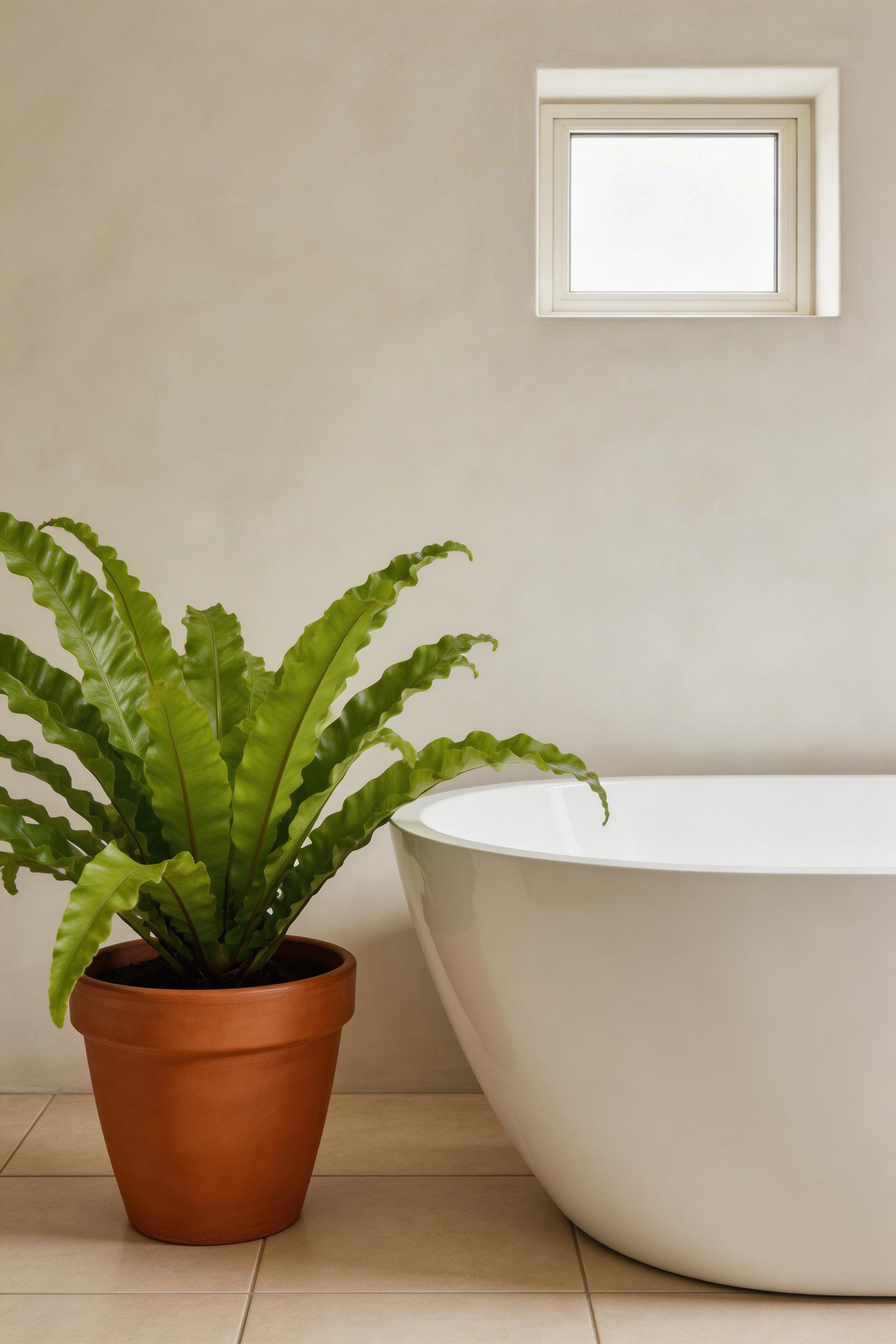
Asplenium nidus (bird’s nest fern) is the single best performer for low-light bathroom environments. It grows vigorously in steam, unfurls new fronds during a morning shower, and asks almost nothing in return. Epipremnum aureum (pothos in its golden or marble queen form) does well on a high shelf, cascading down 3 to 4 feet over time. Air plants (Tillandsia) mounted on a piece of driftwood or displayed in a small glass terrarium work well in brighter bathrooms near windows.
Scale and Placement
One generous plant does more for a bathroom organic ideas scheme than five small ones. Scale is the principle that separates a genuinely considered organic approach from a random collection of plants. A large bird’s nest fern in a ceramic pot on the floor beside the tub brings genuine presence. A shelf of tiny succulents simply cannot match it. For placement: plants within two feet of the shower steam zone grow fastest; those on shelves far from any light source struggle. Also, reduce watering by 30 to 40 percent compared to what you’d give the same plant elsewhere in the house. Bathroom humidity substitutes for part of that water need.
8. Woven Seagrass and Jute Storage Baskets
Natural fiber storage is one of the most accessible bathroom organic ideas — low cost, immediately available, and effective both functionally and visually. As organic bathroom ideas go, seagrass baskets offer the best ratio of effort to effect. The key is choosing the right fiber for the right position, and exercising some restraint in how many you use.
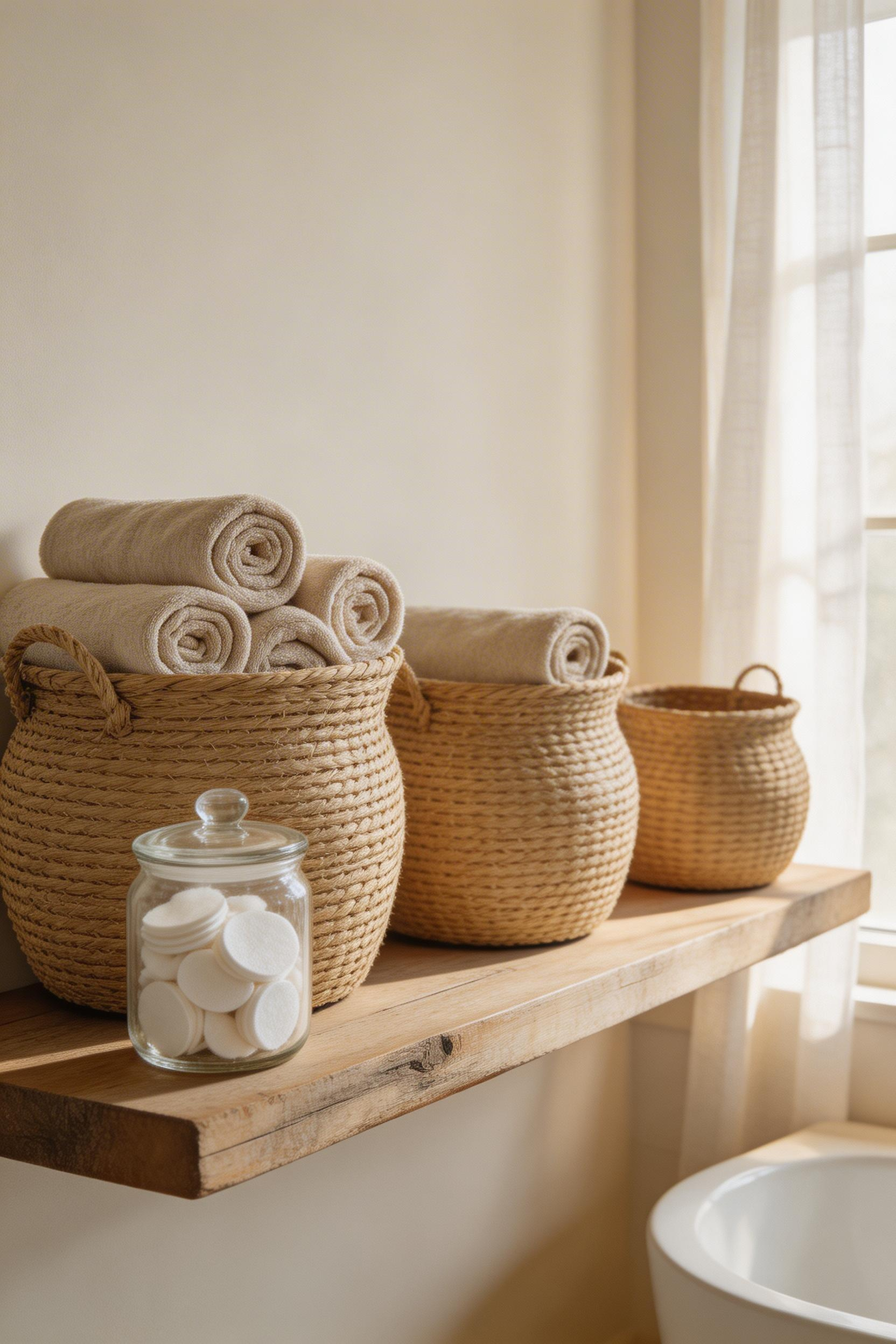
Seagrass is the most moisture-tolerant of the natural basket fibers. It handles bathroom humidity better than jute. Jute can develop mildew if placed on a wet floor, so keep it on open shelves where air circulates freely. Belly baskets (wide-mouth, rounded form) are the most useful shape. Small sizes (6 to 8 inches) hold soaps and cotton rounds. Medium (12 to 14 inches) hold rolled towels beautifully. Large (18 to 20 inches) double as laundry storage. Pottery Barn’s seagrass sets ($89 to $119 for three sizes) are a reliable starting point. West Elm’s Woven Seagrass Belly Basket ($39 to $69) is a strong single-piece option.
The Discipline of the Palette
However, the most important rule with natural baskets is also the simplest: buy three sizes in the same weave and fiber, and use them consistently. Mixing seagrass with rattan, or pairing tight-woven rectangles with loose jute rounds, creates visual noise that undermines the organic bathroom aesthetic entirely. Pick one fiber, one weave pattern, and vary only the size. Keep woven baskets off the bathroom floor unless the floor stays reliably dry. A waterproof liner inside any basket holding damp items is worth adding from the start.
9. Copper and Unlacquered Brass Hardware That Patinas Naturally
Most bathroom hardware arrives in a finished state and stays that way. Chrome stays chrome. Nickel stays nickel. Unlacquered brass and raw copper do something different: they change. They read the conditions of your home: the minerals in your water, the oils on your hands, the humidity of your showers. The finish they develop is entirely specific to your space and your use. That is not a flaw. That is the whole point.
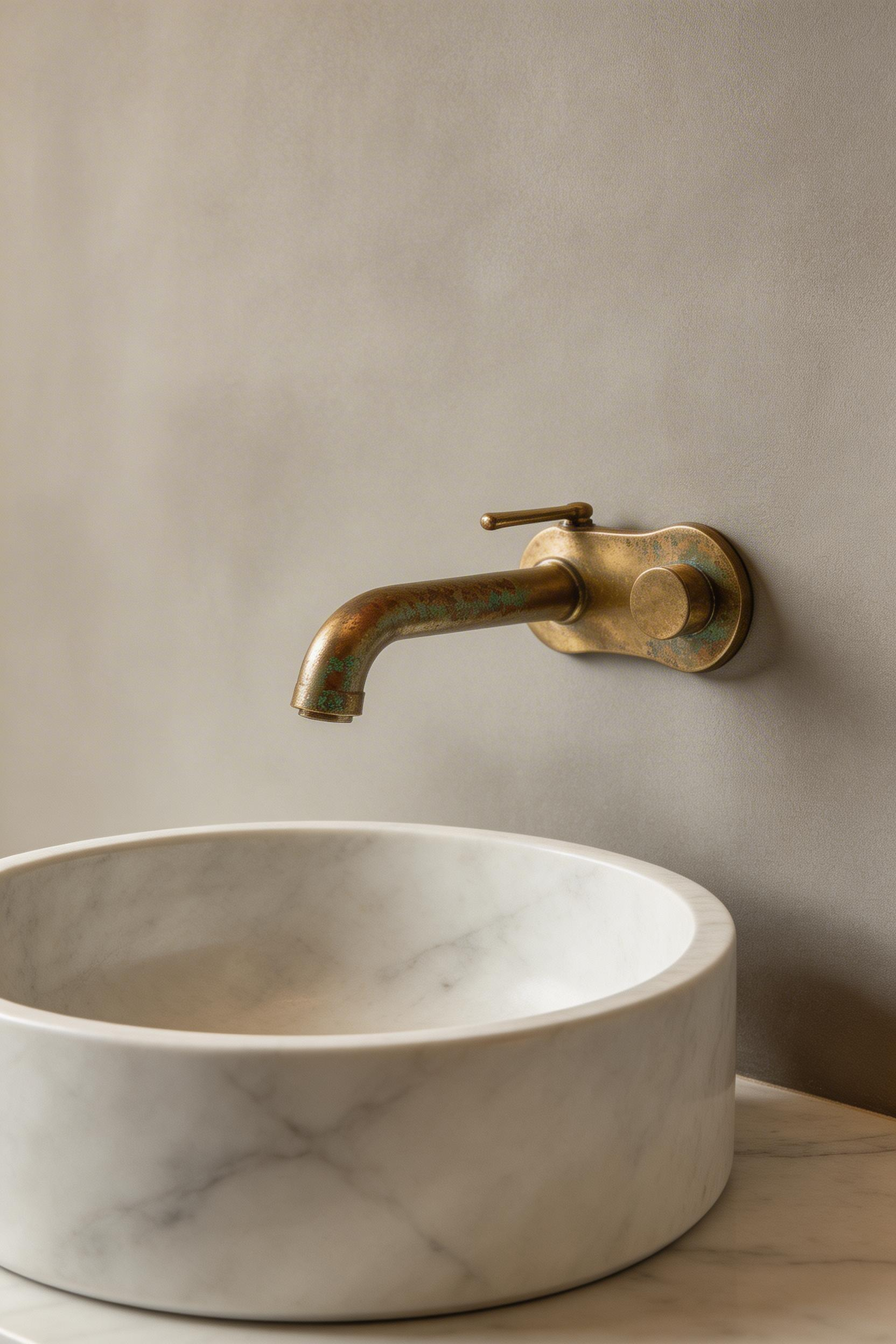
Unlacquered brass has no protective coating — it oxidizes on contact with air, water, and skin oils. The patina becomes visible after 3 to 6 months and settles into a consistent finish over 12 to 24 months. Waterworks Henry Unlacquered Brass Basin Mixers ($580 to $820) are an investment-grade choice. Kohler’s Purist in unlacquered brass ($340 to $480) is a more accessible option. Both age in the same honest direction. For accessories like towel rings and toilet roll holders, House of Antique Hardware supplies solid copper pieces ($45 to $75) that develop a warm reddish-brown tone over time.
Maintenance and Metal Mixing
When it comes to bathroom storage and organization, unlacquered brass pairs well with wooden shelves and woven baskets. But it does not mix well with chrome or nickel. Stick to one metal family: unlacquered brass, aged copper, and raw iron all belong together. The maintenance protocol is simple: wipe dry after use to slow the patina process, or leave water contact to accelerate it. Never use abrasive cleaners or acidic products unless you are deliberately stripping back to restore the base metal.
10. Terracotta and Ceramic Accessories: Small Details That Make Bathroom Organic Ideas Cohere
The smallest things in a bathroom carry more visual weight than people expect. A hand-thrown soap dish in raw terracotta. A cylindrical brush holder in matte sage glaze. A small vessel for cotton rounds in cream-glazed stoneware. None of these are significant objects in isolation. But together they build the material vocabulary that makes bathroom organic ideas feel considered rather than accidental.
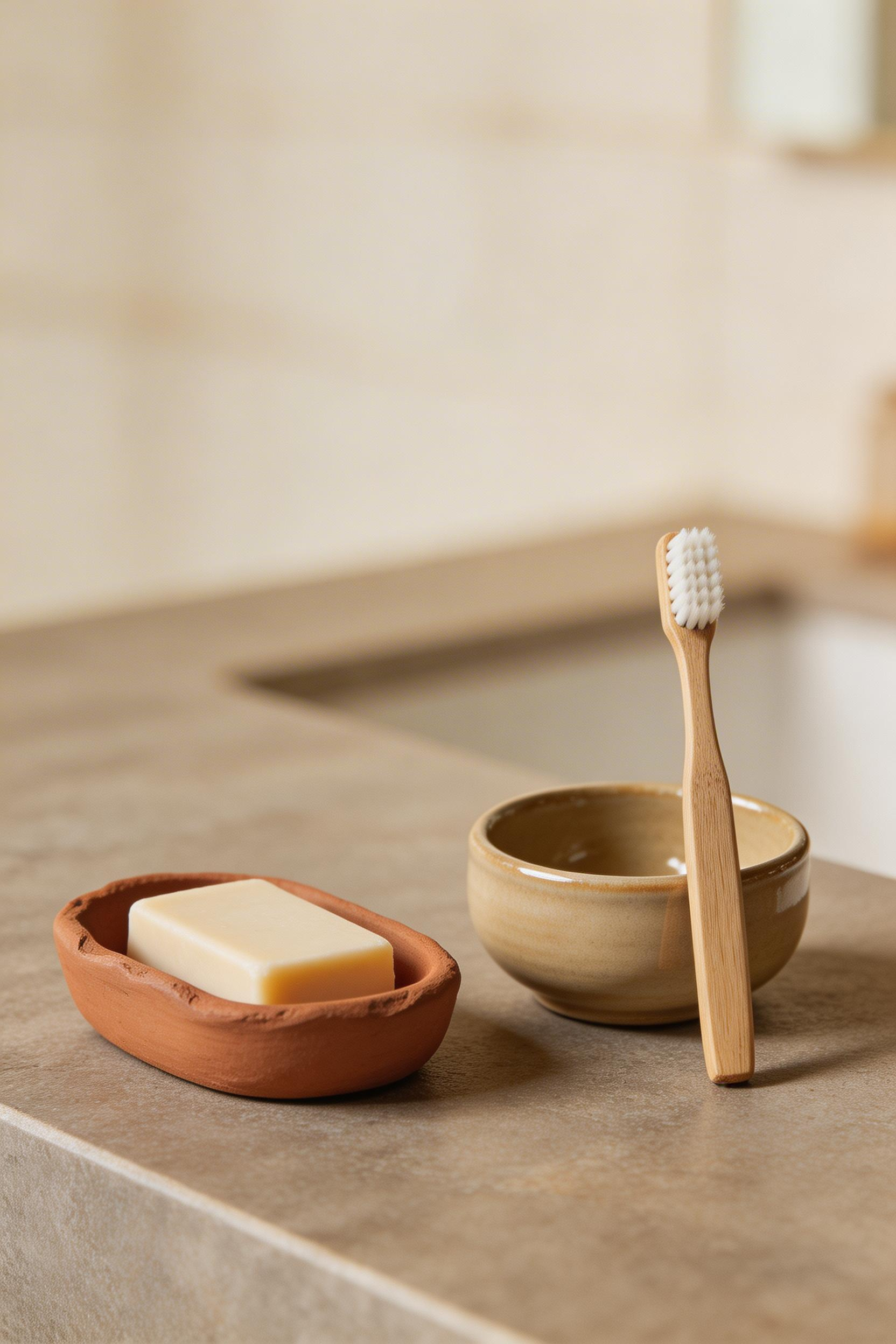
Farmhouse Pottery’s Stoneware Soap Dish ($28 to $38) is hand-thrown in Vermont with drainage grooves and a matte oyster, slate, or ink glaze. Hay’s Barro toothbrush stand in terracotta ($22 to $30) uses a simple cylindrical form that does not compete with anything else on the counter. For a set of three coordinating canisters — cotton buds, cotton balls, spare soaps — CB2’s matte ceramic bath set ($45 to $65) delivers a convincingly handcrafted look. The price is mass-market. The appearance is not.
Artisan Versus Mass Market
Buying one or two pieces from an actual ceramicist — Etsy, a craft fair, or a local studio — is the right approach. Then fill in the rest with good mass-market alternatives. You will notice the difference immediately when you handle them side by side: the weight, the slight asymmetry, the depth of glaze. But the mixed collection feels more naturally gathered than a perfectly coordinated set. For anyone exploring rustic bathroom ideas that overlap with the organic approach, this kind of layered sourcing is the method that distinguishes a lived-in bathroom from a showroom.
Seal any unglazed terracotta pieces before placing them in a bathroom. A penetrating stone sealer (two coats, buffed off) prevents soap and moisture absorption. Re-seal annually.
11. Reclaimed Wood Vanity Tops and Floating Shelves
Reclaimed wood brings something to a bathroom that new timber cannot: the evidence of a previous life. Nail holes, weathered grain, saw marks from a different era of milling — these are not defects to be filled and hidden. They are proof of provenance, and in a bathroom built around natural materials and honest imperfection, they do more design work than any perfectly smooth surface.
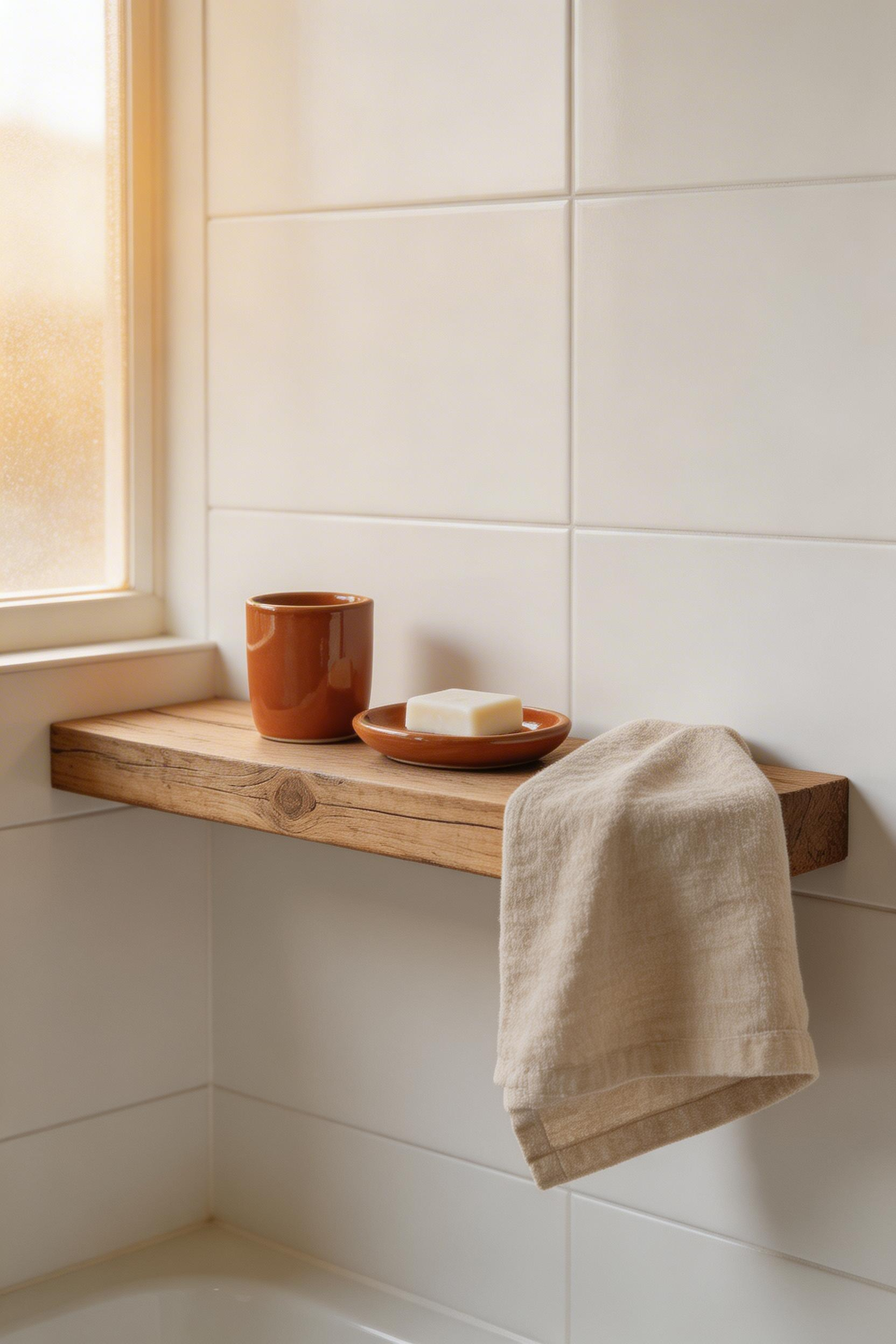
For floating shelves away from the sink splash zone, reclaimed wood is both beautiful and practical. Old-growth Douglas fir and white oak with proper sealing hold up well. Elmwood Reclaimed Timber offers custom-cut pieces at $45 to $110 per linear foot. On Etsy, Barnwood USA supplies genuine reclaimed barn wood shelves in custom lengths for $55 to $130. Rubio Monocoat Oil Plus 2C ($55 to $75 per 350ml) is the most reliable sealer for bathroom wood. It penetrates the fibre without creating a surface film. Also, it provides excellent water resistance in just one coat — which is genuinely useful when you are working with uneven reclaimed grain.
An Honest Word About Countertops
Reclaimed wood as a vanity countertop is a different commitment. The surface area near a sink gets wet multiple times a day — that is a lot of work for a soft finish, and it will show. Re-sealing every two to three years is the minimum. If you want the warmth of wood at the vanity, a better approach is a natural stone countertop (see item 12) with reclaimed wood cabinet doors below. You get the character of the wood without placing it at the waterline. In that configuration, proper small bathroom interior design can carry both materials without either one suffering.
12. Natural Stone Countertops: Soapstone, Granite, and Slate
Stone countertops bring a quality of permanence to a bathroom that no other surface material matches. They also vary enormously in their maintenance demands — and the wrong choice for a bathroom context can turn a beautiful material into a daily chore.
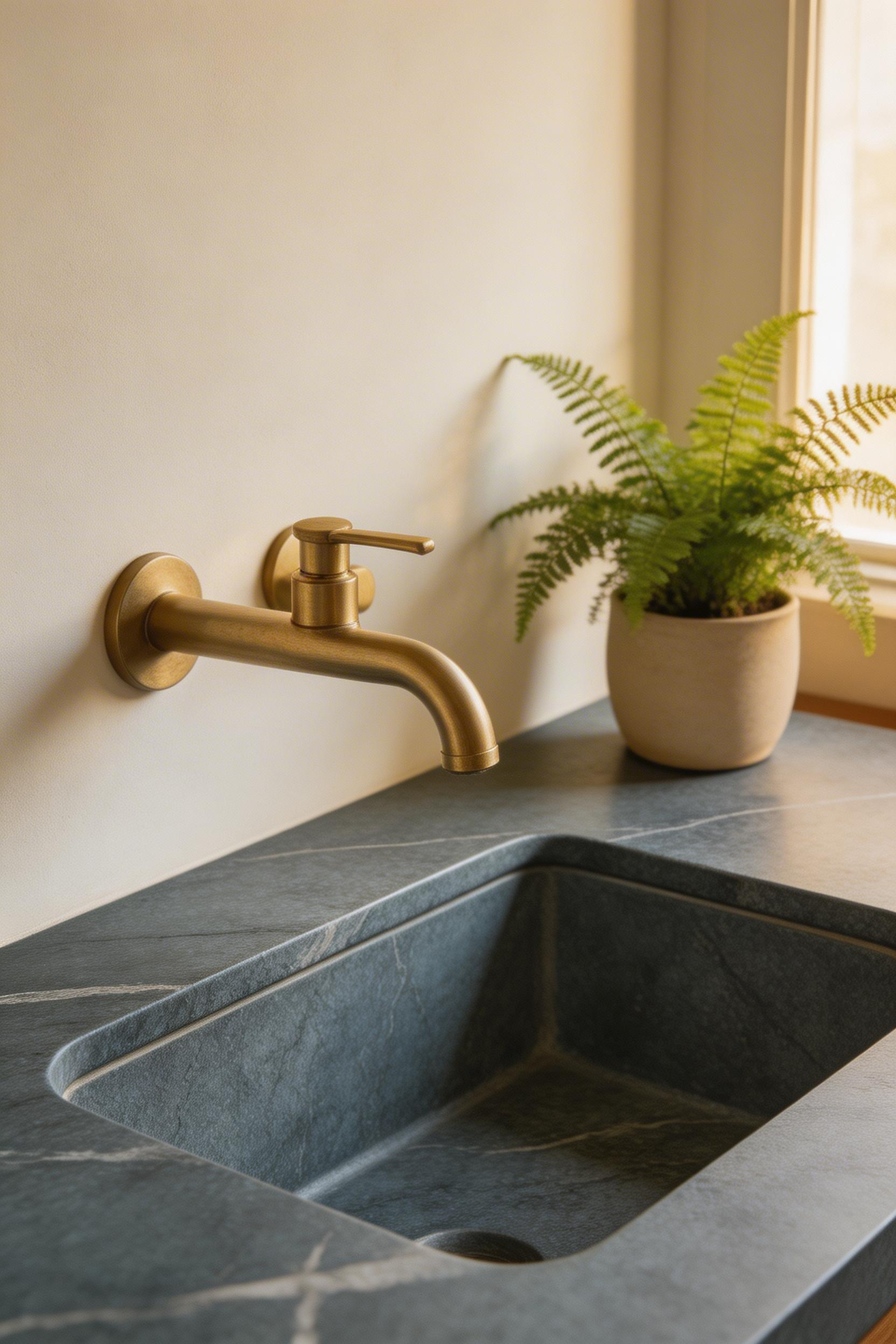
Soapstone is the practical standout. Composed primarily of talc, it is naturally non-porous and requires no sealing — the only commonly available bathroom stone where that is genuinely true. It develops a rich, dark patina with mineral oil treatment and self-heals light scratches when oiled. Virginia Mist Soapstone ($80 to $105 per square foot installed) is sourced from a quarry in Virginia. It offers a grey-blue tone with visible veining. That palette pairs naturally with warm wood, brass, and terracotta — all the materials that recur throughout a bathroom organic ideas scheme. Granite is harder and lower-maintenance than marble, provided it is sealed properly (every one to three years). Absolute Black granite ($40 to $65 per square foot installed) has near-zero porosity and works with almost any organic material palette.
Why Not Marble
Marble is the most commonly requested stone for bathroom countertops and also the most misunderstood. It is reactive to acids — toothpaste, many hand soaps, and most bathroom cleaners will etch the surface permanently. Etching is not a maintenance issue that can be managed; it is a material characteristic. Marble is better used as a backsplash tile or a shower wall accent where it does not receive daily acid contact. For anyone planning a mindful bathroom makeover, choosing the right stone from the start saves years of frustration.
13. Linen Window Treatments for Soft, Natural Light
Bathroom light has a quality problem in most homes. It is either too direct (a single overhead fitting casting flat, shadowless illumination) or too absent (a frosted glass block window letting in diffuse grey). Linen window treatments are one of the most effective adjustments available. They change the character of natural light, making it warmer and more diffuse. Synthetic sheers do not replicate the effect — the fibre itself is different.
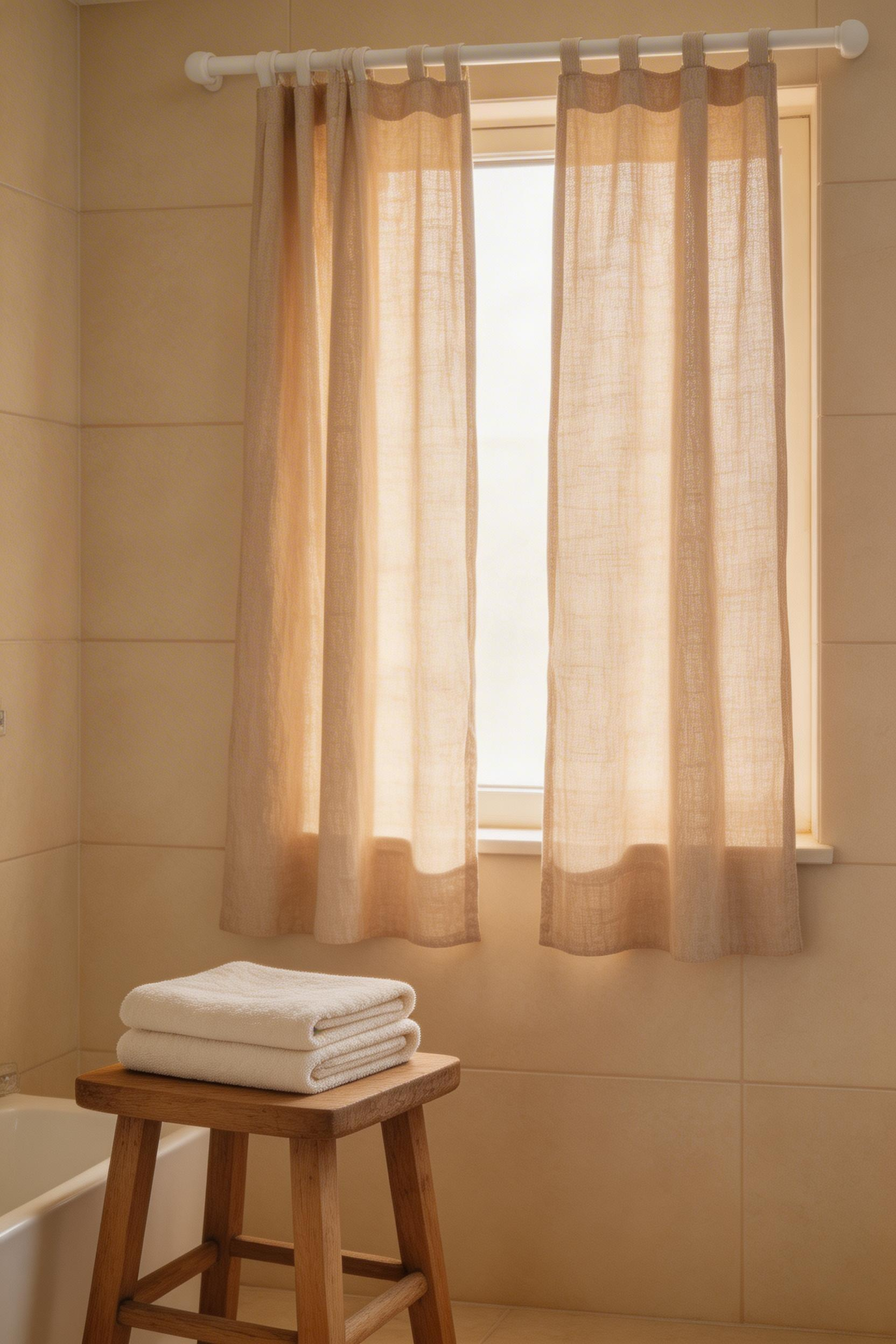
Unlined Belgian linen panels (Pottery Barn, $89 to $149 per panel) let light pass through while warming and softening it. The fibre structure of linen — longer and more irregular than cotton — creates a slight texture that is visible in the light transmission. Woven wood shades (Smith & Noble, $130 to $320 per window) are a strong alternative that adds horizontal texture. Bamboo, jute, and reed each filter light slightly differently. All of them share the natural material vocabulary of a bathroom organic ideas scheme, so any of the three choices works.
Practicalities of Natural Textiles in a Steamy Room
Linen in a bathroom should be machine-washable — avoid dry-clean-only versions in a steam environment. For privacy, a café curtain approach works well. A panel covering the lower two-thirds of the window provides the coverage you need. The upper section stays open, drawing in as much light as possible. Install curtain rods 4 to 6 inches beyond the window frame on each side to make the window appear wider.
Linen production uses approximately 13 times less water than conventional cotton. It also requires no irrigation in traditional European cultivation areas such as Belgium, France, and the Netherlands. So it is a genuinely sustainable choice that also happens to be the most beautiful option for this application.
14. Beeswax Candles and Botanical Diffusers: The Sensory Side of Bathroom Organic Ideas
The organic bathroom idea extends beyond what you see. Scent is the most underused element in bathroom organic ideas. It is also the most immediate. Nothing else communicates arrival in a particular kind of space as quickly as the right fragrance. The difference between a synthetic vanilla spray and a cedar beeswax candle is the difference between an air freshener and an atmosphere.
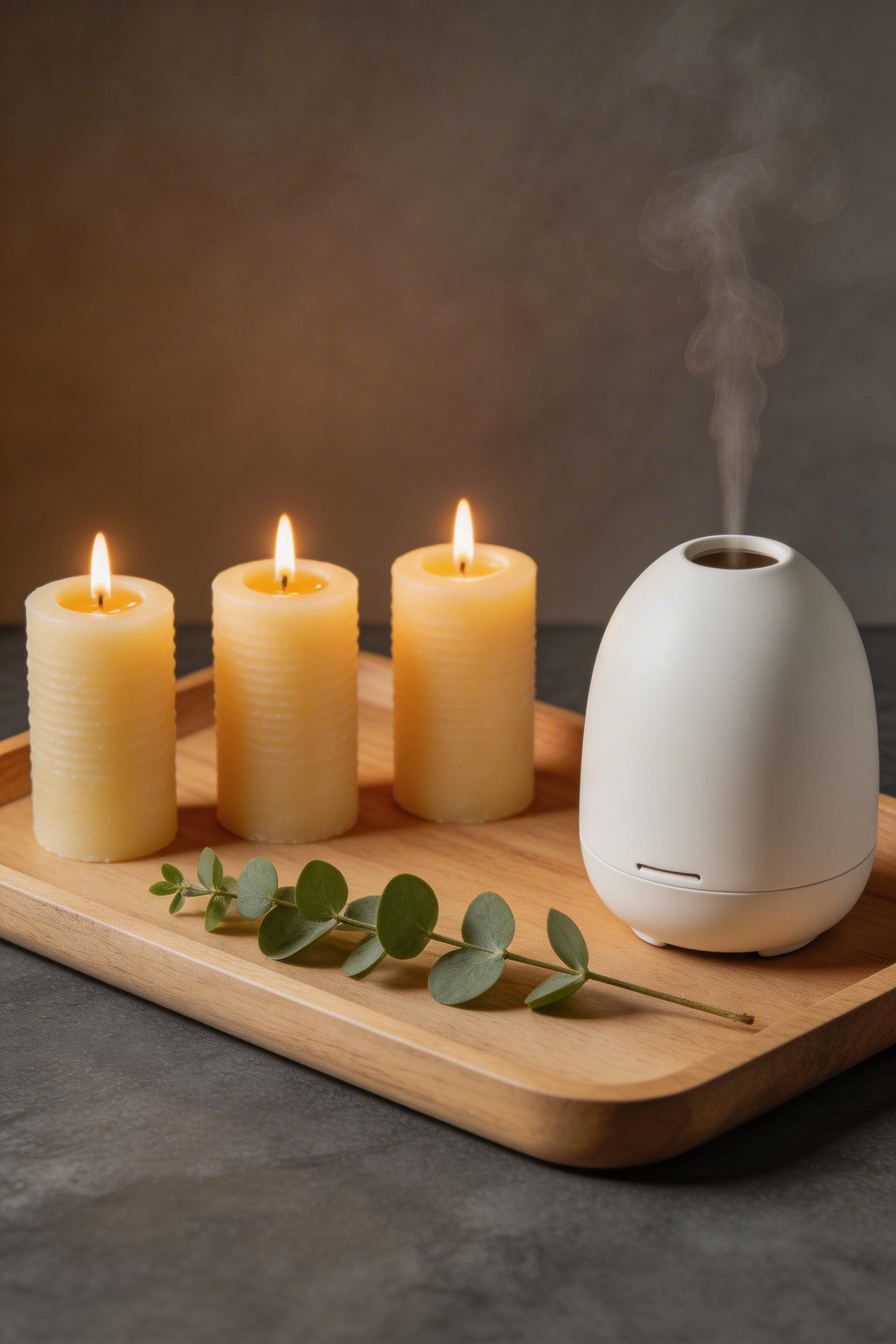
Paraffin candles release toluene and benzene as combustion by-products — a meaningful concern in a small, poorly ventilated bathroom. Beeswax candles burn clean, produce a warm amber flame, and emit a faint honey scent on their own before any added fragrance. Big Dipper Wax Works pure beeswax pillars ($18 to $38) have a 30 to 60 hour burn time and genuinely outperform paraffin on every metric that matters. Anecdote Candles’ Hinoki Cedar blend ($28 to $45) uses a beeswax-coconut wax base with cedar and hinoki essential oils. It is one of the most coherent scent choices for a bathroom built around organic ideas — the fragrance comes from the same material world as the room itself.
The Importance of Scent Discipline
For diffusers, the Vitruvi Stone Diffuser ($119) in ceramic pairs well visually with the organic bathroom palette. The scent choices that work best are all drawn from the same natural material world as the bathroom itself. Eucalyptus, cypress, vetiver, sandalwood, bergamot, and hinoki cedar are the most coherent options. Research on Shinrin-yoku (Japanese forest bathing) found that phytoncides from cedar and cypress measurably reduced cortisol in study participants. Immune markers also improved. So the scent is not just pleasant — it is physiologically grounding in a way that synthetic fragrance cannot replicate. Choose one scent family and stay in it. Mixing eucalyptus diffuser with vanilla candle breaks the effect immediately.
15. A Restrained Earth-Toned Colour Palette: The Foundation All Bathroom Organic Ideas Depend On
Everything in this list of bathroom organic ideas depends, ultimately, on the palette that holds it together. Natural materials look coherent when the surrounding colour story draws from the same family — stone, clay, sage, warm white. They look accidental and jumbled when placed against bright white tile, cool grey paint, or anything with a blue or purple undertone.
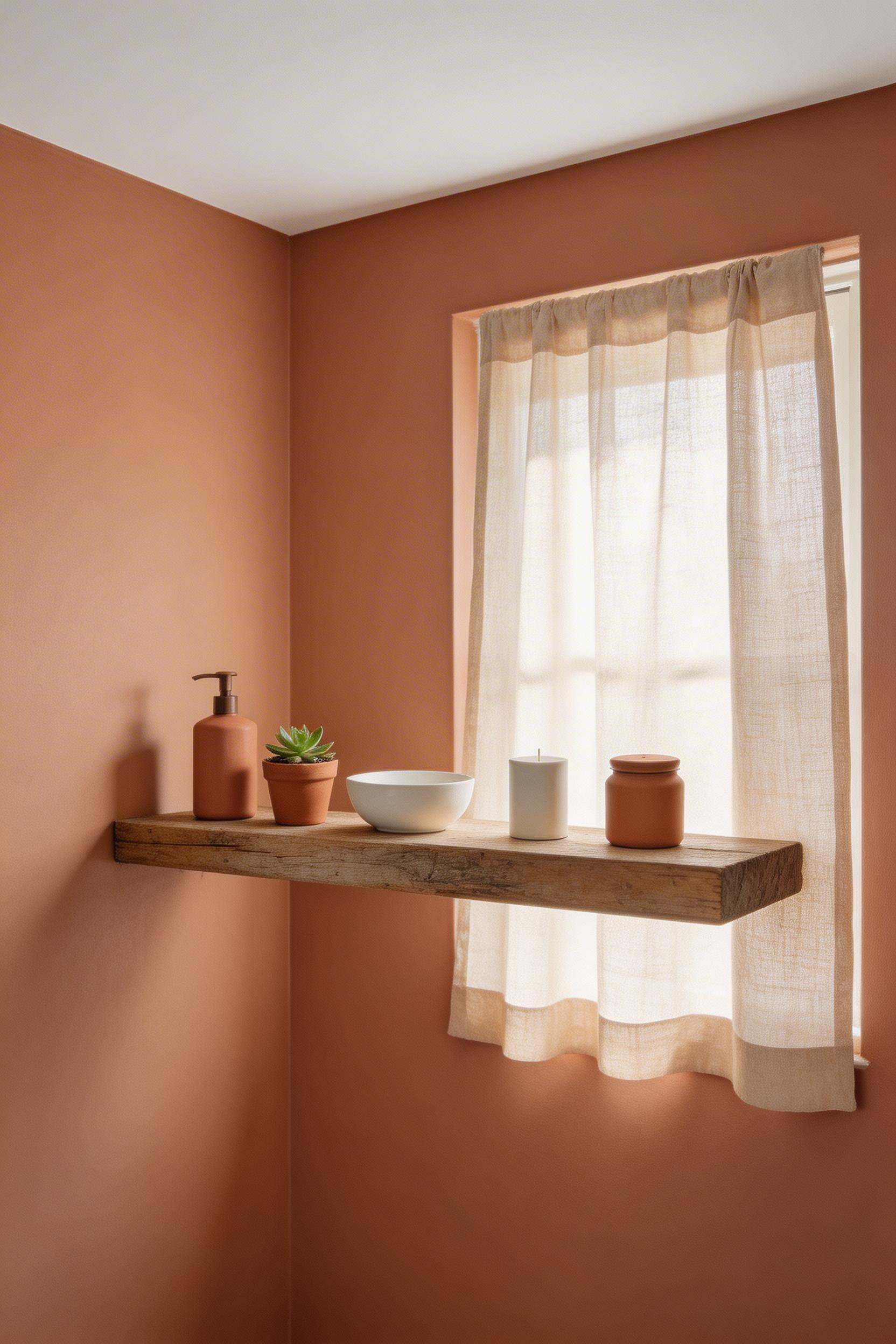
The organic bathroom palette works within four colour families. Stone: warm greys, beige, putty. Clay: terracotta, rust, warm ochre. Green: sage, moss, olive. Neutral: warm white, cream, linen. What they share is warmth of undertone. Introducing anything cool — a sharp bright white, a grey with blue in it, a cool lilac — breaks the cohesion immediately. Farrow & Ball’s Elephant’s Breath No.229 (warm grey) at around £60 per 750ml is the most versatile organic bathroom grey. Benjamin Moore’s Whitall Brown HC-69 is a warm putty brown that works with natural wood and terracotta in equal measure. Clare Paint’s Gone Fishing (sage green, $67 per gallon, zero VOC) in eggshell is the most reliable sage option for North American renovations.
Finish, Grout, and the Full Commitment
Paint finish matters: matte paint in a bathroom absorbs moisture and promotes mildew — eggshell is the practical minimum. Grout colour is also part of the palette. Warm putty or sand grout pulls tile toward the organic material world; white grout pushes the same tile toward clinical. One luxury natural bathroom materials decision that pays disproportionate returns is sealing the grout in a warm neutral tone before the bathroom goes into regular use.
Sample testing matters more in a bathroom than in any other room. The light bounces off tile, stone, and wood differently than it does elsewhere. Live with large samples (at least A4 size) for a full day before committing. Environmental psychology research from the University of Texas found that warm neutral rooms produced lower anxiety and higher calm ratings than bright or cool-toned walls. In summary, that is exactly why bathroom organic ideas built on earthy palettes work — they are not merely aesthetics. They are physiology.
Building Your Organic Bathroom: Where to Begin
The case for bathroom organic ideas is not really about design trends. It is about the quality of the daily experience you build for yourself in a room that bookends every single day. These 15 ideas do not need to be applied all at once. In fact, the best organic bathrooms are built gradually, one considered addition at a time.
If you are starting from scratch, begin with the colour palette and the wall finish. Those are the decisions that everything else anchors to. If you are working within an existing space, start with the materials that move fastest: towels, baskets, candles, ceramic accessories. These require the least commitment and carry the most immediate effect. A seagrass basket, a set of organic cotton waffle towels in oatmeal, and a beeswax candle in cedar can shift the sensory character of a bathroom in an afternoon. That is how accessible these bathroom organic ideas actually are.
For the structural investments — stone countertops, teak furniture, moss panels, plaster walls — work through them in order of impact and budget. Good bathroom renovation planning means sequencing the decisions so each one serves the next. Soapstone is the most maintenance-honest choice for a countertop. Teak is the only wood worth considering near water. Limewash is the entry point for plaster, not tadelakt. These are not compromises. They are the choices that hold up over years, age honestly, and continue to feel right when everything else around them changes. The organic bathroom is not a project with an end date. It is a direction.